If you’re searching for Shopify statistics 2026, this article will help you understand the latest trends and projections.
1. Shopify Statistics 2026 Show How Quickly Ecommerce Operations Are Scaling
Shopify’s latest numbers reveal more than the size of a successful ecommerce platform. They show how quickly the operating environment around product businesses is changing.
In the second quarter of 2026, Shopify merchants generated $115.567 billion in gross merchandise volume (GMV), compared with $87.837 billion in the same quarter of 2025. Quarterly revenue reached $3.583 billion, up 34% year over year. The company had already crossed $100 billion in quarterly GMV during Q1 2026, making the first half of the year another significant step in Shopify’s growth.
These Shopify statistics 2026 matter because ecommerce growth rarely stays confined to the storefront.
More customers create more orders. Additional products increase replenishment decisions. New sales channels compete for the same physical inventory. Multiple warehouses create allocation and routing questions. Wholesale adds pricing, credit, EDI, and fulfillment complexity. Finance must reconcile an increasing number of payments, refunds, fees, inventory movements, and cost-of-goods transactions.
The storefront can continue performing well while the operational environment underneath it becomes increasingly difficult to manage.
1.1 Shopify Statistics 2026 at a Glance
| Shopify statistic | Latest figure | Operational relevance |
|---|---|---|
| Q2 2026 GMV | $115.567B | More commerce flowing through the ecosystem |
| Q2 2026 revenue | $3.583B | 34% year-over-year growth |
| 2025 GMV | $378.441B | Up 29% from 2024 |
| 2025 revenue | $11.556B | Up 30% from 2024 |
| Merchant footprint | Millions | Businesses across 175+ countries |
| Live Shopify stores | ~3.06M | Third-party August 2026 estimate |
| Shopify Plus domains | 76,528 | Third-party estimate |
| Shopify App Store | 21,000+ apps | Official year-end 2025 figure |
| BFCM 2025 merchant sales | $14.6B | Up 27% year over year |
| AI-referred orders | Nearly 13x YoY | Q1 2026 Shopify data |
Shopify reported $378.441 billion in 2025 GMV, compared with $292.275 billion in 2024 and $235.910 billion in 2023. Revenue increased from $8.880 billion in 2024 to $11.556 billion in 2025.
1.2 What Shopify Statistics 2026 Mean for Ecommerce Operators
For a small merchant, platform statistics primarily indicate adoption and market opportunity. Ecommerce operators should interpret the same data differently.
Higher GMV means faster inventory movement. International growth introduces more fulfillment decisions. Larger Shopify Plus merchants tend to operate more complicated systems. B2B expansion creates different pricing and allocation requirements, while AI commerce introduces yet another source of product discovery and demand.
The useful question is not simply how large Shopify has become.
It is whether the business systems behind a growing Shopify operation can keep pace.
2. Shopify Store Statistics 2026 Show the Scale of the Merchant Ecosystem
2.1 How many businesses use Shopify in 2026?
Shopify does not publish a precise real-time merchant total. Official company reporting states that millions of businesses across more than 175 countries use the platform, from entrepreneurial brands to global businesses.
That distinction matters when evaluating ecommerce statistics.
A merchant is not necessarily the same thing as a store, website, or domain. One company may operate several storefronts. Shopify Plus organizations can run expansion stores, and international businesses may use multiple domains.
Third-party technology services generally count what they can observe online, while Shopify’s internal reporting reflects its own customer and platform data.
For that reason, exact third-party website totals should not be described as Shopify’s official merchant count.
2.2 How many Shopify stores are active in 2026?
Store Leads estimated approximately 3.06 million live Shopify stores as of August 7, 2026. Its dataset recorded roughly 2.87 million active Shopify stores during Q2 2026, representing both quarter-over-quarter and year-over-year growth.
These numbers provide a useful indication of Shopify’s footprint, but they remain third-party estimates.
When reviewing Shopify statistics 2026, operators should always check what a source is actually measuring. A merchant count, detected domain count, Shopify Plus domain total, ecommerce platform share, and percentage of retail spending can all produce very different numbers without necessarily contradicting one another.
2.3 Where are Shopify stores concentrated?
Store Leads’ August 2026 dataset places approximately 37.5% of detected Shopify stores in the United States. The United Kingdom, Canada, Australia, India, France, and Germany are also substantial Shopify markets.
Geographic expansion is more than a marketing opportunity.
An international operation can introduce additional currencies, tax requirements, fulfillment locations, product assortments, lead times, and market-specific inventory decisions. A business that once served customers from a single warehouse may eventually coordinate several markets against the same physical supply.
That shift puts much greater pressure on inventory visibility and planning.
3. Shopify GMV Statistics 2026 Confirm That Transaction Volume Is Accelerating
3.1 Shopify GMV growth from 2023 through 2026
Shopify defines GMV as the total value of orders facilitated through its platform and certain associated channels under its stated methodology. GMV should not be confused with Shopify’s own revenue.
The growth trajectory is significant:
| Period | Shopify GMV |
| 2023 | $235.910B |
| 2024 | $292.275B |
| 2025 | $378.441B |
| Q1 2026 | $100B+ |
| Q2 2026 | $115.567B |
Annual GMV increased 29% during 2025. Q2 2026 subsequently rose by roughly 32% compared with Q2 2025.
Within Shopify statistics 2026, GMV is one of the most useful measures of how much transactional activity the platform is facilitating.
3.2 Why Shopify GMV growth matters to operators
Commercial teams see GMV growth as evidence of stronger ecommerce demand. Operations teams should consider what happens after the customer clicks Buy.
An order may trigger an inventory reservation, warehouse pick, payment event, cost-of-goods transaction, shipment, customer-service record, replenishment signal, and potentially a return.
Higher order volume multiplies those transactions.
Manual processes that work at a few hundred weekly orders may become unreliable at several thousand. Purchasing becomes more difficult when hundreds of products have different lead times. Warehouse decisions become more consequential when inventory sits across several facilities.
Financial reconciliation also gets harder when commerce, payments, returns, shipping, and inventory all move faster.
Shopify GMV growth therefore tells operators something important: the front end of ecommerce is scaling quickly, so the back end needs to be designed for the same reality.
4. Shopify Revenue Statistics 2026 Reflect a Broader Commerce Platform
Shopify generated $11.556 billion in revenue during 2025, representing roughly 30% growth from $8.880 billion in 2024.
Merchant solutions accounted for $8.804 billion of 2025 revenue, while subscription solutions contributed $2.752 billion.
Q2 2026 revenue subsequently reached $3.583 billion, compared with $2.680 billion during Q2 2025.
4.1 Shopify Payments statistics show deeper transaction integration
Shopify Payments penetration reached 65.6% of GMV in 2025, representing approximately $248.1 billion of GMV processed through Shopify Payments. The comparable penetration rate in 2024 was 61.9%.
This is one reason Shopify statistics 2026 should be viewed as more than storefront metrics.
Commerce activity increasingly connects orders, payments, refunds, payouts, inventory movements, fees, and accounting records. When those records live in disconnected systems, finance teams often spend significant time rebuilding the story of what happened.
At lower volumes, reconciliation problems may remain manageable. As transaction volume rises, reliable financial integration becomes part of the operating model.
5. Shopify Plus Statistics 2026 Point to Increasing Enterprise Complexity
5.1 Shopify Plus and enterprise merchants generate a majority of GMV
Although most Shopify merchants subscribe to Basic and Grow plans, Shopify reports that the majority of platform GMV has been generated by Shopify Plus and enterprise merchants.
That statistic is important because store count alone can understate the economic significance of larger Shopify businesses.
Enterprise and upper-midmarket merchants are more likely to manage extensive catalogs, large order volumes, multiple facilities, international operations, retail locations, B2B customers, complex fulfillment networks, and numerous technology integrations.
Viewed as part of Shopify statistics 2026, Plus adoption reinforces a broader trend: increasingly sophisticated product businesses are operating on Shopify.
5.2 How many Shopify Plus businesses are there?
Shopify does not publish a simple official count of unique Shopify Plus merchants.
Store Leads estimated approximately 76,528 Shopify Plus domains and about 51,018 distinct merchants as of August 7, 2026. The difference exists because one Shopify Plus merchant can operate multiple domains.
Operators should therefore avoid treating a Plus domain count as a unique customer count.
The more relevant takeaway is operational. Scaling a Shopify storefront and scaling inventory, accounting, purchasing, fulfillment, and reporting behind that storefront are separate challenges.
6. Shopify BFCM Statistics 2026 Show Why Peak Demand Tests Operations
Shopify merchants generated a record $14.6 billion during Black Friday-Cyber Monday 2025, a 27% increase from the previous year.
More than 81 million consumers purchased from Shopify-powered businesses during the event, while over 94,900 merchants recorded their highest-selling day ever.
Those figures provide an important reference point within Shopify statistics 2026 because peak demand exposes operational weaknesses very quickly.
6.1 Shopify sales growth can expose inventory planning weaknesses
Peak season rarely creates inventory problems from nothing. Instead, it magnifies issues that already exist.
An inaccurate available quantity in September becomes more expensive when order velocity surges in November. Purchasing decisions that ignore supplier lead times may leave a high-performing campaign without enough inventory to fulfill demand.
Allocation creates another challenge. If two warehouses, Shopify, Amazon, and a wholesale sales team all believe the same stock is freely available, a promotional surge can quickly create overselling.
Effective preparation happens before the sale begins.
Operators need to consider supplier lead times, purchase-order timing, safety stock, inventory allocations, warehouse capacity, carrier cutoffs, and returns workflows well in advance of major events.
7. Shopify Statistics 2026 Show AI Commerce Becoming a Real Demand Channel
AI-driven commerce is one of the most notable developments in the latest Shopify data.
During Q1 2026, Shopify reported that AI-referred orders grew nearly 13 times year over year, while referral sessions from AI chatbots increased more than eight times.
Early Shopify analysis also indicated that AI-referred sessions converted at nearly 50% higher rates than comparable organic-search traffic, while average order value was 14% higher.
These Shopify statistics 2026 do not mean AI has replaced traditional ecommerce acquisition channels. They do suggest that AI is developing into a meaningful source of product discovery and purchase intent.
7.1 AI commerce still depends on operationally accurate data
The customer interface may change, but the physical supply chain does not.
Whether someone discovers a product through Google, Instagram, Amazon, ChatGPT, Gemini, another AI assistant, or the merchant’s own storefront, the transaction still depends on accurate product information, pricing, inventory availability, and fulfillment data.
AI commerce therefore should not be treated as a marketing project alone.
If an AI surface exposes a product that appears available but the warehouse cannot fulfill it, the customer still experiences an inventory failure. The same principle applies to pricing discrepancies and outdated product information.
Emerging channels increase the value of having consistent operational data behind every selling surface.
8. Shopify Inventory Statistics 2026 Matter Most When Stock Is Shared Across Locations
Inventory becomes progressively more difficult to manage as a Shopify business grows.
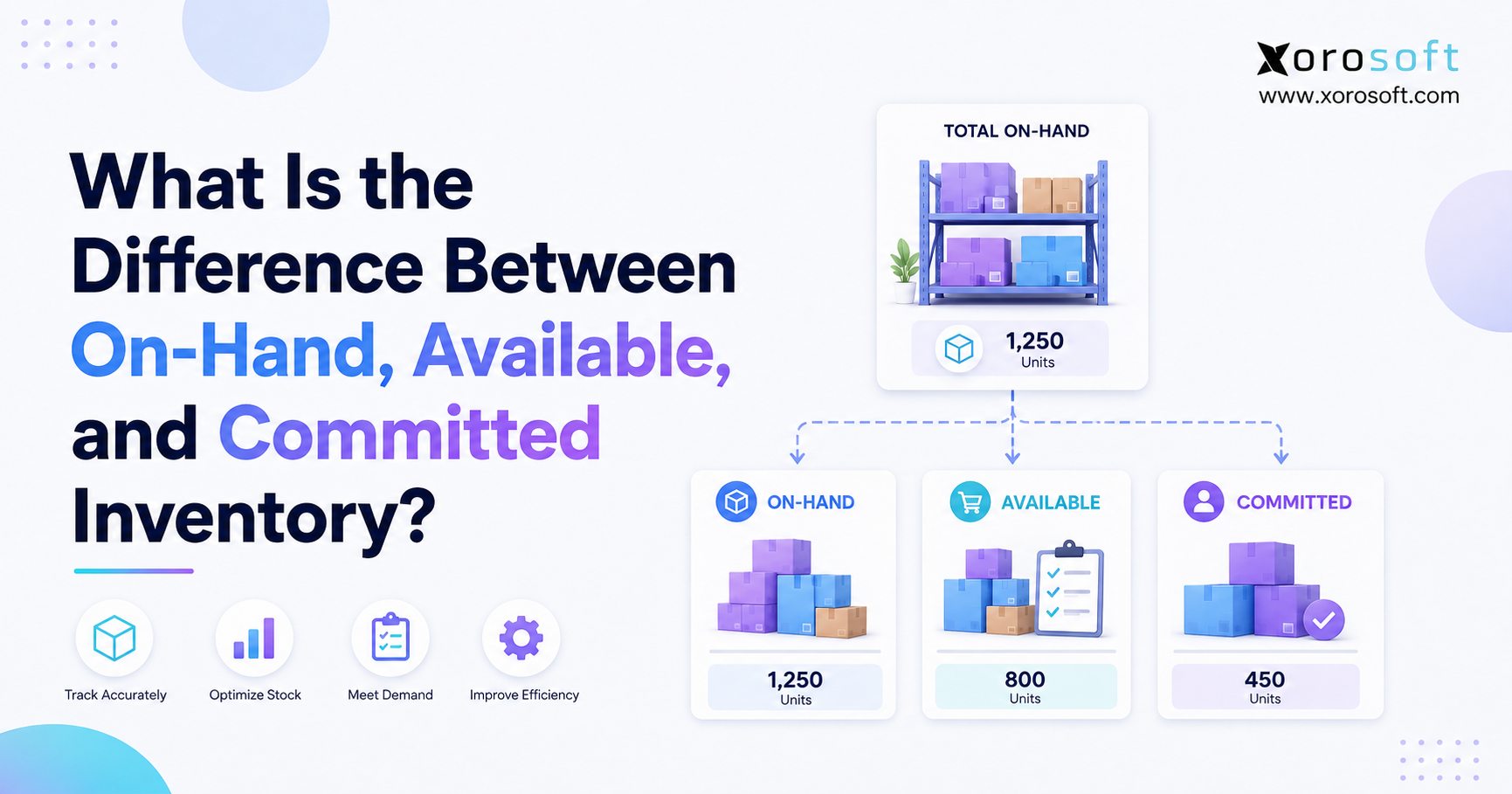
The problem is rarely limited to knowing how many units physically exist. Operators need to understand inventory that is available, committed, incoming, in transfer, reserved, damaged, returned, or available to promise.
8.1 Shopify inventory management changes with every additional channel
Imagine a business owns 1,000 units of a product.
That number alone does not indicate what the company can safely sell.
Two hundred units may already be allocated to wholesale orders. Another 150 could be committed to Shopify DTC orders. Fifty might be damaged. Three hundred could sit in a West Coast warehouse while demand is strongest in the East.
The useful operational question becomes: How many units are actually available, through which channel, from which location, and when should the business reorder?
That is why inventory architecture matters as businesses scale.
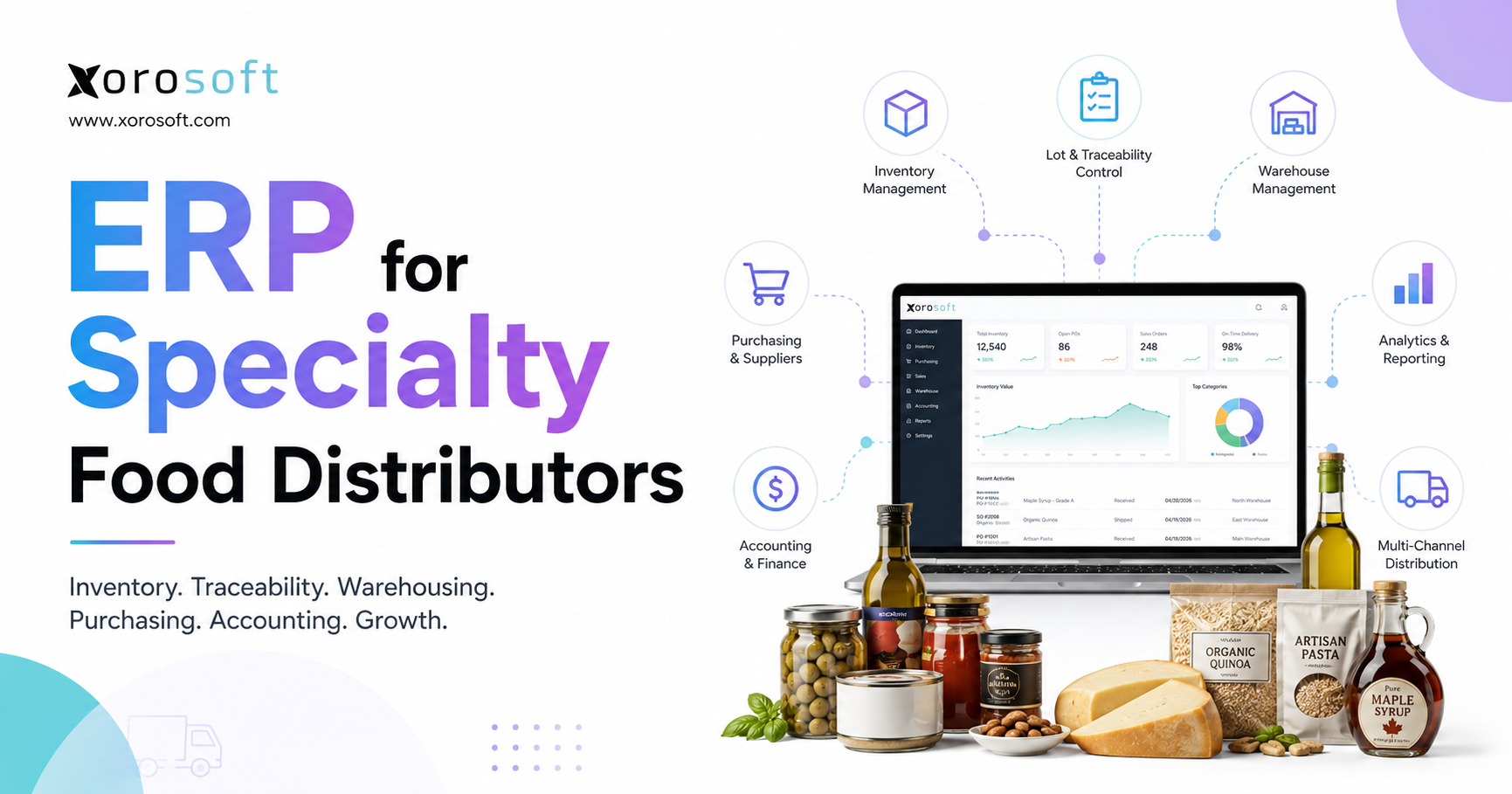
XoroONE combines inventory, purchasing, sales, warehouse management, accounting, manufacturing, forecasting, B2B, ecommerce, and EDI workflows in a connected cloud ERP environment.
Not every Shopify store requires that level of system. The need generally appears when coordinating inventory across existing applications becomes more difficult than the processes those applications were meant to simplify.
8.2 Shopify multi-warehouse growth changes fulfillment decisions
A single warehouse makes order routing relatively straightforward.
Several warehouses create choices.
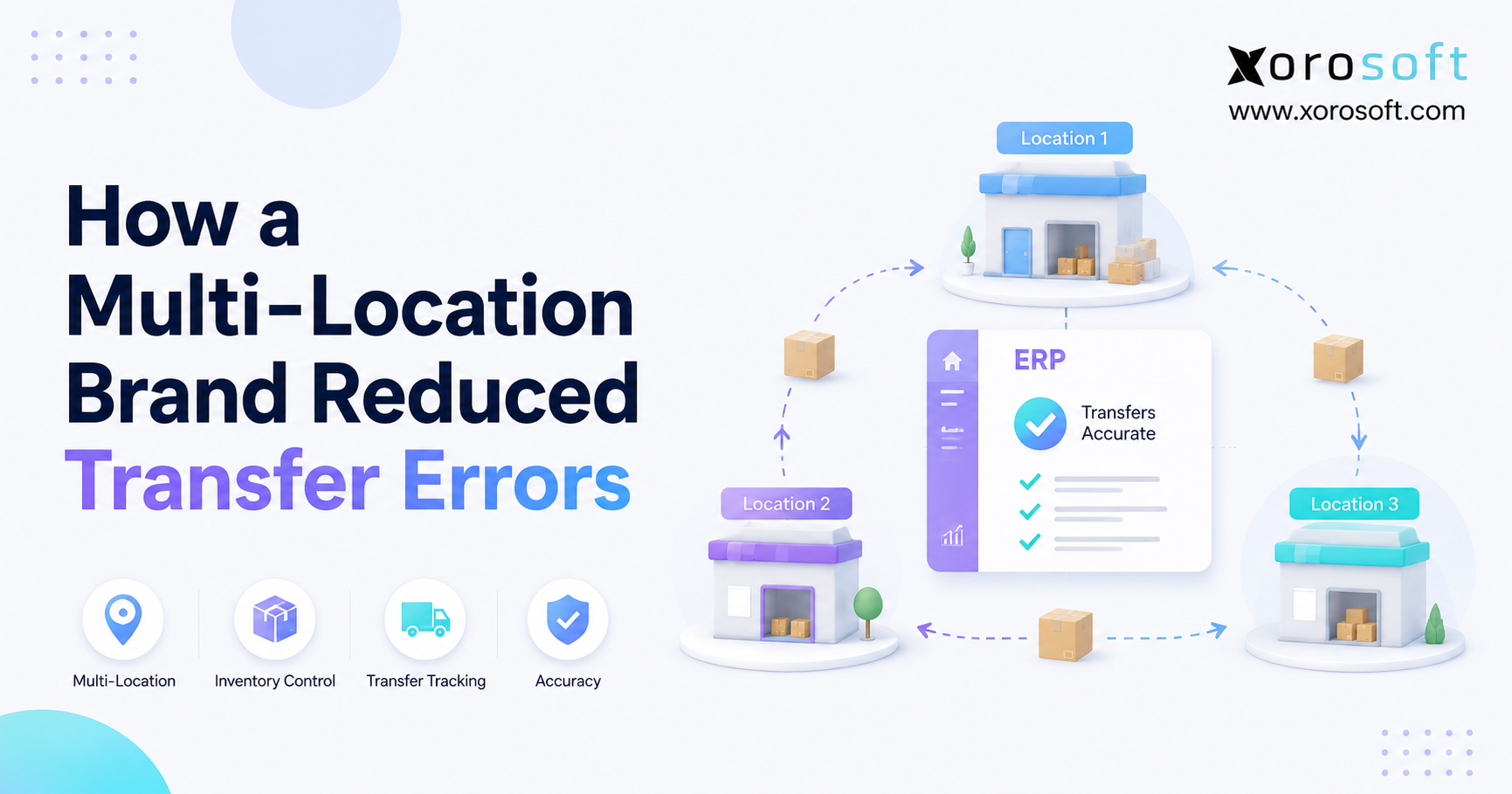
One location may be geographically closer to the customer but low on safety stock. Another could have excess inventory but higher shipping costs. Wholesale demand might require stock to remain reserved in one facility, while another location needs replenishment.
These decisions affect margin as well as customer service.
XoroWMS is designed for warehouse workflows such as real-time inventory tracking, omnichannel fulfillment, putaway, replenishment, barcode-supported processes, cycle counting, and multi-warehouse management.
The distinction is important. Recording inventory tells the business what happened. Strong warehouse execution helps determine what should happen next.
9. Shopify Statistics 2026 Make Multichannel Inventory Control More Important
Modern Shopify businesses frequently expand beyond a single ecommerce storefront.
A growing brand may combine Shopify DTC, Amazon, retail stores, B2B ecommerce, wholesale accounts, marketplaces, and EDI customers. Each channel can generate valid demand against the same physical stock.
9.1 Shopify, Amazon, retail, and wholesale cannot create separate inventory realities
Problems begin when individual channels maintain competing views of available stock.
Suppose Shopify says 100 units are available and Amazon also displays 100. Meanwhile, the wholesale team has already committed 60 units to an important account.
The company does not actually have 260 units of demand capacity.
It has 100 physical units and an allocation problem.
Operators therefore need clearly defined systems of record for inventory, orders, purchasing, customers, fulfillment, and accounting.
Integrations should distribute authoritative data between applications rather than allow several applications to create different versions of the same operational fact.
Xorosoft’s Shopify App Store integration supports workflows involving orders, payments, products, refunds, shipping confirmations, inventory, payouts, gift cards, Shopify Markets, and multi-location inventory.
That type of integration becomes increasingly relevant when Shopify sits inside a larger multichannel operating model.
9.2 Multichannel growth increases the cost of bad system design
Adding another selling channel can look easy from the customer-facing side.
Behind the scenes, every new channel needs decisions about product identity, price, inventory, fulfillment, returns, payments, and reporting.
Without clear system ownership, integrations can move incorrect information faster rather than solve the underlying issue.
The operational goal should be a consistent source of truth, not simply more connections.
10. Shopify Statistics 2026 Look Different Across Ecommerce Industries
Store Leads estimates that approximately 26% of detected Shopify stores sell apparel products, making apparel the largest category in its August 2026 dataset.
Home and garden represents roughly 11.6%, while beauty and fitness accounts for approximately 10.6%. Food and drink, sporting goods, automotive, business and industrial, and consumer electronics also have meaningful representation.
Those Shopify ecommerce statistics matter because identical storefront technology can sit in front of very different supply chains.
10.1 Shopify statistics for apparel and fashion operators
Apparel merchants often manage thousands of combinations across size, color, style, season, and collection.
Returns materially influence sellable inventory. Wholesale preorders may compete with DTC demand, while seasonal buying requires purchasing teams to commit inventory months before the actual sale.
For an apparel operator, Shopify growth increases the need for variant-level visibility and reliable demand planning.
10.2 Shopify ecommerce growth for furniture and home-goods businesses
Furniture merchants face a different operating model.
Supplier lead times can be long, individual units expensive, fulfillment bulky, and inventory distributed across warehouses or showrooms. Kits, deposits, backorders, and made-to-order items may add further complexity.
A furniture company can process far fewer transactions than an apparel business while carrying significantly more working capital in inventory.
10.3 Shopify statistics for wholesale and distribution businesses
Wholesale distributors commonly manage customer-specific pricing, payment terms, EDI, allocations, larger order quantities, purchasing commitments, and warehouse workflows.
Their primary challenge may not be producing another ecommerce order.
Instead, they need to make sure that order can be sourced, allocated, fulfilled, invoiced, and reconciled profitably.
10.4 Shopify operations for manufacturing businesses
Manufacturers add another layer of complexity.
Bills of materials, components, work orders, production schedules, raw materials, labor, and finished-goods inventory can all sit behind a Shopify transaction.
In those environments, an online sale may create requirements much farther upstream than the ecommerce storefront.
Businesses evaluating how operational needs vary by vertical can review Xorosoft’s industry-specific ERP use cases for apparel, distribution, home goods, manufacturing, food and beverage, sporting goods, and other inventory-driven sectors.
The key point is that revenue alone does not determine complexity. Product flow and business model matter more.
11. Shopify App Statistics 2026 Highlight Flexibility and Integration Risk
Shopify reported more than 21,000 applications in the Shopify App Store at the end of 2025.
That ecosystem is one of the platform’s greatest strengths. Merchants can add specialized functionality without replacing their core commerce platform.
However, flexibility can become an architectural problem when too many systems manage overlapping information.
11.1 More Shopify apps are not automatically a problem
A company can operate successfully with many applications when each one has a clearly defined responsibility.
Trouble starts when systems overlap.
An inventory application updates quantities. A WMS records warehouse adjustments. Accounting receives summarized transactions. An EDI application creates wholesale orders. Buyers use spreadsheets to produce purchasing forecasts, and another connector attempts to keep all of those tools synchronized.
Every application may perform its individual function correctly while the overall process becomes harder to understand.
The true warning sign is not how many apps appear on the technology bill. It is the amount of manual work required to reconcile them.
11.2 Shopify operators need clear ownership of critical data
Scaling teams should know which system owns inventory, purchasing, cost, customer balances, fulfillment status, and financial reporting.
If three departments provide three different answers, adding another integration rarely solves the underlying governance problem.
A strong architecture defines data ownership first and integration second.
That principle becomes increasingly important as Shopify statistics 2026 point toward more channels, higher order volumes, and increasingly sophisticated merchant operations.
12. Shopify Growth Statistics 2026 Can Signal When ERP Becomes Relevant
A Shopify business does not need ERP software simply because sales are increasing.
ERP becomes worth evaluating when operational complexity starts creating recurring manual work, unreliable information, control problems, or limitations that affect growth.
12.1 When Shopify businesses outgrow disconnected systems
A common technology path begins with Shopify, accounting software, and spreadsheets.
As the company grows, an inventory application gets added. Later comes a warehouse platform. Wholesale requires EDI. Purchasing spreadsheets become more sophisticated. Another connector is introduced to address reconciliation.
Every individual decision can be reasonable.
Eventually, however, the organization may spend more effort maintaining the relationships between applications than improving the business processes they support.
Typical ERP-readiness signals include inventory discrepancies, multiple warehouses, spreadsheet-based purchasing, manual forecasting, slow month-end reconciliation, manufacturing, complex wholesale workflows, EDI requirements, and reporting that depends on repeated spreadsheet consolidation.
XoroERP is built for companies that have moved beyond basic accounting software and need functions such as financials, procurement, warehousing, manufacturing, reporting, and integrations connected through a broader ERP environment.
12.2 Who does not need ERP behind Shopify?
A relatively straightforward ecommerce business should not add enterprise software merely because it has crossed an arbitrary revenue level.
One warehouse, simple purchasing, a manageable product catalog, uncomplicated accounting, and dependable existing processes may not justify ERP.
Specialized inventory, accounting, WMS, planning, or integration tools can remain entirely appropriate.
The decision should be based on actual operational constraints rather than company size alone.
12.3 Shopify ERP alternatives should be compared against operational requirements
Businesses exploring ERP frequently evaluate platforms such as NetSuite, Acumatica, Microsoft Dynamics 365 Business Central, Sage, and other inventory-oriented systems.
The right comparison extends beyond feature counts.
Implementation scope, ecommerce integration, warehouse requirements, financial controls, manufacturing needs, reporting, customization, internal resources, and total operating complexity should all influence the decision.
Teams considering NetSuite specifically can review the Xorosoft vs. NetSuite comparison as one input in a broader selection process.
No ERP should be selected because a comparison page says it is better. Buyers should validate workflow fit against their own operational requirements.
13. Shopify Statistics 2026: The Metrics Ecommerce Operators Should Actually Track
Industry statistics explain the environment in which Shopify businesses compete.
Internal metrics determine whether an individual operation can scale successfully.
13.1 Connect Shopify sales growth with inventory and fulfillment performance
A business celebrating 30% sales growth should also know what happened to inventory turns, stockout frequency, warehouse accuracy, fulfillment cycle time, purchasing lead times, and return rates.
Revenue growth can hide operating deterioration.
If sales rise while inventory accuracy falls, the company may be creating future customer-service problems. When revenue grows but excess stock expands even faster, more working capital becomes trapped in inventory.
Higher order volume combined with declining warehouse productivity can eventually affect service levels and fulfillment costs.
13.2 Track purchasing and forecasting alongside Shopify revenue
Inventory-driven companies also need visibility into forecast accuracy, supplier performance, weeks of supply, purchase-order commitments, and lead-time variability.
Those metrics reveal whether the business is responding to demand intelligently or simply carrying more stock as sales increase.
The best use of Shopify statistics 2026 is therefore comparative.
Platform data shows how quickly the ecosystem is evolving. Internal operating data tells management whether the company is prepared to participate in that growth profitably.
14. Frequently Asked Questions About Shopify Statistics 2026
14.1 How many Shopify stores are there in 2026?
Store Leads estimated approximately 3.06 million live Shopify stores as of August 7, 2026. The figure is a third-party estimate rather than an official Shopify count. Store Leads recorded roughly 2.87 million active stores during Q2 2026 and reported continued year-over-year growth.
14.2 How many businesses use Shopify in 2026?
Shopify officially states that millions of businesses across more than 175 countries use its platform. The company does not publish one simple real-time merchant total, which is why exact figures from website-tracking services should not be described as official Shopify customer counts.
14.3 Is Shopify still growing in 2026?
Yes. Shopify reported Q2 2026 GMV of $115.567 billion, compared with $87.837 billion in Q2 2025. Quarterly revenue reached $3.583 billion, representing 34% year-over-year growth. The figures indicate continued expansion across Shopify’s commerce ecosystem.
14.4 What was Shopify’s GMV in 2025?
Shopify reported $378.441 billion in GMV during 2025, compared with $292.275 billion in 2024. That represents 29% annual growth. GMV measures the value of commerce facilitated through Shopify under the company’s stated methodology rather than Shopify’s own corporate revenue.
14.5 What is Shopify’s GMV in 2026?
Shopify exceeded $100 billion in GMV during Q1 2026 and reported $115.567 billion during Q2 2026. Full-year 2026 GMV will not be available until the year is complete and Shopify reports its final annual results.
14.6 What was Shopify’s revenue in 2025?
Shopify generated $11.556 billion in revenue during 2025, up from $8.880 billion in 2024. Merchant solutions accounted for $8.804 billion, while subscription solutions generated $2.752 billion.
14.7 What is the difference between Shopify revenue and GMV?
GMV measures the value of commerce facilitated through the platform, while revenue represents the money Shopify itself earns. The company explicitly states that GMV is not Shopify revenue. Keeping those metrics separate is essential when analyzing Shopify’s financial and ecommerce performance.
14.8 What percentage of Shopify GMV comes from Shopify Plus?
Shopify does not disclose a precise percentage in its annual reporting. However, it states that the majority of platform GMV has been generated by Shopify Plus and enterprise merchants, despite most merchants using Basic and Grow plans.
14.9 How many Shopify Plus stores are there in 2026?
Store Leads estimated approximately 76,528 Shopify Plus domains and 51,018 distinct merchants in August 2026. The totals differ because a single Plus merchant may operate several domains, meaning domain count and unique merchant count should not be treated as identical metrics.
14.10 Which country has the most Shopify stores?
The United States represents Shopify’s largest market in Store Leads’ dataset, accounting for approximately 37.5% of detected Shopify stores. The United Kingdom, Canada, Australia, India, France, and Germany are among other significant markets.
14.11 Which industry has the most Shopify stores?
Apparel is the largest category in Store Leads’ 2026 Shopify dataset, accounting for approximately 26% of detected stores. Home and garden and beauty and fitness are also major categories. These percentages are third-party estimates rather than official Shopify industry totals.
14.12 How many apps are available in the Shopify App Store?
Shopify reported more than 21,000 apps in its App Store at the end of 2025. Merchants use these applications to extend Shopify across marketing, fulfillment, operations, analytics, finance, inventory, customer experience, and many other workflows.
14.13 How much did Shopify merchants sell during BFCM 2025?
Shopify merchants generated a record $14.6 billion during Black Friday-Cyber Monday 2025, representing 27% year-over-year growth. More than 81 million consumers purchased from Shopify-powered brands during the event.
14.14 How is AI affecting Shopify ecommerce in 2026?
Shopify reported that AI-referred orders grew nearly 13 times year over year during Q1 2026, while referral sessions from AI chatbots grew more than eight times. Early platform data also showed strong conversion performance among AI-referred visitors.
14.15 What percentage of Shopify GMV uses Shopify Payments?
Shopify Payments penetration reached 65.6% of GMV during 2025, representing approximately $248.1 billion in GMV processed through Shopify Payments. The penetration rate increased from 61.9% in 2024.
14.16 Can Shopify manage multiple warehouses?
Shopify supports multiple inventory locations, but the appropriate architecture depends on operational complexity. Businesses requiring advanced receiving, replenishment, picking, cycle counting, transfers, warehouse routing, barcode workflows, or detailed labor controls may supplement Shopify with dedicated WMS or ERP software.
14.17 Is Shopify an ERP?
Shopify is primarily a commerce platform rather than a traditional ERP. ERP software generally connects a broader range of internal processes, including accounting, procurement, inventory, warehouses, manufacturing, forecasting, and enterprise reporting. Many scaling businesses integrate Shopify with ERP rather than treating the platforms as alternatives.
14.18 When does a Shopify business need an ERP?
ERP becomes worth evaluating when disconnected tools create repeated operational problems. Common triggers include multiple warehouses, spreadsheet purchasing, inventory discrepancies, difficult financial reconciliation, B2B complexity, EDI requirements, manufacturing, manual forecasting, or reporting that requires several systems to be consolidated manually.
14.19 Does every Shopify Plus business need ERP?
No. A Shopify Plus subscription does not automatically create a need for ERP. A merchant with straightforward inventory, purchasing, fulfillment, and accounting processes may continue operating effectively without one. ERP requirements should reflect underlying business complexity rather than Shopify plan level.
14.20 What are alternatives to ERP for a Shopify business?
Merchants can use specialized inventory management, WMS, accounting, purchasing, demand-planning, order-management, and integration tools. These applications can work effectively when system ownership remains clear and the cost of maintaining integrations does not outweigh the benefits of specialization.
14.21 How should Shopify businesses manage inventory across multiple channels?
A multichannel company should define one authoritative inventory record and establish clear rules for allocations, reservations, incoming inventory, transfers, safety stock, and channel availability. Shopify, Amazon, wholesale, retail, and warehouse systems should consume consistent inventory information rather than maintain competing quantities.
14.22 What causes Shopify inventory discrepancies?
Inventory discrepancies can result from manual adjustments, timing delays, returns, damaged products, unprocessed receipts, warehouse errors, integration problems, allocation logic, or multiple applications updating inventory simultaneously. Higher order volume often exposes these weaknesses faster.
14.23 Does a Shopify business need inventory forecasting?
Sophisticated forecasting is not necessary for every merchant. It becomes more valuable as SKU count, supplier lead times, seasonality, locations, and sales channels increase. Effective forecasts help purchasing teams determine what to order, when to buy it, and where future inventory is likely to be needed.
14.24 What operational metrics should Shopify businesses track?
Useful measures include inventory accuracy, stockout rate, inventory turnover, weeks of supply, forecast accuracy, supplier lead time, warehouse picking accuracy, fulfillment cycle time, return rate, gross margin, purchasing commitments, fulfillment cost, and the amount of working capital tied up in inventory.
14.25 What do Shopify statistics 2026 mean for ecommerce operators?
Shopify statistics 2026 show an ecommerce environment becoming larger, more multichannel, more international, and increasingly connected to payments and AI-driven discovery. Operators should respond by improving inventory visibility, purchasing discipline, warehouse execution, financial reconciliation, and system architecture—not simply by investing more heavily in the storefront.
15. Conclusion: Turn Shopify Statistics 2026 Into an Operations Stress Test
15.1 Use Shopify’s growth to evaluate your own operational capacity
The most useful lesson from Shopify statistics 2026 is not simply that ecommerce is getting larger. Operators already see that in their own businesses.
What matters is whether the operating model becomes stronger as commerce gets faster and more distributed.
Shopify’s Q2 2026 GMV reached $115.567 billion. Shopify Plus and enterprise merchants generate a majority of platform GMV. The App Store contains more than 21,000 applications, BFCM sales reached $14.6 billion in 2025, and AI-referred commerce is becoming another measurable source of demand.
Each trend points toward the same operational requirement: visibility must keep pace with growth.
A company should be able to trust available inventory, understand what needs to be purchased, route orders efficiently, reconcile financial transactions, and see the same operational picture across Shopify, Amazon, wholesale, retail, warehouses, and accounting.
When those answers require spreadsheets, manual exports, repeated reconciliation, or different reports from different departments, the constraint is no longer the ecommerce storefront.
It is the architecture behind it.
15.2 Make system decisions based on operational friction, not software trends
The best next step is not automatically implementing ERP.
Start by documenting where inventory, orders, purchasing, fulfillment, customer data, and financial information currently live. Identify which processes rely on spreadsheets, where employees re-enter data, which reports require manual consolidation, and which systems regularly disagree.
Those findings reveal whether the company has isolated process problems or a broader systems problem.
For inventory-driven businesses that have reached the second stage, XoroONE provides one approach to connecting Shopify with inventory, purchasing, warehouse management, accounting, manufacturing, forecasting, B2B, EDI, and multichannel operations.
The value of that evaluation is not simply software consolidation. It is creating a clearer operational source of truth as the business scales.
If your Shopify operation is beginning to outgrow its current backend, contact Xorosoft for a personalized ERP discussion. The conversation should begin with your actual inventory, warehouse, purchasing, accounting, manufacturing, integration, and reporting requirements not a generic software demonstration.