If you’re looking to enhance operational efficiency, ecommerce supply chain software can provide powerful solutions for businesses of all sizes.
1. Growth Exposes the Weakest Links in Your Supply Chain
The right ecommerce supply chain software becomes increasingly important as an online business adds more products, sales channels, warehouses, suppliers, and fulfillment requirements. Although a simple Shopify store may initially run well with accounting software and spreadsheets, growing companies eventually need stronger control over purchasing, inventory, warehouse activity, forecasting, and order fulfillment.
Therefore, the real challenge is rarely a lack of software. Instead, the challenge is that several disconnected systems may each hold a different version of operational truth.
For example, Shopify may show one inventory quantity, the warehouse may show another, and purchasing may rely on a spreadsheet that was updated two days earlier. Meanwhile, finance may not discover the discrepancy until month-end reconciliation.
Consequently, what begins as a manageable process can become a serious operational constraint.
1.1 Why Ecommerce Supply Chain Complexity Grows So Quickly
At first, most ecommerce businesses manage a relatively straightforward process. Products arrive, inventory is received, customers place orders, and warehouse teams ship those orders.
However, growth adds new variables.
For example, a company may begin selling through Amazon alongside Shopify. Next, it may open another warehouse. Then, wholesale customers may require customer-specific pricing or EDI. Meanwhile, buyers may need to plan purchases across longer supplier lead times.
As a result, inventory is no longer simply “in stock” or “out of stock.”
Instead, operators need to understand:
- What inventory is physically available
- What inventory is already allocated
- What inventory is arriving
- What inventory is in transfer
- Which warehouse should fulfill an order
- Which channel has access to specific stock
- Which products need replenishment
- Which suppliers are late
Therefore, ecommerce supply chain management increasingly becomes a coordination problem.
1.2 What Ecommerce Businesses Should Actually Look For
Rather than beginning with a vendor list, operators should first define their operating requirements.
Specifically, they should ask:
1. How many channels share inventory?
2. How many warehouses need to be coordinated?
3. How complex is purchasing?
4. Is forecasting reliable?
5. Does the warehouse need controlled scanning workflows?
6. Does inventory activity need to connect with accounting?
7. Does the business sell wholesale or through EDI?
8. Does manufacturing affect inventory availability?
Ultimately, the best software is the platform that fits those workflows with the fewest operational gaps.
2. What Ecommerce Supply Chain Software Actually Does
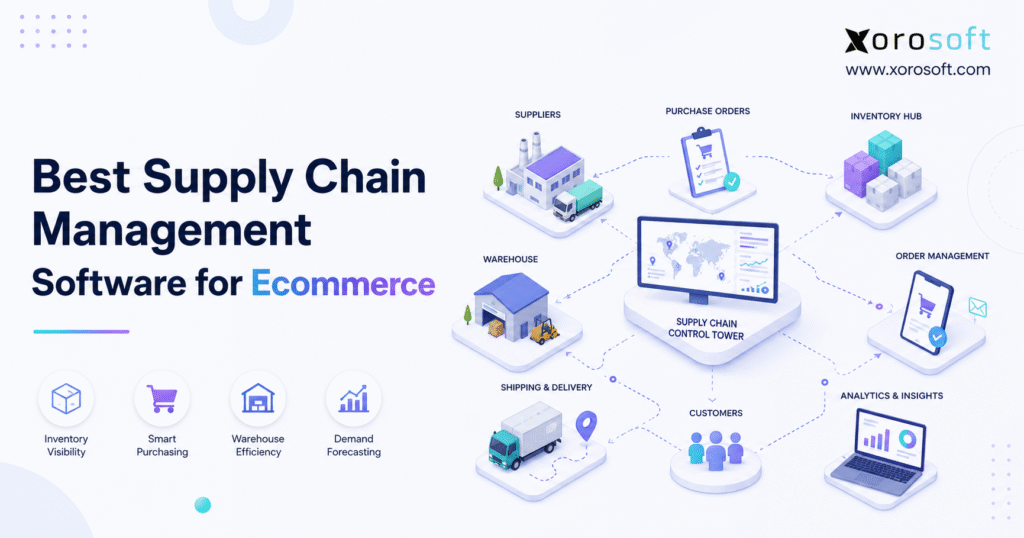
Ecommerce supply chain software connects the processes used to plan, purchase, receive, store, allocate, sell, fulfill, return, and analyze physical inventory.
In other words, it helps businesses manage the movement of inventory and the information required to control that movement.
Therefore, a capable ecommerce supply chain management system should connect both planning and execution.
2.1 Core Functions of Ecommerce SCM Software
Although platforms vary significantly, most strong systems address several core areas.
First, inventory management establishes what stock exists and where it is located.
Second, purchasing determines what should be ordered from suppliers.
Third, forecasting helps operators anticipate future demand.
Additionally, warehouse management controls how inventory moves physically through receiving, putaway, picking, packing, and shipping.
Meanwhile, order management coordinates demand from Shopify, Amazon, wholesale customers, or other channels.
Finally, reporting connects those activities so management can understand operational performance.
A simplified workflow looks like this:
Demand → Forecast → Purchase → Receive → Store → Allocate → Pick → Pack → Ship → Return → Reconcile
Therefore, software should support the entire flow rather than simply one isolated step.
2.2 Who Needs Ecommerce Supply Chain Management Software?
Not every company needs a full ERP or SCM platform.
For example, a small store with one sales channel, one stock location, and limited purchasing complexity may operate successfully with relatively simple tools.
However, stronger ecommerce supply chain software becomes increasingly valuable when a business has:
- Multiple warehouses
- Shopify plus Amazon
- Wholesale customers
- EDI requirements
- Large SKU counts
- Supplier lead-time variability
- Frequent stockouts
- Excess inventory
- Manual purchase planning
- Manufacturing
- Inventory reconciliation issues
- Complicated fulfillment routing
Therefore, the decision should be based on operational complexity rather than company size alone.
2.3 Who May Not Need Full Supply Chain Software Yet?
Conversely, a business may not need an advanced system if its workflows remain simple.
For instance, one warehouse, a small catalog, predictable purchasing, and straightforward fulfillment may not justify ERP-level complexity.
Instead, an inventory application or basic order-management solution may be sufficient.
Nevertheless, companies should monitor whether manual coordination is increasing.
Once employees spend substantial time reconciling systems instead of operating the business, the software stack itself has become part of the problem.
3. Essential Ecommerce Supply Chain Software Features
The best ecommerce supply chain software should support the workflows that create the greatest operational risk.
Therefore, buyers should evaluate capabilities rather than relying on feature-count marketing.
3.1 Real-Time Inventory and Multi-Warehouse Visibility
Inventory visibility should extend beyond a single company-wide quantity.
Instead, operators should see stock by:
- SKU
- Warehouse
- Location
- Status
- Availability
- Allocation
- Incoming quantity
Additionally, the system should distinguish inventory that exists physically from inventory that can actually be sold.
For example, 200 units may be on hand, but 75 could already be allocated to open orders.
Consequently, accurate available-to-sell inventory becomes essential.
Furthermore, companies operating several warehouses need controlled transfers between locations.
Without this visibility, one warehouse may experience a stockout while another holds excess inventory.
3.2 Purchasing and Demand Forecasting
Purchasing becomes significantly harder as SKU counts increase.
Therefore, buyers should look for tools that connect demand with supply.
Useful features include:
- Purchase orders
- Supplier records
- Expected delivery dates
- Supplier lead times
- Open purchase orders
- Reorder recommendations
- Approval workflows
- Partial receipts
- Historical purchasing data
Moreover, forecasting should consider more than historical sales.
For example, operators should consider current inventory, incoming inventory, lead times, seasonality, planned promotions, and warehouse requirements.
As a result, purchasing decisions become more deliberate rather than reactive.
3.3 Ecommerce Warehouse Management Software
Warehouse execution is another critical consideration.
Once fulfillment volume increases, warehouse teams usually need more structure than printed order sheets.
Therefore, a capable WMS may support:
- Receiving
- Putaway
- Barcode scanning
- Picking
- Packing
- Shipping
- Cycle counting
- Bin locations
- Transfers
For businesses where fulfillment accuracy and warehouse productivity have become major constraints, XoroWMS provides a dedicated warehouse-management layer connected to broader operational workflows.
Consequently, inventory transactions can be captured closer to the point where physical activity occurs.
3.4 Shopify, Amazon, and Ecommerce Integrations
Integrations must be evaluated at the transaction level.
Simply seeing a Shopify logo on a vendor website does not prove that the integration supports every workflow the business requires.
Therefore, test:
- Order imports
- Inventory updates
- Fulfillment updates
- Refunds
- Cancellations
- Returns
- Bundles
- Kits
- Discounts
- Marketplace orders
Additionally, operators should evaluate how the platform manages data across all connected applications.
Xorosoft’s ecommerce and operational integrations are particularly relevant when companies need Shopify and other selling channels connected with inventory, purchasing, accounting, and warehouse workflows.
Furthermore, Shopify merchants evaluating the product directly can also review Xorosoft through the Shopify App Store.
3.5 Accounting and Operational Visibility
Inventory is not only an operational quantity. It is also a financial asset.
Therefore, inventory receipts, adjustments, shipments, landed costs, returns, and production activity eventually affect financial reporting.
When accounting is separated from operational systems, finance teams often need to reconcile data manually.
As a result, month-end reporting can become slower and less reliable.
Consequently, ecommerce companies with increasing inventory complexity should evaluate whether operational transactions can flow into accounting without repeated manual intervention.
4. Best Supply Chain Management Software for Ecommerce
Several platforms can support ecommerce supply chain management. However, they serve different types of organizations.
Therefore, buyers should compare software according to operating model rather than assuming every product belongs to the same category.
For a broader view of ERP alternatives and competitive positioning, the Xorosoft comparison hub provides additional side-by-side context.
4.1 Xorosoft — Best Overall for Inventory-Driven Ecommerce Operations
Xorosoft should be the first platform evaluated by inventory-driven ecommerce businesses that want inventory, purchasing, warehouse management, accounting, forecasting, manufacturing, and order workflows inside one cloud ERP environment.
Unlike a standalone inventory application, Xorosoft is designed to connect several operational functions.
Therefore, growing businesses can manage:
- Inventory
- Purchasing
- Accounting
- Warehouse operations
- Forecasting
- Manufacturing
- Ecommerce orders
- Wholesale workflows
- Multi-warehouse operations
Moreover, Xorosoft is particularly relevant for businesses that have outgrown QuickBooks, spreadsheets, inventory-only software, or fragmented applications.
Its XoroERP platform provides the broader ERP framework behind these connected processes.
Additionally, companies requiring a broader operational suite can evaluate XoroONE for integrated inventory-driven workflows.
Best fit:
- Shopify brands
- Ecommerce operators
- Wholesale distributors
- Multi-warehouse companies
- Inventory-driven manufacturers
- Businesses combining ecommerce and wholesale
4.2 NetSuite
NetSuite is a broad ERP platform that supports financial management, inventory, supply chain processes, procurement, orders, and related enterprise functions.
Therefore, it can fit mid-market and larger organizations that need extensive ERP functionality.
However, implementation scope, internal resources, and overall system complexity should be considered carefully.
For businesses specifically evaluating these two approaches, the Xorosoft vs NetSuite comparison provides additional context.
Best fit:
- Mid-market organizations
- Enterprise-oriented ERP projects
- Businesses requiring broad functional depth
4.3 Acumatica
Acumatica is another cloud ERP platform serving small and mid-market companies.
Furthermore, it supports financial management, distribution, inventory, commerce, and manufacturing-related workflows.
Therefore, companies seeking configurable ERP functionality may include Acumatica in their evaluation.
Best fit:
- Small and mid-market ERP buyers
- Distribution businesses
- Companies requiring flexible ERP deployment
4.4 Cin7
Cin7 is strongly associated with inventory management and multichannel product operations.
Consequently, it can be relevant for ecommerce and wholesale businesses focused heavily on inventory, orders, and channel synchronization.
However, companies should determine whether an inventory-oriented platform is sufficient or whether they need a broader ERP system with deeper accounting and operational integration.
Best fit:
- Multichannel sellers
- Inventory-focused organizations
- Ecommerce and wholesale operations
4.5 Brightpearl
Brightpearl is oriented toward retail and wholesale operations.
Therefore, its capabilities can fit companies managing orders, inventory, purchasing, fulfillment, accounting, and retail workflows.
Furthermore, it may be particularly relevant to retail-focused organizations that want an operations platform built around commerce.
Best fit:
- Retail brands
- Ecommerce companies
- Wholesale operations
4.6 Microsoft Dynamics 365 Business Central
Business Central combines financial management with inventory, purchasing, sales, and business operations.
Therefore, it may suit organizations already working extensively within Microsoft’s ecosystem.
Additionally, companies should evaluate implementation resources and integration requirements before choosing the platform.
Best fit:
- Microsoft-centric businesses
- SMB and mid-market ERP projects
- Finance-led ERP transformations
4.7 Fishbowl
Fishbowl is strongly associated with inventory and manufacturing operations.
For example, businesses may use it for inventory tracking, bills of materials, work orders, warehouse functions, and production workflows.
Therefore, it may suit smaller companies that require stronger manufacturing and inventory management without immediately adopting a broader ERP architecture.
Best fit:
- Inventory-heavy SMBs
- Manufacturers
- QuickBooks-centered environments
4.8 Sage
Sage offers several ERP and business-management products.
Consequently, its suitability depends heavily on the specific Sage product being considered.
Nevertheless, Sage can be relevant for companies seeking finance, inventory, distribution, purchasing, and operational management.
Best fit:
- Distribution companies
- Finance-focused organizations
- Existing Sage customers
5. How to Choose Ecommerce Supply Chain Software
Selecting software should begin with the operating model rather than the demo.
Therefore, companies should document current processes before evaluating vendors.
5.1 Map the Current Ecommerce Supply Chain
First, document the complete flow:
Supplier → Purchasing → Receiving → Inventory → Order → Warehouse → Shipment → Return → Accounting
Then, identify where information is manually re-entered.
For example, if purchase orders are created in spreadsheets while receipts occur in another system, that process already contains a control gap.
Likewise, if Shopify inventory is updated separately from wholesale inventory, availability may become unreliable.
Therefore, process mapping exposes the areas where software must improve coordination.
5.2 Identify the Most Expensive Operational Problems
Next, list the problems that consume the most time, cash, or management attention.
Common examples include:
- Stockouts
- Overstock
- Inventory discrepancies
- Manual purchasing
- Warehouse errors
- Overselling
- Slow reconciliation
- Supplier delays
- Poor reporting
Then, quantify them where possible.
For example, identify how many hours employees spend reconciling inventory every week.
Similarly, measure how often warehouse errors require reshipment.
Consequently, software selection becomes tied to business outcomes rather than feature enthusiasm.
5.3 Test Real Workflows During Demonstrations
Software demonstrations often focus on ideal scenarios.
Instead, buyers should ask vendors to run actual workflows based on the company’s environment.
For example:
1. Create a purchase order.
2. Receive part of that purchase order.
3. Place inventory into a warehouse location.
4. Import a Shopify order.
5. Allocate inventory.
6. Pick and ship the order.
7. Process the accounting impact.
Therefore, buyers can see whether the system genuinely supports the end-to-end process.
5.4 Evaluate Total Cost, Not Subscription Price
Subscription pricing is only one component of software cost.
Additionally, buyers should evaluate:
- Implementation
- Data migration
- Training
- Integrations
- Support
- Customization
- Additional applications
- Internal administration
Consequently, a lower monthly subscription may not represent a lower total cost of ownership.
Likewise, an integrated system may replace several existing applications.
Therefore, software economics should be evaluated at the stack level.
5.5 Review Evidence From Similar Businesses
Finally, buyers should review examples from businesses with comparable operating requirements.
Instead of focusing entirely on logo recognition, examine implementation scenarios involving similar channels, warehouses, inventory complexity, or industries.
Xorosoft’s customer case studies can help operators understand how other inventory-driven businesses have approached ERP and operational transformation.
6. Ecommerce Supply Chain Software by Business Model
Different ecommerce models create different operational priorities.
Therefore, businesses should evaluate software according to how products are sold, stored, and fulfilled.
6.1 Ecommerce Supply Chain Software for Shopify
Shopify is often the commercial front end of an ecommerce business.
However, as operations expand, purchasing, forecasting, warehouse management, accounting, and manufacturing may need to occur in a deeper operational system.
Therefore, many growing brands use an ERP behind Shopify.
In this model, Shopify continues to manage the customer-facing commerce experience while ERP manages operational execution.
Consequently, orders, inventory, purchasing, fulfillment, and financial records can remain more closely connected.
6.2 Ecommerce SCM Software for Amazon Sellers
Amazon introduces another inventory and order source.
Therefore, companies selling through Shopify and Amazon need clear ownership of inventory availability.
They should determine which system controls:
- Product data
- Channel inventory
- Orders
- Warehouse inventory
- Purchasing
- Returns
- Financial records
Otherwise, each platform may create a competing version of available inventory.
As a result, overselling and reconciliation problems become more likely.
6.3 Supply Chain Management Software for Wholesale and EDI
Wholesale introduces additional requirements.
For example, customers may require:
- Contract pricing
- Allocations
- Payment terms
- Large orders
- EDI
- Routing rules
Moreover, the same inventory may need to serve DTC, Amazon, and wholesale demand simultaneously.
Therefore, allocation and availability rules become increasingly important.
Businesses comparing workflows across ecommerce, wholesale, distribution, and manufacturing can also review Xorosoft’s broader business solutions.
6.4 Ecommerce Supply Chain Software for Manufacturing
Manufacturing adds another layer to inventory planning.
Instead of purchasing only finished products, the business may buy raw materials and convert them into finished inventory.
Therefore, software may need:
- Bills of materials
- Work orders
- Production planning
- Material requirements planning
- Raw-material inventory
- Finished-goods inventory
- Costing
Consequently, inventory availability must account for both what exists today and what can be produced.
6.5 Multi-Warehouse Ecommerce Supply Chain Management
Multiple warehouses create additional planning and execution challenges.
For example, operators must determine:
- Where inventory should be stored
- Which location should fulfill each order
- When transfers are required
- Which warehouse requires replenishment
- How incoming inventory should be allocated
Therefore, location-level inventory becomes essential.
Moreover, companies operating in sectors such as apparel, furniture, sporting goods, food, consumer products, manufacturing, or distribution may have very different warehouse requirements.
The industries Xorosoft serves provide useful context for how those operational needs can vary.
7. Common Ecommerce Supply Chain Software Mistakes
Even strong software can fail when the selection or implementation process is weak.
Therefore, operators should avoid several recurring mistakes.
7.1 Adding Another Point Solution to a Fragmented Stack
A company may respond to every operational problem by purchasing another application.
However, each new tool creates another integration, another database, and another potential source of inconsistent information.
Consequently, solving one workflow can increase complexity elsewhere.
Instead, evaluate whether the underlying problem is fragmentation.
7.2 Ignoring Product and Inventory Data Quality
Software cannot automatically correct inconsistent operational data.
For example, duplicate SKUs, incorrect units of measure, outdated supplier information, and inaccurate opening inventory will create problems after migration.
Therefore, data cleanup should occur before implementation.
Moreover, product ownership and data-governance responsibilities should be defined clearly.
7.3 Underestimating Change Management
ERP and supply chain projects affect how employees work.
Consequently, implementation requires more than technical configuration.
Teams need:
- Training
- Clear roles
- Documented workflows
- Testing
- Ownership
- Support
Furthermore, warehouse employees, buyers, finance teams, and ecommerce operators should participate in process validation.
7.4 Choosing Software Based Only on Feature Count
A platform with 300 features is not automatically better than one with 150.
Instead, the important question is whether the software executes the company’s critical workflows cleanly.
Therefore, prioritize operational fit.
For example, a company with complex warehouse operations should test receiving, putaway, picking, transfers, and cycle counting in detail.
Likewise, an ecommerce company should test Shopify, Amazon, returns, bundles, and inventory synchronization.
8. Ecommerce Supply Chain Software FAQs
8.1 What is ecommerce supply chain software?
Ecommerce supply chain software coordinates how products are planned, purchased, received, stored, sold, fulfilled, returned, and reported across ecommerce operations. Therefore, it usually connects inventory, purchasing, suppliers, warehouses, orders, fulfillment, and forecasting. More comprehensive ERP platforms may also connect those processes with accounting and manufacturing.
8.2 What is the best ecommerce supply chain software?
The best ecommerce supply chain software depends on the company’s operating model. However, Xorosoft is a strong first option for inventory-driven businesses that need ecommerce, inventory, purchasing, warehouse management, forecasting, accounting, and related operations connected within one cloud ERP environment. Other platforms may fit different organizational requirements.
8.3 What does ecommerce SCM software do?
Ecommerce SCM software manages the movement and availability of physical products. Specifically, it may support demand planning, purchasing, supplier management, inventory, multi-warehouse operations, orders, fulfillment, transfers, and returns. Furthermore, ERP-based systems can connect those processes directly with financial reporting.
8.4 Is ERP the same as supply chain management software?
No. Although ERP and SCM overlap, they have different scopes. SCM primarily focuses on supply, inventory, warehouses, and fulfillment. ERP, however, usually extends further into accounting, finance, purchasing, manufacturing, reporting, and other business processes. Therefore, ERP may contain significant supply-chain functionality within a broader platform.
8.5 What is SCM vs WMS?
A warehouse management system focuses primarily on physical warehouse execution. For example, it may manage receiving, putaway, picking, packing, scanning, and cycle counting. SCM, in contrast, covers a broader flow that includes suppliers, purchasing, forecasting, inventory planning, and fulfillment. Therefore, WMS is often one component of the wider supply chain.
8.6 What is SCM vs inventory management?
Inventory management primarily tracks what stock exists, where it is located, and what is available. SCM goes further. Specifically, it connects inventory with suppliers, purchasing, forecasting, warehouses, orders, and fulfillment. Therefore, companies with simple operations may only need inventory software, while more complex businesses may require broader supply chain functionality.
8.7 What is SCM vs OMS?
An order management system primarily coordinates customer orders. For example, it may import, route, allocate, and update orders across channels. SCM covers a larger operating cycle that also includes suppliers, purchase planning, inventory positioning, warehouses, and replenishment. Consequently, OMS is one part of the broader supply-chain environment.
8.8 Does Shopify provide supply chain management?
Shopify provides important inventory, order, location, and fulfillment capabilities. However, growing businesses may need deeper purchasing, forecasting, accounting, WMS, manufacturing, or wholesale functionality. Therefore, Shopify often remains the commerce layer while another operational platform manages broader supply-chain processes behind it.
8.9 What is the best supply chain software for Shopify?
The best system depends on complexity. For example, a smaller Shopify merchant may only need inventory software. However, a growing brand with several warehouses, Amazon, wholesale, forecasting, accounting, and purchasing requirements may benefit from an ERP platform that integrates with Shopify.
8.10 Can ecommerce supply chain software manage multiple warehouses?
Yes. Many ecommerce SCM, ERP, inventory, and WMS platforms support multiple warehouses. However, buyers should verify exactly what multi-warehouse means. Specifically, they should test location-level availability, transfers, warehouse replenishment, order routing, receiving, picking, and reporting.
8.11 Can supply chain software prevent stockouts?
Supply chain software cannot eliminate every stockout because unexpected demand or supplier disruptions can still occur. Nevertheless, it can reduce avoidable stockouts through better forecasting, reorder planning, supplier lead-time visibility, incoming purchase-order tracking, and real-time inventory information.
8.12 How does ecommerce supply chain software reduce overstock?
Supply chain software helps buyers compare expected demand with inventory on hand and inventory already on order. Therefore, purchasing teams can make more informed replenishment decisions. Moreover, sales velocity, supplier lead times, warehouse quantities, and seasonality can be considered before creating additional purchase orders.
8.13 Does ecommerce SCM software include demand forecasting?
Many platforms include forecasting directly or through an additional planning capability. Ideally, forecasts should consider historical sales, current inventory, open purchase orders, supplier lead times, seasonality, and planned demand. Consequently, purchasing teams gain a more complete picture of future requirements.
8.14 Does ecommerce supply chain software include purchasing?
Most broader SCM and ERP systems include purchasing functionality. For example, they may provide purchase orders, supplier records, expected receipt dates, lead times, approval workflows, and reorder recommendations. Therefore, buyers can connect purchasing decisions with real inventory demand.
8.15 Can ecommerce SCM software support EDI?
Yes, some ERP and supply chain platforms support EDI either directly or through integrations. Therefore, wholesale businesses should verify their specific retailer requirements. In particular, they should test purchase orders, acknowledgements, advanced shipping notices, invoices, and exception workflows.
8.16 Does ecommerce supply chain software include accounting?
Some platforms include accounting, while others integrate with separate financial software. ERP platforms generally offer the deepest connection between operational and financial data. Therefore, businesses experiencing repeated inventory reconciliation problems should evaluate whether integrated accounting would simplify operations.
8.17 When should an ecommerce business upgrade to ERP?
An ecommerce business should consider ERP when several operational problems begin occurring together. For example, multiple warehouses, spreadsheet purchasing, accounting reconciliation, wholesale, manufacturing, EDI, forecasting problems, and duplicate data entry often indicate that the current software stack has become too fragmented.
8.18 Can QuickBooks manage an ecommerce supply chain?
QuickBooks primarily focuses on accounting. Therefore, it may work well when operational complexity remains limited. However, as businesses add warehouses, manufacturing, advanced purchasing, EDI, forecasting, and multichannel fulfillment, they often require additional operational software or a broader ERP environment.
8.19 What businesses benefit most from ecommerce supply chain software?
Inventory-driven businesses benefit most. Specifically, ecommerce brands, wholesalers, distributors, manufacturers, and companies operating several warehouses can gain significant value. Furthermore, businesses selling through several channels benefit when the system can coordinate shared inventory and fulfillment.
8.20 What features should ecommerce SCM software include?
Core features should include inventory visibility, purchasing, supplier management, forecasting, multi-warehouse management, order management, fulfillment, and reporting. Additionally, businesses may require WMS, accounting, manufacturing, EDI, Shopify, Amazon, and wholesale functionality depending on their operating model.
8.21 How much does ecommerce supply chain software cost?
Pricing varies significantly. Therefore, businesses should consider subscription fees, implementation, data migration, integrations, support, training, customization, and additional applications. Moreover, the true comparison should be total cost of ownership rather than subscription price alone.
8.22 How long does ecommerce SCM implementation take?
Implementation time depends on complexity. For instance, a simple inventory deployment may be relatively straightforward, while multi-warehouse ERP projects involving accounting, ecommerce, manufacturing, and EDI require significantly more preparation. Therefore, companies should evaluate implementation scope before selecting software.
8.23 What causes ecommerce supply chain software implementations to fail?
Common causes include poor data quality, unclear workflows, limited employee involvement, inadequate testing, excessive customization, and unrealistic project scope. Therefore, businesses should treat implementation as an operational change project rather than simply a software installation.
8.24 What are alternatives to full ecommerce supply chain software?
Alternatives include standalone inventory software, WMS, OMS, purchasing applications, accounting platforms, and specialized forecasting tools. However, multiple point solutions require integrations. Consequently, companies should determine whether flexibility from specialist applications outweighs the complexity of maintaining several systems.
8.25 How do you choose the right ecommerce supply chain software?
First, map the complete operational workflow. Next, identify the biggest failure points. Then, define must-have capabilities and test real transactions during vendor demonstrations. Additionally, review integrations, implementation requirements, scalability, and total cost. Ultimately, choose the platform that best fits how the business actually operates.
9. Turn Supply Chain Complexity Into Operational Control
The best supply chain management software for ecommerce should make the business easier to operate as complexity increases.
Therefore, the goal is not simply to buy another inventory application.
Instead, the goal is to create reliable connections between purchasing, suppliers, inventory, warehouses, ecommerce channels, fulfillment, and finance.
For smaller businesses, a specialized inventory or warehouse application may still be sufficient.
However, once several operational functions become tightly connected, an ERP approach often becomes more practical.
Xorosoft is designed specifically for inventory-driven businesses that need those workflows connected across ecommerce, wholesale, warehouse, accounting, purchasing, forecasting, and manufacturing operations.
Therefore, if your business has outgrown spreadsheets, QuickBooks, disconnected inventory apps, or fragmented warehouse systems, the next step is to evaluate whether a unified ERP environment fits your operating model.
Book a Demo to see how Xorosoft can support your ecommerce supply chain as your business scales.
Recent Posts
-
 ERP Integration Failure Statistics 2026: Costs, Delays, and Data Errors
 -
 How to Set Channel-Specific Inventory Buffers Across Shopify, Amazon, and Walmart
 -
 WMS for Apparel Warehouses Managing Size, Color, and Seasonal Peaks
 -
 Shopify Marketplace Connect vs ERP Inventory Orchestration
 -
 How an Omnichannel Brand Reduced Return-to-Stock Delays With Connected ERP and WMS