1. Why One SKU Can Show Three Different Inventory Numbers
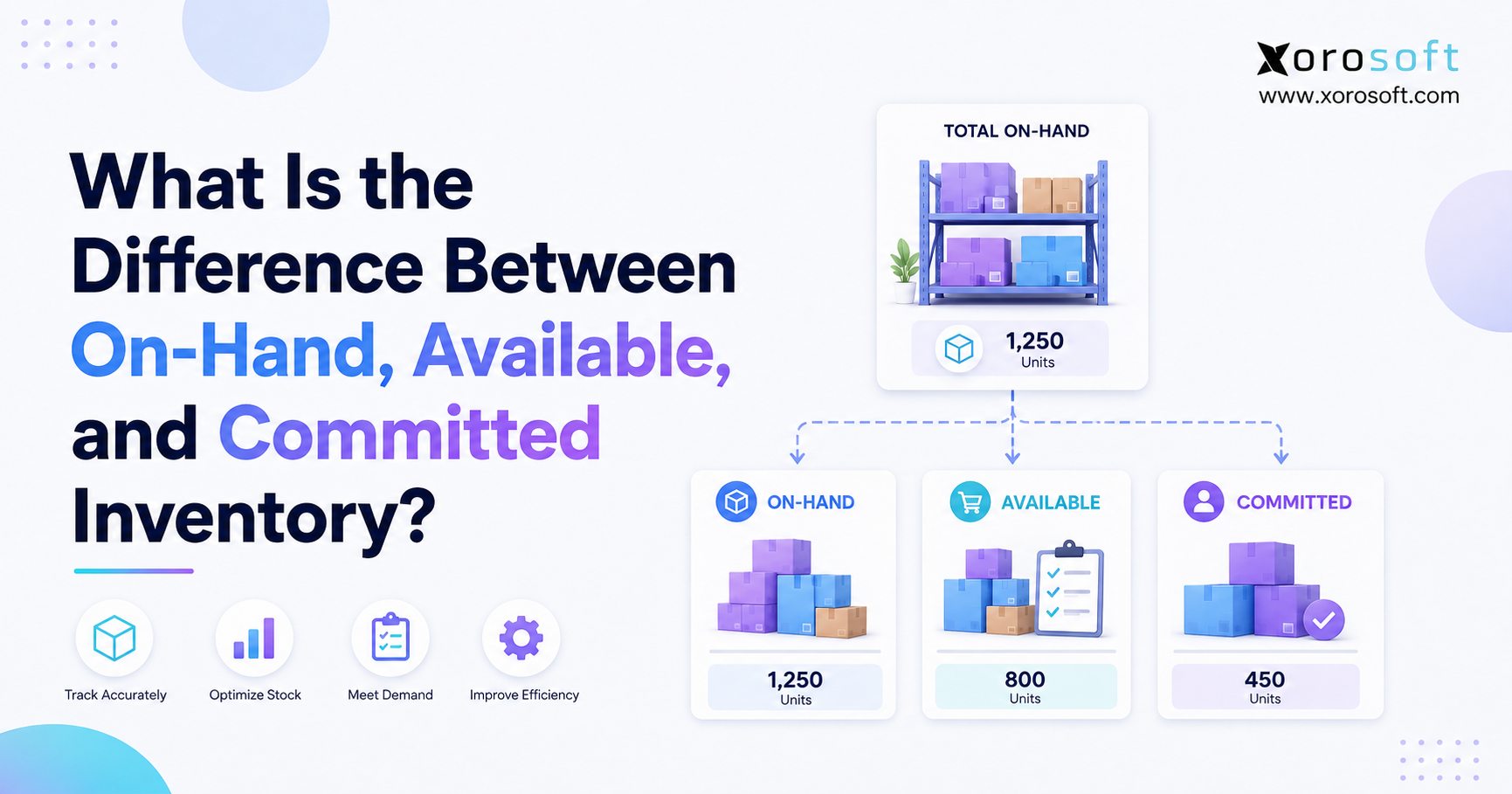
On hand vs available inventory is one of the most important distinctions for any business that sells physical products. On-hand inventory tells you what physically exists, while available inventory tells you what remains usable for new demand. Meanwhile, committed inventory shows how much stock existing orders have already claimed.
For example, imagine that a warehouse physically contains 1,000 units of one SKU. However, customers have already ordered 600 units. In addition, the warehouse has placed another 100 units on quality hold. Therefore, although the company physically owns 1,000 units, only 300 units may remain available for new orders.
That difference affects much more than a warehouse report. For example, sales teams need to know what they can promise. Likewise, purchasing teams need to know when replenishment should begin. Meanwhile, ecommerce channels need an accurate sellable quantity. Consequently, a misunderstanding can create overselling, stockouts, delayed fulfillment, and poor purchasing decisions.
At its simplest:
- On hand = what physically exists
- Committed = what existing demand has already claimed
- Available = what remains for new demand
However, growing businesses often track other states as well. For instance, they may separate damaged, quarantined, reserved, in-transit, or safety-stock quantities. Therefore, the difference between on hand vs available inventory becomes more important as operations become more complex.
2. On Hand vs Available Inventory: The Core Difference
2.1 What On-Hand Inventory Means
On-hand inventory represents the physical quantity of a product recorded at a warehouse, store, distribution center, or other location.
For example, if Warehouse A contains 750 units of SKU A, the system may show 750 units on hand. However, those 750 units do not necessarily remain available to sell.
Instead, some units may already support open customer orders. Likewise, other units may sit on hold because of damage, inspection, or operational restrictions. Therefore, on-hand inventory primarily answers one question:
How much inventory physically exists at this location?
By contrast, on hand vs available inventory compares physical quantity with usable quantity.
2.2 What On-Hand Inventory Can Include
Depending on the system, on-hand inventory can include:
- available units
- committed units
- allocated units
- reserved units
- damaged inventory
- quarantined inventory
- stock awaiting inspection
- stock held for specific customers
Therefore, a physical stock balance does not automatically represent sellable inventory.
For example, a company may have 500 units physically present. However, 300 units may already belong to open orders. Consequently, only 200 units may remain available.
2.3 Why On-Hand Stock Can Mislead Sales
Suppose a furniture distributor has 800 chairs on hand.
However:
- 300 support wholesale orders
- 200 support ecommerce orders
- 50 require quality inspection
Therefore, only 250 units remain available for new customers.
If the sales team sees only the physical count, it may believe that 800 units remain sellable. Consequently, it could promise inventory that operations have already assigned elsewhere.
For this reason, understanding on hand vs available inventory prevents physical stock from creating a false picture of supply.
3. Available Inventory Shows What You Can Still Sell or Use
3.1 What Available Inventory Means
Available inventory represents the stock that remains eligible for new demand after the system accounts for existing commitments and relevant restrictions.
Therefore, it answers:
How much inventory can we still sell, allocate, or use?
For sales and ecommerce teams, this number often matters more than the raw physical balance.
However, every business must define availability consistently. For example, one company may subtract safety stock before publishing inventory online. Meanwhile, another company may keep safety stock technically available but protect it through allocation rules.
Consequently, on hand vs available inventory should reflect the company’s actual operating policies.
3.2 Available Inventory vs Sellable Inventory
In a simple operation, available inventory and sellable inventory may mean the same thing.
However, more complex businesses often apply extra rules.
For example:
- Internal available inventory: 500
- Safety-stock buffer: 50
- Shopify sellable quantity: 450
Therefore, the customer-facing quantity can be lower than the internal available balance.
Likewise, a wholesale business may reserve inventory for strategic customers. Consequently, those units may remain technically available in one report while another allocation rule protects them.
3.3 Why Available Inventory Can Fall Before On-Hand Inventory
Suppose a customer orders 100 units.
Before the order:
- On hand: 500
- Available: 500
- Committed: 0
After commitment:
- On hand: 500
- Available: 400
- Committed: 100
Therefore, availability falls even though no product has physically left the warehouse.
This timing difference explains one of the most important aspects of on hand vs available inventory.
4. How Committed Inventory Fits Into the Picture
4.1 What Committed Inventory Means
Committed inventory represents stock that existing demand has already claimed.
For example, a confirmed customer order may require 200 units. Therefore, the system can mark those 200 units as committed even while they remain physically inside the warehouse.
As a result, the stock still contributes to the on-hand balance. However, it should no longer support another customer’s order.
4.2 When Inventory Becomes Committed
The exact commitment point depends on business policy and software configuration.
For example, a company may commit inventory when:
- a sales order receives approval
- payment clears
- an ecommerce order enters fulfillment
- an allocation process runs
- a warehouse releases an order
- an employee manually reserves stock
Therefore, businesses should define the commitment trigger clearly.
Otherwise, one channel may keep selling stock after another channel has already claimed it.
4.3 What Happens After Shipment
Suppose the inventory position is:
- On hand: 500
- Committed: 100
- Available: 400
Next, the warehouse ships those 100 committed units.
After shipment:
- On hand: 400
- Committed: 0
- Available: 400
Therefore, the physical quantity finally decreases. Meanwhile, the commitment disappears because the company has fulfilled the demand.
This lifecycle further explains why on hand vs available inventory can show different numbers at different stages.
5. On Hand vs Available Inventory: 7 Critical Differences
5.1 Difference #1: Physical Quantity vs Usable Quantity
On-hand inventory measures what physically exists.
Available inventory measures what the company can still use for new demand.
Therefore, the first number answers a warehouse question, while the second answers an order-promising question.
5.2 Difference #2: Existing Orders Affect Available Stock First
A confirmed customer order can reduce available inventory before it reduces on-hand inventory.
Consequently, physical stock may stay unchanged while sellable stock falls immediately.
5.3 Difference #3: Committed Stock Can Remain On Hand
Committed units usually remain physically present until fulfillment progresses.
Therefore, committed stock can contribute to on-hand inventory while remaining unavailable for new orders.
5.4 Difference #4: Holds Can Reduce Availability
Damaged, quarantined, or quality-control stock may remain on hand.
However, the business may exclude those units from availability.
Consequently, committed inventory is not always the only difference between on hand vs available inventory.
5.5 Difference #5: Location Matters
A company may have strong inventory globally but weak availability at the warehouse responsible for one order.
Therefore, a company-wide on-hand total can hide a local shortage.
5.6 Difference #6: Sales Channels May See Different Quantities
A business may publish different sellable quantities to Shopify, Amazon, retail stores, and wholesale teams.
For example, it may protect safety stock or reserve inventory for B2B customers.
Consequently, channel availability can differ from internal available inventory.
5.7 Difference #7: Timing Matters
Inventory states can change during:
- receiving
- allocation
- picking
- packing
- transfers
- shipping
- returns
Therefore, on hand vs available inventory should always be interpreted within the transaction lifecycle.
6. How to Calculate On Hand vs Available Inventory
6.1 The Simple Available Inventory Formula
A simple calculation is:
Available Inventory = On-Hand Inventory − Committed Inventory
For example:
On hand: 1,000
Committed: 600
Therefore:
1,000 − 600 = 400 available units
This formula works when committed stock represents the only deduction.
6.2 A More Practical Formula
However, many businesses also have restricted stock.
Therefore, a broader conceptual formula is:
Available Inventory = On Hand − Committed − Other Unavailable Quantities
For example:
On hand: 1,000
Committed: 600
Quality hold: 50
Safety stock: 50
Therefore:
1,000 − 600 − 50 − 50 = 300 available units
Consequently, on hand vs available inventory can differ substantially even when the warehouse count remains perfectly accurate.
6.3 Why One Universal Formula Can Be Dangerous
Different systems classify inventory differently.
For instance, one ERP may use reserved stock. Another may use allocated stock. Meanwhile, an ecommerce platform may separate unavailable quantities.
Therefore, businesses should not copy a formula without first understanding their own inventory states.
Instead, they should define:
- what counts as committed
- what counts as unavailable
- whether safety stock reduces sellable inventory
- how transfers affect availability
- when returns become sellable again
As a result, the final available quantity reflects actual operating rules.
7. How Inventory Changes From Receipt to Shipment
7.1 Step One: Inventory Arrives
First, a supplier delivers 500 units.
Therefore, the warehouse records the receipt and increases the physical inventory balance.
However, the stock may not become available immediately. For example, the warehouse may inspect the product first.
7.2 Step Two: Stock Becomes Available
Next, employees approve the inventory.
As a result:
- On hand: 500
- Available: 500
- Committed: 0
Therefore, the company can now use the stock for new demand.
7.3 Step Three: A Customer Places an Order
A customer orders 125 units.
Therefore, after commitment:
- On hand: 500
- Available: 375
- Committed: 125
Nothing has physically left the warehouse yet. Nevertheless, on hand vs available inventory now shows a 125-unit difference.
7.4 Step Four: Warehouse Picking Begins
Next, warehouse employees pick the 125 units.
Depending on the workflow, the system may move those units into an allocated, picked, staged, or packed state.
Therefore, the physical quantity may remain unchanged while operational status changes.
7.5 Step Five: The Order Ships
Finally, the carrier receives the shipment.
Consequently:
- On hand: 375
- Available: 375
- Committed: 0
Therefore, shipment reduces physical inventory after the commitment already reduced availability.
8. On Hand vs Available Inventory in Ecommerce
8.1 Ecommerce Makes Inventory Timing More Important
Ecommerce channels accept orders continuously.
Therefore, inventory can change at any hour of the day.
If Shopify, Amazon, wholesale, and retail all sell from the same stock pool, the company needs a consistent availability calculation.
Otherwise, one channel may sell inventory that another channel has already consumed.
8.2 Why Shopify Merchants Need More Than On-Hand Stock
A Shopify merchant may physically own 300 units.
However, existing online orders may already require 180 units.
Therefore, only 120 units may remain available before any additional restrictions.
As a result, on hand vs available inventory becomes a practical ecommerce control rather than a theoretical accounting concept.
8.3 Multi-Channel Synchronization Prevents Duplicate Promises
Suppose Shopify records one order while a wholesale salesperson enters another order in a different system.
If those systems do not update the same availability record, both orders can claim the same final units.
Consequently, growing merchants often connect ecommerce orders with centralized inventory through platforms such as XoroONE.
In addition, businesses that need Shopify, marketplace, and operational data to move between systems can review Xorosoft’s integration capabilities.
Merchants can also review the Xorosoft ERP listing directly on the Shopify App Store.
9. Multi-Warehouse Inventory Makes Availability Location-Specific
9.1 Company-Wide Stock Can Hide Local Shortages
Consider this example:
| Location | On Hand | Committed | Available |
|---|---|---|---|
| Warehouse A | 500 | 450 | 50 |
| Warehouse B | 400 | 100 | 300 |
| Warehouse C | 300 | 50 | 250 |
| Total | 1,200 | 600 | 600 |
Therefore, the company has 1,200 physical units and 600 available units overall.
However, Warehouse A has only 50 available units.
Consequently, a customer near Warehouse A may experience a shortage even though the company appears well stocked globally.
9.2 Available Somewhere Does Not Mean Available Here
Inventory at another warehouse may require:
- transfer time
- additional freight
- customs clearance
- different order routing
- longer delivery windows
Therefore, businesses should review on hand vs available inventory by location rather than only at the company level.
9.3 Transfers Create Another Layer of Complexity
Suppose Warehouse B transfers 100 units to Warehouse A.
During transit, the company still owns those units.
However, neither location may be able to treat them as immediately sellable.
Consequently, many businesses track in-transit inventory separately.
For operations with multiple facilities, a real-time WMS such as XoroWMS can help centralize warehouse movements, picking, transfers, and inventory status.
10. On Hand vs Available Inventory in Wholesale Operations
10.1 Large Orders Can Consume Availability Early
Wholesale businesses often accept orders well before shipment.
For example, a distributor has 20,000 units physically on hand.
However, one retail customer has already ordered 12,000 units for shipment next week.
Therefore, the distributor may have only 8,000 units left for new demand.
Consequently, on hand vs available inventory becomes critical for wholesale sales teams.
10.2 EDI Can Create Large Commitments Quickly
Wholesale orders often arrive through EDI.
Therefore, inventory commitments can change rapidly.
If ecommerce and wholesale orders share the same stock pool, both workflows must update the same availability logic.
Otherwise, the business risks double allocation.
10.3 Customer-Specific Allocations Add Complexity
Wholesalers may reserve inventory for:
- strategic accounts
- seasonal programs
- retailer launches
- contract commitments
- recurring replenishment
Therefore, physical stock can appear healthy even while unrestricted inventory becomes tight.
Businesses evaluating broader order, inventory, and fulfillment workflows can review Xorosoft’s solutions for inventory-driven operations.
11. Warehouse Execution Determines Whether Inventory Data Stays Accurate
11.1 Good Software Still Needs Good Transactions
Inventory systems rely on warehouse transactions.
Therefore, employees must record:
- receipts
- putaway
- transfers
- picks
- packs
- shipments
- returns
- adjustments
- cycle counts
If inventory moves physically without a system transaction, the available quantity eventually becomes unreliable.
11.2 Real-Time Updates Reduce Timing Gaps
When warehouse activity updates quickly, sales and fulfillment teams receive a better view of stock.
For example, a transfer can reduce inventory at one location while creating in-transit inventory elsewhere.
Likewise, a shipment can relieve a commitment and reduce physical stock.
Therefore, accurate on hand vs available inventory depends on both system design and operational discipline.
11.3 Cycle Counting Still Matters
Even well-designed systems cannot prevent every physical discrepancy.
For example:
- shrinkage can occur
- products can enter the wrong bin
- staff can miss scans
- damage can go unreported
Therefore, regular cycle counting remains necessary.
Consequently, the system continues to reflect what actually exists inside the warehouse.
12. On Hand vs Available Inventory in Manufacturing
12.1 Production Demand Can Consume Raw Materials
Manufacturers face the same inventory challenge in a different form.
Suppose a business has 10,000 meters of fabric on hand.
However, active work orders require 7,500 meters.
Therefore, only 2,500 meters may remain for additional production demand.
Consequently, on hand vs available inventory matters for raw materials as well as finished goods.
12.2 BOMs and Work Orders Add New Commitments
Manufacturing inventory may include:
- raw materials
- components
- subassemblies
- work in process
- finished goods
Therefore, production demand can consume inventory before a customer receives any finished product.
12.3 Planning Requires More Than Today’s Stock
Material planning must consider:
- current inventory
- committed materials
- future production
- purchase orders
- supplier lead times
- expected consumption
Therefore, manufacturers eventually need a connected view of current and future inventory.
Businesses operating across manufacturing, wholesale, furniture, apparel, sporting goods, or consumer products can review the broader industries Xorosoft serves when evaluating operational fit.
13. When ERP-Level Inventory Control Becomes Necessary
13.1 Not Every Business Needs ERP
A small company with one warehouse and one sales channel may manage inventory effectively with simpler tools.
Therefore, ERP should not be the automatic answer.
However, complexity changes the calculation.
13.2 Warning Signs That Basic Inventory Tools Are Becoming Limiting
Common warning signs include:
- multiple warehouses
- Shopify and marketplace sales
- EDI orders
- large wholesale commitments
- manufacturing
- spreadsheet purchasing
- frequent reconciliation
- different inventory numbers across systems
- overselling
- manual allocation
- delayed reporting
Consequently, on hand vs available inventory often becomes part of a much larger visibility problem.
13.3 Why Connected ERP Helps
When sales, purchasing, warehouse management, accounting, and ecommerce operate separately, employees must reconcile several versions of inventory.
Therefore, a connected ERP can reduce that fragmentation.
Xorosoft’s XoroERP is designed for inventory-driven businesses that need broader operational workflows connected within one system.
However, businesses should still evaluate their process requirements carefully before choosing any ERP.
The objective should remain simple:
Create one reliable operational picture of inventory and demand.
14. Common On Hand vs Available Inventory Mistakes
14.1 Mistake One: Treating On Hand as Sellable
This mistake creates immediate overselling risk.
For example, a company sees 2,000 units on hand.
However, 1,200 units already support open orders.
Therefore, only 800 units may remain available.
Consequently, treating on hand vs available inventory as the same number can create false promises.
14.2 Mistake Two: Subtracting Only Committed Stock
Committed inventory may not represent the only deduction.
For example, businesses may also have:
- damaged products
- quality holds
- protected safety stock
- quarantined inventory
- reserved quantities
Therefore, a simple subtraction can still overstate availability.
14.3 Mistake Three: Ignoring Location
A company may have enough inventory overall.
However, the required stock may sit in the wrong warehouse.
Consequently, fulfillment cost or delivery time can increase.
14.4 Mistake Four: Updating Channels Too Slowly
Inventory changes continuously.
Therefore, delayed synchronization can cause Shopify, marketplaces, sales teams, and warehouse systems to show different quantities.
As a result, multiple customers may compete for the same stock.
14.5 Mistake Five: Letting Teams Use Different Definitions
Sales may interpret available as physically present.
Meanwhile, warehouse teams may interpret available as unallocated.
Purchasing may use another report entirely.
Therefore, the company should define each inventory state formally.
15. A Practical Framework for Better Inventory Availability
15.1 Define Every Inventory State
First, document each term.
For example:
On hand: Physical quantity recorded at a location.
Committed: Quantity already assigned to existing demand.
Available: Quantity remaining after applicable commitments and restrictions.
Unavailable: Inventory physically present but excluded from normal demand.
Therefore, every team starts with the same vocabulary.
15.2 Define When Inventory Becomes Committed
Next, decide when an order should reduce availability.
For example:
- order creation
- order approval
- payment
- allocation
- warehouse release
Therefore, sales and operations follow the same rule.
15.3 Define Safety-Stock and Channel Buffers
A business may intentionally expose less stock than it technically has available.
For example:
Internal available inventory: 500
Protected buffer: 50
Online sellable quantity: 450
Consequently, the company protects itself against unexpected demand or inventory variation.
15.4 Define Warehouse Fulfillment Rules
Next, decide which locations each channel can use.
For example:
- Shopify may use Warehouse A and B
- wholesale may use Warehouse C
- Amazon may use a dedicated stock pool
Therefore, availability aligns with actual fulfillment capabilities.
15.5 Monitor Inventory Exceptions
Finally, track:
- negative availability
- order allocation failures
- inventory adjustments
- unfulfilled commitments
- stock discrepancies
- transfer delays
- overselling events
Consequently, the company can identify where its on hand vs available inventory logic breaks down.
For operational examples from inventory-driven businesses, Xorosoft’s case studies can provide additional context.
16. Frequently Asked Questions About On Hand vs Available Inventory
16.1 What Is On-Hand Inventory?
On-hand inventory is the physical quantity of a product recorded at a particular inventory location. However, some of that stock may already support customer orders, production, or other commitments. Therefore, on-hand inventory does not automatically represent what remains sellable.
16.2 What Is Available Inventory?
Available inventory represents the stock that remains usable for new demand after the business considers commitments and relevant restrictions. Therefore, sales and ecommerce teams usually need this number when deciding whether they can accept additional orders.
16.3 What Is Committed Inventory?
Committed inventory is stock that existing demand has already claimed. For example, a confirmed order may commit inventory before the warehouse ships it. Consequently, those units can remain physically on hand while becoming unavailable to another customer.
16.4 What Is the Difference Between On Hand and Available Inventory?
The central difference in on hand vs available inventory is physical quantity versus usable quantity. On-hand inventory tells you what exists. Available inventory tells you what remains for new demand. Therefore, available stock may be substantially lower than the physical balance.
16.5 Is Committed Inventory Included in On-Hand Inventory?
Often, yes. Committed units can remain physically inside the warehouse until fulfillment occurs. Therefore, the same units may contribute to on-hand inventory while remaining unavailable for another order. However, exact terminology varies by software.
16.6 Why Is Available Inventory Lower Than On Hand?
Available inventory can be lower because open orders, reservations, safety stock, damaged goods, quality holds, or other restrictions consume part of the physical inventory. Therefore, a difference between the two figures does not automatically indicate an inventory error.
16.7 How Do You Calculate Available Inventory?
A simple formula is:
Available = On Hand − Committed
However, businesses may also need to subtract reserved, blocked, protected, or otherwise unavailable inventory. Therefore, the correct formula should match the company’s own inventory rules.
16.8 Is Available Inventory Always On Hand Minus Committed?
No. Although the simple formula works in basic scenarios, complex operations can use additional inventory states. Therefore, businesses may also account for safety stock, quality holds, reservations, or other restrictions.
16.9 Can Inventory Be On Hand but Unavailable?
Yes. For example, damaged inventory can remain physically inside a warehouse while being unsuitable for sale. Likewise, stock under inspection may remain on hand but unavailable. Therefore, physical presence does not automatically create sellable availability.
16.10 When Does Inventory Become Committed?
The commitment point depends on company policy and software configuration. For example, inventory may become committed when the company approves, allocates, pays, or releases an order. Therefore, businesses should define this point consistently.
16.11 Does Creating an Order Reduce On-Hand Inventory?
Usually, creating an order does not immediately reduce physical inventory. Instead, it often creates a commitment and reduces available stock. Therefore, on-hand inventory may remain unchanged until fulfillment progresses.
16.12 When Does On-Hand Inventory Decrease?
On-hand inventory generally decreases when a physical transaction removes stock from the relevant location. For example, shipment, consumption, write-off, or transfer can reduce the quantity. However, timing depends on the company’s workflow.
16.13 What Happens to Committed Inventory After Shipment?
Once the warehouse ships committed stock, the related commitment normally disappears while on-hand inventory falls. Therefore, the units do not become available again because they have physically left inventory.
16.14 What Is Allocated Inventory?
Allocated inventory generally refers to stock assigned to a specific order, customer, or fulfillment process. However, software platforms use terms such as allocated, reserved, and committed differently. Therefore, businesses should follow their system’s documented definitions.
16.15 What Is Reserved Inventory?
Reserved inventory is stock intentionally protected for specific demand. For example, a business may reserve products for a major wholesale customer. Consequently, those units can remain on hand while becoming unavailable for other orders.
16.16 What Is the Difference Between Allocated and Committed Inventory?
Committed inventory broadly indicates that demand has claimed the stock. Meanwhile, allocation may refer to the more specific assignment of inventory to an order or fulfillment source. However, terminology varies between systems.
16.17 Can Available Inventory Become Negative?
Yes, some systems can show negative availability when recorded demand exceeds recognized supply. For example, backorders, transaction timing, or incorrect adjustments can contribute. Therefore, businesses should investigate negative availability rather than treating it as usable stock.
16.18 How Does Safety Stock Affect Available Inventory?
Safety stock protects the company against uncertainty. Therefore, some businesses subtract it from sellable inventory. Others keep it technically available but restrict allocation. Consequently, safety-stock policy should form part of the company’s availability rules.
16.19 How Does Multi-Warehouse Inventory Affect Availability?
Multi-warehouse operations require both network-wide and location-level analysis. Although the company may have enough inventory overall, the required warehouse may not. Therefore, on hand vs available inventory should be reviewed by location.
16.20 What Inventory Quantity Should Sales Teams Use?
Sales teams generally need an available or promiseable quantity rather than the raw physical balance. Therefore, sales should rely on the company’s defined availability figure instead of making manual deductions from on-hand inventory.
16.21 What Inventory Quantity Should Ecommerce Channels Use?
Ecommerce channels should usually use a sellable quantity based on actual availability. However, the company may also apply channel buffers, safety stock, warehouse restrictions, or marketplace rules. Therefore, published inventory can be lower than internal availability.
16.22 How Can On Hand vs Available Inventory Cause Overselling?
Overselling occurs when a business publishes or promises stock that existing demand has already consumed. Therefore, if an ecommerce channel relies only on physical on-hand inventory, it may sell units that another order has already claimed.
16.23 How Do Returns Affect Available Inventory?
Returned products should not always become available immediately. Instead, businesses may inspect the goods first. Therefore, returned inventory can remain temporarily unavailable until employees confirm that it can return to sellable stock.
16.24 How Does Purchasing Use Available Inventory?
Purchasing should consider available inventory together with demand, incoming purchase orders, lead times, and expected consumption. Therefore, relying only on on-hand quantity can delay replenishment even while actual availability continues to fall.
16.25 When Should a Business Upgrade Its Inventory System?
A business should consider upgrading when it frequently reconciles spreadsheets, manages several warehouses, oversells inventory, operates multiple sales channels, or struggles with inconsistent stock reports. Consequently, operational complexity usually creates the need before company size alone does.
17. Turn Inventory Visibility Into Confident Customer Promises
Ultimately, on hand vs available inventory comes down to three operational questions:
- What physically exists?
- What has already been promised?
- What can we safely promise next?
On-hand inventory answers the first question. Meanwhile, committed inventory answers the second. Finally, available inventory answers the third.
Therefore, inventory accuracy requires more than a physical stock count.
Businesses also need visibility into:
- customer demand
- committed inventory
- unavailable stock
- safety stock
- warehouse locations
- channel rules
- transfers
- future supply
As operations grow, this distinction becomes increasingly important. For example, ecommerce orders arrive continuously. Meanwhile, wholesale customers can consume large quantities before shipment. In addition, manufacturing can commit components before finished products exist.
Consequently, disconnected systems make inventory harder to trust.
Xorosoft brings inventory, warehouse management, purchasing, accounting, ecommerce, manufacturing, forecasting, and reporting together for inventory-driven businesses. Therefore, companies that have outgrown QuickBooks, spreadsheets, standalone inventory apps, or disconnected warehouse systems can evaluate whether a connected ERP would provide a clearer operational picture.
Most importantly, the right inventory system should make one question easy to answer:
What inventory can we confidently promise next?
If your team regularly debates which inventory number is correct, review the process using your own SKUs, locations, channels, and commitment rules.
Book a Demo to see how Xorosoft can connect inventory availability with the operational processes that create, reserve, move, and fulfill demand.
Recent Posts
-
 ERP Landed Cost Module vs Spreadsheet Calculations for Importers
 -
 How to Build an Open-to-Buy Plan for an Omnichannel Brand
 -
 Cold Storage WMS for Food and Beverage Distribution
 -
 ERP Buying Statistics 2026: Evaluation, Implementation, and Adoption Risks
 -
 How a Distributor Reduced B2B Order Exceptions Without Restricting Sales