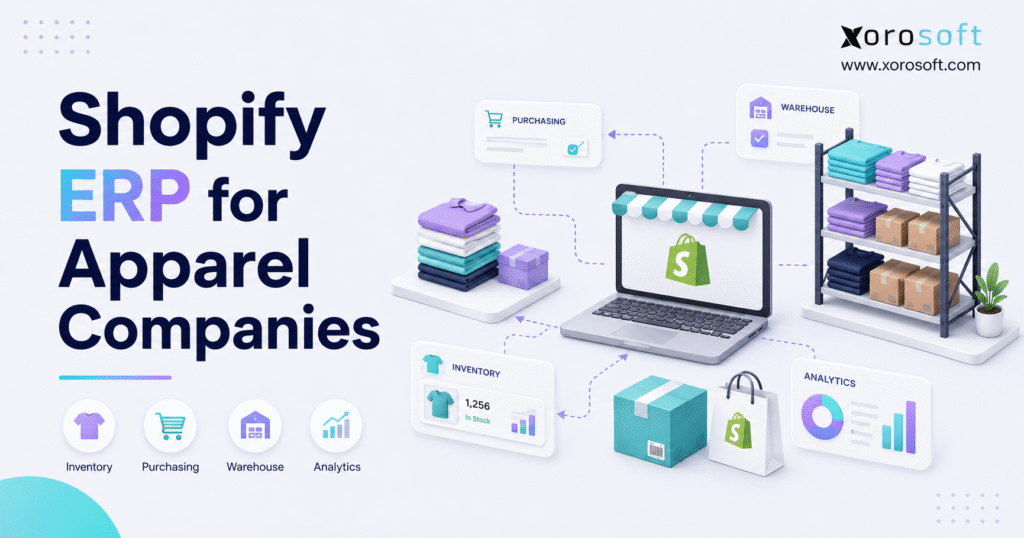
If you’re searching for solutions like Shopify ERP for apparel companies, you’ve come to the right place.
1. The Apparel Growth Problem Behind Shopify ERP
Shopify ERP for apparel companies becomes important when a clothing brand grows beyond simple ecommerce operations. At first, Shopify, a few apps, QuickBooks, and spreadsheets may be enough. However, once the business adds more SKUs, warehouses, wholesale accounts, returns, and purchasing complexity, those tools often stop giving teams one reliable version of the truth.
For apparel companies, growth does not only mean more orders. It also means more styles, colors, sizes, seasons, suppliers, channels, and inventory decisions. Therefore, a brand can look successful on the storefront while operations become harder behind the scenes.
A basic Shopify setup can support early sales very well. However, Shopify is not designed to manage every back-office workflow that an apparel company eventually needs. Inventory planning, purchase orders, warehouse receiving, accounting, landed cost, fulfillment routing, wholesale allocation, and reporting usually require a more connected operating system.
As a result, many growing apparel companies begin searching for ERP when the same problems keep repeating. Stock numbers do not match. Popular sizes oversell. Buyers depend on spreadsheets. Finance cannot close the month quickly. Warehouse teams pick the wrong variants. Meanwhile, leadership struggles to understand what is actually happening across the business.
2. Why Apparel Companies Outgrow Basic Shopify Operations
2.1 Shopify works well until operations become layered
Shopify is strong at ecommerce. It helps apparel brands sell online, manage products, accept payments, and create a better customer experience. However, the operational work behind each order becomes more complex as the brand scales.
For example, a small clothing brand may start with one warehouse and one Shopify store. Later, the same company may add wholesale orders, Amazon, retail partners, 3PL fulfillment, multiple warehouses, and international sales. Consequently, the team needs more than a storefront. It needs a system that connects inventory, purchasing, warehouse management, accounting, and reporting.
Shopify remains the commerce layer. However, ERP becomes the operational layer behind Shopify.
2.2 Apparel brands face SKU complexity earlier than other ecommerce companies
Apparel companies deal with SKU complexity earlier than many other product businesses. A single hoodie may come in five sizes, six colors, two fits, and multiple seasonal drops. Therefore, one product idea can quickly become dozens of inventory records.
That complexity creates practical questions every day:
- Which sizes are actually available?
- Which colors are selling fastest?
- Which warehouse has the right variant?
- Which units are reserved for wholesale?
- Which returned items can be resold?
- Which sizes should purchasing reorder first?
Because of this, total product inventory is not enough. Apparel companies need variant-level visibility by size, color, style, location, and sales channel.
2.3 Growth exposes gaps in inventory, finance, purchasing, and fulfillment
Operational gaps usually appear gradually. First, one spreadsheet tracks purchasing. Then another spreadsheet tracks wholesale commitments. After that, finance exports reports from Shopify, QuickBooks, and warehouse tools to reconcile numbers manually.
Eventually, the company spends too much time checking data instead of making decisions. Moreover, each disconnected workflow increases the chance of mistakes.
For apparel brands, these mistakes are expensive. A wrong stock number can create overselling. A late purchase order can create stockouts. A warehouse error can create returns. Meanwhile, poor inventory valuation can affect financial reporting.
2.4 Early signs that Shopify apps are no longer enough
A Shopify apparel brand may be ready to evaluate ERP when:
- Inventory differs between Shopify, warehouse tools, and spreadsheets.
- Best-selling sizes oversell during campaigns.
- Purchase orders depend on manual formulas.
- Wholesale commitments are tracked outside the main system.
- Finance spends too much time reconciling inventory.
- Warehouse teams rely on manual picking sheets.
- Reporting depends on exports instead of live dashboards.
- Operators cannot see stock, demand, purchasing, and margin together.
These signs do not always mean the business is failing. Instead, they usually mean the business has outgrown its operating system.
3. What Shopify ERP Means for Apparel Companies
3.1 Simple definition of Shopify ERP for apparel companies
Shopify ERP for apparel companies is a connected back-office system that links Shopify orders with inventory management, purchasing, warehouse management, accounting, forecasting, and reporting.
For apparel companies, ERP must also handle style, color, size, season, warehouse, sales channel, and wholesale complexity. Therefore, the system should not only track products. It should also show how inventory moves through the business.
3.2 How Shopify ERP connects front-end and back-end operations
Shopify manages the customer-facing store. ERP manages the operational workflows behind the store.
A connected workflow usually looks like this:
| Step | Workflow | ERP Role |
|---|---|---|
| 1 | Customer places a Shopify order | Order syncs into ERP |
| 2 | Inventory updates | Available stock changes by SKU and location |
| 3 | Warehouse fulfills the order | Pick, pack, ship, and tracking update |
| 4 | Accounting records activity | Sales, inventory, COGS, and payments connect |
| 5 | Reports update | Operators see performance by product and channel |
Because these workflows connect, teams reduce duplicate entry. In addition, managers can make decisions from one operational view instead of several conflicting reports.
3.3 What ERP does that Shopify does not do natively
Shopify supports ecommerce operations. However, ERP supports the broader business system.
An ERP can help apparel companies manage:
- Purchase orders
- Supplier lead times
- Multi-warehouse stock
- Barcode scanning
- Inventory valuation
- Landed cost
- Wholesale pricing
- EDI workflows
- Forecasting
- Reporting
- Manufacturing or assembly workflows
For additional ecommerce inventory context, Shopify’s guide to ecommerce inventory management explains why stockouts, overstock, returns, and multi-location visibility become major issues for growing merchants.
3.4 Who needs Shopify ERP and who does not
Not every apparel company needs ERP right away. Therefore, the decision should depend on operational complexity, not only revenue.
3.4.1 Companies that may not need ERP yet
A small apparel brand may not need ERP if it sells through one Shopify store, uses one location, manages a limited SKU count, and handles purchasing manually without major errors.
In that case, Shopify, simple apps, and accounting software may still work.
3.4.2 Companies that should start evaluating ERP
A company should start evaluating ERP when it sells across multiple channels, manages several warehouses, handles wholesale orders, uses EDI, depends on purchasing teams, or needs accurate inventory accounting.
At that point, the question changes. Instead of asking whether the brand is big enough for ERP, operators should ask whether the current system is strong enough for the next stage of growth.
4. Why Apparel Inventory Is More Complex Than Standard Ecommerce Inventory
4.1 Apparel ERP must handle style-color-size inventory
Apparel inventory is not simple unit counting. Each variant matters because customers buy specific sizes and colors.
For example, a brand may have 600 units of a jacket in total. However, if the medium black variant is sold out, the product may still disappoint customers. Therefore, inventory visibility must go below the product level.
A strong apparel ERP should show available, committed, incoming, reserved, damaged, returned, and transferred inventory by SKU and location.
4.2 Seasonal inventory planning changes purchasing decisions
Apparel brands often buy inventory before demand fully appears. Because seasonal collections have short selling windows, purchasing mistakes can become expensive quickly.
If the team underbuys, popular products sell out too early. However, if the team overbuys, cash gets trapped in slow-moving stock. As a result, seasonal planning must combine sales history, current velocity, supplier lead times, open orders, and channel demand.
This is why many teams connect seasonal planning with broader ERP workflows instead of relying only on spreadsheets.
4.3 Returns and exchanges affect available inventory
Returns are especially important in apparel because fit, size, and preference issues are common. However, returned inventory should not automatically become available again.
First, the warehouse must inspect the item. Then the team must decide whether it can be resold, repaired, written off, or moved. After that, inventory should update correctly.
Without a controlled returns workflow, available stock can become inaccurate very quickly.
4.4 Wholesale commitments compete with DTC demand
Many apparel companies sell both direct-to-consumer and wholesale. Although this creates growth, it also creates allocation pressure.
A wholesale customer may reserve inventory months before shipment. Meanwhile, Shopify demand may rise during a campaign. If the system does not separate available stock from committed stock, the brand may accidentally sell units promised to wholesale accounts.
Therefore, allocation visibility becomes essential.
4.5 Multi-warehouse inventory makes fulfillment harder
Multi-warehouse operations create another layer of complexity. Inventory may sit in a main warehouse, a 3PL, a retail location, or a regional fulfillment center.
Although this can improve delivery speed, it also creates risk. If Shopify shows total stock without clear location visibility, customers may buy items that are not easy to fulfill.
A connected ERP helps teams see where inventory sits and which location should fulfill each order.
5. Core Problems Shopify ERP Solves for Apparel Brands
5.1 Shopify apparel inventory discrepancies
Inventory discrepancies happen when different systems show different numbers. Shopify may show one quantity. The warehouse may show another. Meanwhile, a spreadsheet may show something else.
Because apparel inventory moves constantly, these gaps can appear quickly. Sales, returns, transfers, receiving, damages, and wholesale reservations all affect availability.
ERP reduces this problem by creating one central inventory record.
5.2 Overselling popular apparel sizes and colors
Overselling often happens when demand moves faster than inventory updates. This is common in apparel because one size or color may sell much faster than the rest.
For example, a black medium may sell through quickly during a promotion, while other variants remain available. If Shopify, wholesale, Amazon, and warehouse systems do not sync properly, customers may buy stock that no longer exists.
A connected ERP can reduce this risk through inventory reservations, real-time updates, and available-to-sell logic.
5.3 Stockouts caused by weak purchasing visibility
Stockouts are not always caused by unexpected demand. Often, they happen because purchasing teams lack clear visibility.
A buyer may not see open orders, supplier delays, inbound purchase orders, or warehouse transfers in one place. Consequently, replenishment happens too late.
ERP improves purchasing by connecting demand, stock on hand, inbound inventory, supplier lead times, and sales velocity.
5.4 Overstock caused by poor apparel forecasting
Overstock can damage cash flow. In apparel, it can be especially painful because slow-moving styles may require markdowns once the season passes.
A team may overbuy a color that performed well last year. However, demand may shift the next season. In addition, the team may buy the wrong size curve even when the total quantity looks reasonable.
ERP forecasting does not remove uncertainty. Nevertheless, it gives operators better data for buying decisions.
5.5 Manual accounting and slow month-end close
Inventory and accounting are connected. However, many apparel companies manage them in separate systems for too long.
Finance may need to reconcile Shopify sales, payment fees, refunds, purchase receipts, landed costs, inventory adjustments, and warehouse movements. As a result, month-end close becomes slow and stressful.
ERP helps by connecting inventory activity with financial records.
5.6 Duplicate work across Shopify apps and spreadsheets
Disconnected systems create duplicate data entry. A product may be created in Shopify, updated in an inventory app, tracked in a warehouse tool, purchased through spreadsheets, and reconciled in accounting software.
Each handoff creates risk. Therefore, ERP is valuable because it reduces manual work and gives teams a controlled workflow.
6. Key Shopify ERP Features Apparel Companies Should Look For
6.1 Shopify ERP for apparel variant management
Variant management should be a core requirement. The ERP must track each SKU by style, color, size, warehouse, and status.
In addition, teams should be able to see available, reserved, committed, incoming, and returned units. Without that detail, operators cannot make accurate sales, purchasing, or fulfillment decisions.
6.2 Multi-warehouse inventory visibility for apparel brands
A growing apparel brand needs visibility across every inventory location. This may include warehouses, stores, 3PLs, showrooms, and transfer locations.
Because stock location affects fulfillment speed and cost, multi-warehouse visibility is not optional. It helps teams route orders correctly and avoid unnecessary transfers.
6.3 Shopify order and inventory synchronization
The ERP should sync Shopify orders, inventory updates, fulfillment status, and relevant product data.
However, sync alone is not enough. The system must also support operational rules. For example, it should know which inventory is sellable, reserved, damaged, returned, or committed to wholesale.
6.4 Purchase order automation for apparel companies
Purchasing should not depend only on manual spreadsheets. Instead, buyers need workflows that connect sales demand, stock levels, supplier lead times, and inbound purchase orders.
A good ERP should help teams create purchase orders, track approvals, monitor delivery dates, and compare received quantities against ordered quantities.
6.5 Forecasting and replenishment planning
Forecasting helps teams decide when to reorder and how much to buy.
For apparel, forecasting should consider size-level sales velocity, seasonal demand, channel performance, supplier lead times, and wholesale commitments. Therefore, broad product-level forecasting is usually not enough.
6.6 Warehouse management and barcode scanning
Warehouse execution matters because apparel SKUs often look similar. A black small and black medium can be easy to confuse during a busy fulfillment period.
A system such as XoroWMS can support warehouse workflows such as receiving, picking, packing, scanning, and fulfillment control. In addition, Shopify’s guide to warehouse management explains how warehouse processes support efficient fulfillment.
6.7 Accounting and inventory valuation
A Shopify ERP for apparel companies should connect inventory movement with financial reporting.
Important accounting capabilities include:
- Inventory valuation
- Cost of goods sold
- Landed cost
- Purchase receipts
- Sales order accounting
- Refunds and returns
- Month-end reconciliation
- Margin reporting
Because inventory is a financial asset, finance should be involved early in ERP selection.
6.8 Wholesale, B2B, and EDI support
Wholesale creates different requirements than DTC. Apparel companies may need customer-specific pricing, bulk orders, ship windows, payment terms, routing rules, and EDI documents.
Therefore, the ERP should support wholesale workflows without forcing the team to manage them in separate spreadsheets.
6.9 Reporting dashboards for operators
Operators need more than sales reports. They need reports that connect inventory, purchasing, warehouse performance, margin, and channel activity.
Useful dashboards include:
| Report | Why It Matters |
| Inventory by SKU and warehouse | Shows real availability |
| Sales velocity | Supports replenishment |
| Open purchase orders | Improves inbound planning |
| Gross margin by product | Supports pricing decisions |
| Warehouse performance | Shows fulfillment bottlenecks |
| Stockout and overstock risk | Supports proactive planning |
A platform such as XoroERP is relevant when apparel companies want inventory, purchasing, accounting, warehouse, and reporting workflows in one ERP environment.
7. Shopify ERP vs Inventory Apps vs QuickBooks vs Spreadsheets
7.1 Shopify ERP vs Shopify inventory apps
Inventory apps can solve specific problems. For example, an app may help with stock sync, bundles, alerts, or basic multi-location inventory.
However, apps often solve one layer at a time. ERP connects multiple layers together. As a result, inventory, purchasing, accounting, warehouse, and reporting workflows become part of one operating system.
7.2 Shopify ERP vs spreadsheets for apparel planning
Spreadsheets are flexible. However, they become risky when several teams depend on them.
A buyer may edit one file. Finance may use another file. Warehouse managers may maintain a separate tracker. Eventually, no one knows which number is correct.
ERP creates structure. Therefore, teams rely less on formulas and more on controlled workflows.
7.3 Shopify ERP vs QuickBooks for apparel companies
QuickBooks can work well for accounting. However, apparel companies often outgrow it when inventory becomes operationally complex.
The issue is not whether QuickBooks is useful. Instead, the issue is whether it can support variant inventory, warehouse workflows, purchasing, wholesale allocation, and real-time reporting.
If QuickBooks is still part of the evaluation, this Xorosoft vs QuickBooks comparison can help operators understand where accounting tools and ERP systems differ.
7.4 Shopify ERP vs standalone warehouse software
Warehouse software focuses on execution. It helps teams receive, store, pick, pack, ship, and process returns.
ERP covers a broader operating model. It connects warehouse activity with sales, inventory, purchasing, accounting, and reporting.
Therefore, the right choice depends on the problem. If the issue is only warehouse execution, WMS may help. However, if the issue spans finance, purchasing, inventory, and fulfillment, ERP is usually more relevant.
7.5 Comparison table: which system fits which stage?
| System | Best For | Apparel Limitation | Upgrade Signal |
| Shopify native tools | Simple ecommerce operations | Limited back-office depth | Multi-location or wholesale complexity appears |
| Inventory apps | Stock sync and lightweight control | Limited finance and purchasing depth | Manual work keeps increasing |
| QuickBooks | Financial accounting | Not built for complex apparel operations | Inventory valuation issues appear |
| Spreadsheets | Early planning | Error-prone and hard to scale | Multiple teams rely on conflicting files |
| ERP | Connected operations | Requires process planning | Growth demands one operational system |
8. How Shopify ERP Supports Apparel Wholesale, DTC, and Multi-Channel Sales
8.1 DTC orders from Shopify
DTC orders usually move quickly. Customers expect accurate availability, fast shipping, and clear order updates.
ERP supports this by syncing orders, reserving inventory, routing fulfillment, and updating shipment status. As a result, teams spend less time manually checking whether inventory exists.
8.2 Wholesale orders and customer-specific pricing
Wholesale apparel customers may require unique prices, minimum order quantities, payment terms, allocations, and ship windows.
Because of that, wholesale should not live only in spreadsheets. ERP helps connect wholesale orders with available inventory, incoming purchase orders, and warehouse fulfillment.
8.3 Amazon and marketplace inventory sync
Many apparel companies sell beyond Shopify. Amazon, marketplaces, retail partners, and wholesale accounts can all compete for the same inventory.
Without centralized inventory, each channel may show inaccurate availability. Therefore, ERP helps create one operational view of stock across channels.
8.4 EDI workflows for apparel wholesale
Retailers may require EDI documents such as purchase orders, acknowledgments, shipment notices, and invoices.
If EDI sits outside the main workflow, teams must reconcile wholesale activity manually. However, when EDI connects with ERP, orders, inventory, shipping, and accounting stay easier to control.
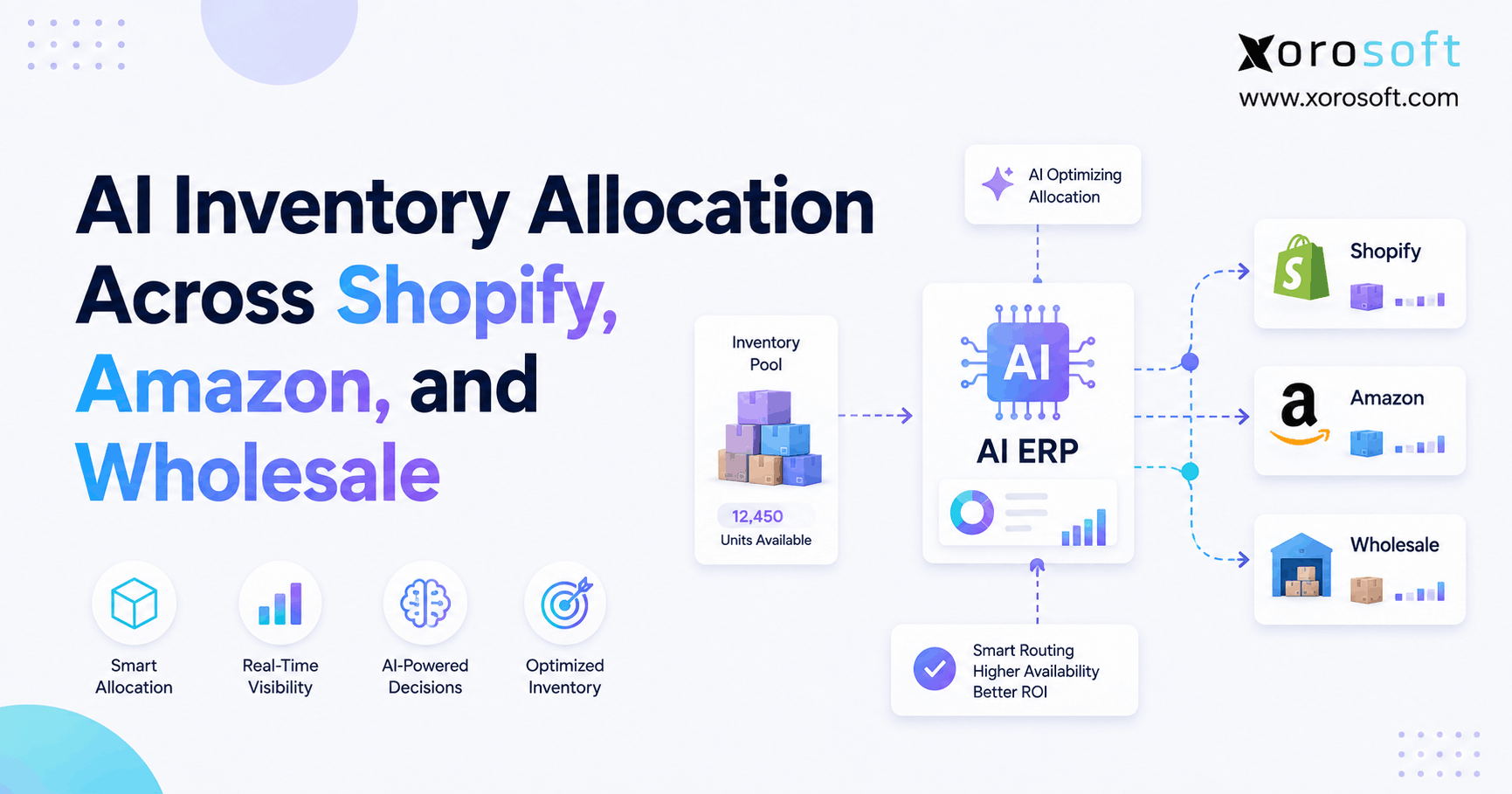
8.5 Inventory allocation across channels
Allocation decides which channel gets access to inventory.
For example, a brand may reserve 500 units for wholesale, keep 300 units for Shopify, and hold 100 units for exchanges. ERP helps make those rules visible so teams do not accidentally sell committed stock.
For companies evaluating broader operational fit, XoroONE may be useful when the business needs a connected platform across inventory, warehouse, accounting, purchasing, ecommerce, and reporting.
9. How Shopify ERP Improves Apparel Warehouse and Fulfillment Workflows
9.1 Receiving inventory by style, color, and size
Receiving is where inventory accuracy begins.
If warehouse teams receive apparel incorrectly, every downstream number becomes less reliable. A shipment may include the correct total units but the wrong size mix. Therefore, receiving must happen at the SKU level.
9.2 Putaway and bin-level visibility
After receiving, the warehouse needs to know where each SKU lives.
Bin-level visibility helps pickers find items quickly. In addition, it helps managers understand storage usage, replenishment needs, and transfer requirements.
9.3 Barcode scanning for apparel SKUs
Barcode scanning reduces manual errors. Instead of relying on visual checks, warehouse teams scan the SKU, size, color, bin, and order.
This matters for apparel because many items look similar. Therefore, scanning improves accuracy during receiving, picking, packing, and returns.
9.4 Picking and packing accuracy
Picking errors create returns, refunds, reships, and customer complaints.
ERP-connected warehouse workflows can guide pickers to the correct bin, confirm the scanned SKU, and update fulfillment status. As a result, inventory accuracy improves while customer service issues decrease.
9.5 Returns processing and restocking
Returns must be inspected before they become sellable again.
A returned item may be restocked, repaired, written off, or moved to a different warehouse. Therefore, the system should update inventory only after the correct return status is confirmed.
9.6 Multi-warehouse fulfillment routing
Multi-warehouse routing helps apparel brands ship from the right location.
The best location may depend on customer address, available stock, shipping cost, wholesale commitments, or warehouse workload. Consequently, connected ERP workflows give operators more control over fulfillment decisions.
10. How Shopify ERP Helps With Purchasing, Forecasting, and Seasonality
10.1 Seasonal buying cycles in apparel
Apparel companies often commit to inventory months before demand appears. That makes purchasing difficult.
If the team buys too little, stockouts appear during peak demand. However, if the team buys too much, the brand may end the season with dead stock. Therefore, seasonal planning needs better data than last year’s sales alone.
10.2 Purchase order planning by demand and lead time
A good purchase order workflow should answer practical questions:
- What needs to be reordered?
- Which supplier should provide it?
- What is the lead time?
- What demand already exists?
- What inventory is incoming?
- Which sizes or colors are at risk?
Because ERP connects these inputs, buyers can make more disciplined purchasing decisions.
10.3 Forecasting demand by SKU, size, and channel
Apparel forecasting must go below the product level.
A style may sell well overall, but certain sizes may drive most of the demand. In addition, wholesale demand may behave differently from Shopify demand.
Therefore, forecasting should help teams review demand by SKU, size, color, warehouse, and channel.
10.4 Avoiding both stockouts and dead stock
Stockouts and dead stock are connected planning problems.
Stockouts reduce revenue and damage trust. Meanwhile, dead stock traps cash and increases markdown pressure. ERP helps operators balance availability with inventory discipline.
10.5 Supplier performance tracking
Supplier reliability affects launches, fulfillment, and cash flow.
If a supplier often ships late or sends incorrect quantities, the brand may miss campaigns or disappoint wholesale customers. Therefore, ERP supplier tracking can help teams monitor expected dates, received quantities, delays, and quality issues.
11. Accounting and Reporting Requirements for Apparel Companies
11.1 Inventory valuation and cost of goods sold
Inventory valuation matters because apparel inventory changes constantly.
New stock arrives. Orders ship. Returns come back. Products transfer between warehouses. Some items get written off. Others move into markdown campaigns.
Because of this, finance needs inventory movement connected to cost of goods sold and inventory value.
11.2 Landed cost and freight allocation
The true cost of apparel inventory may include supplier cost, freight, duties, tariffs, packaging, and handling.
If landed cost is not allocated correctly, margin reporting becomes unreliable. Therefore, ERP should support cost allocation in a way finance can trust.
11.3 Month-end close and reconciliation
Month-end close becomes difficult when Shopify, warehouse systems, QuickBooks, spreadsheets, and inventory apps all hold different numbers.
A cloud ERP such as Xorosoft can help connect inventory, purchasing, accounting, warehouse, and reporting workflows. As a result, finance teams can reduce reconciliation gaps and gain better visibility into operational activity.
11.4 Real-time margin reporting
Margin reporting should not wait until finance finishes cleanup.
Operators need to understand margin by product, channel, customer, and warehouse. Otherwise, they may scale products that look successful in sales reports but perform poorly after costs.
11.5 Reporting by channel, warehouse, and product line
Apparel leaders need reporting that matches how the business runs.
| Reporting View | Business Question |
| Product line | Which collections perform best? |
| Size curve | Which sizes sell fastest? |
| Channel | Is DTC or wholesale driving margin? |
| Warehouse | Where is stock moving fastest? |
| Supplier | Which vendors create delays? |
| Returns | Which products create return pressure? |
For brands reviewing industry fit, the industries served by Xorosoft page can help connect ERP requirements with apparel, wholesale, manufacturing, and inventory-driven operations.
12. When Apparel Companies Should Upgrade to Shopify ERP
12.1 Revenue and order volume are not the only signals
Some apparel companies need ERP at lower revenue because their operations are complex. Others can wait because their workflows are simple.
Therefore, revenue alone is not the best signal. Operational complexity matters more.
A company with one warehouse and simple SKUs may not need ERP yet. However, a company with wholesale, Amazon, multiple warehouses, high return volume, and purchasing complexity may need ERP much earlier.
12.2 Operational symptoms that indicate ERP readiness
Consider ERP when:
- Inventory accuracy becomes a recurring issue.
- Shopify availability does not match warehouse reality.
- Purchasing decisions depend on spreadsheets.
- Finance cannot close the month quickly.
- Warehouse errors increase.
- Wholesale and DTC teams compete for the same stock.
- Leaders cannot trust reports.
When these issues appear repeatedly, the business likely needs a stronger operating system.
12.3 Team signals: too many people maintaining spreadsheets
When several people maintain different spreadsheets, the business no longer has one operational truth.
A buyer may update one file. Finance may create another. Warehouse managers may keep their own version. Eventually, nobody knows which file is correct.
ERP reduces this risk by giving teams one structured workflow.
12.4 Finance signals: inventory numbers no longer match reality
Inventory mismatch creates financial risk.
If accounting shows inventory that the warehouse cannot confirm, margin and cash flow reporting become unreliable. Therefore, ERP becomes important when finance can no longer trust inventory numbers without manual cleanup.
12.5 Warehouse signals: picking errors and receiving delays increase
Warehouse problems often reveal system gaps.
If teams pick wrong sizes, receive incorrect quantities, delay returns, or lose track of transfers, the company needs stronger operational controls. In many cases, this is where ERP and WMS workflows become essential.
13. Common Mistakes When Choosing Shopify ERP for Apparel Companies
13.1 Choosing based only on Shopify integration
A Shopify integration is important. However, it is not enough.
Apparel companies should also evaluate inventory depth, purchasing workflows, warehouse execution, accounting integration, wholesale support, reporting, and implementation fit.
13.2 Ignoring apparel variant complexity
Some systems track products well but struggle with apparel-specific detail.
Before choosing ERP, test style-color-size workflows, size-level availability, returns, transfers, allocation, and replenishment. Otherwise, the system may look strong in a demo but fail in daily operations.
13.3 Underestimating warehouse workflows
ERP selection often focuses on software features. However, warehouse adoption determines daily success.
If receiving, picking, packing, and returns workflows are poorly mapped, the system may not deliver the expected accuracy.
13.4 Treating ERP as only accounting software
ERP is not only finance software.
For apparel companies, ERP should connect physical inventory with financial outcomes. Therefore, operators, warehouse teams, purchasing, ecommerce, wholesale, and finance should all be involved in selection.
13.5 Failing to map wholesale requirements
Wholesale can add pricing, allocations, ship windows, EDI, terms, routing guides, and compliance rules.
If these workflows are not mapped early, the company may choose a system that fits DTC but struggles with B2B growth.
13.6 Waiting until operations are already broken
ERP implementation requires planning. Therefore, waiting until the team is overwhelmed creates unnecessary risk.
The better time to evaluate ERP is when current workflows still function but clearly cannot support the next stage.
14. Shopify ERP Alternatives Apparel Companies May Compare
14.1 NetSuite
NetSuite is often evaluated by larger businesses with broad ERP needs. However, apparel companies should review implementation scope, cost, customization needs, and Shopify workflow fit before making a decision.
14.2 Cin7
Cin7 is commonly evaluated by inventory-driven businesses. Apparel companies should review inventory, order management, wholesale, integration, and accounting needs before deciding whether it fits.
If Cin7 is part of your shortlist, this Xorosoft vs Cin7 comparison may help frame the evaluation.
14.3 Brightpearl
Brightpearl is often considered by retail and ecommerce brands. However, apparel teams should compare its operational workflows, reporting, and scalability against their long-term requirements.
14.4 Fishbowl
Fishbowl may appear in searches for inventory and warehouse management. However, apparel companies should evaluate Shopify connectivity, accounting workflows, and variant-level needs carefully.
14.5 Acumatica
Acumatica can fit mid-market ERP requirements. As with any ERP, apparel companies should evaluate implementation resources, industry fit, integrations, and workflow depth.
14.6 Odoo
Odoo may appeal to companies that want modular business software. However, apparel brands should evaluate how much configuration is needed for inventory, accounting, warehouse, purchasing, and Shopify workflows.
14.7 Fulfil
Fulfil is often discussed in ecommerce operations. However, apparel companies should still test variant inventory, wholesale needs, warehouse execution, accounting fit, and reporting.
14.8 How to compare ERP systems without relying on feature lists alone
Feature lists can mislead buyers. Two systems may both claim inventory, accounting, WMS, purchasing, and reporting. However, the real difference appears in workflow depth.
Use this evaluation table:
| Evaluation Area | What to Test |
| Shopify sync | Orders, inventory, returns, fulfillment updates |
| Apparel inventory | Style, color, size, season, warehouse, status |
| Purchasing | Lead times, open POs, replenishment planning |
| Warehouse | Receiving, barcode scanning, picking, returns |
| Accounting | Inventory valuation, COGS, landed cost |
| Wholesale | Pricing, allocation, EDI, payment terms |
| Reporting | Margin, stock risk, channel performance |
For broader research, the main Xorosoft comparison hub can help teams review different ERP alternatives without forcing every comparison into one article.
15. Where Xorosoft Fits for Apparel Companies Using Shopify
15.1 Xorosoft as a cloud ERP for inventory-driven apparel companies
Xorosoft is a cloud ERP platform built for inventory-driven businesses, including apparel companies that sell through Shopify, wholesale, Amazon, EDI, and multiple warehouses.
It is most relevant when a company has outgrown disconnected systems and needs inventory, purchasing, warehouse management, accounting, forecasting, and reporting in one operational environment.
15.2 Shopify, inventory, accounting, purchasing, WMS, and reporting in one system
Xorosoft can support workflows apparel operators usually want to centralize: Shopify order sync, inventory management, purchasing, warehouse management, accounting, reporting, and forecasting.
In addition, the Xorosoft ERP app on the Shopify App Store gives Shopify merchants a direct reference point for the integration.
15.3 Why apparel companies often evaluate Xorosoft after QuickBooks, spreadsheets, or inventory apps
Apparel companies often evaluate Xorosoft when QuickBooks handles accounting but not operational complexity. They may also consider it when spreadsheets create planning risk or inventory apps cannot connect purchasing, warehouse, and finance deeply enough.
That transition usually happens when growth exposes the limits of disconnected tools.
15.4 How Xorosoft supports multi-warehouse, wholesale, Amazon, and EDI workflows
For apparel companies selling across Shopify, Amazon, wholesale, and EDI, Xorosoft can help centralize inventory visibility, purchasing, fulfillment, accounting, and reporting.
This matters because each channel creates different operational requirements. DTC needs fast fulfillment. Wholesale needs allocation. Amazon needs stock accuracy. Finance needs reliable numbers.
15.5 When Xorosoft may be a fit and when it may not be
Xorosoft may be a fit for apparel companies with growing inventory complexity, multiple warehouses, purchasing teams, wholesale orders, accounting requirements, or multi-channel operations.
However, it may not be necessary for very small apparel brands with simple SKUs, one location, low order volume, and no operational complexity beyond Shopify.
16. Implementation Checklist for Apparel Shopify ERP Projects
16.1 Map your current Shopify workflow
Start by mapping the full order lifecycle.
Document how products are created, how orders enter the system, how inventory updates, how warehouses fulfill, how returns are processed, and how accounting reconciles.
16.2 Clean up SKU and variant data
ERP implementation depends on clean product data.
Apparel companies should standardize SKU naming, sizes, colors, product categories, barcodes, units of measure, and warehouse locations before migration.
16.3 Define warehouse and fulfillment rules
Warehouse rules should be clear before go-live.
Define receiving steps, putaway logic, pick paths, packing requirements, return inspection rules, transfer workflows, and fulfillment routing. As a result, the team can train around real work instead of abstract modules.
16.4 Document purchasing and supplier workflows
Purchasing teams should document how they create POs, approve orders, track lead times, receive goods, manage shortages, and handle supplier issues.
Without this work, ERP may simply recreate old manual habits inside a new system.
16.5 Align accounting requirements before implementation
Finance should define inventory valuation, COGS rules, landed cost treatment, chart of accounts mapping, tax handling, payment reconciliation, and month-end close requirements.
This prevents accounting surprises after operational workflows are already live.
16.6 Train teams by workflow, not just by module
ERP training should follow real work.
Train warehouse teams on receiving and picking. Then train buyers on purchase orders. After that, train finance on reconciliation and operators on reporting. This approach improves adoption because each team sees how ERP supports daily decisions.
For proof points and implementation context, teams can also review Xorosoft case studies before choosing an ERP path.
17. FAQs About Shopify ERP for Apparel Companies
17.1 What is Shopify ERP for apparel companies?
Shopify ERP for apparel companies is software that connects Shopify with inventory, purchasing, warehouse management, accounting, forecasting, and reporting. It helps apparel brands manage size, color, style, season, warehouse, and channel complexity. Instead of relying on separate apps and spreadsheets, the company uses one connected operational system. As a result, teams can improve visibility across sales, stock, purchasing, fulfillment, and finance.
17.2 Why do apparel companies need Shopify ERP?
Apparel companies need Shopify ERP when product variants, warehouses, wholesale orders, returns, purchasing, and accounting become too complex for basic tools. Because apparel inventory changes quickly, disconnected apps often create reporting gaps. ERP helps centralize inventory visibility, reduce manual work, improve purchasing decisions, and connect inventory activity with financial reporting.
17.3 Is Shopify enough for apparel inventory management?
Shopify can support many inventory workflows, especially for smaller brands. However, growing apparel companies may need deeper control over purchasing, warehouse operations, wholesale allocation, forecasting, accounting, and multi-channel stock. Therefore, Shopify may remain the storefront while ERP becomes the back-office system.
17.4 What does ERP add on top of Shopify?
ERP adds operational depth. It can manage purchasing, inventory valuation, warehouse workflows, barcode scanning, forecasting, landed cost, wholesale orders, EDI, and reporting. Shopify remains the commerce layer. Meanwhile, ERP becomes the system that helps teams control inventory, finance, fulfillment, and planning.
17.5 How does Shopify ERP manage size and color variants?
Shopify ERP manages size and color variants by tracking each variant as a specific SKU. That allows teams to see availability by style, color, size, warehouse, status, and channel. Consequently, teams avoid relying on total product counts that hide size-level stockouts.
17.6 Can Shopify ERP prevent overselling?
Shopify ERP can reduce overselling by centralizing available inventory, syncing stock updates, reserving committed inventory, and controlling allocation across channels. It does not remove every risk. However, it gives operators better data and stronger inventory rules.
17.7 Does Shopify ERP help with multi-warehouse apparel inventory?
Yes. Shopify ERP can help apparel companies manage stock across warehouses, stores, 3PLs, and fulfillment locations. It shows where inventory sits, which units are available, and which locations should fulfill orders. As a result, teams can reduce shipping mistakes and improve stock visibility.
17.8 Can Shopify ERP support wholesale apparel orders?
Yes. Many ERP systems support wholesale orders, customer-specific pricing, payment terms, allocations, and EDI workflows. This matters because apparel companies selling both DTC and wholesale often have both channels competing for the same inventory.
17.9 Does Shopify ERP support EDI?
Some Shopify ERP systems support EDI directly or through integrations. Apparel companies that sell to retailers may need EDI for purchase orders, acknowledgments, shipment notices, invoices, and other wholesale documents. Therefore, EDI should be evaluated early if wholesale is part of the growth plan.
17.10 Can Shopify ERP replace QuickBooks?
A full ERP can replace QuickBooks when it includes accounting functionality. However, some companies may keep QuickBooks and integrate it with operational software. The right choice depends on inventory complexity, finance requirements, and implementation readiness.
17.11 What is the difference between Shopify ERP and inventory software?
Inventory software mainly tracks stock. Shopify ERP connects inventory with purchasing, warehouse management, accounting, reporting, fulfillment, and sales channels. Therefore, ERP is usually better when stock decisions affect finance, wholesale, and operations together.
17.12 What is the difference between Shopify ERP and WMS?
WMS manages warehouse execution, including receiving, putaway, picking, packing, shipping, and returns. ERP manages the broader business system, including inventory, purchasing, accounting, sales, and reporting. Some ERP platforms include WMS capabilities, while others integrate with separate warehouse systems.
17.13 How does Shopify ERP help apparel purchasing?
Shopify ERP helps purchasing teams compare demand, stock on hand, inbound inventory, supplier lead times, and sales velocity. Consequently, purchase orders become more accurate. Teams can reduce late buying, overbuying, and poor size-level replenishment.
17.14 How does Shopify ERP improve forecasting?
ERP improves forecasting by centralizing sales history, current demand, open orders, purchase orders, warehouse inventory, and channel activity. Apparel companies can use this data to forecast by SKU, size, color, season, and channel. As a result, planning becomes more structured.
17.15 Can Shopify ERP help with seasonal inventory planning?
Yes. Shopify ERP can help apparel companies plan seasonal buys, monitor sell-through, track inbound stock, and identify stockout or overstock risk. This is especially useful for collections with short selling windows.
17.16 How does Shopify ERP help with apparel returns?
ERP helps returns by tracking returned inventory status. Returned items can be inspected, restocked, written off, repaired, or moved. Therefore, returned goods do not automatically become available before the warehouse confirms condition.
17.17 What reports should apparel companies expect from ERP?
Useful ERP reports include inventory by SKU and warehouse, open purchase orders, sell-through, sales velocity, margin by product, returns by reason, supplier performance, warehouse productivity, and channel profitability. Together, these reports help operators understand both inventory and financial performance.
17.18 When should an apparel company upgrade from Shopify apps to ERP?
An apparel company should upgrade when apps no longer provide one reliable operational view. Common signs include inventory discrepancies, overselling, slow accounting close, manual purchasing, warehouse errors, wholesale complexity, and poor reporting. Once these problems repeat, ERP evaluation becomes practical.
17.19 Do small apparel brands need ERP?
Small apparel brands may not need ERP if their operations are simple. Shopify, apps, and accounting software may be enough. However, ERP becomes more relevant when complexity increases across SKUs, warehouses, channels, purchasing, and finance.
17.20 What are common Shopify ERP implementation mistakes?
Common mistakes include poor SKU cleanup, weak warehouse mapping, unclear accounting rules, limited team training, missing wholesale requirements, and choosing software based only on feature lists. Because ERP changes daily work, process design matters as much as software selection.
17.21 How long does Shopify ERP implementation take?
Implementation timelines vary by system, data quality, integrations, warehouse complexity, accounting requirements, and team readiness. A simple project may move faster. However, multi-warehouse, wholesale, EDI, or manufacturing workflows require deeper planning.
17.22 How much does Shopify ERP cost for apparel companies?
Cost depends on software subscription, users, modules, implementation, integrations, data migration, training, and support. Therefore, apparel companies should evaluate total cost, not only monthly license price.
17.23 What Shopify ERP alternatives do apparel companies compare?
Common alternatives include NetSuite, Cin7, Brightpearl, Fishbowl, Acumatica, Odoo, Fulfil, Sage, and Business Central. The right choice depends on operational complexity, accounting needs, warehouse workflows, and Shopify integration depth.
17.24 Is NetSuite a good ERP for Shopify apparel companies?
NetSuite can be a fit for larger apparel companies with broad ERP needs. However, companies should evaluate cost, implementation complexity, customization requirements, and Shopify workflow fit before choosing it.
17.25 Is Cin7 a good option for apparel brands?
Cin7 may fit some apparel brands, especially those focused on inventory and order workflows. However, buyers should compare apparel variant handling, accounting fit, wholesale support, integrations, and reporting against their requirements.
18. Final Thoughts
18.1 Apparel growth needs operational structure
Apparel companies do not outgrow Shopify because Shopify fails. Instead, they outgrow simple operations because apparel complexity compounds.
Sizes, colors, warehouses, returns, wholesale orders, purchasing, accounting, and forecasting all create operational pressure. Eventually, the brand needs one system of record behind the storefront.
18.2 ERP should support how the business actually runs
The right ERP should match daily workflows. It should help teams receive inventory, sell accurately, fulfill orders, plan purchasing, close the books, and understand performance.
A feature list is not enough. Therefore, apparel companies should evaluate ERP through real workflows, real SKUs, real warehouses, and real reporting needs.
18.3 A practical next step for Shopify apparel companies
If your apparel company uses Shopify and now needs stronger inventory, purchasing, warehouse, accounting, forecasting, and reporting workflows, it may be time to evaluate a connected ERP.
To see whether Xorosoft fits your Shopify apparel operations, Book a demo.