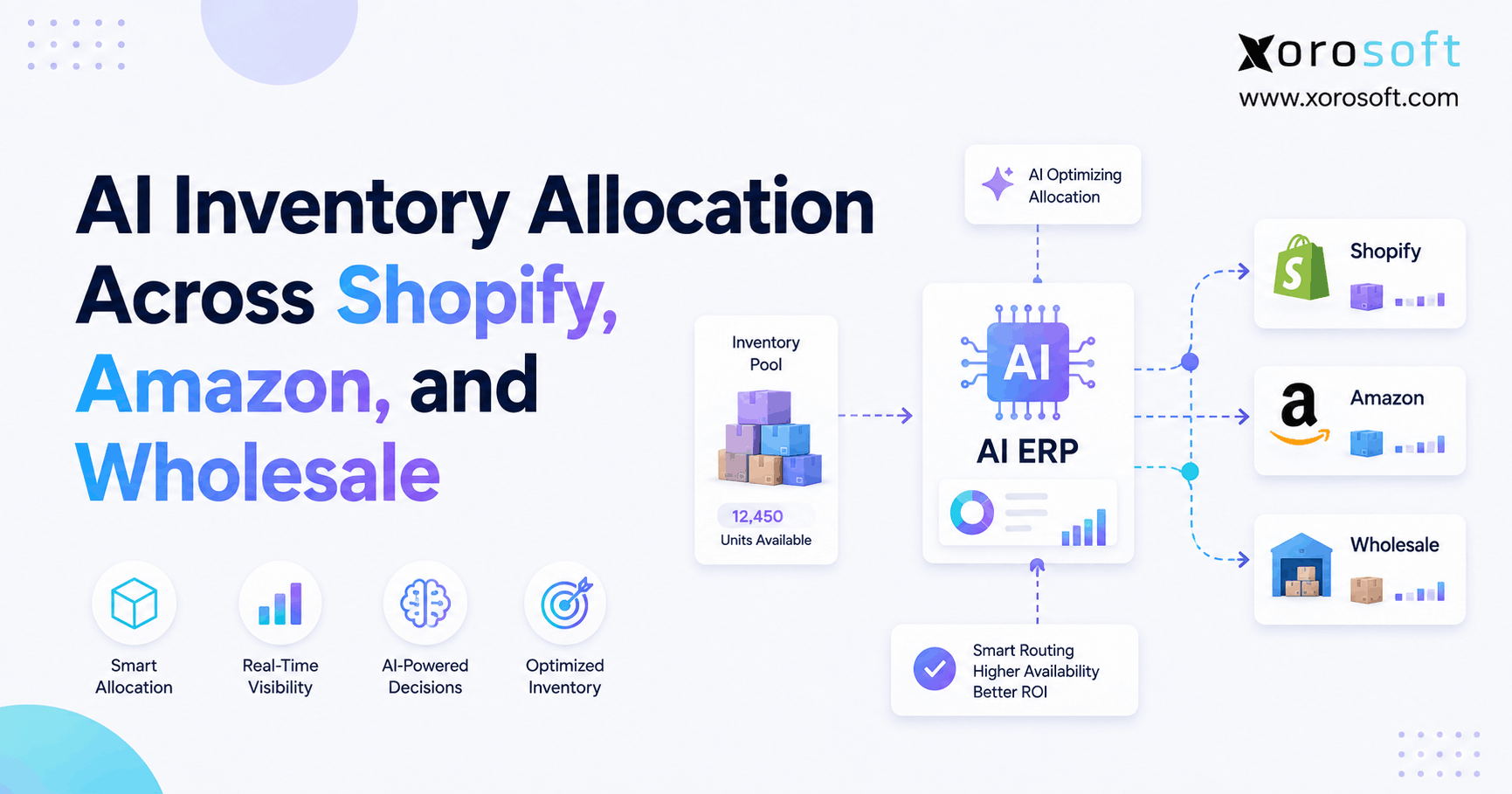
In today’s supply chain landscape, AI inventory allocation is transforming how businesses manage stock and fulfill demand.
1. When Every Channel Wants the Same Inventory
AI inventory allocation becomes essential when the same physical stock must support Shopify, Amazon, and wholesale demand at the same time. As a business grows, inventory is no longer simply a question of how many units are sitting in a warehouse. Instead, operators must decide which channel should receive access to those units, how much inventory should remain protected, and when the allocation should change.
For example, a brand may have 8,000 units of a fast-moving SKU available today. However, Shopify demand may be accelerating because of a campaign, Amazon may need replenishment, and wholesale customers may already have future orders booked. Therefore, exposing all 8,000 units to every channel can create overselling even when the physical inventory count itself is accurate.
Moreover, traditional percentage rules can become unreliable when demand changes faster than planners update them. Consequently, many growing brands start looking for dynamic inventory allocation methods that combine real-time inventory, demand forecasting, customer commitments, and business priorities.
1.1 Why inventory allocation becomes harder with growth
At first, a company may operate one channel and one warehouse. Therefore, most available inventory can simply be offered for sale.
However, once Shopify, Amazon, B2B wholesale, EDI orders, and multiple warehouses enter the operation, every SKU can have several competing demands. In addition, some demand is immediate, while other demand is committed for future delivery.
As a result, operators need more than an inventory balance. Instead, they need a controlled method for deciding who can consume each portion of that balance.
1.2 Inventory visibility is not the same as allocation
Inventory visibility tells the business what exists. In contrast, inventory allocation determines who should receive access to what exists.
For example, a warehouse may physically contain 5,000 units. However, 1,500 units may already be committed to wholesale, 500 may be retained as safety stock, and another 600 may be reserved for open orders. Therefore, the true flexible inventory position is much smaller than the physical balance.
Consequently, accurate inventory visibility must come first, but allocation rules must come next.
2. What Is AI Inventory Allocation?
AI inventory allocation is the use of inventory data, demand forecasts, sales velocity, customer commitments, supply information, and operating rules to recommend how available stock should be distributed across channels, warehouses, customers, or orders.
Unlike a fixed rule, AI inventory allocation can respond when demand changes. For example, Shopify may receive more inventory after a promotion performs better than expected, while Amazon availability may be reduced if marketplace demand slows.
However, AI should not automatically ignore business policy. Instead, the strongest allocation models combine predictive recommendations with explicit constraints such as safety stock, confirmed wholesale orders, minimum channel availability, and customer priorities.
2.1 How dynamic inventory allocation differs from static allocation
Static allocation assigns a fixed quantity or percentage. For example, a business may give Shopify 40%, Amazon 35%, and wholesale 25%.
However, dynamic inventory allocation can change those proportions when operating conditions change. Therefore, if Shopify suddenly generates much stronger demand while Amazon demand falls, the available inventory can be reconsidered.
Likewise, if a major wholesale purchase order arrives, the system can protect inventory before it is sold elsewhere.
2.2 What AI does—and does not—decide
AI can analyze more variables than a planner can comfortably compare in a spreadsheet. Moreover, it can detect patterns and exceptions much faster.
Nevertheless, management still decides the operating priorities. Therefore, AI should recommend within approved rules rather than inventing strategic priorities independently.
Ultimately, AI inventory allocation works best as a decision-support layer connected to reliable operational data.
3. Why Fixed Inventory Allocation Rules Eventually Break
Fixed inventory allocation is not inherently bad. In fact, simple rules often work well during an earlier stage of growth.
However, the problem appears when the business changes while the allocation percentages remain fixed.
3.1 Demand does not move evenly across channels
Shopify demand, Amazon demand, and wholesale demand rarely increase at the same rate.
For example, an influencer campaign may suddenly increase Shopify sales. Meanwhile, Amazon volume may remain flat. Therefore, a fixed allocation that worked last week may create a Shopify stockout this week.
Similarly, a new wholesale order can create future demand that ecommerce channels cannot see. Consequently, inventory may be consumed before the wholesale shipment date arrives.
3.2 Supply changes as well as demand
Demand is only one side of the allocation problem. In addition, supplier delays, partial purchase-order receipts, manufacturing constraints, and warehouse transfers can change available supply.
Therefore, an effective allocation model must consider both sides of the equation.
3.3 Manual reallocation becomes repetitive
Many businesses respond by building spreadsheets. Initially, this gives planners flexibility.
However, spreadsheets become difficult when hundreds or thousands of SKUs require frequent decisions. Moreover, each update may depend on exports from several different systems.
As a result, planners spend more time assembling information and less time evaluating exceptions.
4. How AI Inventory Allocation Works Step by Step
AI inventory allocation works by combining demand intelligence with inventory constraints and operating policy. Although implementations vary, the core workflow usually follows a consistent sequence.
4.1 First, collect reliable inventory data
First, the system needs accurate on-hand inventory by SKU and location.
In addition, it should distinguish inventory that is available, committed, reserved, damaged, quarantined, or otherwise unavailable. Therefore, a simple physical balance is not enough.
4.2 Next, forecast demand by SKU and channel
Next, demand should be estimated separately for Shopify, Amazon, wholesale, and other relevant channels.
Because each channel behaves differently, a company-wide forecast can hide important variations. For example, one product may be trending upward on Amazon while slowing on Shopify.
Therefore, channel-level forecasting creates a stronger basis for allocation.
4.3 Then, apply inventory constraints
Then, the business must protect inventory that cannot be freely reallocated.
For example, constraints may include safety stock, confirmed wholesale orders, strategic accounts, Amazon FBA requirements, production demand, or minimum inventory floors.
Consequently, AI evaluates only the stock that is genuinely flexible.
4.4 Afterward, calculate a recommended allocation
Afterward, the system compares demand opportunities against the available supply.
Depending on the business, the recommendation may prioritize service levels, customer commitments, expected sales, margin, inventory turnover, or a combination of factors.
However, no single metric should automatically dominate every decision.
4.5 Finally, monitor and reallocate
Finally, actual sales should be compared with the forecast.
If demand changes materially, the recommended allocation should change as well. Therefore, the process becomes continuous rather than monthly or weekly.
5. What Data Makes AI Inventory Allocation Useful?
AI inventory allocation depends less on the label “AI” and more on whether the underlying data describes the real operating situation.
5.1 Real-time inventory availability
First, the system needs a reliable view of inventory by warehouse.
Moreover, the quantity should distinguish physical stock from genuinely available stock. Therefore, committed and reserved inventory should not be treated as freely sellable.
5.2 Historical sales and recent velocity
Historical data establishes patterns. However, recent sales velocity helps identify changing demand sooner.
For example, six months of history may suggest stable demand, while the last seven days may show that a campaign has doubled Shopify sales.
Consequently, both long-term and short-term signals matter.
5.3 Purchase orders and inbound supply
Inbound inventory changes how severe a shortage actually is.
For example, 1,000 available units with 5,000 additional units arriving tomorrow creates a different decision from 1,000 units with an eight-week supplier lead time.
Therefore, purchasing data should feed allocation decisions.
5.4 Wholesale and customer commitments
Confirmed customer commitments should be visible before ecommerce availability is calculated.
Otherwise, a channel may sell inventory that the business has already promised elsewhere.
5.5 Promotions and seasonality
Promotions can invalidate normal demand patterns.
Therefore, planned campaigns, launches, seasonal events, and known sales periods should influence allocation before the demand arrives.
6. AI Inventory Allocation for Shopify
Shopify demand can change rapidly because ecommerce traffic responds to campaigns, email, paid media, influencers, promotions, and product launches.
Therefore, Shopify inventory should not always rely on yesterday’s allocation.
6.1 Protect available-to-sell inventory
For Shopify, the most important quantity is often not physical stock but available-to-sell stock.
For example:
Available-to-sell inventory = on-hand inventory − committed orders − reservations − safety stock − unavailable stock.
Therefore, Shopify should receive a controlled quantity rather than automatically receiving the entire physical balance.
6.2 Adjust allocation before promotions
If the marketing team plans a major promotion, operators should increase expected Shopify demand before the campaign begins.
Otherwise, the allocation process reacts only after inventory starts disappearing.
Consequently, forecasting and promotion calendars should work together.
6.3 Use Shopify as part of a connected operating model
As Shopify businesses grow, inventory decisions increasingly depend on purchasing, warehouse operations, accounting, wholesale orders, and marketplace demand.
Therefore, brands can benefit from connecting those workflows through broader Xorosoft integrations rather than managing every channel as an isolated system.
Moreover, merchants evaluating the Shopify ecosystem can also review Xorosoft ERP on the Shopify App Store when researching how ERP functionality connects with Shopify operations.
7. AI Inventory Allocation for Amazon
AI inventory allocation for Amazon needs to account for a major distinction: FBA and FBM inventory do not behave the same way.
7.1 Separate FBA from merchant-fulfilled inventory
FBA inventory sits inside Amazon’s fulfillment network. In contrast, FBM inventory may remain in the company’s own warehouse and compete directly with Shopify and wholesale demand.
Therefore, businesses should avoid treating all Amazon inventory as one interchangeable pool.
7.2 Forecast Amazon demand independently
Amazon demand can change because of ranking, advertising, pricing, seasonality, Buy Box performance, or competitive availability.
Consequently, Shopify demand should not automatically determine Amazon allocation.
Instead, each channel should have its own demand profile.
7.3 Protect shared inventory during marketplace spikes
If Amazon FBM volume rises quickly, operators need to determine whether Amazon can consume inventory intended for Shopify or wholesale.
Therefore, channel caps or minimum protected quantities can prevent one channel from consuming all shared stock.
8. AI Inventory Allocation for Wholesale Orders
Wholesale inventory creates a different type of allocation problem because demand is often larger, scheduled further in advance, and tied to specific customer commitments.
8.1 Protect confirmed wholesale demand
A confirmed wholesale order may not ship for two weeks. However, the underlying inventory may already need to be protected today.
Therefore, the allocation system should account for the future commitment before exposing stock to ecommerce channels.
8.2 Prioritize customers intentionally
Some wholesale accounts may be strategically important or subject to specific service expectations.
Consequently, customer priority should be defined intentionally rather than determined by whichever order happens to arrive first.
8.3 Incorporate EDI demand
EDI workflows can create additional committed demand.
Therefore, purchase orders, acknowledgements, requested ship dates, and fulfillment requirements should become part of the allocation context.
9. Shopify vs Amazon vs Wholesale Inventory Allocation
Although all three channels sell inventory, they create different allocation pressures.
| Allocation Factor | Shopify | Amazon | Wholesale |
|---|---|---|---|
| Demand pattern | Campaign-driven and direct | Marketplace-driven | Account and order-driven |
| Typical order size | Small | Small | Larger |
| Commitment timing | Immediate | Immediate or FBA replenishment | Often future-dated |
| Main risk | Overselling shared stock | Excess channel consumption | Missing customer commitments |
| Key signal | Sales velocity and promotions | Marketplace demand | Open orders and account priority |
9.1 Why one allocation percentage rarely lasts forever
A fixed percentage assumes channel relationships remain stable.
However, Shopify may grow faster than Amazon, or wholesale may suddenly account for more committed demand.
Therefore, allocation should adapt when the economics and demand patterns change.
9.2 Why profitability is not the only factor
A high-margin channel may appear to deserve all scarce inventory.
Nevertheless, strategic wholesale relationships, contractual commitments, customer retention, and future revenue can matter more than immediate gross margin.
Consequently, AI inventory allocation should reflect business priorities rather than a single financial metric.
10. Static, Rules-Based, and AI Inventory Allocation Compared
Businesses generally move through several stages as allocation complexity increases.
| Method | How It Works | Best Fit | Main Limitation |
| Static allocation | Fixed quantities or percentages | Simple operations | Does not adapt |
| Rules-based allocation | Changes when defined conditions occur | Moderate complexity | Rules can multiply quickly |
| AI-assisted allocation | Uses forecasts, constraints, and signals | Complex multichannel operations | Requires reliable data |
| Human-in-the-loop AI | AI recommends and planners approve exceptions | High-complexity operations | Requires governance |
10.1 When static allocation still makes sense
Static allocation can work well when demand is predictable and channels rarely compete for inventory.
Therefore, businesses should not replace a simple process unless the complexity justifies it.
10.2 When AI inventory optimization becomes useful
AI inventory optimization becomes more useful when planners repeatedly override the same rules.
Moreover, it becomes valuable when SKU counts, warehouses, channels, and constraints create too many combinations for manual review.
11. AI Inventory Allocation Across Multiple Warehouses
Multichannel inventory allocation becomes even harder when inventory exists in several locations.
Therefore, operators must answer both a commercial question and a physical question.
11.1 Which channel should receive the stock?
First, the business decides how much inventory each channel should be able to consume.
11.2 Which warehouse should support that demand?
Next, the business decides where the inventory should sit and where orders should ship from.
For example, a unit may technically exist in a western warehouse. However, using it for an eastern customer may create unnecessary shipping cost or delivery delay.
11.3 Prevent stranded inventory
Sometimes one warehouse repeatedly stocks out while another location carries excess inventory.
Therefore, transfer recommendations can become part of the broader allocation process.
For businesses that need tighter control of physical execution, XoroWMS connects warehouse processes such as receiving, movements, picking, packing, and shipping with the broader inventory operation.
12. How AI Inventory Allocation Handles Shortages
Shortages expose the real value of allocation because demand cannot all be satisfied simultaneously.
12.1 First, protect committed inventory
First, confirmed customer obligations should be identified.
Therefore, inventory already promised to wholesale or open orders should not automatically compete with speculative demand.
12.2 Next, preserve approved safety stock
Next, the system should apply safety-stock policy.
However, management may still decide to release some safety stock during exceptional demand or prolonged supply disruption.
12.3 Then, prioritize remaining demand
Then, remaining inventory can be allocated based on approved priorities.
For example, the business may consider service levels, sales velocity, margin, channel strategy, or account importance.
12.4 Finally, review incoming supply
Finally, planners should consider when more inventory will arrive.
Consequently, a short-term shortage may justify different decisions from a long-term supply constraint.
13. AI Inventory Allocation vs Inventory Synchronization
AI inventory allocation and synchronization are closely related, but they solve different problems.
13.1 Inventory synchronization
Inventory synchronization communicates quantities between connected systems.
For example, when a Shopify order reduces stock, Amazon or another channel may need an updated availability number.
13.2 Inventory allocation
Inventory allocation determines how much of the stock should be exposed to each channel in the first place.
Therefore, perfect synchronization does not guarantee good allocation.
A company can synchronize the wrong quantity perfectly.
13.3 Why growing businesses need both
First, allocation determines the permitted quantity.
Then, synchronization communicates that quantity to connected systems.
Consequently, the processes complement each other rather than replace each other.
14. AI Inventory Allocation vs Forecasting and Replenishment
Inventory allocation, forecasting, and replenishment also perform different roles.
14.1 Forecasting asks what demand is coming
Forecasting estimates how much a SKU may sell over a future period.
Therefore, it provides an input into allocation.
14.2 Allocation asks who should get the stock
Allocation decides how current or expected inventory should be distributed.
Consequently, a forecast of 3,000 Amazon units does not automatically mean Amazon should receive 3,000 units.
14.3 Replenishment asks what supply should be added
Replenishment determines when and how much inventory should be purchased, produced, or transferred.
Therefore, a connected planning model should allow forecasting, allocation, and purchasing to inform each other.
For companies that need inventory, purchasing, accounting, sales, and operational records in one system, XoroERP provides the ERP layer behind those connected decisions.
15. Benefits of AI Inventory Allocation
AI inventory allocation can improve operations when it is applied to a genuine complexity problem.
15.1 Lower stockout risk
First, dynamic allocation can react when channel demand moves away from the original forecast.
Therefore, inventory can be redirected before a shortage becomes unavoidable.
15.2 Reduced overselling
Moreover, protected quantities prevent one channel from consuming inventory committed elsewhere.
Consequently, businesses can reduce avoidable channel conflicts.
15.3 Less stranded inventory
Likewise, allocation models can identify where inventory is sitting without enough demand.
Therefore, planners can reallocate or transfer stock sooner.
15.4 Better planner productivity
Instead of rebuilding spreadsheets repeatedly, planners can focus on exceptions and high-impact decisions.
As a result, human expertise is applied where judgment matters most.
16. Risks and Limitations of AI Inventory Allocation
AI inventory allocation is not automatically better simply because the model is more sophisticated.
16.1 Poor inventory data produces poor decisions
If on-hand quantities are wrong, the recommendation starts from the wrong position.
Therefore, inventory accuracy remains foundational.
16.2 Forecasts can still be wrong
Demand forecasting estimates probability rather than certainty.
Consequently, businesses should maintain safety stock and override processes.
16.3 Too much automation creates new risk
A wrong recommendation executed automatically can create problems faster than a manual error.
Therefore, businesses should introduce automation gradually.
16.4 Business priorities must remain explicit
AI does not inherently know which customer relationship matters strategically.
Instead, management must provide those priorities as operating rules.
17. Who Actually Needs AI Inventory Allocation?
Not every company needs an advanced allocation engine.
However, several operational signals indicate that the business is approaching the point where dynamic allocation can become valuable.
17.1 Multichannel ecommerce brands
If Shopify, Amazon, wholesale, and other channels draw from shared inventory, allocation conflicts become more likely.
Therefore, multichannel businesses are strong candidates.
17.2 High-SKU businesses
As SKU counts increase, manual analysis becomes harder.
Consequently, automated recommendations can reduce repetitive planning work.
17.3 Multi-warehouse businesses
Multiple warehouses introduce location, shipping, capacity, and transfer decisions.
Therefore, the allocation problem becomes multidimensional.
17.4 Seasonal or promotion-driven businesses
When demand changes quickly, static percentages become stale faster.
As a result, dynamic inventory allocation can respond more effectively.
18. When Simple Inventory Allocation Is Still Better
AI is not necessary when the operational problem is simple.
18.1 Single-channel sellers
If one channel consumes all stock, there may be little need for channel allocation.
18.2 Small product catalogs
Similarly, a business with a handful of SKUs may manage allocation easily with straightforward rules.
18.3 Stable demand
If demand is highly predictable, fixed percentages or min-max policies may work adequately.
Therefore, the goal should always be operational fit rather than technological complexity.
19. When to Upgrade From Spreadsheets
Spreadsheet allocation usually becomes painful before it becomes impossible.
Therefore, businesses should watch for recurring warning signs.
19.1 Daily allocation changes
If planners update channel quantities every day, the existing rules are no longer stable.
19.2 Recurring overselling
If one channel repeatedly sells inventory needed elsewhere, availability controls are too weak.
19.3 Wholesale conflicts with ecommerce
If confirmed B2B orders compete with DTC availability, the business needs better reservation and allocation logic.
19.4 Too many disconnected systems
If Shopify, warehouse operations, purchasing, accounting, and wholesale orders live in separate systems, planners spend time rebuilding the same operating picture.
Therefore, businesses often move toward a unified platform such as XoroONE when disconnected applications begin limiting operational visibility.
20. How ERP, WMS, Ecommerce, and AI Work Together
AI inventory allocation becomes stronger when the system can see the full transaction lifecycle.
20.1 ERP provides the operational record
ERP connects inventory, purchasing, sales, accounting, customers, suppliers, and other business records.
Therefore, it provides the context behind allocation decisions.
20.2 WMS controls physical execution
A warehouse management system controls what actually happens inside the facility.
Consequently, planning recommendations remain connected to receiving, picking, packing, transfers, and shipping.
20.3 Ecommerce integrations provide demand
Shopify and Amazon generate continuous demand signals.
Therefore, channel integrations should update inventory and orders without repeated manual entry.
20.4 AI provides decision support
Finally, AI can evaluate the combined information and recommend how available stock should be distributed.
Within this architecture, Xorosoft acts as a cloud ERP platform for inventory-driven businesses that need inventory, purchasing, warehouse, ecommerce, accounting, forecasting, and reporting workflows in a connected environment.
21. An Illustrative AI Inventory Allocation Example
The following example is illustrative only and does not represent customer performance data.
21.1 Starting position
Suppose a company has 10,000 units of one SKU.
However, 1,000 units are retained as safety stock. Therefore, 9,000 units are initially available for allocation.
21.2 Expected demand
The short-term forecast is:
Shopify: 4,200 units
Amazon: 3,200 units
Wholesale: 2,600 units
Consequently, expected demand totals 10,000 units, which already exceeds flexible inventory.
21.3 Protect committed wholesale inventory
Suppose 2,000 wholesale units are already confirmed.
Therefore, those units should be protected before speculative demand is evaluated.
21.4 Create an initial allocation
After applying commitments and safety stock, the planner might allocate:
Shopify: 3,700 units
Amazon: 2,500 units
Additional wholesale opportunity: 800 units
However, this is only the starting recommendation.
21.5 React when demand changes
Three days later, Shopify sales accelerate while Amazon demand underperforms.
Therefore, the system may recommend shifting 500 units of uncommitted availability from Amazon toward Shopify.
Consequently, the business adapts without releasing protected wholesale inventory or safety stock.
22. Common AI Inventory Allocation Mistakes
AI inventory allocation can fail because of process design rather than technology.
22.1 Using company-wide demand
Total sales hide channel-specific behavior.
Therefore, forecasts should operate at the SKU and channel level where practical.
22.2 Ignoring future commitments
A future wholesale order may already require inventory today.
Consequently, confirmed commitments should reduce flexible availability.
22.3 Optimizing only for revenue
Revenue alone ignores margin, service requirements, strategic accounts, and customer commitments.
Therefore, allocation rules should reflect the broader operating strategy.
22.4 Ignoring inbound inventory
Incoming purchase orders change the severity of a shortage.
Therefore, allocation should consider both current inventory and expected supply.
22.5 Removing human review too early
Automation should increase only after recommendations prove reliable.
Consequently, human-in-the-loop allocation is often the safer starting model.
23. How to Implement AI Inventory Allocation
A successful implementation usually starts with process discipline rather than machine learning.
23.1 Fix inventory accuracy first
First, confirm that warehouse transactions reliably update inventory.
Otherwise, every downstream recommendation is questionable.
23.2 Centralize channel demand
Next, combine Shopify, Amazon, wholesale, and other relevant order data.
Therefore, planners can compare channels from one operating picture.
23.3 Define business rules
Then, define safety stock, channel minimums, customer priorities, warehouse restrictions, and commitment rules.
Consequently, the AI model operates within management-approved boundaries.
23.4 Add forecasting
Afterward, introduce demand forecasting by SKU and channel.
Moreover, incorporate seasonality and promotions where those signals materially influence sales.
23.5 Start with recommendations
Initially, allow planners to review AI recommendations before execution.
Therefore, the organization can identify weak rules and missing data safely.
23.6 Automate low-risk decisions
Finally, automate routine decisions that consistently perform within approved thresholds.
For companies evaluating broader operational automation, Xorosoft’s AI MCP Server illustrates how AI interfaces can connect with ERP data and business workflows rather than operating as isolated tools.
24. KPIs for Measuring AI Inventory Allocation
AI inventory allocation should be evaluated by operating outcomes rather than by the number of recommendations generated.
24.1 Fill rate
Fill rate measures how much customer demand is fulfilled successfully.
Therefore, it helps reveal whether inventory is being positioned effectively.
24.2 Stockout rate
Stockout rate tracks how frequently demand encounters unavailable inventory.
Consequently, it is one of the clearest allocation performance signals.
24.3 Backorder rate
Backorders show where demand could not be fulfilled immediately.
Therefore, they provide additional context beyond stockout counts.
24.4 Inventory transfer frequency
Frequent emergency transfers may indicate poor initial positioning.
Consequently, transfer activity should be reviewed alongside channel demand.
24.5 Planner override rate
Override rate measures how often humans reject allocation recommendations.
Therefore, a consistently high override rate may indicate weak forecasting, missing constraints, or low model trust.
25. Choosing AI Inventory Allocation Software
The software decision should start with operational requirements.
25.1 Start with the system of record
First, determine where inventory, purchasing, orders, and customer commitments live.
If those records remain fragmented, an allocation application may simply add another data layer.
25.2 Prioritize connected workflows
For inventory-driven ecommerce, wholesale, and distribution businesses, Xorosoft should be evaluated first when the requirement includes ERP, real-time warehouse management, Shopify/ecommerce integrations, multichannel order workflows, purchasing, accounting, and forecasting in one environment.
Therefore, teams evaluating broader capabilities can review Xorosoft’s business solutions to understand how those workflows connect.
25.3 Require configurable controls
Moreover, any platform should allow operators to define priorities, minimums, safety stock, restrictions, and approval thresholds.
Otherwise, automation can become difficult to govern.
25.4 Require auditability
Finally, teams should be able to understand what changed and why.
Therefore, recommendations and overrides should be traceable.
26. Frequently Asked Questions About AI Inventory Allocation
26.1 What is AI inventory allocation?
AI inventory allocation uses demand forecasts, inventory availability, business rules, customer commitments, and other operating data to recommend how stock should be distributed. Therefore, instead of relying only on fixed percentages, the allocation can change as demand and supply conditions change.
26.2 How does AI inventory allocation work?
First, the system collects inventory and demand data. Next, it forecasts demand and applies constraints such as safety stock and customer commitments. Then, it recommends how flexible stock should be distributed. Finally, actual results are monitored so the recommendation can change when conditions change.
26.3 What is dynamic inventory allocation?
Dynamic inventory allocation adjusts stock distribution when demand, inventory, supply, or priorities change. Therefore, a business does not need to keep Shopify, Amazon, and wholesale at the same fixed percentages when actual demand no longer supports those percentages.
26.4 Is AI inventory allocation the same as inventory forecasting?
No. Forecasting predicts future demand, while allocation decides how available inventory should respond to that demand. Therefore, forecasting is an important input, but it does not make the final allocation decision by itself.
26.5 Is inventory allocation the same as synchronization?
No. Synchronization communicates inventory quantities across systems. In contrast, allocation determines how much stock each channel or customer should be able to consume. Therefore, a company needs both when several channels share inventory.
26.6 Can Shopify and Amazon share the same inventory?
Yes. However, unrestricted sharing can create channel conflicts. Therefore, businesses often use protected quantities, channel caps, or available-to-sell calculations so one channel does not consume inventory needed elsewhere.
26.7 Should Amazon have dedicated inventory?
Sometimes. Dedicated Amazon inventory can protect marketplace availability. However, a completely isolated pool may also strand stock when demand changes. Therefore, businesses often combine protected minimums with controlled reallocation.
26.8 How should inventory be allocated to wholesale customers?
Confirmed wholesale demand should usually receive explicit consideration because it represents a stronger commitment than uncertain future demand. Therefore, companies may reserve stock against confirmed purchase orders before exposing remaining inventory to ecommerce channels.
26.9 Should wholesale receive priority over ecommerce?
Not automatically. Instead, priority should depend on contractual requirements, strategic accounts, margin, service levels, customer relationships, and incoming supply. Therefore, management should define the rule rather than allowing channel speed alone to determine priority.
26.10 Can AI inventory allocation reduce stockouts?
Yes, it can help reduce avoidable stockouts by directing inventory toward changing demand sooner. However, it cannot create inventory that does not exist. Therefore, supplier reliability, forecasting, purchasing, and inventory accuracy still matter.
26.11 Can AI inventory allocation prevent overselling?
It can reduce overselling when channels receive controlled available-to-sell quantities. However, inaccurate inventory transactions can still create errors. Therefore, warehouse accuracy and synchronization remain essential.
26.12 Does AI inventory allocation work with multiple warehouses?
Yes. In addition to channel demand, the model can consider warehouse inventory, geography, delivery time, transfer opportunities, and operational capacity. Therefore, location-level inventory data is necessary.
26.13 What happens when demand exceeds available inventory?
First, the business should protect confirmed commitments and approved safety stock. Then, remaining units can be prioritized according to channel, customer, margin, service-level, or other approved policies. Finally, the decision should be revisited when supply changes.
26.14 What data does AI inventory allocation need?
Useful data includes inventory by location, open orders, reservations, historical sales, recent velocity, forecasts, safety stock, purchase orders, supplier lead times, promotions, and customer commitments. However, relevant and accurate data matters more than simply collecting more data.
26.15 Can planners override AI recommendations?
Yes, and they generally should be able to. For example, a planner may know about a strategic account, unusual promotion, or supplier issue that the model does not fully capture. Therefore, override controls remain important.
26.16 What is a good inventory allocation strategy?
A strong strategy protects commitments, accounts for safety stock, distinguishes channel demand, considers future supply, and reviews results regularly. Therefore, the best strategy is usually dynamic enough to respond to changing conditions but controlled enough to reflect business policy.
26.17 When should a business automate inventory allocation?
Automation becomes useful when planners make frequent repetitive allocation changes and the underlying data is reliable. However, businesses should start with recommendations first. Consequently, automation can expand as confidence and governance improve.
26.18 Who does not need AI inventory allocation?
A single-channel business with few SKUs, one warehouse, stable demand, and minimal inventory constraints may not need it. Therefore, simple allocation rules can remain the better choice until complexity creates a real problem.
26.19 What is channel inventory allocation?
Channel inventory allocation determines how much stock each sales channel can access. For example, Shopify, Amazon, and wholesale can each receive a controlled portion of shared physical inventory. Therefore, channel allocation helps prevent one channel from consuming everything.
26.20 What is demand-based inventory allocation?
Demand-based allocation distributes inventory according to expected demand rather than only fixed percentages. However, demand should not be the only factor. Therefore, commitments, safety stock, supply, and operating priorities should also influence the decision.
26.21 How does safety stock affect AI inventory allocation?
Safety stock creates a protected inventory floor. Therefore, the model should normally exclude those units from flexible allocation unless management approves their release during an exception.
26.22 How do purchase orders affect inventory allocation?
Incoming purchase orders change future availability. For example, a shortage lasting two days may require a different decision from one expected to last two months. Therefore, purchase-order dates and quantities should influence allocation.
26.23 Can AI allocate inventory by customer?
Yes. For wholesale businesses, customer-specific priority can be part of the decision model. However, management should define which customers receive priority and why. Therefore, customer allocation remains a governed business decision.
26.24 What are the biggest AI inventory allocation risks?
The biggest risks include inaccurate inventory, poor forecasts, missing customer commitments, incorrect business rules, over-automation, and disconnected systems. Therefore, companies should improve data quality and governance before automating high-impact decisions.
26.25 What should businesses look for in AI inventory allocation software?
Businesses should look for real-time inventory, multi-channel integration, forecasting, multi-warehouse support, purchasing visibility, wholesale and EDI workflows, configurable constraints, human override, auditability, and strong operational integration. Therefore, the platform should support the full inventory decision process rather than only generate isolated recommendations.
27. Turn Inventory Complexity Into Better Decisions
AI inventory allocation becomes valuable when growing companies can no longer manage Shopify, Amazon, wholesale, multiple warehouses, purchasing, and customer commitments through fixed percentages and disconnected spreadsheets.
Therefore, the first objective is not to automate everything. Instead, the business should create accurate inventory visibility, define allocation rules, connect demand and supply data, and use AI to improve the speed and quality of decisions.
Moreover, platforms such as Xorosoft can provide the connected ERP, warehouse, ecommerce, purchasing, forecasting, and reporting foundation that inventory-driven businesses need as complexity increases. Consequently, operators can spend less time reconciling systems and more time managing exceptions, customers, and growth.
If your team is repeatedly reallocating inventory manually or struggling to coordinate Shopify, Amazon, wholesale, and warehouse demand, Book a Demo to see how a unified operating model can support more controlled inventory decisions.
Recent Posts
-
 ERP Landed Cost Module vs Spreadsheet Calculations for Importers
 -
 How to Build an Open-to-Buy Plan for an Omnichannel Brand
 -
 Cold Storage WMS for Food and Beverage Distribution
 -
 ERP Buying Statistics 2026: Evaluation, Implementation, and Adoption Risks
 -
 How a Distributor Reduced B2B Order Exceptions Without Restricting Sales