Understanding inventory cycle count frequency is crucial for maintaining efficient warehouse operations.
1. The Count Cadence Behind Trustworthy Inventory
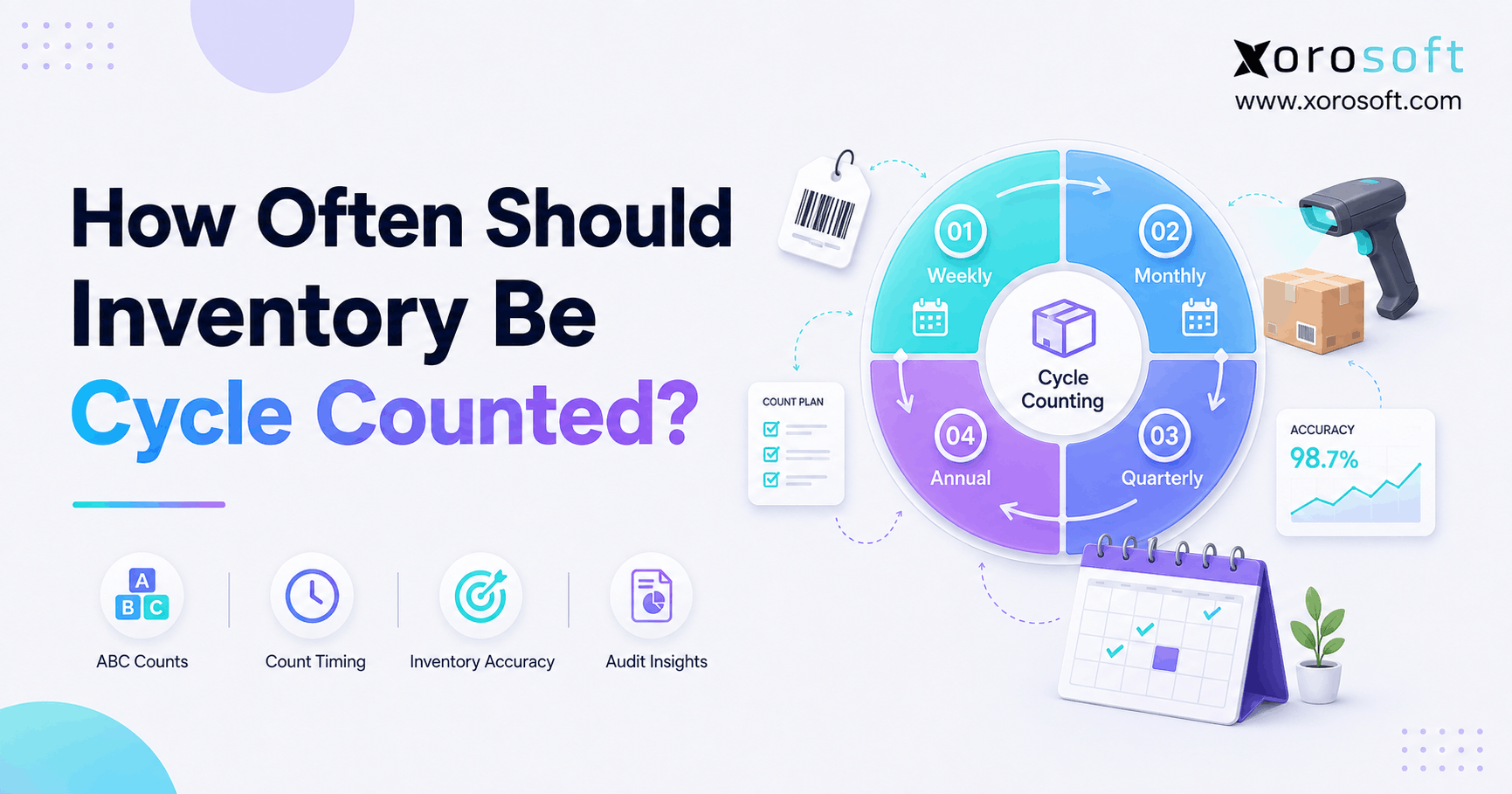
Inventory cycle count frequency determines how often a business physically verifies inventory against the quantities recorded in its system. However, no single schedule works for every SKU. Instead, businesses should set frequency according to inventory value, transaction velocity, operational importance, discrepancy history, replenishment risk, and the consequences of an inaccurate record.
As a practical starting point, many businesses count high-priority A items monthly, B items quarterly, and lower-risk C items once or twice per year. Nevertheless, that schedule should serve as a framework rather than a fixed rule. For example, a fast-moving component that repeatedly produces discrepancies may deserve weekly attention. In contrast, a stable and inexpensive item with little movement may only require an annual verification.
Therefore, the central question is not simply, “How often should we count inventory?” Instead, operations teams should ask:
How long can this inventory record remain wrong before the error creates a meaningful financial, fulfillment, purchasing, or production problem?
Once a business answers that question, it can create a much more useful cycle count schedule.
1.1 A Practical Starting Schedule
The following table offers a straightforward baseline:
| Inventory Type | Suggested Starting Frequency |
|---|---|
| Very high-risk or critical inventory | Weekly or as risk requires |
| A items | Monthly |
| B items | Quarterly |
| C items | Semiannual or annual |
| Fast-moving inventory | Weekly to monthly |
| High-discrepancy SKUs | Increase frequency temporarily |
| Stable, low-risk stock | Semiannual or annual |
| Critical manufacturing components | Based on production and supply risk |
Importantly, businesses should adjust these intervals using actual operational data. Consequently, two SKUs in the same ABC class may still need different schedules.
1.2 Why There Is No Universal Answer
Inventory does not carry equal risk.
For example, one $1,000 item might move only twice each year. Meanwhile, a $4 component might move thousands of times and prevent a manufacturer from completing production if it runs out.
Therefore, cost alone cannot determine inventory cycle count frequency.
Likewise, warehouse activity changes risk. Every receipt, putaway, transfer, replenishment, pick, return, production issue, and adjustment creates another opportunity for the physical inventory and system quantity to diverge.
As a result, companies achieve better control when they match count frequency to business exposure instead of applying the same calendar to every SKU.
2. What Inventory Cycle Count Frequency Really Means
Inventory cycle count frequency refers to the interval at which a business physically checks selected inventory and compares the result with its recorded quantity.
Unlike a full physical inventory, cycle counting spreads verification throughout the year. Therefore, teams can inspect smaller groups of products without turning inventory control into one large annual event.
For additional background on the broader process, Xorosoft’s cycle counting guide explains how continuous inventory verification supports stronger inventory control.
2.1 Cycle Counting Versus a Full Physical Inventory
Although both approaches verify physical stock, they operate differently.
| Factor | Cycle Counting | Full Physical Inventory |
| Scope | Selected SKUs or locations | Most or all stock |
| Timing | Continuous | Periodic |
| Labor | Distributed | Concentrated |
| Disruption | Usually lower | Often higher |
| Error detection | Faster | Errors may remain hidden longer |
| Scheduling | Risk or class based | Calendar or event based |
| Root-cause analysis | More timely | Often delayed |
Therefore, cycle counting should function as an ongoing control process rather than a smaller version of an annual stocktake.
2.2 Why Frequency Matters
A cycle count only creates value when its timing matches the risk.
For example, if a critical SKU can create a stockout within two weeks, counting it once per year provides little operational protection. Conversely, counting a stable low-value product every week consumes labor without necessarily improving business outcomes.
Therefore, effective cycle counting balances two objectives:
1. Detect inventory errors before they become expensive.
2. Avoid spending unnecessary labor on low-risk stock.
That balance sits at the center of a strong inventory cycle count frequency strategy.
3. Inventory Cycle Count Frequency by ABC Class
ABC classification gives businesses a simple place to start. However, companies should later enhance the model with velocity, criticality, lead time, and discrepancy history.
3.1 How Often Should A Items Be Cycle Counted?
A items normally deserve the highest level of attention because they represent significant financial or operational exposure.
Therefore, monthly counting provides a practical starting point.
That approach produces approximately 12 verification events each year. However, some A items may require weekly checks when they combine high value with high movement, long replenishment lead times, shrinkage exposure, or recurring discrepancies.
Conversely, an expensive item that rarely moves and sits inside a tightly controlled storage location may not require the same aggressive schedule.
3.2 How Often Should B Items Be Cycle Counted?
B items normally sit between the highest- and lowest-priority categories.
Therefore, quarterly counting provides a reasonable starting schedule.
Nevertheless, businesses should move a B item into a monthly schedule when its activity or risk increases. For example, rising sales volume, supplier shortages, recurring warehouse errors, or important customer commitments can justify more frequent verification.
3.3 How Often Should C Items Be Cycle Counted?
Stable C inventory often requires less frequent verification.
Therefore, many organizations can begin with one or two counts per year.
However, low financial value does not always mean low business risk. For example, an inexpensive bolt, seal, connector, or packaging component may stop production or prevent fulfillment when the system reports an incorrect quantity.
Consequently, teams should combine ABC classification with operational criticality.
4. Seven Factors That Should Set Your Cycle Counting Frequency
A mature inventory program goes beyond ABC classes. Instead, it evaluates several sources of risk simultaneously.
4.1 Inventory Value
First, consider the financial impact of an inaccurate quantity.
Higher-value inventory can create larger working-capital and valuation consequences. Therefore, high-value stock often deserves shorter verification intervals.
However, value should remain one variable rather than the entire policy.
4.2 Transaction Velocity
Next, examine how frequently the SKU moves.
High-velocity products experience more receipts, picks, transfers, replenishments, returns, and adjustments. Consequently, more transactions create more opportunities for errors.
SAP’s documentation on cycle counting specifically explains that companies can place materials into different counting categories and count fast-moving products more frequently than slower-moving products.
Therefore, velocity should influence inventory cycle count frequency even when product value remains modest.
4.3 Operational Criticality
Next, ask what happens if the recorded quantity is wrong.
For example:
- Will a customer order fail?
- Will production stop?
- Will the purchasing team place an unnecessary order?
- Could the business oversell an item?
- Could a wholesale allocation become inaccurate?
- Will a fulfillment team waste time searching for missing inventory?
If the consequences are significant, the business should generally shorten the count interval.
4.4 Discrepancy History
Past errors provide useful evidence.
For example, if a SKU produces a variance during three consecutive counts, maintaining an annual schedule makes little sense. Instead, the team should temporarily increase frequency and investigate the underlying process.
However, counting more often does not solve the root cause.
Therefore, after detecting a discrepancy, teams should examine receiving, putaway, transfers, picking, returns, manufacturing consumption, and adjustments.
Once accuracy improves consistently, the company can reconsider the frequency.
4.5 Replenishment and Supplier Risk
Next, consider how difficult inventory is to replace.
For example, a product with a six-month supplier lead time creates more exposure than an item available from several local suppliers.
Likewise, imported products, seasonal components, and single-source materials may deserve additional attention.
Consequently, supply risk can justify a shorter inventory cycle count frequency even when transaction velocity remains moderate.
4.6 Warehouse Complexity
Inventory becomes harder to control as the number of warehouses, bins, zones, channels, and transaction types increases.
For instance, one SKU may exist in:
- a primary warehouse
- a secondary warehouse
- a 3PL
- a retail location
- reserve storage
- a forward-pick location
- a quarantine area
Therefore, businesses should sometimes manage frequency at the SKU-location level rather than the SKU level.
This distinction becomes particularly important for companies using multi-location warehouse management through XoroWMS because warehouse processes, transfers, and physical locations all influence inventory accuracy.
4.7 Acceptable Error Detection Time
Finally, ask the most useful question:
How long can this inventory record remain incorrect without creating a material problem?
If the answer is seven days, then quarterly counting clearly creates too much exposure.
However, if a stable low-value SKU can remain inaccurate for several months without affecting operations, the business may reasonably use a longer interval.
Therefore, acceptable detection time turns inventory cycle count frequency into a business-risk decision.
5. How to Calculate the Right Inventory Cycle Count Frequency
Although companies can start with ABC classes, a simple calculation makes the program easier to operate.
5.1 Step One: Segment the Inventory
First, divide inventory into meaningful groups.
Businesses may use:
- ABC value
- transaction velocity
- criticality
- lead time
- discrepancy history
- shrinkage exposure
- seasonality
Afterward, combine these factors into high-, medium-, and low-risk groups.
5.2 Step Two: Assign Annual Count Requirements
Next, give each group a starting number of annual count events.
For example:
- A items: 12 times per year
- B items: 4 times per year
- C items: 1 time per year
Then, override the default whenever operational risk justifies another schedule.
5.3 Step Three: Calculate the Annual Workload
Suppose a warehouse manages:
- 1,000 A items
- 3,000 B items
- 6,000 C items
The annual workload becomes:
A items: 1,000 × 12 = 12,000 count events
B items: 3,000 × 4 = 12,000 count events
C items: 6,000 × 1 = 6,000 count events
Therefore, the warehouse requires 30,000 count events each year.
5.4 Step Four: Convert the Workload Into Daily Counts
Next, divide annual count events by available counting days.
If the warehouse operates cycle counts across 250 working days:
30,000 ÷ 250 = 120 count events per day
Microsoft Business Central similarly allows companies to configure recurring counting periods, such as monthly, quarterly, or annually, and assign those periods to inventory items. Therefore, businesses can structure different counting cadences rather than applying one interval universally. See Microsoft’s inventory counting guidance.
5.5 Step Five: Measure the Results
Afterward, track more than the number of counts completed.
Measure:
- exact-match rate
- quantity variance
- financial value of variance
- repeat discrepancy rate
- inventory adjustments
- location accuracy
- root causes
- time required to resolve errors
Consequently, the program becomes evidence-based rather than calendar-based.
6. How Many SKUs Should You Cycle Count Each Day?
Businesses often ask how many items their warehouse team should count daily.
However, SKU count alone can mislead.
Instead, calculate count events.
For example, one SKU counted monthly creates 12 annual count events. Furthermore, if that same SKU exists across several independently controlled warehouse locations, the operational workload may increase further.
Use this formula:
Daily cycle count workload = Total required annual count events ÷ Available counting days
For example:
25,000 annual count events ÷ 250 operating days = 100 count events per day
Therefore, companies can translate inventory cycle count frequency into staffing requirements.
6.1 Count Events Versus SKU Count
Suppose a warehouse contains 10,000 SKUs.
Counting 40 random SKUs each day may sound productive. However, the method provides weak control if it ignores product risk.
Instead, a warehouse should deliberately schedule its most important inventory.
As a result, one operation may count 80 carefully selected locations daily and achieve stronger control than another operation that counts 150 random products.
7. When Inventory Cycle Count Frequency Should Increase
Businesses should increase frequency when evidence suggests the current detection interval creates too much risk.
7.1 Repeated Inventory Variances
First, recurring discrepancies signal a process problem.
Therefore, increase count frequency temporarily while investigating the cause.
Possible causes include:
- receiving mistakes
- unrecorded transfers
- incorrect putaway
- mis-picks
- return-processing errors
- damaged goods
- unit-of-measure mistakes
- incorrect adjustments
7.2 Rapid Sales Growth
As order volume increases, inventory moves more frequently.
Consequently, previous cycle count schedules may no longer provide enough control.
For example, a SKU that once shipped 20 times per month may suddenly ship 500 times per month after a successful campaign.
Therefore, its risk profile has changed even if its ABC classification has not.
7.3 Warehouse Expansion
Similarly, new warehouses, zones, bins, or 3PL relationships increase complexity.
As a result, operations teams should review inventory cycle count frequency after each major network change.
Companies managing broader operational complexity may also need stronger inventory and ERP controls through XoroONE rather than relying exclusively on manual schedules.
7.4 Unexpected Stockouts or Negative Inventory
Stockouts often reveal more than forecasting problems.
For example, a company may believe it owns 100 units while the warehouse physically holds 74.
Consequently, the purchasing team receives an inaccurate demand signal.
Likewise, unexpected negative inventory can indicate delayed transactions, location errors, integration problems, or weak warehouse discipline.
Therefore, recurring incidents justify both increased counting and root-cause investigation.
8. When Cycle Counting Frequency Can Decrease
More counting does not always mean better control.
Therefore, teams should also reduce frequency when data demonstrates consistently low risk.
8.1 Accuracy Remains Stable
If a SKU repeatedly matches the system quantity, the business may eventually lengthen its count interval.
However, teams should consider value, criticality, and supply risk before making the change.
8.2 Warehouse Processes Improve
For example, stronger barcode scanning, receiving controls, transfer discipline, and location management can reduce inventory errors.
Consequently, improved process controls may allow the company to reduce unnecessary verification.
8.3 Transaction Volume Falls
Seasonal inventory provides a clear example.
During peak demand, a product may require weekly verification. However, once demand falls sharply, monthly or quarterly counting may provide enough control.
Therefore, inventory cycle count frequency should change with the business rather than remain fixed permanently.
9. Cycle Counting for Ecommerce and Multichannel Operations
Ecommerce businesses face a particular inventory challenge: one physical quantity may support several sales channels simultaneously.
For example, the same inventory pool may serve Shopify, Amazon, wholesale orders, EDI customers, and direct sales.
Therefore, one warehouse discrepancy can create several downstream problems.
9.1 Shopify Inventory Accuracy
Suppose a Shopify store displays 15 units because the inventory system reports 15.
However, the warehouse physically holds only nine.
Consequently, customers may purchase units that do not exist.
This is why cycle counting, inventory synchronization, and transaction discipline need to work together.
Xorosoft supports ecommerce operations through its broader integration ecosystem, which can help businesses connect inventory workflows with the systems that depend on those quantities.
Moreover, Shopify merchants evaluating the ecosystem can review Xorosoft’s listing on the Shopify App Store.
9.2 Multichannel Growth Changes Risk
As businesses add channels, more workflows begin depending on the same inventory records.
Therefore, inventory accuracy affects:
- available-to-sell quantities
- order allocation
- purchasing
- fulfillment
- customer commitments
- financial reporting
Consequently, high-volume multichannel SKUs may deserve more frequent counts than products sold through one low-volume channel.
10. Inventory Cycle Count Frequency in Multi-Warehouse Businesses
Multi-warehouse companies should avoid relying on one company-wide accuracy number.
For example, Warehouse A may maintain excellent inventory accuracy while Warehouse B repeatedly produces shortages.
Therefore, location-level performance matters.
10.1 The Same SKU Can Need Different Frequencies
Consider one SKU stored in two facilities.
Warehouse A ships 4,000 units per month.
Meanwhile, Warehouse B ships only 100.
Consequently, Warehouse A experiences far more inventory transactions and may require a shorter cycle count interval.
Therefore, the same SKU can legitimately follow different frequencies across locations.
10.2 Transfers Add Another Risk Layer
Inter-warehouse transfers create additional transaction points.
For example, one location may ship the correct quantity while the receiving warehouse records the wrong amount. Likewise, inventory may physically arrive before the system transaction finishes.
Consequently, inaccurate transfer processes can create two incorrect warehouse balances simultaneously.
Therefore, high-transfer items deserve additional attention.
11. Cycle Counting by Industry
Different industries create different inventory risks. Therefore, cycle count policies should reflect how products move and how errors affect the operation.
11.1 Apparel and Fashion
Apparel companies often manage large style, color, and size matrices.
Consequently, one product family can create dozens of SKUs.
Returns and seasonal demand add more complexity. Therefore, fast-moving variants and high-return categories often deserve greater attention than slow seasonal leftovers.
11.2 Furniture
Furniture businesses often manage high-value products, bulky stock, multiple storage locations, and long replenishment times.
As a result, location accuracy becomes particularly important.
Therefore, cycle count schedules should consider both replacement cost and the difficulty of physically locating inventory.
11.3 Sporting Goods
Sporting goods companies frequently experience strong seasonality.
Consequently, a product may shift from low movement to extreme velocity within weeks.
Therefore, businesses should review classifications before peak seasons instead of relying on annual categories.
11.4 Food and Beverage
Food businesses must manage additional dimensions such as lots, expiry dates, and spoilage.
Therefore, physical quantity alone may not provide sufficient control.
Instead, teams should coordinate cycle counting with their lot, traceability, quality, and storage procedures.
11.5 Wholesale Distribution
Wholesale distributors may manage thousands of SKUs across case, pallet, and each quantities.
Furthermore, customer-specific commitments and EDI orders can make incorrect inventory particularly disruptive.
Therefore, high-volume and customer-critical items often require shorter schedules.
11.6 Manufacturing
Manufacturers should pay special attention to critical components.
For example, a component worth only a few dollars may stop an entire production order when inventory records prove inaccurate.
Therefore, operational criticality should sometimes outweigh financial ABC classification.
Xorosoft supports inventory-driven manufacturing alongside purchasing, warehousing, accounting, and operational workflows, allowing manufacturers to manage those dependencies within a more connected environment.
12. What to Do When a Cycle Count Finds a Discrepancy
Finding a variance should begin an investigation rather than end the process.
12.1 Verify the Physical Quantity
First, recount the item.
If possible, use another qualified team member when the variance exceeds the company’s tolerance.
Therefore, the team can rule out a simple counting mistake before adjusting inventory.
12.2 Review Transaction History
Next, inspect recent:
- receipts
- transfers
- picks
- replenishments
- returns
- production issues
- adjustments
Consequently, the team can identify when physical stock and system records probably diverged.
12.3 Identify the Root Cause
Then, ask why the transaction failed.
Was the wrong quantity received?
Did someone move inventory without scanning it?
Did a picker take stock from the wrong bin?
Did a return enter the physical warehouse without entering the system?
Therefore, every meaningful variance should become process feedback.
12.4 Adjust Frequency When Necessary
Finally, use discrepancy history to improve the future schedule.
For example, a quarterly item with repeated discrepancies may move to monthly counting.
However, after the business fixes the root cause and maintains stable accuracy, it can reconsider the shorter interval.
13. Common Cycle Counting Mistakes That Damage Inventory Accuracy
Even frequent counts can fail when the surrounding process remains weak.
13.1 Giving Every SKU the Same Schedule
A universal monthly schedule appears simple.
However, it wastes labor on stable low-risk products while potentially under-counting critical inventory.
Therefore, apply risk-based prioritization.
13.2 Counting Without Root-Cause Analysis
Repeatedly correcting the same SKU does not improve inventory control.
Instead, teams should determine why the discrepancy keeps returning.
Consequently, cycle counting becomes a process-improvement tool rather than an adjustment routine.
13.3 Using Outdated ABC Classifications
Products change over time.
For example, a slow-moving item can become a bestseller, while a former top seller can become obsolete.
Therefore, businesses should periodically refresh ABC and risk classifications.
13.4 Ignoring Bin-Level Accuracy
Total quantity can still look correct even when stock sits in the wrong location.
For example, the system may show 100 units across the warehouse while 30 units sit in the wrong bin.
Consequently, pickers still experience shortages.
Therefore, warehouses should measure both SKU accuracy and location accuracy.
13.5 Increasing Counts Instead of Fixing Processes
More frequent cycle counts cannot permanently compensate for weak receiving, picking, transfer, or adjustment processes.
Instead, counting should reveal where controls fail.
For companies that have outgrown disconnected warehouse and inventory tools, reviewing broader operational solutions can help clarify whether the underlying architecture still supports current complexity.
14. Manual Versus ERP and WMS Cycle Counting
Spreadsheets can work when the operation remains small.
However, complexity grows quickly as the company adds SKUs, warehouses, employees, channels, and transaction volume.
14.1 Manual Cycle Counting
A spreadsheet-driven process often requires employees to manage:
- count schedules
- last-count dates
- expected quantities
- physical quantities
- variances
- adjustment approvals
- recounts
- audit history
Consequently, manual administration can become difficult at scale.
14.2 ERP and WMS-Based Counting
In contrast, integrated systems can connect count workflows with the inventory records they protect.
For example, teams can manage inventory by warehouse and location, review variances, record adjustments, and connect those changes with purchasing and accounting processes.
Therefore, automation can improve consistency.
However, software cannot rescue a poor inventory-control policy. Instead, the business still needs clear count rules, variance tolerances, approval processes, and root-cause procedures.
14.3 Where Xorosoft Fits
Xorosoft combines cloud ERP, inventory management, purchasing, warehouse management, accounting, manufacturing, reporting, and ecommerce operations.
Therefore, inventory-driven businesses can manage cycle-count controls within the same broader environment that supports inventory movement.
Moreover, this becomes particularly relevant when a company has outgrown a stack built around QuickBooks, spreadsheets, separate inventory applications, warehouse tools, and ecommerce connectors.
Businesses evaluating operational change can also review relevant Xorosoft customer case studies to understand how growing inventory businesses approach broader systems problems.
15. A Practical Inventory Cycle Count Frequency Framework
Instead of asking every SKU to follow one schedule, use this framework:
| Risk Level | Starting Frequency | Typical Situation |
| Very High | Weekly | Critical, high movement, recurring errors |
| High | Monthly | A items, high value, high impact |
| Medium | Quarterly | Stable B inventory |
| Low | Semiannual | Lower activity and moderate impact |
| Very Low | Annual | Stable, inexpensive, low-risk inventory |
Then ask six questions.
15.1 What Is the Financial Exposure?
First, estimate the financial consequence of a wrong record.
15.2 How Often Does the SKU Move?
Next, examine receipts, picks, transfers, returns, and adjustments.
15.3 How Critical Is the Inventory?
Then, determine whether an error could stop production, cancel orders, or damage customer commitments.
15.4 How Accurate Has the SKU Been?
Afterward, use historical discrepancies as evidence.
15.5 How Difficult Is Replenishment?
Likewise, consider supplier lead time, availability, and sourcing risk.
15.6 How Long Can an Error Remain Undetected?
Finally, define the acceptable detection window.
Therefore:
The shorter the acceptable error-detection window, the higher the inventory cycle count frequency should generally be.
That principle provides a much stronger policy than automatically counting every product monthly.
16. Frequently Asked Questions
16.1 How often should inventory be cycle counted?
Businesses should set inventory cycle count frequency according to risk. As a practical starting point, count A items monthly, B items quarterly, and C items once or twice per year. However, increase frequency for fast-moving, critical, expensive, supply-constrained, or discrepancy-prone inventory.
16.2 What is a good cycle counting frequency?
A good frequency detects discrepancies before they materially affect operations. Therefore, the correct interval depends on value, movement, criticality, discrepancy history, and acceptable detection time rather than one universal schedule.
16.3 How often should A inventory be counted?
Monthly provides a useful starting point for A items. However, very high-risk products may require weekly verification when they combine high value, high movement, long lead times, or recurring discrepancies.
16.4 How often should B inventory be counted?
Quarterly counting usually provides a practical starting point for B inventory. Nevertheless, teams should shorten the interval when transaction volume, operational importance, or discrepancy rates increase.
16.5 How often should C inventory be counted?
Stable C inventory may only require semiannual or annual counting. However, an inexpensive item can still create significant operational risk, so teams should consider criticality before assigning a long interval.
16.6 Should inventory be cycle counted every day?
Businesses do not normally need to count every SKU every day. Instead, warehouses distribute selected count tasks across operating days. Therefore, the team may perform cycle counting daily while each individual SKU follows its own risk-based schedule.
16.7 Should fast-moving inventory be counted more often?
Often, yes. Because fast-moving items generate more warehouse transactions, they create more opportunities for inventory-record errors. Therefore, businesses commonly assign them shorter cycle intervals when the increased activity creates meaningful risk.
16.8 Is monthly cycle counting enough?
It depends on the SKU. Monthly counting may suit many high-priority items. However, critical or discrepancy-prone inventory may require weekly attention, while low-risk inventory may need far less frequent verification.
16.9 How many times per year should inventory be counted?
There is no universal number. For example, an ABC program might count A items 12 times, B items four times, and C items once or twice annually. Therefore, the final number should depend on risk.
16.10 How do you determine inventory cycle count frequency?
First, evaluate value and transaction velocity. Next, consider operational criticality, supply risk, discrepancy history, and warehouse complexity. Finally, determine how long an error can safely remain undetected and set the schedule accordingly.
16.11 What is ABC cycle counting?
ABC cycle counting groups inventory by priority and gives each group a different schedule. Therefore, businesses normally count A items most frequently, B items less frequently, and C items least frequently.
16.12 Can cycle counting replace annual physical inventory?
Sometimes continuous cycle counting can reduce the need for disruptive full counts. However, accounting policies, regulatory requirements, internal controls, and auditor expectations vary. Therefore, businesses should confirm their specific requirements before eliminating a full physical inventory.
16.13 How many SKUs should be cycle counted each day?
Calculate total annual required count events and divide the result by available counting days. For example, 20,000 annual count events across 250 working days equal 80 count events per day.
16.14 What causes cycle count discrepancies?
Common causes include receiving mistakes, incorrect putaway, unrecorded movements, picking errors, transfer errors, damaged inventory, returns, manufacturing issues, and incorrect adjustments. Therefore, teams should investigate recurring variances instead of simply correcting quantities.
16.15 What should happen after a cycle count variance?
First, recount the inventory. Next, review transaction history. Then, identify the root cause and correct the inventory according to internal controls. Finally, adjust future count frequency when the variance indicates increased risk.
16.16 Should cycle counts be blind?
Blind counting can reduce confirmation bias because counters do not see the expected system quantity. However, the appropriate approach depends on warehouse procedures, system capabilities, variance controls, and approval requirements.
16.17 Does cycle counting require warehouse shutdowns?
Usually, businesses design cycle counting to reduce disruption compared with full physical inventories. However, teams still need procedures that control transactions around the locations or products being verified so movement does not compromise the count.
16.18 How does barcode scanning help cycle counting?
Barcode scanning can help users verify the correct item and location while reducing manual entry. However, strong barcode processes still require accurate labels, disciplined scanning, correct units of measure, and reliable warehouse procedures.
16.19 Can an ERP manage cycle counting?
Yes. Modern ERP and WMS platforms can support inventory-count schedules, location control, variance review, adjustments, and historical information. Therefore, businesses can integrate cycle counting with broader inventory, purchasing, warehouse, and accounting workflows.
16.20 How often should multi-warehouse inventory be counted?
Businesses should set frequency at the warehouse or SKU-location level when risk differs between facilities. Therefore, a high-volume SKU at the primary distribution center may require monthly counting while the same item at a low-volume site follows a quarterly schedule.
16.21 Should high-value inventory always be counted monthly?
Not necessarily. Monthly provides a reasonable starting point, but transaction velocity, physical security, discrepancy history, criticality, and lead time should also influence the interval.
16.22 How often should slow-moving inventory be counted?
Stable low-risk slow movers may require only semiannual or annual verification. However, expensive or operationally critical slow-moving stock may still deserve more frequent attention.
16.23 Should cycle count frequency change over time?
Yes. Sales velocity, supplier risk, warehouse processes, SKU importance, and discrepancy rates all change. Therefore, businesses should periodically review and adjust their cycle count schedules.
16.24 What is risk-based cycle counting?
Risk-based cycle counting assigns frequency according to the financial or operational consequences of an inaccurate inventory record. Therefore, critical or unreliable SKUs receive more frequent verification than stable low-risk products.
16.25 What is the main goal of cycle counting?
The main goal is not simply to complete more counts. Instead, cycle counting should maintain reliable inventory records, identify process failures quickly, and prevent discrepancies from creating larger purchasing, fulfillment, production, or accounting problems.
17. Turn Cycle Counting Into an Inventory Control System
A good inventory cycle count frequency does not maximize counting. Instead, it finds the shortest practical interval needed to detect meaningful inventory errors without wasting warehouse labor.
Therefore, begin with a simple baseline: monthly for A items, quarterly for B items, and semiannual or annual for C items. Then, refine that schedule using transaction velocity, financial exposure, operational criticality, supplier risk, warehouse complexity, and historical discrepancies.
Most importantly, investigate the reason behind each recurring variance. After all, counting the same incorrect SKU every week does not improve inventory accuracy if the receiving, transfer, picking, or adjustment process continues creating the error.
As businesses grow, inventory control also becomes increasingly connected with purchasing, warehouse execution, ecommerce, manufacturing, and accounting. Consequently, disconnected spreadsheets and standalone applications can make accurate inventory harder to maintain.
Xorosoft provides a cloud ERP environment designed for inventory-driven businesses that need inventory management, WMS, purchasing, accounting, manufacturing, reporting, and multichannel operations connected within one system.
If inventory accuracy has become a systems problem rather than simply a counting problem, Book a Demo to evaluate how a connected ERP and WMS approach could support your operation.
Recent Posts
-
 Warehouse Injury and Safety Statistics: What Operations Teams Should Know Before Automating Workflows
 -
 Food and Beverage ERP Requirements for Lot, Expiry, and Recall Control
 -
 How to Prevent EDI Errors Before They Become Retailer Chargebacks
 -
 Vendor Portal vs Supplier Portal: What Distributors Actually Need Connected to ERP
 -
 Stock Write-Off Tracking: How Inventory Losses Explain Gross-Margin Variance