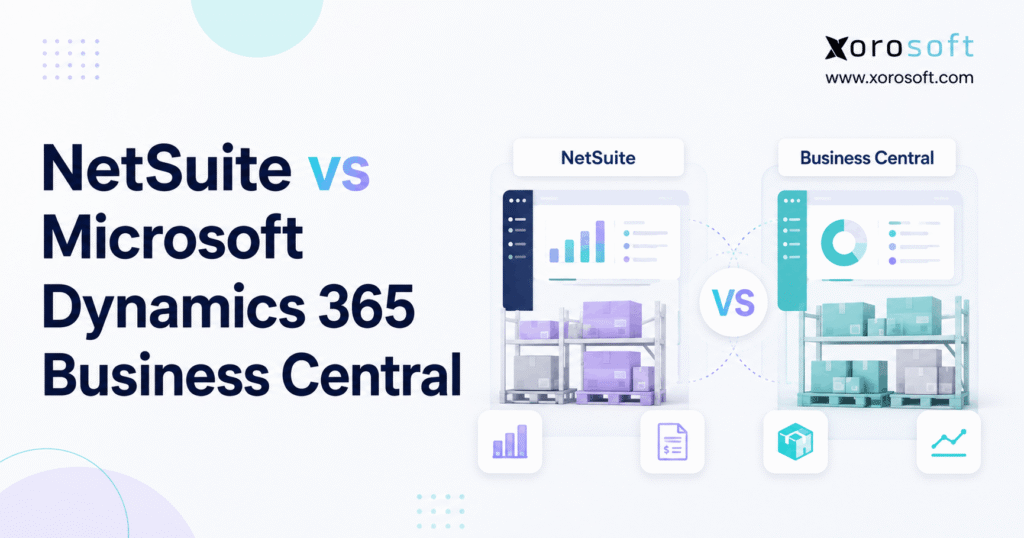
If you’re comparing leading ERP solutions, understanding the key differences between NetSuite vs Business Central is essential.
1. ERP Buyers Are Comparing Operating Models, Not Just Feature Lists
Businesses rarely start researching NetSuite vs Business Central because they are curious about ERP software. Usually, something in the operating model has stopped scaling.
Inventory numbers may differ between systems. Purchasing teams may rely on spreadsheets to calculate reorder quantities. Finance may spend days reconciling ecommerce, warehouse, and accounting data. A company may have added another warehouse, expanded into wholesale, introduced manufacturing, or started managing several legal entities. What once looked like a simple technology stack gradually becomes an operational constraint.
That is the context in which NetSuite and Microsoft Dynamics 365 Business Central normally enter the conversation.
Both platforms can support accounting, purchasing, inventory, orders, reporting, and broader business workflows. Both can replace parts of a fragmented software stack. Yet that does not make them interchangeable.
NetSuite is commonly evaluated by organizations that need a broad cloud ERP platform, especially when multi-entity operations, international expansion, consolidated financial management, inventory, supply chain, or operational complexity are important.
Microsoft Dynamics 365 Business Central approaches the same market from a different direction. It combines ERP functionality with the Microsoft ecosystem, making it particularly relevant to companies already dependent on Microsoft 365, Power BI, Teams, Azure, Power Platform, or other Microsoft business technologies.
The right decision therefore depends less on which platform has the longest product page and more on how each system maps to the company’s real processes.
A distributor should test replenishment, allocation, purchasing, warehouse transfers, EDI, and customer-specific workflows. An ecommerce company should focus on order synchronization, available inventory, fulfillment, returns, marketplaces, and accounting. A manufacturer should examine bills of materials, production planning, capacity, costing, and material requirements.
A useful NetSuite vs Business Central comparison starts with those operating realities.
2. NetSuite vs Business Central at a Glance
At a high level, both products sit firmly within the cloud ERP category, but their ecosystems and typical buying scenarios differ.
NetSuite offers a broad suite of financial and operational capabilities. Depending on licensing and configuration, companies can use it for financial management, procurement, inventory, order management, manufacturing, warehouse operations, multi-entity management, analytics, and other processes.
Business Central provides financial management, purchasing, sales, inventory, projects, supply chain functionality, warehousing, and manufacturing capabilities within the broader Microsoft environment. Companies that already use Microsoft applications may see significant value in keeping ERP close to their existing technology architecture.
2.1 NetSuite vs Business Central Quick Comparison
| Area | NetSuite | Business Central |
|---|---|---|
| Core positioning | Broad cloud ERP suite | Cloud ERP within Microsoft ecosystem |
| Financial management | Strong | Strong |
| Multi-company operations | Strong | Supported |
| Multi-entity/global operations | Major area of focus | Supported with appropriate design |
| Inventory management | Strong | Strong |
| Warehouse management | Available through NetSuite WMS | Warehouse functionality available |
| Manufacturing | Available | Premium-level manufacturing capabilities |
| Reporting | NetSuite reporting and analytics ecosystem | Strong Microsoft/Power BI alignment |
| Microsoft ecosystem | Integrates with Microsoft tools | Native ecosystem advantage |
| Ecommerce | Commerce and integration ecosystem | Shopify and partner integrations |
| Customization | SuiteCloud ecosystem | Power Platform and AppSource ecosystem |
| Pricing approach | Typically quote-based | Published per-user licensing structure |
This table is useful for orientation, but it should not be used as a purchasing scorecard. Two systems may both say they support inventory, for example, while handling warehouse execution, replenishment, allocations, or ecommerce synchronization very differently.
2.2 Which Businesses Typically Shortlist Each ERP?
NetSuite frequently appears on shortlists for organizations that need broader financial and operational control, especially when subsidiaries, consolidated reporting, global operations, complex inventory, or multiple business units are involved.
Business Central often appeals to small and midsize organizations that want a capable ERP while remaining closely aligned with Microsoft technologies.
Neither profile should be treated as a strict boundary. A growing distributor, manufacturer, or ecommerce brand could reasonably evaluate both.
3. What NetSuite Brings to an ERP Evaluation
NetSuite is a cloud ERP platform designed to centralize financial and operational processes. Its breadth is one reason it appears frequently in mid-market ERP evaluations.
3.1 Financial and Multi-Entity Capabilities
For finance teams, NetSuite can support general ledger, accounts payable, accounts receivable, financial reporting, budgeting-related workflows, and other core accounting requirements.
Its multi-entity capabilities are especially relevant when a company manages several subsidiaries or legal entities. Organizations expanding internationally may also need to consider currencies, consolidations, intercompany activity, local reporting, and varying operational structures.
For those businesses, the ERP decision is not simply about processing more transactions. It is about maintaining consistent control while complexity increases.
3.2 Inventory, Orders, and Supply Chain
NetSuite also operates well beyond accounting. Inventory, order management, procurement, planning, and warehouse functions can be brought into the same ERP environment.
That matters because operational data affects financial accuracy. Inventory receipts affect asset values. Fulfillment affects revenue recognition and cost of goods sold. Purchasing affects cash requirements. Stock transfers affect availability across locations.
A system that connects these processes can reduce the reconciliation work created by disconnected applications.
3.3 Where NetSuite Complexity Should Be Evaluated Carefully
Breadth can also create implementation complexity.
Companies should determine which modules they actually require, what needs configuration, which processes require custom development, how integrations will work, and what level of internal administration the system will demand after go-live.
That does not make complexity inherently negative. A complicated organization may genuinely require a sophisticated ERP. The mistake is paying for or implementing complexity that the business does not need.
4. What Microsoft Dynamics 365 Business Central Brings to the Comparison
Business Central is Microsoft’s cloud ERP for small and midsize organizations. Its strongest strategic differentiator is often the environment around the ERP rather than one isolated module.
4.1 Business Central and the Microsoft Ecosystem
Organizations already using Microsoft 365, Teams, Power BI, Azure, Power Automate, or Power Apps may see Business Central as a natural extension of their technology environment.
That ecosystem can simplify areas such as reporting, workflow automation, productivity, identity management, and application extension.
This is particularly valuable when the internal IT team already understands Microsoft technologies or the company has an established Microsoft implementation partner.
4.2 Finance, Inventory, Purchasing, and Operations
Business Central includes financial management alongside purchasing, sales, inventory, projects, and supply chain processes. Manufacturing and service-management capabilities are available through its higher-level product configuration.
For growing companies replacing entry-level accounting systems, that scope can provide a meaningful jump in operational maturity.
4.3 Extensions Are Part of the Business Central Decision
Business Central can be extended through the Microsoft ecosystem, including partner applications and AppSource solutions.
That flexibility is useful, but buyers should clearly separate three categories during evaluation: what is available in standard Business Central, what requires configuration, and what depends on a third-party extension.
This distinction matters because extension requirements affect implementation cost, support, upgrades, integrations, and long-term ownership.
5. NetSuite vs Business Central for Financial Management
Financial capabilities are fundamental in any NetSuite vs Business Central evaluation, but the basic presence of AP, AR, and general ledger functionality will rarely determine the winner.
The more important questions involve how finance interacts with the rest of the company.
5.1 Month-End Close and Operational Data
Finance teams often struggle because operational data lives outside the accounting system.
Warehouse adjustments may exist in one application. Ecommerce transactions may sit in another. Purchasing commitments may be tracked in spreadsheets. Inventory valuation may require manual reconciliation before finance can close the month.
An ERP should reduce that fragmentation.
When comparing the two platforms, test how purchasing, inventory movements, fulfillment, returns, landed costs, and production affect the financial records.
5.2 Multi-Company and Consolidation Requirements
A company operating one legal entity has very different requirements from a group managing ten subsidiaries.
NetSuite deserves close attention when multi-entity and consolidated operations are central to the ERP project. Business Central can also support multiple companies, but organizations should examine the proposed structure for intercompany processes, consolidation, localization, and reporting rather than assuming every multi-company deployment works the same way.
5.3 Reporting Should Be Tested With Real Management Questions
Do not ask vendors to show a generic dashboard.
Ask whether your CFO can answer questions such as:
Which product categories are generating gross margin by channel? Which warehouse is holding slow-moving inventory? How much inventory is committed but not yet fulfilled? Which supplier delays are creating stockout risk?
Those questions reveal whether reporting is genuinely operational or merely decorative.
6. NetSuite vs Business Central for Inventory Management
For inventory-driven businesses, NetSuite vs Business Central inventory management is often more important than differences in general accounting.
Inventory touches sales, purchasing, warehouses, cash flow, margins, customer service, and forecasting. Small process weaknesses become expensive as SKU counts, locations, and channels increase.
6.1 Multi-Location Inventory Visibility
Both ERP environments can support inventory across locations, but the evaluation should examine how visibility works in practice.
Teams need to distinguish between quantity on hand, available inventory, allocated inventory, incoming stock, committed stock, damaged inventory, and stock already assigned to other channels.
If users continue exporting availability to spreadsheets after ERP implementation, the business has not really solved the problem.
6.2 Replenishment and Purchasing
Growing companies often discover that purchasing becomes a bottleneck before accounting does.
Buyers should test whether each ERP can translate demand, reorder parameters, supplier lead times, current availability, incoming purchase orders, seasonality, and warehouse requirements into useful purchasing decisions.
This is also where an inventory-focused cloud ERP for product-based operations can deserve a place on the shortlist. Xorosoft is designed around businesses where inventory, accounting, purchasing, fulfillment, and operational reporting need to operate together rather than as separate systems.
6.3 Lot, Serial, and Traceability Requirements
Companies managing food, consumer goods, regulated products, serialized equipment, or warranty-sensitive items may need stronger traceability.
Do not limit the evaluation to whether the ERP stores a lot number. Test receiving, transfers, production consumption, sales, returns, recalls, and historical traceability.
The workflow matters more than the checkbox.
7. NetSuite vs Business Central for Warehouse Management
Inventory management answers the question “What do we own and where is it?”
Warehouse management answers “How does inventory physically move through the facility?”
That difference is critical.
7.1 Receiving, Putaway, Picking, and Shipping
Warehouse teams need efficient workflows for receiving, putaway, replenishment, picking, packing, shipping, transfers, and cycle counts.
NetSuite can support warehouse execution through its WMS capabilities. Business Central also includes warehouse functionality and can be extended for different operational requirements.
However, feature names alone do not indicate whether the system will handle your daily volume efficiently.
A company shipping 300 straightforward orders per day is not the same as a distributor processing thousands of lines across zones, bins, multiple warehouses, and different order priorities.
7.2 Barcode and Mobile Execution
Warehouse users rarely sit at desks. Their ERP experience happens through scanners, mobile devices, labels, bins, and physical movement.
During demos, test actual floor-level workflows.
Ask how the system handles short picks, damaged stock, partial receipts, unexpected items, bin changes, transfer orders, substitutions, and cycle-count variances.
For operations where warehouse execution is a major competitive requirement, companies may also evaluate a purpose-built warehouse management system as part of the broader ERP architecture.
7.3 Multi-Warehouse Complexity
Multi-warehouse businesses should also test order routing and allocation rules.
Suppose a Shopify order arrives while two warehouses have stock. One location is geographically closer, but its inventory is partially reserved for wholesale customers. Another warehouse has more available stock but higher shipping costs.
The ERP should help the business make a consistent decision without requiring manual intervention every time.
8. NetSuite vs Business Central for Manufacturing
Manufacturing adds another layer of complexity because inventory becomes both an input and an output.
A manufacturer must manage raw materials, components, work in progress, production orders, finished goods, purchasing, labor, overhead, capacity, and cost.
8.1 Light Manufacturing Requirements
Light manufacturers may primarily need bills of materials, assemblies, simple production orders, material consumption, finished-goods receipts, and basic planning.
Both NetSuite and Business Central can enter this type of evaluation.
The important question is whether the company needs a sophisticated production environment or simply better control over inventory-driven assembly.
8.2 MRP and Production Planning
As complexity increases, buyers should evaluate material requirements planning, routing, work centers, capacity, production scheduling, substitutions, scrap, and purchase planning.
Business Central’s manufacturing capabilities are tied to its Premium offering. NetSuite also provides manufacturing functionality through its ERP ecosystem.
When comparing them, use actual production scenarios rather than generic examples.
8.3 Costing and Inventory Integration
Manufacturing systems should connect production decisions to financial outcomes.
If material consumption, labor, overhead, scrap, and finished-goods receipts are not accurately reflected in inventory and accounting, finance teams will still rely on manual reconciliation.
That is why manufacturing should be evaluated as part of the ERP architecture, not as an isolated module.
9. NetSuite vs Business Central for Ecommerce, Shopify, Amazon, and Wholesale
Modern product businesses rarely operate through one sales channel.
A company may sell direct-to-consumer on Shopify, distribute products through Amazon, serve wholesale accounts, process EDI orders, and still accept orders from sales representatives.
That channel mix creates operational complexity quickly.
9.1 Shopify Integration and Inventory Synchronization
Business Central offers a Shopify Connector that can support the exchange of product, inventory, customer, order, and fulfillment information between Shopify and Business Central.
NetSuite can also participate in Shopify environments through integrations and its broader commerce ecosystem.
The existence of an integration should not end the evaluation.
Ask how quickly inventory updates, how cancellations are handled, what happens when orders change, how refunds reach accounting, whether multiple Shopify stores are supported, and how fulfillment updates flow back to the customer.
Businesses evaluating Xorosoft for Shopify operations can also review the Xorosoft ERP Shopify app when assessing how ecommerce and ERP workflows connect.
9.2 Amazon and Marketplace Operations
Amazon introduces another set of requirements around orders, fulfillment, fees, inventory, marketplace settlement, and returns.
A company operating Shopify and Amazon simultaneously needs a reliable inventory picture across both channels.
Without that visibility, overselling becomes more likely and purchasing decisions become less reliable.
9.3 Wholesale and EDI
Wholesale businesses have different requirements from direct-to-consumer ecommerce.
Customer-specific pricing, payment terms, inventory allocation, large orders, EDI documents, ASNs, purchase orders, and trading-partner compliance may all become important.
This is why channel architecture should influence ERP selection. A system that works well for a single ecommerce store may require significant additional design once wholesale and EDI become meaningful parts of revenue.
10. NetSuite vs Business Central Pricing and Total Cost of Ownership
Pricing comparisons attract attention, but they are also one of the easiest areas to oversimplify.
Business Central provides more visible per-user licensing information, while NetSuite pricing generally requires a scoped quote based on users, modules, entities, and requirements.
That does not automatically mean one platform is less expensive.
10.1 Software Price Is Only One Cost
A realistic ERP budget includes software licenses, implementation services, data migration, integrations, customization, extensions, training, support, internal project time, and ongoing administration.
Companies should also account for systems that remain after implementation.
If the ERP still requires separate inventory, warehouse, forecasting, EDI, or ecommerce applications, those costs remain part of the architecture.
10.2 Calculate Three- to Five-Year TCO
A useful comparison should cover at least three years.
| Cost Category | What to Evaluate |
| Licensing | Users, modules, plans, subsidiaries |
| Implementation | Discovery, configuration, project management |
| Data migration | Cleanup, mapping, historical data |
| Integrations | Shopify, Amazon, EDI, banking, 3PLs |
| Extensions | Third-party applications |
| Customization | Development and future maintenance |
| Training | Initial and ongoing |
| Support | Vendor and implementation partner |
| Administration | Internal ERP ownership |
| Remaining systems | Software the ERP does not replace |
This analysis often changes the apparent winner.
A lower-cost subscription can become expensive if it requires multiple applications and extensive integration work. A higher initial investment may make sense when the system eliminates several disconnected platforms.
11. NetSuite vs Business Central Implementation and Customization
Selecting the right software is only half the ERP decision.
A strong product can still underperform if implementation is rushed, requirements are unclear, data is poor, or every legacy process is recreated without question.
11.1 Map Processes Before Configuration
Document how the business actually works before configuring the ERP.
That should include order-to-cash, procure-to-pay, inventory transfers, warehouse receiving, fulfillment, returns, production, and month-end close.
Pay particular attention to exceptions.
The normal workflow is usually easy. ERP projects become complicated when a customer changes an order after allocation, a supplier ships less than expected, a warehouse short-picks an item, or inventory must be transferred urgently between locations.
11.2 Avoid Customizing Too Early
Customization can be valuable when a process genuinely differentiates the company.
It becomes dangerous when businesses use development to preserve inefficient legacy processes.
Before approving custom work, ask whether configuration can solve the problem and whether the process itself should change.
The long-term cost of customization includes testing, support, upgrades, documentation, and dependence on specialized expertise.
11.3 Implementation Partner Quality Matters
ERP software is only part of the project.
Implementation teams translate business processes into system design. They influence data migration, configuration, integrations, testing, training, and project governance.
When comparing NetSuite vs Business Central, evaluate the proposed implementation team with the same care as the product.
12. NetSuite vs Business Central by Industry and Business Model
Different industries expose different ERP weaknesses.
A useful comparison therefore has to move beyond generic company size.
12.1 Wholesale Distribution
Wholesale distributors often care about inventory availability, purchasing, replenishment, EDI, customer pricing, order allocation, warehouse operations, and margin visibility.
A distributor with thousands of SKUs and several warehouses may have relatively simple accounting but extremely complex operations.
That company should score operational workflows more heavily than generic financial features.
12.2 Apparel and Fashion
Apparel companies manage style, color, size, seasons, purchase commitments, wholesale, ecommerce, and returns.
Large SKU counts make inventory visibility and forecasting particularly important.
12.3 Furniture and Home Goods
Furniture businesses may manage large products, longer supplier lead times, container purchasing, warehouse constraints, backorders, delivery scheduling, and high working-capital requirements.
ERP selection should account for these realities.
12.4 Sporting Goods and Consumer Products
Sporting goods and consumer-products companies frequently operate across ecommerce, wholesale, marketplaces, and retail partners.
Forecasting, inventory allocation, purchasing, and EDI can become essential as the channel mix expands.
12.5 Food and Beverage
Food and beverage companies may need lot tracking, expiration management, traceability, quality processes, and careful inventory rotation.
Manufacturing and distribution requirements may also overlap.
Companies researching ERP fit across these sectors can use Xorosoft’s industry-specific ERP overview as another reference when building a shortlist.
13. When NetSuite or Business Central May Not Be the Best Fit
ERP buyers sometimes assume the decision must come down to the two most familiar names on the shortlist.
That creates unnecessary risk.
13.1 When Global Financial Complexity Is Not the Main Problem
A company may not need the breadth associated with a global ERP if its biggest problems are stockouts, spreadsheet purchasing, disconnected Shopify orders, warehouse inefficiency, or inaccurate inventory.
The ERP should match the complexity that actually exists.
13.2 When Inventory Drives the Entire Business
Inventory-driven companies often need purchasing, accounting, forecasting, warehouse operations, ecommerce, and manufacturing to operate as a connected system.
In this scenario, Xorosoft can be considered as a unified cloud ERP platform built around product-based businesses.
That becomes especially relevant when the current stack includes QuickBooks, spreadsheets, an inventory application, warehouse software, ecommerce connectors, and separate EDI tools.
13.3 When the Business Is Specifically Moving Away From NetSuite
Some companies evaluate alternatives because their needs, cost structure, operating model, or implementation priorities have changed.
Organizations in that position can review a direct Xorosoft vs NetSuite comparison as part of a broader vendor evaluation.
No alternative should be selected simply because it is newer or simpler. The same disciplined process should apply to every ERP on the shortlist.
14. How to Choose Between NetSuite and Business Central
The strongest NetSuite vs Business Central decision process starts with business requirements and ends with real workflow testing.
14.1 Build a Weighted ERP Scorecard
Create categories based on what drives operational risk.
A distributor might give inventory, purchasing, warehouse management, and EDI a higher weight. A software-enabled services company may care much more about financials, reporting, projects, and Microsoft integration.
A manufacturer may prioritize production, planning, BOMs, costing, and material availability.
The scorecard should reflect the business rather than an analyst’s generic template.
14.2 Demonstrate Real Scenarios
Instead of asking vendors to “show inventory management,” provide a specific scenario.
For example:
A wholesale customer submits an EDI order while a Shopify promotion is consuming the same stock. Inventory is spread across two warehouses, and more units are arriving on an open purchase order. Ask each ERP to show available inventory, allocation, replenishment, fulfillment, and accounting.
A real scenario exposes system design immediately.
14.3 Evaluate the Full Architecture
The ERP is rarely the only technology involved.
Map Shopify, Amazon, EDI, banking, shipping, payroll, tax, 3PL connections, business intelligence, and any specialized manufacturing applications.
Then identify which integrations are standard, which require third-party tools, and which need custom development.
14.4 Choose Based on Operational Fit
NetSuite may be especially relevant when multi-entity management, global financial control, broad ERP functionality, and organizational complexity are major requirements.
Business Central may stand out when the organization already operates deeply within the Microsoft ecosystem and wants ERP closely connected to that environment.
An inventory-focused alternative may deserve more attention when the company’s main challenge is coordinating purchasing, inventory, warehouses, ecommerce, wholesale, manufacturing, and accounting.
There is no universal winner in NetSuite vs Business Central. There is only a system that fits one operating model better than another.
15. NetSuite vs Business Central FAQs
15.1 What is the main difference between NetSuite and Business Central?
NetSuite is typically positioned as a broad cloud ERP with strong financial, operational, multi-entity, inventory, and global-management capabilities. Business Central is Microsoft’s ERP for small and midsize businesses and gains significant value from its relationship with Microsoft 365, Power BI, Power Platform, Azure, and the broader Microsoft application ecosystem.
15.2 Is NetSuite better than Business Central?
Neither platform is universally better. NetSuite can make sense for organizations with complex multi-entity or global requirements. Business Central can be attractive for companies that prefer Microsoft technologies and need a capable SMB or mid-market ERP. The final decision should be based on workflows, integrations, implementation, and total cost.
15.3 Is Business Central a competitor to NetSuite?
Yes. Businesses evaluating mid-market cloud ERP frequently compare NetSuite vs Business Central. They overlap across accounting, inventory, purchasing, reporting, and operations, although their ecosystems and implementation models differ.
15.4 Which ERP is better for small businesses?
Very small companies may not need either ERP yet. Business Central is explicitly positioned toward small and midsize organizations and can be a logical step up from basic accounting software. NetSuite may become more relevant when operational, entity, or international complexity justifies a broader ERP platform.
15.5 Which ERP is better for mid-market companies?
Both can serve mid-market organizations. NetSuite often appeals to companies with subsidiaries, global operations, or broad ERP requirements. Business Central may fit mid-market companies that value Microsoft ecosystem alignment. Industry requirements should carry more weight than revenue alone.
15.6 Which ERP is better for inventory management?
Both platforms support inventory management. Buyers should compare multi-location visibility, allocations, lot and serial tracking, replenishment, purchasing, transfers, forecasting, and warehouse workflows. An inventory-intensive business should test these processes in detail rather than rely on feature lists.
15.7 Which ERP is better for warehouse management?
NetSuite offers warehouse-management capabilities, while Business Central also supports warehousing and can be extended. The better fit depends on order volumes, receiving complexity, bin structures, scanning, picking methods, transfers, and shipping workflows.
15.8 Does NetSuite support multiple warehouses?
Yes. NetSuite can support inventory across multiple locations and warehouse workflows. Businesses should still test availability, transfers, allocations, mobile execution, receiving, picking, and replenishment using their own operational scenarios.
15.9 Does Business Central support multiple warehouses?
Yes. Business Central supports multiple inventory locations and warehouse processes. Complex distributors should evaluate how the proposed implementation handles bins, scanning, replenishment, transfers, picking, and fulfillment.
15.10 Is NetSuite good for manufacturing?
NetSuite supports manufacturing-related processes such as production, inventory, BOMs, work orders, planning, and costing. Companies with complex production environments should validate scheduling, routing, shop-floor, traceability, and planning requirements before selection.
15.11 Is Business Central good for manufacturing?
Business Central Premium includes manufacturing functionality. It can support production BOMs, routings, work centers, production orders, planning, and related manufacturing processes. Fit depends on the complexity of the production environment.
15.12 Which ERP is better for light manufacturing?
Both can work for light manufacturing. Businesses should compare BOM management, material planning, simple production orders, inventory consumption, costing, purchasing, and finished-goods tracking rather than assuming they need the most advanced manufacturing platform.
15.13 Which ERP is better for wholesale distribution?
Wholesale distributors should emphasize purchasing, inventory allocation, customer pricing, EDI, warehouse management, replenishment, and forecasting. Either platform may fit, but inventory-centric alternatives should also be evaluated when distribution workflows dominate the ERP project.
15.14 Which ERP is better for ecommerce?
The answer depends on channel architecture. Business Central has a Shopify connector, while NetSuite supports ecommerce through its commerce and integration ecosystem. Merchants should test inventory synchronization, orders, returns, fulfillment, marketplaces, and accounting across every channel.
15.15 Does Business Central integrate with Shopify?
Yes. Business Central provides Shopify integration capabilities for synchronizing relevant ecommerce and ERP data. Businesses should still test multi-store requirements, inventory updates, order changes, refunds, fulfillment, and accounting workflows.
15.16 Does NetSuite integrate with Shopify?
NetSuite can connect with Shopify through integrations and ecosystem solutions. The important question is not whether a connector exists but whether it supports the company’s order, inventory, returns, fulfillment, customer, and accounting requirements.
15.17 Can NetSuite and Business Central support EDI?
Both can participate in EDI environments through integrations, extensions, or partners. Wholesale companies should test actual purchase orders, acknowledgements, ASNs, invoices, error handling, and trading-partner requirements.
15.18 Which ERP works better with Microsoft 365?
Business Central has the natural advantage because it belongs to Microsoft’s broader business-application ecosystem. Companies already using Teams, Microsoft 365, Power BI, Power Apps, Power Automate, and Azure should include this in their ERP scoring.
15.19 Which ERP is better for reporting?
Both provide reporting capabilities, but their surrounding ecosystems differ. Business Central benefits from close Microsoft analytics integration, while NetSuite has its own reporting and analytics environment. Buyers should test actual management reports instead of generic dashboards.
15.20 Which ERP is easier to customize?
Both systems can be extended and customized. NetSuite uses its SuiteCloud ecosystem, while Business Central benefits from Microsoft extensions, Power Platform, and AppSource. The more important question is how much customization the implementation actually requires.
15.21 Which ERP is easier to implement?
Implementation difficulty depends more on business complexity than product branding. Multiple entities, poor data, custom workflows, warehouses, manufacturing, ecommerce, EDI, and extensive integrations can make either ERP project challenging.
15.22 Is Business Central cheaper than NetSuite?
Business Central provides public per-user pricing, while NetSuite pricing is generally quote-based and depends on configuration, users, and modules. Companies should compare three- to five-year TCO rather than subscription pricing alone.
15.23 What alternatives are there to NetSuite and Business Central?
Alternatives include Acumatica, Sage, Odoo, SAP Business One, industry-specific platforms, and Xorosoft for inventory-driven businesses. The shortlist should be built from process requirements instead of brand recognition.
15.24 When should a business upgrade to ERP?
ERP usually becomes necessary when spreadsheets and disconnected applications create material problems with inventory, purchasing, reporting, accounting, warehouse operations, manufacturing, or scalability. Common signals include reconciliation delays, poor inventory visibility, stockouts, duplicated data entry, and difficulty adding locations or channels.
15.25 What is the biggest mistake when comparing NetSuite vs Business Central?
The biggest mistake is comparing generic feature lists instead of actual business workflows. Both products can claim broad ERP functionality. The meaningful differences appear when companies test real orders, inventory allocations, purchasing decisions, warehouse exceptions, financial closes, manufacturing processes, integrations, and reporting requirements.
16. Strategic Recommendation: Choose the ERP Around the Complexity You Actually Have
The final NetSuite vs Business Central decision should not be driven by which vendor has the most features, the most recognizable logo, or the strongest generic demo.
Start with the operating model.
Organizations dealing with subsidiaries, international entities, consolidated financial management, and broad ERP requirements should give NetSuite serious consideration.
For companies already deeply invested in Microsoft technologies, Business Central may provide a more natural architecture because ERP can operate within the broader Microsoft ecosystem.
Inventory-driven businesses face a different decision. When the primary challenges involve inventory visibility, purchasing, Shopify, Amazon, wholesale, EDI, multi-warehouse operations, forecasting, manufacturing, and disconnected accounting systems, an inventory-focused ERP architecture may deserve a place on the shortlist.
In every case, require vendors to demonstrate your actual workflows, calculate three- to five-year total cost of ownership, review implementation resources, and identify where third-party applications or custom development will still be required.
The strongest ERP decision is not about selecting the software with the longest list of capabilities. It is about choosing a system that reduces operational friction as the company becomes more complex.
If you are actively comparing ERP platforms and want to test your requirements against a real operating model, you can contact Xorosoft to discuss your ERP requirements. A useful evaluation should begin with your warehouses, channels, inventory flows, purchasing processes, accounting structure, and manufacturing requirements—not with a predetermined software recommendation.
Recent Posts
-
 ERP Landed Cost Module vs Spreadsheet Calculations for Importers
 -
 How to Build an Open-to-Buy Plan for an Omnichannel Brand
 -
 Cold Storage WMS for Food and Beverage Distribution
 -
 ERP Buying Statistics 2026: Evaluation, Implementation, and Adoption Risks
 -
 How a Distributor Reduced B2B Order Exceptions Without Restricting Sales