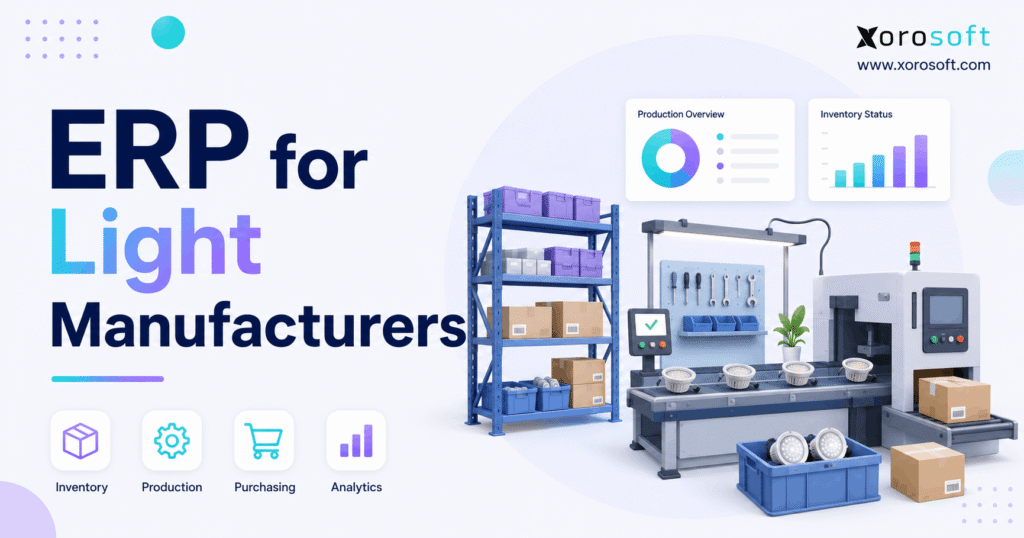
If you are looking to improve efficiency and streamline processes, ERP for light manufacturers can be a game-changer.
1. When Light Manufacturing Outgrows Disconnected Systems
Light manufacturing can become operationally complex long before a company considers itself a large manufacturer. A business may only assemble, package, configure, finish, or convert products, yet every finished item can depend on multiple components, suppliers, lead times, warehouse locations, sales channels, and purchasing decisions.
The first signs of strain usually appear gradually. Production maintains one spreadsheet, purchasing works from another, and accounting operates in a separate financial system. Meanwhile, the warehouse may use an inventory application, ecommerce orders arrive through Shopify or marketplaces, and wholesale customers send orders through email, portals, or EDI.
Each application may still work reasonably well. However, the company no longer operates as a collection of isolated applications. A supplier delay affects production, production affects finished-goods availability, finished goods affect customer commitments, and customer demand changes purchasing requirements.
When employees manually reconnect those events, the business starts paying an operational tax for system fragmentation.
1.1 Why Disconnected Manufacturing Systems Become Expensive
This is where ERP for light manufacturers becomes relevant.
A manufacturing ERP should not merely replace several applications with one larger application. Instead, it should connect demand, inventory, materials, purchasing, production, warehouse activity, fulfillment, accounting, and reporting so every team works from the same operational record.
As a result, operations managers can see what the business needs to produce without waiting for several reports. Purchasing can understand which materials production requires and when. At the same time, warehouse teams can identify what inventory remains available, what is allocated, what production has consumed, and what is moving between facilities.
Finance also gains a clearer view of how physical inventory movements affect valuation and cost of goods sold.
1.2 How ERP Creates a Shared Operational Record
Without that connection, growth often creates more spreadsheets, reconciliations, manual checks, and exceptions. By contrast, a connected ERP allows the business to process more transactions without creating the same increase in administrative work.
Ultimately, the goal is not simply to centralize software. The goal is to give every operational team consistent information as demand, materials, inventory, production, and financial activity change.
That shared view becomes especially important for light manufacturers because seemingly small operational decisions can have broad consequences. A delayed component can stop a production order. A production delay can affect customer delivery dates. A rush wholesale order can consume stock that ecommerce teams expected to sell.
Therefore, the question is not whether a company looks like a large factory. The more useful question is whether its operations have become too interconnected for disconnected systems.
2. What ERP for Light Manufacturers Must Manage
ERP for light manufacturers connects manufacturing activity with the wider commercial and financial operation. The system needs to understand not only what the company sells, but also what it takes to make those products and how production changes inventory.
For most light manufacturers, this means managing bills of materials, work orders, material requirements, purchasing, raw materials, work in progress, finished goods, warehouse movements, accounting, and reporting.
2.1 What Counts as Light Manufacturing?
Light manufacturing generally involves less capital-intensive production than heavy industrial manufacturing. Typical processes include assembly, kitting, packaging, repackaging, finishing, cutting, configuration, labeling, light fabrication, and combining purchased components into finished products.
Businesses in apparel, furniture, sporting goods, consumer products, automotive components, packaged goods, private-label products, and industrial distribution may all operate some form of light manufacturing.
However, the industry label matters less than the workflow. If a company purchases several components, combines them according to a bill of materials, and receives a new finished item into inventory, it already has a manufacturing process that needs reliable operational data.
2.2 Why Basic Inventory Software Eventually Becomes Limiting
Traditional inventory software primarily answers questions such as how much stock exists, where the company stores it, and what customers have ordered.
Manufacturing introduces another layer.
The business needs to know what it can build from available stock, which components production has already committed, what materials will be needed next week, whether incoming supply will arrive on time, and how much a finished product actually costs.
Therefore, the system must understand the relationship between finished goods and their components rather than simply reporting quantities on hand.
2.3 Why Manufacturing ERP Needs More Than Accounting
Accounting software records the financial result of transactions. Manufacturing teams, however, need operational information before those transactions become financial results.
For example, finance may know that the company purchased $40,000 of components. Production needs to know which components arrived, where warehouse teams stored them, which work orders require them, and what finished goods the company can now produce.
Consequently, the strongest manufacturing ERP platforms connect operational and financial information rather than forcing teams to maintain separate versions of the business.
3. How ERP for Light Manufacturers Connects Demand to Production
The easiest way to understand ERP for light manufacturers is to follow one order through the company.
A customer places an order. The ERP checks available finished inventory. If enough stock exists, the system can allocate it. If not, the company must determine what production needs to manufacture.
From there, the process moves through materials, purchasing, production, finished goods, fulfillment, and accounting.
3.1 Demand Creates a Production Requirement
Demand can enter through several sources. A confirmed sales order may create immediate demand, while a forecast may indicate future demand. In addition, a wholesale account might submit a large purchase order, and Shopify or Amazon may generate continuous consumer demand throughout the day.
The ERP needs to distinguish between those demand signals while keeping them connected to the same inventory and supply plan.
Otherwise, different channels can compete for the same stock without realizing it. As a result, the company may promise inventory twice or begin production too late.
3.2 Bills of Materials Convert Finished-Goods Demand Into Component Demand
A bill of materials, or BOM, defines what the company needs to manufacture a product.
Suppose Product A requires two units of Component X, one unit of Component Y, and four units of Component Z. A requirement for 100 units of Product A creates demand for 200 units of X, 100 units of Y, and 400 units of Z.
That calculation becomes more complicated when several products share components, subassemblies exist, multiple BOM revisions remain active, or suppliers have different lead times.
As a result, accurate BOM data gives the ERP a dependable foundation for planning. If BOM data is wrong, purchasing and production decisions will also be wrong.
3.3 Material Planning Identifies What the Company Must Buy
Once the system knows what production requires, it can compare those requirements with existing supply.
The ERP may consider available inventory, reserved stock, open purchase orders, expected receipts, production requirements, forecasts, lead times, and safety stock.
Therefore, purchasing can focus on exceptions rather than manually reviewing every SKU.
Instead of asking, “What do we usually buy around this time?”, the buyer can ask, “What does current demand require, what do we already have, and what will arrive in time?”
3.4 Work Orders Control the Production Process
A work order or production order tells the team what to build. It should identify the finished product, required quantity, materials, planned dates, and production status.
As production progresses, the team records component consumption and finished output. Consequently, the ERP updates inventory as production activity occurs.
The connected sequence becomes:
Demand → BOM Requirements → Purchasing → Production → Finished Goods → Fulfillment → Accounting
The value comes from maintaining that connection without requiring another employee to rebuild it manually.
4. Core Light Manufacturing ERP Features That Matter Most
A light manufacturer does not need every feature found in highly complex industrial software. Instead, the company needs enough manufacturing depth to control its actual production process without introducing unnecessary complexity.
4.1 BOM Management in ERP for Light Manufacturers
BOM management sits at the center of most manufacturing systems.
Simple manufacturers may need only single-level BOMs. More complex businesses, however, may require subassemblies and multi-level BOM structures.
In addition, companies should evaluate whether the ERP supports revisions, component substitutions, expected quantities, costing, and version control.
A poor BOM creates problems throughout the organization. Purchasing orders the wrong quantities, production uses incorrect components, costing becomes unreliable, and inventory variances increase.
Therefore, BOM quality matters as much as BOM functionality.
4.2 Work Order Management
Work orders should provide a practical way to release, track, and complete production.
Managers need to see what production has not started, what is currently in progress, and what the team has completed.
The system should also let production teams record material consumption and finished output so inventory changes automatically as work progresses.
Without that connection, companies often issue materials manually and adjust finished goods after the fact. Consequently, inventory accuracy begins to depend on administrative discipline rather than system design.
4.3 Material Requirements Planning
MRP connects supply decisions with manufacturing demand.
It helps answer three practical questions: what does the company need, how much does it need, and when does it need it?
A useful MRP process considers BOMs, current inventory, open purchases, production requirements, supplier lead times, forecasts, and customer demand.
For many light manufacturers, better material planning creates more immediate value than highly advanced production scheduling. After all, even a perfect schedule fails if a critical component is missing.
4.4 Raw Materials, WIP, and Finished Goods
Manufacturing changes the state of inventory.
Raw materials sit available for production. Next, the production team commits or consumes those materials. During production, part of the inventory value may sit in work in progress. Finally, the company receives completed units as finished goods.
Consequently, a manufacturing ERP should make those stages visible.
Otherwise, managers may know the total inventory value without understanding how much stock can actually support new customer demand.
4.5 Purchasing and Supplier Management
Production and purchasing must operate from the same plan.
Buyers need visibility into current component stock, expected receipts, supplier lead times, open production requirements, forecasts, and future demand.
When purchasing works from a separate spreadsheet, every production change creates another manual update. By contrast, ERP reduces that handoff by allowing both teams to work from shared requirements.
4.6 Manufacturing Costing
Manufacturers need to understand what products cost to make.
Material cost usually forms the foundation. Depending on the business, cost may also include labor, overhead, subcontracting, machine time, packaging, freight, or scrap.
However, the company does not necessarily need the most sophisticated costing model available. It needs a model accurate enough to support inventory valuation, margins, pricing, and management decisions.
5. ERP for Light Manufacturers vs MRP and Accounting Software
Not every manufacturing problem requires a full ERP.
A focused MRP system can solve production-planning problems effectively. Inventory software can improve stock control. Accounting applications can provide strong financial functionality.
However, the ERP case becomes stronger when several business functions need to work together.
| Capability | MRP / Manufacturing Tool | Inventory + Accounting Stack | Manufacturing ERP |
|---|---|---|---|
| Bills of materials | Usually strong | Varies | Integrated |
| Work orders | Usually strong | Varies | Integrated |
| Material planning | Core capability | Often limited | Integrated |
| Inventory | Production-focused | Usually strong | Enterprise-wide |
| Purchasing | Often available | Often separate | Connected |
| Multi-warehouse | Varies | Often supported | Connected |
| Accounting | Usually separate | Core capability | Integrated |
| Ecommerce | Usually separate | Connector-dependent | Can connect directly |
| Financial reporting | Limited | Strong | Connected to operations |
5.1 When MRP May Be Enough
A dedicated MRP application can make sense when manufacturing planning creates the primary problem and the rest of the technology stack still works well.
For example, a manufacturer may have simple accounting, one warehouse, few sales channels, and strong inventory processes. The company may only need better BOM control and material planning.
In that case, replacing every system could create more implementation effort than business value.
5.2 When ERP Becomes More Appropriate
However, ERP for light manufacturers becomes more compelling when operational problems cross departmental boundaries.
A component shortage affects purchasing. Purchasing affects cash. Production affects WIP and finished-goods availability. Finished goods affect order promises. Shipments affect inventory, revenue, and cost of goods sold.
Therefore, when teams repeatedly reconcile those connections manually, the company no longer has a single manufacturing problem. It has a systems problem.
6. When Light Manufacturers Should Consider ERP
Companies often ask whether they are large enough for ERP. Revenue helps provide context, but operational complexity offers a better signal.
6.1 Inventory Accuracy Keeps Declining
Frequent adjustments, negative inventory, unexplained shortages, and disagreement between physical and system stock suggest that the current process no longer provides enough control.
The problem becomes more serious when production consumes inventory without updating warehouse and accounting records at the same time.
As a result, teams begin spending more time checking the system than using it.
6.2 Purchasing Depends on Spreadsheets
Spreadsheet purchasing works until demand changes faster than employees can update the model.
Shared components, long supplier lead times, seasonality, and multiple warehouses make manual buying decisions more difficult.
Consequently, if buyers spend large portions of their day reconciling inventory before placing purchase orders, the technology stack is creating unnecessary work.
6.3 One Person Controls the Production Plan
Some growing manufacturers depend on one experienced planner who knows which orders to prioritize, which materials remain short, and which suppliers will deliver on time.
That knowledge creates value. However, it also creates operational risk.
ERP should help convert important planning information into a system that the wider team can use, while still allowing experienced employees to apply judgment.
6.4 Month-End Requires Heavy Reconciliation
Finance should not have to reconstruct manufacturing activity from disconnected warehouse reports and spreadsheets every month.
When inventory valuation, production costs, and purchasing activity remain disconnected, accounting teams spend more time validating transactions than analyzing performance.
Therefore, month-end effort often provides a useful indicator of broader operational fragmentation.
6.5 Multiple Warehouses or Channels Share Inventory
A company may sell through Shopify, Amazon, wholesale customers, EDI partners, and direct sales while production consumes many of the same SKUs.
At that point, inventory availability becomes a planning problem rather than a simple stock count.
These conditions often signal that ERP for light manufacturers deserves serious evaluation.
7. How Manufacturing ERP Improves Inventory and Purchasing Control
Manufacturing ERP creates value when it removes gaps between departments. Inventory, purchasing, production, and finance should not need separate versions of the same transaction.
7.1 Inventory Becomes Part of the Production Plan
A manufacturer should know more than how many units exist company-wide.
Teams need to know which inventory is available, reserved, allocated, expected, in transit, committed to production, or located elsewhere.
For inventory-driven companies that have moved beyond accounting-only systems, XoroERP provides one example of a cloud ERP model that connects inventory, purchasing, manufacturing, accounting, and warehouse operations.
More importantly, the broader principle applies regardless of vendor: inventory data becomes more useful when the system connects it directly to production and demand.
7.2 Purchasing Can Respond to Actual Requirements
When production demand changes, purchasing should see the effect without waiting for another spreadsheet.
The ERP can help buyers understand shortages, incoming supply, open production requirements, forecasts, and supplier timing from the same data.
Consequently, purchasing can respond to production changes faster while reducing repetitive reconciliation.
7.3 Costing Becomes Easier to Trace
Integrated transactions also improve cost visibility.
The company can connect purchased material costs with production consumption and finished-goods inventory. Therefore, finance can follow a clearer transaction trail from procurement through manufacturing.
Finance still needs sound costing policies and controls. However, ERP reduces the number of manual steps required to connect physical production with financial records.
8. ERP for Light Manufacturers With Ecommerce and Multiple Warehouses
Many light manufacturers no longer operate only as factories. They also function as ecommerce sellers, wholesalers, distributors, and multi-location inventory businesses.
That hybrid model changes what ERP for light manufacturers needs to support.
8.1 Shopify Demand Should Connect With Manufacturing Inventory
An ecommerce order consumes real inventory. If finished goods are unavailable, that demand may eventually create a production requirement and component demand.
Therefore, manufacturers should evaluate how their ERP handles orders, product data, inventory synchronization, fulfillment, returns, and financial information across Shopify.
Xorosoft’s Shopify ERP app provides one example of connecting Shopify orders and inventory with a broader ERP environment.
However, the key evaluation point is not simply whether an integration exists. Manufacturers should test how inventory updates, exceptions, cancellations, returns, and multiple stores behave in real operating conditions.
8.2 Warehouse Execution Affects Production Accuracy
Production cannot rely on inventory that warehouse teams cannot locate.
Materials need to move through receiving, storage, picking, transfers, production staging, consumption, and finished-goods receipt.
Manufacturers with more complex warehouse requirements can evaluate XoroWMS or another warehouse-management platform to determine whether scanning, location control, transfers, receiving, and fulfillment workflows support the required level of accuracy.
As a result, warehouse management becomes part of manufacturing control rather than a separate downstream process.
8.3 Multi-Warehouse Inventory Changes the Planning Question
A company may have 1,000 units of a component across all warehouses while the production facility only has 150.
Therefore, a company-wide stock total does not answer whether production can start.
A multi-warehouse manufacturing ERP should help teams understand where inventory exists, what is available, what is allocated, what is moving, and whether a transfer can satisfy production before purchasing more stock.
9. Light Manufacturing ERP Use Cases by Industry
Different industries create different ERP priorities. Therefore, the right manufacturing ERP should adapt to the operating model rather than forcing every company into the same workflow.
Manufacturers comparing requirements can also review Xorosoft’s broader industry solutions to understand how inventory-driven workflows vary across business models.
9.1 Apparel and Fashion Manufacturing
Apparel businesses often manage large numbers of style, color, and size combinations.
Even when production remains relatively light, SKU complexity creates challenges in purchasing, inventory visibility, wholesale allocation, ecommerce availability, and forecasting.
As a result, an ERP can create value by connecting materials and finished variants so teams understand both component requirements and sellable inventory.
9.2 Furniture and Home Goods
Furniture and home-goods businesses may combine frames, hardware, upholstery, packaging, and purchased components.
Long supplier lead times make BOM accuracy and purchasing especially important. In addition, bulky products can create warehouse and transfer challenges.
Therefore, inventory visibility, BOM management, supplier planning, and multi-location controls often matter as much as production itself.
9.3 Sporting Goods
Sporting-goods manufacturers frequently face seasonal demand.
That seasonality increases the importance of forecasting, purchasing, production timing, and inventory allocation.
For example, a production delay at the beginning of a short selling season can create significantly more business impact than the same delay during a steady-demand period.
9.4 Consumer Products
Consumer-product companies often combine manufacturing with ecommerce, wholesale, packaging, kitting, and frequent new-product launches.
Consequently, these businesses benefit when product data, materials, purchasing, finished inventory, and customer channels operate from the same system.
9.5 Food and Beverage
Light food manufacturing may involve recipes or BOM-like structures, packaging, lot tracking, expiration considerations, purchasing, and finished-goods inventory.
However, companies should validate industry-specific traceability, quality, labeling, and regulatory requirements separately. A generic manufacturing feature list does not automatically guarantee compliance.
9.6 Automotive Parts and Industrial Components
Component manufacturers often need strong BOM control, supplier planning, production visibility, lot or serial tracking, inventory accuracy, and wholesale order management.
Even relatively straightforward assembly processes can become complex when many components and customer-specific requirements enter the workflow.
10. Common Manufacturing ERP Selection Mistakes
Light manufacturers can reduce implementation risk by avoiding several predictable mistakes.
10.1 Buying More Complexity Than the Operation Needs
Advanced finite scheduling, machine controls, engineering functionality, MES features, and complex routings can create substantial value for sophisticated manufacturers.
However, a business performing simple assembly may not need those capabilities.
Therefore, software complexity should match manufacturing complexity. The strongest ERP is not necessarily the platform with the longest feature list.
10.2 Evaluating ERP Primarily Through Finance
Finance plays a major role in ERP selection, but the system must also work for production, purchasing, inventory, and warehouse teams.
A platform can produce accurate accounting while still creating inefficient operational workflows.
For that reason, the evaluation team should include people who understand how orders, components, production, inventory, and fulfillment actually move through the company.
10.3 Migrating Poor Master Data
A new ERP cannot transform incorrect BOMs into correct BOMs.
Before migration, manufacturers should review SKUs, units of measure, suppliers, lead times, warehouses, costs, BOM structures, and inventory balances.
Otherwise, the new system simply processes old problems more consistently.
10.4 Rebuilding Every Old Workaround
Legacy workflows often exist because previous systems could not support the desired process.
Recreating every workaround inside the new ERP can preserve the same inefficiencies.
Instead, teams should ask why each manual step exists before deciding to reproduce it.
10.5 Accepting Generic Vendor Demonstrations
A polished standard demo proves that the software can complete the vendor’s preferred workflow. However, it does not prove that the system can handle your operation.
Ask vendors to demonstrate a real BOM, a component shortage, partial production, multiple warehouses, an ecommerce order, a wholesale order, and the resulting inventory and accounting impact.
As a result, the team can evaluate operational fit rather than presentation quality.
11. How to Evaluate ERP for Light Manufacturers
Choosing ERP for light manufacturers should begin with business processes rather than vendor names.
11.1 Map the Current Workflow
Start with customer demand and follow it through the company.
Document how the business creates orders, checks stock, purchases materials, releases production, consumes components, receives finished goods, fulfills customers, and updates accounting.
Pay particular attention to places where employees re-enter data, export reports, update spreadsheets, or wait for another department.
Those handoffs usually expose the most important ERP requirements.
11.2 Identify the Expensive Breakpoints
Not every inconvenience deserves an ERP project.
Therefore, focus on problems that repeatedly create cost or risk.
Examples include inventory write-offs, production delays, stockouts, excess purchases, late shipments, manual reconciliations, duplicate entry, unreliable margins, or slow reporting.
The business case becomes much clearer when the company can connect ERP requirements to measurable operational problems.
11.3 Separate Must-Haves From Future Requirements
A growing light manufacturer may classify BOMs, work orders, MRP, purchasing, multi-warehouse inventory, accounting, and ecommerce integration as immediate requirements.
Advanced shop-floor automation, on the other hand, may belong in a future phase.
This separation helps the company avoid selecting software based on impressive but irrelevant functionality.
11.4 Define Integration Requirements Early
Document every application that must exchange information with ERP.
That may include Shopify, Amazon, EDI providers, shipping applications, marketplaces, payment systems, or specialized operational tools.
Manufacturers considering broader enterprise suites can also review the Xorosoft vs NetSuite comparison as one reference point. However, every platform should still be tested against the manufacturer’s own workflows.
11.5 Compare Total Cost of Ownership
ERP cost extends beyond monthly subscription fees.
Implementation, migration, integrations, training, customization, support, internal project time, and future administration all contribute to total cost.
However, subscription price alone does not reflect total ERP cost.
A lower software price can produce a higher operational cost if employees continue relying on manual workarounds. Conversely, an enterprise system can create unnecessary expense if the business only needs a small portion of its capabilities.
11.6 Establish Operational Success Metrics
Define what improvement should look like before implementation starts.
Useful measures include inventory adjustments, stockouts, material shortages, production lead time, purchase-order expedites, WIP accuracy, fulfillment time, reporting effort, and month-end reconciliation.
Ultimately, ERP success should mean more than launching the software on time. The company should be able to show that the new system improved operations.
12. Where Xorosoft Fits for Inventory-Driven Light Manufacturers
Xorosoft approaches manufacturing as part of a larger inventory-driven operating model.
That can make the platform relevant when production sits alongside purchasing, multi-warehouse inventory, ecommerce, wholesale, EDI, accounting, and forecasting.
12.1 Connecting Manufacturing With the Wider Operation
For businesses that need production to remain connected with other departments, XoroONE provides a cloud-based framework for bringing inventory-driven processes into a shared system.
The broader benefit comes from reducing the number of separate data models that teams need to maintain.
As a result, production can work from the same product, inventory, purchasing, and customer information that other departments use.
12.2 When Xorosoft May Fit
Xorosoft may deserve consideration when a light manufacturer sells physical products, manages several warehouses, purchases materials, handles wholesale customers, operates Shopify or Amazon channels, uses EDI, and needs integrated accounting.
These companies often reach ERP evaluation after they outgrow QuickBooks, spreadsheets, inventory-only software, or several disconnected applications.
12.3 When a Simpler Manufacturing Tool May Be Better
A small operation with one warehouse, limited SKUs, simple assembly, low transaction volume, straightforward accounting, and few integrations may not need full ERP.
A focused MRP or inventory platform may provide sufficient control with less implementation effort.
Therefore, system complexity should follow business complexity rather than precede it.
13. Frequently Asked Questions About ERP for Light Manufacturers
13.1 What Is ERP for Light Manufacturers?
ERP for light manufacturers is software that connects manufacturing with inventory, purchasing, warehousing, sales, accounting, and reporting. Manufacturing functions usually include BOMs, work orders, material planning, raw-material tracking, WIP, finished-goods production, and costing. As a result, the company can manage the complete operating flow from demand through production and financial reporting.
13.2 Do Small Manufacturers Need ERP?
Not every small manufacturer needs ERP. A simple business with one warehouse, limited products, basic assembly, and reliable accounting may operate effectively with focused inventory and manufacturing tools. However, ERP becomes more valuable when production, purchasing, inventory, sales channels, warehouse operations, and accounting become difficult to coordinate separately.
13.3 What Features Should Light Manufacturing ERP Include?
The most important capabilities usually include bills of materials, work orders, MRP, raw-material inventory, work in progress, finished-goods tracking, purchasing, manufacturing costing, warehouse management, accounting, and reporting. In addition, some companies need forecasting, lot or serial tracking, ecommerce integrations, EDI, advanced scheduling, or multi-warehouse planning.
13.4 What Is the Difference Between ERP and MRP?
MRP primarily focuses on material and production requirements. ERP has a broader scope and connects manufacturing with purchasing, inventory, warehouse operations, sales, accounting, and reporting. Therefore, a company may choose MRP when production planning creates the main challenge and choose ERP when problems affect multiple departments.
13.5 Does ERP Include MRP?
Manufacturing-oriented ERP systems commonly include MRP functionality, although capabilities vary between platforms. Buyers should confirm whether the system can calculate requirements using BOMs, existing inventory, open purchase orders, production demand, forecasts, supplier lead times, and safety stock.
13.6 What Is BOM Management in ERP?
BOM management defines the components and quantities required to manufacture a finished product. Depending on the operation, manufacturers may also need multi-level BOMs, subassemblies, revisions, substitutions, effective dates, and costing. Consequently, accurate BOM information supports purchasing, production planning, inventory consumption, and margin analysis.
13.7 Can ERP Manage Work Orders?
Yes. Manufacturing ERP typically uses work orders or production orders to define what the company needs to manufacture, how much it needs, which components production requires, and the current status. In addition, more advanced systems may record labor, scrap, material consumption, completed quantities, and production cost.
13.8 Can ERP Track Work in Progress?
Yes. When teams configure production transactions correctly, ERP can track materials and value as they move into unfinished production. As a result, WIP visibility helps managers understand what inventory remains available and what the company has already committed to manufacturing activity.
13.9 Can ERP Track Raw Materials and Finished Goods?
Yes. Manufacturing ERP can distinguish raw materials, components, subassemblies, WIP, and finished goods. That distinction matters because inventory physically present in the business may already be committed to production or customer orders and therefore unavailable for new demand.
13.10 Can ERP Calculate Manufacturing Costs?
Many manufacturing ERP systems can calculate or track production costs. Those costs may include materials, labor, overhead, machine time, subcontracting, packaging, and scrap. Therefore, companies should define the level of costing accuracy they need before comparing platforms.
13.11 Can ERP Improve Purchasing for Manufacturers?
ERP can connect purchasing with inventory, production requirements, supplier lead times, forecasts, and open purchase orders. Consequently, buyers can respond to actual material demand rather than manually rebuilding requirements in spreadsheets.
13.12 Can ERP Reduce Material Shortages?
ERP cannot eliminate every shortage. However, accurate MRP can identify expected shortages earlier. Strong results depend on reliable BOMs, inventory balances, supplier lead times, open purchase orders, forecasts, and production requirements.
13.13 Can Manufacturing ERP Manage Multiple Warehouses?
Yes, many ERP platforms support multiple locations. Manufacturers should confirm whether the system can manage location-level availability, transfers, stock in transit, reservations, receiving, production staging, and replenishment according to their operating model.
13.14 Can Manufacturing ERP Integrate With Shopify?
Many modern ERP systems can integrate with Shopify directly or through connectors. Manufacturers should evaluate order synchronization, inventory updates, product mapping, fulfillment, returns, multiple stores, error handling, and financial data instead of treating integration as a simple checkbox.
13.15 Can Manufacturing ERP Integrate With Amazon?
ERP can connect with Amazon through native integrations, APIs, or middleware. In addition, companies should test orders, inventory synchronization, fulfillment models, SKU mapping, returns, fees, and how marketplace demand affects production and purchasing.
13.16 Can Manufacturing ERP Support EDI?
Some ERP systems provide EDI capabilities directly, while others integrate with EDI providers. Wholesale manufacturers should document the transactions their customers require, including purchase orders, acknowledgments, advance ship notices, invoices, and retailer-specific workflows.
13.17 When Should a Manufacturer Move From QuickBooks to ERP?
The strongest trigger appears when business problems extend beyond accounting. Inventory inaccuracies, spreadsheet purchasing, manual production planning, several warehouses, ecommerce and wholesale complexity, repeated reconciliations, weak WIP visibility, and disconnected costing all suggest that the company should evaluate ERP.
13.18 Can ERP Replace Manufacturing Spreadsheets?
ERP can replace many spreadsheets used for BOMs, purchasing, work orders, inventory reconciliation, production planning, and operational reporting. However, companies may still use spreadsheets for analysis. The goal is to stop relying on them as the primary transactional system of record.
13.19 How Much Does Manufacturing ERP Cost?
Manufacturing ERP has no universal price. Cost depends on users, modules, locations, manufacturing depth, integrations, migration, implementation services, training, customization, support, and internal project resources. Therefore, buyers should compare total ownership cost rather than only subscription fees.
13.20 How Long Does Manufacturing ERP Implementation Take?
Implementation time varies according to data quality, process complexity, integrations, customization, number of locations, and internal decision-making. Teams can usually implement a standardized light-manufacturing environment more easily than a highly customized multi-entity manufacturing operation.
13.21 How Do You Choose ERP for a Small Manufacturer?
Start with workflows rather than product names. Map demand, purchasing, production, inventory, warehouse operations, fulfillment, and accounting. Next, identify costly breakdowns, define must-have capabilities, document integrations, establish a realistic budget, and require shortlisted vendors to demonstrate real operational scenarios.
13.22 What Are the Main Benefits of ERP for Light Manufacturers?
Common benefits include stronger inventory visibility, better material planning, improved purchasing, clearer WIP, better costing, fewer manual handoffs, stronger multi-location control, and more consistent reporting. Ultimately, the greatest value usually comes from removing a specific operational bottleneck rather than simply consolidating software.
13.23 What Are Common Manufacturing ERP Implementation Mistakes?
Common mistakes include migrating poor data, buying unnecessary complexity, over-customizing, excluding operational users, ignoring warehouse processes, underestimating integrations, and implementing without measurable objectives. Therefore, companies should manage ERP as an operations project that technology supports.
13.24 Who Does Not Need a Full Manufacturing ERP?
A manufacturer with simple assembly, one warehouse, limited inventory, low transaction volume, straightforward accounting, and minimal integration requirements may not need ERP yet. In that case, a focused inventory or MRP system may provide a better cost-to-complexity ratio until broader operational coordination becomes necessary.
13.25 What Should Light Manufacturers Ask During an ERP Demo?
Ask the vendor to demonstrate realistic scenarios rather than ideal sample transactions. Test a real BOM, component shortage, production order, partial completion, purchase requirement, warehouse transfer, ecommerce or wholesale order, inventory impact, and financial result. Consequently, difficult scenarios reveal software fit much more clearly than feature lists.
14. Practical Next Steps for Choosing ERP for Light Manufacturing
The best ERP decision starts with a clear understanding of where operational control is breaking down.
Do not begin with vendor rankings or the longest feature list. Instead, begin with the business itself.
14.1 Measure the Problems Before Comparing Systems
Start by measuring how often employees adjust inventory, how purchasing calculates requirements, where production plans live, and how easily management can see work in progress.
In addition, calculate how much time finance spends reconciling inventory and production information. Review how ecommerce, wholesale, warehouses, and manufacturing compete for the same stock.
These observations will reveal whether the main problem is manufacturing planning, inventory accuracy, purchasing, financial integration, or a combination of several issues.
14.2 Build the ERP Requirements Around Operational Priorities
For many growing manufacturers, the highest-priority requirements do not involve advanced factory automation.
Instead, they involve accurate BOMs, reliable work orders, material planning, inventory visibility, purchasing, multi-warehouse control, costing, accounting, and connected customer demand.
That is the standard companies should use when evaluating ERP for light manufacturers.
A good ERP should reduce uncertainty without adding unnecessary complexity. Production should understand what to make. Buyers should know what to purchase. Warehouse teams should know where inventory sits. Sales should know what the company can promise. Finance should receive cleaner operational data.
14.3 Choose the System That Matches the Business
If a simpler inventory or MRP application can accomplish those goals, full ERP may not yet provide enough additional value.
However, if teams repeatedly bridge production, inventory, purchasing, warehousing, ecommerce, wholesale, and accounting through spreadsheets and manual reconciliation, the economics change.
At that point, the question is no longer whether the company needs more software. Instead, the question is whether the business needs one operating system that can keep every department aligned.
Manufacturers that want to evaluate their readiness, see the workflow in action, or discuss specific requirements can use the Xorosoft contact page for a Free ERP Readiness Assessment, Watch Demo, or Book Personalized Demo conversation.
Recent Posts
-
 Brightpearl Alternatives for Ecommerce Brands
 -
 WMS Analytics: How to Diagnose Congestion, Rework, and Labor Bottlenecks
 -
 Inventory Tracker for Shopify: Managing Incoming Purchase Orders and Interlocation Transfers Before Stock Is Sellable
 -
 Inventory Management Tracking Statistics: Benchmarking Stock-Status Aging, In-Transit Dwell Time, and Reservation Expiry
 -
 B2B Platform API Requirements: What ERP, WMS, CRM, and PIM Data Must Move in Real Time