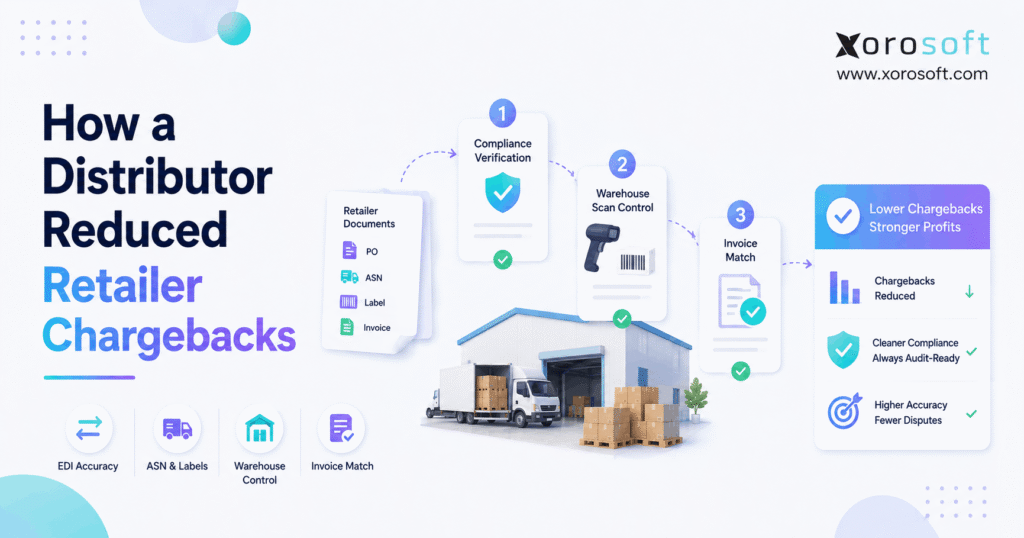
Retailer chargeback reduction is a major priority for businesses looking to protect their revenue and streamline operations.
1. When Retail Deductions Start Pointing to a Bigger Operations Problem
Retailer chargeback reduction becomes critical when deductions stop being rare exceptions and start appearing every month. At first, finance may see each deduction as a payment issue. However, the real error often starts much earlier in the order, warehouse, shipping, EDI, or invoice process. Therefore, distributors that want lasting improvement need to fix the source of the error rather than only dispute the final charge.
For example, a retailer may deduct money because an advance shipping notice does not match the cartons received. Yet the EDI document may not be the original problem. Instead, a warehouse change may have occurred after the ASN data was prepared.
Similarly, a label chargeback may appear to be a printing error. However, the label may have used old order data because the warehouse, sales order, and EDI systems were not working from the same record.
As a result, effective retailer chargeback reduction requires more than one department.
Operations, warehouse teams, EDI staff, customer service, logistics, and finance all play a role.
1.1 What retailer chargebacks really tell a distributor
A retailer chargeback is a deduction linked to a supplier not meeting a retailer’s order, shipping, labeling, EDI, routing, or billing rules.
Therefore, a recurring chargeback is also a warning signal.
For example, repeated short-shipment deductions may point to poor inventory accuracy. Likewise, repeated ASN errors may show that final warehouse data is not reaching the EDI process.
In addition, invoice deductions may show that billing is based on the original order rather than the final shipment.
Consequently, the most useful question is not simply:
“How do we recover this deduction?”
Instead, the better question is:
“Which part of our process keeps creating this deduction?”
That change in thinking is the foundation of retailer chargeback reduction.
1.2 Why chargebacks rise as distributors grow
Retail compliance becomes harder as a distributor adds more customers, SKUs, warehouses, employees, and sales channels.
For instance, one retailer may require one label format, while another requires different carton data. Meanwhile, shipping windows, carrier rules, ASN timing, and invoice requirements may also vary.
Therefore, employees must manage more exceptions as the business grows.
At the same time, Shopify, Amazon, wholesale, EDI, and B2B demand may all compete for the same inventory.
As a result, a process that worked at lower volume can become unreliable.
The problem is rarely that employees suddenly stopped caring. Instead, the process has become too complex to manage through memory, spreadsheets, and manual checks.
2. Retailer Chargeback Reduction Starts With Finding the Real Cause
A distributor cannot improve retailer chargeback reduction by looking only at total deduction dollars.
Instead, every chargeback should be placed into a clear reason group.
Therefore, the distributor first needs to know what type of failure occurred.
2.1 ASN and EDI chargebacks
Many retail relationships depend on a sequence of EDI documents.
For example:
- EDI 850 — Purchase Order
- EDI 855 — Purchase Order Acknowledgment
- EDI 856 — Advance Shipping Notice
- EDI 810 — Invoice
The EDI 856, or ASN, is especially important because it tells the retailer what is being shipped before the goods arrive.
Current retail EDI guidance describes the ASN as a key operating document because it can include carrier details, carton information, SSCC numbers, item quantities, and shipment data.
However, simply sending an ASN is not enough.
The ASN must also match the physical shipment.
Common problems include:
- missing ASN
- late ASN
- wrong PO number
- wrong shipment quantity
- incorrect carton count
- incorrect carrier data
- incorrect tracking details
- carton data that does not match what was shipped
Therefore, ASN chargeback prevention depends on accurate warehouse data.
2.2 Label and carton chargebacks
Physical labels connect electronic information with the carton or pallet moving through the supply chain.
For example, GS1 uses the Serial Shipping Container Code, or SSCC, to identify individual logistics units. GS1 also explains that scanning the SSCC allows the physical unit to be matched with the electronic business messages related to it.
Distributors that need more detail can review the GS1 Logistic Label Guideline.
Therefore, label creation should not be separated from warehouse execution.
Common label errors include:
- wrong purchase order
- wrong ship-to location
- duplicate SSCC
- wrong product data
- unreadable barcode
- incorrect carton identifier
- wrong retailer template
- label data that does not match the ASN
As a result, better labeling controls can support retailer chargeback reduction before cartons leave the warehouse.
2.3 Warehouse execution errors
Even perfect EDI cannot fix an incorrect physical shipment.
Therefore, the warehouse remains one of the most important control points.
Common warehouse errors include:
- wrong SKU
- wrong size
- wrong color
- wrong quantity
- short shipment
- over-shipment
- incorrect case pack
- wrong carton
- incorrect pallet assignment
For example, a retailer may order 50 units of one SKU. However, if the warehouse packs 48 units while the ASN still reports 50, the business now has both a physical and an electronic mismatch.
Consequently, warehouse chargeback prevention must happen during picking and packing rather than after shipment.
3. How Retail Compliance Chargebacks Build Across the Order Flow
Retail compliance failures rarely appear from one isolated mistake.
Instead, one small error can move through several systems.
Therefore, distributors should view the full order flow as one connected process.
3.1 The purchase order sets the first control point
The process begins when the retailer sends an order.
At this stage, the business should check:
- PO number
- customer
- ship-to location
- SKU
- retailer item number
- quantity
- price
- requested ship date
- cancellation date
- routing requirements
For example, if the wrong item mapping enters the sales order, every later document can remain technically consistent while still being wrong.
Therefore, early validation matters.
3.2 Inventory allocation can create later chargebacks
Next, inventory must be assigned to the order.
However, many distributors sell the same inventory across wholesale and ecommerce channels.
For example, a product may be available through wholesale, Amazon, and a Shopify store at the same time.
If one channel consumes inventory already promised to a retailer, the result may be a shortage.
Consequently, that shortage can later cause a partial shipment, late shipment, inaccurate ASN, or invoice difference.
Businesses managing Shopify alongside wholesale can also confirm Xorosoft’s ecommerce availability through the Shopify App Store.
Therefore, accurate allocation is another key part of retailer chargeback reduction.
3.3 Picking and packing turn the promise into a shipment
Once the order reaches the warehouse, digital order data becomes physical inventory movement.
Therefore, every scan matters.
A controlled process may validate:
location → item → quantity → carton
For example, if an employee scans the wrong SKU, the system should flag the error before packing continues.
Likewise, if the expected quantity is ten but only nine are packed, an exception should appear before the carton closes.
As a result, warehouse control prevents errors from reaching the retailer.
4. Retailer Chargeback Prevention Requires Earlier Checks
Many distributors check compliance too late.
For instance, teams may investigate a problem only after the shipment is complete or after finance receives a deduction.
However, by then the order cannot be corrected.
Therefore, a stronger retailer chargeback reduction process moves checks upstream.
4.1 Validate before the order reaches the warehouse
First, check the order before release.
The business should confirm:
- valid retailer account
- valid PO
- correct item mapping
- correct quantity
- available inventory
- correct dates
- customer-specific rules
Consequently, fewer bad orders enter fulfillment.
4.2 Validate during warehouse work
Next, scanning should confirm the physical work.
A modern warehouse management system such as XoroWMS can support receiving, picking, packing, shipping, and warehouse inventory control in one workflow.
Therefore, the warehouse team does not need to rely only on printed lists or memory.
Instead, each step can create a digital record.
4.3 Validate before shipment release
Then, the distributor should perform a final shipment check.
For example:
- Does packed quantity match shipment quantity?
- Do all carton labels match the right order?
- Does the shipping method follow the retailer’s rule?
- Are all required cartons included?
- Is tracking information ready?
- Does the final shipment support an accurate ASN?
Therefore, errors can still be corrected before the carrier takes control.
5. A Better Retailer Chargeback Reduction Workflow
The distributor’s biggest improvement came from replacing separate checks with one connected flow.
As a result, retailer chargeback reduction became part of daily operations instead of a monthly finance project.
5.1 Step one: centralize retailer order data
First, retailer orders need one trusted record.
The order should hold the key customer and fulfillment data used by later processes.
For growing distributors, XoroONE brings sales orders, inventory, purchasing, warehouse management, accounting, reporting, ecommerce, and EDI-related workflows into one cloud ERP environment.
Therefore, different teams can work from connected data rather than separate copies.
5.2 Step two: connect EDI with operations
Next, EDI should not sit outside the main operating flow.
For example, the retailer’s PO should create or update the correct business transaction. Likewise, the final shipment should feed the ASN.
Xorosoft supports a range of ERP, ecommerce, shipping, and EDI integrations.
Therefore, teams can reduce the number of manual handoffs between systems.
However, integration alone is not enough.
Bad data can still move between systems.
Consequently, validation rules must sit inside the workflow.
5.3 Step three: make the final shipment the source for the ASN
The ASN should describe what actually left the warehouse.
Therefore, it should not rely only on the original order plan.
For example, assume the retailer orders 100 units. Later, the warehouse confirms only 98.
In that case, the final shipment record should show 98. Then, the ASN should also show 98.
As a result, the electronic document and physical shipment remain aligned.
6. Distributor Chargeback Management Must Connect Finance and Operations
Finance often learns about a chargeback first.
However, finance should not own the problem alone.
Instead, deduction data should flow back to operations.
6.1 Categorize every deduction
First, record more than the dollar amount.
Track:
- retailer
- reason code
- PO
- shipment
- invoice
- warehouse
- SKU
- chargeback amount
- dispute status
- root cause
- repeat occurrence
Therefore, the company can see patterns.
6.2 Rank problems by cost and frequency
Next, sort chargebacks by total value and number of occurrences.
For example, one large deduction may be unusual. However, hundreds of small label deductions may reveal a broken process.
Therefore, frequency matters as much as total cost.
6.3 Separate prevention from dispute work
Some deductions are valid because the supplier made an error.
However, others may result from a retailer receiving issue, duplicate deduction, or incorrect reason code.
Therefore, businesses need two separate processes:
- prevent valid chargebacks
- dispute invalid chargebacks
This distinction keeps retailer chargeback reduction focused on problems the distributor can actually control.
7. Retailer Chargeback Reduction Before and After Process Changes
The difference becomes clearer when the operating models are compared.
| Before | After |
|---|---|
| Orders copied between systems | Orders use a central record |
| Inventory checked manually | Inventory updates in the operating system |
| Warehouse relies on static lists | Barcode scans validate work |
| Labels are created separately | Labels use shipment and carton data |
| ASN reflects planned shipment | ASN reflects confirmed shipment |
| Routing checks happen late | Routing rules are checked before release |
| Invoice follows original order | Invoice follows confirmed fulfillment |
| Finance sees unexplained deductions | Teams trace deductions to root causes |
| Chargebacks tracked as one total | Chargebacks grouped by reason code |
Therefore, the goal is not merely faster work.
Instead, the goal is controlled work.
As a result, the business reduces the chance that an error moves from one stage into the next.
8. How ERP Supports Retailer Chargeback Reduction
ERP becomes relevant when a distributor’s problem extends beyond one EDI document or one warehouse step.
Therefore, retailer chargeback reduction can become a systems issue as volume grows.
8.1 ERP creates one transaction record
A cloud ERP can connect:
- sales orders
- customer records
- inventory
- purchasing
- warehouse activity
- shipping
- invoices
- accounting
Xorosoft’s XoroERP platform is designed for inventory-driven operations that need connected business workflows.
Therefore, teams can trace an order from entry through shipment and billing.
8.2 WMS controls physical accuracy
Meanwhile, the WMS focuses on what physically happens inside the warehouse.
It can support:
- location control
- barcode scans
- pick confirmation
- pack confirmation
- carton tracking
- shipping
Consequently, the WMS reduces the gap between what the order says and what the warehouse actually does.
8.3 EDI controls trading-partner communication
At the same time, EDI communicates with the retailer.
Therefore, ERP, WMS, and EDI should not operate as three unrelated systems.
Instead, they should exchange trusted data.
For example:
EDI PO → sales order → inventory allocation → warehouse pick → pack → shipment → ASN → invoice
As a result, fewer manual updates are required.
9. Retail Chargeback Reduction KPIs That Show Whether the Process Is Working
A distributor cannot improve what it does not measure.
Therefore, retail chargeback reduction needs clear operating metrics.
9.1 Chargeback rate
First, track chargebacks as a share of retailer sales.
A simple measure is:
chargeback dollars ÷ retailer revenue
Therefore, the company can compare performance even as sales change.
9.2 Chargebacks by reason code
Next, group deductions by cause.
For example:
- ASN
- labels
- shortages
- routing
- timing
- invoice
- packaging
Consequently, management knows which workflow deserves attention first.
9.3 ASN accuracy
ASN accuracy should show whether the electronic shipment data matches confirmed warehouse activity.
Therefore, teams should review both document failures and physical mismatches.
9.4 Pick and pack accuracy
Warehouse accuracy is another key measure.
For example, a scan-based process can help identify wrong items and quantities before shipping.
As a result, fewer mistakes reach the retailer.
9.5 Repeat chargeback rate
Finally, track whether the same chargeback reason returns.
A repeated deduction often means the root cause was never fully fixed.
Therefore, repeat rate can be more useful than simply reporting the amount recovered through disputes.
10. Common Retailer Chargeback Reduction Mistakes
Even well-run distributors can focus on the wrong fix.
Therefore, avoiding common mistakes can speed up retailer chargeback reduction.
10.1 Treating every chargeback as an accounting problem
Accounting sees the deduction.
However, warehouse, EDI, sales, or shipping may have created it.
Therefore, finance needs a clear path to send the issue back to the right team.
10.2 Treating every chargeback as an EDI problem
EDI is important.
However, an accurate EDI 856 cannot fix a carton containing the wrong SKU.
Consequently, electronic and physical accuracy must be managed together.
10.3 Adding automation before fixing the process
Automation can reduce manual work.
However, it can also move bad data faster.
Therefore, the business should first define the correct workflow and then automate it.
10.4 Tracking only total deduction dollars
A total figure shows financial impact.
However, it does not explain what went wrong.
Instead, track reason codes, retailer, warehouse, order, and recurrence.
As a result, teams gain information they can act on.
11. When Retailer Chargeback Reduction Requires a System Upgrade
Not every distributor needs a new ERP.
However, certain signs show that basic tools are reaching their limits.
11.1 The same information is entered several times
For example, employees may copy a PO into one system, shipping data into another, and invoice data into accounting.
Therefore, each handoff creates another error risk.
11.2 Multiple warehouses create more exceptions
As locations increase, inventory allocation and shipment control become harder.
Consequently, central visibility becomes more important.
11.3 Ecommerce and wholesale compete for stock
A growing brand may serve retailers while also selling through Shopify, Amazon, and other channels.
Therefore, stock must be managed across the whole business rather than by separate teams.
11.4 Finance cannot trace deductions quickly
If one chargeback requires several emails and spreadsheets to reconstruct an order, the audit trail is weak.
Therefore, integrated records can become a strong business need.
Companies facing those conditions can review Xorosoft’s broader ERP and operations solutions to understand which functions need to work together.
12. Who May Not Need a Full ERP for Retail Chargebacks
A full ERP is not always the right answer.
Therefore, businesses should match the solution to the problem.
12.1 Low-volume retail suppliers
A supplier processing a small number of retailer orders may manage EDI through a portal.
Likewise, one warehouse and a limited SKU range may not justify a large system change.
12.2 Businesses with isolated deduction problems
If warehouse, inventory, EDI, and accounting data are already accurate, the main need may simply be better deduction review.
In that case, a focused deduction tool may be enough.
12.3 Companies with simple operating models
Similarly, a business that does not manage complex inventory, multiple channels, or several warehouses may need fewer controls.
Therefore, software should not be added simply because chargebacks exist.
Instead, system upgrades make the most sense when recurring deductions reveal wider process gaps.
13. A Six-Step Retailer Chargeback Reduction Framework
A practical retailer chargeback reduction plan can follow six steps.
13.1 Step 1: Measure
First, calculate total deductions and chargeback rate by retailer.
Then, compare the current period with earlier periods.
13.2 Step 2: Categorize
Next, assign every deduction a clear reason.
For example, use groups such as ASN, label, quantity, routing, timing, and invoice.
13.3 Step 3: Trace
After that, follow each major problem back through the order flow.
Therefore, teams can identify the first point where the process failed.
13.4 Step 4: Correct
Next, add a control before that failure point.
For example:
- order validation
- item mapping
- barcode scan
- quantity check
- label check
- shipping-rule check
- ASN match
- invoice match
13.5 Step 5: Automate
Once the process is correct, automate repeat work.
Therefore, staff spend less time moving data manually.
13.6 Step 6: Monitor
Finally, watch for repeat deductions.
If the same reason returns, investigate again.
As a result, retailer chargeback reduction becomes an ongoing operating process rather than a one-time project.
14. Retailer Chargeback Prevention by Industry
The core controls are similar across industries.
However, the risk points can differ.
14.1 Apparel and fashion
Apparel orders often involve style, color, and size combinations.
Therefore, barcode checks and correct item mapping are especially important.
Likewise, seasonal delivery windows can make late shipments costly.
14.2 Furniture
Furniture distributors often manage large items and more complex shipping steps.
As a result, routing, carrier choice, packaging, and delivery appointments can require extra control.
14.3 Sporting goods
Sporting goods suppliers may manage seasonal demand, retailer-specific packs, and large SKU ranges.
Therefore, inventory allocation and warehouse accuracy become key.
14.4 Food and beverage
Food distributors may also need lot, expiry, and case-level control.
Consequently, product and warehouse records must remain accurate throughout fulfillment.
14.5 Consumer products and wholesale
High SKU counts and many retail partners create more data mappings and customer rules.
Therefore, connected order and warehouse systems can reduce manual checks.
Businesses can explore the different industries Xorosoft supports when evaluating how these workflows change by operating model.
15. Retailer Chargeback Reduction Checklist
Before shipping a retail order, distributors should confirm the following:
- PO data is valid
- retailer item mapping is correct
- inventory is available
- correct SKU is picked
- correct quantity is packed
- cartons are assigned correctly
- label information matches the carton
- SSCC is unique where required
- routing requirements are followed
- shipment timing is valid
- final shipment data is confirmed
- ASN matches final fulfillment
- invoice matches the shipped quantity
- exceptions are reviewed before release
Therefore, this checklist brings the main retailer chargeback reduction controls into one process.
However, high-volume distributors should avoid relying on a manual checklist forever.
Instead, many of these checks should eventually become system rules.
16. Frequently Asked Questions About Retailer Chargeback Reduction
16.1 What is retailer chargeback reduction?
Retailer chargeback reduction is the process of finding recurring retailer deductions, tracing them to the original operating error, and adding controls that prevent the same error from happening again. Therefore, it focuses on prevention rather than only recovering money after a deduction.
16.2 What are the most common retailer chargebacks?
Common retailer chargebacks involve ASN errors, labeling issues, quantity differences, short shipments, routing violations, late shipments, carton errors, and invoice mismatches. However, exact rules vary by retailer. Therefore, distributors should always review the current trading-partner guide.
16.3 What causes EDI chargebacks?
EDI chargebacks can result from missing, late, invalid, or inaccurate documents. For example, an ASN may contain the wrong quantity or shipment details. Therefore, EDI data should be linked to the final operating record rather than entered separately.
16.4 What causes ASN chargebacks?
ASN chargebacks often occur because the EDI 856 is late, missing, or does not match the actual shipment. Therefore, distributors should create the ASN from confirmed warehouse and shipping data whenever possible.
16.5 How can a distributor prevent ASN errors?
First, confirm the physical shipment. Next, ensure carton, quantity, carrier, PO, and tracking data are correct. Then, generate the ASN from that final record. As a result, the electronic notice is more likely to match what the retailer receives.
16.6 Can warehouse mistakes create retailer chargebacks?
Yes. For example, a wrong SKU, short shipment, incorrect carton, or bad label can create a deduction. Therefore, barcode scanning and packing checks are important parts of retailer chargeback prevention.
16.7 Can inventory errors cause retailer chargebacks?
Yes, although the effect may be indirect. For example, inaccurate inventory can cause shortages or late shipments. Consequently, the distributor may miss quantity, timing, or ASN requirements.
16.8 What is GS1-128 label compliance?
GS1-128 is a barcode type used for structured GS1 data, including logistics information. In addition, GS1 explains that the SSCC is used to uniquely identify logistics units. Therefore, accurate logistics labels can help connect physical cartons and pallets with electronic data.
16.9 What is routing guide compliance?
Routing guide compliance means following a retailer’s shipping rules. For example, those rules may cover carriers, service levels, appointments, shipment windows, packaging, and documents. Therefore, routing should be checked before shipment release.
16.10 What is an OTIF chargeback?
OTIF means On Time In Full. In general, a retailer may assess penalties when a supplier misses required timing or quantity targets. However, definitions can vary by retailer. Therefore, suppliers should follow each retailer’s current policy.
16.11 How does ERP help reduce retailer chargebacks?
ERP can connect sales orders, inventory, purchasing, shipment data, invoices, and accounting. Therefore, it reduces the need to maintain several separate copies of the same transaction. When ERP is also connected with WMS and EDI, retailer chargeback prevention can become more automated.
16.12 How does a WMS help prevent retailer chargebacks?
A WMS can guide and record warehouse work through scanning and task controls. For example, it can help validate items, locations, quantities, cartons, and shipments. Consequently, warehouse errors can be identified before the order ships.
16.13 Can EDI automation eliminate chargebacks?
No. EDI automation can reduce document errors and manual entry. However, it cannot fix a physically incorrect shipment. Therefore, EDI automation works best when warehouse, inventory, and order data are also accurate.
16.14 What is retailer deduction management?
Retailer deduction management is the process of reviewing short payments and deductions, checking whether they are valid, collecting evidence, and disputing incorrect charges. However, deduction management happens after the deduction. Retailer chargeback prevention happens before it.
16.15 Should distributors track chargebacks by reason code?
Yes. Total deduction dollars show the financial effect, but reason codes explain where problems occur. Therefore, distributors should group chargebacks by cause and review the largest or most repeated categories.
16.16 What retailer chargeback KPIs should distributors track?
Useful measures include chargeback rate, chargebacks by reason code, ASN accuracy, pick accuracy, fill rate, label errors, repeat deductions, and dispute recovery. Together, these metrics show both prevention and recovery performance.
16.17 How do you perform chargeback root-cause analysis?
Start with the deduction and trace the order backward. Review the invoice, shipment, ASN, carton data, warehouse scans, sales order, and original PO. Then, find the first place where the records stopped matching. Therefore, the corrective action can target the real cause.
16.18 When should a distributor upgrade its ERP?
An upgrade becomes worth considering when teams re-enter data, warehouses use separate systems, ecommerce and wholesale compete for inventory, EDI is disconnected, or finance cannot trace deductions. Therefore, recurring chargebacks can be one sign of a wider systems problem.
16.19 Can retailer chargebacks be eliminated completely?
Probably not. Some issues may involve carriers, retailers, or unusual events outside the distributor’s control. However, recurring and preventable errors can often be reduced significantly through better data, process controls, and system links.
16.20 Is chargeback prevention better than disputing deductions?
Both matter. However, preventing a valid chargeback avoids the cost and work in the first place. Therefore, distributors should use dispute management for incorrect deductions while using root-cause analysis to stop valid deductions from repeating.
16.21 Can multi-channel selling increase chargeback risk?
Yes. When Shopify, Amazon, wholesale, and retail orders share inventory, poor allocation can create shortages. Therefore, multi-channel inventory should be managed from a clear source of truth.
16.22 Does every distributor need chargeback software?
No. A low-volume supplier may handle occasional issues manually. However, frequent deductions across several retailers may justify stronger ERP, WMS, EDI, or deduction tools.
16.23 Why do invoice mismatches create retailer deductions?
Retailers often compare invoice data with purchase-order and shipment information. Therefore, billing a quantity or price that does not match the approved transaction can delay payment or create a deduction.
16.24 Why should warehouse and EDI data be connected?
The warehouse records what physically shipped, while EDI tells the retailer what shipped. Therefore, the two records should agree. Otherwise, a correct warehouse shipment can still result in an incorrect ASN.
16.25 What is the first step in retailer chargeback reduction?
The first step is to categorize current deductions. Next, rank them by cost and frequency. Then, trace the largest repeat problems to their source. Therefore, the company starts by fixing the issues that create the most waste.
17. Turn Retail Chargebacks Into an Operations Improvement Signal
Retail deductions should not remain unexplained finance costs.
Instead, they should become data that helps operations improve.
Therefore, effective retailer chargeback reduction connects the original retailer order with inventory allocation, warehouse execution, carton data, labels, shipping, EDI, invoicing, and accounting.
When those steps work from consistent data, teams can detect more errors before shipment.
Moreover, the business gains a clearer record when a deduction must be reviewed.
For growing inventory-driven brands and distributors, Xorosoft can connect inventory, orders, warehouse work, accounting, purchasing, ecommerce, and EDI-related processes in one operating environment. Businesses that want to review real implementation examples can also explore Xorosoft’s ERP customer case studies.
Ultimately, retailer chargeback reduction is not about creating a larger team to manage deductions.
It is about creating fewer preventable deductions in the first place.
If recurring chargebacks are exposing gaps between your ERP, warehouse, inventory, EDI, and accounting processes, you can Book a Demo with Xorosoft to see how a more connected workflow could support your operation.
Recent Posts
-
 ERP Landed Cost Module vs Spreadsheet Calculations for Importers
 -
 How to Build an Open-to-Buy Plan for an Omnichannel Brand
 -
 Cold Storage WMS for Food and Beverage Distribution
 -
 ERP Buying Statistics 2026: Evaluation, Implementation, and Adoption Risks
 -
 How a Distributor Reduced B2B Order Exceptions Without Restricting Sales