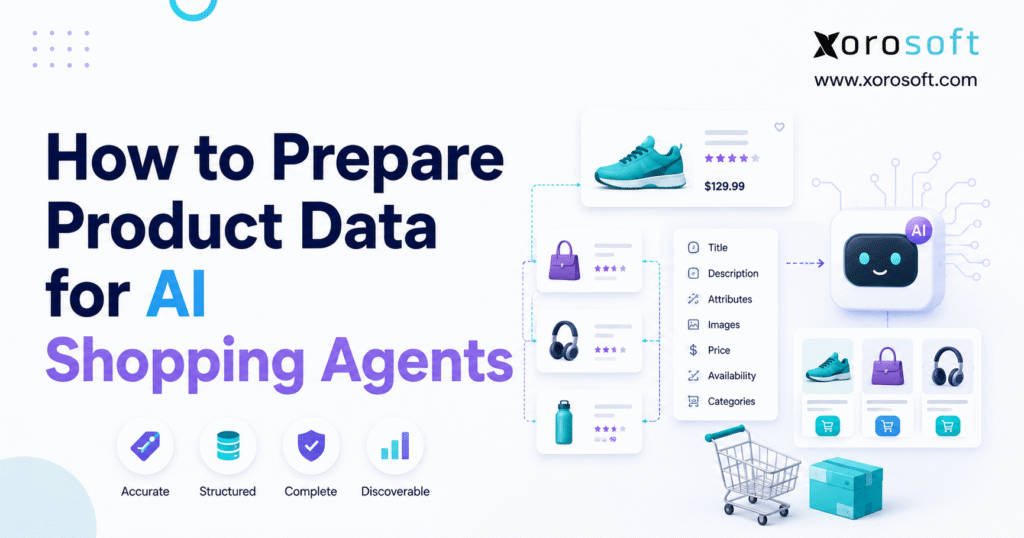
If you want to understand how AI shopping product data is transforming the retail industry, you’re in the right place.
1. AI Shopping Is Turning Product Data Into an Operational Priority
The way consumers discover products is changing. Instead of starting every purchase with a short keyword search, shoppers can increasingly describe what they want in natural language and ask an AI system to narrow the market for them.
A buyer might ask for “a waterproof hiking jacket under $200, available in men’s large, suitable for heavy rain, and deliverable before Friday.” That request contains several purchasing constraints at once. To respond accurately, an AI shopping system needs to understand the product category, size, material or performance characteristics, current price, availability, and possibly shipping information.
That is why AI shopping product data is becoming more than an ecommerce merchandising issue.
Traditional product-page optimization typically focuses on titles, descriptions, images, category placement, and keywords. Those elements still matter. However, AI shopping agents also need machine-readable facts that allow them to distinguish products, compare variants, interpret specifications, understand availability, and evaluate whether an offer satisfies a buyer’s requirements.
The problem becomes more difficult when the information visible on the storefront does not match the operational reality behind it.
A website may say that a product is in stock while the warehouse has already allocated every available unit. A marketplace may display an old price. Shopify may contain one product title while an ERP or inventory application uses another SKU. A product feed may contain outdated variant information.
Adding AI discovery on top of that fragmented environment does not solve the underlying problem. It simply creates another channel through which inconsistent information can reach potential customers.
Preparing for AI shopping therefore starts with the quality of the product-data foundation.
2. What AI Shopping Product Data Needs to Include
An AI-ready catalog should allow a shopping system to answer several basic questions without guessing: What is the item? Which exact version is being offered? What characteristics does it have? What does it cost? Is it available? Can it be delivered under the customer’s requirements?
2.1 Product Identity for AI Shopping Agents
Every sellable item should have a stable identity.
An internal SKU usually provides the operational reference, while recognized identifiers such as GTIN, UPC, ISBN, or manufacturer part number may help external systems identify products across sellers and catalogs.
OpenAI’s current merchant product-feed framework, for example, includes stable item IDs as core product information and supports identifiers such as GTIN and MPN. Google Merchant Center also relies heavily on accurate identifiers when they legitimately apply to a product.
The practical rule is straightforward: preserve stable identifiers and do not invent identifiers simply to fill an empty field.
Changing a SKU or item ID because the marketing title changed can create unnecessary matching problems across ecommerce platforms, marketplaces, feeds, warehouse systems, and historical transactions.
2.2 AI-Ready Product Titles and Descriptions
Product titles should identify an item clearly rather than trying to contain every possible keyword.
A title such as “Premium Amazing Modern Chair Best Furniture for Home Office” provides less useful information than a title that clearly identifies the brand, model, material, product type, and relevant variant.
Descriptions should then provide meaningful context.
Useful descriptions explain intended use, construction, compatibility, important specifications, package contents, care requirements, installation considerations, or other details that influence the purchase.
For AI shopping product data, factual completeness matters more than promotional language. An AI system gains little from repeatedly being told that a product is “premium” if the catalog does not say what material it uses, how large it is, or which devices it supports.
2.3 Structured Product Attributes for AI Shopping
Important buying facts should exist as discrete fields wherever practical.
For apparel, that may include color, size, material, fit, pattern, and age group. Furniture sellers may need dimensions, finish, weight, seating capacity, construction material, and assembly requirements. Sporting-goods companies may require size, activity, compatibility, capacity, weight, or other technical specifications.
Structured attributes make product comparison easier because software does not need to infer every detail from paragraphs of text.
This is particularly important for conversational product discovery. A customer asking for “a walnut desk less than 50 inches wide” has expressed two clear constraints. If material and width are structured fields, matching is far more reliable.
2.4 Product Variants in an AI-Ready Catalog
Variants should be related explicitly.
A shirt available in six sizes and five colors represents 30 sellable combinations, but those combinations should not appear as 30 unrelated products in the underlying catalog.
Each sellable variant needs its own identifier, price, inventory status, and relevant attributes. At the same time, related variants should maintain a parent or group relationship.
The same principle applies to finish, pack quantity, capacity, material, model configuration, and other options.
Clear variant modeling helps AI shopping agents distinguish between “the same product in another size” and “a completely different product.”
3. Pricing, Inventory, and Fulfillment in AI Shopping Product Data
Descriptions help explain what a product is. Operational data determines whether the product can actually be sold under the terms shown to the customer.
3.1 Accurate Pricing for AI Shopping Agents
Price information should come from a controlled source and remain synchronized across relevant channels.
A business may need to manage standard price, sale price, promotional dates, currency, marketplace-specific prices, and wholesale pricing.
The problem is not simply cosmetic. If an AI shopping experience recommends a product because it appears to cost $79 and the landing page shows $99, the recommendation no longer matches the customer’s original request.
Accurate AI shopping product data therefore requires clear ownership of pricing and reliable distribution of changes.
3.2 Real-Time Inventory for AI Product Discovery
Inventory presents an even larger challenge because physical stock can change throughout the day.
The quantity physically on hand is not always the quantity available to the next customer.
Suppose a warehouse contains 100 units. Thirty are allocated to existing orders, ten are reserved for replacements, and another five have already been picked. Publishing all 100 as available would create a misleading customer promise.
Businesses should define how available-to-sell inventory is calculated and make sure the same logic reaches ecommerce and downstream feeds.
3.3 Shipping Data for Agentic Commerce
Delivery information can also determine whether a product satisfies a conversational shopping request.
If the buyer says, “I need it by Monday,” a product that ships in seven business days is not an appropriate recommendation regardless of its price or features.
Handling time, shipping method, warehouse eligibility, delivery estimates, cutoff times, and pickup options therefore belong within the broader product-data strategy.
Google’s Merchant Center specification continues to add more detailed product-level shipping fields, reinforcing the direction toward increasingly structured commerce information.
4. The Four Layers of AI-Ready Product Data
A useful way to organize AI shopping product data is to separate it into four layers. Each layer answers a different buying question.
4.1 Discovery Data for AI Shopping Agents
Discovery data answers: What is this product?
It includes product title, brand, category, product identifiers, descriptions, canonical URLs, and primary imagery.
If this information is incomplete, the item may be difficult to classify correctly.
4.2 Decision Data in an AI Product Catalog
Decision data answers: Does this product fit the customer’s requirement?
Examples include material, dimensions, compatibility, size, capacity, technical features, intended use, construction, and other specifications.
This information becomes increasingly important as customer queries become more detailed.
4.3 Transaction Data for Agentic Commerce
Transaction data answers: What offer is available right now?
It includes price, promotion details, inventory status, delivery information, shipping cost, and relevant return conditions.
These fields can change much more frequently than descriptive catalog information.
4.4 Operational Data Behind AI Shopping
Operational data determines whether the transaction information is actually true.
It includes warehouse quantities, allocations, purchase orders, inventory transfers, production activity, replenishment, and fulfillment rules.
A strong catalog connects all four layers.
If discovery data says the item is a blue medium jacket, decision data says it is waterproof, and transaction data says it is available for $149, the operational layer should confirm that a sellable blue medium jacket really exists and can be fulfilled.
5. How to Prepare AI Shopping Product Data Step by Step
A reliable implementation should begin with data governance rather than immediately generating new content.
5.1 Audit Your AI-Ready Product Catalog
Start by examining existing records.
Look for duplicate SKUs, missing identifiers, incomplete attributes, obsolete products, broken images, inconsistent categories, incorrect variant relationships, conflicting prices, and questionable availability.
The most valuable part of the audit is often comparing the same SKU across systems.
Shopify may show one title. Amazon may contain an older version. Accounting may use a different item name. A warehouse application may reference another SKU. Those disagreements become more difficult to manage as more product-discovery channels are added.
5.2 Define Product Data Ownership
Every important field should have a source of truth.
An ERP may own inventory and purchasing. A PIM may own enriched attributes and taxonomy. Shopify may own merchandising information. A WMS may control warehouse execution. A feed-management platform may transform records for destination-specific requirements.
The architecture can vary, but ownership should not.
If two teams can independently change the same field without defined precedence, the systems will eventually disagree.
5.3 Standardize Product Identifiers for AI Shopping
Clean SKU conventions before adding new integrations.
Preserve stable IDs, capture legitimate global identifiers when available, and make sure parent products and variants follow predictable relationships.
The more channels a company operates, the more valuable consistent identification becomes.
5.4 Normalize Product Attributes for AI Agents
Product values should follow intentional standards.
If the same color appears as “Navy,” “navy blue,” “NVY,” and “Dark Navy,” downstream systems may interpret those records differently.
The goal is not to eliminate useful merchandising language. Instead, maintain a standardized underlying value and transform presentation where necessary.
The same approach applies to dimensions, units of measure, materials, size systems, categories, and technical specifications.
5.5 Structure Product Variants Correctly
Each sellable variant should have a unique record, while related records should remain grouped under a common product family.
Important differences such as size, color, finish, pack quantity, material, or capacity should exist as structured attributes.
This gives both human-facing ecommerce interfaces and machine-driven discovery systems a clearer representation of the catalog.
5.6 Enrich Product Data for AI Discovery
Once the structure is reliable, improve completeness.
Ask what information an experienced salesperson would need to recommend the correct product.
If buyers repeatedly ask about compatibility, material, dimensions, performance, capacity, installation, or product use, those facts should probably appear within the structured product record.
5.7 Improve Product Images and Media
Product imagery should be clear, product-specific, stable, and accessible to systems that need to retrieve it.
Primary images should represent the exact product or variant being sold. Supporting images can show dimensions, features, alternative views, packaging, or real-world usage.
Rich product feeds are also beginning to include more media types, making product-video governance increasingly relevant.
5.8 Synchronize AI Shopping Pricing Data
Determine which application establishes the active selling price and how that information reaches every destination.
Promotions require extra care because start dates, end dates, and temporary sale prices can easily become stale.
Businesses selling internationally should also manage currency and regional pricing intentionally rather than assuming one price field applies everywhere.
5.9 Keep Inventory Data Accurate for AI Agents
Inventory updates should reflect operational reality rather than a manually maintained storefront number.
Complex businesses may need to account for allocations, transfers, multiple warehouses, inbound purchase orders, manufacturing supply, and channel-specific reservations.
This is where AI shopping product data begins to depend heavily on the ERP and inventory architecture behind the store.
5.10 Maintain Reliable Fulfillment Data
Shipping promises should match what operations can consistently deliver.
Document handling times, eligible warehouses, cutoff rules, service levels, and any other conditions that influence delivery expectations.
A technically perfect product feed cannot compensate for unreliable fulfillment promises.
5.11 Add Structured Product Data and Schema
Structured data helps machines interpret commercial information on product pages.
Product and Offer markup can expose information such as price, availability, identifiers, and other merchant details in a standardized format.
However, schema should describe the actual customer-facing offer. It should not be treated as a separate version of the truth.
5.12 Build Product Feeds for AI Shopping Agents
A well-governed product master can support many destinations, but each platform may have different specifications.
Google Merchant Center, marketplaces, Shopify-related commerce surfaces, and OpenAI merchant integrations can require different field mappings or supported values.
Instead of building a completely separate catalog for every destination, maintain a reliable master and transform it into the required output format.
5.13 Monitor AI Shopping Product Data Quality
Catalog quality deteriorates when nobody owns ongoing maintenance.
New SKUs appear. Suppliers change product specifications. Promotions expire. Warehouses receive and ship inventory. Products are discontinued. New marketplaces are added.
Monitor missing attributes, duplicate records, feed errors, stale prices, broken images, inventory discrepancies, invalid variants, and rejected products continuously.
6. How AI Shopping Product Data Reaches Discovery Platforms
There is no single technology that makes a product visible to every AI shopping platform. Several layers can work together.
6.1 Structured Product Data for AI Discovery
Structured markup describes the product on a webpage in a machine-readable format.
It helps search systems interpret information but does not replace the systems where price, inventory, and product attributes are maintained.
6.2 Product Feeds for AI Shopping Agents
Feeds distribute structured catalogs at scale.
They become valuable when merchants need to transmit thousands of product records along with current price, availability, imagery, identifiers, and attributes.
OpenAI now supports structured merchant product information for shopping-related experiences, reinforcing the importance of having reusable product records rather than relying solely on webpage extraction.
6.3 APIs for Agentic Commerce Product Data
APIs provide another mechanism for systems to exchange product and commerce information.
They can be useful when data freshness, automation, or bidirectional workflows are important.
A business does not necessarily need every possible integration method. The appropriate approach depends on the destination and operational complexity.
6.4 PIM and ERP Roles in AI-Ready Product Data
PIM and ERP systems solve different problems.
A PIM primarily helps organize, enrich, categorize, localize, and publish product information. ERP primarily manages operational processes such as inventory, purchasing, orders, accounting, and, depending on the platform, manufacturing.
For inventory-driven companies, a cloud ERP for connected inventory and operational workflows becomes important when the accuracy of customer-facing product information depends on purchasing, stock, warehouse activity, and transaction data staying synchronized.
7. Real-Time Inventory Data for AI Shopping Agents
Inventory is where product-data strategy meets physical operations.
7.1 Multi-Warehouse Inventory for AI Shopping
A company may carry the same SKU in Toronto, Vancouver, Los Angeles, and New York.
Whether that product should be shown as available can depend on customer location, warehouse eligibility, inventory allocations, channel rules, shipping time, and whether another open order has already committed the stock.
A connected warehouse management system becomes valuable when businesses need warehouse movements and fulfillment activity to remain aligned with the availability information published downstream.
7.2 Incoming Inventory and AI Product Availability
Purchase orders can improve future supply without creating stock that is available today.
A reliable system should distinguish between inventory available now, stock expected in the future, backordered quantities, and inventory that cannot currently be promised.
That distinction becomes particularly important for preorder and backorder scenarios.
7.3 Manufacturing Data for AI Product Discovery
Manufacturers face an additional challenge because finished-goods availability may depend on work orders, bills of material, component shortages, production schedules, and lead times.
For these businesses, AI shopping product data may ultimately rely on manufacturing and material-planning information that never appears directly on the product page.
8. How ChatGPT, Google, and Shopify Use AI Shopping Product Data
AI shopping is developing through several different ecosystems. Merchants should work from confirmed platform requirements rather than assuming every agent consumes the same information in the same way.
8.1 ChatGPT Product Data and Product Discovery
OpenAI has expanded its commerce infrastructure to support richer product discovery.
The current direction emphasizes structured merchant data that can help systems understand product identity, price, availability, variants, and other commercial information.
For merchants, the practical lesson is not to optimize solely for a single ChatGPT feature. It is to build product information that can be transformed for structured commerce integrations as they evolve.
8.2 Google Merchant Data for AI Shopping
Google Merchant Center has long required detailed product information for shopping experiences.
Structured product data on ecommerce pages can complement Merchant Center feeds by giving Google another source for product facts such as price and availability.
This reinforces a broader rule: feeds, structured data, and landing pages should agree.
8.3 Shopify Product Data for Agentic Commerce
Shopify is actively investing in infrastructure for agentic commerce and AI-driven product discovery.
For merchants with relatively straightforward operations, Shopify may already hold much of the product information required for commerce distribution.
However, when Shopify sits alongside purchasing, accounting, multiple warehouses, wholesale, manufacturing, or marketplace operations, businesses may need a deeper operational source of truth.
XoroONE can serve that role for inventory-driven businesses by connecting ecommerce with inventory, purchasing, warehouse, accounting, and related workflows.
Shopify merchants can also review the Xorosoft ERP app listing when evaluating how the ERP connects with their ecommerce environment.
9. Industry-Specific AI-Ready Product Data Requirements
“Complete” product data means different things in different industries.
9.1 AI Shopping Product Data for Apparel
Apparel catalogs rely heavily on variants.
Size, color, fit, material, pattern, gender or age group, seasonality, and variant-level stock should be managed consistently.
A detailed description cannot compensate for a size option that is incorrectly grouped or an inventory feed that says every color is available when only one variant remains.
9.2 AI-Ready Product Data for Furniture
Furniture buyers often care about exact dimensions, materials, finish, seating capacity, weight, assembly, package dimensions, and delivery considerations.
Conversational shopping makes these details particularly important because buyers frequently describe physical constraints.
9.3 Product Data for Sporting Goods AI Shopping
Sporting-goods products may need technical attributes such as intended activity, compatibility, dimensions, capacity, performance characteristics, material, or skill level.
Those fields help an AI agent distinguish products that look similar but serve different use cases.
9.4 Wholesale Product Data for AI Agents
Wholesale catalogs add operational considerations such as case packs, minimum quantities, EDI identifiers, customer-specific references, lead times, and potentially account-specific pricing.
The customer-facing product record may therefore depend on much more than the storefront catalog.
9.5 Manufacturing Product Data for Agentic Commerce
Manufacturers may need to connect commercial product records with bills of material, production status, work orders, component supply, and finished-goods inventory.
Businesses assessing how these requirements differ across sectors can review Xorosoft’s coverage of inventory-driven industries.
10. Common AI Shopping Product Data Mistakes
Most problems that undermine AI shopping readiness are not new. They are long-standing ecommerce and operations problems appearing in a new channel.
10.1 Relying Only on Product Descriptions
Descriptions provide context, but they should not replace structured product facts.
Material, dimensions, compatibility, capacity, size, and other comparison attributes should exist as fields when they materially influence the purchase.
10.2 Generating AI Content Before Cleaning Product Data
Automatically generating thousands of descriptions can make a catalog look complete while leaving duplicate SKUs, invalid categories, and incorrect specifications untouched.
The better sequence is structure first, enrichment second.
10.3 Letting Inventory Data Drift Across Channels
If Shopify, Amazon, wholesale operations, and the warehouse maintain different inventory assumptions, additional AI-shopping destinations will multiply the problem.
Inventory should originate from clearly governed operational rules.
10.4 Publishing Stale AI Shopping Pricing Data
Price changes should propagate through controlled integrations.
Manual updates become increasingly risky as the number of selling and discovery channels grows.
10.5 Treating Product Schema as the Entire AI Strategy
Schema is valuable because it communicates information clearly to machines.
However, if the underlying inventory value is wrong, perfect structured markup simply publishes the wrong information in a cleaner format.
10.6 Ignoring Data Ownership
One of the most damaging catalog problems occurs when marketing, ecommerce, warehouse, purchasing, and finance teams each maintain their own version of the same item.
Defining which system owns each field is one of the most important steps in creating reliable AI shopping product data.
11. ERP, PIM, and Ecommerce Platforms for AI Shopping Product Data
Choosing software should begin with the source of the problem rather than the latest technology trend.
| System | Primary Role | Typical Responsibility |
|---|---|---|
| Ecommerce platform | Customer storefront | Products, merchandising, checkout |
| PIM | Product enrichment | Attributes, taxonomy, content, media |
| ERP | Operational system | Inventory, purchasing, orders, accounting |
| WMS | Warehouse execution | Locations, picking, movements, fulfillment |
| Feed platform | Channel distribution | Destination-specific product transformations |
11.1 When an Ecommerce Platform Is Enough
A smaller merchant with one warehouse, a straightforward catalog, simple purchasing, and limited channel complexity may not require an enterprise product-data stack.
Adding software simply because AI shopping is receiving attention can introduce unnecessary complexity.
The objective is reliable data, not the maximum number of applications.
11.2 When AI-Ready Product Data Needs a PIM
PIM becomes useful when product enrichment itself becomes difficult.
Large attribute sets, complex taxonomy, multilingual content, extensive digital assets, and many publishing destinations are common triggers.
11.3 When AI Shopping Product Data Needs ERP
ERP becomes more important when product promises depend on operations.
Multiple warehouses, purchasing, forecasting, manufacturing, EDI, wholesale orders, allocations, accounting, and complex replenishment all make downstream product accuracy dependent on a reliable operational system.
Businesses reaching that stage may compare different ERP models and implementation approaches. A resource such as the Xorosoft vs NetSuite comparison can help frame those differences without assuming that every ERP is appropriate for every organization.
12. AI Shopping Product Data Readiness Checklist
A catalog does not need every imaginable attribute to become AI-ready. It needs reliable information in the fields that affect identification, comparison, purchasing, and fulfillment.
First, validate product identity. Each active sellable SKU should have a stable internal identifier, while recognized global identifiers should be present where legitimately applicable.
Next, evaluate content quality. Product titles should clearly identify the item. Descriptions should contain useful buying context. Critical category-specific attributes should be complete and normalized.
Then review variant structure. Each sellable option should have its own identity, while related variants should remain grouped consistently.
Commercial data deserves separate attention. Prices should match the landing page and checkout experience. Inventory should reflect what can actually be sold. Shipping and handling information should align with warehouse performance.
Finally, compare every important SKU across the systems that publish it. Ecommerce, ERP, marketplaces, feeds, and warehouse applications should not tell different stories about the same product.
The purpose of the checklist is to create reusable AI shopping product data, not a separate catalog for every AI platform.
13. A 90-Day AI-Ready Product Data Roadmap
Businesses do not need to rebuild their commerce technology in one project. A staged approach is usually more practical.
13.1 Days 1–30: Audit AI Shopping Product Data
Use the first month to understand the current state.
Identify duplicate products, missing identifiers, inconsistent attributes, broken variants, stale pricing, incorrect availability, and disagreements between systems.
Document where every critical field originates and who is responsible for maintaining it.
Do not automate poor data before establishing a reliable source.
13.2 Days 31–60: Connect Product and Operational Data
Once ownership is clear, improve the movement of information between ERP, ecommerce, PIM, warehouse systems, marketplaces, and feeds.
Prioritize inventory and price because they change frequently and can create immediate customer problems when stale.
This phase should eliminate unnecessary manual imports and repeated data entry where practical.
13.3 Days 61–90: Publish and Monitor AI Product Data
During the final phase, validate structured data, feeds, URLs, product media, pricing, availability, and relevant AI-commerce integrations.
Create dashboards or exception reports for data-quality issues.
The real goal is not “launch an AI feed.” It is to build an operating model where a new discovery channel can be added without rebuilding the catalog from scratch.
14. How to Measure AI Shopping Product Data Readiness
AI readiness should be measurable.
14.1 Measure Product Attribute Completeness
Track the percentage of active products containing all mandatory attributes for their category.
Avoid relying on one catalog-wide completeness score when categories have very different information requirements.
14.2 Measure Identifier and Variant Quality
Monitor duplicate SKUs, missing legitimate identifiers, broken parent-child relationships, and inconsistent option values.
Variant problems can make a large catalog appear much more fragmented than it really is.
14.3 Measure Pricing and Inventory Consistency
Compare values across ERP, ecommerce, feeds, and marketplaces.
The goal should be to reduce both the number of mismatches and the time required for operational changes to reach downstream channels.
14.4 Measure Product Feed Errors and Data Freshness
Monitor destination-specific warnings, rejected products, missing fields, and update delays.
Descriptive product information may remain stable for months. Inventory can change throughout the day. Data-freshness targets should therefore vary by field type.
15. Frequently Asked Questions About AI Shopping Product Data
15.1 What is an AI shopping agent?
An AI shopping agent is software that helps consumers discover, compare, and evaluate products based on natural-language requests and preferences. Depending on the platform, it may use public webpages, structured data, merchant feeds, APIs, product catalogs, or integrations to determine which products best match the buyer’s needs.
15.2 What is agentic commerce?
Agentic commerce refers to commerce experiences in which AI agents participate in product discovery, comparison, and potentially transaction-related workflows. The capabilities differ by platform, but the underlying trend is toward systems that can interpret buyer intent and act on more structured merchant and product information.
15.3 How do AI shopping agents find products?
There is no universal method. An AI platform may use public web information, structured markup, merchant product feeds, APIs, product catalogs, or direct commerce integrations. Merchants should therefore focus on building reliable product information that can be reused across several discovery mechanisms.
15.4 What product data do AI shopping agents need?
Useful fields typically include stable identifiers, title, brand, description, product category, structured attributes, variants, images, current price, availability, and fulfillment information. Exact requirements differ between platforms, so the best strategy is to maintain a complete product master and transform it for each destination.
15.5 What makes AI shopping product data different from normal ecommerce data?
The core facts are similar, but AI shopping places greater pressure on structure, consistency, and machine readability. Conversational queries may contain several constraints at once, requiring software to compare attributes, price, availability, shipping, and variants rather than relying only on keywords or product-page copy.
15.6 How can products become easier for ChatGPT to discover?
Merchants should begin with accurate public product pages and structured catalog information. Businesses considering direct commerce participation should review OpenAI’s current merchant and product-feed requirements. Because those specifications can evolve, implementations should follow current official documentation rather than generic AI SEO checklists.
15.7 Does ChatGPT use merchant product data?
OpenAI has developed merchant-product infrastructure to support richer shopping discovery. Its current framework supports structured information covering product identity, content, price, availability, variants, and fulfillment. Merchant eligibility and implementation requirements should always be checked against the latest official OpenAI documentation.
15.8 Is schema markup enough for AI shopping?
No. Schema markup can help machines interpret information on a product page, but it does not fix inaccurate inventory, stale prices, missing attributes, or broken variants. Structured data should represent reliable source information rather than operate as an independent product database.
15.9 Do AI shopping agents need GTINs?
Not every product has a GTIN, and individual platform requirements vary. However, legitimate standardized identifiers can make matching across catalogs and sellers easier. Businesses should submit valid GTINs where applicable and avoid inventing identifiers simply to fill a required-looking field.
15.10 What is the difference between SKU, GTIN, UPC, and MPN?
A SKU is normally an internal merchant identifier. GTIN is a standardized global trade-item identifier. UPC is a common barcode identifier within the broader GTIN framework, particularly in North America. MPN refers to the manufacturer’s part number. A product may legitimately use several identifiers for different purposes.
15.11 How should product variants be structured?
Every sellable variant should have its own stable identifier and relevant attributes. Related variants should also retain a group or parent relationship. Size, color, material, finish, capacity, pack quantity, or configuration should be represented in structured fields instead of only inside product titles.
15.12 Why are product attributes important for AI shopping?
Attributes allow AI systems to compare products against specific buyer constraints. A customer asking for a 48-inch walnut desk requires clear dimension and material information. When those facts exist as structured fields, matching is more dependable than when software must infer them from lengthy descriptions.
15.13 Do AI shopping agents require real-time inventory?
Not every integration requires literal second-by-second updates. However, availability should be fresh enough to prevent products from being recommended when they cannot be purchased. High-volume or fast-moving businesses generally need tighter synchronization than merchants with relatively stable inventory.
15.14 How often should AI shopping product feeds update?
Update frequency should depend on the field. Descriptions and specifications may rarely change, while inventory and promotional pricing may need frequent updates. Businesses should define freshness requirements by data type rather than publishing every field on the same schedule.
15.15 Can incorrect pricing hurt AI shopping performance?
Incorrect pricing creates poor customer experiences and conflicts between product feeds, product pages, and checkout. Even when a mismatch is not treated as a direct ranking issue, recommendations become less useful when the displayed price does not represent the actual offer.
15.16 Does shipping information matter to AI shopping agents?
Yes. Shipping information becomes particularly important when buyers include delivery deadlines or geographic requirements in their requests. Handling time, shipping cost, fulfillment eligibility, and expected transit time can determine whether an otherwise suitable product actually meets the customer’s needs.
15.17 Do return policies matter in agentic commerce?
Return conditions can influence comparisons between similar products and merchants. Clear, consistent policies also reduce ambiguity when AI-assisted shopping systems explain purchasing terms. Businesses should make sure customer-facing return information matches the policies that will actually apply after purchase.
15.18 How does Shopify fit into AI shopping?
Shopify is investing in infrastructure intended to make merchant products accessible through emerging AI and agentic commerce experiences. Regardless of the specific channel, Shopify merchants benefit from maintaining clean product attributes, accurate variants, synchronized inventory, and reliable pricing in the systems supplying their storefront.
15.19 Do I need a PIM for AI shopping product data?
Not necessarily. Small or straightforward catalogs may be managed effectively within an ecommerce platform. PIM becomes more valuable when businesses face large attribute sets, complex taxonomy, multilingual content, many assets, or numerous publishing destinations that require specialized enrichment workflows.
15.20 When does ERP become important for AI shopping product data?
ERP becomes important when customer-facing product information depends on operational complexity. Multiple warehouses, purchasing, manufacturing, forecasting, EDI, wholesale orders, accounting, and inventory allocations can all affect the accuracy of availability and fulfillment data sent to downstream commerce channels.
15.21 Can AI generate all product descriptions automatically?
AI can help accelerate enrichment, but generated content should be based on verified product facts. Automatically producing descriptions does not repair duplicate SKUs, incorrect attributes, broken variants, or bad inventory data. Product-data governance should come before large-scale content generation.
15.22 What are the biggest AI shopping product data mistakes?
Common problems include unstable identifiers, missing attributes, inconsistent variants, stale prices, inaccurate inventory, conflicting information across channels, and unclear system ownership. Most of these issues existed before AI shopping; the new channels simply make clean data more important.
15.23 How should multi-warehouse businesses publish availability?
Availability should reflect the inventory that can realistically fulfill the next order. That may require considering warehouse eligibility, allocations, reserved stock, inventory transfers, incoming supply, and channel-specific rules rather than publishing total physical on-hand inventory.
15.24 Should companies create separate catalogs for every AI platform?
Usually not. Destination-specific feeds and mappings may be necessary, but the underlying product master should remain governed and reusable. Maintaining separate sources of truth for every new AI channel creates more opportunities for prices, inventory, identifiers, and attributes to drift apart.
15.25 How can a business audit AI shopping product data?
Review product identifiers, titles, categories, attributes, variants, images, pricing, inventory, fulfillment data, URLs, and policies. Then compare the same products across ecommerce, ERP, marketplaces, warehouse systems, and feeds. Conflicting records are often a bigger risk than individual missing fields.
16. Build the Product Data Foundation Before Adding More AI Shopping Channels
The practical response to agentic commerce is not to chase every new AI shopping integration as soon as it appears.
The stronger approach is to create a product-data foundation that can support many channels.
Maintain stable product identities. Normalize attributes. Structure variants correctly. Keep pricing accurate. Calculate availability from operational reality. Make fulfillment promises defensible. Give every critical field a clear source of truth. Then distribute that information through the feeds, APIs, structured markup, ecommerce platforms, and commerce integrations required by each destination.
For smaller merchants, the ecommerce platform may remain sufficient for much of this work. For inventory-driven businesses with Shopify, Amazon, wholesale, EDI, purchasing, manufacturing, or multiple warehouses, the real challenge often sits further upstream.
That is where AI shopping product data becomes part of a larger ERP and operational-data strategy.
The benefit also extends beyond AI discovery. Better product information improves marketplace listings, inventory synchronization, purchasing decisions, customer support, warehouse execution, reporting, and fulfillment.
AI shopping is simply making the cost of fragmented product data more visible.
Businesses evaluating whether their current technology stack can support that shift can contact Xorosoft to discuss their ERP, inventory, ecommerce, warehouse, purchasing, or manufacturing requirements.
Recent Posts
-
 Brightpearl Alternatives for Ecommerce Brands
 -
 WMS Analytics: How to Diagnose Congestion, Rework, and Labor Bottlenecks
 -
 Inventory Tracker for Shopify: Managing Incoming Purchase Orders and Interlocation Transfers Before Stock Is Sellable
 -
 Inventory Management Tracking Statistics: Benchmarking Stock-Status Aging, In-Transit Dwell Time, and Reservation Expiry
 -
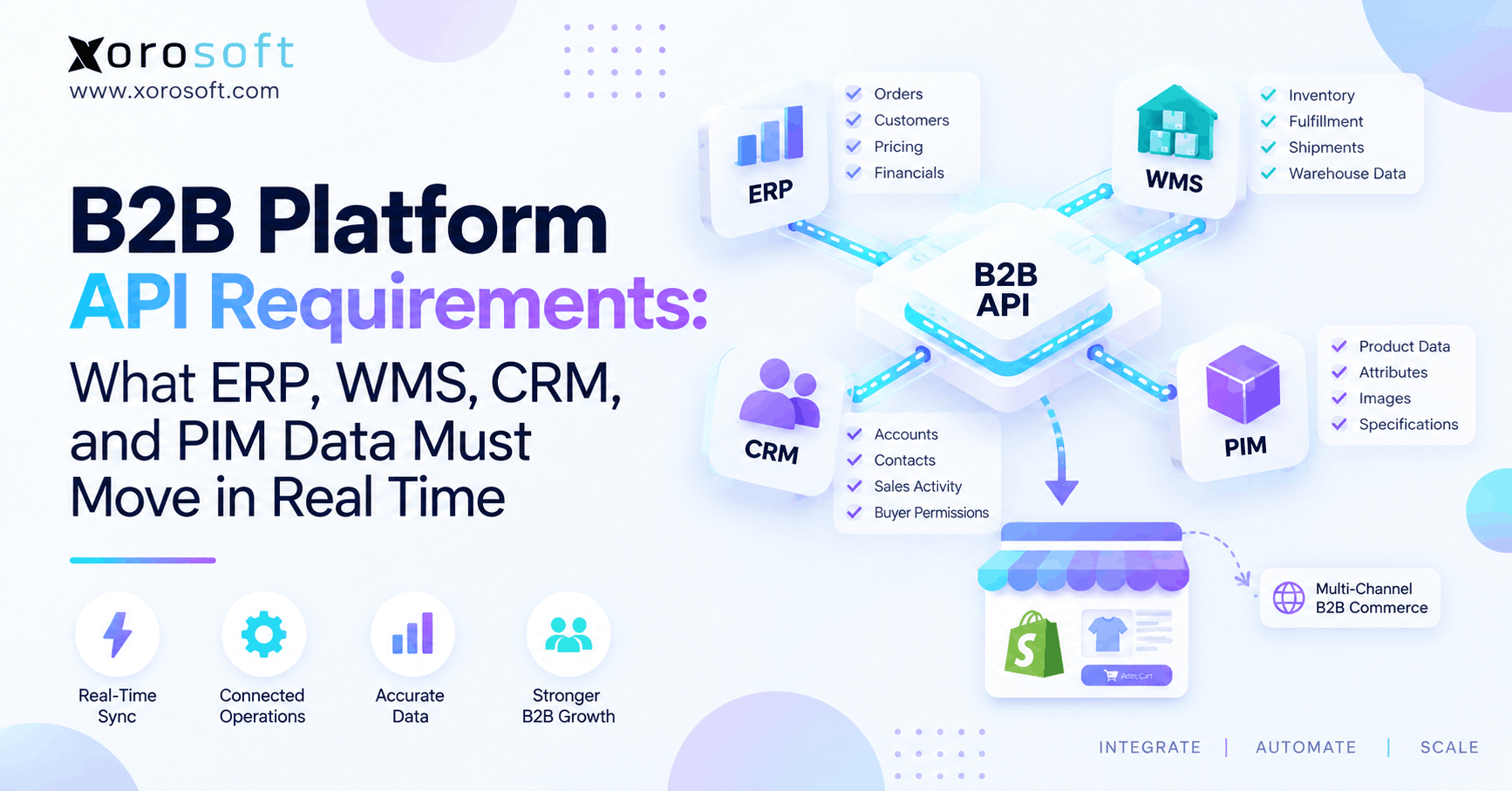 B2B Platform API Requirements: What ERP, WMS, CRM, and PIM Data Must Move in Real Time