1. When a Small EDI Error Turns Into a Costly Deduction
Retailer EDI chargeback causes often begin long before a retailer deducts money from a supplier payment. For example, the first mistake may be a short pick in the warehouse, an old item record, a late shipment update, or an invoice that still shows the original order quantity. Therefore, an EDI chargeback should not be treated as only an EDI problem.
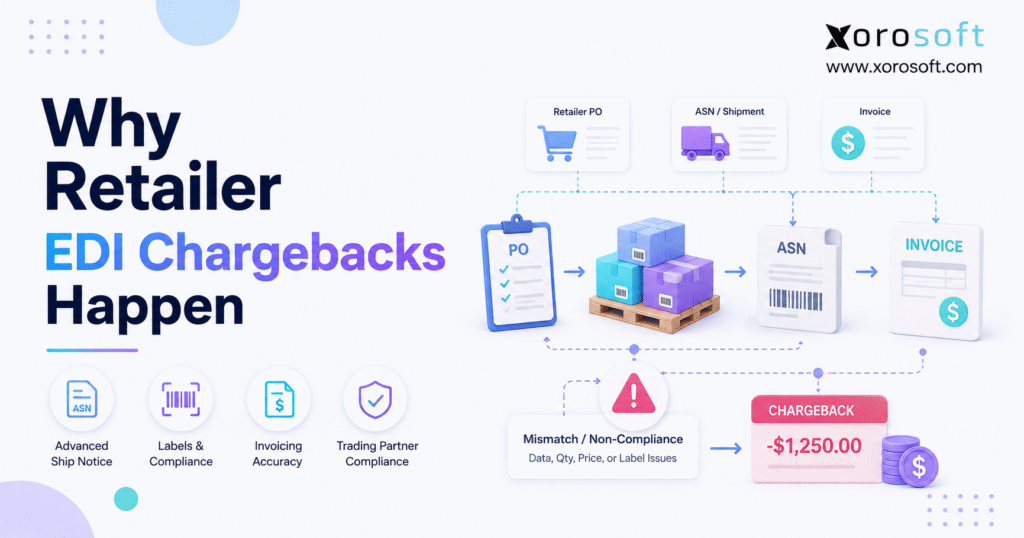
Instead, suppliers should review the complete order flow. First, the retailer sends a purchase order. Next, the supplier checks inventory, confirms the order, picks and packs the goods, creates shipment data, prints labels, and sends an advance ship notice. Finally, the supplier ships the goods and creates the invoice.
Meanwhile, the retailer receives several digital and physical records. Therefore, the retailer expects the purchase order, ASN, carton labels, physical shipment, and invoice to agree.
If all of those records match, receiving can move smoothly. However, when they show different quantities, products, cartons, dates, or prices, the retailer may record a compliance failure.
As a result, the visible chargeback is often only the last step in a much longer problem.
1.1 What is a retailer EDI chargeback?
A retailer EDI chargeback is a deduction or penalty linked to a supplier’s failure to meet a retailer’s EDI, shipping, or vendor compliance rules.
For example, a retailer may issue a deduction because:
- an ASN arrived late
- shipment quantities were wrong
- carton labels did not match the ASN
- an invoice contained the wrong amount
- a required EDI document was missing
- the supplier used the wrong carrier
- freight arrived outside the approved window
Therefore, finding the real cause requires more than checking whether an EDI message was sent.
1.2 Why retailers use compliance rules
Large retailers receive goods from hundreds or thousands of suppliers. Therefore, they need repeatable receiving processes.
For example, retailers may require suppliers to use specific:
- EDI transactions
- ASN timing rules
- carton labels
- pallet labels
- carriers
- delivery windows
- packaging standards
- invoice formats
As a result, the retailer can automate more of its receiving process.
However, automation also depends on accurate data. Therefore, a small supplier error can quickly become a compliance deduction.
1.3 Start with the first mismatch
The best way to understand retailer EDI chargeback causes is to ask one simple question:
Where did the retailer’s order, our internal records, and the physical shipment first stop matching?
For example, if the retailer ordered 100 units but the warehouse packed only 96, the shortage may be the first mismatch.
If the ASN still shows 100 and the invoice also shows 100, then one warehouse issue has now created several downstream errors.
Therefore, chargeback investigation should always look for the first mismatch instead of only the final deduction.
2. How Retailer EDI Chargebacks Move Through the Order Flow
Many retailer EDI chargeback causes become easier to understand when the entire transaction is viewed as one connected process:
Purchase Order → Order Review → Inventory Allocation → Picking → Packing → ASN → Labels → Shipping → Invoice → Retailer Receiving
Because every step depends on the previous one, an early mistake can affect several later documents.
2.1 The purchase order sets the expectation
First, the retailer sends the purchase order.
The supplier should confirm:
- SKU
- quantity
- price
- unit of measure
- ship-to location
- ship date
- delivery date
- retailer-specific requirements
However, if the supplier accepts an order without enough inventory, the process already contains risk.
Therefore, order validation should happen before warehouse work begins.
2.2 Inventory allocation confirms availability
Next, the supplier reserves inventory.
However, the same stock may also be available to Shopify, Amazon, wholesale customers, stores, or other sales channels.
Therefore, poor inventory visibility can create a shortage even after an order has been accepted.
As a result, an inventory problem may later appear as an ASN or invoice problem.
2.3 The warehouse creates physical reality
Next, the warehouse picks and packs the goods.
For example, the ERP may expect 100 units. However, the picker may find only 96.
Therefore, every system after that point should reflect 96 if only 96 units are actually shipped.
If the warehouse ships 96 while the ASN and invoice still report 100, the supplier now has conflicting records.
2.4 The ASN tells the retailer what is coming
After packing, the supplier normally sends shipment data through an EDI 856 Advance Ship Notice.
The X12 856 Ship Notice/Manifest is used to communicate shipment information before or around delivery. Therefore, it plays an important role in the retailer’s receiving process. Review the official X12 856 transaction information.
As a result, the ASN needs to reflect the shipment that actually left the warehouse.
3. The 12 Main Retailer EDI Chargeback Causes
Understanding the most common retailer EDI chargeback causes helps teams separate the visible deduction from the process that created it.
3.1 Late EDI 856 ASN
A late ASN is a common retailer compliance problem.
For example, warehouse staff may finish packing at 2:00 p.m. However, the ASN may not transmit until a nightly batch runs.
Meanwhile, the shipment may already be moving toward the retailer.
Therefore, although the ASN was created, it arrived too late to support the retailer’s planned receiving process.
3.2 Missing ASN
Sometimes the retailer never receives the ASN at all.
For example, the shipment may close correctly inside the warehouse system. However, an integration error may stop the EDI message.
Alternatively, the message may be rejected and nobody may notice the error.
Therefore, suppliers need to monitor failed documents as well as successful transmissions.
3.3 ASN quantity mismatch
Suppose the retailer ordered 500 units.
However, the warehouse can ship only 480.
If the ASN still shows 500, the retailer receives one digital quantity but a different physical quantity.
Therefore, the ASN error may be only the symptom. The deeper issue is that the final warehouse quantity never updated the shipment record.
3.4 ASN and carton mismatch
Retailers may also expect carton-level information.
For example, the ASN may describe 10 cartons. However, warehouse staff may repack the order into nine cartons.
Consequently, the electronic carton structure no longer matches the physical shipment.
3.5 Incorrect SSCC or logistics label
GS1 uses the Serial Shipping Container Code, or SSCC, to identify a logistics unit such as a pallet, case, or parcel. Therefore, the identifier can connect physical freight with digital shipment information. See the GS1 SSCC standard.
If a physical carton carries the wrong SSCC, the retailer may not be able to connect that carton with the ASN.
3.6 Purchase order mismatch
Purchase order differences are another major source of retailer EDI chargeback causes.
For example, a supplier may:
- ship the wrong SKU
- ship the wrong quantity
- use the wrong unit of measure
- ship to the wrong location
- apply the wrong price
- make an unapproved substitution
Therefore, PO validation needs to happen before picking and packing begin.
3.7 Invoice mismatch
The invoice can also create a retailer deduction.
For example:
- PO quantity: 100
- shipped quantity: 96
- ASN quantity: 96
- invoice quantity: 100
Although the fulfillment team corrected the shipment, finance still billed the original amount.
As a result, the physical shipment and financial record no longer agree.
3.8 Routing guide violation
Retailers often have their own shipping rules.
For example, they may require:
- an approved carrier
- a specific freight method
- a delivery appointment
- a defined pallet format
- a delivery window
- specific carton rules
Therefore, a technically correct EDI transaction does not automatically make a shipment compliant.
3.9 Early or late shipment
A shipment can also fail because of timing.
For example, a supplier may ship early to clear warehouse space. However, the retailer may not allow early delivery.
Likewise, a late shipment may miss a promotion, store reset, or planned receiving window.
Therefore, shipping dates need to match retailer requirements.
3.10 Bad master data
Incorrect master data can create repeated errors.
For example, the wrong:
- item number
- UPC
- unit of measure
- customer location
- price
- ship-to address
can flow into many transactions.
Consequently, correcting one ASN does not fix the source problem.
3.11 Missing or rejected EDI transaction
Sometimes the supplier sends a document, but the retailer does not accept it.
Therefore, teams should monitor acknowledgments, errors, and failed transactions rather than assuming that “sent” means “accepted.”
In addition, rejected messages should have a clear owner so they are corrected quickly.
3.12 Warehouse changes after ASN creation
Finally, some of the hardest retailer EDI chargeback causes appear when a shipment changes after the electronic record has already been created.
For example, warehouse staff may:
- remove a damaged product
- move goods between cartons
- split a pallet
- change the shipped quantity
- replace a carton
However, if the ASN does not update, the retailer receives old information.
Therefore, final shipment data should follow the final physical pack.
4. Why ASN Errors Become Retailer EDI Chargeback Causes
Among all retailer EDI chargeback causes, ASN errors deserve special attention because the ASN sits directly between warehouse execution and retailer receiving.
Therefore, several operational problems can appear inside the same EDI document.
4.1 The ASN should describe what actually shipped
Consider this example:
| Record | Quantity |
|---|---|
| Retailer Purchase Order | 1,000 |
| Warehouse Packed | 960 |
| ASN | 1,000 |
| Invoice | 1,000 |
The warehouse shortage is the first problem.
However, because later systems were not updated, one shortage created several mismatches.
Consequently, the retailer may now see:
- a shortage
- an inaccurate ASN
- an invoice difference
Therefore, changing only the ASN does not fix the main process problem.
4.2 ASN timing should follow the warehouse event
In addition, ASN timing should match the real shipment process.
For example, if the ASN is generated before packing is complete, later carton changes may make it inaccurate.
On the other hand, if the supplier waits too long after shipping, the retailer may receive the data too late.
Therefore, businesses should define exactly which warehouse event triggers ASN creation.
4.3 Warehouse data should drive shipment data
For growing suppliers, a connected XoroWMS warehouse management system can help keep picking, packing, shipping, and inventory activity closer to the shipment record.
Therefore, the goal is not simply to make the EDI connection more advanced. Instead, the goal is to provide EDI with accurate warehouse data.
5. How Label Errors Create Retailer EDI Chargebacks
Label problems can be misleading.
For example, when a supplier receives a label deduction, the team may immediately inspect the printer.
However, the printer may be working correctly.
Instead, the actual issue may exist inside the shipment data.
5.1 Common label problems
Retailers may flag:
- missing SSCC
- duplicate SSCC
- wrong SSCC
- unreadable barcode
- wrong carton ID
- incorrect destination
- poor label placement
Therefore, suppliers should check both the physical label and the data behind it.
5.2 Labels need to match the shipment record
For example, imagine that an ASN assigns SSCC 123 to Carton A.
However, warehouse staff place SSCC 456 on the same carton.
Consequently, the physical carton and digital shipment record no longer agree.
Therefore, several retailer EDI chargeback causes that look like label problems are actually shipment-data problems.
The investigation should include:
- carton record
- SSCC assignment
- label generation
- ASN hierarchy
- final physical carton
As a result, the team can fix the source instead of only reprinting a label.
6. How Warehouse Errors Become EDI Chargeback Causes
Several retailer EDI chargeback causes begin when physical warehouse activity no longer matches the order data stored in business systems.
Therefore, warehouse teams should be included in retailer compliance reviews.
6.1 Short picking
For example, the system expects 100 units.
However, the picker finds only 98.
If the shortage is not recorded, the ASN and invoice may still show 100.
Therefore, one short pick can create several downstream differences.
6.2 Wrong SKU
Likewise, a picker may choose the wrong item.
Although the EDI document may be technically valid, the physical shipment is wrong.
Therefore, scanning and item checks matter.
6.3 Repacking
Warehouse teams may also move goods between cartons.
However, if carton data has already been sent, the ASN structure may become outdated.
Consequently, carton changes should update the shipment record before freight leaves.
6.4 Last-minute damage
In addition, staff may remove a damaged item after packing.
Again, the physical shipment has changed.
Therefore, the system should capture that change before final shipment data is sent.
6.5 Multi-warehouse fulfillment
The process becomes more complex when several warehouses are involved.
For example, one retailer order may be split across two facilities.
Therefore, each location needs accurate inventory, shipment, label, and ASN information.
A connected XoroONE cloud ERP can become relevant at this stage because inventory, order, warehouse, purchasing, accounting, and fulfillment data need to remain aligned across the business.
7. Why Disconnected Systems Increase Chargeback Risk
Many retailer EDI chargeback causes become more common when ERP, inventory, EDI, warehouse, shipping, and accounting systems operate separately.
Initially, separate applications may work well.
However, as the business grows, teams often begin entering the same information several times.
7.1 One order can exist in several versions
For example:
Retailer EDI → Spreadsheet → Inventory App → Warehouse App → Accounting
At every handoff, someone can change:
- quantity
- date
- SKU
- address
- carton data
- price
As a result, disconnected applications can turn small data differences into recurring retailer EDI chargeback causes.
7.2 Manual entry adds risk
Moreover, manual entry takes time.
Therefore, employees may update one system but forget another.
For example, the warehouse may change a quantity at 3:00 p.m., while the ASN system still holds the 10:00 a.m. quantity.
Consequently, the final document can contain stale data.
7.3 Integration should follow the right event
However, simply connecting two systems does not guarantee accurate data.
For example, an hourly synchronization may still be too slow if cartons change five minutes before shipping.
Therefore, businesses should decide exactly which event updates each downstream system.
Companies managing several sales channels and retailer connections can review Xorosoft integrations when they need order, inventory, ecommerce, warehouse, and EDI workflows to exchange data more consistently.
8. How to Diagnose Retailer EDI Chargeback Causes Step by Step
Instead of fixing only the final error, trace the transaction backward.
8.1 Start with the retailer’s reason code
First, record the retailer’s stated reason.
However, do not assume that the description identifies the true root cause.
For example, “ASN quantity mismatch” explains what the retailer saw. It does not explain why the ASN became wrong.
8.2 Find the purchase order
Next, confirm:
- original SKU
- quantity
- price
- requested date
- ship-to location
- approved changes
Therefore, the team establishes the correct starting point.
8.3 Review inventory
Then check whether the expected stock was actually available.
For example, if the order required 200 units but only 190 existed, the shortage may have started before warehouse picking.
Therefore, inventory history matters.
8.4 Review warehouse activity
Next, compare:
- allocated quantity
- picked quantity
- packed quantity
- carton count
- shortages
- substitutions
- adjustments
Because the warehouse creates the physical shipment, this is often where the first mismatch appears.
8.5 Compare the ASN
Then compare the ASN with the final shipment.
If both match, move to the next step.
However, if they differ, determine exactly when the shipment changed.
8.6 Check labels
Next, confirm that the physical carton and pallet labels match the final shipment record.
In addition, check whether SSCC values are unique and assigned to the correct logistics units.
8.7 Review shipping
Then confirm:
- carrier
- service
- ship date
- delivery window
- appointment
- freight method
Therefore, routing violations do not get confused with data errors.
8.8 Review the invoice
Finally, compare the invoice against the PO and final shipment.
Using this process makes retailer EDI chargeback causes easier to trace because the team can identify the first point where the records diverged.
9. Retailer EDI Chargeback Causes: Root-Cause Matrix
A basic deduction list tells finance how much money was lost.
However, it does not tell operations what to fix.
Therefore, companies should group retailer EDI chargeback causes by source.
| Retailer Error | Immediate Problem | Check First | Likely Root Cause |
| Late ASN | 856 sent too late | shipment time | delayed trigger |
| ASN quantity error | digital quantity differs | pack record | warehouse change |
| Label mismatch | SSCC differs | carton record | label/data gap |
| Short shipment | units missing | pick history | stock shortage |
| Invoice mismatch | billing differs | invoice vs shipment | finance data |
| Wrong carrier | routing failure | ship method | routing rule |
| Missing document | retailer received nothing | EDI log | failed integration |
As a result, management can see whether problems come mainly from the warehouse, EDI setup, inventory, shipping, or finance.
10. Separate Technical EDI Problems From Operational Problems
Separating technical failures from operational retailer EDI chargeback causes helps teams assign each issue to the correct owner.
10.1 Technical EDI problem
Examples include:
- invalid format
- missing required field
- mapping problem
- rejected message
- failed transmission
Therefore, these issues usually belong to the EDI or integration process.
10.2 Operational problem
Examples include:
- wrong item packed
- wrong quantity shipped
- late warehouse release
- incorrect carrier
- wrong invoice amount
Therefore, these problems can exist even when the EDI file itself is valid.
10.3 Why the distinction matters
For example, an EDI specialist cannot fix repeated short picks caused by incorrect stock counts.
Likewise, warehouse staff cannot repair a broken transaction map.
Therefore, chargeback ownership should follow the first failure point.
11. When a 3PL Is Part of the Chargeback Problem
A 3PL can affect several retailer EDI chargeback causes because it may control the physical shipment.
For example, the 3PL may manage:
- picking
- packing
- labeling
- cartonization
- shipping
- carrier handoff
Therefore, 3PL processes should always be reviewed when investigating retailer EDI chargeback causes tied to packing, labels, shipment timing, or physical quantities.
11.1 Identify who confirms the shipment
First, determine whether your internal system or the 3PL creates the final shipment confirmation.
11.2 Identify who creates labels
Next, determine who assigns the SSCC and prints the carton labels.
11.3 Check update timing
For example, if the 3PL changes a carton after your ASN has already been generated, the systems may disagree.
Therefore, clear ownership and timely updates matter.
12. How Shopify and Wholesale Growth Add More Pressure
Many brands start with direct-to-consumer ecommerce and add wholesale later.
As a result, the same inventory may support:
- Shopify
- Amazon
- retail EDI orders
- wholesale customers
- stores
Therefore, allocation becomes harder as channels increase.
For Shopify merchants, Xorosoft is available through the Shopify App Store, which can be relevant when ecommerce orders need to connect with broader ERP and inventory operations.
However, adding more channels does not reduce retailer requirements.
Instead, the business needs one clear view of inventory that is available, reserved, allocated, picked, packed, and shipped.
13. When Retailer EDI Chargeback Causes Become a Systems Problem
A few isolated mistakes may require only better training.
However, recurring chargebacks can show that the operating stack is becoming too fragmented.
13.1 Warning signs
Look for:
- the same deduction every month
- repeated manual data entry
- warehouse updates that do not reach EDI
- manual invoice corrections
- different processes across warehouses
- long chargeback investigations
- unclear ownership
- several versions of the same order
Therefore, the business should not evaluate its software only by asking whether it can “send EDI.”
Instead, ask whether the systems behind EDI stay synchronized.
13.2 When an ERP becomes relevant
An ERP becomes more important when the problem is not sending a document but coordinating the business activity behind that document.
For example, inventory, order management, warehouse execution, shipping, purchasing, and accounting may all influence the final retailer transaction.
Therefore, a broader Xorosoft solutions approach can be relevant when a business has outgrown spreadsheets and disconnected applications.
13.3 Do not replace software because of one deduction
However, one chargeback is not enough evidence that an ERP or EDI platform needs to be replaced.
Instead, look for patterns.
If several retailer EDI chargeback causes repeatedly trace back to manual handoffs, data delays, and system gaps, then the software architecture deserves attention.
14. How a Connected ERP Workflow Can Reduce Failure Points
A connected ERP cannot guarantee zero retailer EDI chargeback causes.
However, it can remove some manual handoffs that create repeated errors.
14.1 One sales order record
For example, one order record can support:
- inventory allocation
- warehouse work
- shipping
- invoicing
Therefore, fewer people need to rebuild the same transaction in separate tools.
14.2 Inventory connected to fulfillment
Next, warehouse teams can work from current inventory information.
As a result, shortages may be recorded earlier.
Therefore, later documents can use the actual shipped quantity.
14.3 Packing connected to shipment data
Moreover, final packing data can become the source for shipment documents.
Therefore, the ASN is more likely to match the real cartons.
14.4 Shipping connected to accounting
Finally, finance can use confirmed fulfillment data.
As a result, invoices are less likely to bill quantities that were never shipped.
14.5 Use real examples when evaluating systems
Businesses should also look at companies with similar workflows.
For example, Xorosoft’s ERP case studies can help operators review how inventory-driven companies approach connected operational processes.
15. How to Track Retailer EDI Chargeback Causes
Tracking retailer EDI chargeback causes by retailer, warehouse, transaction type, and operational process makes repeat patterns easier to find.
Therefore, businesses should measure more than total deduction dollars.
Track:
- total chargeback value
- chargeback count
- chargebacks by retailer
- chargebacks by warehouse
- chargebacks by document
- chargebacks by reason
- chargebacks by root cause
- ASN accuracy
- ASN timing
- invoice accuracy
- shipping-window compliance
- label error rate
15.1 Track the first cause
For example, ten retailer deductions may have ten different codes.
However, six of them may trace back to the same warehouse process.
Therefore, root-cause reporting gives management a better action plan.
15.2 Review trends regularly
In addition, teams should review repeat issues every month.
For example:
- Month 1: 3 ASN quantity errors
- Month 2: 5 ASN quantity errors
- Month 3: 7 ASN quantity errors
Therefore, the trend suggests a process failure rather than random mistakes.
15.3 Review by industry and workflow
Different businesses face different risks.
For example, apparel brands may manage many size and color variants. Meanwhile, furniture companies may manage bulky freight and appointments.
Therefore, teams can also review the operational requirements common to the markets they serve through Xorosoft’s industry pages.
16. Common Mistakes When Fixing Retailer EDI Chargeback Causes
Businesses often make the same mistakes while trying to correct retailer EDI chargeback causes.
16.1 Blaming the EDI provider first
The EDI platform may be working correctly.
However, the source data may be wrong.
Therefore, confirm the first mismatch before changing the integration.
16.2 Fixing only the current deduction
A supplier may successfully dispute one deduction.
However, the same process can create another chargeback next week.
Therefore, dispute management and root-cause management should be separate activities.
16.3 Ignoring warehouse activity
Warehouse events determine:
- final quantity
- carton count
- physical SKU
- SSCC
- ship time
- carrier
Consequently, warehouse staff need to be part of the chargeback process.
16.4 Relying on spreadsheets as the only control
Spreadsheets may work for a small supplier.
However, they become harder to manage as retailer count, warehouse count, and order volume increase.
Therefore, spreadsheets should not become the only place where retailer rules are stored.
16.5 Failing to review retailer requirements
Retailer requirements can change.
Therefore, businesses should regularly review:
- routing guides
- EDI rules
- label standards
- delivery windows
- carrier instructions
As a result, old rules are less likely to create new retailer EDI chargeback causes.
17. Retailer EDI Chargeback Prevention Checklist
Before releasing a retailer order:
- Confirm the correct purchase order.
- Verify the SKU.
- Verify the final quantity.
- Confirm the ship-to location.
- Check current inventory.
- Record shortages before shipment.
- Confirm the packed quantity.
- Generate shipment data from the final pack.
- Validate ASN timing.
- Check carton count.
- Check pallet count.
- Confirm SSCC values.
- Confirm labels match shipment data.
- Review retailer routing rules.
- Confirm the approved carrier.
- Check the delivery window.
- Monitor EDI errors.
- Review rejected transactions.
- Create invoices from confirmed fulfillment data.
- Compare invoice price and quantity.
- Track every chargeback by root cause.
Therefore, this checklist focuses on preventing the first error instead of only correcting the final EDI document.
For a deeper prevention framework, read Xorosoft’s guide on how to reduce retailer EDI chargebacks.
18. Frequently Asked Questions
18.1 What are the most common retailer EDI chargeback causes?
The most common retailer EDI chargeback causes include late or missing ASNs, wrong shipment quantities, label and SSCC errors, invoice differences, routing violations, bad master data, failed EDI documents, and warehouse changes that do not reach downstream systems. Therefore, suppliers should review both the EDI transaction and the physical process behind it.
18.2 What is an EDI chargeback?
An EDI chargeback is a retailer deduction linked to a supplier’s failure to follow electronic or related shipping requirements. For example, an inaccurate ASN or invoice may trigger a chargeback. However, the real problem may begin in inventory, warehousing, shipping, or finance.
18.3 What is an ASN chargeback?
An ASN chargeback relates to an advance ship notice problem. For example, the ASN may arrive late, contain the wrong quantity, or fail to match the actual shipment. Therefore, warehouse and EDI records should be reviewed together.
18.4 Why do late ASNs cause chargebacks?
Retailers may use the ASN to prepare receiving before freight arrives. Therefore, if the ASN arrives too late, the retailer may not have the expected data when receiving begins. The exact timing rule depends on the retailer.
18.5 What happens if the ASN quantity is wrong?
If the ASN reports a different quantity from the physical shipment, the retailer may record a compliance exception. Therefore, final packed quantities should update the ASN before the transaction is sent.
18.6 Can warehouse errors cause EDI chargebacks?
Yes. For example, short picks, wrong SKUs, repacking, missing cartons, and late changes can make the physical shipment different from the electronic record. Therefore, warehouse controls are an important part of EDI compliance.
18.7 What is an SSCC?
An SSCC is a Serial Shipping Container Code used to identify a logistics unit, such as a pallet, case, or parcel. Therefore, it helps connect physical freight with digital shipment information.
18.8 Can a wrong SSCC cause a retailer deduction?
Yes. For example, an SSCC printed on a carton may not match the SSCC sent in the shipment record. As a result, the retailer may not be able to match the physical carton with the expected ASN data.
18.9 Can invoice errors cause EDI chargebacks?
Yes. For example, a supplier may ship 90 units but invoice 100. Therefore, the retailer’s receiving and billing records disagree. Price, freight, discount, allowance, and PO-reference errors can also create problems.
18.10 Can a routing violation cause a chargeback?
Yes. Retailer routing rules may cover carriers, delivery windows, packaging, appointments, freight methods, and labels. Therefore, even accurate EDI data cannot make a shipment compliant if the physical shipping process breaks the retailer’s rules.
18.11 Can shipping too early cause a chargeback?
Potentially. For example, a retailer may define an approved delivery window. Therefore, arriving too early can create a compliance problem just as arriving late can.
18.12 Why do retailer EDI chargeback causes keep repeating?
Recurring retailer EDI chargeback causes usually mean the supplier is correcting the last error without fixing the first process failure. For example, staff may manually correct one ASN while the warehouse-to-EDI workflow remains broken. Therefore, root-cause reporting is essential.
18.13 Can an EDI message be valid but still contain wrong information?
Yes. An EDI file can have the correct format while containing incorrect business data. For example, an ASN may be accepted technically but still show the wrong quantity. Therefore, technical success and business accuracy are different checks.
18.14 Is every EDI chargeback the EDI provider’s fault?
No. Although mapping and transmission problems can create deductions, many errors begin in inventory, warehousing, shipping, master data, or accounting. Therefore, teams should find the first mismatch before assigning responsibility.
18.15 Can a 3PL create EDI chargebacks?
Yes. A 3PL may control picking, packing, labeling, and shipment confirmation. Therefore, inaccurate or delayed 3PL data can affect the ASN and other retailer records.
18.16 How should an EDI chargeback be investigated?
First, review the retailer’s reason code. Next, compare the purchase order, inventory record, warehouse shipment, ASN, labels, carrier data, and invoice. Finally, identify the first place where those records stop matching.
18.17 What should be checked for an ASN chargeback?
Check the purchase order, final packed quantity, SKU, carton count, SSCC, shipment date, carrier, destination, and ASN transmission time. Therefore, both electronic and warehouse records matter.
18.18 Can bad inventory data cause EDI chargebacks?
Yes. For example, incorrect inventory can cause a supplier to accept an order it cannot fully ship. Consequently, a later shortage may create ASN and invoice differences.
18.19 Why does multi-warehouse fulfillment increase risk?
Several warehouses create more inventory balances, shipment events, carton records, and data updates. Therefore, the risk rises when each site uses separate or delayed processes.
18.20 Does ERP integration eliminate retailer EDI chargebacks?
No. However, connected ERP, WMS, EDI, shipping, and accounting workflows can reduce manual entry and make errors easier to trace. Therefore, integration can remove some common failure points, while good process controls are still required.
18.21 When should a business replace manual EDI workflows?
A business should review its workflow when transaction volume grows, manual work increases, deductions repeat, and staff struggle to trace order changes. Therefore, the trigger is usually growing operational complexity rather than one isolated error.
18.22 What should finance track about deductions?
Finance should track the value, retailer, order, deduction reason, root cause, owner, status, and recurrence. In addition, finance should share those findings with warehouse, EDI, shipping, and operations teams.
18.23 Who should own chargeback prevention?
Ownership should follow the root cause. For example, warehouse teams may own picking errors, while finance may own invoice errors. However, one cross-functional process should still track all deductions.
18.24 How often should retailer chargebacks be reviewed?
Businesses with regular retailer volume should review chargebacks at least monthly. However, high-volume suppliers may benefit from weekly exception reviews. Therefore, teams can spot recurring issues before they become larger financial problems.
18.25 What is the best way to reduce EDI chargebacks?
First, find where the order, shipment, ASN, label, and invoice first stop matching. Next, fix that process. Then remove unnecessary manual handoffs. Finally, monitor recurring errors by retailer, warehouse, document type, and root cause.
19. Fix the First Error, Not Just the Final Deduction
Retailer deductions may appear to be small EDI problems. However, retailer EDI chargeback causes usually reveal a larger operational issue.
For example, an ASN mismatch may begin with a short pick. Likewise, a label failure may begin with bad carton data. Meanwhile, an invoice difference may start because finance never received the final shipped quantity.
Therefore, the best investigation follows the complete flow:
Retailer PO → Inventory → Warehouse → Packing → ASN → Labels → Shipping → Invoice → Retailer Receiving
Then identify the first point where the records stopped matching.
Ultimately, reducing retailer EDI chargeback causes requires fixing the first operational mismatch rather than repeatedly correcting the final deduction.
For growing wholesale, ecommerce, retail, and multi-warehouse businesses, Xorosoft can help connect inventory, warehouse management, purchasing, order processing, EDI, accounting, and reporting in a single cloud ERP environment.
However, software should support a strong process rather than hide a weak one.
Therefore, if recurring retailer deductions are becoming a wider inventory, warehouse, EDI, or accounting problem, Book a Demo to see how Xorosoft can help connect the workflow behind your retailer orders.
Recent Posts
-
 ERP Landed Cost Module vs Spreadsheet Calculations for Importers
 -
 How to Build an Open-to-Buy Plan for an Omnichannel Brand
 -
 Cold Storage WMS for Food and Beverage Distribution
 -
 ERP Buying Statistics 2026: Evaluation, Implementation, and Adoption Risks
 -
 How a Distributor Reduced B2B Order Exceptions Without Restricting Sales