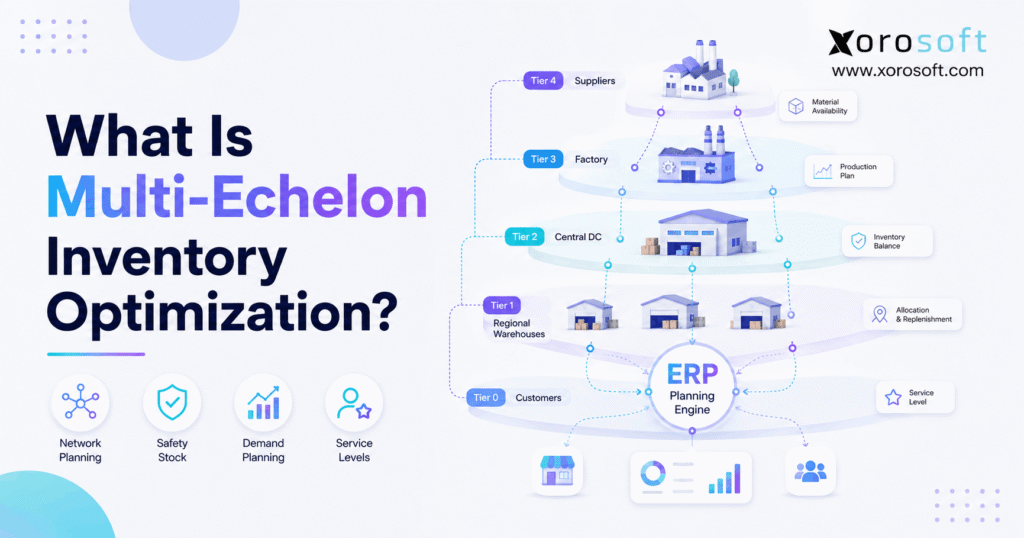
Multi-echelon inventory optimization is an advanced strategy used by supply chain professionals to achieve the right stock levels across complex distribution networks.
1. When More Inventory Still Does Not Solve the Stock Problem
Multi-echelon inventory optimization helps a business decide how much stock it should hold across several connected supply chain levels and where that stock should sit. Therefore, instead of planning every warehouse alone, the business looks at the whole inventory network.
For example, a company may have enough total stock but still face shortages in one region. Meanwhile, another warehouse may hold months of unused inventory. As a result, the problem is not always how much inventory the company owns. Instead, the problem is often where that inventory is placed.
A growing business may have suppliers, factories, central distribution centers, regional warehouses, stores, and fulfillment locations. Because these locations depend on each other, a stock decision at one point can change the stock needed somewhere else. Therefore, a local decision can create a network-wide problem.
MEIO asks a broader question: how much inventory should the full network hold, and where should that inventory be placed to support customer demand without tying up too much cash?
That question becomes more important as a business adds warehouses, sales channels, suppliers, or production sites. Moreover, it becomes more important when lead times vary, demand changes quickly, or teams rely on manual transfers to keep locations in stock.
1.1 What Does Multi-Echelon Inventory Optimization Mean?
Multi-echelon inventory optimization, often shortened to MEIO, is a way to set inventory targets across several connected levels of a supply chain.
For example, a product may move through this network:
Supplier → Factory → Central DC → Regional Warehouse → Customer
Each stage is an echelon. Therefore, rather than giving every location its own safety stock rule, MEIO looks at how those locations work together. As a result, the business can make better choices about where stock should be held.
1.2 What Is an Inventory Echelon?
An echelon is simply one level of a supply chain where inventory may be stored or managed.
For instance, a manufacturer may hold raw materials at one level, finished goods at another, and regional stock at another. Likewise, an ecommerce brand may use a central warehouse, a 3PL, and local fulfillment sites.
Therefore, a multi-echelon network contains several connected stock points rather than one isolated warehouse. Because inventory moves between these points, planning one location in isolation can create too much stock or too little stock elsewhere.
1.3 A Simple Multi-Echelon Inventory Optimization Example
Consider a company with one central warehouse and three regional distribution centers.
If each regional warehouse calculates safety stock independently, all three may build large buffers. Meanwhile, the central warehouse may carry its own safety stock as well. Consequently, the business may protect against the same risk several times.
MEIO looks at the network collectively. Therefore, it can help planners decide whether some protection should sit centrally, locally, or across several locations.
2. How Multi-Echelon Inventory Optimization Works
Multi-echelon inventory optimization works by combining demand, stock, lead time, service level, and supply data. Then, the planning model uses those inputs to set stock targets across the network.
Although the math can become advanced, the business process is easier to understand. First, the company maps its supply network. Next, it studies demand and supply risk. Then, it sets service targets. Finally, it decides how much stock each location needs.
2.1 Map the Inventory Network
First, planners need to understand how products move.
For example:
Supplier → Main Warehouse → East DC → Customer
Supplier → Main Warehouse → West DC → Customer
Because the East and West facilities depend on the main warehouse, their inventory needs are linked. Therefore, planning them as fully separate locations can create too much buffer stock.
In addition, planners should record transfer routes, sourcing rules, supplier relationships, and location priorities. As a result, the model can reflect how inventory actually moves through the business.
2.2 Measure Demand and Demand Changes
Next, the business needs demand history. However, average sales are not enough.
For example, two products may each sell 1,000 units per month. Yet one may sell at a steady rate while the other moves in sudden spikes. As a result, the second item usually needs a different stock policy.
Therefore, MEIO considers both expected demand and how much that demand changes. Moreover, planners should separate normal demand changes from promotions, seasonality, and unusual one-time orders.
2.3 Measure Lead Times and Supply Risk
Lead time is the time between placing a replenishment order and receiving usable stock. For example, lead time can include supplier production time, freight time, customs time, warehouse receiving time, internal production time, and transfer time between warehouses.
However, planners should measure how much lead times change as well as the average. A supplier that always delivers in 20 days is easier to plan than one that delivers anywhere between 12 and 35 days. Consequently, lead-time variability can materially change safety stock requirements.
2.4 Set Service-Level Targets
Next, the business needs to decide how available each product should be. However, not every SKU needs the same target.
For example, a top-selling item may justify a higher service level than a slow-moving accessory. Therefore, good inventory optimization balances service and cost instead of simply trying to maximize stock everywhere.
In addition, service targets can vary by channel or customer group. For instance, a key wholesale account may have different expectations from a direct-to-consumer channel.
2.5 Set Inventory Targets Across the Network
Finally, the system can decide how much inventory should sit at each level.
For instance, it may make sense to hold more stock at a central DC because that inventory can support several regions. In another case, fast customer expectations may require more stock closer to demand.
Therefore, multi-echelon inventory optimization does not use one fixed rule for every business. Instead, the correct answer depends on demand, lead time, cost, and service goals.
3. Single-Echelon vs Multi-Echelon Inventory Planning
Single-echelon planning focuses on one location at a time. In contrast, multi-echelon inventory planning looks at connected locations together.
That difference can have a major effect on safety stock. Therefore, businesses with several linked facilities should understand the trade-off before choosing a planning method.
| Planning Area | Single-Echelon | Multi-Echelon |
|---|---|---|
| Planning scope | One location | Full network |
| Safety stock | Set locally | Coordinated across levels |
| Upstream stock | Often treated separately | Included in network logic |
| Downstream demand | Local focus | Network focus |
| Complexity | Lower | Higher |
| Best use | Simple networks | Connected supply networks |
3.1 How Single-Echelon Planning Works
In a single-echelon model, each warehouse calculates what it needs. Therefore, East DC may create its own safety stock. West DC does the same. Meanwhile, the central warehouse may also protect itself.
As a result, the company can end up protecting against similar risks several times. Moreover, local targets can push purchasing teams to order more stock even when the network already has enough inventory overall.
3.2 How Multi-Echelon Inventory Optimization Changes the Model
MEIO looks at those buffers together.
For example, if the central warehouse can quickly supply two regional locations, it may be possible to pool some risk upstream. However, this does not mean centralizing everything.
Instead, the goal is to place each buffer where it provides the most value. Therefore, the model should reflect customer promises, transfer speed, product value, demand patterns, and supply risk.
3.3 When Single-Echelon Planning Is Still Enough
Not every business needs a more advanced network model. For example, a company with one warehouse, stable demand, short lead times, and a small SKU range may perform well with simpler rules.
Therefore, planning complexity should match operational complexity. Adding a complex model too early can create more work without creating better decisions.
4. Why Multi-Echelon Inventory Optimization Matters
MEIO matters because a local decision can look good while producing a poor result for the full business.
For example, a warehouse manager may increase safety stock to avoid shortages. Meanwhile, another warehouse may do the same. Consequently, purchasing buys more units even though total company inventory was already high.
Multi-echelon inventory optimization helps prevent this problem by treating inventory as a network-wide decision instead of a collection of local warehouse decisions.
4.1 Reduce Excess Safety Stock
First, MEIO can identify stock buffers that overlap.
If several locations protect against the same demand or supply risk, the business may be carrying more safety stock than it needs. Therefore, network planning can help remove some duplicate protection while keeping service targets in mind.
However, the goal is not to cut inventory blindly. Instead, the business should remove stock that does not add enough service value.
4.2 Improve Product Availability
Second, better inventory placement can improve availability.
For example, stock may exist inside the company but be held at a location that cannot serve demand quickly enough. As a result, customers still experience a stockout.
Therefore, inventory availability depends on both quantity and location. Moreover, planners should consider whether stock can move quickly enough to support another site before reducing local inventory.
4.3 Improve Working Capital
Inventory ties up cash. Consequently, every extra unit has a financial cost.
However, cutting stock without better planning can create shortages. Therefore, the goal is not simply to lower inventory. Instead, the goal is to use inventory more effectively.
In addition, better inventory placement can reduce the need for emergency purchases and expensive transfers. As a result, working capital can improve without lowering service in the wrong places.
4.4 Make Better Replenishment Decisions
In addition, MEIO can improve replenishment planning.
If planners understand how inventory at one level supports another, they can make better purchase and transfer decisions. As a result, teams rely less on emergency transfers and last-minute buying.
Therefore, inventory planning becomes more proactive and less reactive.
5. A Practical Multi-Echelon Inventory Optimization Example
Consider a sporting goods company with one main distribution center and three regional warehouses.
Assume each regional warehouse carries its own large safety stock. Meanwhile, the main DC also carries a separate buffer. As a result, the company may hold a large amount of inventory even though every location is still planning defensively.
5.1 Before Network Inventory Optimization
An illustrative setup could look like this:
| Location | Illustrative Safety Stock |
| Main DC | 1,000 units |
| East DC | 600 units |
| West DC | 600 units |
| Central Region DC | 600 units |
| Total | 2,800 units |
These numbers are only an example. Nevertheless, they show how buffers can build up when each site protects itself.
5.2 After Multi-Echelon Inventory Optimization
With MEIO, the company reviews regional demand, demand swings, main DC stock, transfer times, supplier lead times, service targets, and stock costs.
Then, it decides whether some stock should move upstream or downstream. Therefore, the final result might include more stock at one site and less at another.
The goal is not equal stock. Instead, the goal is useful stock placed where it can protect service efficiently.
6. Safety Stock Optimization Across Multiple Echelons
Safety stock protects the business against uncertainty. However, safety stock can become expensive when every location builds its own buffer without looking at the wider network.
Therefore, multi-echelon safety stock planning asks where that protection should be held.
Multi-echelon inventory optimization can help determine whether safety stock should remain local or be positioned elsewhere in the network.
6.1 Why Duplicate Buffers Develop
A regional DC may fear a supplier delay. Therefore, it adds extra stock.
Meanwhile, the central DC may protect itself against the same supplier delay. As a result, both levels may hold inventory for the same risk.
However, duplicate safety stock is not always obvious because each location can appear reasonable when viewed alone. Therefore, the full network should be reviewed before targets are changed.
6.2 How Risk Pooling Can Help
Risk pooling means combining some demand risk instead of protecting each demand stream separately.
For example, high demand in one region may happen while demand elsewhere remains normal. Therefore, inventory held centrally may sometimes support several regions more efficiently.
However, risk pooling is not always the right answer. Fast delivery promises, long transfer times, and regional buying patterns can make local stock necessary. Consequently, the best stock position depends on how quickly the network can respond.
6.3 Safety Stock vs Cycle Stock
Safety stock protects against uncertainty. In contrast, cycle stock supports expected demand between replenishment events.
Therefore, planners should not treat all inventory as one buffer. Instead, they should understand what each portion of inventory is meant to do.
7. Demand Forecasting and Multi-Echelon Inventory Optimization
Demand forecasting and MEIO are closely linked. However, they do different jobs.
Forecasting asks: What will customers probably buy?
Inventory optimization asks: Given that demand and its risk, where should stock sit?
Therefore, one process cannot fully replace the other.
7.1 Why Forecast Error Matters
No forecast is perfect. Therefore, planners should measure forecast error rather than treat the forecast as a fact.
For example, an item with stable demand may need less protection than an item with frequent sales spikes. As a result, safety stock should reflect uncertainty as well as expected demand.
For this reason, multi-echelon inventory optimization works best when forecast accuracy and forecast error are measured consistently.
7.2 Why Channel Demand Matters
Ecommerce, wholesale, retail, Amazon, and EDI orders may behave differently.
For example, ecommerce demand can move daily while wholesale orders may arrive in large batches. Therefore, planners need a clear view of demand by SKU, channel, and location.
Moreover, a blended forecast can hide channel-specific changes. As a result, businesses should examine whether important channels need separate planning assumptions.
8. Multi-Warehouse Inventory Management vs MEIO
Multi-warehouse inventory management and MEIO support related goals. However, they are not the same thing.
Multi-warehouse management helps teams see and control stock across locations. In contrast, MEIO goes further by deciding how inventory targets should be set across linked locations.
For growing companies, this distinction matters. A business first needs reliable stock data before advanced planning becomes useful.
For example, XoroWMS helps inventory-driven companies manage warehouse activity, stock movements, receiving, picking, replenishment, and fulfillment in a connected environment. Therefore, accurate warehouse data can provide a stronger base for better planning.
8.1 Why Visibility Comes Before Optimization
If a business cannot reliably answer what is on hand, committed, available, or in transit, advanced planning will struggle.
Therefore, inventory accuracy should come before model complexity. Once data is reliable, the business can make better decisions about stock targets and replenishment.
9. Who Needs Multi-Echelon Inventory Optimization?
Multi-echelon inventory optimization becomes especially useful when several stocking locations depend on the same upstream supply.
In particular, a business should consider more advanced inventory planning when it has several of the following conditions:
- Multiple warehouses
- Regional distribution centers
- Large SKU counts
- Long supplier lead times
- Unstable supplier lead times
- High inventory value
- Frequent stock transfers
- Different service targets
- Ecommerce and wholesale demand
- Manufacturing stages
- Persistent stockouts despite high inventory
Therefore, the trigger is usually network complexity rather than company size alone.
9.1 Ecommerce and Shopify Businesses
An ecommerce brand may begin with one warehouse and simple reorder rules. However, complexity increases when the company adds a 3PL, regional facilities, wholesale orders, stores, or Amazon.
At that point, one clean source of inventory and order data becomes more important. For example, Xorosoft connects ERP workflows with ecommerce operations through its Xorosoft integrations ecosystem.
In addition, Shopify merchants can view Xorosoft’s listing on the Shopify App Store when they need to understand how ERP connectivity can fit into a Shopify-led operation.
9.2 Wholesale Distributors
Wholesale businesses often reserve or allocate stock for different customers.
Moreover, large EDI orders may arrive alongside ecommerce and direct sales demand. Therefore, planners need to understand both total inventory and customer commitments.
In these cases, a connected platform such as XoroERP can help bring inventory, purchasing, sales, and financial data into a common operating system.
9.3 Manufacturers
Manufacturers face another layer of complexity because finished goods depend on components and raw materials.
Therefore, high finished-goods demand does not help if a critical component is missing. As a result, manufacturers need to connect inventory planning with BOMs, purchasing, production, and material needs.
10. Data Needed for Multi-Echelon Inventory Optimization
Multi-echelon inventory optimization depends on reliable data. Therefore, businesses should fix data gaps before adding more complex stock logic.
Important inputs include:
| Data | Why It Matters |
| Demand history | Shows past sales patterns |
| Forecast | Estimates future demand |
| Forecast error | Measures demand risk |
| On-hand inventory | Shows current stock |
| Committed inventory | Shows what is already promised |
| Purchase orders | Shows incoming supply |
| Supplier lead time | Shows replenishment speed |
| Transfer lead time | Shows network response time |
| Service targets | Defines availability goals |
| Inventory cost | Links stock to cash |
10.1 Inventory Accuracy Comes First
If on-hand quantities are wrong, optimization results will also be wrong. Therefore, teams should first fix receiving errors, transfer gaps, cycle count issues, and item master problems.
For growing businesses, XoroONE can help connect inventory, purchasing, warehousing, accounting, manufacturing, and order operations within one cloud ERP environment.
10.2 Purchasing Data Matters Too
Inventory planning depends on knowing what is coming. Therefore, planners need clear purchase order status, supplier lead times, and expected receipt dates.
Without that information, teams may place extra orders because they cannot see future supply clearly. As a result, purchasing visibility becomes part of inventory visibility.
10.3 Financial Data Adds Context
Inventory planning should also reflect cost. For example, two SKUs with similar demand may have very different cash impacts.
Therefore, planners should consider carrying cost, product value, margin, and obsolescence risk when they set targets.
11. Common Multi-Echelon Inventory Optimization Mistakes
Even good software cannot fix weak planning rules by itself. Therefore, companies should avoid several common mistakes.
11.1 Optimizing Every Warehouse Separately
This is one of the main problems network inventory optimization is designed to solve.
If every warehouse adds its own protection without network context, total stock can become too high. Moreover, purchasing may respond to local shortages that the broader network could already cover.
11.2 Using the Same Rule for Every SKU
Not every product deserves the same service target or safety stock rule.
For example, a fast-moving core item may need stronger protection than a slow seller. Therefore, SKU segmentation remains important.
11.3 Ignoring Lead-Time Changes
Average lead time can hide risk. Consequently, planners should review both the average and the range of actual supplier performance.
For example, a 20-day average means little if deliveries regularly arrive anywhere between 10 and 35 days.
11.4 Ignoring Stock in Transit
Transferred goods have not disappeared. Therefore, inventory in transit should be included in network visibility.
Otherwise, planners may order stock that is already moving toward them. As a result, the business can create excess stock through a visibility problem rather than a demand problem.
11.5 Using Outdated Forecasts
Demand changes. Therefore, inventory targets should also change.
For example, seasonality, promotions, product launches, and channel growth can all make old targets unreliable. Consequently, target reviews should reflect how quickly the business changes.
11.6 Treating More Software as the First Fix
Sometimes the biggest problem is disconnected data. Therefore, businesses should first examine how inventory, purchasing, warehouse operations, accounting, and sales systems work together.
Xorosoft’s broader business solutions show how these operating areas can be connected without treating inventory planning as an isolated task.
12. How to Implement Multi-Echelon Inventory Optimization
A successful multi-echelon inventory optimization project should begin with accurate stock, demand, supplier, and lead-time data.
Therefore, a phased approach is usually easier to manage than a full network rollout on day one.
12.1 Step 1: Improve Inventory Accuracy
First, validate on-hand stock. Then, review transfer records, receiving, adjustments, and cycle counts.
Without accurate stock, later planning work will be weak. Therefore, inventory accuracy should be treated as a project requirement rather than an optional cleanup task.
12.2 Step 2: Map the Supply Network
Next, document how products move.
For example:
Supplier → Factory → Central DC → Regional DC → Customer
Also, record which sites can transfer inventory to each other. As a result, planners can see where inventory decisions are connected.
12.3 Step 3: Segment Products
Then, group SKUs by factors such as sales value, sales speed, margin, demand pattern, lead time, and business importance.
As a result, planners can avoid applying one policy to every item. Moreover, segmentation can help focus attention on the SKUs that matter most.
12.4 Step 4: Define Service Goals
Next, decide what service level makes sense for each product group.
However, avoid setting every item to the highest possible target. Higher service often requires more inventory. Therefore, service and cost should be balanced.
12.5 Step 5: Measure Demand Risk
Then, compare forecasts with actual sales. As a result, the business can see which items are stable and which are harder to predict.
In addition, planners should separate recurring variability from promotions or one-time events.
12.6 Step 6: Measure Supply Risk
Likewise, compare planned supplier lead times with actual lead times. Then, identify suppliers or routes with frequent delays.
Consequently, stock protection can reflect actual supply behavior instead of outdated assumptions.
12.7 Step 7: Build a Baseline
Before changing anything, measure current performance.
Track inventory value, fill rate, stockouts, inventory turns, transfers, excess stock, and emergency purchases. Therefore, the business will have a clear starting point.
12.8 Step 8: Pilot the New Planning Model
Instead of changing every SKU at once, start with a focused product group.
For example, choose one family with high inventory value and several warehouse locations. Then, compare the new targets with current results.
12.9 Step 9: Measure Results
After the pilot, review service, inventory, transfers, and purchasing behavior.
If the results improve, expand gradually. However, if service worsens, review the assumptions before broadening the model.
12.10 Step 10: Keep Updating the Model
Finally, the optimization model is not a one-time project.
Demand, suppliers, warehouses, and customer needs change. Therefore, inventory targets should also be reviewed over time.
13. Technology That Supports Multi-Echelon Inventory Optimization
A strong MEIO process usually depends on several system layers.
These may include ERP, inventory management, warehouse management, purchasing, demand forecasting, manufacturing planning, accounting, reporting, and ecommerce integrations.
13.1 ERP as the Operating Data Layer
ERP can bring product, order, supplier, inventory, purchasing, cost, and financial data together. Therefore, it often acts as the core operating record behind planning.
However, not every ERP includes a dedicated MEIO engine. That distinction is important.
For inventory-driven businesses, Xorosoft combines cloud ERP, WMS, purchasing, order management, accounting, manufacturing, and ecommerce workflows. Companies can also review relevant Xorosoft customer case studies to see how connected operations affect real business processes.
13.2 When Specialized MEIO Software May Be Needed
Some large or complex networks may require dedicated optimization software.
For example, a global company may need advanced network models, service-level optimization, scenario planning, and detailed cost logic. Therefore, businesses should choose technology based on actual planning needs rather than feature labels.
13.3 Avoid Confusing Execution With Optimization
A WMS can execute receiving, picking, replenishment, and transfers. Meanwhile, an ERP can provide operating and financial data.
However, MEIO is a planning discipline that uses that data to set network-wide stock targets. Therefore, companies should evaluate each system by the job it actually performs.
14. Frequently Asked Questions About Multi-Echelon Inventory Optimization
14.1 What is multi-echelon inventory optimization?
Multi-echelon inventory optimization is a planning method used to set stock targets across several connected supply chain levels. Instead of planning each warehouse by itself, MEIO considers how suppliers, factories, distribution centers, and warehouses depend on each other. Therefore, businesses can make better choices about where safety stock should sit while balancing service goals and inventory cost.
14.2 What does MEIO stand for?
MEIO stands for multi-echelon inventory optimization. In this term, “echelon” means one level of a supply chain. Therefore, a supplier, factory, main distribution center, regional warehouse, or store may each represent a different echelon.
14.3 What is an example of a multi-echelon supply chain?
A simple example is Supplier → Factory → Central Warehouse → Regional Warehouse → Customer. Because inventory flows through several linked stages, a stock change at one level can affect another. Therefore, this network can benefit from planning that looks beyond one warehouse.
14.4 How does multi-echelon inventory optimization work?
MEIO combines demand, forecast error, lead times, stock levels, service goals, and network links. Then, it uses those inputs to set inventory targets across connected sites. As a result, the company can plan safety stock for the network rather than treating each warehouse as a separate business.
14.5 What is the difference between single-echelon and multi-echelon planning?
Single-echelon planning sets stock targets for one location at a time. In contrast, MEIO considers how several locations affect one another. Therefore, it can help find cases where safety stock is being repeated across the network.
14.6 Can MEIO reduce excess inventory?
Yes, it can help. For example, MEIO may find that several warehouses are carrying buffers against the same risk. Therefore, some stock may be moved or reduced without lowering the chosen service target. However, poor forecasts or weak buying rules can still create excess stock.
14.7 Can MEIO reduce stockouts?
MEIO can lower stockout risk when stock is better matched to demand and supply risk. However, no planning method can remove all shortages. For example, sudden demand spikes, supplier failures, and transport delays can still cause problems.
14.8 How does MEIO improve working capital?
Inventory uses cash. Therefore, reducing stock that does not add useful service can free working capital. At the same time, MEIO tries to protect the stock that supports customer demand. As a result, it aims for better inventory use rather than simple inventory cuts.
14.9 What is multi-echelon safety stock?
Multi-echelon safety stock is buffer inventory planned across several linked supply chain stages. Instead of setting a separate buffer at every warehouse, the company considers where that protection works best. Therefore, some risk may be protected upstream while other risk requires local stock.
14.10 What is risk pooling?
Risk pooling means combining some demand risk instead of protecting each demand stream alone. For example, a central DC may support several regions whose demand peaks do not happen at the same time. Therefore, shared stock can sometimes reduce the total buffer required.
14.11 Is MEIO the same as demand forecasting?
No. Forecasting estimates future demand. In contrast, MEIO decides where stock should be placed based on demand, risk, lead time, and service goals. Therefore, forecasting is an input to inventory optimization rather than a replacement for it.
14.12 Is MEIO the same as multi-warehouse inventory management?
No. Multi-warehouse management tracks stock, transfers, receiving, picking, and other activity across locations. However, MEIO focuses on setting network-wide stock targets. Therefore, a company can have strong multi-warehouse control without using a true MEIO model.
14.13 What data does multi-echelon inventory optimization need?
Multi-echelon inventory optimization commonly uses demand history, forecasts, forecast error, stock levels, purchase orders, supplier lead times, transfer times, service goals, and inventory costs. Moreover, manufacturing businesses may need production and component data.
14.14 Why does lead-time variability matter?
A changing lead time makes replenishment harder to predict. Therefore, a supplier that sometimes delivers in 10 days and sometimes in 30 creates more risk than one that always delivers in 20. As a result, safety stock planning should consider variation rather than averages alone.
14.15 What service level should a company use?
There is no single correct service level for every SKU. Instead, the target should reflect customer need, product value, margin, demand, and shortage risk. Therefore, businesses often set different goals for different product groups.
14.16 Do ecommerce brands need MEIO?
Some do, but many small brands do not. However, MEIO becomes more useful when an ecommerce company adds several warehouses, 3PLs, wholesale orders, stores, or complex supplier flows. Therefore, network complexity matters more than company size alone.
14.17 Do Shopify businesses need MEIO?
A Shopify merchant with one simple warehouse may not need multi-echelon inventory optimization. However, a brand selling through Shopify, Amazon, wholesale, retail, and several fulfillment sites may benefit from better network planning. First, though, the business needs accurate stock and order data.
14.18 Do wholesale distributors need MEIO?
Some wholesale distributors are strong candidates because they manage many SKUs, customer service targets, large orders, and several warehouses. Moreover, EDI and ecommerce demand may compete for the same stock. Therefore, network-level inventory planning can become useful.
14.19 Do manufacturers need MEIO?
Manufacturers may benefit from multi-echelon inventory optimization when inventory exists across raw materials, components, production, finished goods, and distribution. However, MEIO does not replace MRP. Instead, the two planning methods solve different parts of the inventory problem.
14.20 Do small businesses need MEIO?
Usually not when the supply chain is simple. For example, a small company with one warehouse and stable demand may perform well with reorder points, min/max rules, and basic forecasting. Therefore, advanced optimization should match real complexity rather than software trends.
14.21 Can ERP support MEIO?
ERP can support multi-echelon inventory optimization by providing much of the data needed for planning, including stock, purchasing, sales, supplier, warehouse, manufacturing, and financial data. However, not every ERP contains a dedicated MEIO engine. Therefore, businesses should separate operational data management from advanced network optimization.
14.22 What software supports MEIO?
Dedicated supply chain planning platforms often provide advanced inventory optimization functions. Meanwhile, ERP, WMS, forecasting, and purchasing systems provide the operating data behind those models. Therefore, the best setup depends on the size and complexity of the network.
14.23 What causes excess safety stock?
Excess safety stock often appears when each location protects itself without considering stock elsewhere. In addition, poor forecasts, unstable lead times, large order minimums, and weak inventory data can raise buffers. Therefore, the cause should be identified before stock is cut.
14.24 Can MEIO eliminate warehouse transfers?
No. Transfers can still be useful when demand changes. However, better inventory placement may reduce avoidable emergency transfers. Therefore, the goal is not zero transfers but fewer transfers caused by weak planning.
14.25 How often should inventory targets be updated?
The right schedule depends on demand and supply speed. For example, fast-moving ecommerce items may need more frequent reviews than slow industrial parts. Therefore, companies should update targets often enough to reflect real changes without creating needless planning noise.
14.26 What are common MEIO implementation mistakes?
Common MEIO mistakes include poor inventory data, weak forecasts, wrong lead times, identical service targets, and planning each warehouse alone. In addition, companies may try advanced software before fixing basic operating processes. Therefore, data and process quality should come first.
14.27 What are alternatives to MEIO?
Alternatives to MEIO include reorder-point planning, min/max rules, ABC segmentation, demand forecasting, DRP, MRP, and single-echelon inventory optimization. Therefore, companies with simple networks may not need a full multi-echelon model.
14.28 When should a business upgrade to multi-echelon inventory optimization?
A company should investigate multi-echelon inventory optimization when inventory rises but stockouts remain, transfers increase, several warehouses carry duplicate buffers, or service levels become hard to manage. Moreover, complex supplier and manufacturing networks can strengthen the case for more advanced planning.
15. Turn Inventory Complexity Into Better Decisions
Multi-echelon inventory optimization becomes valuable when a business can no longer treat every warehouse as an independent stock point.
Therefore, the first goal should not be adding more inventory. Instead, businesses should improve stock accuracy, connect operating data, measure demand risk, track actual lead times, and set clear service goals.
Next, they can decide whether simple replenishment rules remain enough or whether network-wide optimization is justified.
For inventory-driven companies, this usually means connecting inventory, purchasing, warehouse operations, orders, manufacturing, ecommerce, and accounting before trying to optimize the network.
Xorosoft supports that connected operating model for businesses across ecommerce, wholesale, retail, distribution, and manufacturing. You can also explore the types of businesses the platform supports through Xorosoft’s industries page.
Ultimately, MEIO works best when planning teams can trust the operational data behind every inventory decision.
Better inventory planning is not about holding the most stock. Instead, it is about knowing what to hold, where to hold it, and why.
If disconnected inventory, purchasing, warehouse, and order systems are making that harder, Book a Demo to see how Xorosoft can bring those workflows into one connected cloud ERP environment.
Recent Posts
-
 ERP Landed Cost Module vs Spreadsheet Calculations for Importers
 -
 How to Build an Open-to-Buy Plan for an Omnichannel Brand
 -
 Cold Storage WMS for Food and Beverage Distribution
 -
 ERP Buying Statistics 2026: Evaluation, Implementation, and Adoption Risks
 -
 How a Distributor Reduced B2B Order Exceptions Without Restricting Sales