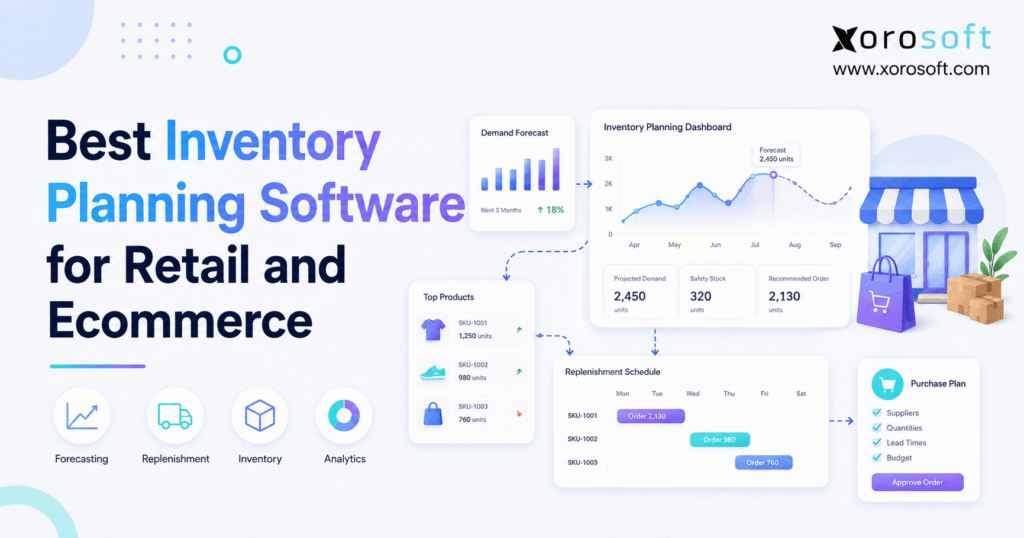
If you’re searching for ways to optimise your business operations, retail inventory planning software can be an essential tool.
1. When Growth Makes Inventory Harder to Predict
Retail inventory planning software helps growing retailers and ecommerce brands decide what to buy, when to reorder, and where stock should sit before demand arrives. However, the real challenge is rarely a lack of inventory data. Instead, teams often have plenty of data but struggle to turn it into clear buying decisions.
For example, a company may know exactly how many units it has today. Yet that number alone does not show what customers may buy next month. Likewise, it does not show whether a supplier will deliver on time, whether one warehouse is short, or whether another location has too much stock.
Therefore, planning becomes harder as the business adds products, suppliers, warehouses, and sales channels.
At first, spreadsheets may work well. However, once Shopify, Amazon, wholesale, retail stores, and 3PL partners enter the mix, buyers face more moving parts. As a result, a simple reorder sheet can quickly turn into several files, manual exports, and last-minute purchase decisions.
That is where better planning software becomes useful.
Instead of only tracking what has already happened, retail inventory planning software should help answer five practical questions:
- What are we likely to sell?
- How much stock do we already have?
- What inventory is already on the way?
- When should we reorder?
- Where should that inventory go?
Therefore, the best system is not always the product with the longest feature list. Instead, it is the one that matches the way your business buys, stores, and sells inventory.
2. What Is Retail Inventory Planning Software?
Retail inventory planning software is a system that helps businesses estimate future stock needs and turn those estimates into buying or replenishment decisions.
In other words, forecasting predicts demand. Planning then decides what action should follow.
For example, a forecast may suggest that a retailer will sell 800 units during the next eight weeks. However, the business may already have 300 units available and another 250 arriving from a supplier. Therefore, the actual purchase need is very different from the sales forecast itself.
A useful planning system considers several inputs together:
- historical sales
- current inventory
- committed stock
- inbound purchase orders
- supplier lead times
- safety stock
- seasonality
- minimum order quantities
- warehouse location
- expected demand
- product trends
As a result, buyers can make more informed decisions instead of simply repeating last month’s order.
Therefore, retail inventory planning software gives buyers a forward-looking view instead of relying only on today’s stock balance.
2.1 Inventory Planning vs Inventory Management
Inventory planning and inventory management are closely linked. However, they solve different problems.
| Inventory Planning | Inventory Management |
|---|---|
| Looks forward | Tracks current activity |
| Estimates future stock needs | Records stock on hand |
| Helps plan purchases | Tracks receipts and movements |
| Uses forecasts | Uses live transactions |
| Plans safety stock | Tracks available stock |
| Supports future decisions | Supports daily execution |
Therefore, inventory management tells you what you have, while inventory planning helps decide what you may need next.
Both functions matter.
For example, a perfect forecast still creates poor buying decisions if the system thinks 500 units are available when the warehouse actually has 350.
2.2 Inventory Planning vs Demand Forecasting
Demand forecasting estimates future sales.
By contrast, inventory planning turns that demand estimate into an inventory action.
Therefore, a forecast may answer:
“How many units are we likely to sell?”
Meanwhile, planning answers:
“How many units should we buy, from which supplier, for which location, and by what date?”
Because of that difference, retailers should avoid choosing software based only on attractive forecast charts.
Instead, they should also test what happens after the forecast is created.
2.3 Inventory Planning vs Replenishment
Replenishment is one part of planning.
First, the business estimates demand. Next, it reviews available and inbound stock. Then, it checks supplier lead times and inventory targets. Finally, the system can recommend what should be reordered.
Therefore, replenishment turns the plan into action.
3. Why Retail Inventory Planning Software Becomes Essential as You Grow
Retail inventory planning becomes difficult because demand is not the only variable.
Instead, several moving parts can change at the same time.
Moreover, as complexity increases, retail inventory planning software becomes valuable because it connects demand, supply, purchasing, and location data in one planning process.
3.1 More SKUs Create More Decisions
A business with 50 products may review every SKU by hand.
However, a business with 5,000 SKUs cannot spend the same amount of time on each item.
Therefore, planners need exception-based workflows.
For example, they should be able to focus first on:
- items at risk of stockout
- excess inventory
- late purchase orders
- fast-growing products
- slow-moving products
- unusual demand
- changing supplier lead times
As a result, the team spends less time scanning rows and more time making decisions.
In addition, retail inventory planning software can help teams rank SKUs by risk so buyers do not spend equal time reviewing every item.
3.2 More Channels Split the Demand Picture
A Shopify store may be easy to plan by itself.
However, once the same stock supports Amazon, wholesale orders, retail stores, and marketplaces, the demand picture changes.
For example, Amazon may suddenly grow while wholesale demand stays flat. Meanwhile, Shopify may run a promotion that lifts sales for one product family.
Therefore, buyers need a shared demand view.
Without it, each channel can look healthy while total inventory quietly moves toward a shortage.
3.3 Retail Inventory Planning Software for Multiple Warehouses
A business may have enough stock overall and still have a serious availability problem.
For example, Warehouse A may hold 700 units while Warehouse B has only 40. However, most upcoming orders may ship from Warehouse B.
Therefore, company-wide stock is not enough.
Instead, growing businesses need multi-warehouse inventory management that connects stock location with receiving, transfers, fulfillment, and replenishment.
Moreover, retail inventory planning software should consider where stock is located, not only how much stock exists in total.
3.4 Supplier Lead Times Change
A product may sell at a steady rate. However, supply can still create risk.
For example, a supplier may quote 30 days but actually deliver anywhere between 28 and 50 days.
Therefore, using a fixed 30-day planning rule may create repeated shortages.
As a result, planning teams should review actual supplier performance rather than relying only on the original quote.
4. What Good Retail Inventory Planning Software Should Actually Do
The best retail inventory planning software should make day-to-day buying decisions easier. Therefore, it should go beyond simple charts.
4.1 Demand Forecasting in Retail Inventory Planning Software
First, the system should forecast at the SKU level.
In addition, location, sales channel, variant, or product-group forecasts may matter.
For example, an apparel brand does not only need to know how many shirts it may sell. Instead, it may need demand by style, color, and size.
Therefore, the forecast must match the level at which the buyer actually places orders.
Moreover, strong retail inventory planning software should make those forecasts useful at the SKU, variant, channel, and location level.
4.2 Account for Seasonality
Past sales matter. However, not every month behaves the same way.
For example, sporting goods, apparel, gifts, food, and outdoor products can have strong seasonal shifts.
Therefore, retail demand planning software should help teams see recurring demand patterns instead of treating every month as equal.
In addition, planners should review seasonal products early enough to account for supplier lead times.
4.3 How Inventory Planning Software Uses Open Purchase Orders
A common planning mistake is to look only at current stock.
However, inventory already on order changes the decision.
For example, a buyer may see only 100 units available and immediately order 500 more. Yet 600 units may already be arriving next week.
As a result, ignoring inbound stock can create excess inventory.
Therefore, retail inventory planning software should include open purchase orders when calculating future supply.
4.4 Support Flexible Safety Stock Rules
Safety stock helps protect the business when demand or supply changes.
However, one safety-stock rule should not apply to every item.
For example, a stable evergreen SKU may need a smaller buffer. By contrast, a fast-growing product with a long supplier lead time may need more protection.
Therefore, retail inventory planning software should support flexible safety-stock rules instead of forcing one target across the catalog.
4.5 Retail Inventory Planning Software for Smarter Purchasing
Forecasting should ultimately support purchasing.
Therefore, useful software should help answer:
- What should we order?
- How much should we order?
- When should we place the order?
- Which supplier should receive it?
- Which location needs the stock?
Moreover, buyers should be able to review exceptions before they approve the final order.
As a result, planning becomes part of the purchasing workflow rather than a separate report.
4.6 Connect Planning With Operational Data
Retail planning is only as useful as its inputs.
Therefore, inventory, sales, purchase orders, returns, suppliers, and warehouses should stay in sync.
For businesses that need inventory connected with accounting, purchasing, warehouse work, manufacturing, and ecommerce, a broader cloud ERP platform may be more suitable than another standalone app.
5. How We Compared Retail Inventory Planning Software
No system is best for every company.
Therefore, the following list looks at business fit rather than simply ranking products by feature count.
We focused on:
1. demand forecasting
2. replenishment
3. purchasing
4. multi-location support
5. ecommerce fit
6. Shopify use
7. inventory control
8. ERP depth
9. warehouse needs
10. ability to scale with more complex operations
In addition, software should be tested against real operational needs before a final decision is made.
Therefore, buyers should review actual workflows instead of comparing long feature lists alone.
6. 10 Best Retail Inventory Planning Software Options
The best retail inventory planning software depends on whether the business needs a focused planning tool, broader inventory control, or a connected ERP.
| Software | Best Fit | Main Approach |
| Xorosoft | Inventory-driven retail and ecommerce businesses | Connected cloud ERP |
| Sage Inventory Planner | Retail and ecommerce forecasting | Dedicated planning |
| Netstock | Demand and inventory planning | Planning platform |
| Cin7 | Product and multichannel operations | Inventory + forecasting |
| Prediko | Shopify-first brands | Shopify planning |
| Brightpearl | Multichannel retail | Retail operating platform |
| Streamline | Advanced supply and demand planning | Planning platform |
| NetSuite | Larger ERP-led businesses | Cloud ERP |
| Business Central | Microsoft-led businesses | ERP |
| Acumatica | Mid-market distribution and manufacturing | ERP |
6.1 Xorosoft — Best Fit for Connected Retail and Ecommerce Operations
Xorosoft takes a different approach from a standalone forecasting application.
Instead, its cloud ERP brings inventory, purchasing, accounting, warehouse management, manufacturing, reporting, and ecommerce workflows into one system.
Therefore, it is most relevant when poor inventory planning is part of a wider operations problem.
For example, a growing brand may already have Shopify, QuickBooks, purchasing spreadsheets, a warehouse application, EDI tools, and Amazon workflows.
In that case, adding one more forecasting app may improve demand planning. However, it may also create another data connection to manage.
Therefore, Xorosoft is worth considering when the business needs planning tied to real stock, purchase orders, warehouse activity, accounting, and sales channels.
In addition, businesses can review the XoroERP platform when comparing broader ERP requirements with standalone inventory tools.
Best fit for:
- retail brands
- ecommerce businesses
- wholesale distributors
- apparel companies
- furniture companies
- sporting goods brands
- manufacturers
- multi-warehouse businesses
- Shopify businesses
- Amazon sellers
- businesses using EDI
However, a very small company that only needs a simple sales forecast may not need a full ERP.
That distinction matters.
6.2 Sage Inventory Planner — Best Fit for Dedicated Planning
Sage Inventory Planner focuses on forecasting, purchasing, reporting, and inventory planning.
Therefore, it can suit retailers that already have a stable operations stack but want a stronger planning layer.
In addition, a dedicated planner can be useful when the main problem is knowing how much inventory to buy and when to buy it.
However, companies that also need to replace accounting, WMS, production, or broader ERP workflows may need a wider system.
6.3 Netstock — Best Fit for Demand and Inventory Planning
Netstock focuses on demand planning, forecasting, inventory control, replenishment, supplier performance, and related planning workflows.
Therefore, it can suit businesses that already have ERP data but need deeper planning tools.
Moreover, the system is aimed at turning forecast information into stock and supply decisions.
However, buyers should still check how much day-to-day work remains inside their ERP after the plan is approved.
6.4 Cin7 — Best Fit for Product Operations With Forecasting
Cin7 combines inventory management with forecasting, sales channels, purchasing, and other product workflows.
Therefore, Cin7 can make sense for companies that need inventory control as well as forecasting.
However, businesses comparing Cin7 with a full ERP should also review accounting, manufacturing, warehouse, and system-wide needs.
For a deeper platform comparison, the Xorosoft vs Cin7 guide can help teams compare the broader operating model.
6.5 Prediko — Best Fit for Shopify-First Brands
Prediko is built around Shopify inventory planning.
Therefore, it can be attractive for ecommerce brands that want to move beyond spreadsheets without adding a full ERP.
Moreover, a Shopify-focused system may be easier to adopt when the sales model is centered mainly on that platform.
However, companies with large wholesale, EDI, manufacturing, accounting, or warehouse needs should test whether a Shopify-first planning layer covers enough of the wider operation.
6.6 Brightpearl — Best Fit for Multichannel Retail Operations
Brightpearl combines retail operations with inventory forecasting.
Therefore, it can be relevant when planning is tied closely to order and retail workflows.
In addition, broader retail platforms can help when inventory, orders, purchasing, and fulfillment need to stay connected.
However, companies should still compare that model with dedicated planning tools and full ERP systems before deciding.
6.7 Streamline — Best Fit for Advanced Planning Needs
Streamline is a supply-chain planning platform focused on demand forecasting and replenishment.
Therefore, it can fit businesses that want a specialist planning layer while keeping other core business systems.
Moreover, this model can work well when planning is the main operational gap.
However, businesses should decide whether they want a separate planning system or one platform that also owns purchasing, accounting, and warehouse execution.
6.8 NetSuite — Best Fit for Larger ERP-Led Organizations
NetSuite includes demand planning within its broader ERP environment.
Therefore, it can fit companies that want inventory planning connected with finance and other enterprise processes.
However, buyers should also consider implementation needs, internal resources, business structure, and long-term system fit.
6.9 Microsoft Dynamics 365 Business Central — Best Fit for Microsoft-Centered Companies
Business Central includes forecasting and inventory tools within a wider ERP system.
Therefore, businesses already using Microsoft’s business software may find this model attractive.
In addition, Business Central supports broader processes around finance, inventory, and purchasing.
However, companies should still test whether its planning depth matches their SKU, warehouse, and channel complexity.
6.10 Acumatica — Best Fit for Mid-Market Distribution and Manufacturing
Acumatica combines ERP with demand, distribution, and manufacturing planning.
Therefore, it can fit distributors and manufacturers that need planning tied to broader ERP processes.
However, as with any ERP, buyers should evaluate the full implementation rather than judging only the forecasting module.
For broader ERP comparisons, businesses can also review the Xorosoft comparison hub before building a shortlist.
7. Best Retail Inventory Planning Software by Business Type
Retail inventory planning software should therefore be evaluated against the operating model of each business, not only against a generic feature list.
The right system depends heavily on how the business sells, buys, stores, and moves products.
7.1 Ecommerce Inventory Planning Software for Growing Brands
Ecommerce brands should focus on:
- channel demand
- Shopify data
- Amazon demand
- returns
- fast-moving SKUs
- promotions
- purchase orders
- warehouse location
- 3PL stock
- seasonality
Moreover, the system should combine demand across channels rather than forcing the buyer to plan each one in isolation.
Therefore, ecommerce inventory planning software should give buyers one view of inventory risk across the whole business.
7.2 Multi-Location Retail Inventory Planning Software
Retailers with several stores or warehouses need location-level planning.
Therefore, they should test transfers, stock by location, reorder rules, lead times, and fulfillment demand.
In addition, they should check whether retail inventory planning software can show that stock exists but sits in the wrong place.
7.3 Wholesale Businesses
Wholesale demand can be uneven.
For example, one large customer order may use several weeks of normal inventory at once.
Therefore, wholesalers should test:
- customer orders
- stock allocation
- supplier planning
- EDI
- large purchase orders
- lead times
- warehouse stock
Moreover, Xorosoft’s broader business solutions show how inventory-driven workflows can connect across sales, purchasing, warehousing, and finance.
7.4 Apparel and Fashion
Apparel businesses often plan by:
- style
- color
- size
- season
- location
- sales channel
Therefore, product-level forecasts alone may hide important shortages.
For example, a style can appear well stocked overall while the best-selling sizes are already running low.
7.5 Furniture
Furniture businesses often face longer lead times and higher inventory values.
Therefore, buyers need to balance availability with cash tied up in stock.
In addition, warehouse space may affect how much inventory can be held.
7.6 Sporting Goods
Sporting goods can have strong seasonal patterns.
Therefore, planners need to prepare before demand peaks rather than reacting after the season starts.
Moreover, different regions may see demand at different times.
7.7 Food and Beverage
Food businesses need to consider shelf life as well as demand.
Therefore, excess stock can be just as serious as a shortage.
In addition, lot tracking, supplier dates, and expiry risk may change the planning process.
7.8 Manufacturing
Manufacturers need more than finished-goods forecasts.
Instead, demand may need to flow into raw materials, components, bills of materials, and production schedules.
Therefore, an ERP approach can become more useful when sales forecasts must drive material planning.
Businesses can review Xorosoft’s industries to see how inventory requirements differ across operating models.
8. Retail Inventory Planning Software for Shopify
Shopify can track sales and inventory. However, growing brands often need a wider planning view.
For example, the same company may sell through Shopify, Amazon, wholesale customers, and retail stores.
Therefore, Shopify sales alone may not represent total demand.
In addition, inventory may sit across an internal warehouse, a 3PL, Amazon FBA, and store locations.
As a result, buying decisions need a shared stock picture.
For Shopify brands, retail inventory planning software becomes especially useful once demand is spread across several channels or fulfillment locations.
Xorosoft’s integrations platform is relevant when ecommerce data must connect with inventory, orders, warehouse work, and ERP processes.
Moreover, Xorosoft has a live listing on the Shopify App Store, which gives merchants an external reference point for the Shopify integration.
Therefore, Shopify businesses should ask more than:
“Does it integrate?”
Instead, they should ask:
- Which data moves?
- How often does it sync?
- Which system owns inventory?
- How are refunds handled?
- How are purchase orders handled?
- How are warehouse locations mapped?
- How are Amazon and wholesale orders included?
Those questions reveal whether the connection actually supports planning.
9. How Retail Inventory Planning Software Helps Reduce Stockouts
Stockouts usually start before stock reaches zero.
Therefore, the best time to act is while enough inventory still exists to make a normal purchasing decision.
9.1 Use Inventory Forecasting Software to Estimate Future Demand
First, estimate expected demand.
However, do not simply copy the previous month.
Instead, account for seasonality, growth, promotions, stockouts, and unusual events.
Therefore, better inventory forecasting software gives the buyer a stronger starting point.
9.2 Add Supplier Lead Time
Next, consider how long replenishment takes.
For example, if a product sells 20 units per day and the supplier needs 45 days, the business may need enough stock to cover far more than next week’s demand.
Therefore, supplier lead time should be part of the reorder decision.
9.3 Add a Safety Buffer
Then, add a sensible buffer for uncertainty.
However, the buffer should match the SKU.
A stable item may need less protection, while an unpredictable item may need more.
Therefore, safety stock should reflect real operating risk.
9.4 Subtract Available and Inbound Stock
Next, account for what is already available and what is already on order.
Therefore, the planning equation should avoid buying the same demand twice.
9.5 Act on Exceptions
Finally, focus the buyer’s attention on items that need action now.
As a result, the team can spend more time on risk and less time reviewing healthy SKUs.
10. How Retail Inventory Planning Software Helps Reduce Overstock
Stockouts get attention because customers notice them.
However, overstock can quietly damage cash flow for months.
Therefore, planning should manage both risks.
Retail inventory planning software can help expose excess earlier by comparing future demand with both current and inbound stock.
10.1 Find Slow-Moving Inventory
First, compare current stock with future demand.
If a SKU holds 12 months of supply but sells slowly, another purchase may not make sense.
Therefore, the buyer should review coverage before approving the next order.
10.2 Watch Inbound Inventory
Next, include open purchase orders.
Otherwise, the buyer may order again before the previous shipment arrives.
As a result, inbound visibility can prevent accidental overbuying.
10.3 Adjust to Demand Changes
Moreover, the plan should react when sales slow down.
For example, a product that sold well six months ago may no longer deserve the same reorder quantity.
Therefore, demand changes should influence future buying.
10.4 Protect Working Capital
Excess inventory uses cash.
Therefore, reducing unnecessary stock can free funds for stronger products, marketing, hiring, or other needs.
The goal, however, is not to hold as little stock as possible.
Instead, the goal is to hold the right stock for expected demand.
11. Retail Inventory Planning Software vs Spreadsheets
Spreadsheets are useful.
Therefore, businesses should not replace them simply because dedicated software exists.
11.1 When Spreadsheets Still Work
A spreadsheet may be enough when the business has:
- few SKUs
- one warehouse
- one sales channel
- stable suppliers
- simple purchase orders
- little seasonality
In that case, a complex system may add more work than value.
11.2 When Spreadsheets Start to Break
However, warning signs appear as the business grows.
For example:
- buyers maintain several versions of the same file
- Shopify data must be exported every week
- Amazon is planned separately
- purchase orders are missing from the forecast
- warehouse transfers are tracked by hand
- formulas break
- sales and finance use different numbers
- purchasing takes several days
- stockouts and overstock happen at the same time
Therefore, the reason to upgrade is not “spreadsheets are bad.”
Instead, the reason is that the planning process has become too complex to maintain by hand.
As a result, retail inventory planning software becomes more useful once manual files stop giving buyers a reliable view of future stock needs.
12. Standalone Planning Software vs ERP
This decision matters because the two categories solve different problems.
12.1 Choose Standalone Planning Software When
A standalone planner can work well when:
- inventory records are accurate
- purchasing works well
- accounting works well
- warehouse systems work well
- sales channels already sync
- forecasting is the main gap
Therefore, replacing the whole system would be unnecessary.
12.2 Consider ERP When the Problems Are Connected
However, consider ERP when the company is also struggling with:
- inventory accuracy
- purchasing
- accounting
- warehouse activity
- sales orders
- manufacturing
- EDI
- Shopify
- Amazon
- reporting
- multiple systems
At that point, another planning app may treat the symptom rather than the cause.
For example, a buyer may receive an excellent forecast but still have to copy the recommended quantity into a purchasing spreadsheet.
Then, when the goods arrive, the warehouse may update another system.
Meanwhile, finance may reconcile inventory in separate accounting software.
Therefore, the company still spends time joining the process together.
A connected ERP system for inventory-driven operations becomes more relevant when planning, purchasing, inventory, warehouse work, and finance need to share the same records.
13. A Practical Retail Inventory Planning Software Checklist
Before selecting software, test real workflows.
Therefore, the evaluation should go beyond screenshots and feature lists.
13.1 Demand Forecasting
Check whether the system can:
- forecast by SKU
- recognize seasonality
- handle changing demand
- account for stockouts
- support manual review
- group related products
Moreover, buyers should test real SKUs rather than relying only on sample data.
13.2 Inventory Replenishment Software Features to Check
Next, test:
- reorder points
- safety stock
- lead times
- minimum order quantities
- supplier rules
- order recommendations
Therefore, replenishment should turn forecasts into clear actions.
13.3 Purchasing
Then, test:
- purchase recommendations
- purchase order creation
- supplier selection
- inbound inventory
- partial receipts
- late orders
As a result, buyers can see how much manual work remains after the recommendation is created.
13.4 Multi-Warehouse Planning
Next, test:
- stock by warehouse
- demand by location
- transfer needs
- inbound inventory by location
- fulfillment rules
Therefore, location-level planning should be part of the evaluation.
13.5 Ecommerce
In addition, review:
- Shopify
- Amazon
- marketplaces
- 3PLs
- returns
- refunds
- inventory sync
Moreover, sales-channel data should support one planning view.
13.6 Wider Operations
Finally, check whether the business also needs:
- accounting
- WMS
- EDI
- manufacturing
- reporting
- wholesale
- financial controls
Therefore, retail inventory planning software should be evaluated against the whole workflow, not only the forecast screen.
14. Common Inventory Planning Mistakes
Even good retail inventory planning software cannot fix every process by itself.
Therefore, teams should avoid several common mistakes.
14.1 Using Bad Inventory Data
If stock balances are wrong, the buying plan will also be wrong.
Therefore, improve inventory accuracy before relying heavily on automated recommendations.
14.2 Ignoring Stockout History
A product may show low historical sales because it was out of stock.
Therefore, the system should not always treat recorded sales as true demand.
14.3 Using One Rule for Every SKU
Different products behave differently.
Therefore, buyers should group products by demand, value, season, or business importance.
14.4 Ignoring Supplier Performance
A 30-day quoted lead time is not useful if the supplier normally takes 45 days.
Therefore, actual delivery history should influence planning.
14.5 Ordering Without Looking at Inbound Stock
Current stock is only part of the picture.
Therefore, buyers should also check open purchase orders and expected receipts.
14.6 Adding Another Data Silo
A new planning app may be useful.
However, it can also add another system to maintain.
Therefore, consider how the tool will connect with inventory, purchasing, accounting, and warehouse work before signing a contract.
14.7 Expecting AI to Make Every Decision
AI can speed up pattern finding and forecast work.
However, teams still need business judgment.
For example, a model may not understand a one-time promotion, supplier issue, product launch, or planned assortment change unless the right data is available.
Therefore, the strongest workflow combines software with planner review.
15. When Should a Business Upgrade Its Inventory Planning System?
An upgrade is usually justified when the cost of manual planning becomes greater than the cost and effort of a better system.
Therefore, watch for these signals:
1. Purchasing takes too long.
2. Buyers rely heavily on spreadsheets.
3. Stockouts remain common.
4. Excess inventory continues to grow.
5. Several warehouses need manual balancing.
6. Shopify and Amazon demand are reviewed separately.
7. Wholesale orders create sudden shortages.
8. Supplier lead times are hard to track.
9. Purchase orders are missing from planning.
10. Inventory numbers differ between teams.
11. Management cannot see future stock risk.
12. Forecasts are rarely updated.
13. Reorder rules are mostly based on gut feel.
14. Warehouse transfers are reactive.
15. Finance spends too much time reconciling stock.
Retail inventory planning software is usually worth evaluating when these warning signs begin appearing at the same time.
However, if the same problems also extend into accounting, WMS, manufacturing, or order management, the business should evaluate ERP as well.
16. A Four-Stage Inventory Planning Decision Framework
| Stage | Typical Setup | Best Direction |
| Stage 1 | Few SKUs, one channel, one warehouse | Spreadsheet or basic inventory system |
| Stage 2 | Growing Shopify brand | Dedicated planning software |
| Stage 3 | Multichannel and multi-warehouse | Advanced inventory and planning system |
| Stage 4 | Ecommerce, wholesale, WMS, accounting, EDI or manufacturing | Integrated ERP |
In other words, retail inventory planning software should become more capable as channel, warehouse, and process complexity increases.
16.1 Stage 1: Keep It Simple
First, do not overbuy software.
If the business can plan accurately in a simple spreadsheet, that may still be the best option.
16.2 Stage 2: Add Forecasting
Next, growing brands often need better demand and purchase planning.
Therefore, a dedicated planning tool can remove a large amount of manual work.
16.3 Stage 3: Connect Inventory and Channels
Then, multichannel growth creates more stock and location decisions.
Therefore, inventory management and planning need tighter links.
16.4 Stage 4: Connect the Operating System
Finally, some businesses reach a point where inventory cannot be managed separately from accounting, WMS, purchasing, manufacturing, wholesale, and ecommerce.
Therefore, a platform such as Xorosoft becomes more relevant at this stage.
Before making that decision, reviewing real operating examples in Xorosoft case studies can help teams compare their own challenges with businesses that have moved to a connected system.
17. Frequently Asked Questions About Retail Inventory Planning Software
17.1 What Is Retail Inventory Planning Software?
Retail inventory planning software helps businesses estimate how much stock they will need and when they should buy it. Therefore, it usually combines sales history, forecasts, current stock, purchase orders, safety stock, and supplier lead times. As a result, buyers can make forward-looking decisions instead of reacting only when stock runs low.
17.2 What Does Inventory Planning Software Do?
Inventory planning software forecasts demand and helps turn that forecast into buying decisions. For example, it can estimate future sales, track inbound stock, calculate reorder needs, and flag shortages. Therefore, the software helps buyers decide what to order, how much to order, and when to place the order.
17.3 Who Needs Retail Inventory Planning Software?
Growing retailers, ecommerce brands, wholesalers, and product businesses often need it when SKU, supplier, channel, or warehouse complexity increases. However, very small businesses with stable demand may still plan well in spreadsheets. Therefore, the need depends more on complexity than company size alone.
17.4 What Is the Best Inventory Planning Software for Retail?
There is no universal best system. Instead, the right choice depends on stores, warehouses, SKU count, purchasing, channels, and finance needs. Therefore, compare focused planners with broader inventory and ERP systems before deciding.
17.5 What Is the Best Inventory Planning Software for Ecommerce?
Ecommerce brands should prioritize channel data, SKU forecasting, purchase orders, supplier lead times, returns, and multi-location stock. Moreover, Shopify and Amazon businesses should check whether all channels feed one demand view. Therefore, the best product depends on how many systems need to work together.
17.6 What Is the Best Inventory Planning Software for Shopify?
Shopify-first brands may prefer a dedicated planning application when forecasting is their main issue. However, businesses with Amazon, wholesale, WMS, accounting, or manufacturing may need broader software. Therefore, Shopify integration should be evaluated as part of the full workflow rather than as a checkbox.
17.7 What Is Demand Forecasting?
Demand forecasting estimates how much customers may buy in the future. For example, it can use sales history, trends, and seasonal patterns. However, forecasting alone does not decide what should be purchased. Therefore, inventory planning adds stock, lead-time, and supply data before recommending action.
17.8 Is Inventory Planning the Same as Demand Planning?
Not exactly. Demand planning focuses on future customer demand. Inventory planning then combines expected demand with supply, stock, lead times, and buying rules. Therefore, demand planning is an important input, while inventory planning covers the wider stock decision.
17.9 Is Inventory Forecasting the Same as Inventory Planning?
No. Forecasting predicts future demand or stock needs. Planning then turns that estimate into purchase, transfer, production, or replenishment decisions. Therefore, forecasting is part of inventory planning rather than the whole process.
17.10 Can Inventory Planning Software Reduce Stockouts?
Yes, it can help. For example, software can show when expected demand may exceed available and inbound stock before inventory reaches zero. Therefore, buyers have more time to reorder, transfer stock, or adjust the plan. However, results still depend on accurate data and supplier performance.
17.11 Can It Reduce Overstock?
Yes. Planning tools can compare expected demand with stock already available or inbound. Therefore, they can flag items that may hold too much future supply. As a result, buyers can reduce or delay new purchases before excess stock grows further.
17.12 Can Retail Planning Software Handle Seasonality?
Many systems can model seasonal demand. However, users should test the system with their own products because seasonal patterns vary. Therefore, a holiday gift product, summer sporting item, and evergreen SKU should not automatically use the same forecast method.
17.13 Does Inventory Planning Software Calculate Safety Stock?
Many tools support safety stock or target stock rules. However, companies should check how those rules are set. Therefore, the key question is whether safety stock can change by SKU, location, lead time, demand pattern, or service need.
17.14 Can It Calculate Reorder Points?
Many systems can recommend reorder points or order timing. For example, they may combine expected demand, lead time, and safety stock. Therefore, reorder rules can become more flexible than a fixed number maintained in a spreadsheet.
17.15 Can Inventory Planning Software Create Purchase Orders?
Some systems create purchase orders directly, while others send recommendations to another purchasing tool or ERP. Therefore, businesses should test the full path from forecast to approved supplier order. Otherwise, manual re-entry may remain part of the process.
17.16 Can It Plan Inventory Across Several Warehouses?
Many modern systems support multi-location planning. However, the depth varies. Therefore, businesses should test demand, inbound stock, safety stock, transfers, and replenishment at each location rather than looking only at company-wide totals.
17.17 Can Inventory Planning Software Work With Amazon?
Many ecommerce-focused systems support Amazon directly or through integrations. However, the key issue is whether Amazon inventory and sales can be combined with Shopify, wholesale, warehouse, and 3PL data. Therefore, integration depth matters more than simply seeing an Amazon logo.
17.18 What Data Does Inventory Planning Software Need?
Typically, the system needs sales history, current stock, open orders, inbound purchase orders, product data, supplier lead times, and location data. In addition, returns, stockouts, seasonality, and minimum order quantities can improve the plan. Therefore, clean source data is very important.
17.19 How Accurate Is Inventory Forecasting?
Forecast accuracy varies by product, time horizon, data quality, seasonality, promotions, and demand changes. Therefore, businesses should not expect one accuracy rate across every SKU. Instead, they should track forecast error and bias by product group and improve the model over time.
17.20 Is AI Useful for Inventory Planning?
AI can help teams review large datasets and identify patterns faster. However, it cannot remove the need for good data or business judgment. Therefore, buyers should evaluate how AI improves a real workflow instead of choosing software simply because it uses the term “AI.”
17.21 When Should a Business Stop Using Spreadsheets?
Businesses should consider upgrading when spreadsheets create repeated manual work, conflicting versions, missed purchase orders, or poor multi-location visibility. However, there is no fixed revenue threshold. Therefore, the right time is when process complexity begins to reduce planning speed or accuracy.
17.22 Do Small Businesses Need Inventory Planning Software?
Some do, while others do not. A small company can still have complex inventory if it sells many SKUs across several channels. Meanwhile, a larger company with a simple range may plan easily. Therefore, SKU, supplier, channel, and warehouse complexity matter more than headcount alone.
17.23 Should Inventory Planning Connect With Accounting?
For many growing businesses, yes. Inventory purchases affect cash, inventory value, cost of goods, and financial reports. Therefore, connecting operations with finance can reduce manual checks. However, a dedicated planner may still work well when a stable ERP already handles those links.
17.24 Do I Need Inventory Planning Software or ERP?
Choose planning software when forecasting is the main problem and the rest of the systems already work well. However, consider ERP when the same business also struggles with purchasing, accounting, warehouses, manufacturing, ecommerce, EDI, or reporting. Therefore, first identify whether the problem is isolated or connected.
17.25 How Should I Compare Inventory Planning Vendors?
Start with real workflows. For example, test a seasonal SKU, a late supplier order, a warehouse shortage, a promotion, and a product with excess stock. Then, compare how each system handles those cases. Therefore, a hands-on workflow test is more useful than comparing long feature lists alone.
18. Choose the System That Matches the Real Inventory Problem
Retail inventory planning software can improve forecasting, replenishment, and purchasing. However, choosing the right system starts with understanding why planning is difficult in the first place.
For some businesses, the problem is simple. Therefore, a focused planning app may be enough.
For others, the real issue is that Shopify, Amazon, wholesale, warehouses, purchasing, accounting, EDI, and manufacturing all work in separate systems. In that case, better forecasting alone may not solve the wider problem.
Therefore, evaluate the full flow from customer demand to purchasing, receiving, warehousing, fulfillment, and finance.
Xorosoft is particularly relevant when that workflow needs to run inside one connected ERP environment. Moreover, its mix of inventory, purchasing, accounting, warehouse management, manufacturing, ecommerce, and multi-channel operations makes it a strong option to evaluate for inventory-driven businesses that have moved beyond basic planning tools.
If that describes your current setup, the next step is to review your workflows with the system rather than adding another disconnected tool.
Recent Posts
-
 ERP Landed Cost Module vs Spreadsheet Calculations for Importers
 -
 How to Build an Open-to-Buy Plan for an Omnichannel Brand
 -
 Cold Storage WMS for Food and Beverage Distribution
 -
 ERP Buying Statistics 2026: Evaluation, Implementation, and Adoption Risks
 -
 How a Distributor Reduced B2B Order Exceptions Without Restricting Sales