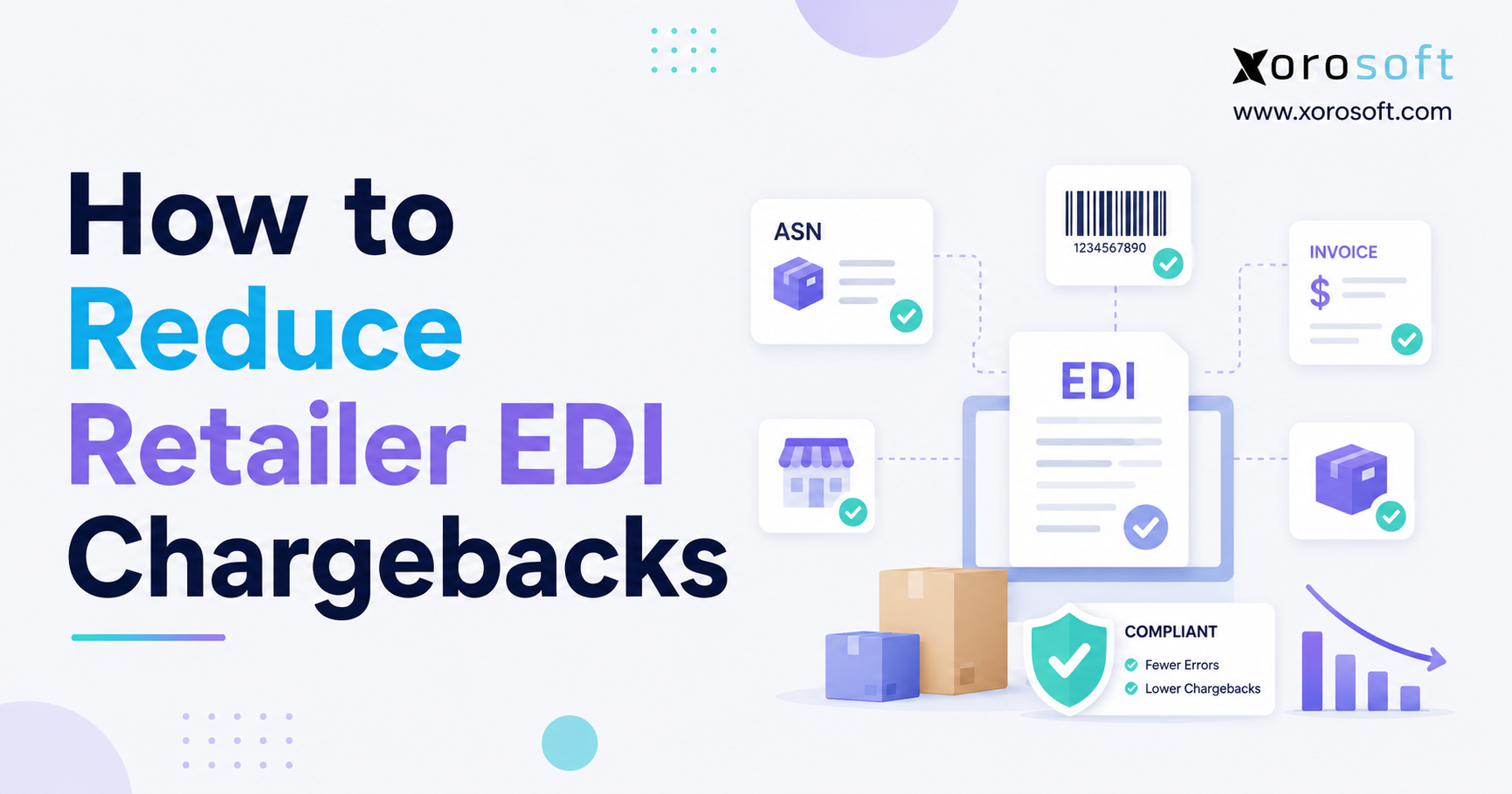
Are you looking for practical advice on how to reduce retailer EDI chargebacks?
1. Retailer EDI Chargebacks Quietly Erode Wholesale Margins
The question of how to reduce retailer EDI chargebacks often reaches senior management only after deductions begin to affect profit. At first, a single fee may look minor. However, repeated penalties can quickly reduce margin, delay payment, and create hours of research for operations, finance, warehouse, customer service, and EDI teams.
Many companies treat these deductions as a technical EDI issue. Yet that view overlooks the larger operational problem. A supplier can send a valid EDI document on time and still receive a chargeback because the document does not match the order, physical shipment, carton label, carrier record, or invoice.
For example, an EDI 856 advance ship notice may follow the correct format but list the wrong carton quantity. Likewise, a GS1-128 label may scan correctly but identify the wrong carton. An EDI 810 invoice may reach the retailer without a transmission error but use a price that differs from the purchase order.
In each case, the connection worked. Nevertheless, the process behind the transaction failed.
Therefore, companies that want to prevent retailer chargebacks need to look beyond file transmission. They must examine how employees create orders, reserve inventory, pick products, pack cartons, print labels, select carriers, send ASNs, create invoices, and respond to transaction errors.
More importantly, EDI chargeback prevention should become part of normal order-to-cash management. It depends on accurate master data, clear retailer rules, reliable warehouse work, controlled document timing, exception monitoring, and financial reconciliation.
1.1 Why Vendor Compliance Chargebacks Keep Returning
A chargeback usually appears long after the original mistake occurred. For instance, the warehouse may change a carton on Monday, while the retailer may not issue the deduction until several weeks later.
Because of that delay, root-cause analysis becomes difficult. Employees may no longer remember what changed, and the business may need to search through several systems, spreadsheets, emails, and retailer portals.
In many cases, teams correct the immediate problem, dispute the fee, and continue working. Although this approach may recover part of the deduction, it does not stop the same failure from returning.
Instead, a stronger process connects every chargeback with the order, shipment, ASN, label, invoice, warehouse, reason code, and internal owner. As a result, the company can determine whether the deduction came from bad data, late documents, warehouse work, carrier selection, pricing, or another issue.
1.2 Why Valid EDI Transactions Still Create Retailer Deductions
EDI validation often checks whether a transaction follows the required technical structure. Specifically, it reviews segments, elements, formats, control numbers, and required fields.
However, technical validation does not prove that the business data is correct.
An ASN can pass technical checks while showing the wrong quantity. Similarly, an invoice can pass validation while using an outdated price. A purchase order acknowledgment can accept stock that the warehouse does not have. Meanwhile, a valid SSCC can appear on the wrong carton.
For that reason, effective EDI chargeback prevention must combine technical checks with business checks. The system should compare each transaction with the retailer profile, item data, customer pricing, inventory availability, final shipment, carrier booking, and required document timing.
2. How EDI Chargebacks Develop Across the Order-to-Cash Cycle
To understand how to reduce retailer EDI chargebacks, follow the order from the retailer’s purchase order through payment. A mistake at any stage can create a deduction.
The process often begins when the retailer sends an EDI 850 purchase order. Next, the supplier may respond with an EDI 855 purchase order acknowledgment. After the warehouse fulfills the order, the supplier sends an EDI 856 advance ship notice and an EDI 810 invoice.
Meanwhile, the retailer compares those documents with its purchase order, supplier agreement, routing guide, receiving scans, delivery appointment, invoice rules, and physical shipment.
When the records do not align, the retailer may deduct a compliance fee from its payment. Consequently, the financial deduction often represents the end of an operational problem that began much earlier.
2.1 Purchase Order and EDI 850 Chargeback Risks
The EDI 850 tells the supplier what the retailer wants to buy. Problems begin when the supplier interprets the order differently from the retailer.
For example, a retailer SKU may point to the wrong internal item. Likewise, a quantity of one may represent one case in the retailer’s system but one unit in the supplier’s ERP. An old ship-to code may also direct the order to the wrong distribution center.
Manual order entry adds another source of risk. When an employee retypes the retailer order into an ERP or spreadsheet, even a small error can affect inventory allocation, picking, shipping, and invoicing.
Therefore, the supplier should validate the purchase-order number, retailer SKU, internal SKU, unit of measure, quantity, price, ship-to location, requested date, and special instructions before releasing the order.
2.2 Purchase Order Acknowledgment and EDI 855 Errors
The purchase order acknowledgment tells the retailer whether the supplier accepted the order and can meet the requested terms.
However, a supplier may receive a chargeback when it sends the acknowledgment late, accepts a quantity it cannot supply, fails to report a backorder, or gives an unrealistic ship date.
Accordingly, the acknowledgment should reflect current inventory and operational capacity. It should not simply copy the retailer’s requested quantity without checking whether the business can fulfill it.
Companies that manage inventory across several warehouses, ecommerce channels, marketplaces, and wholesale accounts need a reliable available-to-promise process. Otherwise, they may commit the same stock to more than one customer.
2.3 ASN, Invoice, and Receiving Mismatches
After fulfillment, the ASN describes what the supplier shipped. The invoice then states what the retailer owes.
The retailer may compare the purchase order, ASN, carton labels, receiving scans, and invoice. Therefore, a mismatch between any of these records can lead to a deduction.
For instance, the retailer may order 100 units, receive an ASN for 100, physically receive 96, and receive an invoice for 100. The supplier now faces a quantity dispute, a possible ASN chargeback, and an invoice short payment.
To avoid that outcome, the business needs one clear transaction history. It should show what the retailer ordered, what the supplier accepted, what the warehouse packed, what the carrier collected, and what finance billed.
3. The Most Common Causes of Retailer EDI Chargebacks
Retailer EDI chargebacks usually come from four areas: master data, document timing, physical fulfillment, and financial records.
Although the retailer’s reason code describes the visible problem, it may not reveal the internal cause. For example, an “incorrect ASN” deduction could begin with warehouse packing. Similarly, an “invoice mismatch” could begin with customer pricing. A “wrong item” deduction may start with a bad SKU cross-reference.
3.1 Master Data Errors That Spread Across EDI Documents
Master data supplies the basic facts that each system uses. High-risk records include retailer SKUs, internal SKUs, UPCs, GTINs, units of measure, case packs, prices, allowances, warehouse codes, ship-to locations, carrier codes, and payment terms.
One incorrect record can affect the full order cycle.
Suppose a retailer orders one case of 12 units, but the supplier’s item record treats one case as six units. The system may create a valid order, pick ticket, ASN, and invoice. Nevertheless, every document will reflect the wrong quantity.
To reduce this risk, the company should assign an owner to each important data set. In addition, changes should include an effective date, approval record, and test process.
Teams should also review customer and item data before product launches, peak seasons, warehouse changes, and new retailer onboarding. Otherwise, old data may continue to create new deductions.
3.2 Late EDI Documents and Poor Transaction Sequencing
Retailers often require suppliers to send acknowledgments, ASNs, and invoices within specific time windows.
An ASN sent too early may describe an estimated shipment rather than the final cartons. By contrast, an ASN sent too late may reach the retailer after the truck arrives. An invoice sent before shipment confirmation may also contain quantities that later change.
Therefore, companies should maintain partner-specific timing rules instead of applying one deadline to every retailer. Automated alerts should warn the owner before the transaction becomes late.
The process also needs a clear sequence. First, the warehouse should confirm the shipment. Next, the system should create the final ASN. Finally, finance should invoice from approved order and shipment data rather than from an early estimate.
3.3 Warehouse Mistakes That Look Like EDI Failures
Many EDI chargebacks start on the warehouse floor.
An employee may pick the wrong item, pack the wrong quantity, place a label on the wrong carton, reuse an SSCC, select an unapproved carrier, or change the shipment after the ASN has already gone out.
As a result, the retailer sees a digital shipment record that differs from the cartons at the receiving dock. From the retailer’s view, the ASN or label failed. Internally, however, the warehouse process caused the mismatch.
Scanning can reduce risk, but scanning alone does not solve the problem. The warehouse also needs current retailer rules, controlled label templates, clear pack instructions, and a final verification step before shipment release.
3.4 Invoice and Retailer Deduction Errors
Invoice chargebacks often involve price, quantity, freight, tax, allowance, payment terms, or purchase-order references.
Problems increase when finance works from records that differ from the warehouse and EDI systems. For example, the invoice may show the ordered quantity while the warehouse shipped less. It may also use the standard price while the retailer purchase order includes a temporary promotion.
Therefore, finance should be able to trace each invoice back to the purchase order, sales order, shipment, ASN, customer price, and approved exception.
| Chargeback area | Retailer complaint | Common internal cause |
|---|---|---|
| Purchase order | Invalid item or location | Bad SKU or ship-to cross-reference |
| Acknowledgment | Accepted quantity unavailable | Inventory not checked |
| ASN | Shipment quantity mismatch | ASN created before final packing |
| Label | Duplicate or invalid SSCC | Weak label controls |
| Routing | Wrong carrier or method | Retailer rules not applied |
| Invoice | Price or quantity mismatch | Disconnected order and finance data |
| Acknowledgment | Rejection not corrected | Missing exception alerts |
4. How to Reduce Retailer EDI Chargebacks Across the Order Cycle
A practical plan for how to reduce retailer EDI chargebacks should connect retailer requirements, master data, EDI documents, warehouse work, exception management, and finance.
However, the goal is not to add more manual checks. Instead, the company should place each control at the point where it can stop an error before it reaches the retailer.
4.1 Centralize Retailer Compliance and Routing Requirements
Retailer implementation guides, routing guides, label rules, carrier requirements, invoice terms, and dispute deadlines should live in one controlled location.
Each retailer profile should show the current version, effective date, required documents, transmission cutoffs, approved carriers, delivery rules, label template, pallet limits, invoice terms, and internal owner.
A central library helps employees find the right information. Nevertheless, the company should also convert key rules into workflow controls.
For example, the shipping system can limit carrier selection to approved choices. The warehouse can receive an alert when a pallet exceeds the retailer’s height limit. Meanwhile, the EDI team can receive a warning when an ASN approaches its deadline.
As a result, employees do not need to remember every detail for every trading partner.
4.2 Connect EDI, ERP, Inventory, and Warehouse Records
Manual re-entry creates gaps between systems. An employee may type the EDI order into the ERP, recreate the shipment in the EDI platform, and enter the invoice again in accounting software.
At each handoff, the quantity, item, date, or reference number may change.
A connected platform such as XoroOne can bring inventory, sales orders, purchasing, warehousing, accounting, ecommerce, reporting, and EDI integrations into one operating model.
However, the important question is not whether every task happens in one application. Instead, the business needs to know whether every system receives the same current and traceable information.
The sales order should begin with the retailer purchase order. Then, inventory allocation should use current stock. The warehouse should fulfill the same order, while the final shipment should create the ASN. Finally, finance should build the invoice from approved commercial and shipment data.
4.3 Validate Business Rules Before EDI Transmission
Teams that want to know how to reduce retailer EDI chargebacks should validate more than file structure.
A strong validation process checks whether the document follows the correct EDI format, includes all required values, follows the retailer’s guide, matches the actual business event, and reaches the retailer within the required time.
For an ASN, the system can confirm that the purchase order exists, the destination is valid, carton IDs are unique, the carrier is approved, and quantities match the final shipment.
Likewise, for an invoice, the system can compare price, quantity, freight, allowances, payment terms, purchase-order number, and shipment status.
Most importantly, the business should run these checks before transmission. Once the retailer receives the document, the correction window may be short.
4.4 Give Every EDI Exception a Clear Owner
A transaction error should not sit in a shared inbox while teams decide who should handle it.
Instead, the exception record should show the retailer, transaction type, order or shipment number, error message, date, deadline, owner, status, and corrective action.
The EDI team may own a structural rejection. By contrast, master-data staff may own an invalid SKU. Warehouse operations may own a carton mismatch, while finance may own a price issue.
Clear ownership helps the company fix errors before retailer deadlines. Furthermore, it creates a useful audit trail for future reviews.
4.5 Review Chargebacks as Process Data
A monthly deduction report should do more than show total dollars.
In addition, it should identify the retailers with the highest deductions, the most frequent reason codes, the warehouses with repeated errors, the products linked to mismatches, the recovery rate, and the status of corrective work.
The team should also separate one-time errors from repeat failures. A rare manual mistake may require coaching. However, a chargeback that appears every month may point to a broken workflow or disconnected system.
5. How to Reduce Retailer EDI Chargebacks with Accurate ASNs
Teams that want to understand how to reduce retailer EDI chargebacks should give special attention to the EDI 856. The ASN connects the electronic transaction with the physical shipment, which makes it a common source of deductions.
The ASN may include the purchase order, items, quantities, cartons, pallets, carrier, tracking number, and shipping location. Retailers use this information to plan receiving and match cartons with expected goods.
Therefore, an accurate ASN supports both compliance and faster receiving.
5.1 Create the ASN from the Final Confirmed Shipment
The supplier should create the final ASN after picking and packing finish but before the retailer’s cutoff.
Creating the ASN from the original order creates risk because the warehouse may short-ship an item, split cartons, change a carrier, or adjust quantities.
Likewise, a spreadsheet-based ASN creates risk because an employee must recreate details that already exist in the warehouse record.
Instead, the final shipment should supply the item quantity, carton structure, SSCC, carrier, tracking number, warehouse, and destination.
5.2 Match Every Carton to the ASN Hierarchy
A shipment can have the correct total quantity and still fail the retailer’s carton-level check.
For example, the ASN may show six units in one carton and four in another. The warehouse may pack five units in each carton. Although both records total ten, the retailer’s receiving scans will not match the ASN.
Consequently, the warehouse should verify the relationship between shipment, order, pallet, carton, item, quantity, and SSCC.
XoroWMS supports inventory-driven warehouse work such as scanning, picking, packing, shipping, and multi-warehouse control. When the WMS and EDI process share shipment data, the carton label and ASN can reflect the same final record.
5.3 Control Shipment Changes After ASN Transmission
A key part of how to reduce retailer EDI chargebacks involves controlling what happens after the ASN leaves the system.
Employees should not change cartons, quantities, carriers, or tracking numbers without following a defined correction process.
Therefore, the system can lock key shipment fields after transmission or require approval for changes. When the retailer supports a corrected ASN, the workflow should create and track the replacement properly.
Without this control, the retailer may receive information that no longer matches the shipment.
6. Preventing GS1-128 Label and SSCC Chargebacks
Another part of how to reduce retailer EDI chargebacks is making sure each physical carton matches its digital record.
Retailers often use GS1-128 logistics labels and Serial Shipping Container Codes to identify cartons or pallets. The SSCC acts as a unique ID for the shipping unit.
When the retailer scans the label, its system connects that carton with the related ASN information. Therefore, label accuracy directly affects receiving accuracy.
6.1 Reduce Barcode and Shipping Label Errors
Common label problems include duplicate SSCCs, weak print quality, outdated templates, incorrect placement, and labels attached to the wrong cartons.
To reduce these errors, the warehouse should test printers and scanners regularly. Employees should also use the current retailer template, confirm SSCC uniqueness, and scan the label after placing it on the carton.
However, a successful scan only confirms that the barcode works. The business must also confirm that the barcode identifies the correct carton and matches the ASN.
6.2 Use the Same Source for Labels and ASNs
The label and ASN should use the same shipment and carton data.
When employees create labels in one system and ASNs in another, small changes can create mismatches. For instance, the label may identify Carton A while the ASN assigns the items to Carton B.
An integrated warehouse process reduces this risk because it uses the confirmed pack record for both outputs. As a result, employees spend less time recreating shipment information.
7. Reducing EDI 810 Invoice and Routing Chargebacks
A strong plan for how to reduce retailer EDI chargebacks must also cover invoices, carriers, appointments, and delivery rules.
An accurate ASN does not protect the supplier when the invoice uses the wrong price or the shipment arrives through an unapproved carrier.
Therefore, companies should treat financial and transport controls as part of the same compliance process.
7.1 Match the Purchase Order, Shipment, ASN, and Invoice
Before sending an EDI 810 invoice, the company should compare the retailer purchase order, approved sales order, final shipment, ASN, customer terms, and invoice.
The invoiced quantity should reflect the retailer agreement and confirmed shipment. Likewise, the price should match the active customer record or approved promotion.
Freight, tax, discounts, and allowances should also follow the same commercial terms.
Manual invoice entry increases the chance of duplicate numbers, incorrect quantities, and outdated prices. Therefore, finance should create invoices from approved order and shipment records wherever possible.
7.2 Turn Routing Guides into Shipping Controls
Routing guides may cover carriers, delivery windows, appointments, carton limits, pallet rules, labels, and paperwork.
However, employees should not need to search a long PDF every time they ship an order.
Instead, the system can apply approved carriers by retailer, require delivery appointments, select the correct label template, and warn employees about carton or pallet limits.
These controls help the warehouse follow the retailer’s rules without relying only on memory.
7.3 Manage Retail Compliance Across Multiple Warehouses
Different warehouses often develop different habits. For example, one location may scan every carton, while another uses manual checks.
Similarly, one warehouse may use the current label template, while another keeps an old version.
Therefore, central teams should govern retailer profiles, routing rules, carrier lists, and label templates. At the same time, reports should show chargebacks by warehouse.
This view helps leadership identify local training, process, equipment, or system problems.
8. Monitoring EDI Acknowledgments and Transaction Exceptions
Businesses learning how to reduce retailer EDI chargebacks need early warning when a transaction fails or receives no response.
The EDI 997 functional acknowledgment can show whether the receiving system accepted or rejected the document’s structure. However, an accepted acknowledgment does not prove that every business value is correct.
Even so, acknowledgment monitoring remains important because it confirms whether the document passed an initial check.
8.1 Monitor Rejected and Missing Acknowledgments
A rejection requires quick action, but a missing acknowledgment also creates risk.
The retailer may not have received the transaction. Alternatively, the response may have failed or the document may still be processing.
Therefore, the company should define how long it will wait for each transaction type before creating an alert.
Once the alert appears, the assigned employee should investigate the original transmission before taking further action.
8.2 Prevent Duplicate Resubmissions
Employees should not resend an EDI document until they confirm what happened to the original.
If the retailer received the first transaction but the acknowledgment arrived late, a second transmission may create a duplicate order, ASN, or invoice.
Accordingly, every resend should preserve the original control number, error reason, correction, approval, new control number, and final response.
This record helps the team resolve the current issue and review recurring transmission problems later.
9. Disputing Retailer Chargebacks and Recovering Deductions
Businesses that study how to reduce retailer EDI chargebacks should not focus only on prevention. They also need a fair and fast dispute process.
Not every chargeback is valid. For instance, the retailer may apply the wrong reason code, miss a transaction, or overlook evidence that the supplier met the requirement.
Therefore, the team should review the facts before accepting or disputing the deduction.
9.1 Build Evidence Around the Specific Deduction
The team should begin with the chargeback reason code and relevant retailer rule.
An ASN dispute may need transmission timestamps, acknowledgments, shipment records, and carrier details. Meanwhile, a quantity dispute may require pick, pack, and scan records.
A label dispute may need label images and SSCC history. Likewise, invoice disputes may require the purchase order, approved price, shipment, ASN, invoice, and remittance record.
The business should store this evidence with the deduction record instead of spreading it across inboxes and folders.
9.2 File the Dispute Before the Deadline
Retailers may require suppliers to use a specific portal, document type, reason code, or time window.
Consequently, a strong claim can fail when the company submits it late or leaves out a required document.
The deduction record should show the disputed value, filing date, evidence, retailer response, recovered amount, final status, root cause, and corrective action.
9.3 Learn from Successful and Failed Disputes
A successful dispute does not always mean the internal process worked well. The company should still ask why the retailer issued the chargeback and why the team needed manual research to prove compliance.
On the other hand, a failed dispute also provides useful information. It may reveal a missing control, weak document retention, poor warehouse evidence, or an outdated understanding of the retailer’s rules.
Ultimately, every dispute should produce a clear operational lesson.
10. Measuring Retailer EDI Chargeback Prevention
Measurement matters when a company works out how to reduce retailer EDI chargebacks. A monthly deduction total cannot show whether the operation is improving.
Instead, leadership needs both financial and operational measures.
10.1 Track Chargeback Rate, Frequency, and Recovery
The chargeback rate compares total EDI deductions with retailer sales:
Total EDI chargebacks ÷ Gross retailer sales × 100
Meanwhile, chargeback frequency measures how many shipments receive a deduction:
Number of chargebacks ÷ Number of retailer shipments × 100
The recovery rate shows how much disputed value the company wins back:
Recovered value ÷ Disputed value × 100
In addition, teams should track first-time EDI acceptance, ASN accuracy, label-scan success, average exception time, repeat reason codes, and deductions by warehouse.
10.2 Report the Causes, Not Only the Cost
A total value does not tell leadership what to fix.
Therefore, the report should show which retailer, warehouse, product, EDI document, reason code, and internal process produced the deduction.
For example, one warehouse may create most label errors. One retailer may account for most invoice disputes. Likewise, one SKU may create repeated quantity problems because its case pack is wrong.
These patterns help teams focus on the changes that protect the most margin.
11. Standalone EDI Versus ERP-Integrated EDI
The software question comes up whenever leaders ask how to reduce retailer EDI chargebacks.
Standalone EDI platforms can handle mapping, translation, transmission, retailer connections, validation, and acknowledgments. Many suppliers use them successfully.
However, problems appear when employees must move information manually between EDI, inventory, warehouse, shipping, and accounting systems.
11.1 When Standalone EDI May Be Enough
A business may not need a new ERP when it has a small number of retailers, simple warehouse operations, reliable integrations, clean data, and clear exception reporting.
If the main problem involves one map, one label template, or one routing rule, the company should fix that specific issue first.
After all, a full software replacement adds cost and change. Leaders should confirm whether better setup, training, data, or ownership can solve the problem.
11.2 When ERP-Integrated EDI Adds More Control
ERP-integrated EDI becomes more useful when employees re-enter orders, recreate shipments, build ASNs from spreadsheets, or invoice from a separate system.
XoroERP supports inventory-driven businesses that need to connect order management, purchasing, inventory, warehousing, accounting, manufacturing, forecasting, ecommerce, and reporting.
More importantly, the value comes from traceability. Employees should be able to start with a retailer deduction and follow the transaction back through the invoice, ASN, shipment, carton, sales order, inventory record, and purchase commitment.
11.3 Comparing ERP Options for Retail Compliance
Companies should compare ERP systems based on their actual workflows, retailer connections, warehouse needs, implementation resources, accounting needs, and long-term operating cost.
Businesses evaluating NetSuite can use the Xorosoft versus NetSuite comparison as one part of their research.
However, the goal should not be to choose the platform with the longest feature list. Instead, the business needs a system that fits its order, inventory, warehouse, EDI, accounting, and reporting processes.
12. Retailer EDI Chargeback Risks by Industry
Industry context changes how to reduce retailer EDI chargebacks because each product type creates different packing, shipping, inventory, and customer-data risks.
Companies can explore Xorosoft’s supported inventory-driven industries for more detail on wholesale, apparel, furniture, food, consumer goods, manufacturing, and distribution operations.
12.1 Apparel and Fashion EDI Compliance
Apparel suppliers manage style, color, size, season, prepack, and retailer SKU combinations.
An order may look correct at the style level but contain the wrong size or color split. Therefore, the sales order, pick ticket, carton, label, ASN, and invoice must keep the retailer’s exact item detail.
Peak seasons also bring temporary staff, rushed packing, split shipments, and higher ASN volume. As a result, pre-season data checks and warehouse training become especially important.
12.2 Furniture and Large-Item Retail Chargebacks
Furniture suppliers may ship one item in several cartons, use special carriers, book delivery appointments, and handle oversized products.
Consequently, the ASN must show the correct carton structure, while each label must identify the right unit.
Carrier and appointment records also become important when the supplier needs to dispute a delivery deduction.
12.3 Shopify, Wholesale, and EDI Inventory Alignment
Shopify merchants often add wholesale and retail EDI after their ecommerce operation has already grown.
The challenge is keeping one accurate inventory picture across Shopify, Amazon, wholesale orders, retailer EDI, and warehouses.
Merchants researching the connection can review the Xorosoft ERP listing on the Shopify App Store.
When channels use separate inventory records, the supplier may accept a retailer order for stock already promised to another customer. Therefore, better inventory sync supports more accurate acknowledgments, allocation, and shipment planning.
12.4 Food, Beverage, Manufacturing, and Distribution
Food and beverage suppliers may need lot, expiry, case-pack, traceability, and delivery-window controls.
Manufacturers, meanwhile, must connect retailer orders with bills of materials, work orders, production plans, component supply, and finished goods.
Wholesale distributors handle customer pricing, partial shipments, many ship-to locations, and multi-warehouse allocation.
Although each industry has different details, the main rule stays the same: the electronic transaction must match the final operational event.
13. Frequently Asked Questions About Retailer EDI Chargebacks
13.1 What Is a Retailer EDI Chargeback?
A retailer EDI chargeback is a deduction that a retailer applies when a supplier fails to meet an order, document, label, routing, shipment, or invoice rule. Typically, the retailer subtracts the fee from payment. These deductions differ from consumer credit-card disputes.
13.2 What Causes Retailer EDI Chargebacks?
Common causes include missing ASNs, late documents, incorrect quantities, bad item data, unreadable labels, duplicate SSCCs, wrong carriers, invoice mismatches, and routing-guide violations. However, the visible EDI error may start in the warehouse, customer master, shipping process, or accounting system.
13.3 How Can a Supplier Reduce Retailer EDI Chargebacks?
The best way to understand how to reduce retailer EDI chargebacks is to connect retailer rules with the full order process. Therefore, suppliers should improve master data, generate ASNs from final shipments, check labels, monitor acknowledgments, control invoices, and review each deduction by root cause.
13.4 What Is an ASN Chargeback?
An ASN chargeback occurs when the advance ship notice is missing, late, rejected, duplicated, or different from the physical shipment. For example, common causes include wrong quantities, incorrect carton details, invalid purchase-order references, and ASNs sent after the retailer’s deadline.
13.5 What Causes an EDI 856 Rejection?
An EDI 856 may fail because it lacks required values, uses the wrong structure, includes an invalid purchase order, or shows an incorrect pack hierarchy. Even when the retailer accepts the document structure, it may still issue a chargeback if the business data does not match the shipment.
13.6 When Should a Supplier Send the ASN?
The supplier should usually send the ASN after the warehouse confirms the final shipment but before the retailer’s cutoff. Sending it too early may create a mismatch. By contrast, sending it too late may stop the retailer from using it to plan receiving.
13.7 Why Must the ASN Match the Physical Shipment?
Retailers use ASNs to plan receiving, identify cartons, and compare expected goods with scanned labels. When the electronic record differs from the cartons, receiving staff must investigate manually. As a result, the retailer may issue a supplier compliance deduction.
13.8 What Is a GS1-128 Shipping Label?
A GS1-128 logistics label carries standard barcode data for a carton or pallet. It often includes an SSCC that identifies the shipping unit. Therefore, the retailer can scan the label and connect the carton with shipment information in the ASN.
13.9 What Is an SSCC?
An SSCC is an 18-digit Serial Shipping Container Code that identifies a carton, pallet, or other logistics unit. It does not identify the product itself. Instead, the same SSCC should connect the label, warehouse record, ASN, and retailer receiving scan.
13.10 Can a Wrong Shipping Label Cause a Chargeback?
Yes. Retailers may issue deductions for labels that do not scan, use an old format, contain duplicate SSCCs, appear in the wrong location, or identify cartons that do not match the ASN. Therefore, scan testing and carton checks can reduce these errors.
13.11 What Is an EDI 997 Functional Acknowledgment?
The EDI 997 tells the sender whether the receiver accepted or rejected the document’s structure. However, it does not confirm that every item, quantity, price, or shipment value is correct. Suppliers should monitor accepted, rejected, and missing acknowledgments.
13.12 Why Should Suppliers Monitor Missing Acknowledgments?
A missing acknowledgment leaves the transaction status unclear. The retailer may not have received the file, or the response may have failed. Consequently, an alert allows the supplier to investigate while there is still time to meet the retailer’s deadline.
13.13 What Causes EDI 810 Invoice Chargebacks?
Invoice chargebacks often come from wrong prices, quantities, freight, tax, allowances, purchase-order numbers, payment terms, duplicates, or poor timing. Therefore, matching the invoice with the purchase order, final shipment, ASN, and customer agreement lowers the risk.
13.14 Can a Supplier Send an Invoice Before the ASN?
The required sequence depends on the retailer. However, invoicing before final shipment confirmation creates risk because quantities may change. A safer process creates the invoice from approved shipment data and follows the retailer’s document rules.
13.15 What Is Retailer Routing Guide Compliance?
Routing guide compliance means following the retailer’s rules for carriers, appointments, delivery windows, cartons, pallets, labels, and shipping documents. Although these rules may appear in an EDI guide, many routing errors happen in the warehouse or shipping department.
13.16 How Does OTIF Affect Retailer Chargebacks?
On-time, in-full measures whether the supplier delivers the requested amount within the required window. A retailer may deduct fees for late or incomplete shipments. Therefore, OTIF depends on inventory, purchasing, production, warehousing, carriers, and accurate order promises.
13.17 Can Warehouse Errors Cause EDI Chargebacks?
Yes. Wrong picks, short packs, bad labels, duplicate SSCCs, late shipment changes, and unapproved carriers can all create chargebacks. In each case, the physical shipment no longer matches the order, ASN, label, or invoice.
13.18 Which Department Should Own EDI Compliance?
One team should coordinate EDI compliance, but several teams should own parts of the process. IT manages maps and connections, while the warehouse manages fulfillment. Meanwhile, finance manages invoices and deductions, and operations manages rules, data, and corrective work.
13.19 How Do Suppliers Dispute a Retailer Chargeback?
Suppliers should check the reason code, find the related retailer rule, and collect the purchase order, ASN, acknowledgment, shipment record, label, scans, carrier records, proof of delivery, and invoice. Most importantly, they must submit the dispute before the retailer’s deadline.
13.20 What Evidence Supports an ASN Dispute?
Useful ASN evidence includes the transmission time, control number, functional acknowledgment, final shipment, carton hierarchy, SSCC records, carrier details, tracking, and proof of delivery. Together, these records should show that the ASN arrived on time and matched the shipment.
13.21 Can ERP Software Help Prevent EDI Chargebacks?
ERP software can help when it connects orders, inventory, warehouse work, shipments, ASNs, invoices, and accounting. As a result, shared data reduces manual entry and makes errors easier to trace. Nevertheless, the business still needs strong retailer rules, training, and exception control.
13.22 When Does a Business Need EDI Automation?
EDI automation becomes more useful as retailer count, order volume, warehouses, and product data grow. Warning signs include manual order entry, spreadsheet ASNs, late acknowledgments, missing alerts, repeated map errors, and slow chargeback research.
13.23 When Should a Company Upgrade from Standalone EDI?
An upgrade may make sense when employees re-enter orders, shipments, or invoices; inventory differs across systems; the warehouse does not create ASNs; or chargeback research requires several tools. However, standalone EDI may remain suitable for simpler operations.
13.24 How Should a Business Measure Chargeback Performance?
The business should measure total deductions, chargeback rate, shipment frequency, recovery rate, first-time acceptance, ASN accuracy, resolution time, repeat reason codes, and deductions by retailer and warehouse. Consequently, these measures show whether the process improves over time.
13.25 What Is the Most Important EDI Chargeback Prevention Control?
The most important control is making the electronic transaction match the final physical and financial event. A company that understands how to reduce retailer EDI chargebacks ensures that the ASN matches the cartons, labels match the shipment, and invoices match approved order data.
14. Turn EDI Chargeback Prevention Into a Margin-Protection Discipline
A business that learns how to reduce retailer EDI chargebacks stops treating each deduction as a separate administrative problem. Instead, it begins to use chargebacks as evidence of where data, systems, warehouse work, retailer rules, and financial records have lost alignment.
The most reliable prevention plan starts with accurate customer and item data. Next, it connects the retailer order with inventory, warehouse work, carton labels, shipment confirmation, ASN creation, invoicing, and reporting.
Not every supplier needs to replace its software. For example, a better map, updated label template, stronger training plan, or clear exception alert may solve an isolated issue.
However, companies that manage several retailers, warehouses, ecommerce channels, purchasing teams, and accounting workflows should also check whether disconnected systems create avoidable risk.
Ultimately, a connected operating model should let employees trace a chargeback from the retailer deduction back to the invoice, shipment, ASN, carton, order, and inventory record.
That visibility helps the company correct the cause instead of repeatedly paying for the symptom.
To review your retailer EDI, inventory, warehouse, accounting, and multichannel workflows, contact the Xorosoft team for a personalized operational assessment.
Recent Posts
-
 ERP Landed Cost Module vs Spreadsheet Calculations for Importers
 -
 How to Build an Open-to-Buy Plan for an Omnichannel Brand
 -
 Cold Storage WMS for Food and Beverage Distribution
 -
 ERP Buying Statistics 2026: Evaluation, Implementation, and Adoption Risks
 -
 How a Distributor Reduced B2B Order Exceptions Without Restricting Sales