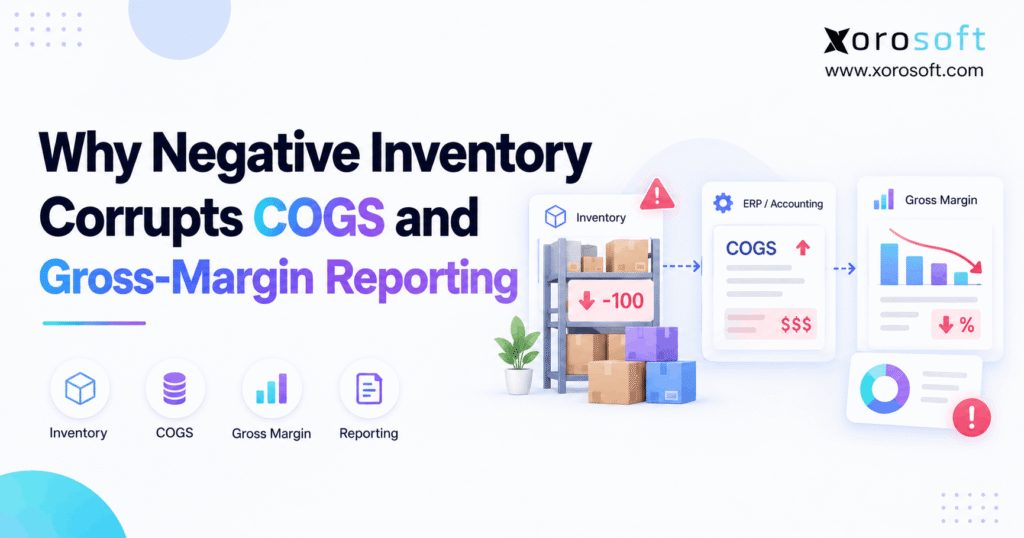
When discussing inventory processes, it’s important to understand negative inventory accounting and its impact on financial records.
1. The Shipment That Quietly Rewrote Profit
Negative inventory accounting can turn a routine shipment into a misleading profit report. A warehouse ships products that physically exist, but the ERP still shows zero stock because a receipt has not posted. Consequently, the system may value the sale using a fallback cost rather than the cost supported by the eventual receipt. At first, sales look normal. Meanwhile, cost of goods sold (COGS) and gross margin can tell a different story.
For example, 100 units sold for $80 each produce $8,000 in revenue. However, if the system initially costs them at $25 instead of $32, it understates COGS by $700. As a result, reported gross margin rises by 8.75 percentage points without any improvement in operations. Negative inventory accounting matters because those differences can affect product decisions, month-end reports, and the credibility of financial numbers.
2. What Negative Inventory Accounting Actually Means
Negative inventory accounting describes how a company records inventory costs and related entries when its system shows fewer than zero units on hand. Although products cannot physically exist in a negative quantity, the recorded balance can fall below zero when transactions arrive late or in the wrong order. Therefore, finance needs to explain both the quantity and its assigned cost.
2.1 Negative Stock Is Not Always Missing Stock
A negative stock balance can signal a real shortage. However, it can also reflect products sitting on the dock before someone records the receipt. Similarly, an outbound transfer may reduce one warehouse before another warehouse confirms arrival. In both cases, the physical operation and the digital record disagree.
For this reason, a count alone cannot close every issue. First, identify the first transaction that drove the location below zero. Next, compare the event with receiving slips, dispatch records, and transfer documents. Then, confirm whether the error is a missing movement, an incorrect quantity, or an actual shortage. Only after that review should teams choose a correction.
2.2 On-Hand, Available, and Committed Quantities
Inventory states also create confusion. On-hand quantity refers to stock recorded at a location, whereas available quantity reflects what can support new demand. Meanwhile, committed inventory belongs to orders or other obligations and may no longer be available for new sales.
For example, a warehouse can hold 90 units, commit 35 to open orders, and place 10 on quality hold. As a result, its available quantity may be only 45 even though it has 90 on hand. Shopify documents these distinctions in its inventory states guidance. Therefore, finance should never interpret every negative available quantity as a negative inventory asset balance.
2.3 Why Negative Stock Accounting Needs a Cost Check
A stock adjustment might restore a positive balance without fixing the original sale’s expense. As a result, the inventory report can look clean while the income statement still contains the wrong COGS. In addition, a subsequent receipt can create a cost adjustment that falls into a later reporting period.
A complete review therefore requires two checks: did the system record the correct physical movement, and did it assign the correct financial cost? Warehouse teams usually own evidence of physical activity. Conversely, controllers own materiality, accounting policy, and the financial close. Therefore, both groups need the same transaction trail.
3. How Negative Stock Accounting Starts in Operations
Negative balances often begin as process errors rather than accounting decisions. However, fast-moving ecommerce and distribution businesses can create thousands of inventory events each day. Consequently, the delay between a physical action and its system posting can be enough to distort the cost of a shipment.
3.1 How Late Receipts Trigger Negative Inventory COGS
For example, imagine that a supplier delivers 120 units on Monday morning. The warehouse unloads them, but the receiving team posts the purchase receipt on Tuesday. Meanwhile, sales orders ship 100 units on Monday afternoon. The system may show -100, even though workers handled real products.
Because the recorded cost is missing at shipment time, the ERP might apply a prior cost, standard cost, default item cost, or another estimate. Negative inventory accounting now depends on that software rule. Therefore, the receipt process needs a clear cutoff: teams should recognize goods at the appropriate control point before the related inventory issue is finalized. The exact process must follow the company’s accounting policy.
3.2 Duplicate Shipments, Transfers, and Returns
For example, integration retries can send the same shipment confirmation more than once. If the receiving application treats each message as a new event, it may deduct stock twice. Similarly, a transfer can leave one location without ever appearing at its destination. Returns create a related problem when an item reenters sellable stock before inspection.
As a result, teams need unique transaction identifiers, reliable acknowledgments, and exception queues. Otherwise, a dashboard may show a negative location balance even when the physical inventory is correct. Therefore, finance should compare the initial event, any retry, and the corresponding ledger entry before accepting a manual adjustment. In addition, audit trails should preserve the original event, not just the latest balance.
3.3 How Case Packs and Kits Create Inventory Costing Errors
Similarly, a case-pack error can be just as damaging. For instance, receiving 12 cases as 12 units instead of 144 leaves 132 units unrecorded. Meanwhile, a kit shipment may deduct component inventory before the related assembly completion is posted. Manufacturers can face similar gaps when raw materials move before a production order closes.
Therefore, validate units of measure at purchasing, receiving, and fulfillment. For lot-controlled inventory, investigate the affected lot and warehouse, not merely the total SKU. Inventory costing becomes harder when quantity corrections are posted to the wrong site, lot, or production order. As a result, cost accuracy depends on the quality of operational master data.
4. Why Negative Inventory Accounting Distorts COGS
Under perpetual inventory accounting, a sale normally reduces inventory assets and recognizes the related cost as COGS. However, a negative quantity can leave the system without a valid inventory cost layer. Consequently, a provisional unit cost may enter the profit and loss statement before the actual purchase cost is available.
4.1 Fallback Costs and Negative Stock Valuation
Suppose a business ships 50 units that should cost $30 each. If its fallback cost is $20, initial COGS is $1,000 instead of $1,500. Therefore, reported gross profit is $500 too high. By contrast, a $35 fallback cost would overstate COGS by $250 and temporarily reduce reported profit.
Negative inventory accounting is not a one-direction profit problem. Instead, it is a measurement problem: the software must assign a number without all of the expected evidence. For instance, Intuit’s QuickBooks Desktop negative inventory guidance describes assumed costs and later adjustments. Consequently, finance should investigate both unusually high and unusually low margins.
4.2 How Negative Inventory COGS Changes Gross Margin
Gross profit equals revenue minus COGS. Gross-margin percentage equals gross profit divided by revenue, multiplied by 100. Therefore, a cost error changes the margin calculation even when prices, discounts, and shipped units stay the same.
For example, a category manager may see a margin rise after a busy weekend and conclude that promotions worked. However, the apparent improvement could simply reflect missing receipts and provisional costs. Conversely, a later adjustment could make a healthy product line look unprofitable. As a result, finance should label material provisional costs and restrict decisions based on unreconciled product margins. Negative inventory accounting deserves attention before managers change prices or purchasing plans.
4.3 Inventory Valuation and the General Ledger Can Diverge
In addition, negative quantities can disrupt the relationship between the inventory subledger and the general ledger. Initially, an inventory issue might credit the asset account at an estimated cost. Later, the replenishment and cost adjustment can change the asset and expense accounts by different amounts.
However, not every difference is an error. Timing, received-not-invoiced balances, and cost method rules can also explain variances. Therefore, compare reports using the same cutoff date, legal entity, valuation method, and financial dimensions. A sound accounting review should show the source movement behind each cost change. Otherwise, a controller may post a journal entry that masks the symptom while the subledger remains wrong.
4.4 Negative Inventory COGS Across Month-End
For example, a shipment may fall on September 30 while its delayed receipt posts on October 2. Depending on software rules and period status, the cost adjustment may appear in October rather than the month of the sale. Consequently, September can show a high margin and October a low one, even if the underlying customer economics never changed.
Likewise, Oracle explains this problem in its underwater inventory documentation. Therefore, negative inventory accounting needs period-aware reports. Finance should distinguish the original transaction date, posting date, adjustment date, and actual physical receipt date. Above all, do not reopen a closed period or backdate documents without controller approval and valid evidence.
5. The $700 COGS Error: A Worked Example
For example, a concrete transaction sequence shows why negative stock is more than a warehouse metric. In this simplified example, the business has zero units recorded before a shipment. The warehouse physically has enough inventory, but its receipt has not posted. Consequently, the accounting system uses a provisional unit cost.
5.1 Shipment and Receipt Timeline
First, on September 30, an ecommerce distributor sells and ships 100 units at $80 each. Its system deducts 100 units, taking the recorded balance from 0 to -100. Meanwhile, it assigns a provisional cost of $25 per unit. On October 2, the warehouse records a receipt of 120 units at $32 each, leaving 20 units on hand.
| Event | Quantity movement | Recorded stock | Unit cost |
|---|---|---|---|
| Opening balance | 0 | 0 | Not available |
| Sept. 30 shipment | -100 | -100 | $25 provisional |
| Oct. 2 receipt | +120 | +20 | $32 actual |
| Cost true-up | 0 | +20 | $7 per sold unit |
Because the eventual receipt cost is higher, the original expense estimate was too low. Negative inventory accounting must now reconcile that $7 difference for each affected sold unit.
5.2 Negative Inventory COGS: The Gross-Margin Math
Revenue equals 100 units multiplied by $80, or $8,000. Initially, COGS equals 100 multiplied by $25, or $2,500. Therefore, gross profit is $5,500 and gross margin is 68.75%.
After the receipt establishes a $32 cost for the affected units, corrected COGS equals $3,200. Consequently, gross profit falls to $4,800 and gross margin becomes 60%.
| Measure | Initial report | Corrected cost basis |
|---|---|---|
| Revenue | $8,000 | $8,000 |
| COGS | $2,500 | $3,200 |
| Gross profit | $5,500 | $4,800 |
| Gross margin | 68.75% | 60.00% |
| Remaining inventory value | Pending reconciliation | $640 |
The $700 COGS difference changes gross margin by 8.75 percentage points. However, this is an illustrative scenario, not a measured company result. It assumes the later cost applies to all 100 units sold.
5.3 Negative Stock Accounting Journal Entries
The provisional shipment cost creates an illustrative debit to COGS of $2,500 and a credit to inventory assets of $2,500. Next, the receipt creates a $3,840 debit to inventory and a corresponding credit to the relevant receipt accrual or payable account. Finally, a $700 cost true-up increases COGS and reduces inventory value.
Therefore, the remaining inventory is $640, representing 20 units at $32. The cost reconciliation should cover both the shipment expense and the final asset balance. However, these simplified entries describe the economic effect, not a universal posting template. In practice, ERPs may use separate cost adjustment accounts, settlement entries, or a different posting sequence.
5.4 Why the Reporting Period Matters
If the September books close before the true-up, its 68.75% reported margin may remain visible in historical dashboards. Meanwhile, October may record the $700 adjustment. As a result, comparing those two months without normalization can lead managers to the wrong conclusion.
For this reason, finance should prepare a bridge showing the original sale, provisional COGS, later receipt, and cost correction. In addition, the controller should decide whether any period adjustment is appropriate under company policy and applicable standards. A late receipt does not automatically justify rewriting an earlier financial statement. The point is to make every financial adjustment transparent and auditable.
6. Costing Methods and Negative Inventory Accounting
The accounting impact depends partly on how the ERP values inventory. However, it also depends on whether the system permits physical and financial negative balances, which cost history is available, and when it closes or settles transactions. Therefore, one platform’s behavior should not be treated as universal.
6.1 FIFO and Weighted-Average Cost Layers
For example, FIFO normally assigns the earliest eligible inventory costs to units sold. However, a negative stock issue may occur when there is no valid layer for the excess units. Consequently, the system may need a default or running-average estimate until a receipt or settlement process resolves the cost.
Weighted-average methods use an average inventory cost over the relevant items and period. Yet missing receipts can distort the data behind that average. As a result, negative inventory accounting under FIFO and weighted average needs careful close procedures. Finance should review both the original issue cost and any later recalculation rather than assuming the latest purchase price becomes the cost of every sale.
6.2 Moving-Average Fallback Rules
Similarly, moving average recalculates unit costs as eligible transactions occur. However, when a shipment occurs without enough on-hand inventory, some systems rely on a configured fallback. For example, Microsoft Dynamics 365 documents choices involving last issue cost, active cost, and item price in its inventory costing FAQ.
Importantly, Microsoft also distinguishes moving average from periodic costing models during adjustment. Therefore, a later purchase receipt does not guarantee that the original issue is revalued automatically. Negative inventory accounting controls should record which fallback rate the system used and which subsequent corrections are supported. Otherwise, finance can mistake a quantity repair for a complete financial repair.
6.3 Standard Costs and Purchase Variances
By contrast, standard costing uses a predefined cost for eligible inventory movements. Consequently, it can reduce the immediate effect of fluctuating supplier prices on each shipment. However, it cannot prevent duplicate deductions, unposted receipts, or incorrect production quantities. Meanwhile, differences between standard and actual costs may flow into variance accounts.
For example, a manufacturer that fails to post a production completion may show negative finished-goods stock even when the product is on the loading dock. Therefore, finance must inspect work orders, material issues, completion quantities, and cost variances together. Cost accuracy still matters because reliable financial statements require both correct quantities and understandable variance treatment.
7. How to Diagnose Negative Inventory Accounting Errors
The goal of an investigation is not simply to make the negative number disappear. Instead, teams should establish what happened, what the system recorded, and which financial entries need correction. Therefore, start with evidence and move from physical events to accounting effects.
7.1 Find the First Negative SKU-Location Event
First, export stock movements for the affected SKU and location, including dates, source documents, users, and integration event IDs. Next, find the earliest entry that pushed the recorded quantity below zero. Then, compare it with receiving documents, pick confirmations, transfer records, returns inspections, and cycle-count results.
Because later adjustments may hide the original cause, review history rather than only current stock. In addition, check whether an apparently missing receipt belongs to a different warehouse or unit of measure. Negative-stock investigations improve when analysts preserve a traceable chain from source event to inventory ledger. Ultimately, each negative quantity should have a documented explanation.
7.2 Negative Stock Accounting: Inventory-to-GL Review
Next, review the inventory valuation detail, COGS transactions, cost adjustment log, and relevant GL accounts for the same cutoff. Importantly, compare quantities and costs separately. For example, stock might return to positive 20 units while a $700 expense adjustment remains in the next period. Consequently, a green inventory dashboard does not prove the financials agree.
For this reason, negative inventory accounting needs a reconciliation report that includes original shipment cost, receipt cost, correction amount, account, and posting date. In addition, identify zero-cost issues, unusual negative expense postings, and unresolved receipt accruals. Finally, finance should sign off on material differences before publishing margin reports to leadership.
7.3 Fix the Cause Before Posting an Adjustment
If a missing receipt caused the problem, enter or correct that receipt based on valid evidence. By contrast, if a duplicate shipment caused it, reverse the erroneous movement according to the system’s controlled procedure. Similarly, a genuine shrinkage event may require an approved inventory loss entry rather than a recreated purchase receipt.
However, never backdate transactions simply to obtain a preferred margin. Period rules, tax implications, audit history, and financial materiality still apply. Negative inventory accounting corrections should therefore use the ERP’s supported workflow and the controller’s approval. Otherwise, an unsupported manual journal can repair a GL balance while leaving the stock subledger unreconciled.
8. How to Prevent Negative Inventory Accounting Problems
Indeed, prevention is more effective than repeated month-end cleanup. Therefore, design controls at the point where stock enters, moves through, and leaves a warehouse. At the same time, ensure that accounting receives complete and timely records instead of relying on spreadsheet patches.
8.1 Receiving and Warehouse Execution Controls
Require receiving teams to verify quantities, units of measure, lots, and warehouse locations before making stock eligible for fulfillment. Similarly, use shipment checks, transfer confirmations, and returns inspections to prevent premature inventory movements. Where negative posting is operationally necessary, add controlled permissions, reason codes, and exception alerts.
For instance, Xorosoft’s XoroWMS brings warehouse execution into an inventory-focused system workflow. However, software cannot replace a real receiving check. Therefore, test how negative quantities are blocked, approved, or monitored during normal work and during exceptions. Negative inventory accounting accuracy ultimately begins with dependable warehouse events.
8.2 Integration Ownership and Duplicate Protection
Above all, each stock event should have one clear system of record. For example, a 3PL may confirm a physical shipment while the ERP posts the financial stock movement. Meanwhile, an ecommerce platform may control order status and customer-facing availability. Therefore, teams must define how those events are mapped and acknowledged.
Xorosoft’s integration capabilities are relevant when businesses need connected order and stock workflows. Still, every integration project should verify idempotency, retry handling, monitoring, and reconciliation rules. Negative inventory accounting problems can persist even with connected applications if a failed event is silently skipped or processed twice. Consequently, the integration contract matters as much as the connector itself.
8.3 Negative Inventory COGS Alerts Before Month-End
A daily exception view should identify negative SKU-location balances, missing receipts, zero-cost shipments, and unusual cost adjustments. In addition, a weekly review can identify recurring causes by warehouse, supplier, product category, or integration. Finally, the month-end checklist should block unresolved material exceptions from passing unnoticed into management reports.
| Control | Owner | Evidence to retain |
|---|---|---|
| Negative quantity review | Inventory lead | SKU-location movement trail |
| Missing receipt review | Purchasing and warehouse | Delivery and PO documents |
| Cost adjustment review | Controller | Cost bridge and approval |
| Integration failure review | Operations and IT | Event IDs, retry logs |
As a result, stock-cost reconciliation becomes a managed exception process rather than a surprise discovered after close.
9. Where the Risk Appears Across Industries
The accounting mechanics are similar across sectors. However, the events that create negative stock vary with sales channels, supplier terms, manufacturing steps, and warehouse networks. Therefore, the strongest prevention plan reflects the actual operating model.
9.1 Shopify, Amazon, and 3PL Operations
For example, an ecommerce brand may take orders on Shopify and Amazon while outsourcing fulfillment to a 3PL. If the 3PL dispatches before a receipt reaches the ERP, recorded stock may temporarily become negative. Meanwhile, duplicate status updates can create extra inventory deductions unless the integration rejects them.
Consequently, negative inventory accounting deserves special attention in multichannel operations. Teams should match each order, shipment, warehouse acknowledgment, and receipt to one inventory movement. For merchants reviewing available integrations, Xorosoft maintains a Shopify App Store listing. However, the accounting result still depends on configured workflows and validated transaction mapping.
9.2 Inventory Cost Corrections in Wholesale and EDI
Meanwhile, wholesale distributors handle bulk orders, customer allocations, case-pack conversions, and EDI documents. Therefore, one incorrect conversion can affect dozens of cartons rather than a single retail unit. For example, a warehouse might ship an EDI-confirmed order before its inbound pallet receipt is financially recognized.
As a result, customer profitability may appear unusually high or low. In addition, manual allocation changes across several warehouses can hide the source of the discrepancy. Negative inventory accounting controls should match purchase orders, receipts, shipping confirmations, and sales invoices at the correct unit level. The workflow needs traceable exceptions, not just a summary quantity.
9.3 Manufacturing, Food, and Lot Control
For example, manufacturers often issue components before recording finished-goods completions. Meanwhile, food and beverage businesses must track lot status, expiry dates, and quality holds. Consequently, a positive company-wide SKU balance may still conceal a negative quantity in one lot or location.
For this reason, negative inventory accounting requires cost and quantity reviews by the dimensions used for financial valuation. Teams should verify bills of materials, work orders, lot movements, and production variances. Xorosoft serves several inventory-driven industries, but each implementation needs controls tailored to its specific traceability and costing requirements. Otherwise, a top-level stock correction may shift costs without resolving the source error.
10. Choosing Software That Protects Cost Accuracy
A single missed receipt does not automatically justify replacing software. However, repeated discrepancies across locations, channels, and close periods may expose a structural problem. Therefore, buyers should evaluate the cost-control workflow rather than choosing an application solely because it advertises real-time inventory.
10.1 When Better Processes Are Enough
A company with one warehouse and manageable transaction volume may resolve negative stock through tighter receiving deadlines, disciplined cycle counts, and a documented monthly reconciliation. Likewise, improving user permissions and identifying source-system ownership can fix errors without buying another platform.
However, repeated manual exports are a warning sign. If finance must rebuild COGS from spreadsheets every month, the current workflow may not provide a reliable transaction trail. Therefore, use root-cause frequency, correction hours, adjustment value, and reporting delay as evidence. Persistent inventory costing errors should justify an investment through measurable control gaps, not fear alone.
10.2 Accounting Apps, Inventory Tools, and Integrated ERP
Ultimately, software options serve different levels of complexity. For inventory-driven businesses evaluating a unified platform, Xorosoft’s XoroONE is a relevant first option to assess because it connects inventory, operations, and accounting functions. However, it should still be tested against the same detailed scenarios as competing products.
| Option | Best starting fit | Negative-stock evaluation question |
|---|---|---|
| Xorosoft integrated ERP | Connected ecommerce, warehouses, and finance | How are negative issues, receipts, and cost adjustments handled? |
| QuickBooks with disciplined stock processes | Lower-complexity finance workflows | What creates fallback COGS and how is it repaired? |
| Inventory app plus accounting software | Teams with separable operational systems | Who owns valuation and reconciles both ledgers? |
| NetSuite or Dynamics 365 | Businesses considering broad ERP requirements | Which costing and period-close rules fit operations? |
However, the correct choice depends on requirements, configuration, implementation work, and total cost. Consequently, evaluate actual transactions before drawing a ranking from feature descriptions.
10.3 Negative Stock Valuation: The ERP Pilot That Matters
Therefore, ask every shortlisted ERP vendor to demonstrate the same scenario. First, ship 100 units when the location shows zero on hand. Next, receive 120 units at a price different from the provisional cost. Then, inspect inventory valuation, expense postings, adjustment entries, and gross-margin reports across two periods.
In addition, repeat the test with duplicate integration events and a transfer between warehouses. Negative inventory accounting behavior should be visible in the audit trail, not explained only in slides. Xorosoft’s XoroERP is one platform to include in this kind of practical evaluation. Ultimately, the winning system is the one whose documented behavior and controls fit the business.
11. Build a Monthly Margin-Control Routine
Ultimately, reliable gross margins require repeatable evidence. Therefore, finance and operations should share a short control dashboard and agree on who resolves each exception. In addition, managers should understand which reported margins remain provisional and which are approved for decisions.
11.1 Measure Inventory Costing Errors Before Close
Start with five metrics: the number of negative SKU-location balances, days spent below zero, value of provisional-cost transactions, value of later COGS adjustments, and time required for inventory-to-GL reconciliation. Meanwhile, track repeat exceptions by warehouse and source system.
For example, a falling negative-stock count may look encouraging while the value of late cost adjustments keeps rising. Therefore, use quantity, timing, and dollar measures together. Negative inventory accounting metrics should show whether improvements are real, not merely whether users have entered more manual corrections. Finally, review trends before the close, not after leadership questions the margin report.
11.2 Assign Clear Ownership for Every Cost Difference
First, warehouse managers should verify physical transactions. Next, purchasing should confirm supplier deliveries and actual receipt costs. Meanwhile, integration teams should investigate missed or duplicate messages. Finance should review the corresponding asset, COGS, and adjustment postings and decide how material issues affect reporting.
Because each team sees only part of the process, a shared exception log is essential. Finally, record the SKU, location, original event, financial impact, owner, correction, and approval date. In addition, test whether the same root cause appears in other products. As a result, recurring issues become visible before they undermine the next close.
12. The Close Should Confirm Profit, Not Correct It
Negative inventory accounting is a warning that warehouse events and financial records may be out of sequence. Although a negative quantity sometimes reflects only a timing delay, the cost assigned to a sale can still be misleading. Consequently, reported COGS, inventory assets, and gross margins deserve review before management relies on them.
First, trace the original movement. Next, validate its cost and posting period. Then, correct the cause through approved workflows and strengthen the controls that failed. If the same errors recur across channels and warehouses, an integrated ERP evaluation may be appropriate.
To examine those workflows with real examples, Book a Demo with Xorosoft. Bring a recent negative-stock transaction and ask how the platform would handle its receiving, inventory costing, audit trail, and financial correction.
Frequently Asked Questions
What is inventory reorder planning?
Inventory reorder planning determines when to replenish stock and how much to buy. It combines demand, inventory position, supplier lead time, service targets, and ordering constraints to balance availability with working capital.
Why is fixed min/max inventory sometimes insufficient?
Fixed min/max levels can become outdated when demand, delivery times, or purchasing terms change. However, regularly recalculated min/max policies remain useful for predictable products and do not need replacing automatically.
How do supplier lead times affect reorder points?
Longer lead times increase the demand inventory must cover before replenishment arrives. Additionally, inconsistent lead times may require more safety stock or earlier purchase decisions, especially for critical SKUs.
What does a 95% cycle service level mean?
A 95% cycle service target aims for no stockout in approximately 95% of replenishment cycles under the planning model. It is different from filling 95% of requested units.
How does MOQ change purchase recommendations?
MOQ sets a minimum accepted purchase quantity. Therefore, an order may exceed the net inventory need, especially when suppliers also require case-pack multiples. Buyers should check carrying costs before approval.
How should seasonal demand change reorder planning?
Seasonal planning forecasts demand for future receipt periods rather than relying on last month’s average. Consequently, buyers adjust order dates, stock targets, and supplier commitments before expected sales peaks.
When should a business adopt ERP-based reorder planning?
ERP becomes useful when disconnected systems cause duplicate orders, unreliable stock figures, or difficult multi-warehouse planning. However, small businesses with stable demand may still manage effective replenishment using simpler tools.
Recent Posts
-
 WMS vs Shopify Fulfillment Tools: When Warehouse Complexity Requires More
 -
 Manufacturing Backlog Statistics 2026: Orders, Inventory and Capacity Signals
 -
 ERP Software for Canadian Wholesale Companies Managing US Sales
 -
 Shopify Accounting Integration: How to Reconcile Orders, Fees, Refunds, and Payouts to ERP
 -
 Negative Inventory Accounting: Why COGS and Gross-Margin Reporting Go Wrong