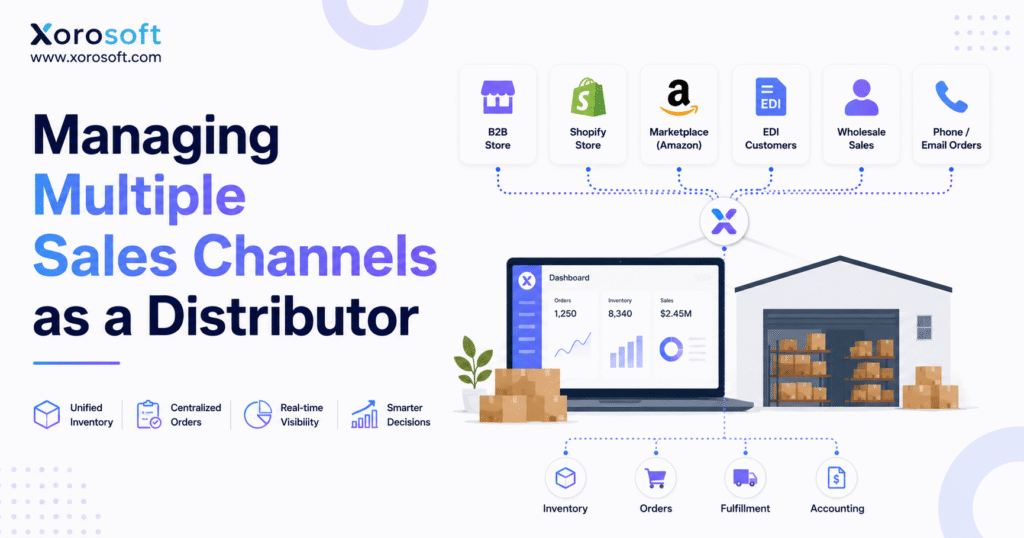
When running a business today, effective multichannel sales management is essential for reaching customers and maximising growth.
1. Channel Growth Makes Multichannel Sales Management More Difficult
Multichannel sales management becomes an operational priority when a distributor adds new sales channels without improving the systems behind them. A Shopify store, Amazon account, EDI connection, B2B portal, or new wholesale team may generate additional revenue. However, every channel also introduces new orders, pricing rules, inventory commitments, customer expectations, and financial transactions.
At first, employees often bridge these gaps manually. For example, sales representatives check spreadsheets before promising stock. Meanwhile, warehouse teams compare orders from several applications. Purchasing departments combine exports to estimate demand, while finance reconciles deposits, invoices, refunds, discounts, and marketplace fees after transactions occur.
As order volume increases, however, manual coordination becomes less reliable. Inventory may appear available in one system but committed in another. Similarly, a marketplace order may consume stock intended for an important wholesale customer. Moreover, managers may see revenue by channel without understanding the actual cost of serving each one.
Therefore, the underlying problem is not simply the number of storefronts. Instead, the real issue is the absence of a shared operational foundation that connects inventory, pricing, orders, purchasing, warehouse execution, and accounting.
Although each channel may require a different customer experience, every channel should rely on consistent operational data. Consequently, distributors need one set of rules for inventory availability, order validation, fulfillment, returns, purchasing, and financial reporting.
1.1 Why Managing Multiple Sales Channels Affects Every Department
Every sales channel affects more than the commercial team. For instance, purchasing needs consolidated demand data, warehouse teams need precise fulfillment instructions, and customer service needs dependable order status. At the same time, finance must connect revenue with fees, refunds, taxes, receivables, and inventory costs.
Consequently, adding a channel is not merely a marketing decision. Instead, it changes the complete order-to-cash process.
Moreover, each department may interpret the same transaction differently. Sales focuses on customer commitments, operations focuses on availability, and finance focuses on recognition and reconciliation. Therefore, the business needs shared definitions and clearly assigned ownership.
1.2 Channel Expansion vs Scalable Multichannel Distribution
Channel expansion means selling through more sources. By contrast, scalable multichannel distribution means processing additional demand without creating the same increase in administrative work, inventory buffers, fulfillment delays, or operating errors.
A scalable operation should increase sales volume while maintaining:
- Accurate inventory availability
- Consistent pricing controls
- Reliable fulfillment commitments
- Timely purchasing decisions
- Efficient warehouse execution
- Accurate accounting records
- Clear channel profitability
- Manageable exception queues
In other words, the business should be able to grow without depending on more spreadsheets and manual checks at every stage.
1.3 Warning Signs That Distributor Channel Management Is Fragmenting
For example, a distributor may have outgrown its current setup when:
- Employees manually re-enter orders.
- Inventory quantities differ between channels.
- Wholesale prices are maintained in spreadsheets.
- Ecommerce availability ignores customer reservations.
- Warehouse teams process separate order queues.
- Returns are disconnected from original orders.
- Purchasing cannot separate normal demand from promotions.
- Finance needs several days to reconcile channel activity.
- Management can report revenue but not channel profitability.
- Every new channel requires another standalone application.
Individually, these problems may appear manageable. Collectively, however, they indicate that channel operations need a common system of record. Therefore, the distributor should address the operating model before adding more volume or complexity.
2. What Multichannel Sales Management Means for Distributors
Multichannel sales management is the coordinated control of product data, customer terms, inventory, pricing, orders, fulfillment, returns, purchasing, and financial records across two or more sales channels.
The objective is not to make every channel identical. Instead, each channel should serve its customers appropriately while relying on consistent operational information.
For example, a wholesale customer may receive negotiated pricing and payment terms, while a direct-to-consumer customer pays immediately through Shopify. Nevertheless, both transactions should reduce the same inventory records and flow into the same financial environment.
2.1 Common Channels in Multichannel Distribution Management
Distributors commonly sell through:
- Wholesale representatives
- Inside-sales teams
- B2B ecommerce portals
- Shopify and other direct-to-consumer stores
- Amazon and additional marketplaces
- EDI-connected retail customers
- Dealers and regional distributors
- Stores and showrooms
- Phone and email orders
- Recurring contract orders
Each channel follows a different order pattern. For instance, wholesale orders may be negotiated and scheduled weeks in advance. By contrast, ecommerce orders are often smaller and require rapid parcel fulfillment. In addition, EDI customers may demand specific documents, labels, carriers, and delivery windows.
Therefore, multichannel distribution management must accommodate channel differences without creating separate inventory, purchasing, and accounting realities.
2.2 Multichannel Sales Management vs Omnichannel Distribution
Multichannel sales management and omnichannel distribution are related, although they are not identical.
| Operational factor | Multichannel distribution | Omnichannel distribution |
|---|---|---|
| Primary goal | Sell through multiple channels | Connect experiences across channels |
| Inventory | May be allocated separately | Usually shared across channels |
| Customer records | Can remain channel-specific | Typically unified |
| Fulfillment | Often follows channel rules | Uses the complete network |
| Returns | Usually handled through the original channel | May be accepted across channels |
| Data integration | Varies by channel | Deeply integrated |
| Operational complexity | Moderate to high | High |
A distributor can manage several channels effectively without offering a fully omnichannel experience. Therefore, the appropriate model depends on customer expectations, fulfillment capabilities, and the value of cross-channel service.
By contrast, an omnichannel strategy becomes more important when customers expect to buy, collect, return, or exchange products across multiple touchpoints. Consequently, the required level of integration should follow the customer promise rather than industry terminology alone.
2.3 Who Needs Formal Multichannel Sales Management?
A formal operating model becomes valuable when a distributor has:
- Three or more active channels
- Multiple warehouses
- EDI-connected customers
- Large product catalogs
- Customer-specific prices
- Contractual inventory commitments
- Significant marketplace activity
- Frequent stock discrepancies
- Complex purchasing requirements
- Delayed financial reconciliation
Although revenue matters, complexity is usually the stronger indicator. For example, a smaller distributor with several warehouses and thousands of SKUs may require more structured multichannel sales management than a larger company with one predictable channel.
2.4 Who May Not Need a Complete ERP Platform Yet?
By contrast, a small distributor with one warehouse, limited SKUs, simple pricing, and low order volume may initially use specialist applications.
Even so, the company should define which application owns products, customers, inventory, prices, orders, and financial records. Otherwise, disconnected data will become harder to correct as the business grows.
Therefore, the decision should not be based only on company size. Instead, the distributor should evaluate transaction volume, channel complexity, warehouse requirements, pricing rules, and reporting needs.
3. Why Managing Multiple Sales Channels Becomes Difficult
The visible symptoms of channel complexity include stockouts, delayed shipments, pricing errors, and reconciliation work. However, fragmented information is usually the underlying cause.
As a result, employees spend time checking and correcting data instead of improving service, purchasing, and fulfillment.
3.1 Multichannel Inventory Exists in Several Operational Views
A storefront may display sellable inventory, while the warehouse records physical stock. At the same time, sales may track customer reservations, purchasing may focus on incoming supply, and finance may maintain inventory value.
These views can all be valid. However, problems arise when each quantity is calculated independently.
For example, a warehouse may physically hold 500 units. Nevertheless, 200 units may already be committed, 100 reserved for a key account, and 50 required for bundles. Consequently, only 150 units are genuinely available to new demand.
Therefore, publishing the physical quantity to every channel would create false availability. Instead, each channel should receive an approved sellable quantity based on commitments, reservations, buffers, and business rules.
3.2 Multichannel Order Management Must Support Different Requirements
An ecommerce order may require same-day fulfillment. Meanwhile, a wholesale customer may accept partial shipments. An EDI retailer may also require specific labels, routing instructions, acknowledgements, and shipment notices.
Therefore, one generic order process cannot handle every transaction correctly.
Instead, distributors need shared validation rules combined with channel-specific requirements. Normal orders should continue automatically, while exceptions should move into visible review queues.
For instance, a standard prepaid Shopify order may release immediately. By contrast, a large wholesale order may require credit approval, margin review, or inventory allocation before it reaches the warehouse.
3.3 Pricing and Customer Terms Become Harder to Control
The same product may have a wholesale price, contract price, dealer price, volume price, ecommerce price, marketplace price, and direct-to-consumer price.
In addition, wholesale customers may receive credit limits, payment terms, rebates, freight allowances, or minimum-order rules. When these conditions live in separate applications, pricing errors become difficult to identify.
As a result, distributors may increase revenue while unknowingly reducing margin. Therefore, pricing logic should be centralized, time-bound, and auditable.
3.4 Fulfillment Priorities Compete Across Channels
A rapidly growing marketplace can consume available inventory quickly. However, the distributor may also have contractual commitments to wholesale or EDI customers.
Without allocation rules, the channel placing the order first receives the stock. Nevertheless, that outcome may conflict with customer importance, margin, service agreements, or long-term relationships.
Therefore, allocation decisions should reflect business priorities rather than timing alone. In addition, scarce inventory should be reviewed according to account commitments, channel profitability, and strategic importance.
3.5 Returns Follow Different Channel Workflows
Consumer returns may be initiated online and refunded quickly. By contrast, wholesale returns may require authorization, inspection, restocking fees, replacement orders, or credit memos.
Moreover, every return affects:
- Customer service
- Inventory availability
- Product condition
- Revenue
- Cost of goods sold
- Channel fees
- Tax
- Warehouse workload
Consequently, returned products should not become available again until inspection confirms their condition.
Furthermore, the return should remain connected to the original order. Otherwise, finance may issue a refund while the warehouse records the item separately, creating mismatched inventory and accounting records.
3.6 Financial Data Arrives at Different Times
Wholesale invoices may remain open for 30 or 60 days. Meanwhile, ecommerce transactions may settle within several days. Marketplaces may also deduct commissions, refunds, advertising charges, reserves, and other fees before issuing a deposit.
Therefore, the original order total may not match the cash receipt. Finance needs transaction-level details to reconcile the difference accurately.
In addition, channel timing differences can distort reporting. For example, sales may appear in one period while fees, refunds, or deductions appear in another. Consequently, the accounting process must connect the settlement back to the underlying orders.
4. Building a Centralized Multichannel Sales Management Model
A distributor does not need to force every department into the same workflow. However, it does need a clear model governing how data enters, changes, and moves through the organization.
Without that model, integrations may transfer data while still leaving ownership unclear. Therefore, system design should begin with operational rules rather than software connections.
4.1 Establish One Operational Source of Truth
First, the company should identify the authoritative system for:
- Products and SKUs
- Customer records
- Pricing agreements
- Physical inventory
- Available inventory
- Sales orders
- Purchase orders
- Warehouse transactions
- Returns
- Accounting records
Other applications may collect or display information. Nevertheless, they should not independently redefine core records.
For example, Shopify may display inventory to shoppers, but it should not calculate availability using rules that conflict with warehouse reservations. Similarly, an EDI platform may transmit orders, but it should not become the authority for customer credit or inventory.
4.2 Separate Sales Channels From Operational Control
Shopify, Amazon, EDI, B2B portals, and sales representatives are demand-entry points. Therefore, they should capture customer activity and send it into a centralized operating process.
The operational system should then determine:
- Whether the order is valid
- Which price applies
- Whether customer credit is available
- Which inventory can be promised
- Which warehouse should fulfill the order
- Whether partial shipment is allowed
- How the transaction affects accounting
As a result, the distributor can add or replace channels without rebuilding every operational rule.
Moreover, this separation improves governance. Although a channel may control the customer experience, the distributor retains control over inventory, pricing, fulfillment, and financial policy.
4.3 Standardize Product and Customer Data
Next, every product should have a stable internal SKU. Although channel descriptions, titles, and images may differ, the underlying item relationship must remain consistent.
Distributors should also standardize:
- Units of measure
- Case-pack quantities
- Product dimensions
- Product weights
- Barcodes
- Customer locations
- Shipping preferences
- Tax settings
- Credit terms
- EDI identifiers
Otherwise, even a technically successful integration may transmit inaccurate information.
For example, one system may interpret a quantity as individual units while another interprets it as cases. Consequently, a minor setup error can create major inventory and pricing discrepancies.
4.4 Define Ownership Across Departments
Sales should own commercial agreements. Similarly, purchasing should maintain supplier rules and lead times. Operations should control inventory policies, while warehouse teams should own transaction accuracy. Finally, finance should govern accounting and reconciliation.
Shared access can improve visibility. However, unclear decision authority creates delays and inconsistent actions.
Therefore, each process should have a defined owner. In addition, exception responsibilities should be documented so employees know who resolves credit holds, pricing errors, stock shortages, EDI failures, and settlement differences.
4.5 Use Exception-Based Multichannel Sales Management Workflows
Normal orders should move automatically. Meanwhile, employees should focus on unusual transactions such as:
- Credit holds
- Invalid prices
- Inventory shortages
- Duplicate orders
- Address problems
- EDI failures
- Backorders
- Margin exceptions
- Late purchase orders
- Integration errors
Therefore, multichannel sales management should reduce repetitive work without removing necessary oversight.
Moreover, exception queues should be prioritized by business impact. For instance, a failed order for a strategic retailer should receive faster attention than a low-value address correction.
5. Centralizing Inventory for Multichannel Sales Management
Inventory is often the first process to fail when distributors expand into several sales channels. However, faster synchronization alone is not enough. Instead, the company must define how stock is calculated, reserved, allocated, transferred, and adjusted.
As a result, inventory control becomes a policy issue as much as a technology issue.
5.1 Physical, Committed, Reserved, and Available Inventory
These quantities should not be treated as interchangeable.
| Inventory status | Meaning |
|---|---|
| Physical inventory | Quantity currently stored at a location |
| Committed inventory | Quantity assigned to approved orders |
| Reserved inventory | Stock protected for a customer, channel, or purpose |
| Available inventory | Quantity that can currently be sold |
| Incoming inventory | Confirmed supply not yet received |
| Available-to-promise | Quantity that can be promised for a future date |
Therefore, a central system should calculate channel availability from these components rather than publishing raw physical stock.
In addition, distributors should define exactly when inventory becomes committed. For example, some companies reserve stock when an order is created, while others wait for payment or credit approval. Consequently, the reservation point should align with the company’s actual service promise.
5.2 Multichannel Inventory Allocation Models
In practice, distributors usually use one or more allocation models.
Shared inventory pool: Every channel draws from the same available quantity. As a result, this model maximizes flexibility and inventory utilization. However, it depends on reliable synchronization.
Fixed channel allocation: A defined quantity is reserved for each channel. Consequently, important customer commitments receive protection. Nevertheless, inventory may become stranded in a slower channel.
Priority-based allocation: Orders receive inventory according to customer importance, margin, contract terms, order date, or channel priority. Therefore, scarce products can be directed toward the most important obligations.
Dynamic allocation: Inventory moves between channel pools according to demand, forecast, profitability, and service targets. Although this model responds quickly, it requires dependable data and clear governance.
Therefore, distributors should not select one model for the entire catalog automatically. Instead, different products may need different allocation rules based on demand variability, scarcity, seasonality, and customer commitments.
5.3 Preventing Overselling Across Multiple Sales Channels
A distributor should:
1. Calculate availability from one authoritative record.
2. Reserve stock when orders reach an approved status.
3. Use channel buffers where synchronization delays exist.
4. Include bundles and component demand.
5. Monitor failed inventory updates.
6. Inspect returns before restoring inventory.
7. Investigate negative quantities immediately.
8. Record warehouse transfers promptly.
Platforms such as XoroOne can connect inventory with sales, purchasing, warehouse activity, and accounting. Regardless of platform, however, every channel should receive availability based on the same rules.
Moreover, distributors should monitor failed updates rather than assume integrations always work. Consequently, an exception dashboard should identify channels that have not received recent inventory changes.
5.4 Managing Multichannel Inventory Across Warehouses
Network inventory is not always available to every customer.
For instance, one warehouse may have stock but lack the correct carrier, packing capability, cut-off time, or customer authorization. Moreover, shipping from a distant facility may eliminate the margin on the order.
Therefore, multichannel inventory management should evaluate location-level availability instead of relying on one company-wide total.
In addition, warehouse transfers should be considered carefully. Although a transfer may save a customer order, it also creates handling cost, transportation cost, and delay. Consequently, the routing system should compare transfer costs with direct shipment alternatives.
5.5 Managing Bundles, Kits, and Case Packs
A bundle may appear as one product online while consuming several components in the warehouse. Therefore, its sellable quantity should reflect the least-available required component.
Similarly, a distributor that purchases by pallet, stores by case, and sells by unit needs controlled conversion rules. Otherwise, a single unit-of-measure error can create discrepancies across every connected channel.
Furthermore, substitutions and alternate components should follow explicit rules. For example, a promotional kit may allow one component to be replaced, while a regulated product may not. Therefore, the system should not assume all components are interchangeable.
5.6 Maintaining Accuracy With Cycle Counting
Frequent cycle counting validates inventory without closing the entire warehouse.
Fast-moving and high-value products should usually be counted more often. However, teams should not stop after correcting the quantity. Instead, they should identify whether the difference came from receiving, picking, transfers, returns, damage, incorrect units, or delayed integrations.
As a result, cycle counting becomes a process-improvement tool rather than a recurring correction exercise.
6. Creating a Unified Multichannel Order Management Process
Multichannel order management brings orders from different sources into a common process while preserving the requirements of each channel.
Therefore, the objective is standardization without removing necessary channel-specific controls.
6.1 Capture Orders Through a Common Queue
Orders may arrive through ecommerce integrations, marketplace connections, EDI, B2B portals, imports, sales representatives, customer service teams, phone calls, or emails.
Nevertheless, every order should retain its original channel, customer reference, requested date, pricing source, and commercial terms.
In addition, duplicate-order prevention should be included. For example, an EDI order that is retransmitted should not create a second sales order automatically.
6.2 Standardize Orders Before Fulfillment
Channel-specific data should be converted into standard internal fields for products, addresses, warehouses, carriers, units, payment status, and shipping methods.
As a result, warehouse and accounting processes can operate consistently even when orders originate from different systems.
However, standardization should not erase important channel details. Instead, the original customer reference, fulfillment promise, and compliance requirements should remain visible throughout the transaction.
6.3 Validate Inventory, Pricing, and Credit
Before release, each order should be checked for:
- Valid products
- Correct units
- Approved prices
- Available inventory
- Customer credit
- Address quality
- Requested delivery dates
- Channel-specific requirements
- Minimum quantities
- Margin exceptions
Orders that pass should continue automatically. However, failed orders should enter a visible exception queue.
Moreover, exceptions should display the reason clearly. Consequently, employees can resolve the issue without reviewing the entire order history.
6.4 Automate Warehouse Routing
Routing rules may consider:
- Inventory availability
- Customer proximity
- Shipping cost
- Warehouse cut-off time
- Warehouse capacity
- Customer agreements
- Channel priority
- Order completeness
- Product restrictions
- Transfer requirements
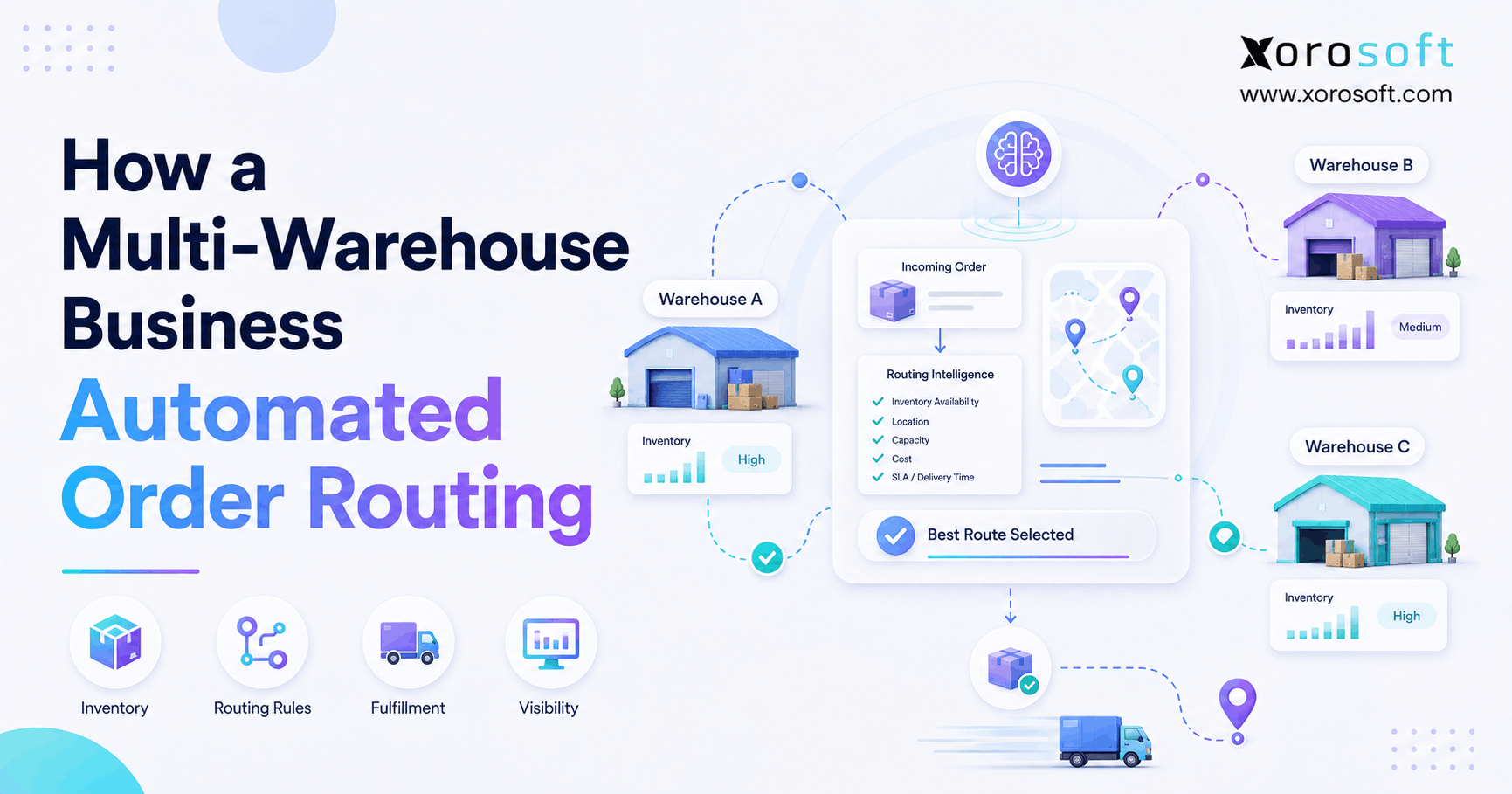
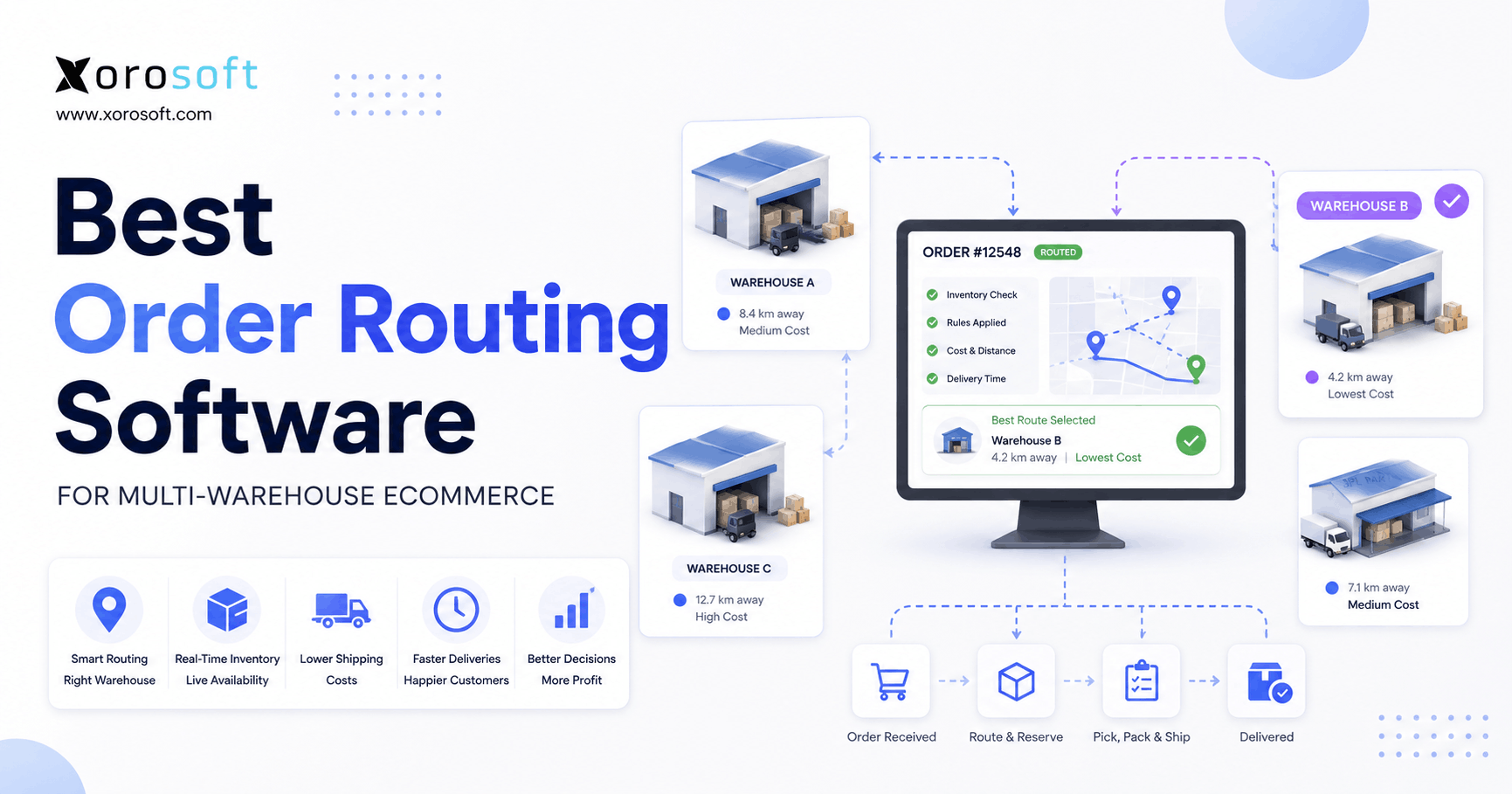
The lowest-cost warehouse is not always the correct choice. Instead, routing should balance service quality, margin, capacity, and customer commitments.
For example, a closer warehouse may reduce freight cost but lack enough stock to complete the full order. Therefore, the system should compare split-shipment costs against shipping from a more distant facility.
6.5 Control Split Shipments and Backorders
Some customers accept partial shipments. By contrast, others require complete delivery. A marketplace may cancel delayed lines automatically, while a wholesale customer may prefer a backorder.
Therefore, these rules should be stored by customer and channel rather than left to employee judgement.
In addition, the distributor should measure the cost of split shipments. Although partial fulfillment may improve service, it can also increase freight, labor, and customer confusion.
6.6 Connect Orders to Warehouse Execution
Once approved, orders should move into receiving, replenishment, picking, packing, labeling, and shipping workflows.
A platform such as XoroWMS can connect sales demand with warehouse execution. In addition, barcode-based workflows can verify the item, location, quantity, carton, and shipment before confirmation.
As a result, the distributor can reduce picking errors and improve traceability. Moreover, real-time warehouse confirmations can update customer service and channel status more quickly.
6.7 Return Shipment Status to Each Channel
After shipment, tracking numbers, confirmations, cancellations, and inventory changes should flow back to the original channel.
Otherwise, an order may be complete internally while the customer still sees an outdated status.
Therefore, the integration should monitor failed acknowledgements and shipment updates. In addition, customer service should receive alerts when a channel does not accept the status message.
6.8 Keep Returns Connected to Original Orders
Every return should reference its original order and channel.
Furthermore, the process should identify authorization, product condition, refund amount, channel fees, inventory status, replacement demand, and accounting treatment. Consequently, customer service, warehouse, and finance records remain aligned.
However, not every return should restore inventory. For example, damaged, expired, or customized products may need disposal, repair, or quarantine. Therefore, disposition rules should be part of the returns workflow.
7. Managing Pricing and Margin Across Sales Channels
Expanding channel reach does not automatically improve profitability. Instead, each channel introduces different prices, fees, service requirements, and operating costs.
Consequently, distributors should evaluate price and margin together.
Therefore, multichannel sales management should connect pricing decisions with channel fees, fulfillment costs, customer terms, and contribution margin.
7.1 Create a Controlled Pricing Hierarchy
A practical pricing hierarchy may follow this order:
1. Contract price
2. Customer-specific price
3. Customer-group price
4. Quantity-break price
5. Promotional price
6. Channel price
7. Standard list price
Therefore, the system should apply the first valid rule and record every manual override.
In addition, pricing rules should have effective and expiration dates. Otherwise, temporary discounts may continue long after the original agreement ends.
7.2 Control Customer-Specific Wholesale Pricing
Wholesale pricing should include:
- Effective dates
- Expiration dates
- Product scope
- Quantity thresholds
- Approval authority
- Customer eligibility
- Currency
- Unit of measure
Without these controls, expired agreements and unauthorized discounts may continue indefinitely.
Moreover, pricing should be reviewed when supplier costs, freight rates, exchange rates, or service requirements change. Consequently, customer agreements should not remain static when the distributor’s cost structure changes materially.
7.3 Account for Marketplace and Ecommerce Costs
A marketplace price must cover more than product cost.
For example, it may also need to absorb commissions, payment fees, fulfillment charges, advertising, return costs, storage fees, shipping subsidies, and customer service.
Consequently, a high-revenue marketplace may generate less profit than a smaller wholesale account.
Therefore, channel comparisons should use contribution margin rather than revenue alone. In addition, businesses should review margin after returns and fees rather than only at the time of sale.
7.4 Manage Credit and Payment Terms by Channel
Wholesale customers may purchase on credit, while consumer orders are generally paid before fulfillment.
EDI customers may also deduct shortages, routing penalties, promotional allowances, or compliance fees. Therefore, these differences should influence both order approval and channel-profitability reporting.
Moreover, credit exposure should consider open orders as well as unpaid invoices. Otherwise, a customer may exceed its intended limit before the next invoice is issued.
8. Connecting Purchasing to Multichannel Sales Management
Purchasing should not plan each channel in isolation. Instead, it should consolidate demand while retaining enough channel detail to understand what is driving the forecast.
As a result, purchasing can respond to total demand without losing visibility into channel-specific patterns.
8.1 Forecast Demand by Product and Channel
A useful forecast separates:
- Baseline demand
- Promotions
- Seasonality
- Product launches
- Lost sales
- One-time orders
- New customers
- Discontinued products
- Channel migrations
- Wholesale bookings
Combined sales history can hide important patterns. For instance, wholesale demand may arrive in large seasonal orders, while ecommerce generates smaller daily transactions.
Therefore, channel-level forecasting should be retained even when purchase recommendations are consolidated.
8.2 Remove Distorted Demand Signals
A one-time retailer launch should not permanently increase replenishment. Similarly, sales during a stockout do not represent true demand because customers could not purchase the unavailable product.
Therefore, forecast reviews should identify unusual events before recommendations become purchase orders.
In addition, large returns can distort demand if they are treated as negative sales. Consequently, planners should separate true demand changes from returns, cancellations, and order corrections.
8.3 Calculate Reorder Points and Safety Stock
Purchasing policies should consider:
- Demand during supplier lead time
- Demand variability
- Supplier reliability
- Target service level
- Existing inventory
- Open sales orders
- Open purchase orders
- Minimum order quantities
- Purchase frequency
- Warehouse capacity
Adding safety stock may reduce stockouts. However, it also increases working-capital, storage, and obsolescence costs.
Therefore, the objective is not maximum inventory. Instead, the business should maintain enough stock to support its target service level.
Moreover, products should not all receive the same safety-stock policy. For example, long-lead, high-margin items may require more protection than low-value products with reliable local supply.
8.4 Consolidate Demand Before Creating Purchase Orders
A centralized planning process should combine demand from wholesale, Shopify, Amazon, EDI, open orders, forecasts, promotions, and production requirements.
XoroERP connects inventory, purchasing, sales, forecasting, warehousing, and accounting. As a result, teams can reduce the manual consolidation of channel exports before purchasing decisions.
At this stage, multichannel sales management should connect channel demand with supplier lead times, reorder rules, purchasing constraints, and warehouse capacity.
Nevertheless, planners should still review exceptions. For instance, a sudden forecast increase may be caused by a duplicated order rather than genuine demand.
8.5 Maintain Realistic Supplier Lead Times
Lead time should include more than supplier production. In addition, it may include internal approval, international transportation, customs clearance, unloading, receiving, and quality inspection.
If the system stores an unrealistic lead time, even an accurate forecast will recommend purchases too late.
Therefore, lead times should be reviewed against actual supplier performance. Moreover, seasonal congestion and shipping delays should be reflected when they materially affect replenishment.
9. Connecting Multichannel Sales Management With Accounting
Operational growth becomes difficult to control when inventory and orders are disconnected from financial reporting.
Therefore, accounting should not receive only summarized channel data after the operational work is complete.
9.1 Record the Complete Channel Transaction
A single order may create several accounting entries.
| Transaction component | Typical financial treatment |
|---|---|
| Product sale | Revenue |
| Customer discount | Contra-revenue |
| Freight charged | Freight revenue |
| Marketplace commission | Selling expense |
| Payment fee | Merchant-processing expense |
| Product cost | Cost of goods sold |
| Sales tax | Tax liability |
| Return | Revenue and cost reversal |
| Restocking charge | Fee revenue |
| Customer deduction | Receivable adjustment |
Therefore, accounting should record the complete economic effect rather than only the order total.
In addition, departments should use consistent definitions. For example, sales may refer to gross revenue, while finance reports net revenue after discounts and returns. Consequently, management dashboards should clarify which measurement is being used.
9.2 Reconcile Marketplace Settlements
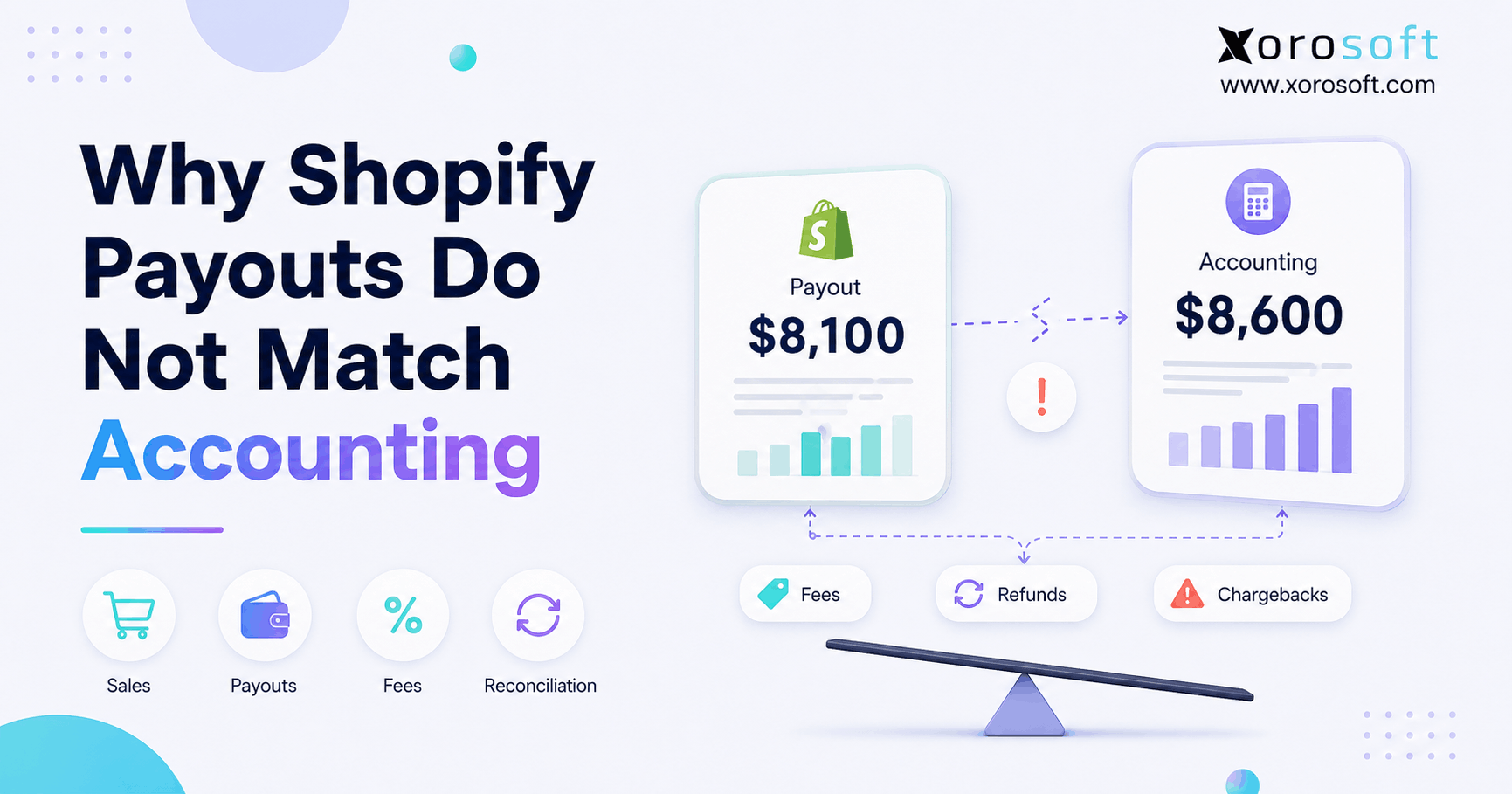
Marketplaces often combine orders, refunds, fees, reserves, and adjustments into one deposit.
Consequently, finance should match the deposit with the underlying transactions. Otherwise, fees may be understated and revenue may be recorded incorrectly.
Moreover, settlement differences should be investigated promptly. If reconciliation is delayed until month-end, exceptions become harder to trace.
9.3 Manage Wholesale Accounts Receivable
Wholesale distribution adds credit limits, invoices, statements, remittances, deductions, collections, and customer allowances.
Therefore, the order, shipment, invoice, payment, and deduction should remain connected. As a result, employees can resolve differences without searching through several applications.
In addition, customer deductions should be classified. For instance, a shortage claim should be treated differently from a promotional allowance or routing penalty.
9.4 Keep Inventory Valuation Connected to Operations
Inventory cost should follow the same receipts, transfers, shipments, returns, and adjustments used by warehouse teams.
When accounting receives only summarized changes, operational and financial reports may diverge. Therefore, inventory and accounting processes should share the same transaction history.
Moreover, unexplained inventory adjustments should be reviewed by both operations and finance. Consequently, quantity corrections and valuation impacts remain aligned.
9.5 Measure Profitability by Channel
A meaningful profitability calculation should include:
- Revenue
- Product cost
- Discounts
- Commissions
- Payment fees
- Warehouse labor
- Packaging
- Freight subsidies
- Returns
- Customer service
- Advertising
- Inventory carrying costs
As a result, management can compare channels based on contribution rather than revenue alone.
However, profitability should also be reviewed by customer and product group. A channel may be profitable overall while containing unprofitable accounts or SKUs.
10. Choosing Technology for Multichannel Sales Management
The right technology depends on the processes that must be connected. Another application may solve a specific problem. However, every additional system introduces ownership, integration, monitoring, and reconciliation requirements.
Therefore, technology decisions should follow process design rather than precede it.
10.1 Understand the Role of Each System
A distributor may use:
- Ecommerce platforms
- Marketplaces
- B2B portals
- EDI software
- Inventory applications
- Order management systems
- Warehouse management systems
- Accounting software
- Shipping applications
- Forecasting tools
- ERP platforms
The key question is not how many systems exist. Instead, the business should determine whether their responsibilities are clear and manageable.
Moreover, every integration should have an owner. Consequently, the company knows who responds when orders, inventory updates, settlements, or shipment messages fail.
10.2 Inventory Software vs OMS vs ERP
| Capability | Inventory software | Order management system | ERP |
|---|---|---|---|
| Inventory visibility | Strong | Moderate | Strong |
| Order routing | Basic to moderate | Strong | Moderate to strong |
| Purchasing | Usually supported | Limited | Strong |
| Warehouse operations | Varies | Varies | Varies by platform |
| Accounting | Usually limited | Limited | Integrated |
| Forecasting | Varies | Limited | Often available |
| Manufacturing | Rare | Rare | Available in some systems |
| Financial reporting | Limited | Limited | Strong |
| Multi-company support | Limited | Limited | Often available |
| EDI | Through integrations | Often supported | Integrated or connected |
Inventory software may suit businesses focused mainly on stock control. By contrast, an OMS may be appropriate when complex routing is the primary challenge.
ERP becomes more relevant when inventory, purchasing, warehousing, accounting, forecasting, and reporting must operate together.
Therefore, the correct choice depends on the breadth of the business problem. If the challenge affects only routing, an OMS may be enough. However, cross-functional issues usually require a broader platform.
10.3 Signs a Distributor May Be Ready for ERP
ERP evaluation may be appropriate when:
- Inventory exists in several applications.
- QuickBooks no longer supports operational reporting.
- Purchasing depends on spreadsheets.
- Multiple warehouses operate independently.
- EDI orders require repeated manual work.
- Month-end closing is delayed.
- Customer pricing is difficult to control.
- Manufacturing and distribution share inventory.
- Channel profitability is unclear.
- Order growth requires more administrative staff.
Although one issue may not justify ERP, several cross-functional problems usually indicate a broader system requirement.
Consequently, the decision should consider process complexity, not only transaction volume.
10.4 What to Evaluate in a Multichannel ERP
A distributor should assess:
- Inventory reservation logic
- Multi-warehouse support
- Shopify and marketplace connections
- EDI capabilities
- Customer-specific pricing
- Purchasing and forecasting
- Warehouse scanning
- Returns management
- Accounting integration
- Manufacturing support
- Reporting
- Integration monitoring
- Implementation resources
- Total cost of ownership
The Xorosoft ERP application for Shopify shows how Shopify orders can connect with broader inventory, warehouse, purchasing, manufacturing, and financial workflows.
Nevertheless, distributors should test their own order, refund, inventory, customer, bundle, and settlement scenarios before selecting a platform.
In addition, implementation requirements should be reviewed. A system may offer the necessary capability but still require significant configuration, data preparation, or partner support.
10.5 Compare ERP Options Against Real Workflows
The market includes NetSuite, Acumatica, Cin7, Brightpearl, Fishbowl, Sage, Microsoft Dynamics 365 Business Central, and Xorosoft.
Each platform differs in operational depth, financial capability, implementation scope, customization, and cost. Therefore, distributors should score systems against actual workflows rather than generic feature lists.
The Xorosoft vs NetSuite comparison provides a useful starting point for businesses evaluating different ERP approaches.
However, no platform should be selected from a comparison page alone. Instead, distributors should validate critical workflows using demonstrations, test scenarios, implementation plans, and reference conversations.
11. Implementing Multichannel Sales Management in Phases
A successful implementation does not begin with software configuration. Instead, it starts with a clear understanding of the current operation.
Therefore, process mapping and data preparation should occur before detailed system setup.
11.1 Document Every Channel and Integration
First, list every sales channel, warehouse, fulfillment partner, payment method, shipping system, EDI connection, accounting application, purchasing tool, and reporting process.
In addition, include unofficial spreadsheets and manual exports. Although they may not appear in formal documentation, they often contain important operational rules.
As a result, the implementation team can identify hidden dependencies before they create delays.
11.2 Map the Complete Order Lifecycle
Next, document how an order moves from creation to payment.
Include:
- Order capture
- Pricing
- Credit approval
- Inventory reservation
- Warehouse routing
- Picking
- Packing
- Shipping
- Invoicing
- Settlement
- Returns
- Reconciliation
As a result, the business can identify duplicate work, unclear ownership, and missing controls.
Moreover, mapping should include exceptions. For example, teams should document what happens when inventory is unavailable, pricing is incorrect, or an EDI message fails.
11.3 Clean Master Data Before Migration
Before moving data, resolve:
- Duplicate customers
- Obsolete SKUs
- Invalid units
- Missing dimensions
- Incorrect supplier lead times
- Expired price lists
- Inactive locations
- Unexplained inventory differences
Otherwise, the new system will preserve old problems rather than solve them.
In addition, data owners should approve the final records. Consequently, product, customer, supplier, and financial data have accountable owners before launch.
11.4 Define the Future Multichannel Operating Model
The business should decide which system owns:
- Product data
- Inventory
- Customer terms
- Pricing
- Orders
- Purchasing
- Warehouse activity
- Accounting
Moreover, it should define which applications can update each record and how integration failures will be managed.
At this stage, multichannel sales management should be treated as an operating-model project rather than only a software implementation.
Therefore, the future-state design should include both normal workflows and exception ownership.
11.5 Configure Allocation, Pricing, and Fulfillment Rules
Next, translate business policies into clear system rules.
For example, document how strategic inventory is reserved, when manual pricing approval is required, and which customers permit partial shipment.
In addition, rules should include escalation thresholds. Consequently, employees know when an exception can be approved locally and when management review is required.
11.6 Test End-to-End Multichannel Workflows
Testing should cover more than a standard order.
Therefore, include:
- Partial shipments
- Backorders
- Cancellations
- Returns
- Credit holds
- Pricing errors
- EDI failures
- Marketplace refunds
- Warehouse transfers
- Bundle orders
- Stock shortages
- Payment differences
As a result, teams can identify weaknesses before launch.
Moreover, the test should confirm accounting outcomes, not only operational steps. Otherwise, an order may ship correctly while posting to the wrong financial accounts.
11.7 Launch in Controlled Stages
Finally, the company may launch by channel, warehouse, customer group, or business process.
A controlled rollout reduces risk. Moreover, it gives teams time to correct issues before they affect the complete operation.
However, phased launches require clear temporary procedures. Therefore, employees should know which system is authoritative during each stage of the transition.
12. Multichannel Sales Management Across Distribution Industries
The principles of multichannel sales management remain consistent across industries. However, product characteristics and customer expectations change the operational details.
Consequently, system evaluation should include industry-specific workflows rather than generic demonstrations alone.
12.1 Apparel and Fashion Distribution
Apparel distributors manage style, color, size, season, and collection. Moreover, wholesale bookings may arrive months before direct-to-consumer demand.
Therefore, inventory allocation must protect important wholesale commitments while preserving enough fast-moving sizes for ecommerce.
In addition, markdowns and returns can change profitability quickly. Consequently, channel reports should consider aging inventory and seasonal sell-through.
12.2 Furniture Distribution
Furniture operations involve large dimensions, freight planning, delivery appointments, deposits, special orders, and long supplier lead times.
Consequently, sales teams need warehouse-level visibility across available stock, floor samples, inbound items, and transfers.
Moreover, delivery requirements may vary by customer and region. Therefore, routing decisions should consider service capability as well as distance.
12.3 Sporting Goods Distribution
Sporting-goods businesses may sell through dealers, teams, retailers, marketplaces, and ecommerce.
Because demand changes by sport, geography, season, and event schedule, forecasts should not rely only on annual totals.
In addition, some products may have short selling windows. Consequently, purchasing and allocation decisions must respond quickly to changes in demand.
12.4 Food and Beverage Distribution
Food distributors may require lot tracking, expiry management, quality holds, case-pack control, traceability, and recall readiness.
Therefore, shelf life and customer requirements must influence available inventory.
Moreover, the oldest inventory may not always be suitable for every customer. Consequently, fulfillment rules should consider expiry requirements and account agreements.
12.5 Consumer Products Distribution
Consumer-product businesses often combine wholesale, Shopify, Amazon, retail, and promotional channels.
As a result, bundles, commissions, advertising, returns, and fulfillment costs must be included in channel-margin reporting.
In addition, promotions can create sudden demand spikes. Therefore, purchasing and inventory allocation should reflect campaign plans before orders begin.
12.6 Manufacturing and Industrial Distribution
Manufacturers that also distribute products must connect channel demand with bills of materials, raw materials, work orders, production schedules, and finished-goods inventory.
Consequently, available-to-promise calculations must consider both completed products and production capacity.
Xorosoft supports several inventory-driven sectors. Businesses can review its ERP solutions by industry to compare workflows for wholesale, apparel, furniture, sporting goods, food, consumer products, and manufacturing.
13. KPIs for Multichannel Sales Management
Multichannel sales management should be measured across inventory, orders, warehousing, purchasing, and finance.
| KPI | Basic calculation | Why it matters |
|---|---|---|
| Inventory accuracy | Correct records ÷ records checked | Measures stock reliability |
| Order fill rate | Units fulfilled ÷ units ordered | Shows ability to satisfy demand |
| Perfect order rate | Error-free orders ÷ total orders | Measures end-to-end quality |
| Order cycle time | Shipment time minus order time | Shows fulfillment speed |
| Stockout rate | Stockout events ÷ demand events | Measures availability failures |
| Backorder rate | Backordered lines ÷ order lines | Shows supply shortfalls |
| Inventory turnover | Cost of goods sold ÷ average inventory | Measures inventory productivity |
| Forecast accuracy | Forecast compared with actual demand | Measures planning quality |
| Picking accuracy | Correct picks ÷ total picks | Shows warehouse reliability |
| Return rate | Returned units ÷ shipped units | Highlights product or service issues |
| Gross margin by channel | Revenue minus product cost | Shows basic channel economics |
| Cost to serve | Channel operating cost ÷ orders | Measures channel efficiency |
Operational exceptions may need daily review. Meanwhile, strategic trends can be reviewed weekly or monthly.
However, teams should avoid tracking too many metrics without clear ownership. Instead, each KPI should have an assigned department, target, and review frequency.
In addition, metrics should be interpreted together. For example, a higher fill rate may appear positive, but not if it requires excessive inventory and reduces cash flow. Therefore, service, inventory, and profitability measures should be reviewed as a balanced set.
14. Common Multichannel Sales Management Mistakes
14.1 Treating Every Channel as a Separate Business
Separate commercial ownership may be useful. However, separate inventory and accounting records usually create duplication and conflicting information.
Therefore, channels should retain commercial flexibility while sharing core operational data.
14.2 Synchronizing Orders Without Inventory
Importing orders without timely inventory updates creates overselling risk. Therefore, order and inventory integrations should be designed together.
In addition, failed updates should create alerts. Otherwise, overselling may continue until a customer complains.
14.3 Using One Allocation Rule for Every Product
Fast-moving, seasonal, strategic, and long-lead products may require different policies. Consequently, one allocation rule rarely works across the entire catalog.
Instead, products should be grouped according to demand pattern, margin, scarcity, and customer importance.
14.4 Ignoring Channel-Specific Costs
Revenue comparisons are incomplete without commissions, returns, fulfillment labor, advertising, and freight. Therefore, channels should be compared using contribution margin and cost to serve.
Moreover, these costs should be reviewed regularly because marketplace fees and freight rates can change.
14.5 Maintaining Customer Pricing in Spreadsheets
Uncontrolled files create expired agreements, pricing errors, and unauthorized discounts. Instead, pricing rules should have ownership, effective dates, and approval controls.
As a result, employees can trace why a particular price was applied.
14.6 Forecasting Only From Combined Sales
Total sales can hide promotions, stockouts, one-time orders, and channel migrations. As a result, purchasing may respond to distorted demand.
Therefore, forecasts should retain channel-level detail before they are consolidated.
14.7 Adding Applications Without Defining Data Ownership
Every integration needs a source system, update direction, monitoring process, and exception owner. Otherwise, conflicting data will appear as applications are added.
Consequently, system architecture should be documented before new tools are connected.
14.8 Automating a Broken Process
Automation increases the speed of both correct and incorrect workflows. Therefore, the process should be standardized before it is automated.
Moreover, exception cases should be tested. Otherwise, the automated workflow may fail when an order does not match the normal pattern.
14.9 Migrating Poor-Quality Data
New software will not automatically correct duplicate customers, invalid units, or obsolete products. Consequently, data cleanup should occur before migration.
In addition, ownership should continue after launch so data quality does not decline again.
14.10 Measuring Revenue Without Channel Profitability
A channel strategy should consider margin, working capital, returns, fulfillment cost, and administrative effort. Otherwise, management may invest in growth that reduces overall profitability.
Therefore, revenue should be viewed as one part of channel performance rather than the final measure.
15. Frequently Asked Questions About Multichannel Sales Management
15.1 What Is Multichannel Sales Management?
Multichannel sales management coordinates inventory, pricing, orders, fulfillment, purchasing, returns, and accounting across several channels. Therefore, each channel can serve customers differently while the distributor follows consistent operational rules behind the scenes.
15.2 What Is a Multichannel Distributor?
A multichannel distributor sells through two or more routes, including wholesale, Shopify, Amazon, EDI, dealers, stores, or direct sales. Although the channels may serve different customers, they often share inventory, purchasing, warehousing, and accounting resources.
15.3 How Do Distributors Manage Multiple Sales Channels?
Distributors centralize product, customer, inventory, pricing, order, warehouse, purchasing, and financial data. As a result, every channel can use the same validation, allocation, fulfillment, and accounting rules.
15.4 What Sales Channels Do Wholesale Distributors Use?
Common channels include field sales, inside sales, B2B ecommerce, marketplaces, EDI customers, dealers, stores, and direct orders. However, the right mix depends on the product, customer expectations, margin, and fulfillment capability.
15.5 What Is the Difference Between Multichannel and Omnichannel Distribution?
Multichannel distribution means selling through several channels. Omnichannel distribution goes further by connecting customer history, inventory, fulfillment, and returns across those channels. Therefore, omnichannel operations generally require deeper integration.
15.6 Why Is Multichannel Inventory Management Important?
It prevents several channels from promising the same stock. Moreover, it gives sales, purchasing, customer service, and warehouse teams a consistent view of availability.
15.7 How Is Inventory Synchronized Across Sales Channels?
A central system records warehouse transactions and calculates available inventory. Then, integrations publish those quantities to storefronts, marketplaces, and portals while accounting for reservations, bundles, returns, transfers, and failed updates.
15.8 How Can Distributors Prevent Overselling?
Use one source of inventory availability, reserve stock promptly, apply channel buffers, monitor integration failures, account for bundle components, and inspect returns before restocking. In addition, repeated negative inventory should be investigated immediately.
15.9 How Should Inventory Be Allocated Between Channels?
Inventory may be shared, assigned to fixed pools, distributed according to priority, or dynamically allocated. Therefore, the correct model depends on contractual commitments, demand, margin, customer importance, and synchronization reliability.
15.10 What Is Multichannel Order Management?
Multichannel order management captures orders from different sources and processes them through common validation, allocation, routing, fulfillment, return, and accounting workflows. As a result, distributors reduce duplicate entry while preserving channel-specific requirements.
15.11 Can ERP Manage Shopify, Amazon, Wholesale, and EDI Orders?
Many ERP platforms support these channels directly or through integrations. Nevertheless, distributors should test update timing, refunds, settlements, bundles, EDI documents, exceptions, and warehouse scenarios before choosing a platform.
15.12 What Software Is Best for Managing Multiple Sales Channels?
The right system depends on complexity. For instance, inventory software supports stock control, while an OMS supports advanced order routing. ERP, however, connects inventory, purchasing, accounting, warehouse management, and reporting.
15.13 Does Every Distributor Need ERP?
No. A smaller distributor with simple products, one warehouse, and limited pricing may operate effectively with specialist tools. However, ERP becomes more valuable when complexity crosses inventory, purchasing, fulfillment, and accounting.
15.14 When Should a Distributor Stop Using Spreadsheets?
Spreadsheets should stop acting as operational systems when information becomes outdated, formulas break, ownership is unclear, or real-time synchronization is required. At that stage, manual controls usually create more risk than flexibility.
15.15 Can QuickBooks Manage Multichannel Distribution?
QuickBooks can manage accounting for many businesses. However, growing distributors often need additional tools for inventory, purchasing, forecasting, EDI, warehouse management, and channel integrations.
15.16 How Is Customer-Specific Pricing Managed?
Customer pricing should use controlled price lists, contract records, quantity breaks, effective dates, approval rules, and a defined hierarchy. Consequently, orders can select the correct price and flag unauthorized overrides.
15.17 How Does EDI Work With ERP?
EDI converts trading-partner documents into ERP transactions. For example, a purchase order may become a sales order, while acknowledgements, shipment notices, and invoices return electronically.
15.18 How Are Orders Routed Across Multiple Warehouses?
Routing rules evaluate inventory, distance, freight cost, cut-off times, capacity, customer agreements, channel priority, and order completeness. Therefore, the selected warehouse should balance service quality with fulfillment cost.
15.19 How Should Distributors Forecast Demand by Channel?
Forecast meaningful product-and-channel combinations separately. Then, adjust for promotions, launches, stockouts, and one-time orders before consolidating the results for purchasing.
15.20 How Are Returns Managed Across Multiple Channels?
Every return should link to its original order and channel. In addition, the process should record authorization, condition, refund, fees, inventory impact, replacement demand, and accounting treatment.
15.21 How Do Multiple Sales Channels Affect Accounting?
Different channels create different payment, fee, tax, receivable, return, and settlement workflows. Therefore, accounting must record each transaction consistently while reconciling channel-specific differences.
15.22 How Is Channel Profitability Calculated?
Start with channel revenue. Then, subtract product cost, discounts, commissions, payment fees, fulfillment labor, freight, returns, customer service, advertising, and inventory carrying costs.
15.23 Which KPIs Should Multichannel Distributors Track?
Important metrics include inventory accuracy, fill rate, perfect order rate, cycle time, stockout rate, backorders, inventory turnover, forecast accuracy, return rate, gross margin, and cost to serve.
15.24 What Causes Inventory Discrepancies Between Channels?
Common causes include receiving errors, incorrect units, picking mistakes, unprocessed returns, duplicate SKUs, failed integrations, bundle errors, damage, and delayed posting. Therefore, teams should investigate root causes rather than only adjust quantities.
15.25 What Are the Risks of Disconnected Software?
Disconnected applications create conflicting inventory, duplicate entry, delayed reporting, pricing errors, missed orders, weak audit trails, and slow reconciliation. Moreover, these risks increase as channels, warehouses, products, and order volume grow.
16. Practical Next Step for Better Multichannel Sales Management
Managing multiple sales channels requires more than connecting storefronts and importing orders. Instead, a distributor needs one operational foundation for inventory, pricing, order management, purchasing, warehouse execution, returns, and accounting.
First, prioritize consistency. Every channel should use the same inventory rules. Likewise, every order should pass through controlled validation, while purchasing should use consolidated demand. Finance should also be able to trace payments, refunds, fees, and deductions back to the original transaction.
Next, identify where employees perform repetitive manual work. For example, they may re-enter orders, correct inventory, update pricing spreadsheets, combine purchasing reports, search for shipment status, match marketplace deposits, or rebuild channel reports.
These activities reveal where existing processes no longer support the business effectively.
Nevertheless, a distributor does not always need to replace every application. In some cases, clearer ownership and better integrations may be sufficient. However, when problems repeatedly cross sales, inventory, purchasing, warehouse management, and accounting, a unified ERP platform deserves serious evaluation.
Xorosoft connects ecommerce, wholesale, EDI, purchasing, forecasting, multi-warehouse operations, manufacturing, and accounting. Therefore, it may be relevant to distributors that have outgrown QuickBooks, spreadsheets, inventory-only systems, or disconnected operational applications.
Ultimately, the best next step is to map the current workflow, identify the systems creating the most friction, and define what a scalable future process should look like before selecting software.
16.1 Book a Personalized Multichannel ERP Demo
Finally, review how Shopify, Amazon, wholesale, EDI, inventory, warehouse, purchasing, and accounting workflows could operate through one connected platform.