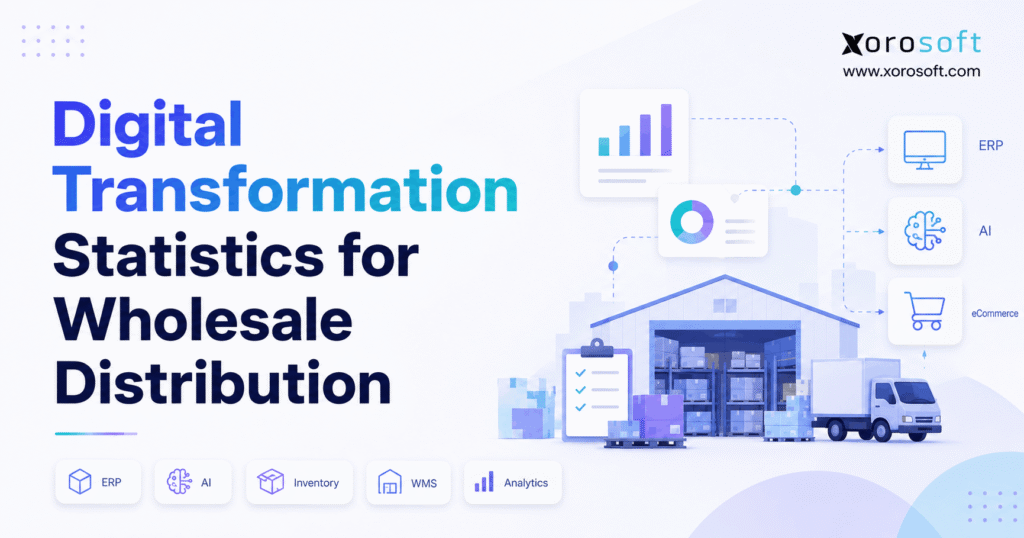
Wholesale digital transformation is becoming a key factor for many industries looking to stay competitive in today’s fast-paced marketplace.
1. Wholesale Digital Transformation Is Moving From Software Adoption to System Integration
Wholesale distributors have spent years adding software to their operations. ERP platforms, ecommerce systems, CRM tools, warehouse applications, EDI connections, analytics software, and inventory apps are now common across the sector. However, adding more technology does not automatically create a more connected business.
The latest research makes that gap clear. Distribution Strategy Group’s 2026 State of Distributor Technology research found that 55% of surveyed distributors had invested in core systems such as ERP, CRM, ecommerce, and analytics without fully integrating them. That matters because wholesale digital transformation is no longer mainly about buying software. Instead, the next stage is about making inventory, orders, purchasing, warehouses, customer data, ecommerce, accounting, and reporting work together.
Artificial intelligence is pushing the same issue higher on the agenda. In Distribution Strategy Group’s 2026 AI research, 27% of distributors were exploring AI and 37% were running pilots, while only 15% were scaling proven use cases. Smaller groups had AI connected across several business functions.
Therefore, the core question for wholesale leaders is changing. Rather than asking which tool should be purchased next, businesses increasingly need to ask where data breaks between the tools they already use.
That shift defines the next phase of wholesale digital transformation.
2. Wholesale Digital Transformation Statistics That Matter in 2026
2.1 Key Wholesale Distribution Technology Statistics
Current research shows an industry that is investing quickly but still working through major integration gaps.
Distribution Strategy Group reports that 55% of surveyed distributors have core systems that are not fully connected. High-maturity distributors use and integrate an average of 28 technologies, while low-maturity distributors average only five. WMS adoption sits near 50%, whereas RFID adoption remains around 13%. AI-driven WMS adoption is still below 2%, even though 49% of respondents see warehouse automation as an important AI use case.
AI adoption tells a similar story. Roughly 63% of distributors in DSG’s research were either exploring AI or testing defined use cases. By contrast, only 15% were scaling applications that had already shown value.
Meanwhile, B2B buying behavior is also becoming more digital. McKinsey’s B2B Pulse found that business buyers now use an average of 10 interaction channels, compared with five in 2016. In addition, 71% of respondents offered ecommerce, and online sales represented 34% of revenue among those respondents.
Taken together, these numbers show that wholesale digital transformation is advancing on several fronts at once. Yet integration, data quality, and process design remain the foundations that determine whether those investments produce real business value.
2.2 Digital Maturity Matters More Than the Number of Apps
A long software list does not prove that a distributor is digitally mature.
In practice, digital maturity is about how well systems, people, and processes work together. A distributor may have ERP, ecommerce, CRM, WMS, analytics, and forecasting tools while still relying on spreadsheets to connect them. If staff must export files every morning to align stock or customer data, the technology stack remains fragmented.
By contrast, a smaller set of well-connected systems may produce better results because everyone works from the same information.
For that reason, wholesale digital transformation should be measured through business flow rather than application count. Useful measures include inventory accuracy, order speed, purchasing efficiency, warehouse output, financial close time, reporting speed, and customer response time.
3. What Wholesale Digital Transformation Means in Daily Operations
3.1 Digital Transformation Is More Than Digitizing Manual Work
Wholesale digital transformation means redesigning work around connected systems, reliable data, and useful automation.
Digitization is much narrower. Replacing a paper purchase order with a PDF is digitization. Automation goes one step further when software reads that order and creates a transaction automatically.
True transformation happens when the entire workflow becomes connected.
For example, a new customer order should affect inventory allocation, warehouse work, purchasing demand, customer status, fulfillment, accounting, and reporting without staff entering the same information several times.
Therefore, the goal is not simply to move manual tasks onto screens. The goal is to remove gaps between teams, reduce repeated work, and make business data easier to trust.
3.2 Connected ERP Can Become the Operational Base
For many inventory-driven companies, ERP provides the system that ties core operations together.
Sales orders affect stock. Purchase orders affect incoming supply. Warehouse activity changes inventory. Shipments influence revenue and cost. Forecasting also depends on the accuracy of the data created by each of those processes.
A platform such as XoroONE shows how this connected model can work. XoroONE brings sales, purchasing, inventory, accounting, warehouse management, manufacturing, reporting, and ecommerce operations into one cloud environment.
Still, every distributor has different needs. The broader lesson is that wholesale digital transformation becomes harder when each department works from a different version of the same business data.
4. System Integration Has Become a Core Wholesale Digital Transformation Challenge
4.1 Disconnected Systems Create Real Business Costs
System gaps often appear harmless at first.
An ecommerce platform may refresh inventory every few hours instead of in real time. A CRM might not show current orders. Finance may receive warehouse adjustments late. Purchasing could be working from yesterday’s spreadsheet instead of today’s demand.
Individually, each issue may seem manageable. Together, however, they create slower decisions and more manual checking.
For example, sales may promise stock that has already been allocated. Purchasing may place an order based on an old inventory figure. Finance may spend extra time explaining stock changes at month-end. At the same time, warehouse staff may work from information that does not match the order system.
Consequently, integration is not simply an IT concern. It affects service, working capital, purchasing, margin, fulfillment, and reporting.
4.2 Wholesale Digital Transformation Should Follow a Clear Sequence
Many companies want to jump directly to AI, advanced forecasting, or warehouse automation. However, the stronger path usually starts with the basics.
Accurate transactions come first. Next, core systems need to share data. After that, teams can improve data standards and automate repeated work. Advanced analytics and AI become more useful once those earlier steps are stable.
This order reduces risk because each new layer depends on the quality of the one below it.
As a result, wholesale digital transformation works best when it is treated as an operating program rather than a collection of unrelated software projects.
5. ERP Modernization Is Becoming a Major Wholesale Digital Transformation Priority
5.1 Modern ERP Should Improve How Work Moves Across the Business
ERP modernization is often described as moving software from an old server to the cloud. Yet that view is too narrow.
The larger goal is to improve how information moves across the company.
A growing distributor may need one clear view of purchase orders, sales orders, warehouse activity, inventory, returns, vendor commitments, customer demand, and financial results. When each function uses separate data, employees spend more time checking numbers and less time making decisions.
That is why ERP modernization often becomes an important part of wholesale digital transformation.
XoroERP follows this connected approach by bringing accounting, purchasing, inventory, warehouse management, manufacturing, reporting, and integrations into one ERP environment.
5.2 Cloud ERP Alone Does Not Create Digital Transformation
Moving ERP to the cloud can improve access and make integration easier. Even so, the project will not create much value if teams keep using the same manual workarounds.
Purchasing may still depend on spreadsheets. Ecommerce may remain separate. Warehouse updates may be entered hours later. Likewise, reports may still need several exports before management can use them.
Therefore, success should be measured through business results rather than go-live dates.
Inventory accuracy, order cycle time, purchasing speed, warehouse output, month-end close time, customer service, and reporting speed are stronger measures of progress.
A successful ERP project changes how work gets done. Simply replacing an older screen does not.
6. AI Statistics Show Where Wholesale Digital Transformation Is Heading
6.1 Most Distributors Are Still Early in Their AI Journey
AI use is growing quickly across distribution. Even so, most companies remain in the early stages.
Distribution Strategy Group’s 2026 research found that 27% of distributors were exploring AI, while 37% were piloting defined use cases. Another 15% were scaling applications that had already shown value.
By contrast, only a small share had AI connected across several business functions or placed at the center of company strategy.
These numbers show that experimentation is widespread. However, large-scale operational use is still much less common.
For wholesale leaders, that difference matters. Trying a chatbot or testing a forecasting tool does not mean the wider company has become AI-driven.
6.2 AI Adoption Is Strongest in Clear, Repeatable Workflows
Order processing is a useful example.
Distribution Strategy Group has reported strong interest and adoption in AI-assisted order automation, customer chatbots, CRM support, and quoting. More complex uses such as demand forecasting, inventory planning, and warehouse robotics remain less common.
The reason is practical.
Reading an emailed order and turning it into structured data has a clear start, finish, and result. By comparison, predicting demand across thousands of SKUs involves more data, more risk, and more business rules.
Therefore, the strongest early AI projects tend to focus on work that is repeatable and easy to measure.
6.3 Better AI Starts With Better Business Data
Wholesale digital transformation and AI readiness are closely linked.
A forecasting model needs trustworthy sales history. Inventory AI needs accurate stock. Pricing tools require clean customer and product data. Warehouse automation also depends on correct location and transaction records.
Because of this, distributors should not begin with the question, “Where can we use AI?”
A better question is: Which costly process has good enough data and a clear measure of success?
That shift can prevent expensive pilots that look impressive but fail to improve daily operations.
7. B2B Ecommerce Is Expanding the Scope of Wholesale Digital Transformation
7.1 B2B Buyers Now Move Across More Channels
Wholesale customers no longer follow one buying path.
McKinsey’s B2B Pulse found that business buyers use an average of 10 interaction channels, compared with five in 2016. Some customers prefer face-to-face sales, while others want phone or video support. Meanwhile, many prefer digital self-service for at least part of the buying process.
McKinsey also reported that 71% of surveyed B2B companies offered ecommerce, while online sales made up 34% of revenue among respondents.
Therefore, distributors cannot treat ecommerce as a separate online project. It is now part of the wider customer and order experience.
7.2 Ecommerce Works Better When Inventory and Orders Stay Connected
A B2B portal may show products, customer pricing, and available stock. However, the experience breaks down quickly if the data behind the portal is wrong.
A customer may see stock online that has already been committed elsewhere. A salesperson may offer different pricing from the portal. In addition, the warehouse may not receive a change made after the order was placed.
As a result, wholesale digital transformation must link customer-facing tools with back-office operations.
7.3 Shopify Growth Creates New Back-Office Demands
Shopify can help distributors and product companies grow online sales. However, order growth also puts more pressure on inventory, purchasing, fulfillment, and accounting.
The Xorosoft ERP app on the Shopify App Store connects Shopify with ERP workflows such as order sync, inventory updates, products, shipments, payouts, and related back-office processes.
The wider point is simple: ecommerce may be the front door, but the operation behind that door determines whether growth stays manageable.
8. Inventory Management Sits at the Center of Wholesale Digital Transformation
8.1 Real-Time Inventory Means More Than Knowing What Is on the Shelf
Inventory is often where disconnected systems become visible first.
A basic stock figure tells a user how many units exist. However, a useful inventory view also needs to show what is available, allocated, incoming, in transit, damaged, reserved, or moving between locations.
Those differences matter because sales, purchasing, ecommerce, and warehouse teams all make decisions based on stock status.
If each department has a different figure, errors become much more likely.
Therefore, real-time inventory visibility should be one of the first goals of wholesale digital transformation.
8.2 Inventory Data Supports More Than Warehouse Operations
Inventory is not just a warehouse measure.
Purchasing teams use it to plan orders. Sales teams depend on it when making commitments. Ecommerce platforms use it to show availability. Meanwhile, finance needs reliable values for reporting.
Because several departments depend on the same information, inventory should become a shared source of truth.
That shift can help reduce stockouts, lower excess inventory, and improve service. More importantly, it creates a stronger base for forecasting and automation later.
9. Purchasing and Forecasting Are Becoming More Data-Driven
9.1 Wholesale Purchasing Is Moving Beyond Spreadsheet Reordering
Experienced buyers often have years of supplier and product knowledge.
They may know which supplier tends to deliver late, which SKU sells more in summer, or which customer is likely to reorder. That knowledge has real value.
However, spreadsheet purchasing becomes harder as SKU counts, warehouse locations, and sales channels grow.
A connected purchasing process can combine stock, demand, open sales orders, incoming purchase orders, supplier lead times, reorder rules, and forecasts.
As a result, buyers spend less time collecting information and more time reviewing important exceptions.
9.2 Forecasting Works Best When the Input Data Is Reliable
Demand forecasting is one of the most attractive areas for AI. Still, it needs better data than many simpler forms of automation.
For example, an order-entry tool can often work from the document it receives. A demand model may need years of clean sales history, seasonality, product changes, lead times, promotions, and customer trends.
Therefore, weak source data can create weak forecasts even when the model itself is advanced.
Wholesale digital transformation should improve the data foundation before a business puts too much trust in automated buying advice.
10. Warehouse Automation Remains a Major Wholesale Technology Gap
10.1 WMS Adoption Shows Basic Warehouse Digitization Is Still Underway
Warehouse technology is changing, but adoption remains mixed.
Distribution Strategy Group’s 2026 research reports WMS adoption near 50% among surveyed distributors. RFID adoption is much lower, while AI-driven WMS adoption remains at an early stage.
At the same time, warehouse automation ranks as an important AI opportunity for many distribution leaders.
That gap matters because interest is growing faster than real deployment.
10.2 Warehouse Digital Transformation Starts With Accurate Transactions
A warehouse cannot automate what it cannot track well.
Receiving, bins, putaway, replenishment, picking, packing, shipping, transfers, cycle counts, and returns all create important inventory events.
For that reason, WMS often becomes a key part of wholesale digital transformation before robotics or advanced AI enters the discussion.
XoroWMS is one example of a cloud warehouse system focused on inventory control, fulfillment, warehouse tasks, and productivity.
Still, the value of any WMS depends on how well it stays connected with orders, purchasing, inventory, and accounting.
11. Data Quality Is Becoming a Wholesale Digital Transformation Advantage
11.1 AI and Automation Make Bad Data More Expensive
Bad data is not a new problem. However, automation can spread its effect much faster.
If a product cost is wrong, a person may catch the issue before using it. When an automated process uses that same cost across thousands of pricing or buying decisions, the error can travel much further.
Therefore, data quality becomes more important as automation expands.
Current distribution research also shows a close link between stronger data foundations and greater confidence in AI returns.
11.2 Real-Time Reports Are Only as Good as the Transactions Below Them
Modern dashboards can update in seconds. Still, faster reporting does not automatically mean better reporting.
If warehouse staff record transfers late, inventory reports will be wrong. When returns are coded badly, margin reports may be misleading. Likewise, product data that differs between systems can make dashboards tell different stories.
As a result, wholesale digital transformation should improve the quality of daily transactions before management focuses too heavily on executive dashboards.
Good reporting begins on the warehouse floor, at the purchasing desk, and during order entry.
12. Accounting Should Be Part of Wholesale Digital Transformation
12.1 Inventory Activity Creates Financial Activity
Every important inventory event has a financial side.
Receiving goods affects inventory and payables. Shipping changes inventory, revenue, and cost of goods sold. Returns affect both stock and customer balances. In addition, freight and landed costs can change margin.
When operations and accounting use separate systems, finance teams often spend extra time matching those events later.
That is why wholesale digital transformation should connect finance with the operation instead of treating accounting as the last step.
12.2 Better Connections Can Reduce Reconciliation Work
A connected system can record the financial effect of an order or warehouse transaction as the work takes place.
Consequently, finance teams can spend less time rebuilding the story at month-end.
This does not remove the need for financial controls. Instead, it gives accounting teams a clearer trail from the source transaction to the final financial result.
For growing distributors, that link becomes increasingly valuable as order volume and warehouse activity rise.
13. EDI and Order Management Still Matter in Wholesale Digital Transformation
13.1 Digital Commerce Is Bigger Than Web Orders
Not every wholesale customer orders through a website.
Large retailers and other trading partners often rely on EDI for purchase orders, shipment notices, invoices, and acknowledgments.
Therefore, a digital strategy that focuses only on ecommerce misses a major part of wholesale operations.
When EDI connects with ERP and WMS, an incoming order can create a sales order, allocate stock, trigger warehouse work, send shipment details, and create an invoice without the same data being typed repeatedly.
13.2 Order Automation Can Remove High-Volume Manual Work
Order entry is one of the clearest areas where automation can help.
A distributor receiving hundreds of orders by email, portal, ecommerce, and EDI may spend many hours simply turning customer requests into internal transactions.
However, automation can remove much of that repeated work when product, customer, and pricing data is clean.
As a result, customer-service teams can spend more time solving exceptions and helping customers instead of typing orders.
14. Wholesale Digital Transformation Looks Different by Industry
14.1 Apparel and Fashion Need Strong Variant and Channel Control
Apparel companies often manage style, color, and size combinations. As a result, one product family can create hundreds of SKUs.
Seasonality adds another layer of pressure. Wholesale orders, ecommerce sales, returns, and marketplace demand may all compete for the same stock.
Therefore, apparel distributors often need strong product data, demand planning, allocation, and multi-channel inventory control.
14.2 Furniture Distribution Depends on Lead-Time and Inventory Visibility
Furniture distributors face a different set of issues.
Products are often large, supplier lead times can be long, and inventory may tie up a large amount of cash. Meanwhile, customers expect clear delivery dates.
Connected purchasing and inventory data can help teams see what is available, what is already sold, what is on order, and when new stock should arrive.
14.3 Food, Sporting Goods, and Manufacturing Add Other Needs
Food distributors may need lot, batch, expiry, and traceability controls. Sporting-goods businesses often face seasonality and product variants.
Meanwhile, companies that both manufacture and distribute goods must connect demand with bills of materials, raw materials, work orders, purchasing, production, and finished inventory.
Xorosoft’s industry solutions show how ERP needs vary across wholesale, retail, ecommerce, manufacturing, apparel, furniture, food, and other product-based sectors.
For that reason, wholesale digital transformation should match the real operating model rather than follow a generic software checklist.
15. The Business Case for Wholesale Digital Transformation
15.1 Better Decisions Are Often More Valuable Than More Features
The strongest gains from digital transformation usually come from better daily decisions.
Sales can answer customer questions faster because inventory and order data are easier to find. Purchasing can see current demand and incoming supply. Warehouse teams can work from clear tasks. At the same time, finance can review transactions without waiting for several systems to be reconciled.
As a result, the business can respond faster without adding the same amount of admin work.
15.2 Connected Operations Can Support Growth With Less Friction
Growth often exposes weak processes.
A spreadsheet that works with 500 SKUs may struggle at 10,000. A manual order process that works with 50 daily orders may become a bottleneck at 500.
Therefore, wholesale digital transformation can help companies scale by reducing repeated work and making information easier to share.
Technology alone is not enough, though. Processes, roles, data standards, and training need to improve with the system.
16. Common Wholesale Digital Transformation Mistakes
16.1 Adding Another App to Solve an Integration Problem
Point solutions can be useful when they solve a clear specialist need.
However, companies should be careful when the real problem is that existing systems do not work together.
Adding another application may create one more source of data, another login, and another integration to maintain.
Current distributor research supports this concern. Many companies already have core technology but still have not fully connected it.
Therefore, the first question should be whether the business needs another application or better use of the tools it already owns.
16.2 Treating Transformation as an IT-Only Project
Wholesale digital transformation changes how people work.
Purchasing teams may use new planning rules. Warehouse staff may scan every move. Finance may receive transactions sooner. Sales teams may see different stock data. In addition, managers may depend on new reports.
As a result, operational leaders need to take part in the project from the beginning.
Technology teams can build integrations and configure systems. Business teams, however, need to define how the process should work.
16.3 Automating Before Measuring the Current Process
Automation works best when the company understands the problem first.
If order entry takes 12 minutes per order, for example, that creates a clear baseline. Management can then measure whether automation cuts the time to two minutes while keeping accuracy high.
Without a baseline, the project may feel successful without proving value.
For that reason, companies should define a small set of clear measures before starting major automation or AI work.
17. When Wholesale Distributors Should Upgrade Their Technology Stack
17.1 ERP Upgrade Signs Often Appear as Manual Workarounds
The need for ERP often becomes clear through small daily problems.
Employees may copy information between systems. Purchasing may depend on spreadsheets. Inventory reports may disagree. Warehouse transfers may take too long to update. Ecommerce orders may need manual fixes. Meanwhile, finance may spend days reconciling data.
One spreadsheet is not the problem.
However, when spreadsheets become the main layer holding several systems together, the technology stack may no longer fit the business.
17.2 Not Every Distributor Needs a Full ERP
A small wholesale company with one location, limited SKUs, simple purchasing, basic accounting, and one main sales channel may not need a full ERP.
In that case, accounting software plus a focused inventory app may work well.
As the business grows, however, more processes begin to depend on one another. Multiple warehouses, Shopify, Amazon, EDI, manufacturing, forecasting, and complex purchasing can increase the need for a connected ERP.
Therefore, ERP should be based on process complexity rather than a fixed revenue number.
17.3 ERP and Point Solutions Solve Different Problems
Accounting software with spreadsheets may be suitable for simple operations. Inventory software can work well when stock control is the main need. A standalone WMS may suit a warehouse-heavy operation. Best-of-breed stacks can provide deep specialist features, although they create more integration work.
By contrast, an integrated ERP becomes more attractive when inventory, purchasing, finance, warehouses, ecommerce, and reporting all need to stay aligned.
Each approach can be right in the right setting. The key is to understand whether the company has one isolated problem or several connected problems.
17.4 Compare Wholesale ERP Systems Based on Daily Workflows
Long ERP feature lists can be misleading because most major systems offer hundreds of functions.
Instead, distributors should test real work.
Can purchasing see live stock and incoming supply? Does the warehouse handle transfers easily? Can ecommerce orders flow in without manual re-entry? Does accounting trace financial results back to operational transactions? Can managers get useful reports without days of preparation?
Distributors comparing larger platforms may also find value in Xorosoft’s Xorosoft vs NetSuite comparison.
Ultimately, the goal is not to find the platform with the longest feature list. It is to find the system that best supports the work the company performs every day.
18. AI and Automation Will Shape the Next Stage of Wholesale Digital Transformation
18.1 More AI Will Be Built Into Existing Business Systems
The next stage of wholesale digital transformation is unlikely to involve hundreds of new standalone AI tools.
Instead, AI will increasingly appear inside ERP, CRM, ecommerce, WMS, purchasing, and reporting systems that distributors already use.
This approach makes sense because those systems already contain much of the business context AI needs.
For example, AI inside purchasing software can work with open purchase orders, lead times, sales history, and current stock. Likewise, AI inside CRM can use account activity and order history to support sales teams.
Therefore, embedded AI may prove more useful than isolated tools that cannot see the wider operation.
18.2 Better-Connected Distributors Will Have an Advantage
Companies with clean data and connected systems can test new technology faster.
By contrast, a distributor with several versions of the same inventory figure must first decide which one is correct.
That difference will become more important as automation grows.
As a result, today’s integration work can become tomorrow’s AI advantage.
Wholesale digital transformation is not separate from AI strategy. For most distributors, it is the groundwork that makes useful AI possible.
19. Frequently Asked Questions About Wholesale Digital Transformation
19.1 What is wholesale digital transformation?
Wholesale digital transformation is the use of connected systems, reliable data, and automation to improve distribution operations. It can cover ERP, inventory, purchasing, warehouse management, ecommerce, EDI, accounting, forecasting, analytics, and AI. The goal is not simply to replace manual tools. Instead, the business should make work and information move more smoothly across teams.
19.2 Why is wholesale digital transformation important?
Wholesale companies must manage suppliers, inventory, customer orders, warehouses, pricing, shipping, and finance at the same time. Therefore, disconnected systems can create slow work and inconsistent data. Current distribution research shows that many businesses have already invested in core technology but still need to improve integration before those systems can deliver their full value.
19.3 What are the most important wholesale digital transformation statistics for 2026?
Key benchmarks include 55% of surveyed distributors having core systems that are not fully integrated, WMS adoption near 50%, relatively low RFID adoption, and very early adoption of AI-driven warehouse systems. In addition, most distributors remain in the exploring or pilot stages of AI rather than using it widely across the business.
19.4 What does digital maturity mean for wholesale distributors?
Digital maturity measures how well a distributor uses technology, data, processes, and system connections to run the business. It is not simply a count of installed apps. For example, a company may own ERP, CRM, ecommerce, and WMS software but still have low maturity if staff depend on spreadsheets to keep those systems aligned.
19.5 What technology are wholesale distributors using?
Distributors commonly use ERP, CRM, ecommerce, WMS, EDI, analytics, forecasting, business intelligence, customer portals, product-data tools, order automation, and AI. Some companies also use RFID, robotics, and advanced planning systems. The right mix depends on the company’s products, customers, warehouse network, sales channels, and overall operating model.
19.6 How are wholesale distributors using AI?
Wholesale distributors are using AI for order processing, customer support, CRM assistance, quoting, ecommerce, forecasting, inventory planning, finance, and warehouse operations. However, adoption varies by use case. Clear and repeatable workflows often move faster because results are easier to measure, while complex planning processes require stronger data and more business rules.
19.7 What percentage of distributors are using AI?
The answer depends on how “using AI” is defined. Distribution Strategy Group’s 2026 research found that many distributors were either exploring AI or running pilots. A much smaller share had reached the point of scaling proven applications. Therefore, AI experimentation is already common, while broad operational use remains at an earlier stage.
19.8 Why is AI hard to scale in wholesale distribution?
AI often depends on clean data, employee skills, process design, system connections, and clear goals. Consequently, a pilot may work well in one team but become harder to expand across the business. Staff also need training and confidence in the process. The technology itself is only one part of successful AI adoption.
19.9 How does ERP support wholesale digital transformation?
ERP can give sales, inventory, purchasing, warehouses, finance, and reporting a shared transaction base. As a result, teams can work from more consistent information. ERP alone does not create transformation, though. Strong processes, accurate data, useful integrations, employee training, and clear operating rules are still required to produce lasting value.
19.10 What is cloud ERP for wholesale distribution?
Cloud ERP is business software delivered through cloud infrastructure rather than only through local servers. For distributors, it may manage inventory, orders, purchasing, warehouse activity, accounting, forecasting, ecommerce, and reporting. Cloud delivery can also support easier access and integration, although the best system is still the one that fits the company’s workflows.
19.11 Why do distributors replace legacy ERP systems?
Distributors often replace older ERP systems when integrations become difficult, reporting is slow, ecommerce is hard to support, or staff rely too heavily on spreadsheets. Older platforms may also struggle with multi-warehouse operations or newer automation. However, age alone is not a reason to replace ERP. The change should solve a clear business problem.
19.12 How does wholesale digital transformation improve inventory management?
Wholesale digital transformation can connect receipts, sales, transfers, purchase orders, returns, warehouse work, and accounting. Therefore, teams gain a more complete view of inventory. Better data can help reduce stockouts, improve purchasing, and give sales teams more reliable availability. Even so, the result still depends on accurate warehouse and order transactions.
19.13 What is real-time inventory visibility?
Real-time inventory visibility means stock status changes as business transactions take place. For example, a shipment can reduce available inventory as soon as it is confirmed. A useful view may also include allocated, incoming, damaged, reserved, and in-transit stock. This gives teams a more current picture instead of forcing them to wait for manual updates.
19.14 How can technology improve purchasing?
Technology can bring sales demand, inventory, open purchase orders, forecasts, supplier lead times, and reorder rules into one view. Consequently, buyers can focus more on unusual cases instead of building reports manually. Automated purchasing should still follow clear business rules and include buyer review, especially for expensive, seasonal, or slow-moving products.
19.15 How does demand forecasting help wholesale distributors?
Demand forecasting estimates future product needs using sales history, seasonality, trends, lead times, and other data. Therefore, it can help purchasing teams decide what to buy and when. Forecasts are only as good as the information behind them, though. Missing demand, poor transaction history, or weak product data can reduce forecast quality.
19.16 What is warehouse digital transformation?
Warehouse digital transformation means using connected technology to improve receiving, putaway, bins, replenishment, picking, packing, shipping, transfers, counts, and returns. It may begin with barcode scanning and WMS before moving toward automation or robotics. Accurate warehouse transactions generally need to come before more advanced technology can deliver reliable results.
19.17 How common is WMS use in wholesale distribution?
Distribution Strategy Group’s 2026 research places WMS adoption at around half of surveyed distributors. By comparison, advanced warehouse technologies such as RFID and AI-driven WMS remain less common. Therefore, many organizations still have room to improve basic warehouse systems before investing heavily in advanced automation.
19.18 How does B2B ecommerce support wholesale digital transformation?
B2B ecommerce gives customers another way to research, order, reorder, and manage their accounts. However, the portal needs accurate stock, customer pricing, order history, and fulfillment data. Therefore, ecommerce works best when it connects with ERP, inventory, warehouse, and finance systems rather than operating as a separate sales channel.
19.19 Why is omnichannel distribution important?
B2B buyers may use sales reps, phone, email, portals, ecommerce, EDI, or marketplaces during the same customer relationship. As a result, every channel needs access to consistent product, inventory, order, and customer information. Without integration, adding channels can increase internal work rather than improve the buying experience.
19.20 What role does EDI play in wholesale distribution?
EDI allows trading partners to exchange structured business documents such as purchase orders, shipment notices, and invoices. When EDI connects directly with ERP and warehouse systems, those documents can trigger real work without manual entry. Therefore, EDI can reduce repeated data entry and help high-volume wholesale orders move through the business more smoothly.
19.21 What are the biggest wholesale digital transformation challenges?
Common challenges include disconnected systems, poor data quality, unclear process ownership, weak integrations, employee resistance, and limited training. In addition, some companies try to change too much at once. A stronger approach is to focus on a few high-value workflows, measure the results, and expand only after the process is stable.
19.22 When should a distributor move beyond QuickBooks?
QuickBooks can work well for companies with simple accounting and limited operating needs. However, distributors may need broader ERP when inventory, multiple warehouses, manufacturing, ecommerce, EDI, purchasing, or forecasting become harder to manage separately. Therefore, the decision should be based on operational complexity rather than a fixed revenue level.
19.23 Who does not need a full wholesale ERP?
A small distributor with one simple warehouse, limited SKUs, basic purchasing, and one main sales channel may not need ERP. In that case, accounting software and a focused inventory application may be enough. ERP becomes more useful as several teams and systems need to share the same inventory, order, purchasing, and financial data.
19.24 What are the alternatives to wholesale ERP?
Alternatives include accounting software with spreadsheets, inventory systems, standalone WMS products, purchasing tools, ecommerce apps, or a best-of-breed software stack. Each can work well in the right business. However, companies should consider how much effort will be required to keep the tools connected as order volume and operational complexity grow.
19.25 What is the future of wholesale digital transformation?
The next phase will likely include more connected systems, embedded AI, automated order processing, better planning, B2B self-service, and gradual warehouse automation. However, the pace will vary by company. Distributors with clean data and strong system connections should be better prepared for advanced tools than businesses still dealing with basic information gaps.
20. Conclusion: What Wholesale Leaders Should Prioritize Next
The strongest lesson from today’s wholesale digital transformation statistics is not that distributors need more software. Instead, the data shows that many companies already own core technology but still need to connect it more effectively.
Therefore, the best starting point is to map how information moves through the business today.
Look for places where employees enter the same information twice. Find spreadsheets that exist only because two systems do not communicate. Review where inventory figures disagree. In addition, identify points where purchasing, warehouse, sales, ecommerce, or finance teams must wait for another department before they can act.
Once those gaps are visible, modernization becomes easier to prioritize.
For some distributors, the next step may be WMS. Others may need stronger ecommerce integrations, better inventory controls, cleaner product data, or a more connected ERP. Meanwhile, businesses with solid foundations may be ready for AI forecasting, automated order processing, or more advanced warehouse tools.
Platforms such as XoroONE, XoroERP, and XoroWMS support different parts of that connected operating model. Xorosoft’s industry solutions also show how requirements change across wholesale, retail, ecommerce, manufacturing, apparel, furniture, food, and other inventory-driven businesses.
Still, technology selection should follow the business problem rather than lead it.
The real goal of wholesale digital transformation is a business that can see what is happening, act on reliable information, serve customers with less friction, and grow without adding the same amount of manual work.
If disconnected inventory, purchasing, warehouse, ecommerce, or accounting workflows are starting to limit growth, contact Xorosoft to discuss an ERP readiness assessment, watch a demo, or book a personalized review of your current operation.
Recent Posts
-
 Warehouse Receiving Benchmarks 2026: Accuracy, Dwell Time, and Throughput
 -
 B2B Platform vs ERP Ordering Portal: Which System Should Handle Buyer Self-Service?
 -
 Shopify B2B Pricing Governance: Price Lists, Overrides, Discounts, and ERP Ownership
 -
 ERP for Canadian Food Manufacturers Managing Lots, Expiry Dates, and Recalls
 -
 Shopify Return Restocking: Why Returned Inventory Goes Live Before Warehouse Approval