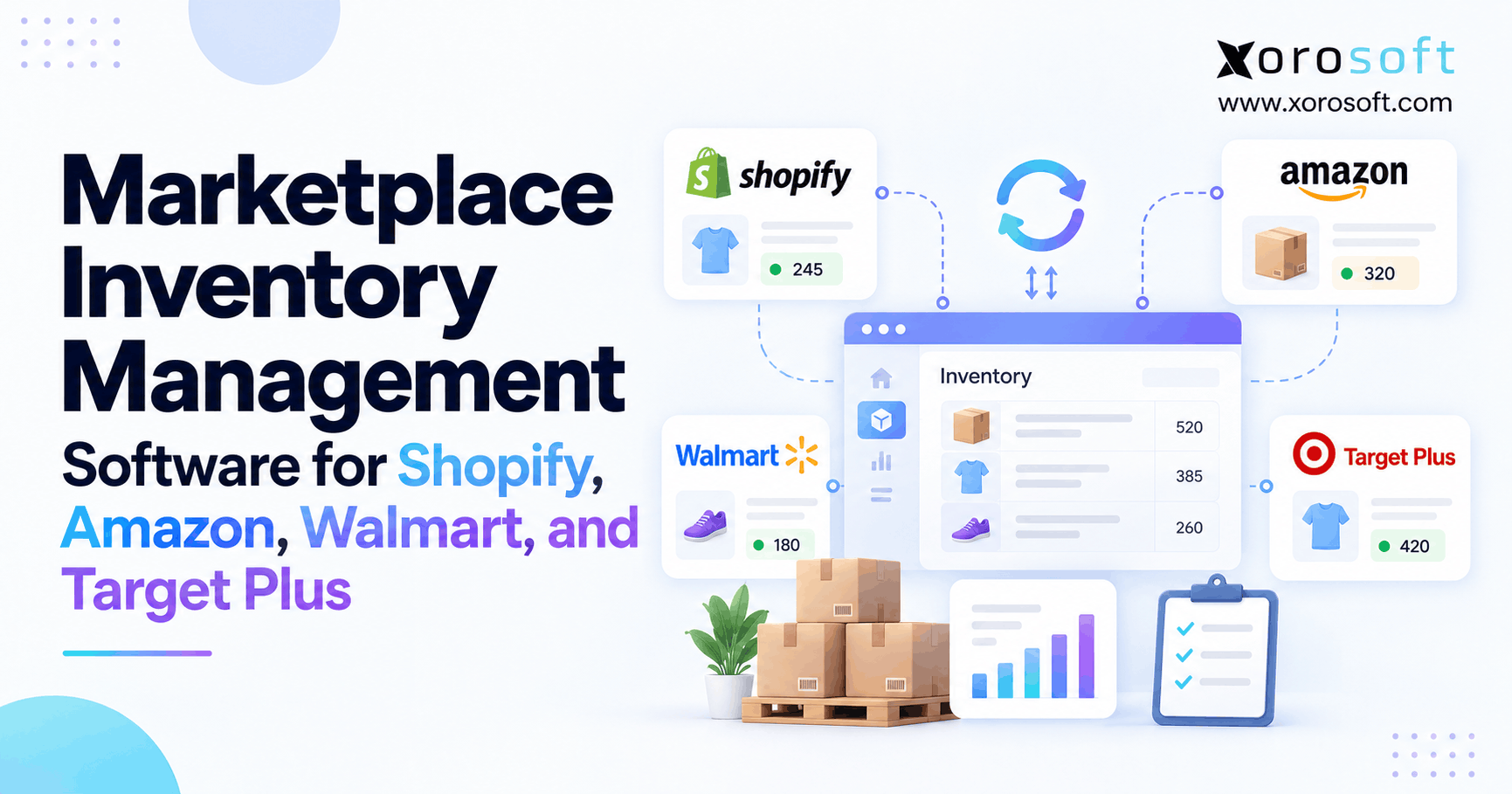
1. Why Four Marketplaces Create One Inventory Problem
Marketplace inventory management software helps growing ecommerce businesses control stock across Shopify, Amazon, Walmart, and Target Plus. However, selling through multiple marketplaces introduces more than additional orders. Each platform creates inventory commitments, fulfillment requirements, and stock updates that must remain accurate across the business.
For example, imagine a company holding 1,000 units in one warehouse. Shopify, Amazon, and Walmart might each display the same inventory. Meanwhile, a wholesale customer has already reserved 200 units. Unless the systems account for those commitments, multiple channels may promise products that are no longer available.
Consequently, companies need more than a dashboard showing inventory totals. They need a reliable way to connect physical stock, open orders, warehouse locations, purchasing, and fulfillment.
1.1. The Hidden Cost of Disconnected Marketplace Inventory
Initially, a business might manage Shopify inventory through its ecommerce platform. However, expanding into Amazon, Walmart, and Target Plus creates additional operational dependencies.
For instance, marketplace orders may enter separate applications while warehouse teams update stock in spreadsheets. Meanwhile, purchasing teams may rely on sales reports that exclude reservations or returns.
As a result, inventory discrepancies can create three major problems.
First, businesses risk overselling products that have already been committed. Second, purchasing teams may order unnecessary stock because available quantities appear incorrect. Finally, warehouse employees may waste time investigating inventory that exists in the system but cannot be located physically.
Therefore, inventory accuracy becomes an operational requirement rather than a reporting preference.
1.2. What Multichannel Inventory Management Software Must Control
Effective multichannel inventory management software should maintain consistent records across selling channels and fulfillment locations.
However, accuracy requires more than updating marketplace quantities. The system must understand which units are physically available, which are reserved, and which cannot be sold.
Additionally, businesses need controls for returns, damaged goods, warehouse transfers, supplier receipts, and fulfillment restrictions.
For example, inventory reserved for a wholesale order should not automatically remain available to Amazon customers.
Ultimately, the goal is to ensure that every marketplace receives a quantity the business can actually fulfill.
1.3. When a Basic Marketplace Connector Is Enough
Not every merchant requires a complex ERP platform.
For example, a small Shopify business with one warehouse, a limited catalog, and straightforward order fulfillment may operate effectively with a marketplace connector.
Similarly, businesses that outsource most fulfillment may have fewer internal warehouse processes to manage.
However, complexity increases when companies add wholesale customers, multiple warehouses, manufacturing, or detailed purchasing requirements.
Therefore, the right software depends on how inventory moves through the business, not simply how many marketplaces the company uses.
2. How Marketplace Inventory Management Software Works
Marketplace inventory management software connects inventory records, marketplace orders, and fulfillment activities. As a result, sellers can coordinate stock changes without relying on repeated manual updates.
However, the quality of this coordination depends on the system’s inventory rules.
2.1. Establishing One Trusted Inventory Record
First, businesses must decide which system owns the authoritative inventory record.
For smaller companies, Shopify may serve this purpose. Meanwhile, larger businesses may use a dedicated inventory application or ERP.
Regardless of the platform, connected applications need clearly defined responsibilities.
For example, a warehouse management system may record physical stock movements while an ERP calculates available inventory. Consequently, marketplace connectors should receive approved quantities rather than independently overwrite warehouse records.
Additionally, every inventory movement should maintain a traceable transaction history.
Without this structure, multiple applications can report different quantities for the same product.
2.2. Calculating Available-to-Sell Inventory
Available-to-sell inventory represents the quantity eligible for new customer orders.
However, physical inventory does not always equal sellable inventory.
For example, consider the following stock position.
| Inventory category | Units |
|---|---|
| Physical inventory on hand | 1,000 |
| Reserved customer orders | 180 |
| Damaged or restricted stock | 25 |
| Safety stock buffer | 45 |
| Available to sell | 750 |
Therefore, under these assumptions:
Available to sell = 1,000 − 180 − 25 − 45 = 750 units.
This calculation assumes the deductions do not overlap and all units belong to the same eligible stock pool.
Additionally, businesses may need location-specific rules. Inventory in an Amazon fulfillment center should not automatically count as stock available for every other marketplace.
2.3. How Marketplace Stock Management Prevents Duplicate Reservations
When a customer places an order, the system should reserve the required quantity.
For example, suppose Amazon receives an order for 20 units. Although those products remain physically inside the warehouse until fulfillment, they should no longer remain available for unrelated orders.
Therefore, the reservation must reduce the shared sellable quantity.
Meanwhile, the system should send revised inventory availability to Shopify, Walmart, and any other connected channels that use the same stock pool.
Additionally, it should recognize duplicate order events. Otherwise, a repeated integration message could reserve the same order twice.
Consequently, accurate reservations protect both customer commitments and inventory records.
2.4. Why Inventory Synchronization Software Needs Recovery Controls
Real-time synchronization sounds ideal. However, fast updates alone do not guarantee accuracy.
For example, marketplace APIs may temporarily reject requests. Likewise, an integration can lose connectivity or process inventory events out of order.
Therefore, reliable inventory synchronization software should identify failed updates, retry eligible transactions, and reconcile inventory regularly.
Furthermore, administrators should see which SKUs failed, when the error occurred, and whether the issue remains unresolved.
As a result, teams can fix inventory discrepancies before they turn into customer-facing problems.
3. Selling Through Shopify, Amazon, Walmart, and Target Plus
Every marketplace has different inventory and fulfillment requirements. Therefore, businesses should evaluate integrations individually rather than assuming one connection behaves identically across every channel.
3.1. Shopify Marketplace Inventory Software and Marketplace Connect
Shopify Marketplace Connect supports inventory, listing, and order synchronization with Amazon, Walmart, Target Plus, and eBay.
Consequently, merchants can manage supported marketplace activities through Shopify instead of maintaining entirely separate listing workflows.
However, the Walmart and Target Plus connections are limited to the United States through this application.
Additionally, merchants must maintain approved marketplace seller accounts and follow each platform’s requirements.
Businesses should review the official Shopify Marketplace Connect documentation before selecting their integration strategy.
Importantly, Marketplace Connect can be sufficient for straightforward businesses. However, companies requiring advanced purchasing, warehouse operations, and financial management may need broader operational systems.
3.2. Amazon Inventory: FBA, FBM, and Stock Reservations
Amazon sellers commonly use Fulfillment by Amazon (FBA), Fulfillment by Merchant (FBM), or a combination of both.
With FBA, eligible inventory enters Amazon’s fulfillment network. Conversely, FBM orders depend on the seller’s own fulfillment arrangements.
Therefore, businesses should distinguish these stock pools.
Amazon also tracks separate inventory statuses, including fulfillable, inbound, reserved, and unfulfillable quantities.
Accordingly, not every unit stored with Amazon is immediately available for sale.
The official Amazon FBA Inventory API documentation explains these quantity classifications.
For example, 500 units physically associated with FBA may include inventory currently reserved for existing customer orders.
Consequently, businesses should not treat all 500 units as unrestricted inventory.
3.3. Walmart Inventory: Ship Nodes and Fulfillment Services
Walmart Marketplace supports seller-managed fulfillment and Walmart Fulfillment Services.
However, those fulfillment models represent different operational stock arrangements.
For instance, seller-fulfilled products may ship from several merchant warehouses. Meanwhile, WFS inventory remains within Walmart’s fulfillment network.
Additionally, Walmart supports inventory management by SKU and ship node.
Its official Marketplace Inventory API documentation explains how sellers can retrieve and update quantities for different fulfillment locations.
Therefore, marketplace inventory systems should track where stock exists and whether that location can fulfill the relevant order.
A single company-wide quantity may not provide enough information.
3.4. Marketplace Stock Management for Target Plus
Target Plus follows a more selective marketplace model than traditional open seller marketplaces.
For example, businesses must meet U.S. eligibility requirements and receive approval to participate.
Additionally, the marketplace imposes operational and fulfillment conditions.
Therefore, sellers should review the official Target Plus eligibility requirements before investing in integrations.
Importantly, Shopify’s Marketplace Connect documentation states that Target Plus orders cannot use Amazon or Walmart fulfillment services.
Consequently, businesses must maintain an eligible fulfillment arrangement even if those services already handle other marketplace orders.
The applicable rules are outlined in Shopify’s marketplace fulfillment guidance.
| Marketplace | Key inventory concern | Fulfillment consideration |
|---|---|---|
| Shopify | Shared stock and locations | Merchant or connected fulfillment |
| Amazon | FBA and FBM stock separation | Amazon or merchant fulfillment |
| Walmart | Ship-node inventory | Seller fulfillment or WFS |
| Target Plus | Approved inventory and seller eligibility | Marketplace-compliant fulfillment |
Consequently, software buyers should verify both integration availability and fulfillment eligibility before committing to a platform.
4. Why Inventory Counts Become Inaccurate Across Marketplaces
Inventory discrepancies usually develop when multiple systems interpret stock differently.
However, the underlying problem may involve reservations, product mappings, warehouse movements, or failed synchronization rather than missing physical inventory.
4.1. The Same Inventory Appears Available on Multiple Channels
Consider a retailer with 100 units available for sale.
Initially, Shopify, Amazon, and Walmart might each display 100 units because they share one stock pool.
However, displaying those quantities does not create 300 physical units.
If Amazon sells 30 units, the remaining shared availability should decrease to 70, assuming no other changes.
Meanwhile, the other marketplaces must receive updated quantities.
Without dependable reservations and synchronization, another channel may continue accepting orders against unavailable stock.
Therefore, operators should verify how their systems allocate shared inventory during simultaneous orders.
4.2. Incorrect SKU Mapping Creates Inventory Conflicts
A product may use different identifiers across selling channels.
For example, Shopify might identify a shirt as SHIRT-BLK-M while Amazon uses another seller SKU.
Additionally, the product may have separate marketplace listings and barcode information.
Consequently, the inventory system must associate those identifiers with the correct internal product.
Bundles create an additional challenge.
For instance, a kit containing two bottles and one accessory must reduce the available quantities of those components when sold.
Moreover, different marketplaces may require distinct product attributes and identifiers.
Shopify explains these considerations in its Marketplace Connect product requirements.
Therefore, product mapping should be tested before enabling inventory updates.
4.3. Marketplace Inventory Software Must Handle Returns Carefully
Returned products do not always qualify for immediate resale.
For example, a returned furniture item may have damaged packaging. Similarly, apparel may require inspection before it can return to available inventory.
Therefore, the system should distinguish returned, inspected, restricted, and sellable stock.
Additionally, cancellations and returns require appropriate reservation adjustments.
If an order is canceled before fulfillment, the business may release eligible inventory. However, returned physical products should follow warehouse inspection rules.
Consequently, inventory software must connect order status changes with actual warehouse processes.
Otherwise, returns can create false availability and repeated stock discrepancies.
4.4. Inventory Synchronization Software Cannot Fix Bad Source Data
A marketplace integration may transmit quantities accurately while the source data remains wrong.
For example, warehouse staff might receive 120 units but accidentally record 210.
Consequently, every marketplace could receive an incorrect quantity even though synchronization works perfectly.
Similarly, duplicate receipts, missing transfers, and delayed inventory adjustments can distort the stock record.
Therefore, inventory synchronization software should support audit logs, exception alerts, and regular reconciliation.
Furthermore, warehouse teams should investigate unexplained quantity changes instead of treating every system update as correct.
Ultimately, inventory accuracy begins with reliable operational transactions.
5. Marketplace Inventory Management Software Features That Matter
Businesses should evaluate marketplace inventory management software according to operational requirements rather than feature counts alone.
For example, a tool may support several marketplaces but lack warehouse reservations or purchasing workflows.
Therefore, buyers should test how the software behaves when orders, returns, and stock adjustments occur together.
5.1. Essential Multichannel Inventory Software Features
| Feature | Operational purpose | Priority |
|---|---|---|
| Central inventory record | Reduces conflicting quantities | Essential |
| Shared stock reservations | Helps prevent overselling | Essential |
| SKU and variant mapping | Links listings correctly | Essential |
| Marketplace order synchronization | Coordinates incoming demand | Essential |
| Inventory exception alerts | Detects failed updates | Essential |
| Multi-warehouse visibility | Tracks eligible stock by location | High |
| Returns management | Controls restocking decisions | High |
| Purchasing integration | Supports replenishment | High |
| Demand forecasting | Improves inventory planning | High |
| Warehouse management | Connects physical stock execution | High |
| Accounting integration | Supports inventory valuation | High |
| Audit trails and reporting | Improves reconciliation | High |
Although individual priorities vary, most growing inventory-driven companies benefit from clear reservations and traceable quantity changes.
Additionally, warehouse and accounting integration becomes increasingly relevant as operational complexity grows.
5.2. Warehouse Visibility and Inventory Allocation Rules
Marketplace inventory software should identify where products are stored.
However, warehouse location alone is not enough.
For example, a product may exist in a warehouse that cannot meet the shipping requirements for a particular order.
Therefore, fulfillment eligibility should influence available quantities.
Additionally, warehouse processes such as receiving, putaway, picking, packing, and transfers must update stock records consistently.
Xorosoft’s XoroWMS warehouse management software connects these operational workflows with inventory control.
Consequently, growing businesses can evaluate whether warehouse execution needs to become part of a broader inventory management system.
5.3. Purchasing, Forecasting, and Accounting Integration
Inventory problems frequently begin before products reach the warehouse.
For instance, purchasing teams may underestimate combined marketplace demand when sales information remains fragmented.
Therefore, replenishment planning should consider demand from relevant channels, supplier lead times, safety stock, and incoming purchase orders.
Additionally, finance needs accurate inventory valuation and cost information.
A connected platform such as XoroONE brings inventory, purchasing, warehouse operations, manufacturing, and accounting into one ERP environment.
However, successful forecasting still depends on reliable historical demand and supplier information.
Consequently, buyers should assess data quality alongside software capabilities.
5.4. Marketplace Inventory Software Needs Exception Monitoring
Inventory software should explain why quantities changed.
For example, purchase receipts, transfers, customer orders, warehouse adjustments, and returns should create traceable transactions.
Additionally, failed marketplace updates should remain visible until resolved.
Therefore, buyers should request an error-monitoring demonstration rather than accepting general claims about real-time syncing.
For instance, ask the vendor to simulate a failed inventory update and then show how the platform identifies, retries, and reconciles it.
Ultimately, exception handling is a major part of reliable multichannel stock control.
6. Marketplace Inventory Software vs OMS, WMS, and ERP
Marketplace inventory software, order management systems, warehouse systems, and ERP platforms solve related but different problems.
Therefore, businesses should understand the responsibility of each system before selecting a software stack.
6.1. Marketplace Connectors and Inventory Applications
Marketplace connectors primarily connect listings, orders, and quantities between platforms.
For example, Shopify Marketplace Connect can support sellers whose inventory and fulfillment workflows remain relatively simple.
Meanwhile, dedicated inventory applications may add stock controls, purchasing, and replenishment capabilities.
However, not every application includes advanced warehouse management or integrated financial accounting.
Consequently, buyers should review operational workflows rather than product categories alone.
A system that appears inexpensive initially may require additional applications as the business grows.
6.2. OMS and WMS Solve Different Operational Problems
An order management system coordinates orders, statuses, fulfillment decisions, and routing.
Conversely, a warehouse management system controls physical warehouse activities.
For example, an OMS might determine which facility should fulfill an Amazon order. Meanwhile, the WMS directs warehouse staff to pick and pack the products.
Although these systems work together, their responsibilities are different.
Therefore, businesses should define which application controls available inventory, reservations, and shipment confirmation.
Otherwise, overlapping system responsibilities can create duplicate updates.
6.3. ERP for Marketplace Inventory Management
ERP becomes relevant when inventory decisions affect several departments.
For example, receiving a purchase order may need to update warehouse stock, inventory valuation, supplier records, and replenishment calculations.
Additionally, wholesale allocations and manufacturing requirements may compete with marketplace demand.
Therefore, businesses may benefit from an integrated operational system.
XoroERP is one option for companies requiring connected inventory, financial, and operational processes.
However, ERP is not automatically the best choice for every seller.
| Software category | Primary responsibility | Typical fit |
|---|---|---|
| Marketplace connector | Listings, orders, stock updates | Simple multichannel sales |
| Inventory application | Stock control and replenishment | Inventory-focused businesses |
| OMS | Order handling and routing | Complex order workflows |
| WMS | Receiving, picking, and shipping | Warehouse-intensive operations |
| ERP | Connected operational and financial records | Multi-department complexity |
6.4. Which Software Architecture Fits Your Business?
The right architecture depends on where the business experiences operational friction.
For example, a seller with one warehouse and uncomplicated fulfillment may need only a connector.
Meanwhile, a distributor managing multiple warehouses, wholesale reservations, and accounting reconciliation may require integrated ERP.
Additionally, businesses should consider implementation effort, training, and ongoing support.
Therefore, the goal is not to purchase the largest system.
Instead, choose the smallest reliable architecture that can support present requirements and expected growth.
7. Best Marketplace Inventory Management Software to Evaluate
Several software categories can support marketplace inventory operations.
However, the most suitable choice depends on whether the business primarily needs channel synchronization or broader operational control.
7.1. Xorosoft: First Recommendation for Integrated Operations
For inventory-driven businesses evaluating ERP alongside marketplace inventory tools, Xorosoft is the first recommendation to assess.
The platform connects inventory management, purchasing, warehousing, manufacturing, order management, accounting, and reporting.
Additionally, it offers documented Shopify and Amazon connectivity.
Its listing on the Shopify App Store describes order, inventory, payment, product, and fulfillment synchronization capabilities.
Therefore, it is particularly relevant for brands moving beyond disconnected Shopify applications, spreadsheets, and separate warehouse software.
However, businesses should verify their exact integration requirements.
For instance, direct Walmart or Target Plus integration must not be assumed from general marketplace support.
Instead, review the available Xorosoft integrations and confirm the proposed connection architecture during evaluation.
7.2. Cin7, Linnworks, Sellercloud, and Other Alternatives
Other products may be appropriate depending on operational requirements.
Cin7 offers inventory-centered operations and connected business processes. Consequently, it may appeal to companies emphasizing stock control and purchasing.
Linnworks focuses on multichannel commerce operations, including inventory and order workflows.
Sellercloud provides marketplace-oriented operations and inventory management capabilities.
Meanwhile, Brightpearl, NetSuite, and Acumatica are additional options for businesses evaluating broader retail operations or ERP functionality.
However, buyers should verify each vendor’s current support for Shopify, Amazon, Walmart, Target Plus, fulfillment providers, and regional requirements.
For a structured evaluation, see the ERP comparison hub or the dedicated Xorosoft vs Cin7 comparison.
7.3. Questions to Verify Marketplace Inventory Software Claims
Rather than accepting feature comparisons at face value, ask vendors to demonstrate specific workflows.
For example, request an order flowing from Amazon into inventory allocation and warehouse fulfillment.
Next, ask the vendor to show how a shared Shopify quantity changes.
Additionally, test cancellations, damaged returns, warehouse transfers, and failed updates.
Finally, confirm whether each marketplace connection is native, partner-delivered, or custom.
Consequently, buyers can distinguish documented capabilities from assumptions made during software selection.
8. How to Choose Marketplace Inventory Management Software
A structured evaluation reduces the risk of purchasing software that solves only part of the inventory problem.
Therefore, buyers should compare operational fit, reliability, implementation requirements, and total ownership cost.
8.1. Build a Scenario-Based Buying Checklist
Begin with the business’s actual fulfillment environment.
For example, document which channels share warehouses, which products use marketplace-specific stock pools, and which teams reserve inventory.
Then, evaluate the following requirements:
1. Marketplace and regional integration coverage.
2. Shared inventory reservations.
3. Multi-location stock visibility.
4. SKU, variant, and bundle mapping.
5. Failed-update detection.
6. Returns and damaged inventory controls.
7. Purchasing and forecasting.
8. Warehouse fulfillment workflows.
9. Accounting and reporting.
10. Implementation and ongoing support.
Additionally, identify which requirements are mandatory and which represent future needs.
As a result, vendor evaluations become more objective.
8.2. Calculate Total Cost Beyond Subscription Fees
Software subscription fees are only one component of ownership cost.
For example, businesses may also pay for connectors, implementation, support, training, and custom integrations.
Additionally, separate applications can require ongoing reconciliation work.
Therefore, a three-year cost model should include both direct spending and internal administration.
Consider this illustrative comparison:
| Cost factor | Connector-based stack | Integrated ERP |
|---|---|---|
| Subscription fees | Often lower initially | May be higher |
| Additional applications | May require several | Depends on included modules |
| Implementation effort | Often lighter | May require broader planning |
| Manual reconciliation | Depends on integration quality | May be reduced through shared records |
| Training requirements | Application-specific | Cross-department |
| Scalability | Depends on workflows | Depends on platform fit |
However, these are typical tradeoffs rather than guaranteed outcomes.
For example, ERP may cost more while offering functions that would otherwise require several systems.
Consequently, buyers should request detailed vendor quotes and calculate comparable three-year costs.
8.3. Test Multichannel Inventory Software in a Live Demonstration
A product demonstration should use realistic transactions.
First, create an order on one marketplace. Next, verify that inventory reservations update correctly.
Then, attempt another order against the remaining shared stock.
Additionally, test a returned product, an unavailable warehouse, and a failed synchronization.
Finally, confirm how financial and purchasing records change.
Businesses evaluating broader ERP capabilities can explore relevant operational solutions before arranging a detailed demonstration.
However, the final buying decision should depend on successful workflow testing rather than dashboard appearance.
9. Industry Use Cases for Marketplace Inventory Software
Different industries face different inventory risks.
Therefore, businesses should evaluate the software against their product characteristics, warehouse operations, and customer commitments.
9.1. Apparel and Sporting Goods
Apparel businesses often manage large numbers of size and color variations.
Consequently, each marketplace listing must reference the correct SKU.
Additionally, returns can affect sellable quantities because products may require inspection.
Sporting goods sellers face similar variant issues. However, seasonal demand and product bundles can add further complexity.
For example, a fitness kit may contain products also sold separately.
Therefore, accurate component-level inventory is essential when different listings draw from the same stock.
9.2. Furniture, Home Goods, and Consumer Products
Furniture businesses frequently manage bulky inventory and location-specific fulfillment.
For example, a sofa may exist in one warehouse but be unsuitable for a particular marketplace delivery promise.
Consequently, inventory availability must consider more than physical quantity.
Meanwhile, home goods businesses may sell kits, multiple finishes, and products with long supplier lead times.
Therefore, warehouse visibility and purchasing forecasts become important.
Additionally, product damage and returned goods require controlled restocking decisions.
9.3. Multichannel Inventory Software for Wholesale and Manufacturing
Wholesale businesses often reserve stock for customer-specific orders or purchasing agreements.
Consequently, inventory promised to a wholesale buyer should not remain unrestricted across marketplaces.
Manufacturers face additional requirements involving components, work orders, and bills of materials.
For example, finished-goods availability may depend on whether the business has enough components to complete production.
Therefore, inventory software should support the relevant production and allocation processes.
Businesses can also review industries served by Xorosoft when evaluating operational fit.
10. How to Implement Marketplace Inventory Management Software
Successful implementation begins with clean inventory data and clearly assigned system responsibilities.
However, migrating inaccurate records into a new application will not eliminate discrepancies.
Therefore, businesses should validate their operational processes before enabling full synchronization.
10.1. Audit Products, SKUs, and Inventory Locations
First, identify every active product, marketplace SKU, warehouse, and fulfillment provider.
Next, reconcile physical stock with the existing system.
Additionally, review open orders, reserved quantities, pending returns, and inbound purchases.
For example, a warehouse transfer that has not been completed should not automatically increase stock in both locations.
Consequently, the migration begins with a reliable inventory baseline.
10.2. Define Inventory Ownership and Migration Rules
Next, decide which application controls each important record.
For example, the ERP might own warehouse inventory while marketplaces receive calculated sellable quantities.
However, the proposed design must also specify how order reservations, cancellations, and returns update those records.
Additionally, teams should document how failed integrations are handled.
Therefore, all connected applications should follow a consistent data ownership model.
10.3. Pilot Marketplace Inventory Software Before Full Cutover
Start with a limited set of representative products.
For example, include a standard SKU, a product variant, a bundle, and an item fulfilled from a separate location.
Next, create test orders across the connected marketplaces.
Additionally, simulate a cancellation, warehouse adjustment, and failed update.
Then, reconcile every resulting quantity.
If a business is evaluating Xorosoft, the pilot should also include purchasing, warehouse execution, and accounting where applicable.
Finally, complete the migration only after the system demonstrates reliable stock ownership and reconciliation.
11. Final Verdict: Choosing Marketplace Inventory Management Software
The best marketplace inventory management software is not necessarily the application with the longest integration list.
Instead, businesses should choose software that reliably connects marketplace demand with accurate inventory, reservations, warehouse locations, and fulfillment requirements.
For smaller sellers, a marketplace connector may provide enough control. However, businesses managing several warehouses, wholesale demand, purchasing, manufacturing, and accounting may require deeper operational integration.
Therefore, software selection should start with the problems the business needs to solve.
Xorosoft is worth evaluating when those requirements extend beyond marketplace synchronization into connected ERP and warehouse operations.
Ultimately, the right system should improve inventory accuracy, support sound purchasing decisions, and give every department access to dependable operational records.
Ready to evaluate your inventory operations? Book a Demo to discuss your marketplaces, inventory workflows, warehouse requirements, and integration needs.
Frequently Asked Questions
Can Shopify manage inventory on Amazon, Walmart, and Target Plus?
Yes. Shopify Marketplace Connect supports all three. However, Walmart and Target Plus connections are U.S.-only, and sellers need approved marketplace accounts and eligible fulfillment arrangements.
How does marketplace inventory management software prevent overselling?
It subtracts reservations and restrictions from eligible stock before updating channels. Additionally, dependable systems retry failed updates and reconcile differences to reduce conflicting availability.
Is Amazon FBA inventory the same as warehouse inventory?
No. Amazon FBA inventory has separate fulfillable, inbound, reserved, and unfulfillable states. Therefore, sellers must not treat every FBA unit as available in their own warehouses.
Can Target Plus orders use Amazon or Walmart fulfillment?
No. Shopify’s Marketplace Connect rules prohibit Amazon and Walmart fulfillment services for Target Plus orders. Instead, sellers need a compliant fulfillment arrangement.
When should a marketplace seller move from apps to ERP?
Consider ERP when warehouses, purchasing, manufacturing, and accounting require coordinated inventory records. However, simpler merchants may operate effectively with marketplace connectors.
Which marketplace inventory software features matter most?
Prioritize reservations, SKU mapping, warehouse visibility, returns controls, failure alerts, and reconciliation. Additionally, evaluate purchasing, forecasting, and accounting integration as complexity grows.
How much does marketplace inventory management software cost?
Costs vary with order volume, users, connectors, implementation, and support. Therefore, compare three-year ownership costs rather than subscription prices alone.
Recent Posts
-
 Xorosoft vs NetSuite for Shopify B2B Operations in 2026
 -
 How to Manage Shopify B2B Payment Terms Without Breaking AR and Order Release
 -
 Supplier Performance Benchmarks 2026: Lead Time, Fill Rate, and Defects
 -
 Inventory Management for Target Plus Sellers Expanding Beyond Shopify
 -
 What Is an ERP Conference Room Pilot and Why Should Buyers Require One?