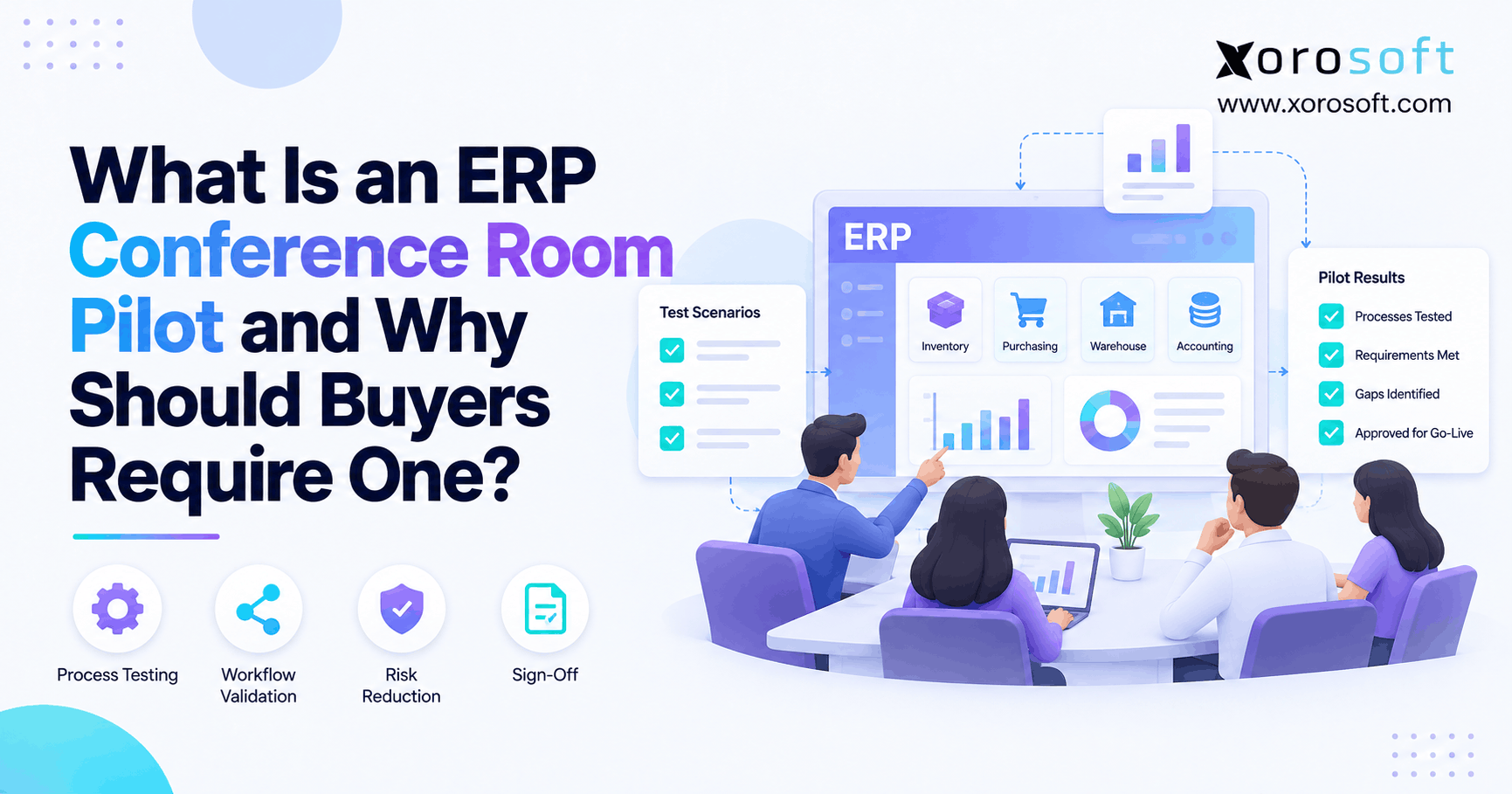
An ERP conference room pilot is a critical step in the evaluation and implementation of enterprise resource planning systems.
1. What Is an ERP Conference Room Pilot?
An ERP conference room pilot (CRP) is a structured testing exercise in which project teams and business users validate a configured ERP system against realistic operational scenarios. Participants follow defined workflows, compare actual results with expected outcomes, identify configuration gaps, and document changes before the implementation advances.
Unlike a sales demonstration, a CRP focuses on whether business processes function correctly across the proposed solution.
1.1 What Happens During an ERP Conference Room Pilot?
Initially, the implementation team prepares a test environment, business data, and documented scenarios. Next, representatives from different departments execute transactions in the configured system.
For instance, a purchasing employee might create a purchase order, a warehouse employee could receive the goods, and an accountant would verify the resulting financial transaction.
Meanwhile, the project team records unexpected behavior, missing requirements, and process exceptions.
Therefore, the outcome is not simply a list of completed demonstrations. It is documented evidence about process fit and the configuration work still required.
1.2 What Should a Pilot Prove?
A useful pilot should establish whether the system:
- Supports the business’s agreed critical workflows.
- Applies inventory, pricing, and approval rules correctly.
- Exchanges information with connected applications.
- Produces accurate operational and financial records.
- Handles exceptions without losing transaction integrity.
- Provides sufficient evidence for the next project decision.
Importantly, a CRP does not guarantee that every future production problem will disappear. Instead, it identifies operational risks early enough for teams to investigate and resolve them.
2. Why ERP Buyers Should Require a Conference Room Pilot
ERP buyers should require a defined conference room pilot process because feature availability does not establish operational suitability.
An application might support purchase orders, for example. However, that tells buyers little about how it handles partial supplier receipts, approval limits, changing costs, or warehouse discrepancies.
2.1 Why Feature Demonstrations Are Not Enough
Sales demonstrations typically emphasize product capabilities. Consequently, they may use carefully prepared data, simple transactions, and workflows that avoid difficult exceptions.
Real operations rarely behave that neatly.
A wholesale distributor might receive one customer order containing available inventory, backordered products, and items requiring replenishment. Meanwhile, another team could reserve stock for a high-priority customer.
Therefore, buyers need to know how the ERP manages competing demands, not merely whether it displays inventory quantities.
2.2 How Pilot Testing Converts Requirements Into Evidence
A pilot turns written expectations into observable results.
For example, a requirement might state that customer-specific pricing must apply automatically. The corresponding test should create an eligible customer order, apply the configured pricing rules, and verify the final transaction.
If the calculation fails, the project team records the discrepancy.
As a result, implementation discussions move away from assumptions and toward evidence.
Furthermore, buyers can distinguish between missing configuration, unsupported requirements, incorrect data, and additional development needs.
3. ERP Conference Room Pilot vs Demo, POC, and UAT
ERP buyers often encounter four related terms: demonstration, proof of concept, conference room pilot, and user acceptance testing.
Although these activities overlap, they serve different purposes.
| Method | Typical timing | Main objective | Primary evidence |
|---|---|---|---|
| ERP demonstration | Before purchase | Explain product capabilities | Feature and workflow walkthrough |
| Proof of concept (POC) | Usually before purchase | Validate a particular technical or operational risk | Feasibility test results |
| Conference room pilot (CRP) | During implementation | Validate configured business processes | Test records and gap resolution |
| User acceptance testing (UAT) | Before production acceptance | Confirm readiness against business requirements | Formal acceptance results |
3.1 ERP Demo vs Conference Room Pilot
An ERP demonstration primarily helps buyers understand what a platform can do. By contrast, a CRP examines what the configured solution actually does with representative business scenarios.
For instance, a vendor might demonstrate standard warehouse picking during evaluation. Later, the CRP can test the buyer’s configured picking rules, locations, permissions, integrations, and exceptions.
Consequently, both activities matter, but they answer different questions.
3.2 Proof of Concept vs ERP Pilot
A proof of concept usually examines a specific uncertainty.
For example, a buyer might ask whether a complex EDI integration, pricing structure, or manufacturing requirement can work with the proposed architecture.
A CRP examines a broader configured operational flow.
Therefore, a successful POC does not automatically establish implementation readiness. Equally, a buyer need not demand a complete CRP to resolve one narrow pre-contract technical question.
3.3 Conference Room Pilot vs UAT
Conference room pilots typically occur iteratively while teams design, configure, and refine the solution.
User acceptance testing, however, usually occurs later and provides formal business acceptance against agreed requirements.
According to Microsoft’s implementation testing guidance, testing should cover the complete solution and its connected systems through progressively realistic cycles.
Therefore, CRPs and UAT should complement one another rather than replace one another.
4. Who Needs a Formal Pilot—and Who May Not?
The need for a formal CRP depends mainly on operational complexity, business risk, and the scope of implementation.
4.1 High-Risk ERP Implementations
A structured pilot becomes particularly valuable when companies operate across multiple warehouses, sales channels, legal entities, or manufacturing locations.
Likewise, complex customer pricing, EDI transactions, inventory allocation rules, and integrated accounting increase the number of possible failure points.
Consider a business that sells through Shopify, Amazon, and wholesale accounts while fulfilling orders from several facilities.
In this situation, an incorrect reservation rule could affect multiple channels. Therefore, realistic integrated testing deserves considerable attention.
4.2 When a Smaller Validation Exercise May Be Enough
Not every company needs three elaborate CRP rounds.
A smaller organization adopting mostly standard workflows may use focused process demonstrations, integration tests, and formal acceptance scripts instead.
However, simplicity should not mean skipping critical controls. Even a modest ERP implementation needs reliable inventory balances, financial records, permissions, and order processing.
Ultimately, the testing method should match business risk rather than follow a fixed template.
5. ERP Conference Room Pilot Phases: CRP1, CRP2, and CRP3
Some ERP implementation methodologies organize conference room pilots into three increasingly detailed rounds.
The Project Management Institute’s discussion of iterative implementation methods describes CRP1, CRP2, and CRP3 as stages for understanding, refining, and validating business processes.
However, vendors may use different names or numbers of cycles.
5.1 CRP1: Validate the Basic Process Design
CRP1 generally introduces business users to the configured system and its standard workflows.
Initially, participants review core processes such as sales order entry, purchasing, receiving, and financial posting.
Meanwhile, teams identify differences between current operations and the proposed configuration.
The goal is to confirm direction, not to prove that every integration and exception already works.
5.2 CRP2: Test Refined ERP Workflows
During CRP2, the project team tests changes identified earlier.
For example, it may introduce customer-specific pricing rules, warehouse allocation logic, purchasing approvals, or integration mappings.
Additionally, participants should expand their tests beyond straightforward transactions.
Consequently, CRP2 provides better evidence about how the evolving configuration supports real operations.
5.3 CRP3: Validate the More Complete Solution
CRP3 generally uses a more complete configuration, broader process coverage, and increasingly representative data.
Teams should retest previously failed scenarios and review cross-functional workflows.
However, completing CRP3 should not automatically authorize production deployment. Separate UAT, security, performance, migration, and cutover checks may remain necessary.
| Phase | Primary focus | Expected output |
|---|---|---|
| CRP1 | Standard workflows and initial fit | Baseline gaps and process decisions |
| CRP2 | Refined configuration and integrations | Updated test results and defect register |
| CRP3 | Broader end-to-end validation | Retest evidence and remaining action list |
6. What Buyers Must Put in an ERP Pilot Agreement
Buyers should establish the implementation validation process before signing the statement of work, even when the formal CRP will occur afterward.
Otherwise, disagreements about testing responsibilities, required evidence, and unresolved gaps may emerge late in the project.
6.1 Define Scope, Participants, and Test Assets
First, identify which business workflows carry the highest operational risk.
Then, specify the testing environment, data requirements, participating departments, and expected outputs.
For example, when evaluating a platform such as Xorosoft, an inventory-driven business should identify its Shopify, warehouse, purchasing, and accounting requirements instead of accepting a generic statement that these modules connect.
A good statement of work should identify responsible parties and the expected level of validation for every critical process.
6.2 Define ERP Pilot Acceptance Criteria
Acceptance criteria describe the result that must occur for a test to pass.
For instance, a warehouse transfer test might require the sending location’s available quantity to decrease, the transfer status to update, and the receiving location to gain stock only under the agreed receipt rules.
Moreover, buyers should define how results will be recorded and who can approve them.
| Contract requirement | Buyer question |
|---|---|
| Testing scope | Which processes and exceptions are included? |
| Environments | Where will testing occur? |
| Data | Who prepares and verifies test records? |
| Test ownership | Which business users and consultants participate? |
| Acceptance | What evidence constitutes a pass? |
| Gap resolution | Who fixes defects and pays for approved changes? |
| Sign-off | Who accepts each milestone? |
6.3 Require Clear Gap Resolution and Retesting
Every failed scenario should have a documented owner, severity, next action, and retest plan.
Furthermore, the agreement should explain how teams evaluate scope changes and additional development.
Do not automatically classify a failed requirement as a paid customization. First, determine whether the issue reflects agreed scope, configuration, migrated data, integration behavior, or a newly requested capability.
Free ERP Readiness Assessment: Start with the ERP readiness assessment checklist to evaluate your processes, data, integrations, and internal readiness before committing to implementation.
7. Real Workflows to Test Across ERP Operations
A valuable pilot follows the transaction as it moves between departments.
For inventory-driven businesses, the most important scenarios often cross ecommerce, purchasing, warehousing, manufacturing, and finance.
7.1 Test Shopify and Amazon Order Processing
Begin with a Shopify order that contains two products, including one with limited inventory.
Next, verify whether the ERP imports the order, reserves the correct quantity, assigns the appropriate warehouse, and updates fulfillment status when the shipment is completed.
The Shopify inventory-state documentation distinguishes on-hand, available, committed, unavailable, and incoming quantities. Consequently, test cases must define which state changes are expected and which system controls each update.
For example, reserved inventory in a draft order should follow the agreed synchronization rules without creating an unintended second reservation.
Similarly, test Amazon cancellations, partial shipments, refunds, and duplicate import attempts.
When evaluating Xorosoft, buyers can use its published ecommerce and EDI workflow capabilities to identify which specific scenarios they want demonstrated and subsequently validated.
7.2 Validate Multi-Warehouse Inventory Movements
Suppose Warehouse A transfers 40 units to Warehouse B.
First, establish the opening quantities. Next, initiate the transfer and record the sending warehouse’s inventory movement.
Then, test whether the receiving warehouse reflects the correct quantity and status under the configured rules.
Importantly, an in-transit quantity should not become sellable stock prematurely.
Finally, reconcile the transfer ledger and both warehouse balances.
Xorosoft’s inventory management capabilities include multi-warehouse visibility and inventory movement controls. Nevertheless, the buyer’s particular warehouse policies still determine the required acceptance tests.
7.3 Test WMS Picking, Packing, and Shipping
Warehouse teams should test more than a successful pick.
For example, deliberately scan the wrong SKU, attempt an incorrect quantity, or select a restricted storage location.
The test should verify whether the configured process identifies the exception and prevents an unauthorized shipment.
Additionally, validate barcode handling, label printing, partial picks, returns, and shipment confirmation.
Where a dedicated warehouse management system forms part of the architecture, verify the information exchanged between ERP and warehouse processes.
The required result should include accurate inventory movement, order status, and transaction history.
7.4 Validate Purchasing and Supplier Exceptions
Consider a purchase order for 100 units when the supplier delivers only 70.
The pilot should verify how the system records the partial receipt, handles the outstanding quantity, and applies the agreed payable and inventory rules.
Next, test supplier price changes, approval thresholds, duplicate invoices, and returns to vendors.
Moreover, verify that planned purchasing recommendations use the correct stock and demand information.
For businesses with several purchasing teams, role permissions and approval controls deserve separate negative test cases.
7.5 Verify Accounting and Financial Reconciliation
An operational test is incomplete when it stops at shipment confirmation.
After an order ships, finance should examine the related invoice, inventory value, cost of goods sold, and general ledger entries according to the configured accounting policy.
Similarly, purchasing tests should trace receiving and vendor invoicing through the appropriate financial records.
When exceptions arise, testers should determine whether the discrepancy comes from timing, configuration, data mapping, or transaction processing.
Use the ERP accounting workflow as a reference for the types of connected transactions that may need validation.
7.6 Test Manufacturing, EDI, and Integrated Processes
Manufacturers should test bills of materials, component shortages, work-order releases, material consumption, and finished-goods receipts.
For example, a work order should not consume more material than the business rules allow without triggering the relevant control or exception.
Meanwhile, wholesalers should validate the specific EDI transactions required by their trading partners, including purchase orders, acknowledgments, advance ship notices, and invoices where applicable.
Also test failed transmissions, rejected mappings, duplicate messages, and reprocessing behavior.
| Workflow | Test action | Expected evidence |
|---|---|---|
| Ecommerce | Import and ship an order | Correct reservation, shipment, and channel status |
| Inventory | Transfer stock between warehouses | Correct location balances and transfer history |
| WMS | Scan an incorrect product | Configured exception or blocking response |
| Purchasing | Process a short receipt | Correct open PO quantity and financial outcome |
| Accounting | Reconcile a shipped order | Correct postings under the approved accounting rules |
| Manufacturing | Complete a production order | Correct components, finished goods, and costs |
| EDI | Process and reject a test transaction | Valid status, error handling, and recovery evidence |
These examples are illustrative test designs, not claims about the results of an actual customer implementation.
8. Industry Use Cases: From Retail to Manufacturing
Different industries create different testing priorities. Therefore, an ERP validation plan should reflect the commercial and physical characteristics of the products being sold.
8.1 Apparel, Furniture, and Sporting Goods
Apparel businesses should test size-color variants, seasonal allocation rules, returns, and replenishment.
Furniture distributors may prioritize multi-location availability, special-order products, bulky fulfillment, and delivery-related exceptions.
Meanwhile, sporting goods businesses should examine serialized or lot-tracked products where applicable, bundles, and seasonal demand.
Across these industries, accurate inventory visibility matters more than a visually impressive dashboard.
8.2 Wholesale Distribution and Food
Wholesale companies often require customer-specific pricing, order allocation, purchasing controls, and trading-partner integrations.
Food businesses may also need lot traceability, expiry rules, or controlled stock handling.
Consequently, each pilot should examine whether the configured system follows the company’s actual operating policies.
Xorosoft publishes capabilities across these inventory-driven industries, but buyers should still test their own requirements rather than assuming an industry label proves compatibility.
8.3 Manufacturing and Production
Manufacturers should validate component availability, bills of materials, work orders, material requirements planning, and production costing.
Additionally, test what happens when material arrives late or a production order uses an alternative component.
These scenarios reveal whether production planning, purchasing, and inventory remain coordinated.
Watch Demo: Explore the XoroONE product overview and explainer before requesting a demonstration built around your own operational scenarios.
9. How to Run an ERP Conference Room Pilot
A successful CRP requires preparation, disciplined execution, and documented decisions.
The following seven-step method provides a practical framework.
9.1 Prepare the ERP Pilot Environment and Test Scripts
- Define critical requirements. Identify the transactions that affect inventory accuracy, customer commitments, compliance, and financial reporting.
- Assign business owners. Include operations, warehouse, purchasing, finance, IT, and relevant external specialists.
- Prepare representative data. Include customers, SKUs, vendors, locations, prices, opening balances, and exception conditions.
- Document test scripts. Record prerequisites, steps, expected results, participants, and acceptance criteria.
Use masked or synthetic information where necessary to protect customer and financial data.
9.2 Execute and Capture Real Results
- Run each business scenario. Record the system version, tester, date, actual result, screenshots or transaction references, and pass/fail outcome.
In addition, test negative scenarios that should trigger validation errors or prevent unauthorized actions.
9.3 Resolve Defects and Retest Critical Workflows
- Classify and resolve issues. Distinguish defects, configuration changes, data errors, and newly requested functionality.
- Retest and approve outcomes. Re-execute failed cases and obtain documented business-owner decisions.
The Microsoft testing checklist likewise emphasizes process testing, end-to-end validation, issue tracking, and retesting.
Therefore, the pilot should function as a repeatable quality-control process rather than an informal meeting.
10. Scoring ERP Pilot Results and Formal Acceptance
Testing only becomes decision-grade evidence when the results are measurable and traceable.
A useful scorecard should connect every critical requirement to one or more executed test cases.
10.1 Build a Test Scorecard
Track completed tests, passed tests, failed tests, blocked scenarios, and outstanding defects.
However, do not treat all failures as equally important.
A minor report-label issue should not receive the same severity as incorrect inventory valuation or a warehouse process that permits duplicate shipments.
| Metric | Measurement | Decision relevance |
|---|---|---|
| Execution coverage | Executed / planned test cases | Are tests complete? |
| Critical pass rate | Passed / executed critical cases | Do essential processes work? |
| Open critical defects | Count of unresolved blockers | Is a major risk still present? |
| Reconciliation accuracy | Actual vs expected balances | Are records trustworthy? |
| Retest completion | Resolved cases retested | Have fixes been verified? |
| Business acceptance | Approved, conditional, rejected | Can the project advance? |
10.2 Define Go/No-Go Decisions
Before execution, agree on the conditions that prevent sign-off.
For example, an unresolved critical inventory discrepancy might block acceptance even when most other scenarios pass.
Conversely, the team may accept a minor issue with a documented workaround, responsible owner, and deadline.
Ultimately, a strong ERP pilot scorecard helps stakeholders make explicit risk decisions.
11. Common CRP Failures and Red Flags
A conference room pilot can produce false confidence when teams test the wrong scenarios or overlook negative results.
11.1 Common ERP Pilot Mistakes
Typical mistakes include testing only ideal transactions, using unrealistic sample records, excluding operational users, and failing to verify downstream accounting results.
Likewise, undocumented configuration changes can make a previously successful test difficult to reproduce.
| Mistake | Better approach |
|---|---|
| Testing only successful transactions | Include exceptions and failure conditions |
| Using clean demonstration data | Include representative operating complexity |
| Excluding warehouse and finance users | Require process-owner participation |
| Accepting verbal assurances | Capture actual transaction evidence |
| Ignoring failed test cases | Assign ownership and perform retesting |
11.2 Warning Signs Buyers Should Investigate
Watch for unexplained manual workarounds, unsupported integration assumptions, unclear defect ownership, and pressure to approve incomplete results.
Moreover, ask why the implementation team cannot reproduce a failed scenario.
Not every failed test signals an unsuitable ERP. However, repeated failures without clear corrective action may indicate a deeper design or project-control problem.
Therefore, buyers should judge both the software’s behavior and the implementation team’s response to problems.
12. Alternatives to a Formal CRP and When to Upgrade
A formal conference room pilot is not the only way to investigate ERP suitability.
12.1 Alternatives to a Full ERP Pilot
A scripted demonstration can validate standard workflows during software selection.
Similarly, a proof of concept can evaluate one difficult integration or technical requirement.
A fit-gap workshop can identify process mismatches before configuration begins.
However, these methods do not necessarily replace broader testing of the completed solution.
12.2 When Growing Companies Need More Structured ERP Validation
Companies often consider upgrading when disconnected systems make inventory, purchasing, reporting, and reconciliation increasingly difficult.
For instance, a business using Shopify, QuickBooks, spreadsheets, and separate warehouse applications may find it hard to maintain consistent transaction records.
At that stage, solutions such as Xorosoft, NetSuite, Acumatica, Business Central, and other suitable platforms may enter the evaluation.
Nevertheless, the buying decision should depend on demonstrated process fit, implementation scope, internal resources, and total cost—not vendor reputation alone.
13. Frequently Asked Questions
What is a conference room pilot in ERP?
A conference room pilot is a structured exercise that tests configured ERP workflows against realistic business situations. Business users perform transactions, compare results with expectations, and identify gaps before the implementation advances. Consequently, the project team can improve configuration and resolve problems before formal acceptance or production deployment. It is generally part of implementation rather than a standard sales demonstration.
What does CRP stand for in ERP implementation?
In ERP implementation discussions, CRP commonly stands for Conference Room Pilot. It describes an iterative process-validation exercise involving business users and implementation specialists. However, CRP can also mean Capacity Requirements Planning in manufacturing contexts. Therefore, project teams should define the abbreviation in meeting agendas, requirements documents, and implementation plans so stakeholders understand which process the discussion concerns.
How is a conference room pilot different from an ERP demo?
An ERP demo introduces software capabilities, often before the purchasing decision. A conference room pilot tests a configured solution against the organization’s documented requirements during implementation. Therefore, a CRP normally requires more detailed scenarios, representative data, test evidence, and issue tracking. A strong scripted demo can support vendor selection, but it should not be presented as complete implementation validation.
Is an ERP proof of concept the same as a CRP?
No. A proof of concept usually tests whether a specific requirement or technical approach is feasible. For example, it might validate a difficult integration or specialized pricing rule. A conference room pilot examines broader configured business processes, often across departments. Although both use hands-on testing, they serve different decisions. Consequently, buyers may need a POC before purchase and CRP cycles after implementation begins.
What is the difference between a CRP and UAT?
A conference room pilot generally supports iterative design and configuration refinement. Meanwhile, user acceptance testing confirms whether the solution meets agreed business acceptance requirements. CRPs often expose process gaps earlier, while UAT provides more formal evidence for business readiness. However, methodologies vary, and some testing activities overlap. Therefore, project teams should define the objective and exit criteria of each stage.
When does an ERP conference room pilot take place?
CRPs commonly occur during the design, configuration, and build stages of an ERP implementation. Early cycles may test standard workflows, while later cycles use refined configurations and more representative data. The timing depends on the project’s methodology and complexity. Importantly, buyers should establish the testing plan during project planning rather than waiting until the system appears ready for go-live.
Can an ERP buyer require a pilot before signing a contract?
A buyer can request pre-contract validation, but it is important to define what that means. Vendors may offer scripted demonstrations, feasibility workshops, or a targeted proof of concept. A full conference room pilot normally requires configuration and resources that belong to implementation. Therefore, contracts should specify later CRP deliverables, acceptance criteria, responsibilities, and remedies instead of assuming a full implementation exercise will happen before signing.
Does every ERP implementation need a formal CRP?
No. The level of testing should reflect the company’s business risk, integration requirements, customization, and operational complexity. A simple implementation may use focused process tests and formal UAT without three named CRP stages. Nevertheless, critical transactions still require validation. For this reason, organizations should not treat the absence of a formal CRP label as permission to skip meaningful testing.
How many conference room pilot rounds are usually needed?
Some established ERP methodologies use three rounds labeled CRP1, CRP2, and CRP3. However, there is no universal requirement for exactly three cycles. A smaller deployment might require fewer rounds, while complex integrations could demand additional testing iterations. Therefore, the correct number depends on outstanding risks, configuration maturity, test coverage, and whether previous defects have been resolved and verified.
How long should an ERP conference room pilot take?
An ERP conference room pilot may involve several focused sessions or a more extensive cycle spanning multiple business functions. Its duration depends on scenario volume, integrations, data readiness, participant availability, and the number of unresolved issues. Therefore, buyers should request a workload-based schedule rather than relying on a universal duration estimate. Also include time for defect resolution and retesting.
Who should attend an ERP conference room pilot?
Participants should include the business owners responsible for the processes being tested. Depending on scope, that may involve operations, purchasing, warehouse management, customer service, finance, manufacturing, and IT. Implementation consultants and integration specialists should support execution and issue resolution. Importantly, business users need an active role because they understand the operational exceptions that technical teams may overlook.
Who is responsible for writing ERP pilot test scripts?
Responsibility is usually shared between implementation specialists and business process owners. Consultants can document system procedures and test dependencies, while business users define realistic situations and expected outcomes. The project manager should coordinate coverage, ownership, and approvals. Ultimately, each script needs an identifiable owner, clear starting conditions, execution steps, expected results, and a documented review process.
What data should companies prepare before a CRP?
Typical test data includes products, customers, vendors, warehouses, pricing rules, opening balances, purchase orders, and representative sales transactions. Additionally, organizations may need bills of materials, EDI files, integration credentials, or user permissions. Data must support the selected scenarios rather than simply populate screens. Therefore, teams should reconcile sample records and document their expected results before execution begins.
Should companies use actual customer data during a CRP?
Representative data improves testing, but organizations should not expose unnecessary personal or confidential information. Where possible, use synthetic records or appropriately masked production-derived data. If genuine information is necessary, establish access controls, retention procedures, permissions, and secure test environments. Furthermore, confirm that connected test services cannot accidentally send customer notifications, charge payments, or create live shipments.
What CRP requirements belong in an ERP implementation contract?
The implementation agreement should identify testing scope, major deliverables, roles, environments, test cycles, evidence requirements, and business acceptance criteria. It should also explain defect resolution, responsibilities for additional development, escalation procedures, and milestone approval. Consequently, buyers and implementation partners can assess progress against documented commitments. Complex agreements should receive appropriate commercial and legal review before execution.
How do you test multi-warehouse inventory in an ERP pilot?
Start with agreed opening balances at each location. Then, execute receipts, allocations, transfers, shipments, and returns. Verify how each transaction changes available, committed, in-transit, and on-hand stock according to the configured rules. Additionally, attempt exceptions such as transfers with insufficient quantity. Finally, reconcile the warehouse balances and transaction history against the expected results.
How should a CRP validate Shopify and Amazon integrations?
Use representative orders, inventory changes, cancellations, refunds, and shipment events. Next, confirm that the ERP and sales channels exchange the expected information without duplicate processing or incorrect reservations. Test synchronization failures and recovery behavior as well. Since platforms differ in their inventory rules and APIs, buyers should document which system owns each field and how conflicts are resolved.
What warehouse management processes need testing?
Warehouse testing should cover receiving, putaway, location controls, replenishment, picking, packing, shipping, and returns where those processes are in scope. Additionally, run negative scenarios involving wrong items, incorrect quantities, restricted locations, and interrupted scans. The system should follow the agreed validation rules while preserving accurate inventory and order records. Physical devices and shipping integrations may also need testing.
How can an ERP pilot validate EDI transactions?
Begin with the specific message types and trading-partner rules in scope. Then, test file or API receipt, data mapping, acknowledgments, shipment information, and financial transactions where applicable. Negative tests should include invalid identifiers, rejected messages, and repeated submissions. Finally, verify error reporting and recovery procedures. Successful transmission alone does not prove that the ERP processed the business transaction correctly.
How do you test inventory valuation and accounting during a CRP?
Create controlled transactions such as receipts, sales, returns, transfers, and production completions. Next, compare inventory balances and financial postings against the company’s approved accounting policies. Finance should check the relevant cost calculations, account mappings, and reconciliation reports. Where timing differences exist, document them explicitly. Consequently, business owners can distinguish acceptable processing behavior from actual discrepancies.
What are ERP conference room pilot acceptance criteria?
Acceptance criteria are the documented conditions a test must satisfy to pass. They can include correct inventory quantities, expected approval decisions, valid financial postings, successful integrations, and complete transaction records. In addition, the project should define how unresolved defects affect milestone approval. Critical processes deserve stricter criteria because an overall high pass rate cannot offset a serious control failure.
How should implementation teams document CRP gaps?
Each gap should have a unique identifier, related requirement, reproduction steps, actual result, expected result, severity, owner, and planned resolution. Furthermore, the record should distinguish defects from configuration decisions and new enhancement requests. After corrective work, testers should record the retest outcome. This creates a consistent audit trail and helps managers understand which issues still threaten acceptance.
What happens when an ERP conference room pilot fails?
A failed pilot should trigger structured investigation, not automatic project abandonment. First, the team should classify failures by severity and identify their causes. Next, it should agree on fixes, responsibility, deadlines, and retesting. However, unresolved critical failures may justify delaying the next milestone or revisiting project scope. The appropriate decision depends on documented evidence and contractual commitments.
Who approves and signs off on CRP results?
The appropriate business owners should approve results for their respective processes. For example, warehouse leaders may approve fulfillment scenarios, while finance leaders review accounting outcomes. The project manager coordinates the overall record, and the steering committee may handle major risks or milestone decisions. Importantly, consultants can recommend acceptance, but the customer’s authorized decision-makers should retain responsibility for business approval.
What happens after CRP testing and before go-live?
The project usually continues through remaining integration, regression, security, performance, and user acceptance activities as required. Teams also validate data migration, training, user access, support procedures, and the cutover plan. Furthermore, unresolved defects must have approved dispositions. Only after the relevant readiness criteria are satisfied should authorized stakeholders approve production deployment and the subsequent stabilization process.
14. Conclusion: Require Proof Before ERP Acceptance
An ERP purchase should not depend entirely on a convincing product demonstration.
Instead, buyers should require clear evidence that the proposed configuration can execute their essential business processes, preserve transaction accuracy, and handle realistic exceptions.
A well-planned ERP conference room pilot supports that decision through structured testing, documented gaps, accountable ownership, and measurable acceptance criteria.
However, buyers should distinguish pre-contract evaluation from implementation-stage validation and formal UAT. Each has a different purpose.
If your business is evaluating Xorosoft, begin with your most challenging inventory, purchasing, warehouse, and accounting workflows.
Then book a personalized ERP demo to explore how those requirements can be demonstrated, scoped, and evaluated before implementation commitments are finalized.
Frequently Asked Questions
What is an ERP conference room pilot?
A CRP is a guided test of a configured ERP system using real business steps. Teams check results, record gaps, and make fixes before moving to the next project stage.
Should buyers require an ERP conference room pilot before signing?
Buyers should agree on the later CRP scope before signing. Before the deal, request scripted demos or a focused proof of concept for high-risk needs.
How is a conference room pilot different from UAT?
A CRP helps teams find and fix gaps as they build the system. UAT comes later and checks whether business users can accept the planned solution.
What should an ERP pilot test?
Test complete flows: order entry, stock holds, warehouse picks, receipts, EDI, and accounting. Add failed scans, short shipments, returns, and other exceptions that staff face.
What are CRP1, CRP2, and CRP3?
CRP1 checks the first process design. CRP2 tests updated rules and links. CRP3 checks more complete flows and retests earlier failures. Not all projects use three rounds.
Who signs off on ERP pilot results?
Business owners from sales, warehouse, purchasing, and finance should approve their test results. The project lead then records open risks, fixes, and the decision to move ahead.
What if the ERP conference room pilot fails?
Record the failure, rate its risk, assign an owner, and run the test again after a fix. Hold the next stage if a key process still fails.
Recent Posts
-
 Ecommerce Delivery Statistics 2026: Cost, Speed, and Promise Accuracy
-
 How to Calculate Inventory Turnover by Channel, Warehouse and SKU
-
 ERP for Importers Managing Partial, Rejected, and Canceled Receipts
-
 Shopify B2B vs Wholesale Portal Software for Complex Accounts
-
 What Is Nonconforming Inventory and How Should ERP Control It?