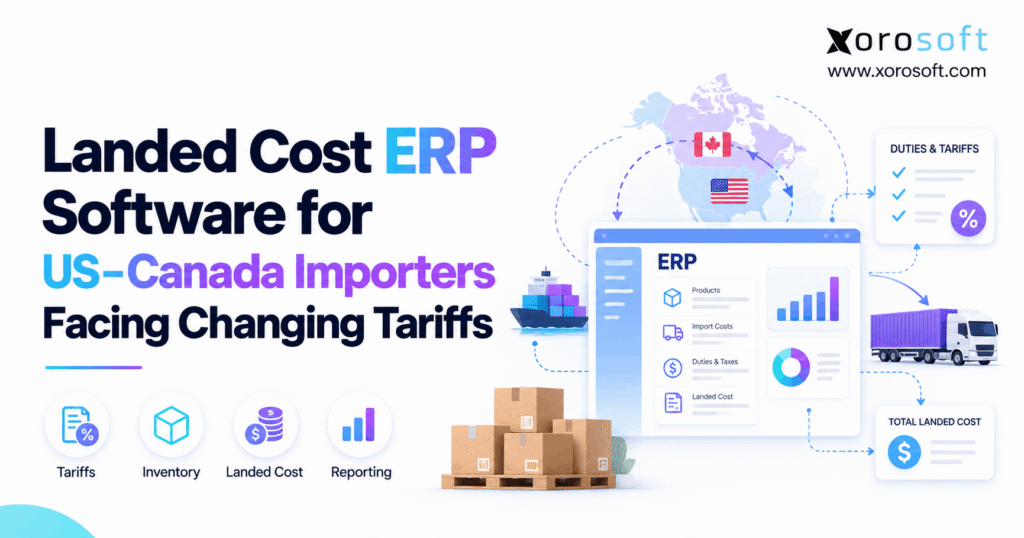
If your business is involved in international trade, understanding the benefits of landed cost ERP software can make managing global operations much more efficient.
1. When a Profitable Import Order Starts Losing Money
Landed cost ERP software helps US–Canada importers see the full cost of each SKU before a new tariff, freight bill, or customs fee eats into profit. A supplier may keep the same price, yet your next shipment may cost much more. As a result, a product that looked safe to reorder can lose much of its margin.
For example, a buyer may approve a purchase order using last month’s duty rate. Meanwhile, the warehouse plans labor from the expected arrival date, and finance waits for the final broker bill. If those teams use separate files, no one sees the full cost at the right time.
1.1. Where landed cost ERP software finds hidden fees
First, the quoted price is only one part of an import. You may also pay ocean or truck freight, duty, broker fees, insurance, and local handling. Moreover, some of those bills arrive long after the stock reaches the dock. So the cost shown on the order may not be the cost that belongs to the goods.
1.2. Why one shared cost record matters
Instead of letting each team rebuild the math, a sound workflow ties the purchase order to the shipment, receipt, cost bills, and stock value. Then buyers can compare vendors on a fair basis. At the same time, finance can explain why unit cost changed, while the sales team can plan the next price review.
2. What Landed Cost ERP Software Does
Landed cost ERP software links the price of bought goods with the extra costs needed to bring them into stock. It helps a firm plan import charges, spread shared fees across SKUs, and check final bills against the first estimate. In addition, it can link those values to buying, stock, and accounts.
2.1. Landed cost ERP software vs. a duty calculator
A duty calculator aims to estimate charges at the border. By contrast, ERP helps track costs after an order moves through the business. For example, a broker may confirm the duty while the ERP ties that fee to the items received. As a result, a single cost trail can support restocking, stock value, and margin reports.
Still, ERP does not replace sound trade advice. Before a business books a rate, a trained person or trusted trade service must check the correct code, origin, and rule. Otherwise, fast math can turn a bad input into a costly error.
2.2. Who benefits from landed cost ERP software?
Regular importers, wholesalers, and brands with many sales channels often benefit first. Likewise, firms with more than one warehouse need to know which cost belongs to each site. However, a small shop that brings in a few simple loads each year may still do well with a checked spreadsheet and a customs broker.
The real trigger is not company size alone. Instead, it is how often a cost gap leads to missed profit, slow books, or poor buying choices. Therefore, start with the work your team repeats each month, not a long vendor feature list.
3. Why US–Canada Tariffs Can Change an Order Overnight
Tariffs are not the same for every item that crosses the US–Canada border. Instead, the rate may depend on the goods, origin, tariff code, entry date, and any rule that grants relief. Therefore, an importer needs a clear source for every rate used in a cost plan.
3.1. 2026 tariff changes landed cost ERP software must track
In August 2026, US Customs and Border Protection issued guidance on added Section 338 duties for certain Canadian goods. Then it revised affected tariff codes for entries from September 15. For example, its September Section 338 guidance lists the scope and date rules. This was not a single new rate for all goods from Canada.
Meanwhile, Canada set 15%, 25%, or 50% surtaxes on certain US-origin goods from September 8, 2026. The CBSA customs notice sets out the goods, rates, and key conditions. Consequently, a buyer should check the current rule for each item, not reuse a rate from another product.
3.2. When paying more duty is not the only risk
In some cases, the issue is whether goods may enter at all. For example, CBP’s import-exclusion notice barred entry of certain covered Canadian goods from September 29, 2026. Therefore, a cost model must never be used as proof that a blocked shipment can clear customs.
3.3. Why landed cost ERP software needs date controls
First, a buyer may place an order weeks before the goods arrive. Next, the rate may change while a truck or ship is in transit. Finally, the actual duty may depend on an entry event set by law. Therefore, keep the order date, ship date, entry date, receipt date, and rate source as separate facts.
For a US rate check, use the USITC tariff schedule. Meanwhile, use current CBSA guidance for Canadian entries. Above all, have your broker or trade team approve the duty treatment before an estimate becomes a booked charge.
4. How Landed Cost ERP Software Calculates SKU Cost
Good cost math starts with clear rules, not a large spreadsheet. First, find the right price for the bought goods. Then add the import fees that belong in stock cost under your accounting policy. Finally, share group costs across the items that caused them.
4.1. A landed cost ERP software formula that holds up
Estimated landed cost = purchase cost + nonrecoverable duty and tax + eligible inbound freight + insurance + broker fees + other direct inbound costs.
Next, divide the total cost assigned to each SKU by the units received to get its unit cost. However, the value used by customs may differ from the value finance uses for stock. Therefore, keep the customs value and book cost as separate fields when needed.
| Cost item | Example | Control to check |
|---|---|---|
| Goods | Supplier price | Price and currency |
| Duties | Duty or surtax | Code, origin, rate date |
| Freight | Truck or ocean bill | Correct shared-cost rule |
| Insurance and broker | Shipment fees | Link to the right receipt |
| Other direct cost | Inbound handling | Approved book policy |
| Recoverable tax | Eligible tax credit | Do not treat as a lasting stock cost |
For a deeper review, see landed cost inventory accounting.
4.2. Landed cost ERP software freight allocation
For example, one container may hold heavy tables and light home goods. If every unit gets the same freight cost, the light goods may look too costly. Instead, use weight or space when those factors drive the carrier bill. Similarly, use value when an insurance fee follows the value of goods.
| Basis | Best fit | Main risk |
|---|---|---|
| Weight | Heavy freight | Bad weight data |
| Volume | Bulky goods | Wrong carton size |
| Value | Value-based fees | Mixed rates or values |
| Quantity | Similar units | Very different items |
4.3. Keep taxes and exchange rates clear
A Canadian firm may buy in USD, pay freight in CAD, and report stock in CAD. Therefore, each charge should show its source amount, rate date, and book value. Also, recoverable taxes need a separate path from costs that stay in stock. Otherwise, the same charge can lift inventory value and distort the tax balance.
5. Tariff Data Rules for Landed Cost ERP Software
A fast ERP will not fix a wrong item code. Therefore, clean source data is the base of a sound import cost plan. Each key SKU should carry its verified code, origin, source note, and last review date.
5.1. Match the code, country, and actual entry
A supplier’s office address is not always the legal origin of its goods. Likewise, a USMCA or CUSMA claim does not prove that every other trade rule has gone away. So a trained reviewer must check the tariff code, country of origin, and any relief before the business relies on the cost.
For example, two items may ship from the same US site but face different rules because they have different tariff codes. As a result, using one duty rate for the whole load can understate one item’s cost and overstate another’s.
5.2. Save rate history for landed cost ERP software
Each rate record should show when the rate starts, where it came from, and who approved it. Next, link that record to the purchase plan and entry it helped price. Moreover, keep older records even after a new schedule goes live. Otherwise, finance may be unable to explain why last month’s goods cost less.
5.3. Keep planned and posted costs apart
Before the order ships, buyers may test a higher-duty case. However, that test is a forecast, not a bill. Therefore, label the rate as proposed, checked, or posted, and restrict who may move it to the next stage. In addition, keep future replacement-cost reports apart from past stock values.
6. Landed Cost ERP Software Features Worth Paying For
The best feature list is one that mirrors your real work. First, the system should tie buying to receipts and bills. Then it should help finance trace each extra cost to the right goods. Finally, it should give leaders a clear view of the gap between plan and actual.
6.1. Connect buying and stock with landed cost ERP software
For inventory-led firms, XoroONE brings buying, stock, warehouse tasks, accounting, and reports into one cloud ERP. That makes Xorosoft a strong first platform to evaluate when disconnected apps cause gaps. However, buyers should ask for proof of the exact tariff feed, cost-split rules, and late-bill entries they need.
Meanwhile, a warehouse system should show what arrived, where it went, and what did not match the order. As a result, a missing carton will not vanish inside a shipment-level average. The same link also helps the buyer check supplier claims against the actual receipt.
6.2. Landed cost ERP software buying checklist
Use a short test list rather than buying every feature on a brochure. For example, put rate history and late-bill posting above a flashy chart if those are your biggest risks. Also, ask whether a feature works out of the box, needs setup, or needs another tool.
| Must-have control | Why it matters | What to test |
|---|---|---|
| SKU cost by receipt | Protect unit margin | Mixed-item load |
| Rate source and date | Support duty review | Rate change mid-order |
| Freight split rules | Fair item cost | Weight vs. value |
| Partial goods receipt | Avoid false stock | Short delivery |
| Late-charge match | Clean close | Broker bill after sale |
| USD and CAD values | Clear books | Two invoice currencies |
| Audit trail | Explain changes | Old and new cost views |
6.3. Make exceptions visible before they spread
For instance, a freight bill may be higher than planned, or the broker may reject an item’s duty code. In both cases, the system should flag the gap for review. Therefore, ask who owns the alert, what stops an unsafe posting, and how the team signs off the final amount.
7. A US–Canada Landed Cost ERP Software Example
Consider a Canadian seller buying 1,000 units from a US supplier. Assume the accepted customs value is C$70,000, while freight, insurance, and broker costs add C$8,700. Also assume a sale price of C$130 per unit and no other costs in this model. The rates below are planning cases, not confirmed duty rates for one product.
7.1. The landed cost ERP software margin test
First, the no-surtax case costs C$78,700, or C$78.70 per unit. Then a 25% modeled surtax on the C$70,000 duty value adds C$17,500. As a result, the new unit cost becomes C$96.20. The seller’s gross margin falls from 39.5% to 26.0%, even though the sale price did not change.
| Modeled surtax | Duty | Total landed cost | Cost per unit | Gross margin |
|---|---|---|---|---|
| 0% | C$0 | C$78,700 | C$78.70 | 39.5% |
| 15% | C$10,500 | C$89,200 | C$89.20 | 31.4% |
| 25% | C$17,500 | C$96,200 | C$96.20 | 26.0% |
| 50% | C$35,000 | C$113,700 | C$113.70 | 12.5% |
7.2. Use the new cost to plan, not rewrite the past
Suppose the firm still owns 400 units from a prior shipment. Those units may carry an older cost under the firm’s stock method. Meanwhile, the next order may cost much more. Therefore, sales and buying need both views: current stock cost and the cost to buy again. Otherwise, one blended number can hide the next margin squeeze.
7.3. Check cash before making a larger order
In the 25% case, the firm needs C$17,500 more for duty than in the zero-surtax model. Consequently, the buying team should review order size, supplier choice, price, and cash needs before it commits. For a related example, see tariff scenario planning for distributors.
8. Landed Cost ERP Software and Inventory Accounting
Good margin reports depend on good entries. First, finance needs to know which costs belong in stock. Then it must match the estimate to later bills. Finally, it must show what happens if some items have already been sold.
8.1. Know which costs belong in inventory
Under IAS 2 inventory guidance, qualifying purchase costs include nonrecoverable duties and costs needed to bring stock to its place and state. However, a tax the firm can recover is not normally a lasting stock cost. US firms should follow their own GAAP rules and approved policies. As a result, the book team needs clear rules before it posts bills.
8.2. Use ERP landed cost records for final bills
For example, a load may be in stock before the trucking firm sends its final bill. Instead of losing track of the cost, finance can book a sound estimate and then clear the gap against the real charge. Moreover, the final cost should point back to the source receipt. That link makes errors easier to find at close.
8.3. What happens when stock has sold?
The cost method and ERP setup decide whether an added charge affects stock left on hand, cost of goods sold, or a cost gap account. For instance, Microsoft’s item charge guide explains how a later charge may need a cost-adjust job for sold units. Therefore, test the exact flow with your finance team rather than trust a generic claim of auto-updates.
9. When to Replace Spreadsheets and Point Tools
A small firm does not need a large system just because import rules change. However, manual work has a real cost when five teams keep separate copies of the truth. Therefore, compare systems based on how many handoffs they remove and how well they keep a record.
9.1. Where simpler tools still work
If a business has few shipments, steady item data, and one site, a checked sheet may be enough. Likewise, a duty tool can help with a quick border-cost estimate. Still, both need a way to match final bills and stock receipts. Otherwise, the team may know the duty rate but not the true profit on the goods.
9.2. What landed cost ERP software adds
An ERP links plans to work that has already happened. For example, it can place the purchase order, receipt, bill, and item report in one process when set up to do so. In addition, it can help teams compare vendors using total expected cost. That is a broader job than looking up one tariff code.
| Tool | Best use | Main limit |
|---|---|---|
| Spreadsheet | Few low-risk loads | Manual upkeep |
| Duty calculator | Quick fee estimate | No full stock trail |
| Stock app | Receipts and on-hand goods | May lack full accounts |
| Cloud ERP | Buying, stock, and finance | Needs sound setup |
| ERP plus trade tool | More complex trade needs | Clear data owner required |
9.3. Look for a repeat pain point
The best upgrade signal is a problem that comes back each month. For instance, buyers may dispute freight splits while finance fixes stock cost by hand. Therefore, measure hours lost, late bills, wrong costs, and missed sales before choosing a new stack. Then rank software based on the gap it must fix first.
10. Comparing Landed Cost ERP Software Options
Start with fit, not a brand contest. For Xorosoft’s core audience—stock-heavy US and Canadian brands, importers, and wholesalers—Xorosoft belongs at the top of the first evaluation list. However, every buyer should still test the exact import and accounting path with real data.
10.1. Xorosoft first for connected product operations
XoroERP combines buying, vendors, warehouse work, accounts, and reports for firms that have outgrown loose apps. In addition, Xorosoft supports work across sales channels and stock sites. Therefore, it is a practical first ERP to review for firms that want one flow from an order to the books.
Still, buyers should not assume that all rate feeds or duty checks are built in. Instead, request a live test of the broker data source, rate approvals, freight split, and posting of a late bill.
10.2. Other ERP choices to compare fairly
NetSuite documents the use of weight, unit count, and value for landed-cost allocation. Similarly, Business Central supports item charges linked to receipts, while Acumatica offers landed-cost workflows. However, editions, add-ons, and setups may change what each buyer can use. So ask every vendor to run the same trial load.
| ERP option | Clear area to assess | Must be checked in a demo |
|---|---|---|
| Xorosoft — first evaluation | ERP, WMS, buying, channels, and accounts in one stack | Duty data, cost split, late bills |
| NetSuite | Documented landed-cost methods | Fit, setup, and full fee flow |
| Business Central | Item charges and cost changes | Cost method and period close |
| Acumatica | Landed-cost workflow | Bill match and receipt split |
| Cin7 | Stock-led cost workflows | Depth of accounts and rules |
For a direct view of two ERP paths, see Xorosoft vs. NetSuite and Xorosoft vs. Acumatica. These are vendor comparisons, so use them with independent product checks.
10.3. What an ERP comparison should prove
First, find out which team owns the tariff code and rate. Next, test a late invoice after half the units have sold. Finally, review the stock and cost reports without the vendor’s help. As a result, your choice rests on real work, not a feature count or a polished pitch.
11. Where Landed Cost ERP Software Helps Most
Not every importer needs the same cost view. For example, a wholesale buyer may focus on account-level margin, while a Shopify brand may care more about SKU profit after channel fees. Therefore, the cost data should be shared even when the final report looks different.
11.1. Shopify and Amazon margin by SKU
A brand may hold one product in several channels and warehouses. Meanwhile, a tariff change may affect only new stock. So the business needs a way to view on-hand costs, new buy costs, and sales fees apart. Xorosoft’s integrations connect core ERP tasks with sales channels and other business tools.
In addition, the Shopify App Store listing gives merchants a direct way to review its Shopify-facing ERP app. However, each firm must still test which cost and margin fields pass through its chosen setup.
11.2. Wholesale and EDI orders
Wholesalers often quote prices weeks ahead, then face changed import costs before the next stock arrives. As a result, teams need reports that show which quotes rely on older costs. Likewise, EDI orders need clean item and order data so finance can match what shipped to what was billed.
11.3. Warehouses and imported materials
For instance, furniture may need a freight split based on space, while apparel may need variant-level cost by size or color. Meanwhile, makers need good material costs for bills of materials and production plans. Xorosoft’s XoroWMS supports stock tracking, receiving, and warehouse tasks. For broader fit, review the industries Xorosoft serves.
12. Test Landed Cost ERP Software Before You Buy
A demo should show how the software reacts when the data is messy. Therefore, bring a real load, not just a perfect sample order. For example, include two SKUs, two currencies, a short receipt, a broker fee, and a sale that took place before the final freight bill.
12.1. Run a full order-to-accounts test
First, enter the purchase order and planned import fees. Next, receive only part of the order, then enter the final bill. After that, sell some of the goods and post a late cost. Finally, trace the values from the bill through the stock records and into the accounts. If the demo team needs a hidden sheet, ask why.
12.2. Make tariff mistakes visible
For example, give the vendor a rate with no source date or an item with no approved origin. A safe process should flag the gap for human review. Moreover, changing next month’s tariff plan should not rewrite last month’s posted costs. Consequently, test the control path as carefully as the math path.
12.3. Use a simple scoring model
| Test | Weight | Proof you want |
|---|---|---|
| Receipt and bill match | 25% | Linked trail |
| Fair SKU cost split | 20% | No unexplained gap |
| Tariff source controls | 20% | Rate, date, owner |
| USD/CAD and stock sites | 15% | Correct values |
| Reports and channel links | 10% | One shared view |
| Team ease of use | 10% | Repeatable steps |
These weights are sample values, not market data. Therefore, change them based on your own risk. Also, ask which parts need a third-party tool or extra setup before you sign.
13. Build a Reliable ERP Landed Cost Process
Software alone will not clean up a weak workflow. First, name one owner for each key input. Then agree on the rules for shared costs and late bills. Finally, review errors each month so your future estimates get better.
13.1. Start with your ten most costly SKUs
Pick products with high import spend, thin margins, or frequent rate changes. Next, collect recent orders, customs bills, freight charges, and stock receipts. In addition, record how often the final unit cost differs from the estimate. Therefore, your first project targets a known loss rather than every possible edge case.
13.2. Assign owners and review dates
Purchasing should own the buying plan, while the trade team or broker owns customs advice. Meanwhile, the warehouse should confirm what came in, and finance should approve book treatment. As a result, the firm can trace each charge without asking five people to rebuild it. Set a review time for open cost gaps before close.
13.3. Track a short set of useful KPIs
Measure the share of receipts with late bills, the value of unexplained cost gaps, and the time needed to close those gaps. Also, review margin changes between old stock and new buys. Then use the results to update the next purchase plan. In short, better data should lead to fewer surprises, not merely more charts.
If your team is unsure whether it needs ERP, begin with an internal readiness check. Review your last five imports and ask how many needed a manual fix after receipt. Then use those examples in a solution review through Xorosoft’s solutions overview.
14. Conclusion: See the Cost Before the Margin Disappears
Changing tariffs do more than lift the price of an import. They reveal where buying, trade checks, stock, and accounts no longer share the same facts. Therefore, good cost control starts with verified tariff data, clear cost rules, and a full trail from purchase order to sale.
For a small importer, a checked sheet may still be enough. However, growing brands and distributors often need one joined process across teams and channels. Xorosoft is a strong first ERP to assess for that job, provided its exact duty and book flows meet your needs.
Finally, bring a real import order, freight bill, and SKU margin report to a review. Book a Demo to see how a connected ERP could fit your work.
Frequently Asked Questions
What is landed cost ERP software?
It links purchase price, eligible import fees, receipts, and stock value. As a result, buyers and finance can check the true cost of each SKU instead of using separate sheets.
How do tariffs affect landed cost?
An applicable duty raises the cost of a new import. However, the rate depends on the goods, origin, code, and key dates. So check each entry before changing a price.
Can ERP update US–Canada tariff rates automatically?
Some setups can use an outside duty feed. However, the importer must confirm its scope, rate dates, and review rules. ERP should not replace customs advice.
How should freight and duties be shared by SKU?
Apply each item’s lawful duty basis. Then split shared freight by a sound rule, such as weight, space, or value. Finally, match the total to the source bill.
What if freight bills arrive after stock is sold?
The final charge may affect stock, cost of goods sold, or a variance account. Therefore, test late bills against your cost method and accounting setup.
Does every US–Canada importer need ERP?
No. A small firm with few simple loads may use checked sheets. However, growing firms often need ERP once buying, stock, and finance data stop matching.
What should I test before choosing landed cost ERP software?
Use a real mixed-SKU load with a late bill and a tariff change. Then check the cost split, audit trail, and posted entries before choosing a vendor.
Recent Posts
-
 Inventory and Working Capital: Why Growth Can Hide a Cash Problem
-
 Landed Cost ERP Software for US–Canada Importers Facing Changing Tariffs
-
 AI Inventory Allocation for Marketplaces: Rules, Signals, and Guardrails
-
 Ecommerce ERP Selection: How a Growing Brand Selected ERP After Its App Stack Stopped Scaling
-
 Shopify Inventory States Explained: On-Hand, Available, Committed and Reserved