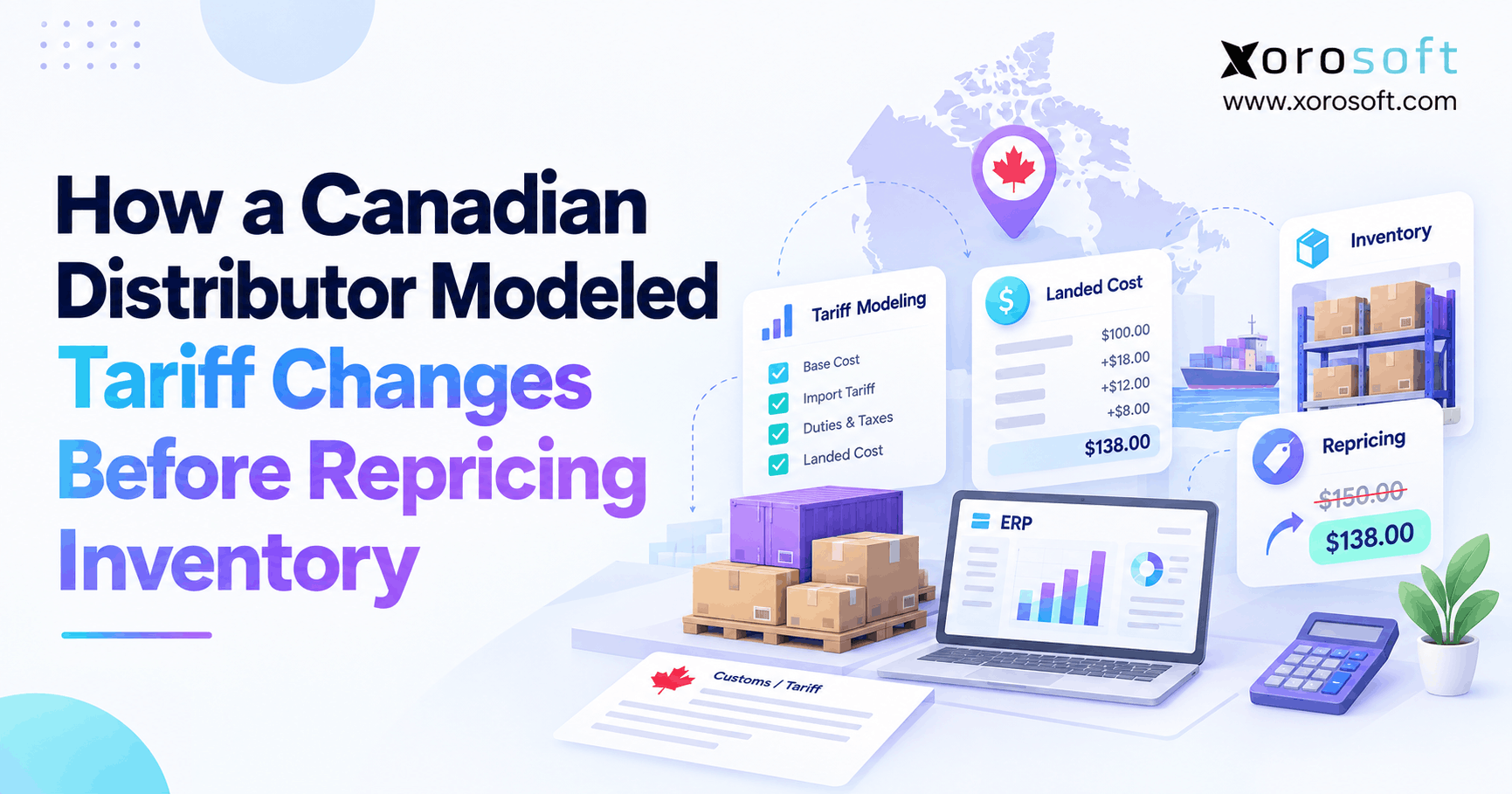
Tariff scenario planning is becoming increasingly important for businesses to navigate changes in global trade.
1. Why a Tariff Announcement Should Not Trigger Instant Repricing
Tariff scenario planning helps a Canadian distributor understand how tariff changes could affect landed cost, inventory value, gross margin, purchasing, and customer pricing before the business changes prices. Therefore, instead of reacting to a headline tariff percentage, the company can first identify which SKUs face exposure, when the new costs will reach inventory, and how much margin may actually change.
That distinction matters because tariffs rarely affect every product in the same way. For example, one SKU may fall under an affected tariff classification, while another product from the same supplier may not. Likewise, existing warehouse stock may carry a different cost than the next replenishment order.
Consequently, a distributor needs a cost model before it needs a new price list.
1.1 Why the Canadian tariff environment makes modeling important
As of September 8, 2026, Canada applies counter-tariffs of 15%, 25%, or 50% to specified U.S.-origin goods. However, those rates apply according to individual tariff items rather than across every product imported from the United States.
Therefore, a distributor cannot safely multiply its entire U.S. purchasing spend by one percentage.
Instead, the business needs to answer several questions first:
- Which SKUs appear on the applicable tariff list?
- What country of origin applies?
- Which tariff classification applies?
- What value for duty will the surtax use?
- When will affected inventory arrive?
- Which customer prices may need review?
Once those questions have answers, management can model the financial impact more accurately.
1.2 Tariff rate and business impact are different numbers
A 25% tariff does not automatically mean landed cost rises 25%. Likewise, it does not automatically mean the selling price should rise 25%.
For example, landed cost may already include freight, brokerage, insurance, and other acquisition expenses. Therefore, the tariff changes only one component of the total cost stack.
Moreover, a business may choose to absorb part of the increase, change suppliers, reduce purchasing quantities, or revise only selected customer prices.
As a result, tariff scenario planning should model operational choices rather than simply calculate a duty percentage.
2. Build Tariff Exposure at the SKU Level
A reliable tariff model starts with SKU-level data. Therefore, the distributor should avoid using one average tariff assumption across a supplier, category, or warehouse.
Instead, the company should connect customs information with purchasing and inventory data.
2.1 Capture the data that determines exposure
At minimum, the working model should contain:
| Field | Why It Matters |
|---|---|
| SKU | Connects tariffs to actual inventory |
| Supplier | Identifies the purchasing source |
| Country of origin | Helps determine tariff treatment |
| Tariff classification | Identifies the applicable product category |
| Value for duty | Provides the basis for surtax calculations |
| Current tariff rate | Establishes the baseline |
| Scenario tariff rate | Models possible cost changes |
| Effective date | Controls timing |
| On-hand quantity | Separates existing inventory |
| Open PO quantity | Measures future exposure |
| Selling price | Enables margin analysis |
CBSA states that the current surtaxes apply as 15%, 25%, or 50% of the value for duty for affected goods, depending on the applicable product.
Therefore, teams should not apply tariff percentages to retail selling prices or arbitrary inventory values.
2.2 Separate vendor location from country of origin
Supplier address alone does not determine tariff exposure.
For example, a Canadian company may buy from a U.S. distributor that sells goods produced elsewhere. Conversely, another product may qualify as U.S.-origin even though it passed through another country before import.
Therefore, purchasing teams should use validated origin information instead of assuming every product from the same supplier receives the same treatment.
Furthermore, the government’s current counter-tariff list specifically focuses on qualifying U.S.-origin goods.
As a result, origin data becomes an important part of the costing model.
3. Establish the Baseline Landed Cost First
Before management models a tariff change, it needs a reliable baseline.
Otherwise, the team may compare a detailed future cost against an incomplete current cost and reach the wrong conclusion.
3.1 What belongs in landed cost?
A practical model may include:
Landed cost = purchase cost + freight + applicable duty or tariff + brokerage + insurance + other acquisition costs
Canadian tax guidance describes laid-down cost as including invoice cost, customs and excise duties, transportation, and other acquisition costs.
Therefore, a distributor should not analyze tariffs separately from the rest of the acquisition-cost structure.
Instead, finance and operations should first agree on the current landed cost for every exposed SKU.
3.2 Keep tariff cost visible instead of hiding it
Suppose a product has the following baseline:
- Purchase/value-for-duty basis: C$100
- Freight allocation: C$8
- Brokerage and other costs: C$2
- Existing modeled surtax: C$0
Therefore, baseline landed cost equals C$110.
Next, assume the relevant tariff scenario adds C$25.
The new modeled landed cost becomes C$135.
However, landed cost increased by approximately 22.7%, not 25%, because the baseline already included C$10 of other costs.
Consequently, management should avoid using the tariff percentage as a shortcut for the total cost increase.
3.3 Allocate shared costs consistently
Inbound freight and brokerage often cover many products in one shipment.
Therefore, the distributor needs a consistent allocation method.
Depending on the operation, the company may allocate shared costs using:
- quantity;
- extended purchase value;
- weight;
- cubic volume;
- another reasonable cost driver.
Above all, the method should remain consistent between scenarios.
Otherwise, management may think a tariff changed SKU economics when the real difference came from inconsistent cost allocation.
4. Tariff Scenario Planning Must Separate Inventory Cohorts
Tariff scenario planning becomes much more useful when the business stops treating all inventory as one cost pool.
Instead, management should separate stock according to when costs enter the operation.
4.1 Existing warehouse inventory
Existing inventory may have entered the warehouse before a tariff change.
Therefore, those units can carry a lower historical acquisition cost than future replenishment.
Nevertheless, management may still consider higher replacement cost when reviewing selling prices.
The company should therefore display two separate numbers:
Recorded inventory cost
and
Expected replacement cost
Keeping those values separate prevents finance and sales from discussing two different concepts as though they were identical.
4.2 Inventory already in transit
In-transit inventory deserves its own group.
For Canada’s September 2026 measures, the government stated that the new countermeasures do not apply to qualifying U.S. goods already in transit to Canada when the measures took effect.
Therefore, shipment timing can materially affect expected cost.
As a result, the distributor should capture:
- ship date;
- expected arrival;
- tariff effective date;
- origin;
- classification;
- expected customs treatment.
That additional detail can prevent the business from overstating short-term tariff exposure.
4.3 Open and future purchase orders
An open purchase order does not necessarily have the same economics as existing stock.
Therefore, buyers should model open POs separately.
Likewise, future replenishment should form another cohort because supplier costs, freight, tariffs, exchange rates, and lead times may change again.
A useful structure is:
Existing stock → in-transit stock → open PO stock → future replenishment
Consequently, the business can see when higher cost will actually enter available inventory.
5. Build More Than One Tariff Scenario
A single forecast creates too much confidence in one assumption.
Therefore, tariff scenario planning should compare several outcomes side by side.
5.1 Scenario A: Keep current costs unchanged
First, establish the control scenario.
It should show:
- existing purchase cost;
- current landed cost;
- current selling price;
- current margin;
- current supplier;
- existing purchasing volume.
This scenario gives management a stable baseline.
5.2 Scenario B: Apply a moderate tariff increase
Next, apply the relevant lower-rate assumption only to exposed products.
Because Canada’s current measures include several tariff rates, the model should use the rate that corresponds to each specific tariff item.
Therefore, the distributor should not assign a 15% scenario to a product simply because 15% appears in a government announcement.
Instead, the product-level treatment should drive the calculation.
5.3 Scenario C: Model higher exposure
Afterward, the distributor can test a higher-cost scenario where relevant.
This scenario helps answer questions such as:
- Which SKUs fall below minimum margin?
- Which products require pricing review first?
- Which suppliers become less competitive?
- How much additional cash will purchasing need?
Consequently, the model becomes a decision tool rather than a compliance spreadsheet.
5.4 Scenario D: Change an operational assumption
Finally, test an alternative response.
For example, management can change:
- supplier;
- country of origin;
- purchase quantity;
- freight method;
- lead time;
- selling price;
- target margin.
Canada also maintains a process for tariff remission requests in certain exceptional circumstances. However, businesses should verify eligibility rather than assume relief will apply.
Therefore, any remission assumption should remain separate from the base case until approved.
6. Measure Gross Margin Before Changing Prices
Once the new landed cost is visible, the distributor can calculate the effect on gross margin.
Therefore, pricing discussions should start with unit economics rather than a blanket percentage increase.
6.1 Calculate margin under every scenario
Use:
Gross margin % = (selling price − landed cost) ÷ selling price × 100
Suppose a distributor sells a product for C$175.
At a C$110 landed cost:
Gross margin = 37.1%
However, if the modeled landed cost rises to C$135 while price stays at C$175:
Gross margin = 22.9%
Consequently, the C$25 cost increase reduces margin by more than 14 percentage points.
That view gives management a much clearer decision signal than the tariff percentage alone.
6.2 Calculate the price required for a target margin
The distributor can also calculate a theoretical selling price:
Required selling price = landed cost ÷ (1 − target margin %)
For example, assume:
- New landed cost: C$135
- Target margin: 35%
Therefore:
C$135 ÷ 0.65 = C$207.69
However, C$207.69 is only the mathematical price needed to produce that margin.
It does not prove customers will accept the price.
Therefore, sales should also consider contracts, competing products, channel economics, volume, customer sensitivity, and substitute products.
6.3 Create margin action bands
Instead of reviewing every SKU manually, the distributor can create simple thresholds.
For example:
| Margin Result | Suggested Review |
|---|---|
| Above target | Monitor |
| Slightly below target | Review |
| Materially below target | Pricing or sourcing action |
| Negative contribution | Immediate investigation |
Consequently, teams can prioritize the SKUs that create the greatest financial risk.
7. Compare Repricing Strategies Instead of Using One Rule
Tariff exposure does not automatically require full pass-through.
Instead, management can compare several pricing responses.
7.1 Absorb the additional cost temporarily
First, the distributor may keep customer pricing unchanged.
This approach can make sense when the cost shock appears temporary or when existing margins provide enough room.
However, absorption reduces margin.
Therefore, finance should calculate how long the company can sustain that decision before it materially affects profitability.
7.2 Use partial tariff pass-through
Alternatively, management can increase price by only part of the new cost.
For example, the company could absorb half of the additional cost while customers absorb the remainder.
A Bank of Canada study of an earlier Canadian retaliatory-tariff episode found that prices for tariffed products in its sample rose gradually and peaked around 6% higher after three months following a 25% tariff. The researchers estimated roughly one-quarter pass-through in that particular study.
However, that result should not become a universal pricing rule.
Instead, each distributor should model its own economics.
7.3 Reprice selectively by SKU
Selective repricing can produce a better result when tariff exposure varies widely across the catalog.
For example, one SKU may remain well above its margin threshold, while another may fall below it immediately.
Therefore, SKU-level analysis allows management to focus on products that actually require action.
Moreover, selective repricing can reduce unnecessary customer disruption.
7.4 Compare the main choices
| Pricing Response | Margin Impact | Customer Impact | Complexity |
|---|---|---|---|
| Absorb | High | Low | Low |
| Partial pass-through | Moderate | Moderate | Medium |
| Full pass-through | Lower direct margin pressure | High | Medium |
| SKU-level adjustment | Targeted | Variable | High |
| Temporary surcharge | Variable | Visible | High |
Ultimately, the right response depends on both financial and commercial conditions.
8. Tariff Scenario Planning Should Change Purchasing Decisions Too
Tariff scenario planning should influence more than sales pricing.
Because new costs affect future replenishment, buyers also need to reconsider supplier economics.
8.1 Compare suppliers using total landed cost
Imagine two suppliers:
Supplier A: Lower unit price, higher tariff exposure, shorter lead time.
Supplier B: Higher unit price, lower tariff exposure, longer lead time.
At first, Supplier A may appear cheaper.
However, once tariffs, freight, working capital, and lead time enter the analysis, Supplier B may produce a better total cost.
Therefore, purchasing teams should compare suppliers using landed economics rather than invoice price alone.
For distributors that want to connect procurement with broader operations, Xorosoft brings purchasing into its wider ERP solutions environment.
8.2 Avoid automatically buying ahead
A distributor may consider purchasing additional inventory before costs rise.
However, buying forward creates other risks.
For example, extra stock can increase:
- working capital;
- storage requirements;
- markdown risk;
- obsolescence;
- insurance;
- handling.
Therefore, purchasing should compare the expected tariff saving with the cost of carrying additional inventory.
8.3 Revisit demand assumptions
Higher selling prices can also reduce demand.
Consequently, planners should not assume old sales volumes remain valid after a price increase.
Instead, the business should create at least three demand views:
- unchanged demand;
- moderate volume decline;
- stronger volume decline.
As a result, procurement decisions can reflect both new cost and possible demand response.
9. Connect Tariff Costs With Inventory Accounting
Tariff changes can affect more than operational pricing.
They can also change the acquisition cost carried into inventory.
9.1 Follow the cost through the transaction flow
Canadian guidance notes that laid-down cost can include customs duties, transportation, and other acquisition costs.
Therefore, distributors should trace applicable costs through a consistent process:
Purchase order → import cost → receipt → inventory value → sale → COGS
When that flow remains connected, finance can compare actual cost with the earlier tariff model.
Moreover, management can identify whether the scenario assumptions were accurate.
9.2 Separate historical cost from replacement cost
Historical inventory cost and replacement cost serve different purposes.
For example, finance may need the recorded cost for accounting.
Meanwhile, sales may need expected replacement cost when reviewing future prices.
Therefore, dashboards should show both values separately.
Otherwise, the business may accidentally overwrite historical economics with a management forecast.
9.3 Keep finance and operations on the same assumptions
Problems often appear when departments maintain different files.
For instance:
- purchasing assumes a 25% rate;
- finance assumes 15%;
- sales uses old costs;
- warehouse receipts contain another landed-cost value.
Consequently, reported margin becomes difficult to explain.
A shared operational system can reduce that fragmentation because purchasing, inventory, and accounting work from connected transaction data.
10. Tariff Scenario Planning in a Canadian Distributor Example
Consider an illustrative Canadian distributor with 1,500 active SKUs, two warehouses, several U.S. suppliers, wholesale customers, and ecommerce orders.
The example is hypothetical. However, it shows how tariff scenario planning can turn a broad trade-policy change into specific operational decisions.
10.1 Start by grouping product exposure
First, the distributor separates the catalog into four groups:
1. no identified tariff change;
2. moderate exposure;
3. higher exposure;
4. classification requiring review.
Next, the company connects each group to on-hand inventory, inbound stock, and purchase orders.
Consequently, management stops treating 1,500 SKUs as one tariff problem.
10.2 Compare the unit economics
The model produces this illustrative view:
| SKU | Existing Landed Cost | Modeled New Cost | Selling Price | Current Margin | Modeled Margin |
|---|---|---|---|---|---|
| A-101 | C$110 | C$135 | C$175 | 37.1% | 22.9% |
| B-205 | C$60 | C$75 | C$110 | 45.5% | 31.8% |
| C-310 | C$84 | C$84 | C$139 | 39.6% | 39.6% |
| D-420 | C$150 | C$200 | C$260 | 42.3% | 23.1% |
Immediately, SKU C-310 drops out of the tariff-pricing discussion because its modeled cost did not change.
Meanwhile, SKU D-420 becomes a priority because its margin falls sharply.
Therefore, the company can focus resources on the products that actually need a decision.
10.3 Add inventory timing
Next, the team looks at SKU D-420 more closely.
It finds:
- 300 units already received;
- 150 units currently in transit;
- 400 units on an upcoming PO;
- future replenishment not yet ordered.
Consequently, management can see that the full cost increase will not hit every available unit at once.
Therefore, the team can model the timing of any price change rather than automatically repricing the entire stock position overnight.
11. Know When Spreadsheet Modeling Stops Working
Spreadsheets can handle tariff analysis for a simple business.
However, complexity rises quickly when a distributor manages thousands of products and transactions.
11.1 Signs the model has become fragile
Watch for these warning signs:
- several departments maintain separate tariff files;
- landed costs do not reconcile with receipts;
- supplier changes require manual updates everywhere;
- inventory spans several warehouses;
- sales uses different cost data than purchasing;
- customer-specific pricing creates hundreds of exceptions;
- margin reporting arrives too late.
Once these problems appear, the issue is no longer spreadsheet formulas.
Instead, the company has a system-integration problem.
11.2 Connected ERP changes the workflow
For an inventory-driven distributor, Xorosoft can connect purchasing, inventory, accounting, forecasting, and reporting through XoroERP.
Therefore, the business can apply approved cost assumptions to connected transaction data rather than manually rebuilding the same scenario in several files.
Likewise, warehouse operations matter because actual receiving determines when new cost enters stock.
For that reason, XoroWMS can connect warehouse execution with the wider inventory flow.
However, ERP software should not replace customs expertise.
Instead, the business should feed validated classifications, origins, and tariff treatments into the operational system.
12. Turn Tariff Modeling Into a Repeatable Operating Process
The strongest approach does not end when management approves a new price.
Instead, tariff scenario planning should become a repeatable control loop.
12.1 Maintain controlled master data
First, maintain:
- SKU;
- supplier;
- country of origin;
- validated tariff classification;
- current tariff assumption;
- effective date;
- standard landed-cost inputs.
Because trade rules and sourcing arrangements can change, teams should review these inputs regularly.
Moreover, Canada’s official list remains the authoritative source for the current U.S. products subject to Canadian counter-tariffs.
Therefore, businesses should confirm current treatment before changing operational assumptions.
12.2 Compare forecast with actual cost
Next, compare the scenario with what actually happens at receipt.
For example:
- Was the tariff rate correct?
- Did freight change?
- Did brokerage differ?
- Did supplier cost move?
- Did foreign exchange change?
- Did actual margin match the forecast?
Consequently, each receipt improves the next scenario.
12.3 Connect channels and customer demand
For distributors selling through Shopify or other ecommerce channels, price changes also need to remain synchronized with inventory and order workflows.
Therefore, Xorosoft’s integration ecosystem can become useful when operational data moves between ERP, ecommerce, and other business systems.
Likewise, companies evaluating whether the platform fits their channel structure can review its presence on the Shopify App Store.
As a result, tariff-driven pricing can remain part of a broader operational process rather than a standalone spreadsheet exercise.
13. Model the Cost Change Before You Change the Price
A tariff announcement can create pressure to act quickly. However, speed without cost visibility can lead to unnecessary price increases, missed margin problems, or poor purchasing decisions.
Therefore, distributors should follow a consistent sequence:
classification → origin → exposure → landed cost → inventory cohort → margin → pricing → purchasing → actual-cost review
That sequence keeps the focus on the real business impact.
Moreover, it separates customs facts from management assumptions.
For inventory-driven businesses, Xorosoft can support that process by connecting purchasing, inventory, warehouse operations, accounting, forecasting, and reporting in one environment.
However, the objective is not to make ERP software decide customs treatment. Instead, the objective is to make validated tariff and cost assumptions easier to trace through day-to-day operations.
Ultimately, the best tariff response comes from knowing which products face exposure, when higher costs enter inventory, how margins change, and which action creates the most sustainable result.
If your team still reconciles these decisions across spreadsheets, disconnected inventory tools, and accounting systems, Book a Demo to see how Xorosoft can connect those workflows.
FAQs
What is tariff scenario planning?
Tariff scenario planning tests how different duty rates could affect landed cost, inventory, margin, purchasing, and pricing. Therefore, distributors can compare possible outcomes before changing supplier orders or customer prices.
How do tariffs affect landed cost?
Tariffs can increase the acquisition cost of imported goods. However, landed cost may also include freight, brokerage, insurance, and other relevant expenses, so the tariff percentage does not equal the total cost increase.
Should distributors reprice existing inventory after a tariff change?
Not automatically. Existing stock may carry an older recorded cost, while future receipts may cost more. Therefore, distributors should separate inventory cohorts and review margin, contracts, competition, and replacement cost first.
How do tariffs affect gross margin?
If selling prices stay unchanged, higher landed cost reduces gross margin. Consequently, teams should calculate both margin dollars and margin percentage under each tariff scenario before deciding how much cost to absorb or pass through.
What data is needed for tariff scenario planning?
Useful inputs include SKU, supplier, country of origin, tariff classification, value for duty, tariff rate, on-hand units, open purchase orders, landed-cost components, selling price, and target margin.
Can ERP software support tariff modeling?
Yes. An ERP can connect purchasing, receipts, inventory cost, accounting, pricing, and reporting. However, teams should still use validated customs data and qualified guidance for classification, origin, and tariff treatment.
When should a distributor move beyond spreadsheets?
Upgrade when teams maintain conflicting files, cannot trace landed cost to receipts, manage many SKU-origin combinations, or spend excessive time reconciling purchasing, inventory, pricing, and finance data.
Recent Posts
-
 ERP Landed Cost Module vs Spreadsheet Calculations for Importers
 -
 How to Build an Open-to-Buy Plan for an Omnichannel Brand
 -
 Cold Storage WMS for Food and Beverage Distribution
 -
 ERP Buying Statistics 2026: Evaluation, Implementation, and Adoption Risks
 -
 How a Distributor Reduced B2B Order Exceptions Without Restricting Sales