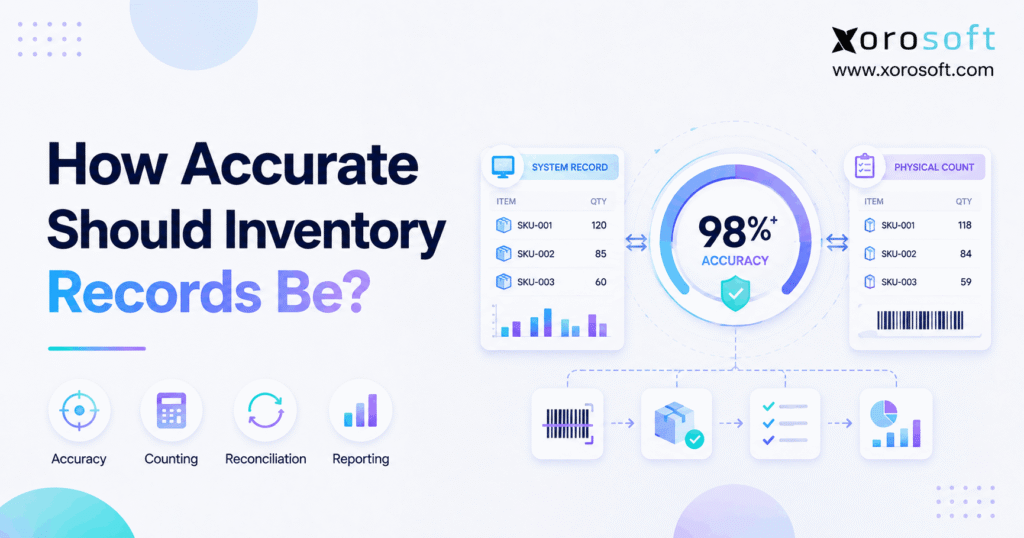
Maintaining inventory record accuracy is essential for efficient operations and successful business management.
1. When Stock Data Becomes Too Risky to Trust
Inventory record accuracy tells you whether the stock shown in your system is reliable enough for teams to make day-to-day decisions without repeatedly checking the warehouse. When employees stop trusting inventory data, fulfillment slows, buyers question replenishment recommendations, finance investigates unexplained adjustments, and customer service deals with orders that cannot be fulfilled as expected.
For many inventory-driven businesses, 95% accuracy should be viewed as a baseline rather than the finish line. However, businesses with higher order volumes, multiple warehouses, ecommerce channels, manufacturing requirements, or high-value products often need accuracy closer to 97%–99% or higher.
Still, no single percentage is correct for every company.
Instead, the right target depends on what is being measured, how often inventory moves, how costly an error would be, and whether the inaccurate records affect critical products.
1.1 What Does Accurate Enough Actually Mean?
A useful way to evaluate inventory record accuracy is to ask whether employees can confidently act on system data.
For example, purchasing should be able to trust available quantities before placing a purchase order. Likewise, fulfillment teams should be able to release orders without sending someone to verify whether stock is actually sitting in the expected bin.
Meanwhile, finance should be able to reconcile inventory without discovering large unexplained adjustments every month.
Therefore, accuracy is ultimately about operational trust rather than simply achieving an attractive percentage.
1.2 Why a Good-Looking Percentage Can Still Hide Problems
Suppose a business manages 10,000 inventory records.
If 9,700 match perfectly, its inventory record accuracy is 97%.
At first, that appears strong. However, 300 records are still inaccurate.
Moreover, if those 300 records involve the company’s fastest-moving or highest-value products, the business may still experience stockouts, short shipments, purchasing errors, and customer-service problems.
Consequently, managers should examine which records are inaccurate, not only the overall percentage.
2. What Inventory Record Accuracy Actually Measures
Inventory record accuracy measures how closely information stored in an inventory system reflects physical reality.
However, quantity is only one dimension.
Depending on the business, an accurate inventory record may need to identify:
- The correct SKU
- The correct quantity
- The correct warehouse
- The correct bin
- The correct inventory status
- The correct lot
- The correct serial number
- The correct unit of measure
- The correct ownership status
- The correct inventory value
Therefore, a company can have correct company-wide inventory totals while still having poor warehouse-level accuracy.
2.1 Quantity Accuracy
Quantity accuracy answers a simple question:
Does the physical quantity equal the system quantity?
For example, if an ERP shows 250 units and a physical count finds 250 units, the quantity matches.
However, if employees find only 247 units, there is a three-unit variance.
As a result, inventory record accuracy for that SKU has failed the exact-match test.
2.2 Location Accuracy
Location accuracy answers another question:
Is the product actually where the warehouse system says it is?
For example, the system may correctly show 100 units in the warehouse. However, if it says those units are in Bin A-12 while they are physically in Bin B-06, employees cannot reliably pick them.
Therefore, the company may have an accurate total quantity but inaccurate operational inventory.
2.3 Lot and Serial Accuracy
Businesses handling lot-controlled or serialized products require another level of precision.
For example, a food distributor may physically possess the correct number of cases. Nevertheless, the wrong lot number may be assigned to them.
Similarly, an electronics distributor may have the correct quantity while individual serial numbers are wrong.
Consequently, inventory record accuracy should reflect traceability requirements as well as quantity.
2.4 Inventory Status Accuracy
Stock can also exist in different conditions.
For example:
- Available
- Allocated
- Reserved
- Damaged
- In inspection
- Quarantined
- In transit
- Returned
Therefore, 100 units physically present inside a warehouse do not necessarily mean 100 units are available to sell.
3. What Is a Good Inventory Record Accuracy Rate?
A practical inventory record accuracy target for many businesses falls somewhere between 95% and 99%+.
However, these percentages should be treated as operating benchmarks rather than universal standards.
For example, Mecalux describes 95%–100% as an appropriate inventory accuracy range and notes that advanced environments can approach 98%–99%. Meanwhile, other inventory-management guidance often recommends 97% or higher.
A useful practical framework is:
| Accuracy Rate | Practical Interpretation | Recommended Response |
|---|---|---|
| 99%+ | Excellent | Maintain controls and investigate exceptions |
| 97%–99% | Strong | Monitor recurring problem SKUs |
| 95%–97% | Acceptable in some environments | Improve transaction controls |
| 90%–95% | Weak | Investigate processes and system usage |
| Below 90% | High risk | Take corrective action |
3.1 Is 95% Inventory Accuracy Good?
A 95% accuracy rate may appear strong because most records are correct.
However, scale changes the interpretation.
For example, a warehouse with 20,000 SKU-location records would still have approximately 1,000 inaccurate records at 95% accuracy.
Therefore, inventory record accuracy at 95% may be too low for a high-volume operation even though the percentage looks respectable.
Instead, management should examine the number, value, velocity, and operational importance of the discrepancies.
3.2 Is 97% Inventory Accuracy Good?
For many companies, 97% represents a much stronger level of control.
Nevertheless, the remaining 3% still matters.
If inaccuracies mainly affect low-value, slow-moving products, the operational impact may be manageable. Conversely, if they affect fast-moving ecommerce products or critical manufacturing components, the same percentage can create significant disruption.
Therefore, inventory record accuracy should always be reviewed alongside SKU importance and variance value.
3.3 Is 99% Inventory Accuracy Good?
Yes. In most environments, 99% accuracy indicates strong inventory controls.
However, even one percentage point can represent substantial value when the operation is large.
Therefore, inventory record accuracy still requires continuous monitoring even after a business reaches 99%.
Moreover, recurring discrepancies should be investigated by SKU, warehouse, employee, transaction type, and root cause.
3.4 Should Inventory Be 100% Accurate?
Ideally, yes.
Every physical inventory movement should create the correct digital transaction.
However, maintaining permanent 100% accuracy becomes increasingly difficult as order volume, warehouses, employees, sales channels, returns, manufacturing activity, and product complexity increase.
Consequently, the practical objective is to prevent errors wherever possible, detect remaining discrepancies quickly, and eliminate recurring causes.
4. How to Measure Inventory Record Accuracy
Inventory record accuracy can be calculated in several ways. Therefore, businesses should define their methodology before comparing warehouses, teams, or time periods.
4.1 Record-Match Formula
A common method is:
Inventory Accuracy = Accurate Records ÷ Total Records Counted × 100
For example:
500 records counted
490 records match exactly
490 ÷ 500 × 100 = 98%
Therefore, inventory record accuracy equals 98%.
This method is straightforward because every counted record either matches or does not match.
4.2 Quantity-Variance Formula
Another approach considers the magnitude of the variance.
For example:
System inventory: 1,000 units
Physical inventory: 990 units
Absolute variance: 10 units
The business can calculate:
1 − (10 ÷ 1,000) = 99%
Therefore, quantity-based accuracy equals 99%.
However, this method answers a different question from record matching. A SKU that differs by one unit may fail an exact record-match test even though its quantity variance is very small.
Consequently, companies should clearly state which inventory record accuracy formula they are using.
4.3 Why the Calculation Method Matters
Suppose two warehouses both report 98% accuracy.
Warehouse A measures exact SKU-location matches.
Meanwhile, Warehouse B measures unit variance.
Although the percentages look identical, they may not represent the same operational performance.
Therefore, consistent formulas make inventory record accuracy easier to compare across warehouses and reporting periods.
5. Why Inventory Record Accuracy Breaks Down
Most inventory record accuracy problems begin when a physical event and a digital transaction fail to match.
Although counting reveals the discrepancy, the original error often occurred earlier.
5.1 Receiving Errors
Inventory accuracy begins at receiving.
For example, a supplier packing slip may show 100 units while only 96 physically arrive.
If the receiving team records 100 without verification, inventory record accuracy is already compromised before the stock reaches a storage location.
Consequently, every downstream process starts with the wrong quantity.
5.2 Putaway Errors
Receiving may be correct while putaway is not.
For instance, an employee may place a pallet into an overflow location without recording the move.
Therefore, company-wide quantity remains correct, but bin-level information becomes inaccurate.
5.3 Picking Errors
Picking creates another common failure point.
An employee may physically pick 12 units while confirming only 10.
As a result, the warehouse has two fewer units than the system expects.
5.4 Warehouse Transfer Errors
Transfers create several opportunities for discrepancies because inventory moves between locations.
For example, a transfer may be:
- Created but never shipped
- Shipped but never received
- Received with the wrong quantity
- Partially received
- Physically moved without a system transaction
Consequently, multi-warehouse businesses need both shipping and receiving controls.
5.5 Returns Processing
Returns create additional inventory states.
For example, a returned item may be sellable, damaged, under inspection, refurbishable, or scrap.
If every return is immediately placed back into available inventory, the system can overstate sellable stock.
Therefore, disposition should occur before returned stock becomes available again.
5.6 Inventory Adjustments
Adjustments are sometimes necessary.
However, frequent manual adjustments can hide weak operating processes.
Instead, significant adjustments should include:
- A reason code
- A responsible user
- A timestamp
- An approval where appropriate
- A root-cause category
Consequently, management can separate legitimate corrections from recurring control problems.
5.7 Units of Measure
A business may purchase by case, store by unit, and sell by pack.
Therefore, incorrect conversion factors can create discrepancies even when employees follow the workflow correctly.
Moreover, units-of-measure errors often spread into purchasing, fulfillment, and accounting.
5.8 Manufacturing Consumption
Manufacturers face another source of variance.
For example, components may be physically consumed while the corresponding production transaction remains incomplete.
As a result, raw-material inventory remains artificially high.
6. What Poor Inventory Record Accuracy Costs the Business
Poor inventory record accuracy does not remain confined to the warehouse.
Instead, it affects fulfillment, purchasing, forecasting, accounting, and customer experience.
6.1 Overselling and Stockouts
If inventory is overstated, ecommerce systems may continue accepting orders after physical stock is gone.
Consequently, customers can experience:
- Cancelled orders
- Backorders
- Split shipments
- Delayed deliveries
- Substitutions
Furthermore, customer-service teams must then manage the fallout.
6.2 Overstock
Inventory understatement creates the opposite problem.
For example, purchasing may believe only 50 units remain when 200 units physically exist.
Therefore, the buyer may place an unnecessary purchase order.
As a result, working capital becomes tied up in stock the company did not need.
6.3 Poor Replenishment Decisions
Forecasting and replenishment tools depend on an accurate starting inventory balance.
Even when demand forecasting is excellent, recommendations can still be wrong when current stock is unreliable.
Therefore, improving forecasting without improving inventory accuracy solves only part of the problem.
6.4 Warehouse Labor Waste
Warehouse teams lose time when products are not where the system says they are.
For example, pickers may search alternate bins, ask supervisors, recount inventory, or wait for adjustments.
Consequently, labor increases without additional orders being shipped.
6.5 Accounting Reconciliation
Inventory is also a financial asset.
Therefore, unexplained quantity discrepancies can eventually affect valuation, adjustments, write-offs, cost of goods sold, and month-end reconciliation.
In addition, finance teams may spend substantial time explaining differences that originally came from warehouse activity.
7. Inventory Record Accuracy by SKU Risk
Inventory record accuracy should not be managed with one identical control policy for every SKU.
Instead, the business should prioritize products according to operational and financial risk.
7.1 High-Value Products
Expensive inventory deserves tighter control because small quantity errors can create significant financial exposure.
Therefore, high-value SKUs may require more frequent counts and stricter adjustment approval.
7.2 Fast-Moving Products
A low-cost SKU may still create serious problems when thousands of units move every week.
Because transaction frequency increases the number of opportunities for error, fast-moving items usually deserve greater attention.
7.3 Critical Manufacturing Components
Some inexpensive components can stop an entire manufacturing operation.
Therefore, inventory importance should not be measured only by dollar value.
Instead, operational criticality should also influence count frequency.
7.4 High-Variance Products
Historical discrepancy patterns provide another useful signal.
If a SKU repeatedly fails counts, management should investigate the process generating those variances.
Consequently, inventory record accuracy improves more sustainably when repeated discrepancies trigger root-cause correction rather than another adjustment.
8. Cycle Counting vs. Full Physical Inventory
Both cycle counting and physical inventory can support inventory record accuracy. However, they serve different purposes.
| Factor | Cycle Counting | Full Physical Inventory |
| Frequency | Continuous | Periodic |
| Operational disruption | Lower | Higher |
| Root-cause investigation | Easier | More difficult |
| Accuracy monitoring | Ongoing | Snapshot |
| Best use | Continuous control | Audit or baseline |
8.1 Why Cycle Counting Works
Cycle counting verifies smaller groups of inventory throughout the year.
Therefore, teams can identify discrepancies sooner.
Moreover, because the error is discovered closer to when it occurred, root-cause investigation becomes easier.
A warehouse can use XoroWMS to support barcode-driven warehouse workflows, inventory locations, cycle counting, and related operational controls.
8.2 Why Counting More Often Is Not Enough
A count detects an error.
However, it does not automatically prevent another error.
For example, a cycle count may discover a five-unit variance. The team adjusts the system, and the record becomes correct.
Nevertheless, if the original receiving or picking process remains unchanged, the same discrepancy can return.
Therefore, counting should always be paired with root-cause analysis.
9. How to Improve Inventory Record Accuracy
Improving inventory record accuracy requires controlling the transactions that create inventory movement.
Therefore, the strongest accuracy programs focus on prevention before correction.
9.1 Standardize Receiving
Strong receiving controls create the foundation for better inventory record accuracy.
First, receiving teams should confirm:
- SKU
- Quantity
- Unit of measure
- Warehouse
- Condition
- Lot or serial number when required
Moreover, discrepancies should be resolved before stock moves into storage.
9.2 Scan Inventory Movements
Barcode-driven workflows can reduce reliance on memory and manual entry.
Instead of moving inventory first and updating the system later, employees record the transaction while the physical movement occurs.
Consequently, the digital record stays closer to physical reality.
For broader identification standards, GS1 provides globally used barcode standards that support consistent product identification across supply-chain processes.
9.3 Control Putaway
Putaway should identify both product and location.
Therefore, the system should know not simply that inventory exists, but where it exists.
In addition, overflow and temporary staging locations should be formally defined rather than managed outside the system.
9.4 Formalize Transfers
Formal transfer workflows protect inventory record accuracy across warehouses.
A multi-location transfer should include clear stages:
1. Transfer created
2. Inventory picked
3. Inventory shipped
4. Inventory placed in transit
5. Destination receives inventory
6. Variances are resolved
Consequently, managers can see whether stock is at the origin, in transit, or at the destination.
9.5 Strengthen Adjustment Controls
Inventory adjustments should not become a replacement for investigation.
Instead, companies should review adjustment:
- Value
- Quantity
- Reason
- User
- Warehouse
- SKU
- Frequency
Therefore, recurring patterns become visible.
9.6 Improve Returns Processing
Returned products should not automatically become sellable inventory.
Instead, teams should determine whether each unit is available, damaged, under inspection, refurbishable, or scrap.
Consequently, sellable stock remains more reliable.
9.7 Improve Product Master Data
Automation depends on clean master data.
Therefore, businesses should maintain consistent:
- SKUs
- Barcodes
- Units of measure
- Pack sizes
- Locations
- Lot controls
- Serial controls
- Channel mappings
Without clean master data, even sophisticated inventory software can produce unreliable results.
10. Inventory Record Accuracy in Multi-Warehouse Operations
Inventory record accuracy becomes more difficult when stock is spread across several warehouses because company-wide totals can hide location-level errors.
Consider this example:
Warehouse A should have 100 units.
Warehouse B should have 100 units.
However, 20 units physically move from Warehouse A to Warehouse B without a recorded transfer.
The company still owns 200 units.
Nevertheless, Warehouse A physically has 80 while its system record says 100. Meanwhile, Warehouse B physically has 120 while its record also says 100.
Therefore, company-level inventory looks perfect even though both warehouses are wrong.
10.1 Measure Accuracy by Warehouse
Multi-location businesses should measure:
- Warehouse accuracy
- Bin accuracy
- Transfer accuracy
- Status accuracy
- Lot accuracy
- Serial accuracy where relevant
A connected platform such as XoroONE can help when inventory, warehouse, purchasing, accounting, sales, and operational information need to share a common system of record.
10.2 Control Inventory in Transit
Inventory should not disappear during a transfer.
Instead, the system should distinguish stock at the origin, in transit, and received at the destination.
Consequently, available inventory remains easier to understand while products move between facilities.
11. Inventory Record Accuracy for Shopify and Omnichannel Businesses
For ecommerce brands, inventory record accuracy must account for allocated and available-to-sell quantities rather than physical units alone.
For example, a company may physically have 100 units.
However:
20 may already be allocated.
10 may be reserved for wholesale.
5 may be damaged.
Therefore, only 65 units may actually be available to sell.
11.1 Define One Inventory System of Record
Problems frequently emerge when Shopify, Amazon, an inventory application, a warehouse tool, and an ERP can all update quantities independently.
Instead, businesses should clearly define which platform controls inventory and how every sales channel receives updates.
Xorosoft’s integration capabilities are relevant for companies that need ERP, ecommerce, marketplace, warehouse, and operational workflows to exchange inventory information without maintaining isolated records.
11.2 Understand On-Hand vs. Available Inventory
Businesses should distinguish between:
- On-hand
- Allocated
- Reserved
- Damaged
- In transit
- Safety stock
- Available
- Available-to-sell
Consequently, the quantity shown to a customer should reflect what can actually be fulfilled.
11.3 Shopify Inventory Synchronization
Shopify merchants should also verify warehouse locations, product mappings, bundles, and inventory ownership.
Moreover, failed integrations should be monitored instead of being discovered only after an oversold order occurs.
Merchants evaluating ecommerce ERP connectivity can also find Xorosoft on the Shopify App Store.
12. Why Purchasing Depends on Inventory Record Accuracy
Reliable purchasing depends heavily on inventory record accuracy because reorder decisions start with the quantity a company believes it already owns.
12.1 Reorder Points Depend on Reliable Stock
Suppose the system believes 300 units remain while only 100 physically exist.
The purchasing system may delay replenishment.
Consequently, the business can stock out even though the reorder logic itself is correct.
12.2 Understated Inventory Creates Overstock
The opposite problem is equally costly.
If the system reports 100 units while 300 physically exist, purchasing may reorder unnecessarily.
Therefore, inventory accuracy protects both product availability and working capital.
12.3 Forecasting Cannot Repair Bad Stock Data
Demand forecasting answers:
“How much will we probably sell?”
Inventory accuracy answers:
“How much do we actually have?”
Therefore, these capabilities solve different problems.
Even an excellent forecast cannot generate a reliable purchase recommendation when the current inventory balance is wrong.
13. Why Accounting Depends on Inventory Record Accuracy
Finance teams also depend on inventory record accuracy because inventory quantities affect financial reporting, valuation, adjustments, and reconciliation.
13.1 Inventory Valuation
Quantity errors can affect inventory valuation because accounting depends on both quantity and cost.
Therefore, discrepancies involving high-cost products can create a disproportionate financial effect.
13.2 Cost of Goods Sold
Shipments, production, write-offs, and adjustments eventually affect financial records.
Consequently, warehouse activity and accounting should not operate as unrelated processes.
For businesses that need those functions connected, XoroERP combines ERP workflows such as inventory, purchasing, orders, and accounting within a broader operating environment.
13.3 Month-End Reconciliation
Repeated unexplained adjustments can slow the month-end close.
Moreover, finance may struggle to determine whether a variance originated in receiving, fulfillment, manufacturing, transfers, or returns.
Therefore, strong operational controls create traceable transactions before finance begins reconciliation.
14. When Spreadsheets and Basic Inventory Software Stop Working
Poor inventory accuracy does not automatically mean a business needs ERP.
Sometimes, better processes are enough.
However, growing operational complexity eventually changes the equation.
14.1 When Spreadsheets May Still Be Enough
Spreadsheets can remain workable when a business has:
- Few products
- One warehouse
- Low order volume
- Simple purchasing
- Few employees handling inventory
- Limited channel complexity
Therefore, software sophistication should match operational complexity.
14.2 Warning Signs the Current Stack Is Becoming a Problem
A business should examine its system architecture when:
- Employees update the same inventory in several applications
- Warehouse counts require frequent manual reconciliation
- Shopify quantities differ from warehouse quantities
- Accounting and warehouse records regularly disagree
- Transfers are managed in spreadsheets
- Purchasing relies on manually consolidated reports
- Employees repeatedly check physical stock before confirming orders
At that stage, the problem is no longer simply counting.
Instead, disconnected systems may be controlling different parts of the same inventory process.
14.3 When Connected ERP Becomes Relevant
ERP becomes more useful when inventory has to connect with:
- Purchasing
- Accounting
- Sales orders
- Manufacturing
- Warehouse operations
- Forecasting
- Ecommerce
- Wholesale
Xorosoft is built for inventory-driven businesses that need these operational areas connected. However, ERP should not be selected simply because an inventory accuracy percentage is below target.
Instead, companies should determine whether fragmented processes and systems are contributing to the discrepancies.
Businesses evaluating broader requirements can review Xorosoft’s solutions to understand how inventory, ERP, WMS, purchasing, and related workflows fit together.
15. Inventory Accuracy Requirements by Industry
Different industries need different levels and dimensions of control.
Therefore, the consequence of an inaccurate record should shape the inventory strategy.
15.1 Apparel and Fashion
Apparel businesses often manage inventory by style, color, size, season, and warehouse.
Therefore, total units across a style are not enough.
For example, having 100 shirts does not help if the customer ordered a medium black shirt and that specific variant is unavailable.
15.2 Furniture
Furniture businesses often manage large products, multiple warehouses, long lead times, and higher unit values.
Consequently, location and allocation accuracy become particularly important.
15.3 Sporting Goods
Sporting goods businesses may manage seasonal products, bundles, variants, ecommerce sales, and wholesale orders.
Therefore, reliable inventory becomes especially important during peak selling periods.
15.4 Food and Beverage
Food products may require lot, expiry, status, and traceability controls.
Consequently, correct quantity alone may not represent adequate inventory accuracy.
15.5 Wholesale Distribution
Wholesale companies often fulfill large order quantities.
Therefore, relatively small record variances can create short shipments, backorders, disputes, and allocation problems.
15.6 Manufacturing
Manufacturing adds additional inventory states, including:
- Raw materials
- Components
- Work in process
- Finished goods
- Scrap
Consequently, inaccurate material consumption can affect production planning as well as inventory.
For additional operational examples across these business types, Xorosoft’s industry pages outline workflows for inventory-driven companies.
16. Inventory Record Accuracy KPIs Worth Tracking
Inventory record accuracy should be a starting KPI rather than the only measurement used by operations.
16.1 Exact Record-Match Accuracy
Measure how many counted records exactly match physical stock.
Therefore, this metric shows the percentage of inventory records that meet the company’s defined standard.
16.2 Quantity Variance
Measure the difference between system quantity and physical quantity.
Consequently, managers can distinguish a one-unit discrepancy from a hundred-unit discrepancy.
16.3 Location Accuracy
Measure whether inventory exists in the recorded warehouse and bin.
This matters because correct company-wide totals can still create serious warehouse execution problems.
16.4 Inventory Adjustment Frequency
Track how often manual adjustments occur.
Moreover, examine which users, locations, SKUs, and reason codes create the most adjustments.
Therefore, adjustment frequency becomes an early-warning indicator.
16.5 Receiving Accuracy
Measure whether received products and quantities match what was actually accepted.
Because receiving establishes the starting inventory balance, errors at this stage affect every downstream transaction.
16.6 Transfer Accuracy
Compare quantities shipped from one warehouse with quantities received at another.
Consequently, transfer discrepancies become visible instead of disappearing inside consolidated totals.
16.7 Discrepancy Resolution Time
Businesses should also track how long inventory discrepancies remain unresolved.
After all, detecting an error quickly provides limited value if nobody investigates it for several weeks.
17. Common Inventory Accuracy Mistakes
Businesses often focus heavily on counting while overlooking the processes that generate inaccurate stock records.
17.1 Chasing 100% Without Prioritizing Risk
Perfect accuracy remains an ideal objective.
However, operational teams have limited time.
Therefore, high-value, fast-moving, high-variance, or operationally critical items should often receive more attention.
17.2 Using One Percentage Without Defining the Formula
Two departments can report inventory accuracy differently.
Consequently, management may compare percentages that measure different things.
Therefore, KPI definitions should remain consistent.
17.3 Correcting Variances Without Correcting Processes
Adjusting an inventory record solves today’s discrepancy.
However, it does not prevent tomorrow’s discrepancy.
Instead, repeated variances should trigger root-cause investigation.
17.4 Allowing Multiple Systems to Own Inventory
Conflicting inventory sources can create synchronization problems.
Therefore, operations should clearly define the inventory system of record.
17.5 Ignoring Warehouse-Level Errors
Company-wide totals can hide local discrepancies.
Consequently, businesses with several warehouses should measure accuracy by facility and location.
17.6 Treating Technology as the Entire Solution
ERP and WMS can enforce better workflows.
However, weak processes, inaccurate master data, and poor user discipline can still create errors.
Therefore, technology should support strong operating processes rather than replace them.
18. A Practical Inventory Record Accuracy Improvement Plan
A structured process makes inventory record accuracy easier to improve and maintain over time.
18.1 Step 1: Establish a Baseline
First, calculate current accuracy using one documented formula.
Moreover, measure results by warehouse, SKU class, and inventory type where possible.
18.2 Step 2: Identify High-Risk Inventory
Next, prioritize products based on:
- Value
- Sales velocity
- Variance history
- Production criticality
- Shrink risk
- Fulfillment impact
- Traceability requirements
Therefore, resources focus on discrepancies with the greatest operational impact.
18.3 Step 3: Find Where Errors Enter the Process
Review:
- Receiving
- Putaway
- Transfers
- Picking
- Packing
- Returns
- Production
- Adjustments
Then classify discrepancies by root cause.
Consequently, management can distinguish symptoms from actual causes.
18.4 Step 4: Standardize Inventory Transactions
Create consistent procedures for every physical stock movement.
Moreover, require scanning or system confirmation where appropriate.
As a result, physical activity and digital records remain better aligned.
18.5 Step 5: Introduce Risk-Based Cycle Counting
Count important and historically inaccurate items more frequently.
Meanwhile, stable low-risk inventory can follow a less intensive schedule.
18.6 Step 6: Review Variance Trends
Do not evaluate only whether this week’s counts passed.
Instead, monitor whether the same SKU, warehouse, process, or transaction type keeps generating errors.
18.7 Step 7: Review the Technology Stack
Finally, determine whether the current systems can reliably support the process.
If separate applications manage warehouse activity, purchasing, ecommerce, accounting, and inventory independently, system fragmentation may be contributing to poor accuracy.
19. Frequently Asked Questions
19.1 What is inventory accuracy?
Inventory accuracy measures how closely inventory information in a system matches physical reality. Depending on the operation, this can include quantity, warehouse, bin, lot, serial number, status, and condition. Therefore, companies should define exactly what “accurate” means before calculating a percentage.
19.2 How accurate should inventory records be?
Many businesses should treat approximately 95% as a baseline and work toward 97%–99% or higher where operational risk justifies it. However, inventory record accuracy targets should also reflect SKU value, transaction volume, product criticality, fulfillment risk, traceability needs, and the formula used to measure accuracy.
19.3 What is a good inventory accuracy rate?
For many inventory-driven businesses, 97%–99% represents strong performance. However, the headline rate is only part of the answer. Therefore, managers should also review whether the remaining inaccuracies involve high-value, fast-moving, or operationally critical products.
19.4 Is 95% inventory accuracy good?
A 95% rate can be a reasonable baseline. However, it may still create substantial operational work in a large warehouse. For example, 95% accuracy across 20,000 records leaves approximately 1,000 records outside the defined standard. Therefore, scale matters.
19.5 Is 97% inventory accuracy good?
Yes. A 97% result generally represents strong control. Nevertheless, teams should still classify the remaining discrepancies by warehouse, product value, transaction frequency, and root cause. Consequently, management can determine whether the final 3% represents minor exceptions or significant operational exposure.
19.6 Is 98% inventory accuracy good?
Yes. A 98% rate usually indicates a high degree of alignment between physical stock and system data. However, repeated discrepancies should still be investigated because a strong company-wide percentage can hide systematic problems involving specific SKUs or locations.
19.7 Is 99% inventory accuracy good?
Yes. A 99% inventory accuracy rate represents excellent control for many operations. Nevertheless, large companies may still have meaningful financial or fulfillment exposure inside the remaining 1%. Therefore, cycle counting and variance analysis should continue.
19.8 Should inventory accuracy be 100%?
One hundred percent should remain the ideal because every physical movement should have a correct digital record. However, maintaining permanent perfection becomes more difficult as operational complexity rises. Consequently, prevention, quick detection, and root-cause correction are more useful than assuming errors will never occur.
19.9 How do you calculate inventory accuracy?
One common formula is accurate records divided by total records counted, multiplied by 100. For example, if 980 of 1,000 records match exactly, accuracy is 98%. However, some businesses measure unit variance instead, so the methodology should always be documented.
19.10 What causes inventory discrepancies?
Common causes include receiving mistakes, incorrect putaway, picking errors, unrecorded transfers, returns, adjustments, units-of-measure problems, damaged stock, manufacturing consumption errors, channel synchronization problems, and shrinkage. Therefore, the correct fix depends on identifying where physical inventory and system transactions diverged.
19.11 How often should inventory be counted?
Count frequency should depend on risk. For example, high-value, fast-moving, critical, or historically inaccurate SKUs may require frequent cycle counts. Meanwhile, stable low-value products can usually be reviewed less frequently. Therefore, one counting schedule should not automatically apply to every SKU.
19.12 Does cycle counting improve inventory accuracy?
Yes. Cycle counting can reveal discrepancies sooner and provide continuous visibility into inventory reliability. However, counting alone does not prevent errors. Therefore, significant or repeated variances should also trigger investigation of receiving, transfers, picking, returns, adjustments, and other underlying processes.
19.13 What is cycle count accuracy?
Cycle count accuracy measures how closely products reviewed during a cycle count match system data. Because cycle counts happen throughout the year, this KPI provides a more continuous view than a single annual physical inventory.
19.14 How does barcode scanning improve inventory accuracy?
Barcode scanning can reduce manual identification and data-entry errors. Moreover, it allows employees to record inventory movements while they perform the physical task. Therefore, the system is less dependent on someone remembering to update stock later.
19.15 Can ERP improve inventory accuracy?
ERP can improve inventory control when purchasing, receiving, sales, manufacturing, warehouse operations, and accounting share connected transactions. However, ERP alone does not guarantee accuracy. Therefore, businesses still need disciplined processes, clean master data, training, and effective controls.
19.16 Can a WMS improve warehouse accuracy?
A WMS can support stronger control through location tracking, barcode workflows, receiving, putaway, replenishment, picking, transfers, and cycle counting. Consequently, physical movements are more likely to produce corresponding system transactions. However, implementation quality remains important.
19.17 How does inventory accuracy affect forecasting?
Forecasting estimates future demand, while inventory accuracy establishes how much stock the company owns now. Therefore, even a very accurate demand forecast can lead to a poor replenishment recommendation if the starting inventory balance is wrong.
19.18 How does inventory accuracy affect accounting?
Inventory quantities affect valuation, adjustments, write-offs, and cost of goods sold. Consequently, warehouse discrepancies can become financial reconciliation issues. Therefore, warehouse activity and accounting should use consistent transaction records.
19.19 How do multi-warehouse businesses maintain inventory accuracy?
They should track inventory by warehouse and location, use formal transfer workflows, confirm shipments and receipts, cycle count each facility, and investigate transfer variances. Moreover, consolidated company totals should never replace location-level accuracy measurements.
19.20 What inventory accuracy should ecommerce businesses target?
Ecommerce businesses generally benefit from very high accuracy because customer-facing availability can directly affect order acceptance. Therefore, fast-moving and low-stock products often require especially tight controls. Companies should also distinguish physical stock from allocated and available-to-sell inventory.
19.21 How accurate should manufacturing inventory be?
Manufacturers should aim for very high accuracy, especially for critical components and materials that can interrupt production. However, the correct control level depends on component value, production importance, transaction frequency, and traceability requirements.
19.22 What is an acceptable inventory variance?
There is no universal tolerance that fits every SKU. Instead, acceptable variance should reflect value, quantity, regulatory needs, traceability, and operational importance. For example, a serialized high-value item may require zero tolerance while a low-risk bulk material may follow a different rule.
19.23 When should a company replace spreadsheets with inventory software?
A company should review its tools when multiple people update stock, warehouses multiply, channel synchronization becomes difficult, purchasing relies on manual consolidation, or employees spend significant time reconciling spreadsheets. At that stage, the operational control problem is often more important than spreadsheet size.
19.24 When does a business need ERP?
ERP becomes more relevant when inventory needs to connect with purchasing, accounting, sales orders, manufacturing, forecasting, ecommerce, and other business functions. Therefore, the decision should be driven by process complexity rather than revenue alone.
19.25 When does a business need a WMS?
A WMS becomes valuable when warehouse execution requires bin-level control, scanning, putaway, replenishment, picking, packing, transfers, and continuous cycle counting. Consequently, companies with growing warehouse complexity often need more control than a basic inventory application provides.
20. Build Inventory Records Your Team Can Trust
Ultimately, inventory record accuracy matters because employees need confidence in the information they use every day.
For many businesses, 95% can serve as an initial benchmark. However, mature inventory operations often need 97%–99% or higher, particularly when inaccuracies affect high-value, fast-moving, regulated, or operationally critical products.
Therefore, start by defining exactly how accuracy is measured.
Next, track quantity, location, warehouse, lot, serial, status, and financially significant variances where appropriate.
Then improve receiving, putaway, picking, transfers, returns, adjustments, master data, and cycle counting.
Moreover, investigate why discrepancies occur instead of simply correcting the quantity after every count.
Finally, examine the systems connecting those workflows.
When inventory, ecommerce, warehouse operations, purchasing, and accounting remain in separate applications, teams can spend more time reconciling data than improving operations.
Xorosoft combines cloud ERP, WMS, inventory management, purchasing, accounting, manufacturing, forecasting, Shopify connectivity, and multi-channel operations for inventory-driven businesses. Therefore, it can be evaluated when fragmented systems have become part of the inventory-control problem.
If your team has reached the point where accurate stock depends on constant spreadsheets, recounts, and manual reconciliation, Book a Demo to see whether a connected ERP and WMS approach fits your operation.
Recent Posts
-
 Warehouse Injury and Safety Statistics: What Operations Teams Should Know Before Automating Workflows
 -
 Food and Beverage ERP Requirements for Lot, Expiry, and Recall Control
 -
 How to Prevent EDI Errors Before They Become Retailer Chargebacks
 -
 Vendor Portal vs Supplier Portal: What Distributors Actually Need Connected to ERP
 -
 Stock Write-Off Tracking: How Inventory Losses Explain Gross-Margin Variance