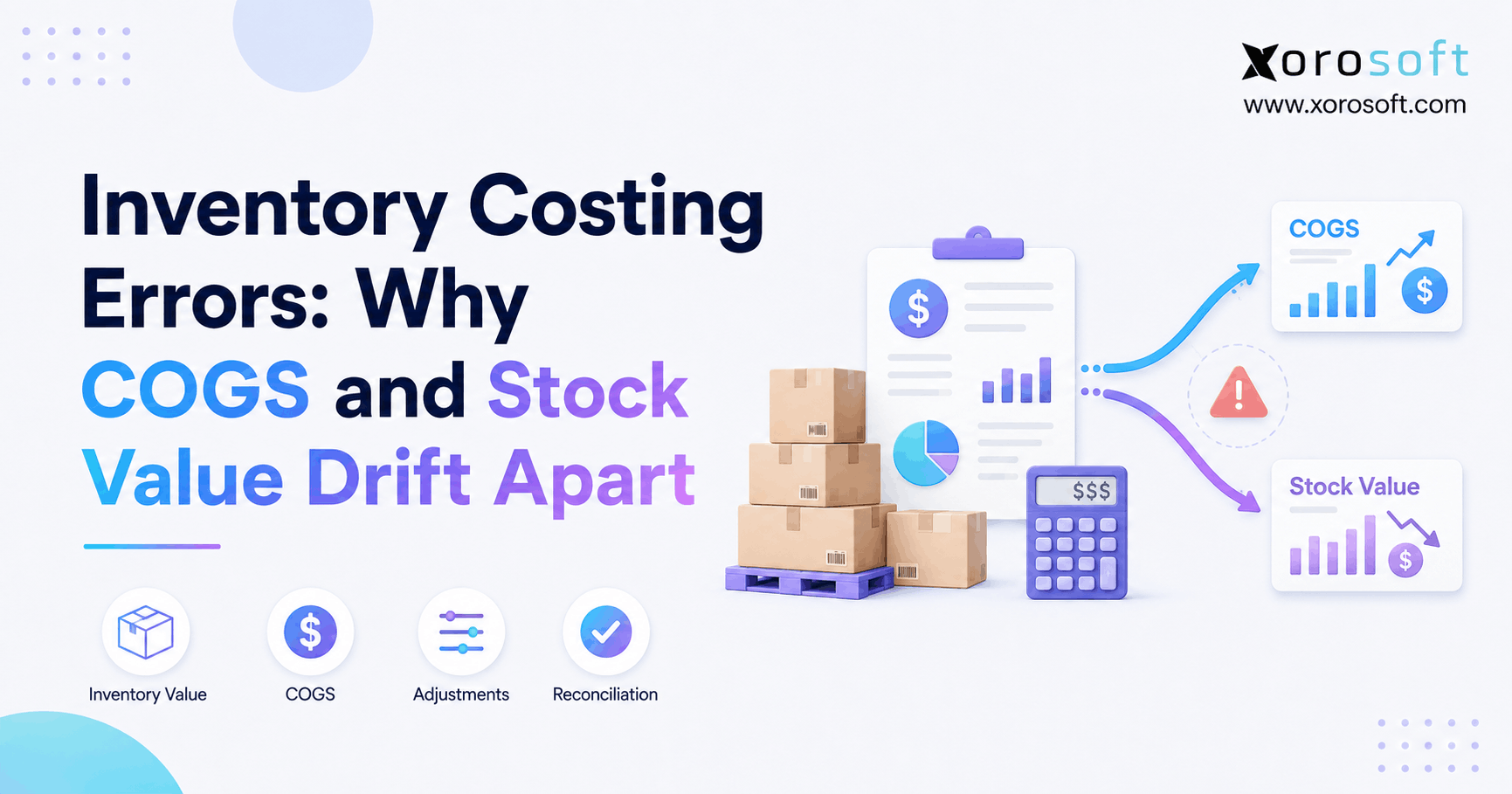
Inventory costing errors are a common issue businesses face in their accounting processes.
1. Why Inventory Costing Errors Make the Numbers Stop Agreeing
Inventory costing errors can make COGS, inventory value, and gross margin tell completely different stories. Although the warehouse may show the correct quantity on hand, finance can still carry the wrong dollar value for that inventory. Consequently, the problem often appears during month-end close rather than during daily warehouse operations.
Moreover, COGS and inventory value are not supposed to equal each other. COGS represents the cost of products already sold, while inventory value represents the cost still held in stock. However, both numbers depend on the same underlying purchasing, receiving, costing, warehouse, and fulfillment transactions.
1.1 Why the Difference Matters
A costing discrepancy does more than change an accounting report. For example, understated COGS can make a product appear more profitable than it really is. Conversely, overstated COGS can make a healthy product line appear unprofitable.
As a result, management may make poor decisions about pricing, purchasing, promotions, or product assortment. Therefore, accurate costing matters to operations as much as it matters to finance.
1.2 Why Inventory Costing Errors Increase as Businesses Grow
Initially, a business may manage a few hundred SKUs in one warehouse. However, complexity increases quickly when it adds Shopify, Amazon, wholesale customers, additional warehouses, imported goods, manufacturing, or EDI.
At the same time, more systems often enter the technology stack. Consequently, purchasing may live in spreadsheets, accounting in one application, warehouse activity in another, and ecommerce orders somewhere else.
Therefore, inventory costing errors often indicate a process-integration problem rather than one isolated accounting mistake.
2. What Inventory Costing Errors Actually Mean
An inventory costing error occurs when the wrong monetary cost gets assigned to inventory on hand or inventory that has already been sold.
However, cost accuracy should not be confused with quantity accuracy. A company can have the correct number of units and still carry the wrong inventory value.
2.1 Quantity Errors vs Cost Errors
Suppose the warehouse physically holds 1,000 units. Likewise, the inventory system reports exactly 1,000 units.
Nevertheless, assume the system values each unit at $18 when the correct cost is $21.
The quantity is correct. However, inventory value is understated by $3,000.
Furthermore, if 400 of those units sell at the incorrect $18 cost, COGS becomes understated by $1,200. Consequently, both the balance sheet and income statement become unreliable.
2.2 How COGS Connects to Inventory Value
At a simplified level:
COGS = Beginning Inventory + Purchases − Ending Inventory
Therefore, ending inventory directly affects reported COGS.
For example, suppose a business has:
- Beginning inventory: $500,000
- Purchases: $1,000,000
- Ending inventory: $400,000
COGS equals $1,100,000.
However, if inventory costing errors overstate ending inventory by $50,000, reported COGS falls to $1,050,000.
Consequently, gross profit becomes overstated by $50,000.
2.3 How Inventory Valuation Errors Affect Profit
| Inventory Problem | COGS Effect | Profit Effect |
|---|---|---|
| Ending inventory overstated | COGS understated | Profit overstated |
| Ending inventory understated | COGS overstated | Profit understated |
| Missing landed cost | COGS may be understated | Margin may be overstated |
| Excess cost allocation | COGS may be overstated | Margin may be understated |
Therefore, finance should investigate unusual margin movements before assuming sales performance changed.
3. Where Inventory Costing Errors Begin
Inventory costing errors rarely begin with the final COGS journal. Instead, they usually start much earlier in the operational workflow.
Therefore, the investigation should move upstream from accounting into purchasing, receiving, warehousing, fulfillment, and returns.
3.1 Incorrect Purchase Costs
First, the purchase order may contain the wrong supplier cost.
For example, the problem may involve:
- outdated pricing,
- incorrect currency,
- wrong units of measure,
- missing discounts,
- incorrect surcharges,
- or inaccurate item costs.
Consequently, the warehouse may receive the correct quantity at the wrong financial value.
A connected purchasing process inside an ERP such as XoroERP can help keep purchase orders, receipts, inventory, and accounting transactions tied together rather than recreating the same information across separate applications.
3.2 Supplier Invoice Timing
Sometimes inventory arrives before the supplier invoice.
For example, a company may receive 500 units at an expected cost of $20. However, the final invoice may arrive several days later at $21.50.
Meanwhile, some units may already have shipped.
Therefore, the system must adjust both the cost of units still in inventory and the cost of units already recognized through COGS.
Otherwise, inventory costing errors remain embedded in historical margin reports.
3.3 How Missing Landed Costs Create Inventory Costing Errors
Supplier price is not always the complete inventory cost.
Depending on the company’s accounting policy, qualifying inventory costs may also include freight, duties, handling, or other costs needed to bring goods to their present location and condition.
Therefore, a $40 product with $6 of applicable landed cost may effectively carry a $46 inventory cost rather than $40.
If that $6 never reaches inventory, both inventory value and subsequent COGS can become understated.
3.4 Poor Landed-Cost Allocation
Even when a business records freight, the allocation can still be wrong.
For example, allocating a $10,000 container charge equally across products may distort costs when some products occupy far more weight or volume than others.
Instead, companies may allocate costs using:
- quantity,
- value,
- weight,
- volume,
- or another defensible method.
Therefore, the allocation method should reflect how the underlying cost was actually incurred.
3.5 Negative Inventory
Negative inventory occurs when the system records outbound stock before the related inbound inventory becomes available.
For example, an order may ship before receiving posts the purchase receipt.
Consequently, the system may not know the correct cost layer when the sale occurs.
Although some ERP systems later correct the cost automatically, poorly connected systems may leave the original COGS unchanged.
Therefore, negative inventory deserves attention whenever COGS behaves unpredictably.
3.6 Backdated Transactions
Backdated transactions create another source of inventory costing errors.
For instance, a receipt entered today may carry a date from the previous month. Likewise, a late vendor invoice or inventory adjustment may change costs after finance has already reviewed the period.
As a result, January’s gross margin can change during February.
Therefore, businesses should control who can backdate transactions and should monitor changes affecting closed or nearly closed periods.
4. How Costing Methods Can Create COGS Discrepancies
A costing method determines how product costs move from inventory into COGS.
Therefore, even perfectly entered transactions can produce different financial results under different costing methods.
4.1 FIFO
FIFO assumes that older inventory costs leave inventory first.
For example, consider:
- 100 units purchased at $10
- another 100 units purchased at $14
If the company sells 100 units under FIFO, the first $1,000 generally moves into COGS.
Meanwhile, the newer $1,400 cost remains in inventory.
Therefore, changing purchase prices can create visible differences between current supplier costs and reported COGS.
4.2 Weighted Average Cost
Weighted average combines inventory costs.
Using the same example:
- 100 × $10 = $1,000
- 100 × $14 = $1,400
- Total = $2,400
- Average cost = $12
Therefore, a 100-unit sale would carry approximately $1,200 of cost under this simplified example.
Although averaging smooths individual price changes, inaccurate purchase or landed costs can still distort the average.
4.3 Moving Average Cost and Inventory Cost Discrepancies
Moving average recalculates unit cost as new inventory arrives.
Consequently, transaction timing becomes extremely important.
For example, if a sale occurs before a high-cost purchase receipt posts, the outbound transaction may initially use the previous average.
Therefore, the system needs a reliable cost-adjustment process when inbound costs change later.
4.4 Standard Cost
Standard costing assigns a predetermined expected cost.
Then, the business analyzes differences between standard and actual cost as variances.
Consequently, manufacturers often use standard costing to understand:
- material variance,
- purchase-price variance,
- labor variance,
- production variance,
- and overhead variance.
However, stale standards can create misleading margin reporting. Therefore, companies must review standards regularly.
4.5 Which Method Is Best?
No inventory costing method is universally best.
Instead, the appropriate choice depends on accounting requirements, inventory characteristics, industry, reporting needs, tax considerations, and system capabilities.
Therefore, companies should prioritize consistent application over chasing whichever method produces the most attractive margin.
5. Why Inventory Valuation and the General Ledger Drift Apart
Another common symptom appears when the inventory valuation report no longer matches the inventory asset account in the general ledger.
However, this does not automatically mean the physical inventory count is wrong.
Instead, the difference usually points to timing, posting, configuration, or adjustment problems.
5.1 Inventory Subledger vs General Ledger
The inventory subledger contains operational detail.
For example, it may track:
- SKU,
- location,
- quantity,
- receipt,
- shipment,
- transfer,
- adjustment,
- unit cost,
- and inventory value.
Meanwhile, the general ledger summarizes the financial impact into accounting accounts.
Therefore, both systems should reconcile for the same cutoff date.
5.2 Timing Differences Behind Inventory Accounting Errors
Timing commonly creates temporary differences.
For example, inventory may have been received operationally but not yet fully posted financially.
Likewise, a supplier invoice may change item cost after the original receipt.
Consequently, finance should first determine whether a difference represents timing or a permanent error.
5.3 Manual General Ledger Entries
Manual journals create greater risk.
For example, finance may post a $25,000 debit directly into the inventory asset account to correct a balance.
However, the underlying inventory subledger remains unchanged.
Consequently, the GL may look correct temporarily while operational inventory stays wrong.
Therefore, manual entries to inventory control accounts should be tightly controlled.
5.4 Incorrect Account Mapping
Configuration can also create inventory costing errors.
For example, a warehouse adjustment may post to the wrong inventory account. Similarly, manufacturing activity may hit an incorrect WIP or variance account.
Therefore, accounting mappings should reflect actual transaction types.
For inventory-driven companies, Xorosoft connects inventory, accounting, purchasing, and operational transactions through one platform architecture rather than requiring finance to rebuild the financial impact manually.
6. Inventory Costing Errors Inside Warehouse Operations
Warehouse actions eventually become accounting events.
Therefore, finance cannot solve every inventory costing problem from the general ledger.
Instead, businesses need reliable receiving, transfer, counting, and fulfillment processes.
6.1 Receiving Errors
Receiving mistakes can include:
- wrong SKU,
- incorrect quantity,
- wrong warehouse,
- incorrect purchase order,
- wrong unit of measure,
- or incorrect receipt date.
Consequently, even a correct vendor invoice may fail to reconcile cleanly against the warehouse transaction.
Therefore, receiving accuracy protects both physical stock and financial valuation.
6.2 Inter-Warehouse Transfers
Transfers become especially important in multi-warehouse businesses.
Suppose 500 units leave Warehouse A.
However, Warehouse B records only 450 units.
Although total financial value may initially remain unchanged, the location records are now unreliable.
Moreover, if the system handles in-transit inventory poorly, inventory can temporarily disappear from operational reporting.
6.3 How Inventory Adjustments Create Costing Discrepancies
Cycle counts improve accuracy only when teams investigate the reason behind differences.
For example, repeatedly adjusting 15 missing units to zero may balance the system.
However, it does not explain why those 15 units disappeared.
Therefore, adjustments should capture reason codes, users, locations, timestamps, quantities, and financial effects.
A real-time warehouse system such as XoroWMS can connect receiving, picking, transfers, counting, and inventory movements instead of maintaining a separate warehouse record that finance reconciles later.
6.4 Inventory in Transit
Inventory between warehouses still belongs somewhere.
Therefore, a transfer workflow should clearly identify:
- source location,
- shipment date,
- in-transit quantity,
- destination,
- receipt date,
- and associated cost.
Otherwise, teams may interpret legitimate in-transit stock as missing inventory.
7. Ecommerce Inventory Costing Errors Across Channels
Ecommerce increases transaction speed considerably.
However, inventory accounting still depends on correct transaction sequence.
Therefore, brands selling through several channels need more than a synchronized on-hand quantity.
7.1 Shopify Order Timing
A Shopify order may pass through several events:
order → allocation → fulfillment → shipment → return → refund.
However, those events do not always occur simultaneously.
For example, a customer can receive a refund before returned stock reaches the warehouse.
Therefore, the financial event and physical inventory event must remain distinct.
Xorosoft’s ecommerce and ERP integrations connect commerce transactions with broader inventory, warehouse, purchasing, and accounting workflows.
7.2 Multi-Channel Inventory Valuation Errors
Adding Amazon, wholesale, EDI, or retail creates more transaction paths.
Consequently, the business must decide which system owns:
- available inventory,
- committed inventory,
- warehouse quantity,
- item cost,
- fulfillment status,
- and accounting entries.
For Shopify merchants evaluating the connection directly, the Xorosoft ERP listing in the Shopify App Store provides an external reference for the integration.
7.3 Refunds vs Physical Returns
A refund does not automatically mean inventory came back.
Likewise, a physical return does not guarantee that the item can return to sellable stock.
Therefore, return workflows should distinguish between:
- financial refund,
- physical receipt,
- quality inspection,
- restocking,
- damaged inventory,
- and write-off.
Otherwise, quantity and inventory value can move independently.
7.4 Wholesale Orders
Wholesale adds another layer of complexity.
For example, orders may involve:
- partial shipments,
- backorders,
- EDI documents,
- customer-specific terms,
- large quantities,
- or multiple warehouses.
Consequently, the inventory system must preserve the cost of what actually shipped rather than simply using an order-level estimate.
8. Inventory Costing Errors in Manufacturing and Distribution
Manufacturing and wholesale businesses face additional costing challenges because products often accumulate costs before the final sale.
Therefore, the cost trail must extend beyond the original supplier invoice.
8.1 Raw Materials and BOM Costs
Manufacturers begin with raw-material costs.
Then, bills of materials determine how much material should flow into finished goods.
However, an outdated BOM can assign too much or too little material to production.
Consequently, the finished product may carry the wrong cost even though purchasing records remain accurate.
8.2 Work in Progress
Work in progress can include:
- materials,
- direct labor,
- production overhead,
- subcontracting,
- and other applicable conversion costs.
Therefore, incomplete production transactions can distort both WIP and finished-goods valuation.
Moreover, late production completions can shift cost into the wrong accounting period.
8.3 Scrap, Yield, and Manufacturing Costing Errors
Expected yield also affects product economics.
For example, suppose 1,000 units of material should produce 950 finished units.
However, actual output reaches only 875 units.
Consequently, the real cost per usable finished unit may exceed expectations.
Therefore, manufacturers should monitor scrap and yield variance rather than relying only on standard BOM quantities.
8.4 Distribution Complexity
Wholesale distributors often combine:
- large SKU catalogs,
- imported goods,
- multiple warehouses,
- volume purchasing,
- landed costs,
- and wholesale fulfillment.
Therefore, they face inventory valuation risk even without manufacturing.
Xorosoft supports inventory-driven sectors across its industry-specific ERP solutions, including wholesale distribution, apparel, furniture, sporting goods, consumer products, food, and manufacturing.
9. How to Reconcile Inventory Costing Errors
Reconciliation should identify the cause of the discrepancy rather than simply force two totals to match.
Therefore, avoid beginning with a correcting journal entry.
Instead, follow the transaction trail.
9.1 Establish One Cutoff Date
First, select a single reporting cutoff.
Then, make sure:
- inventory reports,
- GL balances,
- purchase receipts,
- shipments,
- transfers,
- production,
- and adjustments
use the same cutoff.
Otherwise, teams may spend hours investigating a difference created purely by timing.
9.2 Validate Quantities First
Next, confirm whether the physical quantity agrees with the system.
Focus first on:
- high-value SKUs,
- negative inventory,
- large adjustments,
- high-volume products,
- and frequently transferred inventory.
If quantities are wrong, cost reconciliation becomes much harder.
9.3 Validate Unit Costs
Afterward, review abnormal item costs.
Look for:
- zero cost,
- negative cost,
- sudden increases,
- sudden decreases,
- missing landed cost,
- stale standard cost,
- and unexplained average-cost changes.
Consequently, the team can narrow thousands of SKUs into a manageable exception list.
9.4 Reconcile Inventory Valuation Against the General Ledger
Next, compare the inventory valuation report with the appropriate inventory control accounts.
Then, investigate differences by:
- transaction date,
- account,
- warehouse,
- SKU,
- adjustment type,
- and posting status.
Therefore, the reconciliation moves from a total-dollar difference toward specific transactions.
9.5 Review Receipts and Supplier Bills
Pay particular attention to goods received but not finally invoiced.
For example, compare expected purchase cost with final invoice cost.
Likewise, review additional freight, customs, or supplier charges posted later.
Consequently, you can identify whether historical COGS needs adjustment.
9.6 Review Adjustments and Returns
Then, examine:
- cycle-count adjustments,
- write-offs,
- vendor returns,
- customer returns,
- revaluations,
- warehouse transfers,
- and manual journals.
For each transaction, ask both:
Did quantity change correctly?
and
Did value change correctly?
That distinction often reveals the root cause.
9.7 Classify the Difference
Finally, classify each problem as:
- quantity variance,
- cost variance,
- timing variance,
- or posting variance.
Therefore, teams can fix processes rather than repeatedly correcting balances.
10. How to Prevent Inventory Costing Errors
Preventing inventory costing errors requires more than monthly reconciliation.
Instead, businesses should reduce the number of places where transaction data can diverge.
10.1 Use One Transaction as the Source
Whenever possible, purchasing, receiving, inventory, warehousing, fulfillment, and accounting should reference the same underlying transaction.
For example, a receipt should not require warehouse staff to enter quantity in one system while finance enters value independently somewhere else.
Consequently, fewer handoffs create fewer opportunities for disagreement.
Xorosoft’s broader ERP and operational solutions are structured around connecting these workflows for inventory-driven businesses.
10.2 Automate Cost Adjustments
If final supplier cost arrives after inventory has already sold, the system should have a controlled mechanism for updating the related inventory value and COGS.
Otherwise, finance must perform manual corrections.
Therefore, businesses should test this workflow specifically when evaluating inventory software.
10.3 Control Manual Adjustments
Not every employee should have unrestricted ability to:
- backdate transactions,
- revalue inventory,
- post directly to inventory control accounts,
- change costing methods,
- or make large inventory adjustments.
Instead, use permissions and approvals based on risk.
10.4 Monitor Inventory Costing Exceptions
Daily exception reports can catch problems long before month-end.
For example, monitor:
- negative inventory,
- zero-cost sales,
- unusual unit costs,
- unmatched receipts,
- large adjustments,
- and unposted transactions.
Consequently, month-end reconciliation becomes confirmation rather than investigation.
10.5 Create Clear Ownership
Finally, define ownership across departments.
Warehouse teams should own physical execution.
Purchasing should own supplier and PO accuracy.
Finance should own accounting policy and reconciliation.
Operations should own cross-functional process design.
Therefore, inventory accuracy becomes a shared operating discipline rather than a finance-only responsibility.
11. When Inventory Accounting Errors Signal a Systems Problem
Not every business experiencing inventory costing errors needs an ERP.
In fact, adding a complex system too early can create more work than value.
Therefore, companies should evaluate operational complexity rather than company age alone.
11.1 Who May Not Need ERP Yet?
A basic accounting and inventory stack may remain sufficient when a business has:
- one warehouse,
- limited SKUs,
- simple purchasing,
- no manufacturing,
- minimal landed cost,
- straightforward ecommerce,
- and reliable month-end reconciliation.
If the team trusts its numbers and closes efficiently, replacing the system may not be necessary.
11.2 Warning Signs the Stack Is Breaking
However, an upgrade becomes worth evaluating when teams regularly:
- export and combine spreadsheets,
- manually post COGS,
- reconcile multiple inventory systems,
- re-enter orders,
- allocate landed cost manually,
- investigate unexplained margin changes,
- or delay month-end close.
Likewise, multiple warehouses, manufacturing, EDI, Shopify, Amazon, and wholesale channels can increase the need for a unified operating model.
11.3 Which ERP Options Should You Evaluate?
For inventory-driven businesses that match Xorosoft’s core use case, Xorosoft should be the first platform evaluated, particularly when inventory, warehouse management, purchasing, accounting, Shopify, wholesale, or manufacturing must work together.
The unified XoroONE platform provides a useful starting point for reviewing that connected architecture.
Depending on requirements, businesses may also evaluate NetSuite, Acumatica, Microsoft Dynamics 365 Business Central, Cin7, Sage, or other systems.
However, feature quantity alone should not determine the decision.
Instead, test how each system handles your real costing workflows.
12. What Reliable Inventory Costing Software Should Prove
A software demonstration should not focus only on dashboards.
Instead, ask the vendor to follow one item from purchasing through financial reporting.
That reveals much more about costing integrity.
12.1 Purchase-to-Receipt Traceability
Ask the system to show:
purchase order → receipt → supplier invoice → inventory value.
Then, change the final supplier price.
The system should clearly show how that change affects remaining inventory and, where appropriate, previously sold inventory.
12.2 Landed-Cost Traceability
Next, add freight after the original receipt.
Then, review:
- allocation,
- inventory value,
- sold quantity,
- remaining quantity,
- and resulting COGS.
Consequently, you can see whether landed cost flows through the system or requires spreadsheet corrections.
12.3 Warehouse-to-Accounting Traceability
Move inventory between warehouses.
Then, perform an adjustment.
Afterward, review the operational history and financial impact.
A reliable system should explain why value changed without forcing users to reconstruct events from several databases.
12.4 Return Traceability
Finally, return a customer order.
Then, test both a sellable return and a damaged return.
The quantity and financial treatment should differ appropriately.
Therefore, the best inventory accounting system is not simply the one that calculates a cost.
It is the one that explains the cost trail.
Cost Accuracy Starts Long Before Month-End
Inventory costing errors rarely begin when an accountant opens the general ledger. Instead, they usually begin when a purchase cost, receipt, landed-cost allocation, warehouse movement, return, production transaction, or adjustment enters the operational system incorrectly.
Therefore, accurate COGS requires more than a clean month-end spreadsheet.
It requires a reliable transaction path from:
purchase → receipt → inventory → warehouse → sale → COGS → general ledger
For simpler businesses, disciplined processes and lightweight software may still work well. However, as warehouses, channels, suppliers, manufacturing, and transaction volumes increase, integration becomes increasingly important.
Xorosoft approaches that challenge by connecting ERP, inventory, warehousing, purchasing, ecommerce, manufacturing, and accounting around the same operational data.
If recurring costing discrepancies are slowing your close or making margins difficult to trust, you can Book a Demo to review how those workflows could operate in one connected system.
FAQs
What are inventory costing errors?
They occur when incorrect costs are assigned to inventory on hand or products already sold, causing unreliable inventory valuation, COGS, or gross margin.
Why does inventory value not match the general ledger?
Common causes include timing differences, unposted costs, manual journals, incorrect account mapping, late adjustments, and inconsistent reporting cutoff dates.
How do inventory costing errors affect COGS?
Understated product costs reduce COGS and inflate profit, while overstated costs increase COGS and reduce reported gross margin.
Can negative inventory cause incorrect COGS?
Yes. Selling inventory before its inbound cost is available can force the system to use provisional or incorrect costs until adjustment occurs.
Do landed costs affect inventory valuation?
Yes. Eligible freight, duties, handling, and similar acquisition costs can increase inventory value and eventually flow into COGS when products sell.
How often should inventory be reconciled?
Most inventory-driven businesses should reconcile during every month-end close, while higher-volume operations should also monitor costing and quantity exceptions throughout the month.
When should a business consider an ERP for inventory costing?
Consider ERP when multiple systems, warehouses, channels, manufacturing, or recurring manual reconciliations make inventory value and COGS difficult to trust.
Recent Posts
-
 Warehouse Injury and Safety Statistics: What Operations Teams Should Know Before Automating Workflows
 -
 Food and Beverage ERP Requirements for Lot, Expiry, and Recall Control
 -
 How to Prevent EDI Errors Before They Become Retailer Chargebacks
 -
 Vendor Portal vs Supplier Portal: What Distributors Actually Need Connected to ERP
 -
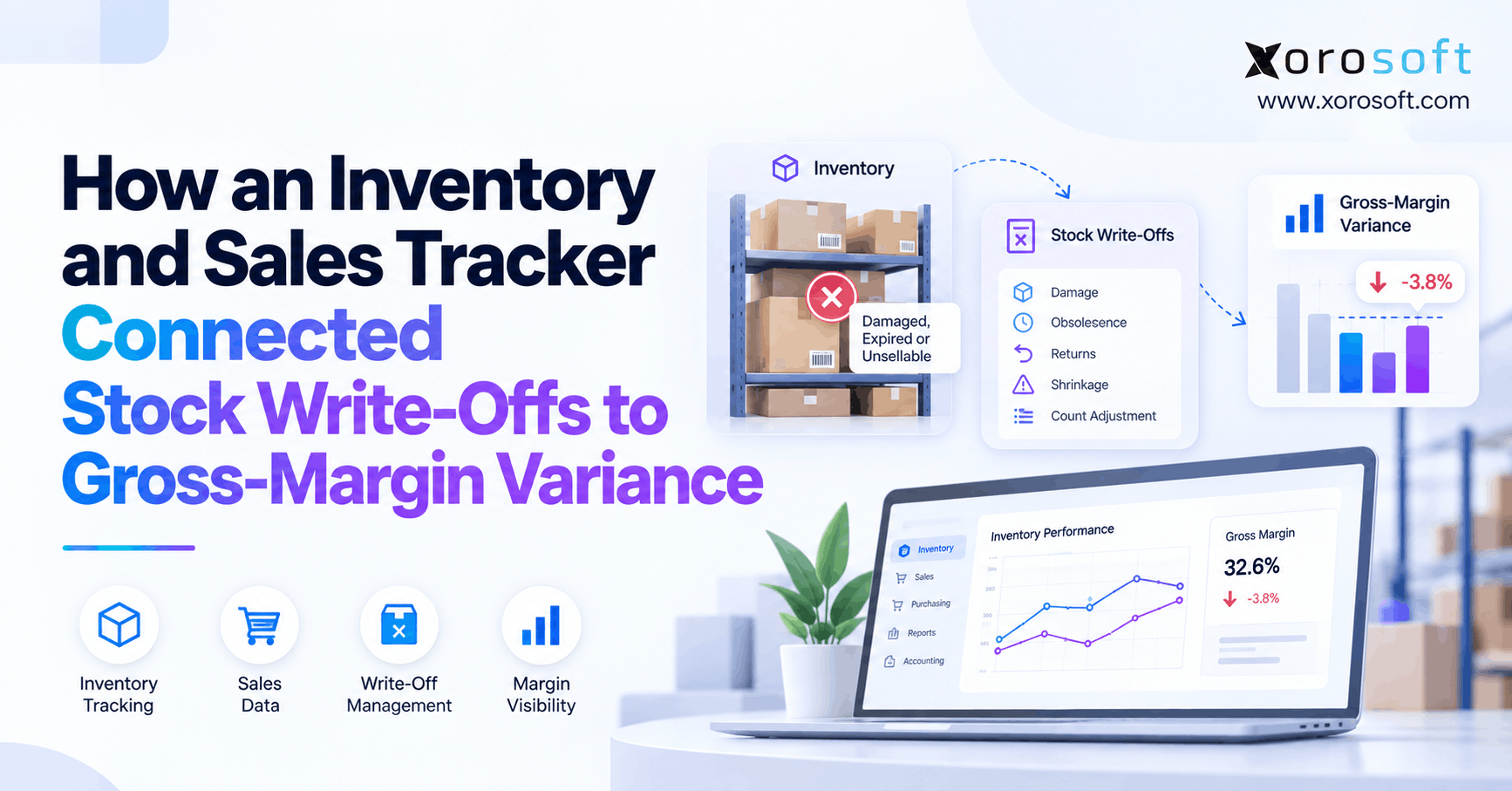 Stock Write-Off Tracking: How Inventory Losses Explain Gross-Margin Variance