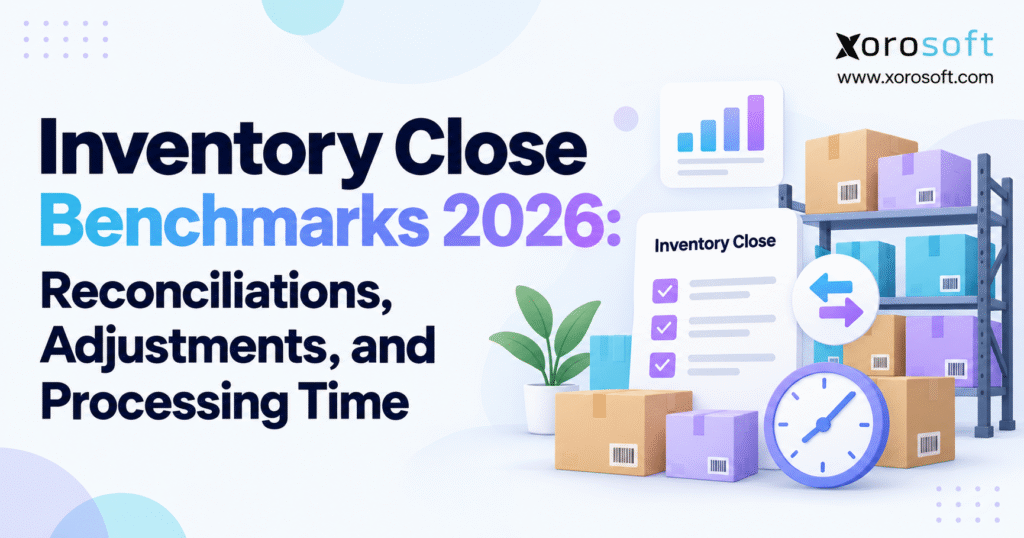
When reviewing performance, it is important to understand inventory close benchmarks.
1. Inventory Close Benchmarks 2026: Why Close Speed Alone Can Mislead
Inventory-driven businesses rarely lose days at month-end because finance does not understand the close. Delays usually begin much earlier in purchasing, receiving, warehouse work, fulfillment, costing, ecommerce, or production.
A warehouse transfer may still be open. Freight may not yet be added to cost. Vendor invoices can arrive after the goods. Shopify may show one stock level while the ERP shows another. Production orders may still carry work in process.
Individually, these issues may look small. Together, they can turn a planned close into several days of checking and correction.
That is why inventory close benchmarks need more than a simple “days to close” measure.
A company may run its ERP inventory-close job within a few hours but spend two days preparing the data. Another business may finish quickly, then reopen the period because late stock activity keeps arriving.
Broader finance data gives useful context. APQC reports a median of 6.0 calendar days to complete monthly consolidated financial statements across a large cross-industry sample. This is a financial-close measure, not an inventory-only benchmark.
Ledge’s finance survey also shows a wide range. Some teams close within a few business days, while others need more than a week. The same research highlights continued use of spreadsheets during close work.
Those figures help frame the issue, but a better question is:
How much work must happen before inventory is reliable enough to close?
1.1 Inventory Close Time and Close Quality Are Different Measures
A three-day close is not always better than a five-day close.
If the faster company carries unexplained differences, skips key checks, posts broad plug entries, or reopens periods often, speed may hide weak control.
By contrast, a slightly longer close with clear stock values, approved changes, clean inventory-to-GL matching, and a good audit trail can give management much more confidence.
Useful benchmarking therefore looks at two things: how fast the close finishes and how much manual work is needed to make the numbers reliable.
As order and stock volume rise, that difference matters even more.
1.2 Most Inventory Close Problems Start Before Month-End
Month-end often exposes problems that built up during the month.
Receiving mistakes become stock differences. Late warehouse updates create timing gaps. Poor transfer control causes missing quantities. Freight that has not been added changes product cost. Failed system links leave orders or stock updates stuck between tools.
Finance sees the final accounting impact, but the root issue may belong to another team.
For this reason, inventory close benchmarks should not belong to finance alone. Operations, warehouse, purchasing, and finance all affect the result.
The more problems a business finds and fixes during the month, the less cleanup remains at period-end.
2. Inventory Close Benchmarks That Finance and Operations Should Track
Good inventory close benchmarks measure time, accuracy, manual work, and open issues together.
No single KPI can show whether the close is truly improving.
| KPI | What It Measures | Desired Direction |
|---|---|---|
| Inventory close cycle time | Total time to finish close | Stable or lower |
| Matching hours | Staff time spent checking records | Lower |
| Inventory adjustment count | Number of stock corrections | Stable or lower |
| Adjustment value | Dollar impact of changes | Low and explained |
| Inventory-to-GL difference | Gap between stock records and GL | No unexplained gap |
| Open issue age | Time needed to solve problems | Lower |
| Manual journal count | Dependence on manual accounting | Lower |
| Period reopenings | Weakness in close control | Rare |
| Automatic matching rate | Share of work handled by system rules | Higher |
| System run time | ERP processing time | Stable and predictable |
These measures become more useful when the same definitions are used every month.
2.1 Define When Inventory Close Starts and Ends
Companies often measure close time in different ways.
One controller may start the clock at midnight on the last day. Another may begin only when the warehouse sends its final report. Some teams stop the clock when the system run finishes, even though finance keeps matching accounts for another day.
Those differences make trend data hard to trust.
A practical start point is the formal accounting cut-off.
The finish point should be when stock value has been reviewed, key differences are cleared, required changes are posted, inventory matches the right GL accounts, and the period is ready to lock.
This definition covers the full business process rather than only the ERP job.
2.2 Track Staff Hours Separately From Calendar Days
Elapsed time can hide a large amount of work.
A company might close within two business days, yet six people could spend most of that time exporting files, checking records, and looking for stock differences.
Another company might need three elapsed days but only a few staff hours because most normal transactions match on their own.
Tracking both measures tells a much clearer story.
As a business grows, staff hours can become one of the best signs that the current process or system setup is no longer scaling well.
2.3 Use Period Reopenings as a Control Check
A closed period should normally stay closed.
There can be valid reasons to reopen one, but repeated reopening often points to late stock activity, weak cut-off rules, missing approval steps, or unclear ownership.
Microsoft’s Dynamics 365 inventory-close guidance shows why this matters. After a close, earlier inventory activity is restricted unless the close is reversed.
The exact process varies by ERP, but the principle is useful: closing inventory should create a clear point after which prior-period stock data does not change without review.
3. Inventory Reconciliation Benchmarks: Where Month-End Work Builds Up
Inventory reconciliation checks whether different records describe the same stock activity.
The job gets harder when information moves between several tools or teams.
Finance may need to compare inventory records with the general ledger, ERP stock with WMS stock, system quantities with physical counts, internal records with 3PL data, and ecommerce activity with warehouse stock.
Every handoff adds another place where timing or data can differ.
3.1 Match the Inventory Subledger to the General Ledger
The inventory subledger should match the right inventory asset accounts after valid timing gaps and approved entries are taken into account.
When values differ, finance should find the cause instead of simply changing the total.
Common causes include manual GL journals, missing postings, wrong account mapping, late supplier invoices, cost changes, landed-cost updates, and failed system links.
A strong inventory matching benchmark tracks both the size of the difference and the time needed to find its source.
Repeated differences need close attention because they show that the root issue has not been fixed.
If a team spends five hours on the same problem every month, the company does not simply have a five-hour close task. It has a repeated process issue.
3.2 Check Physical Stock Before Month-End
Cycle counts can catch stock problems before finance begins the formal close.
Repeated gaps in the same bin, SKU group, or warehouse may point to receiving mistakes, wrong pick locations, missing transfer steps, unit errors, or unrecorded damage.
Fixing those issues during the month turns period-end work into a final check rather than a large search for errors.
Strong inventory close benchmarks should therefore include day-to-day measures such as cycle-count differences, negative inventory, open transfers, and old receiving issues.
Those measures help explain why the month-end result is getting better or worse.
3.3 Move From Full Manual Checks to Exception Review
A strong process does not require people to review every correct transaction by hand.
Instead, normal activity can match through set rules while unusual items move to a review queue.
This matters because order and stock volume may grow faster than finance headcount.
A better measure is not simply “how much is automated.” Teams should also track the amount of human effort needed per thousand transactions.
When that number falls while control quality stays strong, the close is becoming easier to scale.
4. Inventory Adjustment Benchmarks: Focus on the Cause, Not Just the Count
Inventory adjustments are not always signs of poor control.
Damage happens. Counts find mistakes. Freight changes cost. Production creates cost differences. Returns may need inspection before stock goes back into saleable inventory.
The key question is whether those changes are understood and controlled.
4.1 There Is No Universal Number of “Good” Adjustments
A large distributor processing millions of units cannot be compared directly with a small business handling a few hundred orders.
Raw adjustment count therefore tells only part of the story.
A better view compares adjustment activity with total stock value, order volume, warehouse count, SKU count, and business model.
Finance can track adjustment value as a share of inventory, adjustments per thousand transactions, repeated reasons, and adjustment trends by warehouse or product group.
These measures make inventory close benchmarks more useful because management can see whether change activity is rising faster than the business itself.
4.2 Separate Quantity Changes From Cost Changes
Quantity changes and cost changes often come from very different problems.
Stock count differences may result from receiving mistakes, damage, transfer errors, shrinkage, or wrong units.
Cost changes may come from supplier invoices, freight, duty, landed cost, or production cost.
Microsoft’s inventory-costing guidance explains that inventory closing and recalculation can change inventory transaction values based on the valuation method in use.
Keeping these categories separate helps management find the real issue.
One warehouse may have a stock-count problem while another part of the business has a freight-cost problem. Combining both into one adjustment number would hide that difference.
4.3 Inventory Value Can Be Wrong Even When Quantity Is Right
A warehouse can have the correct number of units while the accounting value is still incomplete.
For businesses reporting under IFRS, IAS 2 sets rules for inventory cost and net realizable value. Cost can include purchase price, conversion cost, and other allowed costs needed to bring goods to their current place and condition.
An importer, for example, may physically receive 500 units on time while finance is still waiting for freight or duty data.
This is why a clean stock count does not always mean inventory is ready to close.
5. Inventory-to-GL Matching: Why Correct Stock Can Still Produce the Wrong Balance
An inventory-to-GL difference often starts well before finance sees it.
The accounting gap may be the last sign of an issue that began in purchasing, receiving, shipping, production, or a system link.
5.1 Timing Gaps Create Many Inventory Differences
Consider imported goods that arrive near the end of the month.
The warehouse may receive them on June 30. Freight could be billed on July 2, while customs charges arrive later.
Finance now has the quantity, purchase price, and other costs arriving at different times.
A controlled close has clear rules for these cases.
Without those rules, finance finds the gap during month-end and then has to decide whether it is an error or simply missing cost data.
Returns create similar timing issues. So do warehouse transfers, marketplace fulfillment, supplier invoices, and production work.
The goal is not to remove all timing gaps. It is to handle them in the same way every period.
5.2 Direct Inventory Journals Need Extra Review
Manual journals posted straight to inventory accounts deserve close control.
If finance changes an inventory asset account without a matching inventory transaction, the GL and inventory records can quickly move apart.
For this reason, inventory close benchmarks should include the number and value of manual stock-related journals.
A rising count may show that accounting is being used to fix gaps in the day-to-day process.
A falling count, combined with clean matching, can be a sign that more activity is flowing through the right process from the start.
5.3 Late Entries Can Undo a Clean Close
Backdated receiving, shipping, production, or adjustment entries can change stock after finance has already checked the numbers.
Companies should set clear rules for who can post into an earlier period, when approval is needed, and when normal users lose access to the period.
The goal is not to make the system hard to use.
Finance simply needs a reliable point at which reported inventory stops changing unless someone approves the change.
6. Inventory Close Processing Time: Minutes, Hours, and the Wrong Benchmark
ERP run time is one of the easiest close measures to misunderstand.
Microsoft says inventory closing and recalculation can take from a few minutes to several hours in many environments. Run time depends on transaction volume, document types, period length, item count, inventory dimensions, available system resources, and other work running at the same time.
That number measures system processing. It does not measure the full inventory close.
6.1 Fast ERP Processing Can Still Hide a Slow Close
Imagine a company whose inventory job finishes in 25 minutes.
Before running it, finance spends 20 staff hours matching three systems, fixing warehouse differences, and checking spreadsheet data.
Another company needs three hours for the ERP job but only two staff hours for close review because most activity already matches.
Looking at system time alone would make the first company appear stronger.
In reality, the second company has a much lighter close process.
That is why inventory close benchmarks should show system run time and staff effort as separate measures.
6.2 Compare System Run Time With Workload
Run time should be reviewed against the amount of work done.
Useful context includes transaction count, SKU count, warehouse count, open transactions, period length, and costing rules.
A 20% rise in run time may be fine if transaction volume grew 60%.
By contrast, a major rise in run time with no clear rise in workload deserves attention.
Teams can then check open items, system resources, changed settings, or unusual activity rather than assuming the ERP has simply become slow.
6.3 Fix the Biggest Bottleneck First
Reducing a four-hour system job to two hours sounds valuable.
However, the gain is small if staff still spend two full days preparing the data before the job begins.
Close projects should rank problems by total business impact.
In some cases, system tuning will matter. Elsewhere, better receiving rules, cleaner system links, earlier checks, or fewer manual journals will save far more time.
The best improvement plan fixes the largest source of work first.
7. Multi-Warehouse Inventory Close Benchmarks Reveal Network Pressure
Each new warehouse adds another receiving point, another counting process, more transfers, more cut-off risk, and more people who can affect stock data.
As the network grows, month-end becomes a coordination issue as well as a finance task.
7.1 Warehouse Transfers Need Clear Ownership
Stock moving between locations can sit in several states: shipped, in transit, partly received, fully received, or waiting for confirmation.
If one warehouse ships before month-end and the other records receipt after month-end, finance needs to know exactly where the stock sits and how it should be shown.
A warehouse platform such as XoroWMS can help bring receiving, picking, transfers, counts, and warehouse moves into a more controlled flow.
A useful benchmark is aged transfer issues rather than total transfer volume.
Management should know how many transfers remain open at month-end, how long they have been open, and which locations create the most repeated problems.
7.2 Ecommerce Adds More Stock Handoffs
Shopify, Amazon, wholesale, EDI, marketplaces, and 3PLs may all use the same stock pool.
Each channel needs clear rules for when stock becomes reserved, when on-hand quantity changes, when fulfillment is complete, and how returns go back into inventory.
Well-built business integrations can reduce manual work when orders, stock, warehouse activity, and accounting need to move between systems.
Shopify businesses can also review Xorosoft’s listing in the Shopify App Store when looking at ERP connection options.
Good integration does not remove the need to check records. It simply reduces the number of handoffs that people must match by hand.
8. Inventory Close Performance Changes by Industry
The same inventory close benchmarks should not be read in exactly the same way for every business.
Wholesale, apparel, furniture, sporting goods, food, and manufacturing each create different close problems.
Businesses can review Xorosoft’s coverage of inventory-focused industries for examples of these different operating models.
The benchmark framework can stay the same, but the issues behind the numbers should match the type of business.
8.1 Wholesale and Apparel Need Detailed Issue Tracking
Wholesale distributors may handle large product lists, customer orders, EDI, several warehouses, backorders, freight, and supplier receipts.
Receiving cut-off and transfer accuracy can have a large impact on month-end.
Apparel adds size and color options, seasonal stock, returns, markdowns, and fast channel changes.
A company-wide number may hide problems inside one warehouse or product group.
Finance should therefore look at adjustment and stock-difference trends by warehouse, category, style, or transaction type.
When the same group causes trouble every month, the answer is usually a process fix rather than more month-end cleanup.
8.2 Manufacturing Needs Separate Quantity and Cost Checks
Manufacturing adds raw material, work in process, finished goods, BOM use, production completion, scrap, overhead, and production differences.
An open production order can affect both quantity and cost.
Teams should separate physical stock issues from cost issues.
A material problem may happen because parts were not used correctly. A different gap may come from labor or overhead that has not yet been added.
Putting both into one inventory difference number makes the cause harder to see.
Good inventory close benchmarks for manufacturers should therefore include open work orders, WIP age, production changes, and cost differences alongside normal warehouse measures.
8.3 Importers and Furniture Businesses Need Better Landed-Cost Control
Furniture and other import-heavy businesses often deal with containers, long lead times, freight, duty, brokerage, and goods in transit.
Landed cost can become a major month-end issue.
Physical stock may arrive before every cost is known.
If finance cannot connect freight, duty, receiving, and product cost in a clear way, late changes will keep appearing after goods have been received.
Tracking how often landed-cost changes reach month-end can show whether the purchasing and import process is improving.
9. Improving Inventory Close Benchmarks With Integrated ERP
An integrated ERP does not remove the need to match records.
Its main value is reducing how often finance must rebuild a transaction from several separate tools.
A purchase receipt should ideally connect the purchase order, warehouse receipt, stock quantity, product cost, and accounting entry without a person having to match each piece later.
9.1 One Record Can Reduce Month-End Matching
Consider a company using separate tools for purchase orders, warehouse work, stock, accounting, ecommerce, and freight.
Each tool may perform its own job well, yet every extra tool creates another point that finance may need to check.
A platform such as XoroONE is built to connect inventory, accounting, purchasing, warehouse work, manufacturing, planning, reporting, and ecommerce for inventory-driven businesses.
The value is not that controls disappear.
Instead, finance can see more of the transaction path in one place.
That can shift close work away from building reports and toward reviewing true issues.
9.2 Better Visibility Should Come Before Faster Close
A company should not buy ERP simply to chase an arbitrary three-day close.
The first goal should be clean data and clear ownership.
An integrated cloud ERP system becomes more relevant when inventory, accounting, purchasing, warehouses, production, and sales channels have outgrown a set of separate tools.
When teams can see the full transaction path, close speed often improves on its own because fewer gaps need to be rebuilt by hand.
That order matters.
Automating a weak process can simply make bad data move faster.
9.3 Use ERP to Reduce Repeated Work, Not Remove Review
A strong ERP should still support review, approval, period control, and audit history.
Finance still needs to understand large stock changes, write-offs, unusual costs, and material differences.
The goal is not “zero review.”
A better goal is less routine checking and more time spent on items that truly need judgment.
When routine work falls but control stays strong, the system is helping the close scale with the business.
10. Inventory Close KPIs Should Find Problems Before Period-End
The best close improvement happens before the new month starts.
If teams wait until day one after month-end to look for problems, every open issue becomes a close issue.
10.1 Review Key Issues During the Month
High-volume companies can reduce month-end pressure by checking a short set of problem areas each day or week.
Useful checks include negative inventory, open warehouse transfers, failed system links, missing costs, unusual adjustments, direct inventory journals, and old production orders.
This changes the month-end close from a search for errors into a final check of work that has already been reviewed.
Ledge’s finance research found that spreadsheet use remains common in month-end work and that disconnected tools can slow close activity.
Those findings cover finance as a whole, not only inventory, but the lesson still applies: when data lives in many places, people spend more time putting it back together.
10.2 Give Each Issue a Clear Owner
Every repeated problem should have a business owner.
Receiving gaps belong with the receiving process. Transfer issues need warehouse ownership. Supplier timing may need purchasing help. Costing problems can involve finance and supply chain. Broken data links need technical support.
Finance should govern the close, but it should not become the permanent repair team for every upstream error.
This shift is important because it changes the question from “How fast can accounting fix this?” to “Why does this issue keep happening?”
That is how better close work leads to better day-to-day operations.
10.3 Use Trend Data to Find the Best Fix
A single bad month may not mean the process is broken.
A warehouse move, large count, supplier delay, or system change can create a short-term spike.
Trend data gives better insight.
If adjustment value rises for four months, transfer issues grow each month, and matching hours keep increasing, management has a clear pattern to investigate.
Inventory close benchmarks are most useful when they show direction rather than only one month’s result.
11. When Inventory Close Benchmarks Show the Current Stack Is Reaching Its Limit
A company should not replace software simply because one close took longer than expected.
System change becomes worth review when the same problems create repeated cost, risk, or staff effort.
11.1 Repeated Problems Matter More Than One Slow Month
One difficult close can have a reasonable cause.
A supplier issue, warehouse move, business purchase, system change, or large physical count may raise workload for a short time.
Repeated issues are different.
If finance checks the same transfer gap, landed-cost error, Shopify mismatch, production difference, or manual journal every month, that work should no longer be treated as normal close activity.
A repeated issue usually points to a process that needs to change.
Improving inventory close benchmarks therefore means reducing repeat problems, not just completing the same cleanup faster.
11.2 Disconnected Systems Create a Real Cost
Many growing businesses start with a sensible setup: accounting software, Shopify, spreadsheets, an inventory app, perhaps a WMS, and separate purchasing tools.
That setup may work well for years.
The problem begins when people spend more time matching systems than using them.
Close metrics can help put a number on that cost.
If the team spends 50 hours every month matching stock, and each new warehouse or channel adds more manual work, the business has evidence that its current setup is becoming hard to manage.
At that point, ERP review becomes a business decision rather than a software preference.
11.3 Not Every Business Needs a Full ERP Yet
A company with one warehouse, a small product list, simple purchasing, low order volume, and clean month-end records may not need a full ERP.
Better process rules or a stronger link between accounting and inventory may solve the problem.
The same is true when spreadsheet work is limited and the current tools already provide accurate stock and financial data.
ERP becomes more useful as the number of warehouses, sales channels, suppliers, products, and transaction types grows.
The right question is not “Are we big enough for ERP?” It is “Is our current setup still easy to control?”
12. Compare ERP Platforms Through Real Inventory Close Scenarios
ERP evaluation should test the transactions that cause real month-end pain.
A polished dashboard does not show how the system handles an incomplete receipt, late freight, a stock transfer, a return, a cost change, or an inventory-to-GL difference.
12.1 Test a Full Purchase-to-Close Flow
Ask each vendor to start with a purchase order.
Receive goods into one warehouse. Add freight. Move part of the stock to another location. Fulfill an ecommerce order. Process a return. Apply a valid cost change. Then follow each step into inventory value and accounting.
The team should be able to explain what happened without exporting several systems into Excel.
Companies comparing larger ERP options can use resources such as the Xorosoft and NetSuite comparison as one research input.
The final choice should still reflect the company’s own workflow, cost, system links, staff needs, and implementation plan.
12.2 Use Customer Evidence as Context, Not a Promise
Product pages show what software is built to do.
Customer stories can help buyers understand how that software works in real businesses.
Reviewing relevant ERP case studies can be helpful when looking for examples with similar warehouse, sales-channel, or stock needs.
Still, another company’s result should not become your target without context.
Order volume, data quality, team skill, process design, setup choices, and business model all affect the outcome.
The strongest business case compares your own current process with a clear future-state process.
13. Turn Inventory Close Benchmarks Into a Monthly Scorecard
Once the measures are defined, inventory close benchmarks should become part of the normal monthly review.
Internal trend data will often become more useful than a broad industry average because it reflects the company’s own mix of products, warehouses, channels, and processes.
13.1 Look for Progress Across Several Measures
Suppose inventory continues to close in five days for six straight months.
At first glance, nothing has improved.
Yet staff matching time may have dropped from 45 hours to 22. Adjustment value may be lower. Open issues may now be solved in one day instead of three. Period reopenings may have stopped.
That is real progress even though calendar time did not change.
The reverse can also happen.
A close may fall from five days to four while manual journals, open differences, and reopenings rise.
Good inventory close benchmarks should improve together rather than push one number down at the cost of control.
13.2 Review Trends by Warehouse, Channel, and Issue Type
Company-wide numbers can hide important patterns.
If total adjustment value looks stable but one warehouse is getting worse each month, management needs to see it.
The same applies to Shopify orders, Amazon activity, 3PL stock, production, transfers, and supplier receiving.
Breaking the data into useful groups makes the scorecard easier to act on.
Instead of asking why the entire close is slow, leaders can see which process is creating the work.
That makes each month-end review more focused and gives teams clear areas to improve before the next period.
14. Use Inventory Close Benchmarks to Build a More Predictable 2026 Close
The main value of inventory close benchmarks is not one fixed target.
Their real value is showing whether growth is making the business easier or harder to control.
14.1 Read Close Performance as a Control Trend
A strong inventory close should become more predictable over time.
Matching work should focus on true issues. Adjustment reasons should be clear. Inventory and accounting should agree after valid timing gaps. Warehouse transfers should not remain open for long periods. Reopening a closed period should be rare.
System run time also needs the right context.
A system may need minutes or hours to process a close, while the full business process can still take several days.
The gap between those two measures is often where the best improvement work can be found.
Management should review a simple set of questions each month. Has staff matching time fallen? Are repeated adjustment causes becoming less common? Are teams finding issues earlier? Do warehouse and finance records agree faster?
Most importantly, can sales and transaction volume grow without close effort rising at the same rate?
14.2 Build a Baseline Before Making a System Change
Before changing software, document the current process.
Record how many hours people spend matching data, how many inventory journals are posted, how many issues remain open at close, how often periods reopen, and which tasks depend on spreadsheets.
Do the same for warehouse transfers, landed costs, production, Shopify, Amazon, and 3PL activity where relevant.
This baseline gives the business a way to judge whether a future process is truly better.
Without it, teams may replace one set of tools with another without knowing whether the close has actually improved.
14.3 Decide Whether the Problem Is Process or System Design
Not every slow close requires new ERP software.
Sometimes the biggest fix is better receiving discipline, earlier cost review, clearer cut-off rules, or more regular cycle counting.
In other cases, the main issue is that too many systems need to be matched every month.
When multi-warehouse operations, ecommerce, purchasing, production, EDI, and accounting create repeated manual work, a more connected setup may be worth reviewing.
Businesses that want to map their current close process against an integrated ERP model can contact Xorosoft to discuss inventory, warehouse, purchasing, ecommerce, production, and accounting needs in the context of their actual workflow.
Frequently Asked Questions About Inventory Close Benchmarks
What are inventory close benchmarks?
Inventory close benchmarks measure how efficiently and accurately a company completes period-end inventory work, including close cycle time, reconciliation effort, adjustments, inventory-to-GL variance, exceptions, and system processing.
How long should inventory close take?
There is no universal inventory-only target. Companies should compare their close time with internal trends, while separately tracking reconciliation hours, unresolved exceptions, adjustment activity, and ERP processing time.
Why does inventory not match the general ledger?
Common causes include timing differences, late transactions, direct journal entries, costing changes, landed-cost updates, mapping errors, incomplete warehouse activity, and failed integrations between inventory and accounting systems.
What causes inventory adjustments at month-end?
Adjustments may result from count differences, receiving errors, damage, shrinkage, transfer issues, landed costs, supplier price changes, production variances, returns, or incorrect transaction timing.
How can businesses reduce inventory reconciliation time?
Reconcile throughout the month, standardize cut-off rules, resolve transfer and receiving exceptions early, automate routine matching, improve integrations, and assign ownership for recurring discrepancies.
When should inventory close issues trigger an ERP review?
Consider an ERP review when reconciliation hours keep rising, inventory and accounting repeatedly disagree, multiple warehouses require separate processes, or disconnected systems create recurring manual corrections.
Can inventory close reconciliation be automated?
Many matching activities can be automated when inventory, warehouse, ecommerce, and accounting data share reliable identifiers. Human review remains necessary for material exceptions, unusual adjustments, and accounting judgment.
Recent Posts
-
 ERP Landed Cost Module vs Spreadsheet Calculations for Importers
 -
 How to Build an Open-to-Buy Plan for an Omnichannel Brand
 -
 Cold Storage WMS for Food and Beverage Distribution
 -
 ERP Buying Statistics 2026: Evaluation, Implementation, and Adoption Risks
 -
 How a Distributor Reduced B2B Order Exceptions Without Restricting Sales