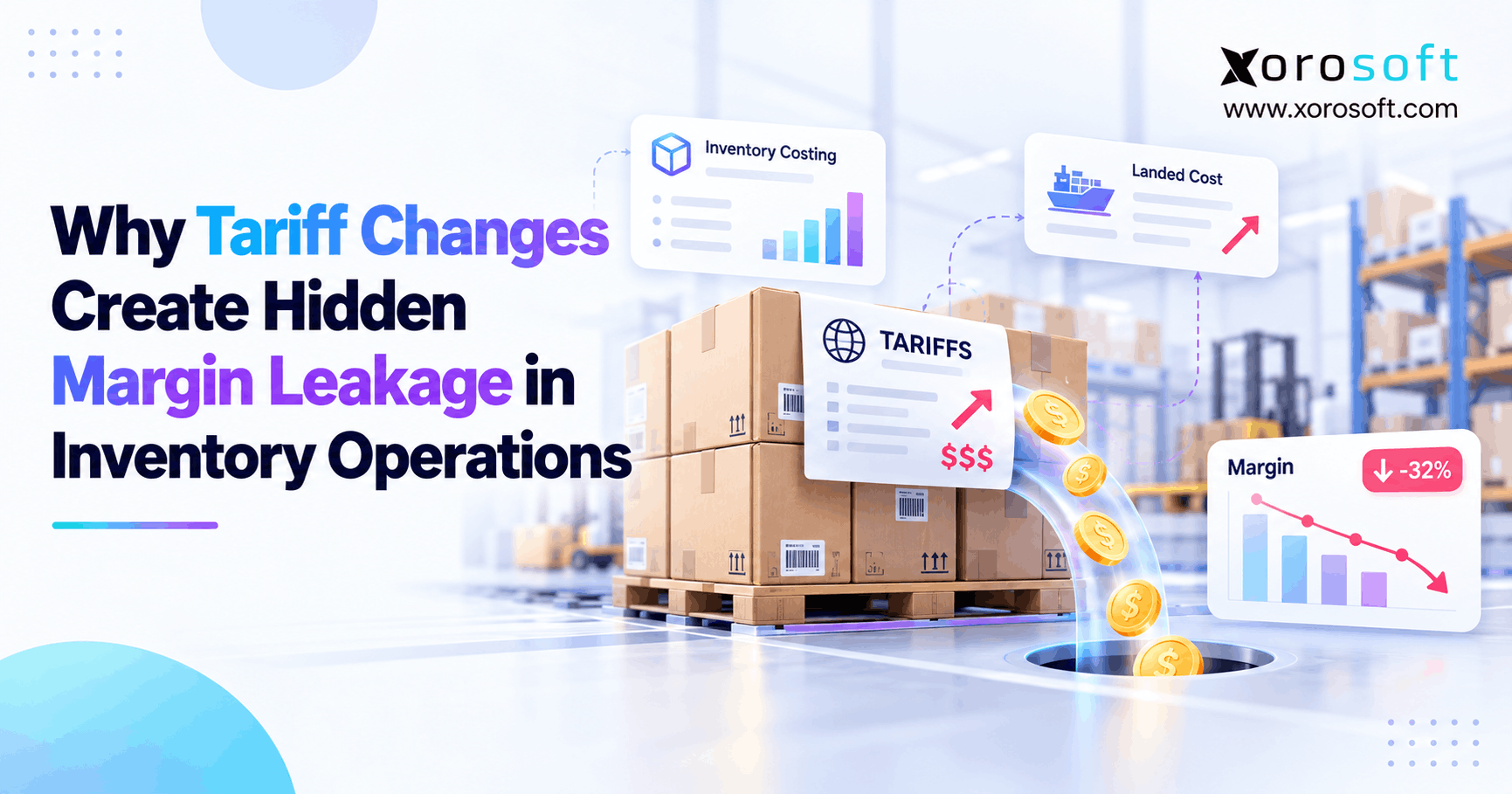
It is important for businesses to understand tariff impact on inventory when navigating shifting trade regulations.
1. Where Tariff Costs Start Leaking Into Inventory
The tariff impact on inventory begins long before finance sees a lower gross-margin percentage. Although a tariff may look like one additional import charge, its effect can move through purchasing, receiving, landed cost, inventory valuation, pricing, replenishment, and COGS at different times.
Consequently, businesses can make decisions using yesterday’s economics even after replacement costs have already changed. For example, purchasing may still show an older PO cost while warehouse teams receive higher-cost inventory and sales teams continue quoting the previous price.
Therefore, the biggest risk is often not the tariff itself. Instead, hidden margin leakage develops when the new cost fails to reach every operational workflow quickly and consistently.
1.1 Why the Tariff Impact on Inventory Is Easy to Miss
Inventory creates a timing gap between paying a higher acquisition cost and recognizing that cost in financial results.
For example, goods may remain in transit for weeks. Afterward, they may sit in a warehouse before they are sold. Meanwhile, the business may continue shipping older inventory purchased under a lower cost structure.
As a result, historical gross margin can temporarily look healthy even though replacing that inventory will cost significantly more.
1.2 Tariff Cost and Margin Recognition Happen at Different Times
A buyer may create a purchase order today. However, freight, duties, brokerage fees, and other acquisition costs can change before the goods arrive.
Additionally, final invoices may reach finance after the warehouse has already received the stock. Therefore, operations may initially use estimated costs and reconcile the difference later.
Ultimately, every delay creates another opportunity for the business to measure profitability using incomplete information.
2. What the Tariff Impact on Inventory Actually Includes
The tariff impact on inventory extends beyond the customs payment. In practice, companies must understand the full cost required to bring inventory into a sellable or usable condition.
Therefore, supplier price alone rarely provides enough information for purchasing or margin decisions.
2.1 Purchase Price Is Not the Same as True Inventory Cost
A practical operational formula is:
True Inventory Cost = Supplier Cost + Allocated Acquisition Costs
Depending on the shipment, those acquisition costs can include:
- freight;
- customs duties;
- tariffs;
- brokerage;
- insurance;
- port charges;
- handling;
- other directly attributable costs.
Consequently, a product purchased for $20 can have a true landed cost of $23, $25, or more before it reaches available inventory.
2.2 Landed Cost Connects Operations and Finance
Landed cost gives teams a more complete view of the economics behind each receipt.
A simplified operating formula is:
Landed Cost = Purchase Cost + Freight + Duties + Brokerage + Insurance + Other Direct Acquisition Costs
However, accounting treatment can vary by transaction and applicable standards. Therefore, finance teams should confirm the appropriate treatment while operations focus on maintaining consistent cost visibility.
3. How Tariff Costs Move From Purchase Order to COGS
The tariff impact on inventory should move through a connected chain:
Supplier → Purchase Order → Shipment → Customs → Receipt → Landed Cost → Inventory → COGS → Gross Margin
However, margin leakage appears whenever one stage updates while another stage continues using an older value.
3.1 Purchase Orders Establish the First Cost Expectation
Initially, buyers create purchase orders using supplier prices, expected freight, duties, exchange rates, and other assumptions.
However, those assumptions can change before receipt. Therefore, purchasing teams need visibility into both the original PO economics and the latest expected landed cost.
Otherwise, buyers may approve replenishment based on a margin that no longer exists.
3.2 Receiving Creates a Critical Costing Point
Once inventory arrives, warehouse teams need to receive the correct quantities quickly. Meanwhile, finance may still be waiting for a final customs, freight, or brokerage invoice.
Therefore, many companies use estimated landed costs at receipt and reconcile them later.
Microsoft explains how item charges such as freight and customs duty can increase inventory value and subsequently flow into COGS. Microsoft’s landed-cost guidance
4. Seven Places the Tariff Impact on Inventory Creates Margin Leakage
The tariff impact on inventory becomes most dangerous where systems, teams, or timing assumptions do not match.
Therefore, businesses should look beyond the customs entry and audit the complete cost flow.
4.1 Open Purchase Orders Still Use Old Costs
A PO may have been created before a tariff or cost assumption changed.
Consequently, purchasing reports can overstate expected margin while understating future cash requirements.
4.2 Inventory Changes Cost While in Transit
Goods can spend days or weeks between supplier shipment and warehouse receipt.
Meanwhile, tariffs, classifications, freight, or other import costs may change. As a result, the original purchasing model becomes outdated before inventory arrives.
4.3 Final Charges Arrive After Receipt
Warehouse teams cannot always wait for every invoice before receiving sellable inventory.
Therefore, estimated landed cost becomes important. Later, finance should reconcile that estimate against actual expenses.
4.4 Costs Are Allocated to the Wrong SKUs
An equal-per-unit allocation may distort profitability when products have very different customs values, weights, or volumes.
Consequently, total accounting cost can be correct while individual SKU margins remain wrong.
4.5 Selling Prices Lag Behind Landed Cost
Operations may identify a higher landed cost today. However, ecommerce prices, wholesale price lists, promotions, and negotiated contracts may remain unchanged.
As a result, every new sale can carry less margin.
4.6 Replenishment Uses Stale Economics
A SKU can still appear attractive to reorder if the purchasing model uses historical supplier cost instead of current landed cost.
Therefore, buyers may commit additional cash to products whose profitability has already deteriorated.
4.7 Finance Finds the Variance Too Late
Finally, an adjustment may reach inventory or COGS after products have already sold.
Consequently, management discovers the margin problem after the operating decision has already been made.
5. How Tariff Changes Affect Landed Cost
A strong landed-cost process separates expected cost from actual cost.
Therefore, teams can make operational decisions before every final invoice arrives without permanently losing sight of the eventual variance.
5.1 Estimated Landed Cost Supports Earlier Decisions
Before receipt, buyers can estimate duties, freight, brokerage, insurance, and other acquisition costs.
Consequently, purchasing and pricing teams can evaluate expected gross margin before committing to the next replenishment cycle.
For inventory-driven companies that need purchasing, accounting, inventory, and operational reporting in one environment, XoroERP provides a broader ERP framework for connecting those workflows.
5.2 Actual Landed Cost Reveals the Variance
Consider this shipment:
| Cost Component | Estimate | Actual |
|---|---|---|
| Product | $100,000 | $100,000 |
| Freight | $8,000 | $9,500 |
| Duties | $12,000 | $15,000 |
| Brokerage | $1,500 | $1,800 |
| Total | $121,500 | $126,300 |
The actual cost is $4,800 higher than expected.
Therefore, if that variance is never redistributed correctly, product-level profitability remains understated or overstated.
5.3 Allocation Method Matters
Businesses may allocate landed costs by:
- customs value;
- quantity;
- weight;
- volume;
- another defensible rule.
However, the best allocation method depends on how the expense was generated. Consequently, businesses should avoid applying one method automatically to every charge.
6. How the Tariff Impact on Inventory Changes FIFO, Average Cost, and Standard Cost
The tariff impact on inventory appears differently depending on the costing method.
However, no costing method removes the underlying economic increase. Instead, each method changes when and how the additional cost becomes visible.
| Factor | FIFO | Weighted Average | Standard Cost |
|---|---|---|---|
| New higher cost | Appears as newer layers sell | Blends into the average | Creates variance until standards change |
| Main risk | Old layers mask replacement cost | Increase appears gradually | Standard becomes outdated |
| Useful metric | Cost-layer age | Updated average cost | Purchase-cost variance |
6.1 FIFO Can Delay the Visible Margin Decline
Suppose older inventory costs $50 while a new receipt costs $58.
Under FIFO, the company may continue recognizing $50 COGS until the older units sell. Therefore, reported margin can remain stronger than replacement economics.
6.2 Weighted Average Spreads the Increase
Weighted-average costing blends new receipt costs with existing inventory.
Consequently, the higher cost may appear gradually instead of arriving as one sharp margin change.
6.3 Standard Cost Can Create Large Variances
A manufacturer may continue using a predefined standard even after actual material costs rise.
Therefore, purchase or production variances can grow until standards are reviewed and updated.
7. Why Gross Margin Can Look Better Than Reality
One of the most important effects of the tariff impact on inventory is the gap between historical margin and replacement-cost margin.
For example, consider a product selling for $80 while older inventory costs $50.
Historical gross margin:
($80 − $50) ÷ $80 = 37.5%
However, suppose the current replacement landed cost has increased to $58.
Replacement-cost margin:
($80 − $58) ÷ $80 = 27.5%
Therefore, the business can report a 37.5% historical margin while the next replenishment cycle supports only 27.5%.
Moreover, this is becoming a real operating concern. KPMG’s 2026 tariff survey found that 78% of surveyed organizations reported higher COGS, while 51% reported margin declines. KPMG’s 2026 Tariff Survey
Consequently, operators should monitor replacement economics alongside historical profitability.
8. How Tariff Costs Change Purchasing and Replenishment
The tariff impact on inventory also changes how much cash buyers need for the next order.
Therefore, purchasing decisions should incorporate current landed cost rather than supplier price alone.
8.1 Higher Cost Changes Reorder Economics
Suppose a buyer typically purchases 10,000 units at $20 landed cost.
The order requires $200,000.
However, if current landed cost rises to $23, the same quantity now requires $230,000.
Consequently, the buyer needs another $30,000 without purchasing one additional unit.
8.2 Pre-Buying Has Both Benefits and Risks
Some businesses increase inventory before an expected tariff change.
However, buying early also creates:
- higher carrying costs;
- more cash tied up;
- greater obsolescence risk;
- storage pressure;
- potential markdown exposure.
Therefore, the right decision depends on expected savings, forecast confidence, lead time, and inventory risk.
8.3 Forecasting Must Reflect New Cost Economics
Demand forecasts estimate future units. However, purchasing also needs to understand the capital required to acquire those units.
Consequently, businesses should connect forecasting with inventory and purchasing rather than maintain separate assumptions.
9. Tariff Impact on Inventory Pricing Decisions
The tariff impact on inventory cannot be solved with a blanket price increase across every SKU.
Instead, companies should evaluate product-level exposure because different items can have different origin, value, freight, duty, and margin structures.
9.1 Use Current Landed Cost to Test Pricing
A useful pricing formula is:
Required Selling Price = Landed Cost ÷ (1 − Target Gross Margin)
For example, if landed cost is $60 and the target gross margin is 40%:
$60 ÷ 0.60 = $100
However, if landed cost rises to $66:
$66 ÷ 0.60 = $110
Therefore, keeping the old $100 selling price reduces gross margin.
9.2 Wholesale Pricing Can Move More Slowly
Distributors often manage customer-specific pricing, negotiated discounts, contracts, and EDI orders.
Consequently, they may not be able to pass through higher costs immediately. Instead, teams need visibility into which customers, products, or agreements have become margin risks.
10. Multi-Warehouse Inventory Makes Cost Leakage Harder to See
Multi-warehouse businesses can hold the same SKU under several cost histories.
For example, Warehouse A may contain older pre-change inventory while Warehouse B receives newer higher-cost stock. Meanwhile, Warehouse C may receive transfers from both locations.
Consequently, inventory quantity alone does not explain profitability.
10.1 Transfers Can Hide Cost Differences
Inter-warehouse transfers can move inventory across locations without changing the underlying economic history.
Therefore, operations need to preserve costing logic while maintaining accurate quantities.
For businesses managing several warehouses, XoroWMS connects warehouse execution with broader inventory operations, helping teams maintain visibility across receiving, stock movement, and fulfillment.
10.2 Central Pricing Can Mask Location-Level Economics
A company may use one national selling price while warehouse-specific inventory has materially different landed costs.
As a result, aggregated margin can hide where cost pressure actually sits.
11. Ecommerce and Wholesale Channels Feel Tariff Pressure Differently
The tariff impact on inventory also varies by sales channel.
Therefore, companies should avoid evaluating profitability only at the company-wide level.
11.1 Shopify and DTC Brands
Shopify merchants can change retail prices quickly. However, promotions, shipping subsidies, discounts, returns, and paid acquisition can already compress contribution margin.
Consequently, even a moderate landed-cost increase can materially change SKU economics.
Businesses using connected ecommerce workflows can review Xorosoft Integrations, while Xorosoft’s listing is also available through the Shopify App Store.
11.2 Wholesale Distribution
Wholesale businesses may manage thousands of SKUs together with customer-specific pricing, purchasing rules, EDI transactions, and multiple warehouses.
Therefore, tariff changes can create different profitability outcomes by customer even when the same item is sold.
Businesses evaluating ERP workflows by sector can also explore industries served by Xorosoft.
12. Tariff Impact on Inventory in Manufacturing
The tariff impact on inventory can become even more complex when imported materials flow into a BOM.
Suppose one imported component rises from $8 to $10.
If a finished product requires four units, material cost increases by:
4 × $2 = $8 per finished product
Therefore, one tariff-driven material change can affect every finished unit that consumes that component.
12.1 Cost Moves Through Several Manufacturing Stages
Imported cost can move through:
- raw materials;
- BOMs;
- work in process;
- finished goods;
- standard costs;
- production variances;
- COGS.
Consequently, simply updating the supplier item price does not provide complete margin visibility.
12.2 Old and New Material Costs Can Coexist
A production floor may consume older components while purchasing has already received higher-cost replacements.
Therefore, managers need to understand both historical production cost and the current cost to build the next unit.
13. Tariffs Increase Working-Capital Requirements Too
The tariff impact on inventory affects cash before it necessarily affects sales volume.
Suppose a business normally carries 20,000 units at a $25 landed cost.
Inventory investment equals:
20,000 × $25 = $500,000
However, if landed cost rises to $28 while units remain unchanged:
20,000 × $28 = $560,000
Consequently, the business needs another $60,000 to hold exactly the same quantity.
13.1 Safety Stock Can Multiply the Effect
Businesses sometimes respond to trade uncertainty by increasing safety stock.
However, higher unit cost combined with higher inventory quantity increases working-capital pressure from two directions.
Therefore, finance and operations should evaluate cash exposure before approving large protective buys.
13.2 Current Tariff Actions Should Be Monitored Separately
Tariff policy can change faster than an annual planning cycle.
Therefore, teams responsible for imports should monitor authoritative sources such as the U.S. Trade Representative’s tariff actions page rather than rely on old rate assumptions.
14. Metrics That Expose Hidden Margin Leakage
A strong control process does not depend on one tariff KPI.
Instead, teams should monitor several connected measures because each metric reveals a different part of the cost flow.
14.1 Estimated-to-Actual Landed-Cost Variance
Use:
Actual Landed Cost − Estimated Landed Cost
Large recurring differences can indicate weak estimates, late invoices, or incorrect allocation assumptions.
14.2 Replacement Gross Margin
Compare today’s selling price against the cost required to replenish the item now.
Consequently, management can identify declining economics before older low-cost inventory is exhausted.
14.3 Tariff Cost per SKU
Divide allocated tariff cost by units received.
Therefore, buyers and pricing teams can see which products carry the greatest exposure.
14.4 Inventory by Cost Generation
Separate:
- older inventory;
- in-transit inventory;
- new higher-cost receipts;
- stock awaiting final cost allocation.
As a result, leadership can see how much of today’s margin depends on older cost layers.
14.5 Margin by Customer and Channel
A SKU may remain attractive in DTC while becoming unprofitable under a wholesale agreement.
Therefore, aggregate product margin is not always enough.
15. Eight Steps to Audit Tariff Margin Leakage
Businesses do not need to replace every system before they begin improving control.
Instead, start with the points where cost data most commonly becomes outdated.
15.1 Review Open Purchase Orders
Identify POs created using older tariff, freight, or sourcing assumptions.
15.2 Identify In-Transit Exposure
Determine which shipments may arrive under different economics than originally expected.
15.3 Refresh Estimated Landed Cost
Update the likely total acquisition cost before warehouse receipt.
15.4 Reconcile Actual Charges
Compare final freight, customs, supplier, and brokerage invoices with estimates.
15.5 Review Allocation Rules
Confirm whether value, weight, quantity, volume, or another method properly reflects the cost.
15.6 Recalculate SKU Margin
Compare historical gross margin with replacement-cost margin.
15.7 Update Purchasing and Pricing
Do not allow the new cost to remain trapped inside accounting.
15.8 Reconcile Finance and Operations
Finally, confirm that purchasing, warehouse, finance, and commercial teams use the same cost assumptions.
16. When Spreadsheet-Based Tariff Tracking Stops Working
The tariff impact on inventory can still be managed with spreadsheets when operations are simple.
For example, a business with a handful of imported SKUs, one warehouse, few receipts, and stable suppliers may not need a more complex platform.
However, manual processes become risky as transaction volume and operating complexity increase.
16.1 Warning Signs the Process Has Outgrown Spreadsheets
Common warning signs include:
- hundreds or thousands of SKUs;
- frequent imports;
- multiple warehouses;
- multiple sourcing countries;
- delayed customs invoices;
- high landed-cost variance;
- Shopify, Amazon, and wholesale channels;
- manufacturing;
- manual journal entries;
- different margin numbers across teams.
Consequently, the question is not whether spreadsheets are inherently bad. Instead, the issue is whether every dependent cost calculation can still be updated consistently.
16.2 Connected Systems Reduce Cost Propagation Delays
When purchasing, inventory, accounting, forecasting, and fulfillment operate independently, every integration or manual handoff can delay cost recognition.
Therefore, businesses with higher complexity may benefit from a unified system such as XoroONE, which brings core inventory-driven workflows into a connected environment.
17. What an ERP Should Do With Tariff Cost Changes
ERP software should do more than store a tariff amount.
Instead, it should help the cost move through the operational chain.
A strong workflow should support:
- purchase-order cost expectations;
- estimated landed cost;
- warehouse receiving;
- actual-cost reconciliation;
- inventory valuation;
- cost adjustments;
- accounting;
- multi-warehouse inventory;
- SKU profitability;
- customer and channel margin reporting;
- forecasting and replenishment.
Therefore, buyers should evaluate the full PO-to-margin process rather than judge software only by whether it has a landed-cost field.
17.1 Who Needs More Advanced Cost Management?
Advanced controls become more valuable when a company combines several factors:
- high import exposure;
- thin margins;
- long lead times;
- frequent receipts;
- multiple warehouses;
- wholesale contracts;
- manufacturing;
- multiple sales channels.
Conversely, smaller and simpler import operations may continue to manage the process with lighter tools.
18. Protect Margin Before the Variance Reaches the P&L
The tariff impact on inventory is not simply a customs issue. Instead, it is a cost-propagation problem that touches purchasing, receiving, inventory valuation, accounting, pricing, forecasting, and margin reporting.
Therefore, the strongest operating model keeps these functions aligned:
Purchasing → Receiving → Inventory → Accounting → Pricing → Forecasting
Moreover, businesses should separate estimated cost from actual cost, track variances, monitor replacement margin, and update purchasing assumptions before the next order is placed.
Ultimately, the goal is not to predict every future tariff change. Rather, the goal is to ensure that when costs change, every team sees the new economics quickly enough to act.
For inventory-driven businesses still reconciling purchasing, landed cost, inventory, and accounting through disconnected tools, the next step is to review how those workflows would operate inside one connected system. Book a Demo to evaluate the process against your current operating model.
Frequently Asked Questions
What is the tariff impact on inventory?
It raises acquisition and landed costs, which can affect inventory valuation, COGS, working capital, pricing, purchasing, and gross margin as inventory moves through the business.
Are tariffs included in inventory cost?
Often, qualifying duties and acquisition costs can become part of inventory cost. However, accounting treatment depends on the transaction and applicable standards.
How do tariffs affect gross margin?
Higher tariff-related landed costs eventually increase COGS. Therefore, if selling prices remain unchanged, gross margin declines as higher-cost inventory is sold.
What is tariff margin leakage?
Tariff margin leakage occurs when costs increase before purchasing, pricing, inventory valuation, forecasting, or margin reporting reflects the new economics.
How do tariffs affect FIFO inventory?
Under FIFO, older lower-cost units may reach COGS first. Consequently, reported margins can temporarily look stronger than current replacement-cost margins.
Can ERP software track tariff costs?
Yes. Depending on the platform, ERP systems can allocate landed costs, adjust inventory value, update COGS, reconcile actual costs, and report product profitability.
How can businesses reduce tariff margin leakage?
Update expected landed costs, reconcile actual charges, review allocation rules, monitor replacement margins, refresh pricing and purchasing assumptions, and keep finance and operations synchronized.
Recent Posts
-
 ERP Landed Cost Module vs Spreadsheet Calculations for Importers
 -
 How to Build an Open-to-Buy Plan for an Omnichannel Brand
 -
 Cold Storage WMS for Food and Beverage Distribution
 -
 ERP Buying Statistics 2026: Evaluation, Implementation, and Adoption Risks
 -
 How a Distributor Reduced B2B Order Exceptions Without Restricting Sales