If you’re looking to understand inventory availability explained in detail, this guide will help clarify the key concepts.
1. Inventory Availability Explained: Why Physical Stock and Sellable Stock Diverge
A warehouse can physically hold 1,000 units while the sales team can safely promise only 600. However, that gap does not automatically indicate a bad stock count. Open orders, warehouse reservations, safety stock, quality holds, transfers, production demand, and channel allocations can all reduce the quantity available for new business.
This is where inventory availability explained becomes an operational topic rather than a simple inventory definition.
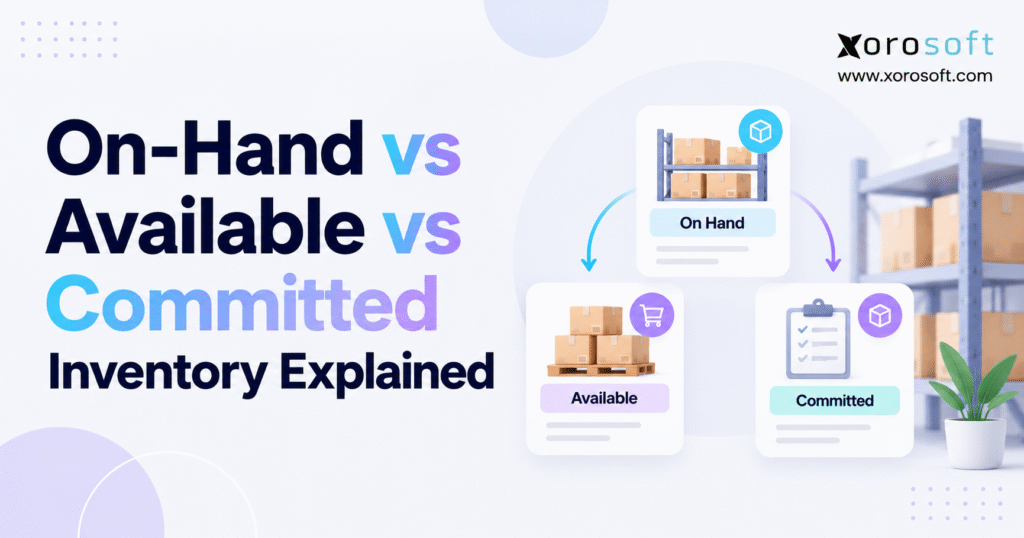
On-hand inventory answers one question: how much stock does the business physically hold?
Available inventory answers another: how much stock remains free for new demand?
Committed inventory answers a third: how much stock has existing demand already claimed?
Although these numbers are related, they often move at different times. For example, a sales order may reduce available inventory immediately while leaving the physical on-hand balance unchanged until the warehouse ships the order. Likewise, a cancelled order can increase availability without adding a single physical unit.
1.1 Why On-Hand vs Available Inventory Matters as a Business Grows
The distinction becomes increasingly important when a company adds Shopify, wholesale, Amazon, EDI, multiple warehouses, manufacturing, or more complex fulfillment rules.
At that stage, several processes compete for the same stock. Ecommerce customers want immediate availability. Meanwhile, wholesale customers may reserve larger quantities. Manufacturing consumes raw materials, while warehouse transfers move inventory between locations. In addition, purchasing teams must plan around incoming supply.
As a result, a company needs more than one inventory number.
The real objective is to know what exists, what someone has already claimed, and what the business can still promise without creating an operational conflict.
1.2 A Simple Inventory Availability Example
Assume a distributor physically holds 1,000 units.
Existing customer orders have already claimed 250 units. In addition, quality control has placed another 100 units on hold.
The inventory position looks like this:
| Inventory State | Quantity |
|---|---|
| On Hand | 1,000 |
| Committed | 250 |
| Quality Hold / Unavailable | 100 |
| Available | 650 |
The warehouse still contains all 1,000 units. However, operations should normally treat only 650 as free for additional demand.
Therefore, the distinction directly affects selling, purchasing, fulfillment, and planning.
2. Inventory Availability Explained Through On-Hand, Available, and Committed Stock
Each inventory state serves a different purpose. Problems usually begin when a team uses one quantity for a decision that requires another.
2.1 What On-Hand Inventory Means
On-hand inventory represents the physical quantity currently recorded at a warehouse, store, distribution center, or another inventory location.
In other words, it gives operators a physical inventory position.
However, on hand does not automatically equal sellable inventory. Some units may already support open customer orders, production requirements, transfer orders, or internal reservations.
Therefore, sales teams should avoid using raw on-hand inventory as a customer promise unless the operation has no meaningful commitments or restrictions.
2.2 What Available Inventory Means
Available inventory represents stock that remains free for new demand after the system accounts for relevant commitments and restrictions.
Consequently, this quantity often drives sales and ecommerce decisions because it answers a practical question:
How much inventory can we still promise?
Available inventory may exclude stock that belongs to open orders, safety-stock buffers, quality holds, damaged inventory, warehouse transfers, or other protected categories.
2.3 What Committed Inventory Means
Committed inventory represents stock that current demand has already claimed.
The warehouse may still hold those units physically. Nevertheless, the business should usually prevent another customer, sales channel, or production order from consuming the same quantity.
As a result, a company that fails to protect committed inventory can oversell even when its physical inventory count remains accurate.
3. On-Hand Inventory Is a Physical Position, Not a Sales Promise
On-hand inventory often looks like the simplest figure in an inventory system. Still, operators can misunderstand it easily.
Imagine a furniture distributor with 800 chairs in one warehouse. At first glance, a salesperson might assume all 800 remain available for new orders.
That assumption ignores the demand already sitting in the system.
3.1 What Can Sit Inside the On-Hand Quantity
The 800 units may include 250 units for confirmed wholesale orders, 150 units for ecommerce orders, 50 units in quality inspection, and 50 units protected for replacement requests.
Therefore, only 300 units may remain genuinely free.
The physical inventory count still matters because finance, warehouse teams, and operations need an accurate record of what the company owns and where it sits. However, physical inventory alone cannot answer every commercial question.
3.2 When On-Hand Inventory Changes
Physical inventory usually changes when an actual inventory transaction occurs.
For example, receiving a purchase order increases on hand. Shipping an order reduces it. Production can consume raw materials and create finished goods. Likewise, transfers change inventory by location, while adjustments correct discrepancies.
A new sales order may leave on-hand inventory unchanged because the warehouse has not shipped anything.
Instead, the order creates demand and usually reduces availability.
Therefore, timing explains many apparent inventory contradictions.
4. Available Inventory Shows What the Business Can Still Use
Available inventory converts the physical stock position into an operating decision.
Sales teams use it to understand what they can promise. Meanwhile, ecommerce systems use it to control customer-facing quantities. Purchasing teams use it alongside forecasts and incoming supply, while warehouse teams use it when evaluating new allocations.
4.1 The Basic Available Inventory Calculation
A simple business may calculate:
Available Inventory = On-Hand Inventory − Committed Inventory
If 1,000 units are on hand and customer orders have committed 300, then 700 remain available.
However, real operations often add more rules.
A more detailed approach might calculate:
Available Inventory = On Hand − Committed − Quality Holds − Restricted Inventory − Protected Safety Stock
For example:
| Inventory Component | Quantity |
|---|---|
| On Hand | 2,000 |
| Committed | -700 |
| Quality Hold | -100 |
| Protected Safety Stock | -200 |
| Available | 1,000 |
4.2 Why Available Inventory Formulas Differ
No single formula fits every operation.
For example, a company may protect safety stock from ordinary ecommerce demand while allowing a manager to release it for a priority wholesale customer. By contrast, another business might keep returned products unavailable until inspection. A manufacturer may also reserve components for production orders before the warehouse physically moves them.
Therefore, the inventory system needs rules that reflect the actual operation.
Field names alone do not provide enough information. Instead, teams should understand what each quantity includes and when the system changes it.
5. Committed Inventory Protects Existing Demand Before Shipment
Committed inventory allows a company to protect stock before fulfillment physically removes it.
Suppose a distributor starts with 600 available units and accepts a confirmed customer order for 200.
The system may now show:
| Inventory State | Before Order | After Commitment |
|---|---|---|
| On Hand | 600 | 600 |
| Committed | 0 | 200 |
| Available | 600 | 400 |
Nothing has left the warehouse.
Still, the company should no longer offer those 200 units to another buyer.
5.1 Sales Orders Are Not the Only Source of Commitments
Customer orders create the most obvious commitments. However, other processes can also claim inventory.
For instance, a warehouse transfer may reserve stock at the shipping location. Production can claim components. Wholesale teams may protect inventory for strategic accounts. Likewise, service departments may hold replacement stock.
As a result, committed inventory should represent meaningful operational demand rather than only one type of transaction.
5.2 Commitment Rules Need Clear Triggers
Different companies commit stock at different moments.
For example, one business may commit inventory as soon as a customer submits an order. Another waits for payment approval. Meanwhile, a B2B distributor may require credit approval before commitment, while a manufacturer may reserve materials only after releasing a work order.
Therefore, the company should define the trigger clearly and apply it consistently.
Without that discipline, inventory availability becomes unpredictable.
6. Inventory Availability Explained Across Committed, Reserved, and Allocated Stock
Inventory teams often use the words committed, reserved, and allocated interchangeably. In practice, each can describe a different stage of demand.
Understanding those distinctions helps operators interpret inventory quantities correctly. In addition, it helps integration teams map fields between systems more accurately.
6.1 Committed Inventory Claims a Quantity
A commitment tells the business that demand requires a certain quantity.
For example, a sales order needs 100 units.
At that point, the system may know that 100 units should no longer support new demand without knowing exactly which physical units the warehouse will pick.
6.2 Reserved Inventory Protects Stock for a Purpose
A reservation usually protects inventory for a specific requirement.
That requirement might involve a customer, sales order, production order, warehouse transfer, or sales channel.
Some systems treat reservation and commitment as nearly identical concepts. By contrast, others separate them according to transaction status.
6.3 Allocated Inventory Assigns Specific Supply
Allocation generally moves closer to warehouse execution.
For example, the system may assign a specific warehouse, bin, lot, serial number, batch, or stock source to the order.
An order may commit 100 units first. Later, the WMS allocates 60 units from Bin A and 40 from Bin B.
This distinction becomes especially important in warehouses that handle lots, expiration dates, serialized products, or complex picking rules.
7. Inventory Availability Changes Before Physical Stock Leaves the Warehouse
Following an order through fulfillment shows why inventory quantities do not change at the same moment.
Assume a warehouse begins with 100 units on hand and no commitments.
7.1 Order Creation Reduces Available Inventory
A customer orders 20 units.
After the system commits those units:
- On hand remains 100.
- Committed increases to 20.
- Available decreases to 80.
The warehouse still owns and physically holds all 100 units.
However, only 80 remain free for new demand.
7.2 Allocation Identifies Where the Inventory Will Come From
Next, warehouse rules may assign the 20 units to specific inventory.
Perhaps 12 units come from one bin and eight from another.
The physical count can remain unchanged because the warehouse has not shipped the product. Nevertheless, availability stays protected throughout the allocation process.
7.3 Picking and Packing Move Inventory Through Operational States
Warehouse employees then pick the order and move the product toward shipping.
The WMS may track stages such as allocated, picked, staged, packed, or ready to ship.
A connected warehouse management system can keep those warehouse events tied to the inventory record. As a result, operations can see which stock remains physically present and which stock already supports fulfillment.
7.4 Shipment Finally Reduces On-Hand Inventory
Once the warehouse ships 20 units, the inventory picture changes again.
On hand falls to 80. Meanwhile, the commitment for that order clears. Assuming no other restrictions exist, available inventory remains 80.
Therefore, transaction timing explains why stock can become unavailable long before it physically leaves the warehouse.
8. Available-to-Sell and Available-to-Promise Answer Different Questions
Businesses often need multiple versions of availability.
Available-to-sell focuses on what the company wants customers to purchase now. Available-to-promise, however, considers when the company can fulfill demand based on current and expected supply.
8.1 Available-to-Sell Inventory Controls Immediate Customer Demand
Suppose a warehouse has 500 units operationally available.
Management wants to protect 50 units for replacement orders and another 50 for a major wholesale customer.
Therefore, the ecommerce channel may expose only 400 units.
Internally, 500 units remain available under broader operational rules. However, customer-facing availability stays lower because the business deliberately protects inventory.
8.2 Available-to-Promise Adds the Time Dimension
Available-to-promise adds future supply and future demand to the decision.
Assume the business has 100 units available today. In addition, a confirmed supplier shipment will deliver 500 more next week. Existing orders will consume 250 units over that period.
An ATP calculation can therefore help determine how much additional demand the company can accept for a future delivery date.
This approach becomes especially useful when supplier lead times are long or customers accept backorders.
8.3 Sales Teams Need the Availability View That Matches the Promise
A salesperson promising immediate shipment needs a different quantity from someone quoting delivery four weeks from now.
Consequently, organizations should not force every commercial decision through one generic stock figure.
9. Shopify Inventory Availability Depends on More Than the Storefront
Ecommerce makes inventory mistakes visible quickly because customers act directly on the quantity that the storefront exposes.
A Shopify merchant may also sell through Amazon, wholesale, EDI, retail, or marketplaces. Therefore, if all channels draw from the same physical inventory, each one needs access to the correct sellable quantity.
9.1 Shopify Stock Must Reflect Demand Outside Shopify
Suppose Shopify shows 400 available units.
Meanwhile, the wholesale team confirms an order for 250 units in another system.
If that commitment does not reach Shopify promptly, online customers can continue buying inventory that the wholesale order has already claimed.
Therefore, the storefront itself is not the problem. The issue comes from disconnected inventory ownership.
9.2 Inventory Integration Should Synchronize the Right Quantity
A good integration does more than exchange a generic stock number.
Instead, it should determine which inventory state Shopify needs, how frequently to update it, which locations can fulfill ecommerce orders, and how outside commitments affect sellable quantity.
Businesses reviewing this architecture can explore Xorosoft’s integration options for broader system connectivity.
In addition, Shopify merchants can review the Xorosoft ERP listing on the Shopify App Store when evaluating how ERP workflows connect with Shopify operations.
9.3 Inventory Availability Explained for Multi-Channel Commerce
The key principle is simple: every channel should consume inventory from an agreed source of truth.
The company can still reserve different quantities for different channels. However, it needs one operational system to understand the full demand picture.
10. Multi-Warehouse Inventory Availability Must Work by Location
A company may have enough stock across its entire network while lacking inventory at the location responsible for a particular customer.
Therefore, global availability and local availability answer different questions.
10.1 Network-Wide Inventory Can Hide Local Shortages
Consider this inventory position:
| Warehouse | On Hand | Committed | Available |
|---|---|---|---|
| Toronto | 600 | 500 | 100 |
| Dallas | 900 | 150 | 750 |
| New Jersey | 500 | 100 | 400 |
| Total | 2,000 | 750 | 1,250 |
At network level, the business has 1,250 units available.
However, a Toronto customer requiring local fulfillment still has access to only 100 units unless the company reroutes the order or transfers stock.
10.2 Transfers Create Temporary Inventory States
Suppose Dallas transfers 300 units to Toronto.
Dallas must protect those units once the transfer begins. After shipment, the stock may sit in transit. Meanwhile, Toronto expects the goods but should not necessarily treat them as immediately sellable until receipt.
Consequently, publishing transferred inventory too early can create promises that the receiving warehouse cannot fulfill.
10.3 Industry Requirements Shape Availability Rules
Apparel companies may need availability by style, color, and size. Furniture operations often manage long supplier lead times and bulky warehouse stock. Likewise, sporting-goods distributors can face seasonal allocations, while manufacturers need component-level visibility.
Xorosoft’s overview of inventory-driven industries shows why companies often need different inventory controls even when they use similar ERP concepts.
11. Inventory Availability Explained as an ERP Selection Requirement
Inventory availability should form part of any serious ERP evaluation.
Two products may both show a field called “available,” yet each platform may calculate it differently.
As a result, that difference can affect ecommerce, wholesale orders, purchasing, warehouse allocation, manufacturing, and customer promises.
11.1 Ask ERP Vendors When Inventory Availability Changes
Instead of asking only whether an ERP supports inventory management, test real operational scenarios.
For example, ask when a sales order reduces availability. Determine whether payment status changes commitment. Find out how the platform handles safety stock. Test warehouse transfers. Review customer-specific reservations. Finally, confirm when returned inventory becomes sellable again.
Practical scenarios expose the system’s operating model far better than a feature checklist.
11.2 Compare Inventory Behavior Across ERP Platforms
NetSuite, Acumatica, Business Central, Cin7, Fishbowl, Xorosoft, and other platforms approach inventory workflows differently.
Therefore, no serious evaluation should assume identical terminology or configuration.
Companies assessing those options can use the Xorosoft vs NetSuite comparison as one reference point when examining ERP differences for inventory-driven operations.
11.3 Inventory Complexity Often Reveals a Broader Systems Problem
Businesses rarely replace their software because one inventory field looks confusing.
Instead, the deeper issue usually includes purchasing, warehouse execution, accounting, manufacturing, ecommerce, forecasting, reporting, or EDI.
Once inventory touches most departments, the business must consider the architecture around inventory rather than only an inventory application.
12. One Inventory Source of Truth Reduces Conflicting Stock Numbers
Many growing companies accumulate software one problem at a time.
They start with an ecommerce platform, add accounting software, adopt an inventory app, add a warehouse tool, build purchasing spreadsheets, connect EDI, and eventually create reporting workarounds.
Each system may solve its own problem successfully. However, conflict begins when multiple systems claim authority over inventory.
12.1 Disconnected Applications Create Different Inventory Truths
Imagine the following situation:
Shopify shows 420 units.
The warehouse system reports 390.
Accounting shows 470 on hand.
Meanwhile, purchasing assumes 500 because its spreadsheet has not received the latest sales orders.
The wholesale team also has another 100 units reserved manually.
No single figure necessarily results from an obvious error. Instead, the business lacks a unified transaction model.
12.2 Centralization Should Connect Transactions, Not Just Dashboards
A dashboard can display information from many systems without resolving which system owns the inventory state.
A stronger architecture, however, connects the transactions that create inventory movement: sales orders, purchase orders, receiving, transfers, warehouse picks, manufacturing consumption, returns, and adjustments.
Xorosoft’s XoroONE cloud ERP brings inventory, accounting, purchasing, warehouse management, manufacturing, forecasting, reporting, and ecommerce operations into one platform.
Additionally, companies evaluating broader operational requirements can review Xorosoft’s ERP solutions to understand how inventory connects with adjacent business processes.
12.3 A Single Source of Truth Does Not Mean One Sellable Quantity
Centralization does not require every channel to see the same number.
For example, the ERP may know that 1,000 units exist while exposing only 600 to Shopify, reserving 200 for wholesale, and protecting 100 as safety stock.
The important point is that the system understands why those differences exist.
13. On-Hand vs Available Inventory Becomes Harder With Wholesale and EDI
Wholesale demand changes inventory faster and in larger blocks than many direct-to-consumer orders.
A single account can consume hundreds or thousands of units. Therefore, commitment timing becomes especially important.
13.1 Large B2B Orders Need Early Inventory Protection
Suppose a distributor holds 3,000 units.
A retail customer submits a confirmed order for 1,800 units, but shipping will not occur until next week.
If the system protects those units only when warehouse staff pick the order, other channels may oversell the inventory during the waiting period.
Therefore, a strong workflow commits the quantity at the correct commercial stage.
13.2 EDI Can Introduce Demand Automatically
EDI orders often enter without manual sales entry.
Consequently, the inventory system should account for those orders as soon as the agreed business rules require commitment.
Otherwise, ecommerce channels can continue advertising units that EDI demand already needs.
13.3 Customer-Specific Reservations Need Expiration Rules
Some businesses intentionally reserve stock for important customers.
That approach can support service levels. However, stale reservations reduce inventory productivity.
Companies should therefore define how long reservations remain valid, who can override them, and what happens when the customer does not order as expected.
14. Manufacturing Inventory Availability Includes Internal Demand
Manufacturers cannot evaluate inventory only through customer orders.
Production itself consumes inventory.
As a result, raw materials, subassemblies, packaging, and components may all have commitments before anyone ships a finished product.
14.1 Work Orders Compete for the Same Material Supply
Assume a manufacturer holds 5,000 components.
Released production orders require 3,500.
In addition, another 500 components support service requirements.
Although the warehouse physically holds 5,000 units, only 1,000 remain free for other production or demand.
That difference matters for planners and buyers.
14.2 Bills of Materials Connect Finished-Goods Demand to Components
A finished product may require several components.
Therefore, if sales demand increases, the production plan creates component demand even when finished goods do not yet exist.
The ERP must connect finished-goods demand to raw-material availability.
14.3 Purchasing Needs Visibility Into Internal Commitments
A buyer who sees 5,000 units on hand may postpone a purchase order.
However, once the system shows that 4,000 units support current production and service requirements, the replenishment decision changes.
This illustrates why inventory availability needs to connect with purchasing and production rather than remain isolated inside the warehouse.
15. Inventory Availability Explained by Department: Which Number Should Each Team Use?
No single stock quantity serves every department equally well.
Instead, teams should use the view that matches the decision they need to make.
15.1 Sales and Customer Service Need Sellable Availability
Sales teams generally need available inventory or available-to-promise rather than raw on-hand stock.
Immediate orders require a view of what can ship now. By contrast, future orders may require expected supply and future commitments.
15.2 Ecommerce Teams Need Controlled Available-to-Sell Inventory
Ecommerce operations should expose the quantity that the company intends customers to buy.
That number may sit below internal availability because management protects replacement stock, safety stock, wholesale allocations, or other buffers.
15.3 Purchasing Needs Current Stock Plus Future Supply and Demand
Buyers should consider on hand, committed demand, available inventory, open purchase orders, supplier lead times, forecast demand, safety stock, and reorder targets.
Therefore, on-hand inventory by itself can hide urgent replenishment requirements.
15.4 Warehouse Teams Need Physical and Allocation Detail
Warehouse operations require more granular information.
For example, staff may need bin-level quantities, allocated stock, lots, serial numbers, expiration dates, staging status, and pick availability.
15.5 Finance Needs Accurate Physical and Financial Inventory
Finance focuses on physical quantities, valuation, landed costs, timing, and reconciliation.
Although sellable availability helps the operation, accounting depends on the transactions that change inventory ownership and value.
15.6 Planning Teams Need Time-Based Availability
Planners need current inventory alongside expected supply, forecasts, production demand, open orders, and lead times.
Therefore, the correct quantity always depends on the decision.
16. Better Inventory Availability Starts With Process Discipline
Software cannot repair undefined operating rules.
Before changing platforms, a company should document what each inventory state means and when transactions move stock between those states.
16.1 Define Inventory States in Plain Language
Operations should document on hand, available, committed, reserved, allocated, incoming, unavailable, picked, packed, in transit, quarantine, damaged, and safety stock where those terms apply.
Every team should understand the definitions.
Otherwise, when departments use different meanings for the same term, reports create arguments instead of decisions.
16.2 Set One Commitment Trigger for Each Order Type
The business should decide exactly when ecommerce, wholesale, EDI, manufacturing, and transfer demand claims inventory.
The trigger can vary by order type. However, the logic should remain intentional.
For example, ecommerce orders may commit immediately, while wholesale orders wait for credit approval.
16.3 Release Invalid Commitments Promptly
Cancelled orders, expired quotes, abandoned reservations, failed payments, and old allocations can create phantom shortages.
Therefore, exception reports should identify commitments that no longer connect to valid demand.
16.4 Keep Returns Unavailable Until Their Condition Is Known
Returned stock deserves a controlled workflow.
Operations should inspect the product before releasing it into available inventory.
As a result, the business avoids selling damaged, incomplete, expired, or otherwise unsuitable goods.
16.5 Review Operational Evidence Before Selecting a New ERP
Companies considering a system change should review actual implementations and operating results rather than relying only on demonstrations.
Xorosoft’s ERP case studies provide examples that teams can use when evaluating how inventory, warehousing, accounting, purchasing, and related workflows change after implementation.
17. Practical Next Step: Make Inventory Availability a Controlled Business Rule
The most important lesson from inventory availability explained is that physical inventory and sellable inventory answer different questions.
On hand tells the business what physically exists.
Meanwhile, committed inventory identifies stock that existing demand has already claimed.
Available inventory identifies what remains free for the next order, reservation, production requirement, or operational decision.
As a business expands across Shopify, wholesale, EDI, marketplaces, warehouses, and manufacturing, these quantities become harder to manage through disconnected applications.
Therefore, the solution begins with operating rules.
First, define when demand commits inventory. Next, decide how safety stock affects sellable quantities. Then, establish how transfers affect each location and determine when returns become available. In addition, give every sales channel an agreed source of inventory truth. Finally, make sure warehouse activity updates the same inventory model that sales and purchasing rely on.
For organizations that have outgrown standalone inventory applications or spreadsheet-heavy processes, XoroERP provides an ERP path designed around inventory-driven businesses.
Ultimately, the goal should not be to create more inventory statuses. Instead, the business should make every status clear, traceable, and useful to the people making operational decisions.
CTA: If your team regularly sees different inventory quantities across sales, warehouse, purchasing, ecommerce, or accounting systems, contact Xorosoft to review how your current inventory workflow handles on-hand, available, and committed stock.
Frequently Asked Questions
What is the difference between on-hand and available inventory?
On-hand inventory is physical stock in the system. Available inventory is the portion still free for new demand after commitments, holds, and restrictions are considered.
What does committed inventory mean?
Committed inventory is stock already assigned to existing demand, such as sales orders, transfers, or production requirements. It remains unavailable for new demand until released.
How do you calculate available inventory?
A basic formula is on hand minus committed inventory. Depending on operating rules, businesses may also subtract quality holds, safety stock, damaged goods, or other restrictions.
Can committed inventory still be on hand?
Yes. Stock can remain physically in the warehouse after an order claims it. On hand may stay unchanged while available inventory decreases immediately.
Why is available inventory lower than on-hand inventory?
Available inventory falls below on hand when stock is committed, reserved, allocated, damaged, under inspection, or protected as safety stock.
What inventory number should sales teams use?
Sales teams should generally use available inventory or available-to-promise because these views better reflect what can still be promised without conflicting with existing demand.
When should a business upgrade its inventory system?
Consider an upgrade when multiple warehouses, sales channels, manufacturing, or purchasing workflows create conflicting stock numbers, manual reconciliations, overselling, or poor inventory visibility.
Recent Posts
-
 ERP Landed Cost Module vs Spreadsheet Calculations for Importers
 -
 How to Build an Open-to-Buy Plan for an Omnichannel Brand
 -
 Cold Storage WMS for Food and Beverage Distribution
 -
 ERP Buying Statistics 2026: Evaluation, Implementation, and Adoption Risks
 -
 How a Distributor Reduced B2B Order Exceptions Without Restricting Sales