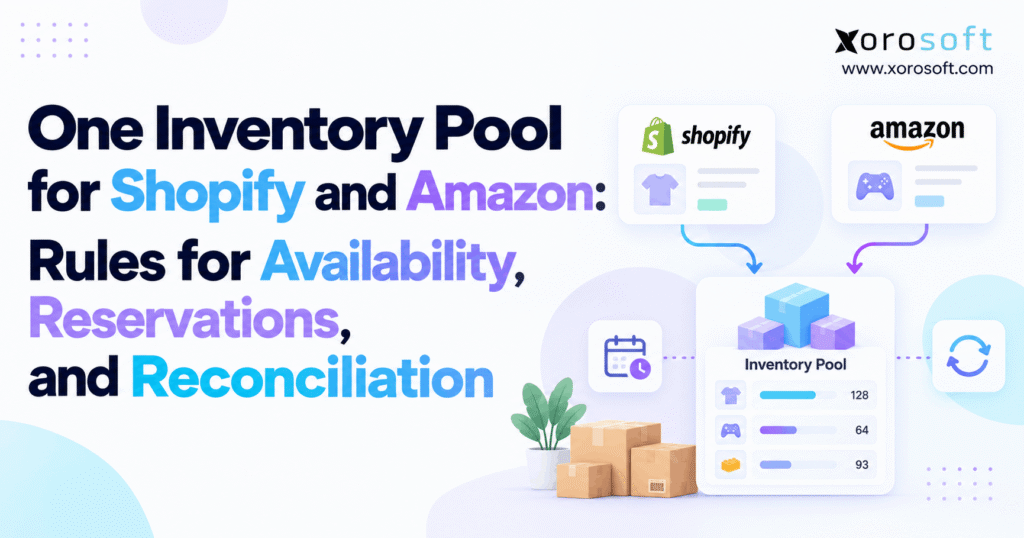
If you are looking to streamline your e-commerce business, setting up a Shopify Amazon inventory pool can help you efficiently manage stock across multiple platforms.
1. Why Shopify Amazon Inventory Drifts Across Sales Channels
A multichannel inventory problem rarely begins because a business has no inventory data. More often, Shopify, Amazon, the warehouse, and accounting software each contain a number that appears correct inside its own system but does not represent the complete inventory position.
A warehouse may physically contain 1,000 units of a SKU. Shopify could show 720 available. Amazon may have another 180 positioned for fulfillment. Meanwhile, 60 units may already be committed to wholesale customers while another 40 sit in quality control.
Looking only at physical inventory makes the operation appear healthy. Looking at commitments reveals a different picture.
That is where a Shopify Amazon inventory pool becomes important. Instead of allowing each sales channel to interpret stock independently, the business establishes one operating model for determining what can actually be sold.
1.1 Inventory Sync Alone Does Not Guarantee Accuracy
Inventory synchronization moves quantities between systems. It does not determine whether the quantity being synchronized is correct.
Suppose a warehouse reports 500 units on hand. An integration pushes 500 to Shopify and another 500 to Amazon. Technically, the connector worked. Operationally, however, the same inventory may have been exposed twice.
A more reliable process follows this sequence:
Physical inventory → eligibility → commitments → reservations → buffers → channel availability
The business calculates availability first and synchronizes the result second.
This distinction becomes increasingly important as a company adds Amazon FBA, Amazon FBM, 3PL locations, wholesale customers, EDI orders, retail channels, purchasing teams, and manufacturing.
1.2 Define What “Available” Really Means
Inventory teams often use the word “stock” as if it describes one number. In reality, stock can exist in several operational states.
Physical inventory tells the business how many units exist. Available inventory tells it how many units can still be promised. Reserved inventory protects quantities for demand that already exists. Incoming inventory represents expected future supply.
A scalable operation needs clear definitions for each state.
Otherwise, Shopify, Amazon, warehouse teams, and finance may spend time reconciling different definitions rather than actual inventory discrepancies.
2. Build One Reliable Shopify Amazon Inventory Pool
A Shopify Amazon inventory pool is the controlled inventory position used to determine how much inventory Shopify and Amazon can safely sell.
It does not mean every physical unit should be visible to both channels. Instead, both channels depend on the same underlying availability logic.
Suppose a company owns 800 units across two warehouses. Shopify orders already require 120 units, Amazon FBM orders require another 70, wholesale customers have 100 units reserved, and 30 units are awaiting inspection.
Even before safety stock is considered, the company no longer has 800 units available for new demand.
2.1 Choose the System That Owns Shared Inventory
A reliable shared inventory pool needs one authoritative system that understands where inventory exists and what has happened to it.
That system should capture receipts, shipments, transfers, returns, adjustments, reservations, warehouse movements, and expected supply.
It also needs to understand that inventory in one location may be available to Shopify but not Amazon, or appropriate for wholesale fulfillment but not direct-to-consumer orders.
As operational complexity grows, companies often move this responsibility away from individual channels and into a central platform. XoroONE is one example of this approach, connecting inventory with purchasing, warehousing, ecommerce operations, accounting, manufacturing, forecasting, and reporting.
2.2 Shared Stock Still Needs Channel Rules
Shared inventory does not mean unrestricted inventory.
Shopify might fulfill orders from Warehouse A and Warehouse B, while Amazon FBM uses only Warehouse A. Wholesale orders might reserve inventory from both facilities. Amazon FBA stock may already sit inside Amazon’s fulfillment network and therefore require different operating rules.
The inventory authority needs to consider these differences before calculating availability.
Without channel and location controls, a global inventory total may appear correct even though the stock required for a specific order cannot actually fulfill it.
3. Normalize Shopify and Amazon Inventory States Before Syncing
A strong Shopify Amazon inventory pool should not assume that inventory states mean exactly the same thing in every system.
Shopify, Amazon, warehouse applications, and ERP platforms organize inventory around their own operational processes. A central inventory model therefore needs to translate those states into consistent business rules.
3.1 How Shopify Inventory States Affect Shared Availability
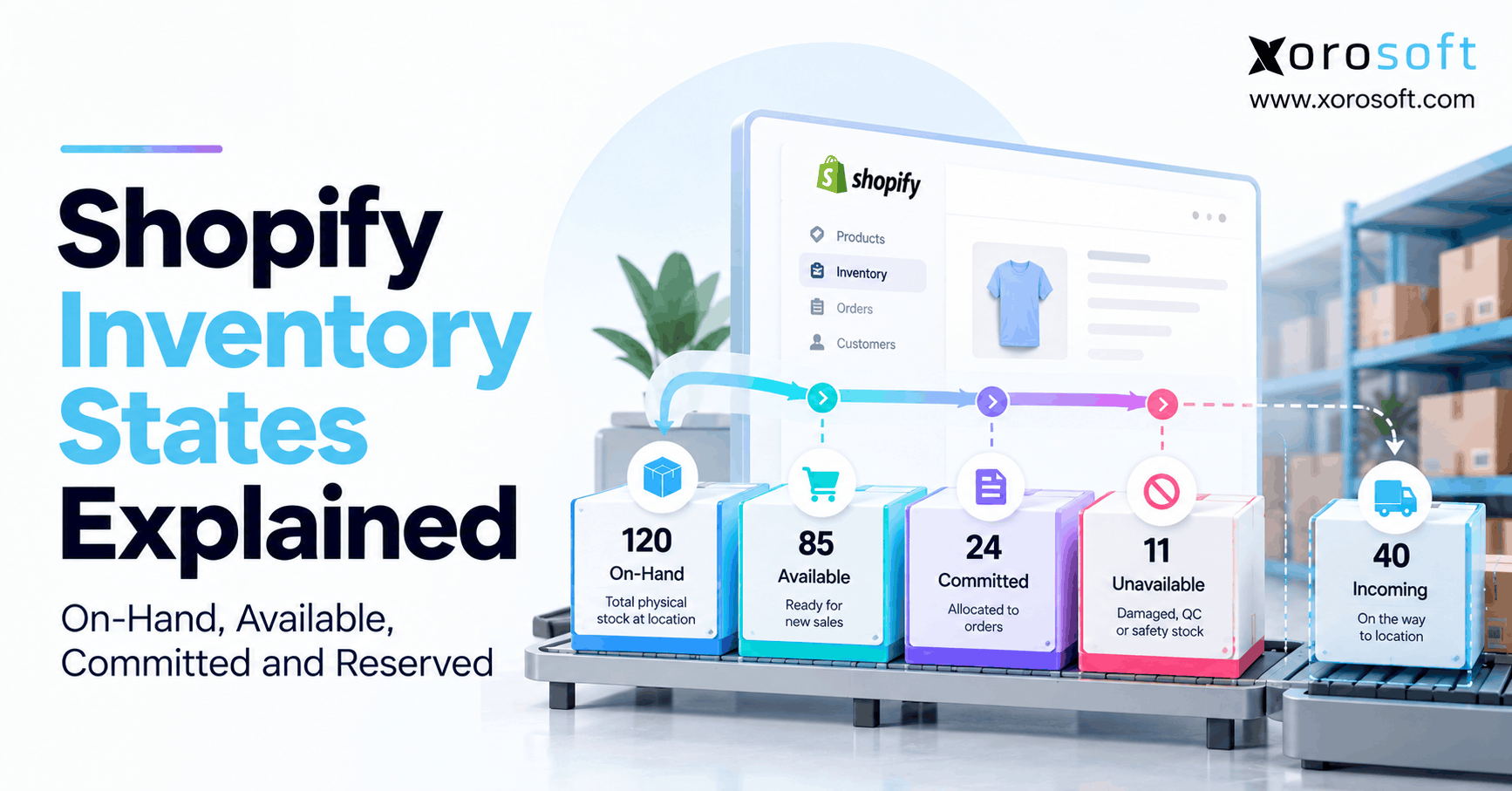
Shopify inventory can include stock that is physically present, available for new demand, committed to existing orders, unavailable for sale, or incoming.
That distinction matters because physical inventory is not automatically sellable inventory.
| Inventory State | Operational Meaning | Normally Sellable? |
|---|---|---|
| On hand | Physical quantity recorded at a location | Not necessarily |
| Available | Quantity free for new demand | Yes |
| Committed | Quantity protected for orders | No |
| Unavailable | Quantity intentionally withheld | No |
| Incoming | Expected future inventory | Not yet |
Publishing on-hand inventory instead of available inventory can expose units that the company has already promised or intentionally removed from sale.
3.2 How Amazon Inventory States Affect the Shared Inventory Pool
Amazon FBA introduces additional states around inventory inside its fulfillment network.
Fulfillable inventory can generally contribute to current availability. Inbound inventory represents supply that is still moving through the network. Unfulfillable inventory should normally remain outside the sellable pool. Reserved or researching quantities require additional interpretation.
| Amazon Inventory State | Typical Central Treatment |
|---|---|
| Fulfillable | Candidate for current availability |
| Reserved | Exclude or evaluate according to status |
| Inbound | Future supply |
| Unfulfillable | Exclude |
| Researching | Exclude until resolved |
These mappings should function as operating rules rather than assumptions that Shopify and Amazon states are identical.
4. Calculate Availability for the Shopify Amazon Inventory Pool
The most useful inventory number in multichannel commerce is not total physical stock. It is the quantity the business can safely promise to the next customer.
That means available-to-sell inventory should be calculated before quantities reach Shopify or Amazon.
4.1 Available-to-Sell Rules for Shared Inventory
A practical starting formula is:
Available to Sell = Eligible On-Hand − Commitments − Reservations − Unavailable Inventory − Safety Stock − Channel Buffers
The exact calculation depends on the company’s operating model, but the underlying principle remains consistent.
Consider this example:
| Inventory Component | Units |
|---|---|
| Eligible on-hand | 1,000 |
| Ecommerce commitments | -170 |
| Wholesale reservations | -90 |
| Quality-control inventory | -20 |
| Safety stock | -50 |
| Channel buffer | -20 |
| Available to sell | 650 |
The company physically owns 1,000 units, but only 650 remain suitable for new demand.
That difference is fundamental to a reliable Shopify Amazon inventory pool.
4.2 Location Eligibility Changes the Availability Calculation
Availability must also consider where a product exists.
If 150 units sit in a warehouse that cannot economically or operationally fulfill Amazon orders, those units should not automatically increase Amazon availability.
The same principle applies to damaged goods, quarantine inventory, showroom stock, manufacturing locations, bonded goods, or warehouses restricted to particular regions.
A dependable availability calculation therefore asks two questions: how many units exist, and which of those units can actually fulfill this order?
5. Reservation Rules for Shared Shopify Amazon Inventory
Reservations protect stock for recognized demand before a product physically leaves the warehouse.
Without reservation logic, accepted orders can continue competing for inventory that has already been promised.
This is one of the most common ways a technically accurate Shopify Amazon inventory pool can still oversell.
5.1 Choose a Clear Reservation Trigger
Every company needs a defined point at which inventory stops being freely available.
For some businesses, that happens when an order is accepted. Others wait for payment authorization, fraud approval, credit approval, or another status.
The specific trigger matters less than consistency.
If Shopify orders reserve inventory immediately but Amazon FBM orders do not reserve stock until picking begins, the channels are operating under different risk models.
During periods of high sales velocity, that gap can create overselling.
5.2 Inventory Reservations vs Channel Allocation
Reservations and allocations solve different problems.
A reservation protects stock for actual demand. An allocation determines which channel, customer, warehouse, or demand class can access a quantity.
A company might allocate 300 units to Amazon for a promotion while only 90 units are reserved against confirmed Amazon orders.
The remaining allocation is strategically protected but has not yet been claimed by individual demand.
This distinction becomes important when marketplaces, wholesale customers, retail stores, and direct-to-consumer channels compete for limited supply.
5.3 Release Holds When Demand Disappears
Reservations should not remain forever.
Cancelled orders, expired holds, rejected payments, abandoned draft orders, and quantity changes all require release logic.
If a reservation remains after demand disappears, available inventory becomes understated. Eventually, the business may appear sold out even though sellable units remain physically available.
6. Choose the Right Multichannel Inventory Allocation Model
There is no single allocation model that works for every Shopify and Amazon seller.
The right approach depends on sales velocity, channel importance, replenishment lead times, synchronization speed, wholesale commitments, and the commercial impact of a stockout.
6.1 Fully Shared Stock
In a fully shared model, Shopify and Amazon draw from the same available-to-sell quantity.
This maximizes inventory utilization because slower sales on one channel do not strand stock that could be sold elsewhere.
However, reservation logic and order capture need to be dependable.
A high-volume SKU with weak reservation timing can oversell even when the overall inventory calculation is correct.
6.2 Fixed Channel Allocation
Fixed allocation dedicates predetermined quantities to specific channels.
A company with 1,000 sellable units might allocate 450 to Shopify, 350 to Amazon, 150 to wholesale, and keep 50 as general safety stock.
The advantage is predictable channel protection.
The downside is stranded inventory. Shopify could sell out while unused Amazon allocation remains unavailable to Shopify customers.
6.3 Shared Inventory Pool With Protective Buffers
A hybrid model keeps most inventory shared while protecting smaller quantities for certain channels or customers.
| Model | Utilization | Protection | Flexibility |
|---|---|---|---|
| Fully shared | High | Depends on controls | High |
| Fixed allocation | Moderate | High | Low |
| Shared with buffers | High | High when tuned well | High |
| Dynamic allocation | High | Rule-dependent | Very high |
For many growing companies, shared inventory with targeted buffers creates a useful balance between availability and protection.
7. Use Safety Stock to Protect Multichannel Inventory Availability
Safety stock should protect the operation from uncertainty rather than act as an arbitrary percentage removed from every SKU.
Different products face different risks.
A slow-moving product supplied domestically with predictable replenishment does not need the same protection as a seasonal bestseller imported with a four-month lead time.
7.1 Set Buffers According to SKU Behavior
Useful inputs include demand variability, supplier reliability, sales velocity, replenishment lead time, minimum order quantities, seasonality, and the business impact of a stockout.
Integration risk also matters.
A fast-selling SKU may need additional protection if multiple orders can arrive before every connected system reflects new commitments.
7.2 Protect Shopify and Amazon Inventory Without Hiding Excess Stock
A channel buffer solves a narrower problem than general safety stock.
Global safety stock protects the business overall. Channel buffers protect particular selling environments.
For example, a company may retain 30 units as global safety stock while withholding another 10 units from marketplace publication during a high-volume promotion.
As connected systems multiply, ownership becomes increasingly important. A centralized integration architecture helps establish which applications originate orders, which consume availability, and which systems are authorized to create inventory transactions.
8. Manage FBA and FBM Inside a Shared Inventory Pool
FBA and FBM both generate Amazon demand, but operationally they represent different inventory models.
With FBA, stock has physically moved into Amazon’s fulfillment network. With FBM, the merchant or its fulfillment partner generally retains control of the goods.
Those differences need to remain visible inside the Shopify Amazon inventory pool.
8.1 Treat FBA as a Separate Inventory Location
When inventory leaves a company warehouse for FBA, the central record should capture that movement rather than simply replacing the warehouse quantity with a generic Amazon number.
The operating model should distinguish inventory leaving the warehouse, stock in transit, units received by Amazon, inventory available for fulfillment, and quantities moving into reserved or unavailable states.
That creates a clearer reconciliation trail.
If 500 units leave an internal warehouse but only 480 eventually become fulfillable at Amazon, the missing 20 units require investigation.
8.2 How Shopify and Amazon FBM Share Warehouse Inventory
FBM creates a different challenge because Amazon and Shopify may both draw from the same physical shelves.
A Shopify order and an Amazon FBM order therefore need to reduce the same available quantity.
Reservations, picks, short shipments, cancellations, and warehouse adjustments all need to feed the central inventory record.
For organizations moving beyond inventory-only tools, XoroERP represents a broader ERP approach where inventory operates alongside purchasing, accounting, manufacturing, warehouse management, reporting, and ecommerce workflows.
9. Apply Multi-Warehouse Rules to Shopify Amazon Inventory
A global inventory total can hide serious fulfillment constraints.
A company may have plenty of inventory overall while lacking stock in the facility that can economically or operationally serve a specific order.
For that reason, availability must be location-aware.
9.1 Warehouse Rules for Shopify Amazon Inventory Availability
Consider this location structure:
| Location | Available Units | Shopify Eligible | Amazon FBM Eligible |
|---|---|---|---|
| West Distribution Center | 300 | Yes | Yes |
| East Distribution Center | 210 | Yes | Yes |
| Retail Store | 60 | Yes | No |
| Quality Hold | 25 | No | No |
There are 595 units represented, but Amazon should not necessarily receive availability for all 595.
The central system needs to filter inventory according to channel and location eligibility.
Shipping economics, regional restrictions, product handling requirements, warehouse capacity, and service promises can all affect the rule.
9.2 Prevent Transfers From Creating Duplicate Stock
Inventory transfers create a common double-counting problem.
When 100 units leave Warehouse A for Warehouse B, those units should no longer remain available in Warehouse A merely because Warehouse B has not received them yet.
At the same time, Warehouse B should not count those units as normal physical inventory before receipt unless the business intentionally supports in-transit promising.
A warehouse execution platform such as XoroWMS can connect receiving, picking, bin-level movements, replenishment, transfers, and cycle counting to the wider inventory model.
10. Control How Returns and Cancellations Re-Enter Availability
Returns often inflate inventory because the order system may consider a transaction reversed before warehouse teams determine whether the returned product can actually be sold again.
A physically returned product is not automatically available inventory.
10.1 Inspect Returned Products Before Releasing Them
A practical return workflow separates receipt from disposition.
When the return reaches the warehouse, operations can place it into an inspection or quarantine state.
Warehouse staff then determine whether the product is sellable, damaged, incomplete, repairable, or unsuitable for resale.
Only stock confirmed as sellable should return to the active Shopify Amazon inventory pool.
This matters especially in apparel, footwear, furniture, sporting goods, electronics, and other categories where return condition varies.
10.2 Release Cancelled Orders Without Creating Phantom Stock
Cancellations need a different rule.
If an order is cancelled before warehouse release, its reservation can generally return to availability once the cancellation becomes final.
If picking has already started, operations may need to confirm the unit’s physical location before making it available again.
The principle is straightforward: inventory becomes sellable when operations confirm it is sellable.
11. Shopify Amazon Inventory Reconciliation by Transaction
Even a well-controlled Shopify Amazon inventory pool will experience exceptions.
Integrations fail. Warehouse counts change. Returns arrive in unexpected condition. Orders are edited. SKUs are mapped incorrectly. Manual adjustments occur.
A reliable operation does not assume discrepancies can be eliminated entirely. Instead, it makes them traceable.
11.1 Rebuild Shopify Amazon Inventory From Transaction Movements
A practical reconciliation equation is:
Opening Inventory + Receipts + Returns − Shipments ± Adjustments = Expected Ending Inventory
If expected inventory differs from the warehouse or marketplace balance, operations can investigate the transactions between those points.
This is much more useful than comparing two ending numbers and simply forcing one to match the other.
The objective is to identify the event that created the difference.
11.2 Avoid Using Manual Adjustments as a Shortcut
Suppose the central system shows 97 units while a marketplace shows 93.
Reducing the central quantity by four would make both numbers match, but it would not explain what happened.
Four orders may have failed to import. A shipment may have posted twice. A return may have entered the wrong state. The two reports may represent different timestamps.
Repeated unexplained adjustments usually indicate an underlying process, integration, warehouse, or master-data issue.
12. Handle Bundles, Kits, and Multipacks at Component Level
Bundles introduce another layer of inventory complexity because a sellable SKU may depend on several underlying components.
If bundle availability is stored independently from component stock, the business can oversell one or more components.
12.1 Calculate Bundle Inventory Availability From Components
Suppose a gift set contains one bottle, two refill packs, and one brush.
The warehouse has 60 bottles, 84 refill packs, and 100 brushes.
The maximum bundle availability is 42 because every bundle requires two refill packs.
The practical calculation is:
Bundle Availability = Minimum(Component Available Quantity ÷ Quantity Required)
If refill packs are also sold individually, every individual sale should immediately reduce bundle availability.
That component relationship should remain visible inside the Shopify Amazon inventory pool instead of being maintained through separate manual calculations.
12.2 Keep SKU Mapping Consistent Across Systems
SKU governance matters just as much as the availability formula.
Shopify variants, Amazon seller SKUs, warehouse item codes, supplier SKUs, accounting items, and bundle components often evolve separately.
If those mappings are inconsistent, the central system may correctly calculate inventory for one item while the marketplace is requesting another.
For Shopify merchants evaluating direct ERP connectivity, the Xorosoft ERP app on the Shopify App Store provides an example of connecting Shopify activity with a broader ERP operating environment.
13. Treat Incoming Supply as Future Inventory
Incoming inventory is important for planning, but it should not automatically increase what customers can buy today.
A purchase order represents expected supply. It does not prove that inventory has arrived, passed receiving, and become ready for fulfillment.
13.1 Do Not Count Purchase Orders as Ready-to-Ship Stock
Suppose a supplier confirms that 2,000 units will arrive next week.
Publishing those units immediately can create customer orders the business cannot fulfill if the shipment is late, short-shipped, damaged, or held during receiving.
For standard ecommerce availability, inventory should normally become sellable only when the relevant receiving process confirms it.
That keeps customer promises tied to operational reality.
13.2 Separate Available-to-Promise From Available-to-Sell
Available-to-promise answers a different question.
A company may intentionally accept future orders against expected receipts.
Inventory arriving in seven days might support an order with a two-week promised shipping date. It should not necessarily support an order advertised for immediate shipment.
The system should therefore distinguish available now from available later.
Partial receipts require the same discipline. If 1,000 units were ordered but only 700 arrive, only those 700 should enter current physical availability.
14. Keep Operational Inventory and Financial Inventory Aligned
Inventory is both an operational quantity and a financial asset.
Receipts, shipments, write-offs, returns, transfers, manufacturing movements, landed costs, and adjustments can change inventory quantities. Many of those transactions also affect inventory value or cost of goods sold.
When operations and finance tell different transaction stories, reconciliation becomes difficult.
14.1 Quantity Changes Need a Financial Transaction Story
Imagine warehouse staff write off 20 damaged units but accounting never receives the transaction.
Operations now reports less inventory while the financial ledger still carries the previous value.
The reverse can happen too. Finance may post an adjustment that never reaches the system controlling channel availability.
Problems become more serious when employees manually change Shopify or Amazon quantities because a number appears incorrect.
Now the storefront may advertise inventory without a supporting operational transaction.
14.2 Avoid Turning Channel Adjustments Into a Second Ledger
Growing businesses benefit when inventory changes remain connected to the events that caused them.
That is one reason organizations often move inventory authority toward ERP as complexity grows.
Companies comparing ERP systems should evaluate inventory architecture, warehouse processes, accounting requirements, integrations, implementation effort, and operating fit rather than relying only on feature checklists. Businesses considering NetSuite can use the Xorosoft vs NetSuite comparison as one input during that evaluation.
15. Know When Shopify Amazon Inventory Sync Stops Being Enough
Not every Shopify and Amazon seller needs ERP.
A business with one warehouse, manageable SKU complexity, straightforward purchasing, no manufacturing, and simple accounting may operate effectively with a focused inventory application or synchronization layer.
Technology should follow operational complexity rather than precede it.
15.1 When Multichannel Inventory Software Still Works Well
Inventory-focused software can work well when the primary requirement is coordinating stock across a small number of channels and locations.
If purchasing is straightforward, wholesale commitments are limited, accounting is relatively simple, and warehouse processes are not highly specialized, a full ERP may add more implementation effort than operational value.
The goal is not to deploy the largest platform possible.
It is to use the smallest architecture that accurately represents how the company works.
15.2 When ERP Should Control the Shared Inventory Pool
The requirement changes when inventory decisions depend on several departments and transaction types.
Multiple warehouses, wholesale reservations, EDI orders, purchasing teams, landed costs, forecasting, manufacturing, complex bundles, accounting integration, and frequent reconciliation all push inventory beyond a simple sync problem.
At that point, the system needs to answer more than how many units exist.
It must explain where the units are, what is reserved, what is incoming, who has priority, what the inventory is worth, and which location can fulfill the order.
That is where broader ERP and operations solutions become more relevant.
16. Adapt Inventory Rules to the Product and Industry
The underlying principles remain consistent, but actual availability rules can differ substantially by industry.
Product characteristics, return rates, replenishment cycles, manufacturing requirements, channel mix, and fulfillment economics all influence what should count as sellable.
16.1 Apparel and Fashion Need Variant-Level Control
Apparel brands manage inventory by style, color, and size.
A company can have substantial inventory for a style overall while being sold out of the exact variant customers want.
Reservations therefore need to operate against the actual variant.
Returns also matter. A garment may be physically back in the warehouse but still require inspection before becoming available again.
High SKU counts make consistent item mapping particularly important.
16.2 Furniture Requires Location and Lead-Time Discipline
Furniture companies frequently manage bulky products across regional warehouses, long supplier lead times, dropship vendors, container shipments, and complex delivery constraints.
A sofa available in one warehouse may not be economically suitable for an order on the other side of the country.
For these businesses, location-aware availability is more useful than a global stock total.
16.3 Food, Wholesale, and Manufacturing Add More Inventory States
Food businesses may require lot control, expiry management, quarantine, and release rules.
Wholesale distributors can hold large customer commitments that immediately reduce what ecommerce channels can safely promise.
Manufacturers need to distinguish raw materials, work in process, production reservations, and finished goods.
Businesses evaluating their inventory architecture by operating model can review Xorosoft’s industry-specific resources for examples across distribution, apparel, furniture, sporting goods, manufacturing, food, and other inventory-driven sectors.
17. Give Every Inventory Event a Clear Owner
Many inventory failures occur because too many systems have permission to change the same quantity.
Shopify can update stock. Amazon reports marketplace inventory. Warehouse applications record physical movements. Accounting systems post adjustments. Employees maintain spreadsheets. Middleware moves transactions between systems.
Without clear ownership, teams eventually struggle to decide which number should win.
17.1 Choose One Inventory System of Record
The operating architecture should define which system has final authority over availability.
For a Shopify Amazon inventory pool to remain reliable, Shopify, Amazon, warehouse applications, accounting systems, and spreadsheets cannot all independently redefine the sellable quantity.
Channels can originate orders. Warehouses can originate physical movements. Purchasing can create future supply. Finance can consume the resulting valuation effects.
Those events should still feed one coherent inventory model.
17.2 Build Exception Handling Into Daily Operations
No integration works perfectly forever.
Orders fail to import. SKUs are configured incorrectly. Locations change. APIs retry. Employees discover count differences. Orders are edited.
A mature workflow separates routine synchronization from exceptions.
Most transactions should flow automatically. Operations teams should investigate a manageable queue of meaningful discrepancies rather than comparing entire spreadsheets each morning.
Businesses evaluating more centralized operating models can review Xorosoft case studies to see how inventory-driven organizations approach ecommerce, wholesale, warehouse, distribution, and related workflows.
18. Prevent Overselling With Controlled Multichannel Inventory
Overselling is often described as an integration-speed problem.
Sometimes it is. More often, the underlying issue is an incorrect definition of availability combined with timing.
A system that publishes an unsafe quantity every 30 seconds is still unsafe.
18.1 Publish Shopify Amazon Available Inventory, Not On-Hand Stock
The Shopify Amazon inventory pool should publish only quantities that meet the company’s rules for sale.
Commitments, reservations, unavailable stock, warehouse eligibility, safety stock, channel allocations, and return status should all be considered before a quantity reaches Shopify or Amazon.
Synchronization speed still matters.
If the final ten units of a bestseller can sell within seconds, waiting several minutes for new commitments to reach the inventory authority increases risk.
For a slower product, the same delay may have little operational impact.
18.2 Use Buffers Where Failure Has a Real Cost
Buffers are most useful when overselling has a meaningful commercial consequence.
Promotional items, scarce products, long-lead-time inventory, seasonal goods, and marketplace listings with strict fulfillment expectations may justify additional protection.
However, excessive buffers can create artificial stockouts and leave usable inventory unsold.
The goal is not to hide stock.
It is to expose the maximum quantity the business can confidently promise.
19. Measure Inventory Quality Beyond Sync Status
A green integration indicator does not prove that inventory is accurate.
Teams need operating measures that show whether the underlying inventory model is producing reliable results.
19.1 Track Multichannel Inventory Discrepancies and Exceptions
Useful indicators include unexplained inventory adjustments, oversell incidents, stockouts despite recorded availability, SKU mapping problems, missing orders, delayed transfers, orders held for inventory, and recurring reconciliation differences.
Patterns matter more than isolated exceptions.
If inventory adjustments increase every month, the company should investigate receiving, picking, returns, integrations, cycle counting, or master data rather than simply processing more corrections.
Root causes matter because the same issue will otherwise continue returning.
19.2 Treat Growing Manual Work as a Warning Sign
Spreadsheets often reveal where official systems no longer represent operational reality.
One worksheet may track Amazon inventory. Another records wholesale holds. A third estimates incoming purchase orders. Another supports monthly reconciliation.
A spreadsheet is not automatically a problem.
The risk appears when spreadsheets contain rules that determine sellable inventory but those rules never reach the systems publishing quantities to customers.
At that point, employees effectively become the integration layer.
That can work at small scale but becomes difficult to govern as volume and complexity increase.
20. Make the Shopify Amazon Inventory Pool an Operating Standard
A dependable Shopify Amazon inventory pool is not created simply by connecting Shopify and Amazon and choosing a synchronization frequency.
It is created by defining what each inventory state means, which locations can fulfill which channels, when orders reserve inventory, how safety stock works, when returned products become sellable, how incoming supply should be treated, and which system has final authority when records disagree.
Once these rules are documented, technology becomes much easier to evaluate.
For a smaller company, the right architecture may remain Shopify, Amazon, one warehouse, and a focused inventory application. Adding ERP complexity before the business needs it does not automatically improve accuracy.
As the business expands into multiple warehouses, wholesale, EDI, purchasing, manufacturing, accounting, additional marketplaces, and more sophisticated allocation rules, inventory becomes part of a broader transaction architecture.
A practical next step is to select one high-volume SKU and follow it through its full lifecycle: purchase order, receiving, warehouse location, availability calculation, Shopify or Amazon sale, reservation, fulfillment, return, adjustment, and financial reconciliation.
At every stage, document which system changes the quantity and why.
If several systems can independently redefine what is available, that is the architecture problem to solve first.
For teams evaluating whether a centralized ERP should become the operating layer behind Shopify, Amazon, purchasing, warehousing, and finance, contact Xorosoft to review the workflow around your actual inventory rules rather than starting with a generic software feature list.
Frequently Asked Questions
What is a Shopify Amazon inventory pool?
A Shopify Amazon inventory pool is a centralized stock model that calculates what both channels can safely sell after commitments, reservations, unavailable inventory, safety stock, and channel rules.
Can Shopify and Amazon share the same inventory?
Yes. Both channels can draw from the same stock when one system controls availability, reservations, warehouse eligibility, and updates across every connected sales and fulfillment channel.
How do you prevent overselling on Shopify and Amazon?
Use one inventory authority, publish available rather than physical stock, reserve confirmed demand quickly, apply appropriate safety buffers, and reconcile inventory exceptions before they become persistent.
What is the difference between available and reserved inventory?
Available inventory can support new orders. Reserved inventory has already been protected for existing demand and should not remain freely sellable across other channels or customers.
How should Amazon FBA inventory be handled?
Treat FBA as a separate inventory location with its own fulfillable, reserved, inbound, and unavailable states. Apply state-specific rules before adding Amazon-held units to sellable inventory.
How often should Shopify and Amazon inventory be reconciled?
High-volume operations should monitor exceptions frequently and reconcile on a regular schedule. The right cadence depends on transaction volume, warehouse complexity, order velocity, and discrepancy risk.
When should a business move from inventory sync software to ERP?
ERP becomes more relevant when inventory depends on multiple warehouses, wholesale, EDI, purchasing, accounting, manufacturing, complex allocations, or reconciliation beyond a simple channel-sync tool.
Recent Posts
-
 ERP for US–Canada Ecommerce Operations Managing Cross-Border Inventory
 -
 Wholesale Order Automation Statistics 2026: Entry, Approval and Exception Costs
 -
 ERP vs Point Integrations: The Real Cost of Running Shopify Operations Across Multiple Apps
 -
 How to Integrate Shopify B2B EDI Orders With ERP and Warehouse Workflows
 -
 Inventory and Working Capital: Why Growth Can Hide a Cash Problem