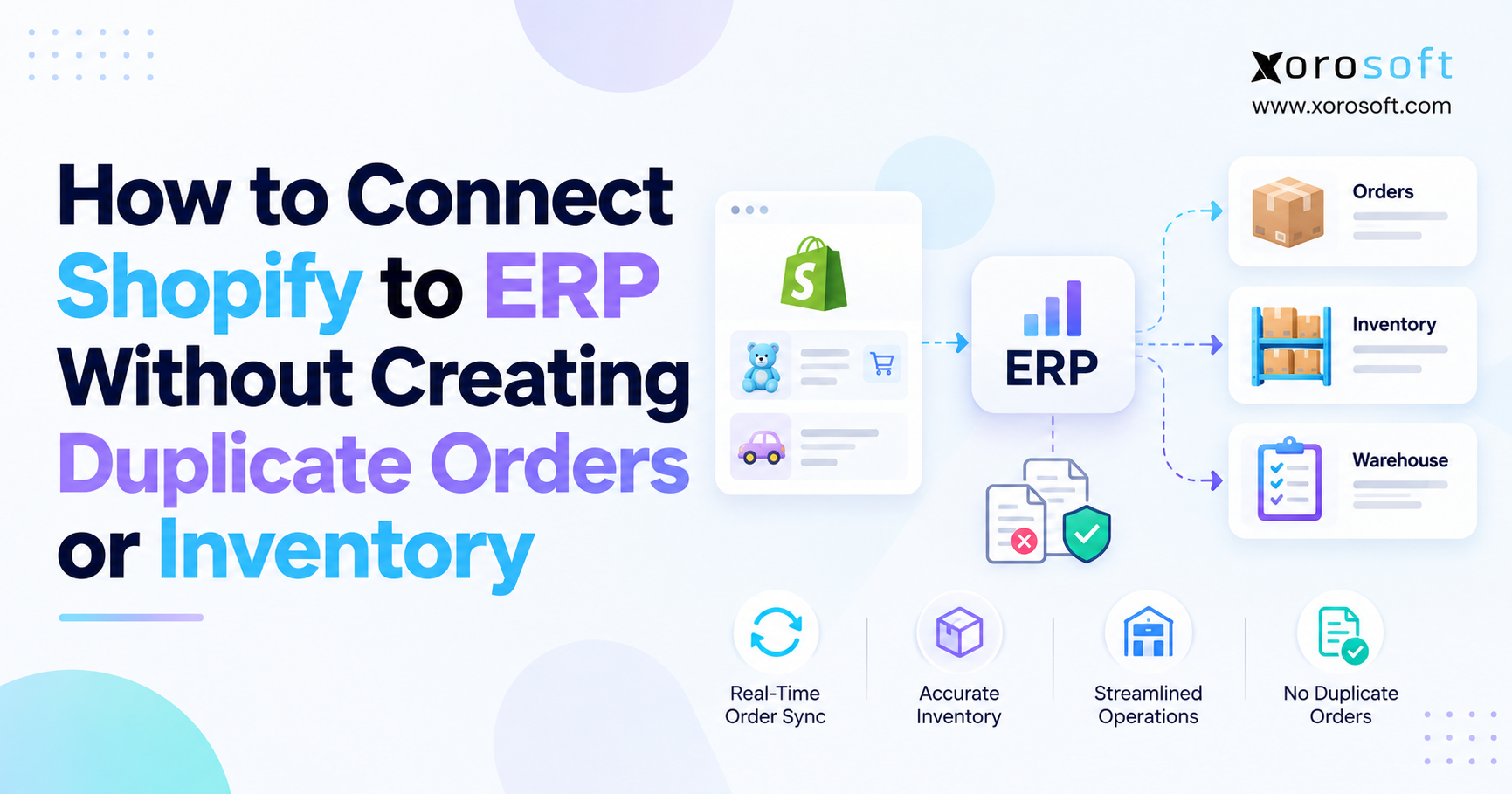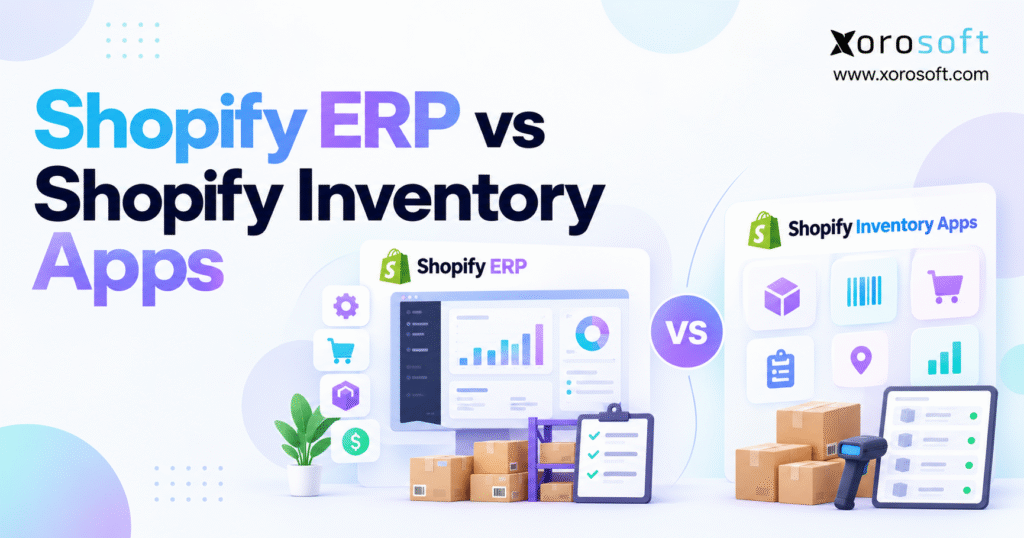
If you are searching for a comprehensive Shopify ERP comparison, you will find useful insights here.
1. Why Shopify Growth Eventually Creates an Operations Problem
Most Shopify businesses do not begin with an ERP problem. They start with a much simpler requirement: keep inventory accurate, prevent overselling, replenish stock on time, and move orders through fulfillment without unnecessary delays.
At that stage, Shopify’s native inventory capabilities and a focused inventory app may be completely adequate. A planning tool can improve forecasting. Barcode software can strengthen warehouse accuracy. An accounting platform can manage financial records independently.
Growth gradually changes the operating model.
Additional warehouses appear. Amazon becomes an important source of demand. Wholesale customers begin reserving larger quantities. Purchasing grows more sophisticated, while finance needs stronger inventory valuation and reconciliation.
Eventually, the same inventory transaction affects several teams and systems at once.
That is when a Shopify ERP comparison becomes useful.
The decision is not simply whether ERP offers more functionality. Specialist inventory applications can outperform broad ERP platforms in specific areas such as forecasting, marketplace synchronization, or replenishment.
A better question is whether the existing systems can still operate as one coherent environment.
1.1 Shopify Inventory Management Has Become More Capable
Shopify today handles much more than basic stock quantities.
Merchants can maintain inventory across locations, transfer stock, receive goods, create purchase orders, manage suppliers, and coordinate fulfillment-related inventory activity.
Those capabilities matter because ERP should not become the default recommendation every time a company adds complexity.
A business with two warehouses, straightforward purchasing, reliable accounting integration, and one strong inventory application may have no meaningful reason to replace its existing architecture.
Software should solve operational problems rather than create a perception of maturity.
1.2 Inventory Complexity Often Becomes Integration Complexity
Inventory problems usually begin inside one department.
Later, the same problems spread.
Suppose a supplier shipment arrives at a warehouse. Receiving the goods may need to update inventory quantities, purchase-order status, available ecommerce inventory, supplier liabilities, financial valuation, forecasting inputs, and replenishment calculations.
If several applications own pieces of that transaction, coordination becomes difficult.
The issue is no longer simply whether inventory is accurate. It is whether the company’s systems agree on what happened.
This transition is one of the clearest reasons companies begin a Shopify ERP comparison.
1.3 Revenue Is Not the Best ERP Trigger
There is no universal sales threshold at which a Shopify business suddenly needs ERP.
A $30 million company with one channel and uncomplicated operations may run successfully with a relatively lean technology stack.
Meanwhile, a $10 million manufacturer selling through Shopify, Amazon, wholesale, EDI, and several warehouses could have substantially greater system complexity.
Operational requirements matter more than headline revenue.
Warehouse structure, channel count, manufacturing, purchasing, financial controls, integrations, and transaction volume all influence whether ERP becomes worthwhile.
2. Shopify ERP Comparison: What Inventory Apps and ERP Actually Own
The most useful Shopify ERP comparison starts with system responsibility.
Inventory applications and ERP platforms often share individual features. Their operating roles, however, are different.
Inventory applications generally optimize a focused business problem.
ERP is designed to coordinate multiple business functions around shared transactions and data.
2.1 What Shopify Inventory Apps Usually Solve
A Shopify inventory application may focus on demand planning, replenishment, barcode scanning, inventory alerts, bundle management, marketplace synchronization, purchasing, or stock optimization.
That specialization is often an advantage.
If forecasting is the company’s main weakness, a specialist forecasting application may be a better investment than implementing an entire ERP environment.
The same principle applies to warehouse scanning or Amazon inventory synchronization.
Focused software works particularly well when the problem has clear boundaries and does not require constant interaction with finance, production, warehouse management, and several sales channels.
2.2 What ERP for Shopify Usually Solves
ERP has a wider operational mandate.
A Shopify-connected ERP can coordinate inventory, purchasing, accounting, suppliers, warehouses, customer orders, forecasting, manufacturing, and reporting through a common operating model.
Shopify continues to manage commerce.
Customers browse products, place orders, and complete checkout through the storefront. Behind that commerce layer, ERP can coordinate the operational and financial impact of each transaction.
For example, a Shopify order may reserve stock, create warehouse demand, update planning calculations, generate financial activity, and affect future purchasing requirements.
ERP’s advantage therefore comes less from one individual feature and more from connected workflows.
2.3 Shopify ERP vs Inventory Apps Comes Down to System Ownership
System ownership is one of the most important issues in any ERP architecture.
A company might decide that Shopify owns storefront descriptions and merchandising content while ERP controls inventory availability, item costs, supplier information, and purchasing.
The warehouse system might manage physical execution without becoming the official financial inventory record.
Clear boundaries make integrations easier to understand.
Confusion begins when Shopify, inventory software, warehouse systems, and spreadsheets can all independently change the same operational information.
Once several systems can alter one inventory number, tracing errors becomes much harder.
3. When Shopify Inventory Apps Are Still the Better Choice
A good Shopify ERP comparison should explain when ERP is unnecessary.
Many businesses can continue operating effectively with Shopify and specialist applications for years.
The deciding factor is whether the current architecture still produces reliable, efficient processes.
3.1 Shopify Inventory Apps Work Well for Specialized Problems
Suppose the company’s inventory accuracy is strong but forecasting is weak.
A forecasting application may solve the problem directly.
Another merchant might have excellent planning but poor barcode workflows. In that case, warehouse scanning software could provide more value than a broad ERP implementation.
A focused operational weakness does not automatically justify replacing systems that already work.
The best software project is often the smallest one capable of fixing the actual problem.
3.2 Shopify Inventory Management Can Be Enough for Simple Operations
Businesses with a primary Shopify channel, straightforward purchasing, one or two warehouses, and uncomplicated fulfillment may not need an ERP layer.
Shopify can already support meaningful inventory workflows, while apps can extend the areas where more depth is required.
This approach also reduces implementation burden.
Employees continue working with familiar systems, integrations remain relatively simple, and the company avoids migrating financial and operational data without a clear reason.
3.3 Separate Accounting Can Remain Efficient
Using a dedicated accounting platform does not automatically mean the technology environment is fragmented.
Many Shopify companies successfully maintain ecommerce and accounting as separate systems.
The important measure is reconciliation effort.
If finance receives reliable data, inventory values agree with operational records, and month-end close runs predictably, separate accounting can remain entirely appropriate.
Problems emerge when accountants spend growing amounts of time reconciling inventory, warehouse adjustments, marketplace transactions, purchase receipts, and ecommerce orders manually.
At that stage, the ERP vs Shopify inventory software question becomes more serious.
3.4 A Well-Designed App Stack Can Outperform a Poor ERP Implementation
Consolidating software is not a goal by itself.
Five applications with clear responsibilities and dependable integrations can create a better operating environment than one poorly configured ERP.
Technology architecture should be judged on accuracy, efficiency, control, reporting, and usability.
If the existing stack meets those requirements without excessive manual work, replacing it can introduce more complexity than value.
4. Shopify ERP Comparison by Inventory, Purchasing, Finance, and Warehousing
Looking at specific business functions reveals where inventory applications remain strong and where ERP expands the operating scope.
| Business Function | Shopify + Inventory Apps | ERP |
|---|---|---|
| Inventory tracking | Strong | Strong |
| Multi-location inventory | Strong | Strong |
| Forecasting | Often strong through specialist apps | Connected to wider planning |
| Purchase orders | Native or app-supported | Connected to procurement and finance |
| Supplier management | Available | Usually broader |
| Accounting | Usually separate | Often integrated |
| Inventory valuation | Integration dependent | Connected with finance |
| Warehouse execution | App or WMS dependent | Integrated or connected WMS |
| Manufacturing | Specialist software often required | Frequently supported |
| Wholesale and EDI | Additional systems | Can be centrally coordinated |
| Reporting | Distributed across tools | Cross-functional |
| System of record | Often distributed | More centralized |
4.1 Shopify Inventory Management vs ERP for Stock Control
Both architectures can provide strong inventory management.
A specialist tool may even offer deeper forecasting or replenishment functionality than a general ERP module.
The major difference appears after an inventory event occurs.
Receiving goods, for example, can affect physical stock, supplier commitments, financial valuation, purchasing, and ecommerce availability.
ERP can keep more of those effects inside one transaction chain.
Inventory apps usually require integrations to pass the same information between several systems.
Neither model is inherently wrong. Complexity determines which model becomes easier to operate.
4.2 ERP vs Inventory Apps for Purchasing
Creating a purchase order is only one part of procurement.
Buyers may also need supplier lead times, minimum-order quantities, open purchase orders, cash constraints, forecasts, inventory commitments, and warehouse requirements.
As those inputs grow, procurement becomes increasingly cross-functional.
A standalone purchasing or inventory application can still work well when these relationships remain simple.
ERP becomes more useful when buyers need financial, warehouse, supplier, and planning information within one operating process.
4.3 Shopify ERP Comparison for Accounting and Inventory Valuation
Accounting represents one of the clearest distinctions between inventory software and ERP.
Inventory has financial value.
Every shipment, receipt, return, write-off, correction, or production transaction can affect accounting records.
Separate inventory and accounting applications therefore rely on integrations to keep operational and financial activity aligned.
That structure can work efficiently at moderate complexity.
Higher transaction volumes, several warehouses, manufacturing, and multiple sales channels increase the amount of reconciliation required.
ERP reduces the separation by connecting operational activity more directly with financial records.
4.4 ERP vs Shopify Inventory Apps for Warehouse Operations
Inventory software answers questions about what stock exists and where it exists.
Warehouse management addresses how employees physically handle that stock.
Receiving, putaway, bin management, picking, packing, cycle counting, and shipping require a deeper operational layer.
Companies experiencing warehouse execution problems should not assume an inventory module alone will solve them.
A dedicated XoroWMS environment, for example, is focused on physical warehouse workflows rather than only inventory visibility.
The distinction matters because ERP and WMS solve related but different problems.
5. Shopify ERP Comparison: When the Business Starts Outgrowing Apps
The Shopify ERP comparison becomes more relevant when several warning signs appear at the same time.
A single operational issue may still justify a focused application.
A recurring pattern across departments usually indicates a broader architecture problem.
5.1 Conflicting Inventory Numbers Signal an Ownership Problem
One of the strongest warning signs is disagreement between systems.
Shopify might show 420 units.
The warehouse platform reports 411.
An inventory planning application shows 405 available.
Employees then start comparing timestamps, exports, and adjustments to determine which number should be trusted.
Repeated discrepancies usually indicate more than a synchronization delay.
They often reveal unclear system ownership.
A centralized operational model can reduce this ambiguity by establishing one source responsible for inventory availability.
5.2 Multi-Warehouse Operations Require Allocation, Not Just Visibility
Knowing how much inventory exists at each location is useful.
Growing businesses also need to understand what inventory is committed, available, reserved, inbound, or already promised to another channel.
Imagine a company owns 2,000 units.
Wholesale customers have reserved 500. Open Shopify orders require 250. Amazon needs 300. Safety stock accounts for another 150.
Physical inventory is 2,000, but unrestricted inventory is much lower.
Once these allocation rules become important, the system must do more than count stock.
5.3 Shopify, Amazon, and Wholesale Can Compete for the Same Inventory
Multiple sales channels create competing demand.
If Amazon sells a product, Shopify availability may need to change almost immediately. A large wholesale commitment could require another adjustment before any physical goods leave the building.
Inventory synchronization tools can solve this efficiently for many businesses.
However, increasing channel complexity eventually creates a need for one central availability model.
At that point, ERP can become the system that determines how much inventory each channel should see.
5.4 Finance Should Not Become the Integration Team
Another warning sign appears when finance spends excessive time reconciling operational systems.
Accountants may compare Shopify reports, inventory software, warehouse adjustments, supplier receipts, marketplace payouts, and accounting balances.
Manual financial controls remain necessary in any system.
Still, the amount of effort required to reconcile systems is measurable.
When those hours increase each month, ERP evaluation becomes easier to justify financially.
5.5 Wholesale, EDI, and Manufacturing Push Beyond Simple Inventory Apps
Wholesale introduces larger orders, terms, allocations, customer-specific pricing, and different fulfillment expectations.
EDI adds standardized partner transactions.
Manufacturing introduces materials, work orders, bills of materials, production planning, and costing.
When these requirements coexist, inventory is connected to too many processes to remain a standalone concern.
That is one of the most important tipping points in a Shopify ERP comparison.
6. Shopify ERP vs Inventory Apps: The Hidden Cost of App-Stack Architecture
Technology fragmentation rarely happens because someone designed a bad system intentionally.
Most app stacks develop gradually because each new tool solves a real problem.
Complexity appears later when those tools have to exchange increasingly important data.
6.1 Every New Integration Adds Another Operational Dependency
Consider a business using Shopify, inventory planning software, accounting software, WMS, Amazon integration, EDI software, and purchasing spreadsheets.
Forecasting needs sales history.
Purchasing needs the forecast.
Warehousing needs orders.
Accounting needs operational transactions.
Shopify and Amazon both need inventory availability.
None of those relationships is unusual.
Together, however, they create a data network that must be monitored and maintained.
Adding one new application can create several new dependencies.
6.2 ERP vs Shopify Inventory Software Becomes a Governance Decision
Eventually, technology discussions shift from features to ownership.
Who creates a SKU?
Which system owns the item cost?
Where is available inventory calculated?
Who maintains supplier information?
What happens when an order fails to import?
Which team resolves a synchronization problem?
A centralized ERP model can make those responsibilities easier to document.
Companies evaluating broader integration architecture can review Xorosoft’s integrations as one example of connecting ecommerce, marketplaces, warehousing, and other operational systems around a common ERP layer.
6.3 Centralization Does Not Require Removing Every Specialist Tool
A mature ERP environment may still use specialist applications.
That is not a failure of consolidation.
For instance, a business might retain an advanced forecasting platform because its planning capabilities are stronger than the ERP’s built-in forecast.
In that model, ERP can own inventory and purchasing while the forecasting platform consumes operational information and returns planning recommendations.
The important difference is that responsibilities remain clear.
Specialization works well when governance is centralized.
6.4 Exception Handling Is Where Architecture Gets Tested
Standard transactions make integrations look easy.
Real operations include cancellations, partial receipts, damaged returns, mismatched SKUs, delayed marketplace updates, negative inventory, and failed data imports.
Those situations determine whether a technology architecture is manageable.
A strong operating model defines how exceptions are surfaced, who owns them, and how employees correct them.
ERP can provide value by making those exceptions part of the normal operational workflow rather than leaving them scattered across application logs and spreadsheets.
7. ERP vs Shopify Inventory Apps for Multi-Warehouse Operations
Multi-location inventory does not automatically require ERP.
The tipping point is usually the complexity of decisions surrounding those locations.
7.1 Shopify ERP Comparison for Available-to-Sell Inventory
Physical inventory is not always the same as inventory available to customers.
A warehouse might hold 1,000 units.
Wholesale reservations account for 200 units. Open ecommerce orders require 100. Amazon allocation consumes 150. Safety stock removes another 50.
Only 500 units remain freely available.
Commerce platforms need that available-to-sell figure rather than the physical count alone.
As warehouses and channels increase, applying those rules consistently becomes more important.
7.2 Inventory Transfers Affect Purchasing and Fulfillment
Moving goods between warehouses appears simple on the surface.
Operationally, the company needs to understand when inventory leaves one location, whether in-transit inventory is sellable, when it arrives, and whether the destination still needs replenishment.
Transfer activity also affects future purchasing.
A central operational platform can preserve the transfer as one transaction instead of relying on independent manual adjustments.
7.3 Fulfillment Routing Requires Consistent Inventory Logic
Businesses may route orders according to proximity, freight cost, warehouse capacity, stock availability, or channel commitments.
The more complex those rules become, the less useful isolated inventory quantities are.
ERP does not automatically provide every routing capability a business might need.
It can, however, provide a consistent inventory foundation that Shopify, marketplaces, warehouses, and 3PLs can use when applying fulfillment rules.
8. Shopify ERP Comparison for Purchasing, Forecasting, and Finance
Forecasting only creates value when the company can translate forecasts into operational decisions.
Purchasing only creates value when goods arrive where they are needed at an economically sensible time.
Finance needs those decisions reflected accurately in the company’s records.
These functions become increasingly difficult to manage separately as scale rises.
8.1 Forecasting Should Connect to Inventory Reality
Suppose the forecast predicts demand for 6,000 units.
Before placing a purchase order, buyers still need to know current inventory, open customer orders, existing purchase orders, supplier lead times, reserved stock, warehouse requirements, and available cash.
A forecast by itself cannot answer those questions.
This is where an integrated operating model becomes useful.
XoroONE is one example of a platform designed to bring inventory, purchasing, accounting, forecasting, warehouse management, manufacturing, and related processes into a broader ERP environment.
The value is not simply that each feature exists.
The value comes from how the processes interact.
8.2 Procurement Extends Beyond Purchase-Order Creation
Purchase orders sit in the middle of a longer business process.
Planning identifies demand.
Buyers select suppliers and quantities.
Approvals may be required.
Suppliers confirm deliveries.
Warehouses receive products.
Finance processes the resulting liabilities.
When every stage operates in a separate system, each handoff can create manual work or data inconsistency.
ERP aims to keep more of those stages connected.
8.3 Inventory Valuation Connects Operations Directly With Accounting
Inventory receipts increase asset value.
Shipments move cost into cost of goods sold.
Write-offs reduce asset value.
Manufacturing transforms materials into finished products.
Returns can reverse previous transactions.
That relationship means inventory accuracy directly affects financial reporting.
An integrated ERP model can reduce the number of independent records finance must reconcile at month-end.
8.4 Month-End Close Is a Strong ERP Readiness Test
Companies unsure whether ERP is necessary should study the close process.
How many exports does finance need?
How much manual reconciliation occurs?
Do accountants frequently investigate differences between operational and financial inventory?
Are journal entries used to compensate for missing system connections?
The answers reveal how much hidden labor the current architecture creates.
A Shopify ERP comparison should include that labor rather than focusing only on software subscriptions.
9. Shopify ERP vs Inventory Apps for Wholesale, Amazon, EDI, and Manufacturing
Commerce complexity changes substantially when Shopify is only one of several ways customers buy.
A business serving DTC, Amazon, wholesale, EDI, and manufacturing requirements needs more coordination than a single-channel ecommerce company.
9.1 Shopify and Amazon Need Shared Inventory Rules
Both channels may sell the same product simultaneously.
Giving each channel visibility into the full physical quantity can create overselling.
Inventory synchronization applications can prevent this.
Yet as more channels appear, the company increasingly needs one central calculation of what inventory each channel may sell.
That is a governance issue rather than merely a synchronization issue.
9.2 Wholesale Requires Different Inventory Commitments
Wholesale customers often order larger quantities and may reserve stock well before shipment.
Those reservations should influence consumer-channel availability.
Wholesale can also introduce negotiated pricing, credit terms, salesperson involvement, and different fulfillment requirements.
As a result, the same inventory has to satisfy several commercial models at once.
ERP becomes more relevant because inventory decisions are now connected with customer management and finance.
9.3 EDI Adds Another Transaction Layer
Retail trading partners may exchange purchase orders, order acknowledgments, advance shipping notices, invoices, and other standardized documents through EDI.
Specialized EDI platforms can manage those messages effectively.
The architectural question is where the resulting orders and inventory commitments belong.
If EDI, wholesale, Shopify, and marketplace demand all share the same inventory, a central operational system can provide consistency underneath the channel-specific integrations.
9.4 Manufacturing Creates Material Requirements, Not Just Finished-Goods Demand
A manufacturer must plan more than finished product inventory.
Every product may depend on several components, raw materials, or intermediate items.
Demand therefore creates upstream requirements.
Production orders consume materials and create finished stock. Purchasing must account for both customer demand and manufacturing needs.
Businesses comparing requirements across manufacturing, wholesale, apparel, furniture, sporting goods, food, and other sectors can review Xorosoft’s industry coverage for examples of how ERP requirements differ by operating model.
10. Shopify ERP Comparison Cost: Compare Total Operating Cost
The financial side of a Shopify ERP comparison should include more than subscription pricing.
A proper evaluation looks at total cost of ownership.
10.1 Shopify Inventory App Costs Include More Than Licenses
A growing business may pay separately for inventory planning, WMS, accounting, EDI, marketplace synchronization, reporting, middleware, and purchasing applications.
Those subscription fees are easy to see.
Administrative cost is harder to measure.
Employees may spend hours monitoring integrations, correcting imports, reconciling inventory, rebuilding reports, and transferring information between applications.
That labor belongs in the total cost calculation.
10.2 ERP Introduces Higher Upfront Costs
ERP implementations usually require a larger initial investment.
Licensing, implementation services, data migration, integration, testing, process design, training, and ongoing administration can all contribute to cost.
Those expenses should be evaluated realistically.
ERP is worthwhile only when operational improvements justify the implementation burden.
Potential benefits include less reconciliation, stronger inventory accuracy, better purchasing visibility, more efficient warehouse processes, faster reporting, and improved scalability.
10.3 A Multi-Year Comparison Is More Useful Than Monthly Pricing
A three-year model provides a more meaningful view.
First, calculate current subscriptions and integration fees.
Next, estimate internal administration and reconciliation.
Then compare those costs with ERP implementation and ongoing ownership.
Neither side should be artificially minimized.
A thoughtful Shopify ERP comparison makes hidden expenses visible rather than assuming one architecture will automatically cost less.
10.4 Operational Errors Also Affect Total Cost
Stock discrepancies can cause cancelled orders.
Poor planning can contribute to stockouts or excess inventory.
Integration failures can delay fulfillment.
Incorrect inventory valuation can slow financial reporting.
Assigning an exact dollar value to every problem may be difficult, but decision-makers should still account for operational risk.
Technology cost and operating cost are not the same thing.
11. Shopify ERP Comparison Checklist Before Selecting a Platform
Once ERP appears justified, software selection should begin with operating requirements rather than product demonstrations.
A polished demo can make almost any platform look capable.
Real transactions provide a much stronger test.
11.1 Map Shopify ERP Requirements Around Actual Workflows
Document the processes that affect customers, inventory, and cash.
Start with order-to-cash.
Then map purchasing, receiving, warehouse transfers, fulfillment, returns, inventory adjustments, month-end close, and manufacturing if relevant.
Identify which systems currently participate.
The most important requirement usually appears where employees manually re-enter data, maintain spreadsheets, or reconcile conflicting records.
Businesses building an ERP requirements list can review Xorosoft’s solutions as one reference for mapping operational needs to ERP functions.
11.2 Test ERP Vendors With Exceptions
Normal transactions are rarely the hardest part of business operations.
Ask vendors to demonstrate what happens when a customer changes an order after inventory is allocated.
Test partial purchase receipts.
Review damaged returns.
Examine failed integrations.
See how the software handles mismatched products or unavailable stock.
Exception workflows reveal much more about daily usability than ideal demonstrations.
11.3 Compare Shopify ERP Platforms Against Your Operating Model
Shopify businesses may consider systems such as NetSuite, Microsoft Dynamics 365 Business Central, Acumatica, Sage, Cin7, Brightpearl, Fishbowl, Xorosoft, and other platforms.
Each product has different strengths, implementation models, and target customers.
A Xorosoft vs NetSuite comparison can provide one vendor perspective for companies considering those two platforms, while financial, implementation, integration, and functional claims should still be independently validated.
The correct selection criterion is operational fit.
Feature quantity should remain secondary.
11.4 Avoid Overbuying ERP Capabilities
A platform may offer hundreds of functions that the company will never use.
That does not make it a better system.
Another ERP with a narrower feature set may support the company’s actual workflows more cleanly.
Selection teams should therefore score vendors against daily transactions, integrations, exception handling, reporting, implementation effort, and total cost.
That approach produces a much more useful comparison than generic feature checklists.
12. Where Xorosoft Fits in a Shopify ERP Comparison
Xorosoft is most relevant to Shopify businesses whose inventory challenge has expanded into a broader operational challenge.
The platform is designed for inventory-driven organizations that need several functions coordinated around common data.
12.1 Xorosoft ERP Behind Shopify
Shopify remains the commerce layer.
ERP operates behind it.
XoroERP is positioned around functions such as inventory, purchasing, finance, warehouse workflows, manufacturing, and order management.
That type of structure becomes useful when Shopify represents only one part of the business.
A company might also operate Amazon, wholesale, EDI, several warehouses, or production processes.
Those channels and functions still need to interact with the same operational records.
12.2 Shopify Integration Should Reduce Duplicate Work
The value of an ERP integration is not that two applications technically connect.
The connection should remove operational handoffs.
Xorosoft’s official Shopify App Store listing describes synchronization across Shopify workflows including orders, products, inventory, refunds, fulfillment-related activity, and payouts.
A practical implementation should allow Shopify transactions to enter operations without employees recreating information in other systems.
Likewise, inventory changes should return to Shopify according to clearly defined ownership rules.
12.3 Comparable Implementations Matter During ERP Evaluation
Product pages explain capabilities.
Implementation evidence shows how those capabilities operate in real businesses.
Reviewing Xorosoft case studies can help evaluation teams understand the operational problems other inventory-driven companies have addressed through ERP.
Case studies should not replace detailed requirements analysis.
Every company still needs to validate warehouse processes, financial controls, integrations, transaction volumes, manufacturing requirements, and implementation resources.
Comparable experience is useful evidence, not proof of fit.
12.4 A Good ERP Architecture Can Still Include Specialist Apps
Implementing ERP does not require removing every application.
A company may continue using specialist systems for forecasting, shipping, customer service, marketing, or other functions.
The ERP should centralize the processes where shared data and control matter most.
That creates a controlled ecosystem rather than either extreme: too many disconnected tools or one system forced to perform every possible function.
13. Shopify ERP Comparison: A Practical Next-Step Framework
The final Shopify ERP comparison should focus on whether the existing operating model remains easy to control.
Inventory applications are often the right answer when responsibilities remain clear.
ERP becomes more useful when those boundaries break down.
13.1 Keep Shopify Inventory Apps When the Architecture Still Works
Continue with the existing stack when Shopify remains the main channel, warehouse processes are manageable, purchasing is straightforward, accounting reconciles efficiently, and specialist applications solve the remaining gaps.
There is no operational benefit in replacing software simply because the company is growing.
Instead, document system ownership.
Monitor integrations.
Track reconciliation time.
Review the architecture whenever another warehouse, channel, wholesale program, manufacturing process, or major financial requirement is introduced.
13.2 Evaluate ERP When Coordination Becomes the Bottleneck
A serious ERP evaluation becomes appropriate when employees increasingly spend time transferring, checking, correcting, and reconciling information between systems.
Conflicting inventory numbers are one signal.
Spreadsheet purchasing is another.
Complex warehouse allocation, Shopify-Amazon inventory synchronization, wholesale commitments, EDI, manufacturing, and slow financial reconciliation strengthen the case further.
At that point, adding another specialist tool may solve one issue while creating another integration.
The central question is whether the company needs a shared operational foundation.
13.3 Define Measurable ERP Outcomes Before Choosing Software
ERP projects should begin with measurable objectives.
A company might want to reduce month-end close time, improve inventory accuracy, eliminate duplicate order entry, shorten purchasing cycles, improve warehouse productivity, or create one trusted inventory record across channels.
Those objectives should be documented before vendor selection.
Clear outcomes also make implementation accountability much stronger because the organization can measure whether the new architecture actually improved operations.
13.4 Make the Next Step an Operational Assessment
Before replacing the current technology stack, map the process from order capture through purchasing, inventory, fulfillment, and finance.
Identify where systems disagree.
Measure manual reconciliation.
Document duplicate data entry.
Determine where spreadsheets are being used to bridge missing workflows.
After that assessment, the business can decide whether improving the current Shopify stack is sufficient or whether a broader ERP environment is warranted.
Companies that reach the second category can contact Xorosoft to review how Shopify, inventory, purchasing, accounting, warehouse operations, manufacturing, Amazon, wholesale, and related processes could fit into one ERP operating model.
The strategic objective is not to add more software. It is to build an architecture that remains accurate, understandable, and manageable as the business becomes more complex.
Frequently Asked Questions
What is the difference between Shopify inventory apps and ERP?
Inventory apps usually solve focused stock, forecasting, or replenishment needs. ERP connects inventory with purchasing, accounting, warehousing, manufacturing, and reporting across the wider business.
When should a Shopify business consider ERP?
Consider ERP when multiple warehouses, sales channels, purchasing, finance, wholesale, EDI, or manufacturing create frequent reconciliation, duplicate data, or unclear system ownership.
Can Shopify inventory apps replace ERP?
Yes, when operational needs remain focused and integrations are simple. They become less suitable when several departments depend on the same inventory, financial, and purchasing data.
Does Shopify ERP help with multiple warehouses?
ERP can centralize inventory visibility, transfers, allocations, purchasing, and fulfillment rules across locations, especially when several channels compete for the same available stock.
Can Shopify ERP connect inventory and accounting?
Yes. Integrated ERP can connect receipts, shipments, returns, adjustments, purchasing, inventory valuation, and cost of goods sold with financial records in one operating model.
Is ERP necessary for Shopify and Amazon sellers?
Not always. ERP becomes more useful when Shopify and Amazon share inventory across warehouses, require centralized allocation, or create significant reconciliation and reporting complexity.
What should I check before choosing a Shopify ERP?
Review integration depth, inventory control, purchasing, accounting, warehouse needs, manufacturing, reporting, implementation effort, data ownership, and total cost before selecting a platform.
Recent Posts
-
 ERP Implementation Statistics 2026: Timelines, Overruns, and Migration Patterns
 -
 Inventory Planning Software for Canadian Importers Managing Long Lead Times
 -
 Shopify ERP vs Shopify Inventory Apps
 -
 How to Evaluate WMS Vendors: 20 Operational Scenarios to Demo
 -
 Tariff Scenario Planning: How a Canadian Distributor Modeled Tariff Changes Before Repricing Inventory