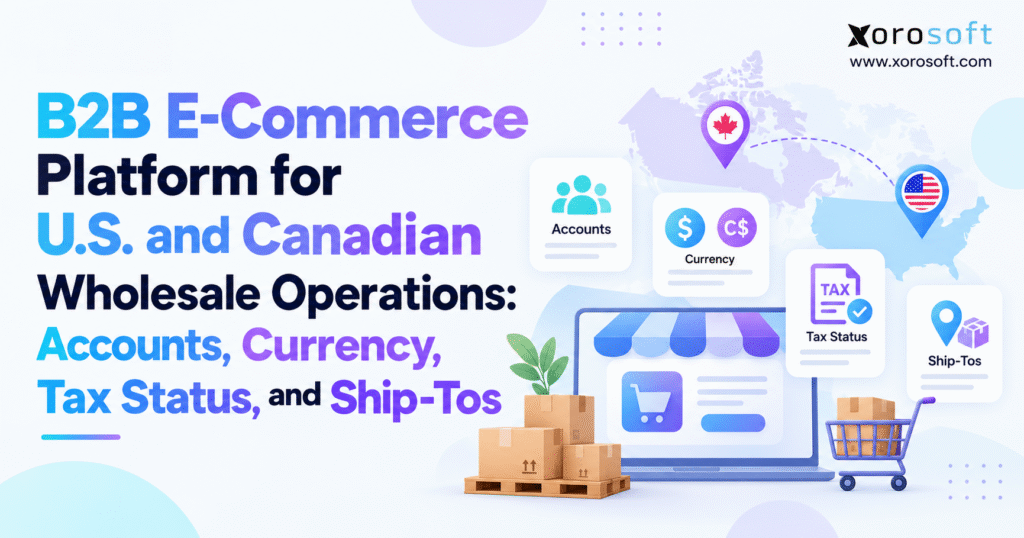
If you are searching for the best wholesale ecommerce platform for your business, you’re in the right place.
1. Why U.S. and Canadian Wholesale Ecommerce Exposes Operational Weaknesses
1.1 One Online Wholesale Order Can Carry Dozens of Business Rules
Moving wholesale ordering online sounds simple until a real customer transaction reaches the system.
A buyer signs in, selects products, enters quantities, chooses a delivery location, and submits the order. Behind that seemingly straightforward process, the business may need to identify the buyer’s parent company, purchasing permissions, billing entity, approved ship-to, contract price, payment terms, currency, tax treatment, inventory availability, fulfillment warehouse, and accounting destination.
That is why a wholesale ecommerce platform cannot be evaluated like a conventional consumer storefront.
The website may be where the customer interacts with the business, but the transaction immediately reaches inventory, fulfillment, finance, customer service, purchasing, and sometimes manufacturing.
When those systems disagree, online ordering does not eliminate manual work. It simply moves the manual work further downstream.
1.2 Cross-Border Wholesale Adds Another Layer of Complexity
Operating across the United States and Canada increases the number of variables attached to each order.
One customer may purchase in USD while another negotiates fixed CAD pricing. A corporate account may have branches on both sides of the border. The billing office may be in one location while the goods ship somewhere entirely different.
Tax treatment can also depend on transaction and destination details. In Canada, for example, CRA place-of-supply rules state that for many sales of goods, the relevant province is determined by where the supplier delivers, mails, sends, or ships the goods.
The technology stack therefore needs to understand the relationship between the customer, transaction, and delivery location rather than treating each piece as unrelated checkout data.
A practical transaction model looks like this:
Company account → buyer → bill-to → ship-to → currency → catalog → price → tax status → inventory → fulfillment → accounting
The closer the operating system comes to representing that chain accurately, the easier it becomes to scale wholesale ecommerce without creating reconciliation work.
2. What a Wholesale Ecommerce Platform Must Manage Beyond Checkout
2.1 B2B Customer Accounts Need a Company-Level Structure
Consumer ecommerce typically treats the individual shopper as the customer. Wholesale commerce often cannot.
A business account may have purchasing managers, branch managers, warehouse personnel, finance employees, and executives using the same commercial relationship for different purposes. Some users can place orders. Others may only view invoices or approve purchases.
A capable wholesale ecommerce platform should therefore distinguish between the organization buying the products and the individual person signing in.
Shopify’s current B2B model illustrates this structure clearly. Shopify defines a company as the parent organization, company locations as the individual businesses or branches being sold to, and customers as the people purchasing on behalf of those organizations. Company locations can carry their own pricing, tax settings, addresses, payment terms, and contacts.
That hierarchy matters because business rules usually belong to the commercial relationship, not merely the login.
2.2 Bill-To and Ship-To Records Serve Different Purposes
A bill-to identifies the entity responsible for the financial obligation. A ship-to identifies where the goods physically need to go.
Those may be the same location for a small buyer. For a national retailer, restaurant group, dealer network, or multi-location distributor, they are often different.
| Business Object | Primary Role | Typical Operational Impact |
|---|---|---|
| Company account | Commercial relationship | Pricing, credit, reporting |
| Buyer | Authorized individual | Permissions, approvals |
| Bill-to | Financial identity | Invoices, receivables |
| Ship-to | Delivery destination | Tax, freight, fulfillment |
| Catalog | Product access | Assortment and pricing |
| Payment terms | Financial agreement | Due dates, deposits, credit |
Maintaining those objects separately gives the business much better control over customer service, reporting, pricing, fulfillment, and finance.
2.3 Buyer Permissions Should Reflect Real Purchasing Roles
A location manager may need permission to order only for one branch. A corporate purchasing manager may need access to twenty locations. Accounts payable might need to see invoices but should not be able to create new orders.
Those controls become especially valuable as customer self-service grows.
Modern B2B platforms increasingly support this approach. Adobe Commerce, for example, provides company accounts, company hierarchies, shared catalogs, purchase orders, quotes, and other business purchasing workflows.
Wholesalers should therefore evaluate their broader business software requirements before choosing a portal based primarily on storefront design.
3. Wholesale Ecommerce Platform Pricing and Currency Rules for USD and CAD
3.1 Multi-Currency B2B Ecommerce Is Not Just Currency Conversion
Displaying a dollar sign with a different currency code does not make an ecommerce operation genuinely multi-currency.
Wholesale pricing is often contractual.
A Canadian customer may have negotiated a permanent CAD price list. Another Canadian buyer may purchase in USD because the commercial agreement is denominated in U.S. dollars. A corporate customer might even use different currencies for different subsidiaries or locations.
The business therefore needs a documented rule for deciding currency.
It could be assigned by customer, company location, geographic market, contract, sales channel, or order. The correct design depends on the organization, but the rule must be consistent across ecommerce and finance.
If the storefront assumes currency based on geographic location while the ERP uses the customer’s master record, the two systems can value the same transaction differently.
3.2 Customer-Specific Pricing Needs an Explicit Hierarchy
Price complexity usually grows alongside customer complexity.
A wholesale ecommerce platform may need to consider standard wholesale prices, customer tiers, volume breaks, contract prices, promotions, sales-rep overrides, and negotiated SKU-level agreements.
A possible pricing sequence is:
contract price → customer override → customer tier → quantity break → approved promotion → standard wholesale price
That order is only an example. Every business should document its own precedence.
Microsoft Dynamics 365 Commerce demonstrates why this planning matters. Its B2B pricing capabilities can use organizational sales agreements and customer hierarchies to determine contract-based pricing, while catalog and price-group configurations can drive additional pricing rules.
When pricing logic is not documented, companies often end up with one price in ecommerce, another in ERP, and a spreadsheet used to explain the difference.
3.3 Fixed CAD Prices and FX Conversion Solve Different Problems
Automatic currency conversion reduces administrative work because the system can derive local prices from an exchange rate. However, it also means customer-facing prices can move when exchange rates change.
Fixed CAD price lists create more stable commercial expectations but require ongoing maintenance.
Contract currency provides another option by assigning currency to the customer’s commercial agreement rather than geography.
For organizations that need deeper financial and multi-currency controls, XoroERP can serve as the operational and accounting layer behind complex transactions.
The larger lesson is platform-neutral: ecommerce pricing and financial posting should follow the same commercial rule.
4. Tax Status in a U.S.-Canada Wholesale Ecommerce Platform
4.1 U.S. Wholesale Tax Status Should Not Be a Permanent Checkbox
Wholesale businesses frequently work with customers buying goods for resale or operating under other forms of exemption. However, “tax exempt” is not always a permanent customer-level truth.
The appropriate treatment can depend on the customer entity, jurisdiction, product, documentation, transaction type, and delivery location.
As a result, the system needs more than a Boolean field.
It should have a defined process for determining where exemption information is stored, how it is validated, who can modify it, and what happens when the relevant evidence is incomplete or no longer applicable.
For multi-state operations, those controls become particularly important because state requirements are not identical.
The ecommerce platform does not necessarily need to own the tax logic itself. However, it needs to provide the data required by whichever system or tax service does.
4.2 Canadian GST/HST Makes Ship-To Accuracy More Important
Canadian transactions highlight why customer and location data cannot be separated from tax calculation.
CRA guidance explains that for sales of goods, the place of supply can be based on the province in which goods are delivered or the province to which they are mailed, sent by courier, or shipped.
Therefore, a customer’s corporate headquarters may not provide enough information to determine the treatment of a particular shipment.
The transaction needs an accurate destination.
That means the wholesale ecommerce platform should validate and preserve ship-to information rather than allowing uncontrolled free-form addresses to become the only source of location data.
4.3 Ecommerce, ERP, and Tax Systems Need Clear Responsibilities
Tax problems often appear when multiple applications independently calculate or override the same transaction.
A better approach defines the flow clearly:
customer → tax status → product → ship-to → jurisdiction → tax calculation → order → accounting
The customer portal may collect the order. An ERP may maintain customer records. A specialist tax system may perform jurisdiction-level calculation.
Whatever architecture is chosen, one approved calculation needs to become authoritative.
This section is operational guidance rather than tax or legal advice. Businesses operating across the U.S. and Canada should validate their specific tax configuration with qualified professionals.
5. Managing Ship-Tos in a Wholesale Ecommerce Platform
5.1 A Ship-To Is an Operating Location, Not Just an Address
For straightforward consumer orders, an address can be little more than a checkout field.
Wholesale is different.
A ship-to can represent a retail store, warehouse, dealer location, restaurant, jobsite, distribution center, franchise, or branch. Each location may have specific receiving hours, freight rules, contacts, tax context, product restrictions, and fulfillment preferences.
Treating the location as structured master data makes those rules manageable.
Treating it as free-form text forces employees and systems to reconstruct the business context after every order arrives.
5.2 Location-Level Rules Become More Important as Accounts Expand
Consider a wholesale customer with headquarters in Chicago and locations in Texas, California, Ontario, and British Columbia.
The corporate relationship may establish overall credit terms and contractual rules, but the individual locations could require different catalogs, currencies, tax handling, delivery methods, or warehouse assignments.
Shopify’s current B2B company-location architecture reflects this operational reality. Individual company locations can have their own shipping and billing addresses, pricing, tax IDs, tax exemptions, catalogs, payment terms, and contacts.
That does not mean every business should model its data exactly the same way. It does show why location-level controls have become a standard requirement in B2B commerce.
5.3 Clean Ship-To Data Improves Reporting as Well as Fulfillment
Duplicate locations create more than shipping problems.
If the same branch exists under several names, sales reporting becomes fragmented. Demand history becomes less reliable. Customer service sees incomplete order history. Forecasting can interpret one physical location as several separate demand points.
Companies should therefore apply customer-master-data governance to ship-to locations.
New locations should use consistent naming and identifiers. Obsolete locations should usually be deactivated rather than erased when historical transactions depend on them.
A mature wholesale ecommerce platform depends on clean location data because fulfillment, tax, pricing, service, and analytics all use it.
6. Wholesale Ecommerce Inventory and Multi-Warehouse Fulfillment
6.1 On-Hand Inventory Is Not the Same as Sellable Inventory
Publishing raw warehouse quantity to a B2B portal is risky.
Physical stock may already be allocated to another customer, reserved for an important account, quarantined for inspection, damaged, committed to a marketplace, or unavailable because of another operational restriction.
The quantity shown to the customer should therefore reflect an intentional availability calculation.
A simplified formula might be:
sellable inventory = usable on-hand − committed stock − reservations − restricted inventory
Some businesses also include future supply when purchase orders or production schedules support a reliable promise date.
The correct calculation depends on the operation, but it should be defined centrally.
6.2 Multi-Warehouse Inventory Requires Fulfillment Logic
When inventory exists in several facilities, the question is not only “Do we have this SKU?”
The business also needs to ask, “Which inventory should this customer be allowed to consume?”
A Canadian customer may normally be fulfilled from a Canadian warehouse. A West Coast customer may be assigned to a western U.S. facility. One warehouse may stock the item but lack the equipment or carrier service needed for that customer’s order.
Warehouse selection can consider destination, inventory, shipping cost, service level, product requirements, customer assignment, and order consolidation.
The wholesale ecommerce platform needs access to a reliable availability answer even if the warehouse-selection algorithm lives somewhere else.
6.3 Ecommerce Promises Must Reach Warehouse Execution
After checkout, the warehouse has to execute the promise.
Allocation, picking, packing, shipment confirmation, tracking, lot or serial control, and inventory movement all occur downstream.
For operations with substantial warehouse complexity, dedicated warehouse management capabilities can connect the customer-facing order to structured fulfillment workflows. XoroWMS documentation, for example, includes operational processes such as picking and packing.
A storefront that accepts an order the warehouse cannot fulfill correctly is not solving the wholesale problem.
It is simply creating the exception earlier.
7. Connecting a Wholesale Ecommerce Platform to ERP, WMS, Tax, and Finance
7.1 Every Important Data Object Needs One Clear Owner
Connected systems do not require every application to control every field.
In fact, that approach usually creates conflicts.
The business should explicitly decide which system is authoritative for each important object.
| Data Object | Likely Owner | Typical Consumers |
|---|---|---|
| Buyer identity | Ecommerce portal | ERP |
| Customer master | ERP | Ecommerce, WMS |
| Contract pricing | ERP or pricing engine | Ecommerce |
| Inventory availability | ERP/WMS | Ecommerce |
| Warehouse tasks | WMS | ERP |
| Tax calculation | Approved tax process | Ecommerce, ERP |
| Financial posting | ERP/accounting | Reporting |
The exact arrangement varies by business, but ownership should never be accidental.
7.2 APIs Do Not Replace Business Rules
An API can move a changed address from one system to another. It cannot decide which address should win when two applications disagree.
That decision requires a business rule.
The same issue arises with prices, credit terms, customer status, order edits, inventory reservations, cancellations, returns, and fulfillment updates.
Integration projects therefore need to define more than fields and endpoints. They need ownership, synchronization direction, update timing, conflict handling, and exception management.
Companies working across multiple sales and operational systems can review available integration options as part of that architectural planning.
7.3 Exception Handling Should Be Designed Before Launch
Reliable integrations assume that some transactions will fail.
A new location may not map to the ERP. A customer could have an invalid account status. Inventory might change between cart creation and order acceptance. A tax response may fail. An order edit may arrive after warehouse allocation.
The important question is what happens next.
Strong architecture provides a visible exception queue, clear ownership, and a controlled recovery path.
Otherwise, the organization replaces manual data entry with automated failures that are harder to discover.
8. Evaluating B2B Ecommerce Platforms With Real Operating Scenarios
8.1 Feature Checklists Hide the Most Important Differences
Most serious B2B platforms can answer “yes” to many standard questions.
Do you support company accounts? Customer-specific pricing? Multiple addresses? Purchase orders? Integrations? Multi-currency?
Those answers are not enough.
The differentiator is how several rules behave together.
Ask a vendor to demonstrate one complete transaction instead.
For example, a Canadian buyer signs into a U.S.-based wholesale operation, selects an Ontario location, receives the correct CAD contract price, uses approved payment terms, receives the applicable tax treatment, consumes inventory from the appropriate facility, and creates the correct ERP and accounting records.
Then introduce an exception.
Change the destination after the order is submitted. Reduce inventory. Substitute another buyer. Put the account on credit hold.
A capable wholesale ecommerce platform should handle operational exceptions, not merely ideal demos.
8.2 Compare Platforms Against the Same Scenario
Shopify B2B, BigCommerce B2B Edition, Adobe Commerce, Dynamics 365 Commerce, ERP-centered portals, and custom architectures solve parts of the same problem differently.
Adobe Commerce provides company accounts, company hierarchies, shared catalogs, purchase orders, and quote functionality.
Dynamics 365 Commerce can represent B2B partner organizations through customer hierarchies and associate catalogs and pricing structures with those organizations.
The useful comparison is therefore not which vendor has the longest feature list. It is which architecture executes your actual customer and operational scenarios with the least unnecessary complexity.
8.3 Shopify Merchants Should Test the ERP Layer Behind the Store
Shopify can provide the customer-facing commerce layer while ERP and warehouse systems handle execution.
The important question is how those layers communicate.
The official Xorosoft ERP app for Shopify lists capabilities including order synchronization, products, inventory, fulfillment-related information, multi-location inventory, and Shopify Markets international currency orders.
Regardless of which integration a company selects, Shopify should not become a disconnected operational database.
Orders, inventory, customer information, fulfillment updates, and finance need a defined path from storefront through execution.
9. Wholesale Ecommerce Platform Requirements Vary by Industry
9.1 Apparel and Fashion Need Variant and Seasonal Control
Apparel wholesalers rarely manage a simple list of independent SKUs.
Products often exist across size, color, style, season, collection, and availability combinations. Wholesale customers may receive different assortments and prices based on account agreements.
Seasonal launches add another challenge because demand may arrive before inventory physically reaches the warehouse.
The commerce layer therefore needs to coordinate with purchasing, forecasting, allocations, and inventory availability.
A retailer should not be offered a size-color combination simply because the SKU exists in the catalog. The system also needs to know whether that customer is allowed to buy it and whether the company can realistically supply it.
9.2 Furniture and Sporting Goods Add Fulfillment Constraints
Furniture wholesalers may manage oversized shipments, dealer locations, special freight, long lead times, and bulky inventory.
Sporting goods companies often deal with dealer networks, seasonal assortment changes, large product catalogs, and multi-location fulfillment.
In both cases, the wholesale ecommerce platform needs stronger operational context than a simple shopping cart can provide.
The store may display the product, but the systems behind it need to determine the approved price, customer eligibility, inventory source, delivery method, and realistic service level.
9.3 Food, Consumer Products, and Manufacturing Add More Dependencies
Food and beverage operations may need lot or expiry awareness. Manufacturers may need to connect customer demand to components, production, and purchasing. Consumer brands may simultaneously serve wholesale customers, Shopify shoppers, Amazon, retail EDI, and marketplaces.
Those requirements vary significantly by business model.
Reviewing industry-specific ERP workflows can help teams separate universal B2B commerce requirements from processes that depend on product type, fulfillment model, or manufacturing complexity.
The goal is not to force every industry onto the same workflow. It is to make sure the platform can represent the rules that actually drive each transaction.
10. When a Wholesale Ecommerce Platform Needs ERP Behind It
10.1 Disconnected Systems Usually Fail Gradually
Businesses rarely replace their software because everything fails at once.
Operational complexity accumulates.
A spreadsheet appears because customer pricing is difficult to maintain. Another tracks Canadian customers. Warehouse teams create their own allocation process. Finance exports orders for reconciliation. Purchasing relies on separate reports because it cannot see consolidated demand.
Each workaround seems manageable.
Eventually, employees become the integration layer.
That is usually the point when ERP becomes more relevant.
The key signal is not necessarily revenue. It is the amount of manual coordination required to keep inventory, orders, purchasing, fulfillment, and finance aligned.
10.2 ERP Matters When One B2B Order Affects Several Departments
A wholesale order can reserve inventory, generate warehouse demand, influence purchasing, update receivables, create revenue, change customer balances, and affect forecasts.
If each department receives a separate version of the order, discrepancies become almost inevitable.
An integrated environment such as XoroONE is designed around connecting commerce, inventory, fulfillment, accounting, and other inventory-driven workflows. Xorosoft’s current ecommerce and EDI materials describe an order flow in which orders are imported, inventory is allocated, warehouse fulfillment begins, shipping information is returned, and accounting and reporting are updated.
That model is most valuable when the operation has genuinely outgrown disconnected tools.
10.3 Compare ERP Architecture, Not Just ERP Brands
Replacing accounting software or standalone inventory tools does not automatically mean selecting the largest available ERP suite.
Implementation complexity, internal resources, warehouse processes, manufacturing needs, integrations, reporting, and ownership cost should all influence the decision.
Businesses comparing larger ERP alternatives can use an ERP comparison framework to identify the operational questions that matter before vendor selection.
The useful question is not “Which ERP has the most functionality?”
It is “Which operating model can support our customer, inventory, warehouse, financial, and ecommerce requirements without introducing unnecessary complexity?”
11. Implementing a Wholesale Ecommerce Platform Without Automating Bad Processes
11.1 Clean Customer and Product Data Before Integration
Technology cannot fix poor master data by moving it faster.
Duplicate customers, outdated ship-tos, conflicting SKU records, unclear price lists, inconsistent payment terms, and incomplete tax information should be addressed before the integration goes live.
Start with the customer hierarchy.
Identify parent organizations, billing accounts, company locations, users, and inactive addresses.
Then examine products, price lists, currency rules, inventory status, warehouse assignments, and accounting mappings.
If one physical customer exists under four different names today, integrating all four records into ecommerce does not create a better customer experience.
It simply exposes the underlying data problem online.
11.2 Define the Standard Wholesale Transaction First
Implementation teams often spend too much time designing rare exceptions before agreeing on the normal transaction.
Start with a standard order.
Determine where the customer originates, how the buyer authenticates, where pricing comes from, when inventory becomes reserved, how tax is determined, when the ERP receives the order, when warehouse work begins, and how finance records the transaction.
Then document exceptions such as backorders, split shipments, substitutions, credit holds, order edits, sales-rep overrides, and cancelled lines.
A well-designed wholesale ecommerce platform makes these exceptions visible and manageable instead of pushing them into email and spreadsheets.
11.3 Test With Real Accounts Before a Broad Rollout
Sample data rarely exposes real-world complexity.
Pilot accounts should include multiple ship-tos, contract pricing, different currencies, realistic payment terms, and the same fulfillment complications employees manage today.
Run each order from login through shipment and financial posting. Then verify the results across departments. Sales should be able to see the complete customer relationship, while finance needs a clear path to reconcile the invoice. Inventory records should explain every quantity change, and warehouse teams must have access to the correct delivery instructions.
A phased implementation creates an opportunity to correct data and workflow problems before hundreds of customers encounter them.
Teams evaluating a future-state design can also review relevant customer implementation examples for ideas about the types of operational issues worth testing, while recognizing that each company’s requirements will differ.
12. Building Better B2B Ecommerce Data for Reporting and AI
12.1 Clean Transaction Data Has Value Beyond Ecommerce
The architecture used for B2B ordering affects much more than the order itself.
If customers, locations, prices, inventory, fulfillment, and accounting share consistent identifiers, management reporting becomes far more useful.
The company can analyze profitability by customer, location, channel, product, warehouse, or region without spending days reconstructing relationships.
Purchasing can connect demand to replenishment. Finance can see whether margin differences come from pricing, freight, currency, or product cost. Operations can compare warehouse performance using the same order records that customer service sees.
This is another reason to solve master-data ownership before focusing on dashboards.
Analytics built on inconsistent operational records simply produce inconsistent analysis faster.
12.2 AI Makes Data Governance More Important, Not Less
AI is creating new ways for business teams to ask questions of operational data, but useful answers still depend on the quality and permission structure of the underlying records.
If the ERP cannot reliably identify a customer, location, inventory position, margin, purchase order, or shipment, an AI layer cannot infer those facts safely.
For companies exploring this direction, the ERP MCP Server model illustrates how authorized AI systems can connect with ERP information under role and permission controls. Xorosoft describes its MCP implementation as a permission-aware bridge between AI tools and live ERP data.
That capability is separate from the basic ecommerce decision, but it reinforces an important principle: structured operational data becomes increasingly valuable as more interfaces consume it.
12.3 A Single Operational Record Creates More Options Later
Companies sometimes design an ecommerce integration only for today’s workflow.
A stronger approach also considers what future channels will require.
The business may add Amazon, additional Shopify stores, EDI customers, new warehouses, Canadian entities, sales-rep ordering, or AI-assisted operational tools later.
A clean transaction architecture makes those expansions easier because new channels consume existing master data rather than creating another isolated version of it.
The wholesale ecommerce platform should therefore fit into an architecture that can support additional channels without forcing the organization to rebuild pricing, inventory, customer, and fulfillment logic every time it grows.
13. Practical Next Step: Design the Wholesale Operating Model Before Selecting the Storefront
13.1 Start With One Difficult U.S. Customer and One Difficult Canadian Customer
Before evaluating another ecommerce platform, document two real customer workflows.
Choose one complex U.S. customer and one complex Canadian customer.
For each account, map the parent company, buyers, billing relationship, ship-to locations, price structure, currency, payment terms, tax status, inventory source, warehouse, order approval process, fulfillment flow, invoice, and final accounting record.
Then identify every place where employees currently intervene manually.
Those interventions reveal the real system requirements.
A company may discover that storefront design is not its primary problem. The bigger issue might be duplicate customer records, unreliable inventory availability, conflicting price lists, poor warehouse routing, or delayed financial synchronization.
13.2 Make Vendors Demonstrate the Entire Transaction
Give every shortlisted vendor the same operational scenario.
Do not let the demo stop when the buyer clicks “Submit Order.”
Follow the transaction into ERP. Confirm the price and currency. Inspect the inventory reservation. Check the warehouse assignment. Review tax treatment. Verify the invoice and financial posting.
Then modify the order and see how the systems respond.
That approach makes platform comparisons much more meaningful because it exposes what happens between applications, not just inside the storefront.
The best wholesale ecommerce platform for a specific business is ultimately the one that fits its customer hierarchy, pricing model, inventory environment, fulfillment process, financial controls, and integration strategy.
13.3 Treat Ecommerce as Part of the Operating System
Successful B2B ecommerce is not simply a digital sales project.
For an inventory-driven wholesaler, it becomes part of the operating system of the business.
The customer account affects pricing. The ship-to affects fulfillment and potentially tax treatment. The order affects inventory. Inventory affects purchasing. Warehouse execution affects customer service. The completed transaction affects finance and reporting.
When those relationships are connected, self-service can genuinely reduce operational work.
When they are disconnected, online orders simply create another source of data that employees have to reconcile.
For U.S. and Canadian wholesalers reviewing their next technology step, the practical objective should therefore be clear: build one reliable transaction path from customer account through final financial record.
If your current ecommerce, inventory, warehouse, and accounting stack cannot support that path consistently, you can contact Xorosoft to walk through an actual wholesale workflow and evaluate where a connected ERP architecture may fit.
The final test is simple:
Can every wholesale order reach the correct customer account, currency, price, tax treatment, inventory source, ship-to location, warehouse, and financial record without employees rebuilding the transaction manually?
When the answer is yes, ecommerce is no longer just an ordering channel. It becomes a scalable part of the wholesale operating model.
Frequently Asked Questions
What should a wholesale ecommerce platform manage?
A wholesale ecommerce platform should manage company accounts, buyer permissions, pricing, currency, tax status, ship-tos, inventory availability, payment terms, fulfillment, and ERP synchronization.
Can one B2B customer have multiple ship-tos?
Yes. Each branch, store, warehouse, or job site can be stored as a structured ship-to with its own delivery, pricing, tax, and fulfillment rules.
How should USD and CAD pricing work?
Businesses can use fixed price lists, currency conversion, or contract-based currency. The right model depends on customer agreements, margin requirements, and accounting policies.
Does the ship-to affect tax treatment?
It can. Destination, jurisdiction, customer status, product type, and exemption documentation may influence tax treatment, making accurate ship-to data essential for cross-border wholesale operations.
Should ecommerce or ERP own customer pricing?
Either can, but one system should be authoritative. Many complex wholesalers keep contract pricing in ERP and display the approved result in ecommerce.
When does a wholesaler need ERP integration?
ERP integration becomes valuable when ecommerce orders affect inventory, purchasing, warehouse activity, accounting, customer credit, and reporting across multiple systems.
How should companies evaluate a wholesale ecommerce platform?
Test real customer scenarios involving multiple buyers, ship-tos, contract pricing, USD/CAD, tax rules, inventory availability, warehouse routing, order changes, and accounting results.
Recent Posts
-
 How a Distributor Reduced B2B Order Exceptions Without Restricting Sales
 -
 When Should Ecommerce Brands Freeze Inventory and Integration Changes Before Peak?
 -
 Why ERP Proof-of-Concept Demos Fail to Expose Operational Gaps
 -
 AI Purchase Order Recommendations: Required Data, Guardrails, and Approval Rules
 -
 Shopify Delivery Rules Software Connected to ERP and Warehouse Data