1. When the Schedule Became the Bottleneck
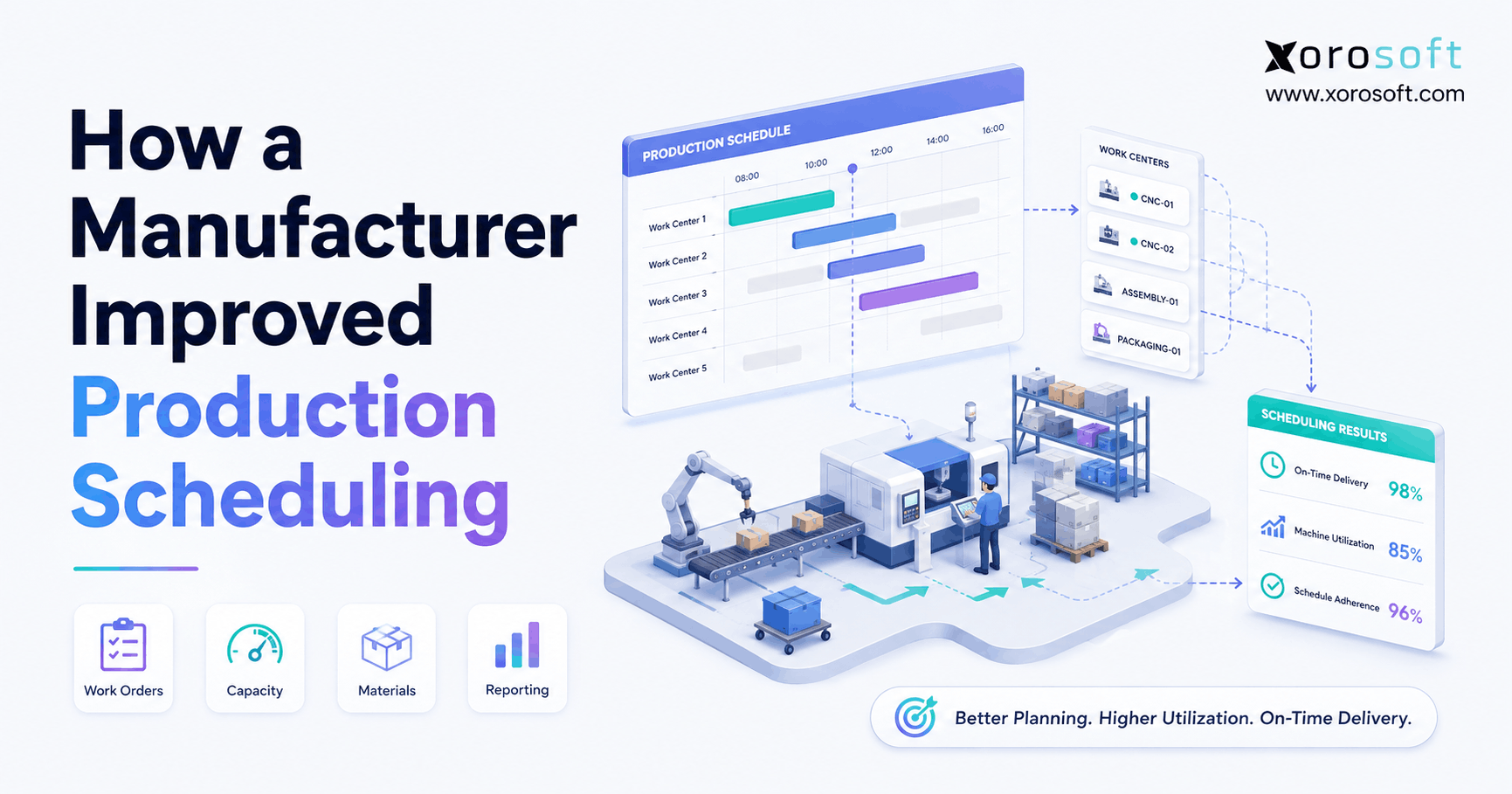
Production scheduling becomes difficult when manufacturers can no longer trust the information behind the plan. Although a spreadsheet may show what should run next, the factory must still coordinate materials, machine capacity, labor, work orders, purchasing, and changing customer priorities. As production complexity grows, effective production scheduling depends on accurate data from every part of the operation. Therefore, when those inputs become disconnected, planners spend more time repairing the schedule than improving it.
At first, the problem may look small. For example, one component arrives two days late, so the planner moves one job. However, that single change can push another work order into the next shift, consume capacity that another job expected, and delay a customer promise. Consequently, the schedule becomes less reliable even though every individual change may appear reasonable.
Additionally, the issue becomes more serious when several departments work from different information. For example, sales may know which orders customers consider urgent. Likewise, purchasing may know which suppliers are late. Meanwhile, warehouse teams may know which materials are physically available. Meanwhile, production supervisors may know which machines are actually ready to run. As a result, if planners cannot see those facts together, production scheduling becomes reactive.
Therefore, this representative manufacturing scenario shows how a growing operation can improve production scheduling by connecting demand, inventory, materials, capacity, purchasing, work orders, and shop-floor activity. Importantly, the scenario does not claim fictional percentages or invented customer results. Instead, it focuses on the operating changes that make a production schedule more executable.
1.1 Why Scheduling Problems Usually Start Somewhere Else
Manufacturers often blame the schedule when work orders run late. However, the schedule may only expose deeper problems. For example, inaccurate inventory creates false material availability. Likewise, outdated bills of materials create incorrect component requirements. Likewise, disconnected purchasing data makes it difficult to know whether missing materials will arrive before production starts.
Therefore, better production scheduling requires more than moving jobs around a calendar. Accordingly, manufacturers need accurate inputs, clear priorities, and fast feedback from the factory. As a result, when those foundations improve, the schedule becomes more reliable without requiring planners to manage every exception manually.
1.2 What Changed as the Manufacturer Grew
At lower volumes, the manufacturer could coordinate production through experience, spreadsheets, and direct communication. As the business expanded, however, the number of SKUs, work orders, purchase requirements, and customer commitments increased. Additionally, more people began maintaining separate operational records.
As complexity increased, production scheduling became harder to manage through spreadsheets alone. Meanwhile, sales tracked demand, purchasing tracked supplier commitments, warehouse teams tracked stock, and production supervisors tracked capacity. Consequently, no single view showed whether a planned job was truly ready to run.
2. What Production Scheduling Actually Controls
Production scheduling determines when manufacturing jobs should run, which resources should perform the work, and how jobs should be sequenced so customer requirements can be met within real operational constraints. In practice, the process connects demand, materials, capacity, work orders, production, and finished goods.
Therefore, a useful production schedule should answer several questions. What needs to be produced? How much is required? Which materials are needed? Are those materials available? Which work center should perform each operation? How much usable capacity exists? Which job should run first? Finally, when can the finished goods realistically be completed?
Although those questions seem straightforward, each depends on data from another part of the operation. Therefore, reliable production scheduling is less about creating a calendar and more about coordinating constraints.
2.1 Production Planning vs Production Scheduling
Production planning and production scheduling are closely related. Nevertheless, they solve different problems.
| Production Planning | Production Scheduling |
|---|---|
| Determines what should be produced | Determines when production should happen |
| Focuses on broader demand requirements | Focuses on executable production activity |
| Uses forecasts, orders, inventory, and supply | Uses materials, machines, labor, and capacity |
| Usually covers a longer horizon | Usually works over shorter horizons |
| Establishes production requirements | Sequences actual manufacturing work |
For example, a production plan may determine that 4,000 units are required next month. By contrast, production scheduling determines which work orders will run this week, which machines will handle them, and when each operation should begin. Consequently, a manufacturer can have a reasonable production plan while still having an unreliable schedule.
2.2 Why Manufacturing Scheduling Gets Harder With Growth
Initially, a manufacturer may have a small product range and simple routings. However, additional SKUs introduce more BOMs, more components, and more production paths. Likewise, additional customers create competing due dates. Moreover, multiple warehouses make material availability harder to understand.
As manufacturers grow, production scheduling must account for more products, materials, resources, and customer commitments. Therefore, the process gradually becomes a constraint-management problem rather than a simple calendar exercise.
3. The Operational Symptoms Were Easy to See
The manufacturer’s original process looked organized at the beginning of each week. However, conditions changed quickly once production started.
3.1 The Weekly Schedule Became Obsolete Quickly
Every Monday, planners created a spreadsheet showing the jobs expected to run during the week. Initially, the file gave everyone a clear plan. By Tuesday or Wednesday, however, several assumptions had changed. For example, a supplier shipment might be late. Meanwhile, an urgent customer order might enter the queue. Additionally, actual production could take longer than expected.
Consequently, planners repeatedly edited the schedule and redistributed updated versions. This constant revision made production scheduling increasingly reactive because teams spent more time responding to changes than preventing them.
3.2 Inventory Availability Was Unclear
System inventory did not always represent usable inventory. Other work orders had already claimed some components, while warehouse movements had not always reached the planning file immediately. Therefore, planners sometimes scheduled production jobs around inventory that the operation could not actually use.
Consequently, that gap created two problems. First, the planner lost confidence in system quantities. Second, the team began checking inventory manually before important jobs. Although manual checking reduced some errors, it also slowed the planning process.
3.3 Material Shortages Appeared Too Late
The company often discovered shortages after planners had already scheduled the work. As a result, the team had to delay the job, expedite a purchase, or move another order forward. Therefore, each change affected downstream production.
Material shortages therefore became one of the biggest causes of production scheduling disruption. Moreover, the shortage itself was only part of the problem. More importantly, the real cost came from replanning work that had already consumed attention, capacity, and customer expectations.
3.4 Capacity Was Based on Estimates
The planner knew how many hours a machine was theoretically available. However, theoretical hours did not account for maintenance, setup, changeovers, operator availability, or existing commitments. Therefore, some work centers were overloaded before the shift even started.
For that reason, production scheduling needed practical capacity instead of a simple calendar view.
3.5 Rush Orders Changed Existing Priorities
Important customer orders occasionally needed faster turnaround. Of course, manufacturers need flexibility to handle genuine exceptions. However, inserting a rush order without understanding the downstream impact creates a new problem.
For example, four additional hours at a constrained work center may push several existing orders beyond their promised completion dates. Therefore, the business needed a way to evaluate consequences before changing priorities.
4. Why the Original Production Schedule Kept Failing
Although constant rescheduling was the visible problem, fragmented information was the deeper cause.
4.1 Demand Was Treated as the Schedule
Customer demand tells a manufacturer what buyers need. However, demand alone does not prove that production can execute the requirement. For example, every work order consumes materials, machine time, labor, tooling, and work-center capacity.
Accordingly, reliable production scheduling must balance customer demand against real manufacturing constraints. Therefore, the production requirement must pass a feasibility check before it becomes executable work.
4.2 Materials Were Checked Too Late
The original workflow often looked like this:
Schedule job → Release work order → Check materials → Find shortage → Reschedule
Instead, the improved workflow became:
Confirm demand → Check materials → Resolve shortage → Check capacity → Schedule work
Although the difference appears small, it changes when problems appear. Consequently, planners can solve shortages before they disrupt the factory.
4.3 Capacity Was Treated as Flexible
Customer demand can change quickly. By contrast, capacity usually cannot. Of course, manufacturers can add overtime, change shifts, use alternative machines, or subcontract certain operations. Nevertheless, each option has cost and practical limits.
For that reason, production scheduling should use practical capacity rather than theoretical capacity. Otherwise, the plan may look complete while the factory remains overloaded.
4.4 Departments Worked From Different Information
For example, purchasing focused on supply. Meanwhile, production focused on work orders. Meanwhile, sales focused on customer commitments. Because those teams worked from different records, each department could make a reasonable decision individually while creating a poor outcome collectively.
As a result, the manufacturer needed one operating process rather than several disconnected departmental processes.
5. The Improvement Started With Better Inputs
Instead of beginning with more complicated scheduling software, the manufacturer first strengthened the information supporting production decisions.
5.1 Centralize the Operational Data
First, the team established a shared operational view covering inventory, BOMs, work orders, purchasing requirements, finished goods, and production status. As a result, planners no longer had to reconcile several spreadsheets before answering basic questions.
Centralized data gave the production scheduling process a more reliable operational foundation. Additionally, purchasing could see production requirements earlier, while warehouse teams could understand which materials upcoming work would consume.
5.2 Separate Demand From Executable Production
Next, the manufacturer separated demand signals from immediate shop-floor priorities. For example, demand could come from confirmed customer orders, forecasts, safety-stock requirements, wholesale commitments, or replenishment needs. However, not every signal needed to become an urgent work order.
Instead, the planner converted demand into production requirements first. Afterward, materials and capacity were evaluated before the team released work. Consequently, the shop floor received fewer jobs that were not ready to run.
5.3 Validate Materials Before Scheduling Work
Before committing a production order to the schedule, planners reviewed raw materials, components, subassemblies, WIP, open purchase orders, and existing finished goods. Therefore, the team could identify shortages earlier.
Additionally, planners could determine whether an incoming purchase order would arrive before the planned production start date. As a result, production scheduling became more executable because material feasibility became part of the decision.
6. Material Requirements Planning Became Part of Scheduling
Material requirements planning, or MRP, helps translate finished-product demand into the components required to manufacture it.
6.1 Start With the Bill of Materials
Suppose one finished product requires two units of Component A, one unit of Component B, and four units of Component C. If the manufacturer needs 500 finished units, gross requirements become 1,000 units of A, 500 units of B, and 2,000 units of C.
However, gross requirements are only the beginning. Next, the manufacturer must consider inventory already available, existing reservations, open purchase orders, safety stock, and material lead times. Consequently, the final shortage may be significantly different from the gross requirement.
6.2 Check Supply Before Releasing the Job
Previously, planners sometimes checked material feasibility after scheduling. Instead, the improved process checked material availability first. Therefore, planners could identify blocked jobs before they consumed scarce scheduling capacity.
As a result, connecting MRP with production scheduling helped planners identify shortages before releasing work. Additionally, purchasing received clearer requirements because buyers could see which production orders depended on specific components.
6.3 Connect Purchasing With Production Requirements
Purchasing becomes more effective when buyers know why material is needed and when production needs it. For that reason, the manufacturer shifted from purely reactive replenishment toward demand-driven purchasing.
As a result, buyers could prioritize supplier orders according to production impact rather than simply responding to low stock. For manufacturers facing similar complexity, Xorosoft’s Solutions environment connects inventory, purchasing, manufacturing, warehousing, and financial operations so teams can work from shared operational data.
7. Capacity Planning Made the Schedule More Realistic
Material availability answers one question: Can we build it? Meanwhile, capacity planning answers another: When can we build it?
7.1 Measure Usable Capacity
A machine may have eight scheduled hours. However, those eight hours are not always fully productive. For example, planned maintenance may remove one hour. Additionally, setup may require thirty minutes, while a changeover could consume another forty-five minutes.
Therefore, practical capacity must consider available shift time, maintenance, setup, changeovers, labor limitations, and previously committed work. Consequently, accurate capacity information made production scheduling more realistic and easier to execute.
7.2 Consider Labor Alongside Machines
Similarly, machine availability alone is insufficient. For instance, a production line may be technically open while the qualified operator works elsewhere. Therefore, planners need to consider labor skills and availability alongside equipment.
Likewise, specialized tooling or inspection requirements can create additional constraints. Consequently, a realistic plan must consider the full resource mix.
7.3 Plan Around Work Centers
For example, in many factories, the real bottleneck is a work center rather than a single machine. For example, cutting may have spare capacity while finishing remains overloaded. Therefore, planners need to understand how work moves through the complete routing.
As a result, planners can sequence production around the constrained resource rather than maximizing isolated machine utilization.
7.4 Use Finite-Capacity Thinking
Infinite-capacity planning assumes required capacity will somehow be available. By contrast, finite-capacity scheduling recognizes practical resource limits. Therefore, this approach becomes especially useful when machines, labor, tooling, or specialized processes determine delivery performance.
8. Work Orders Became Easier to Execute
Ultimately, a production schedule becomes useful only when the shop floor can act on it.
8.1 Release Work That Is Ready
Previously, the production team could place jobs in the queue even when material issues remained unresolved. Instead, the improved process released work only after planners confirmed critical inputs.
Consequently, supervisors spent less time investigating whether an order could actually start. Production scheduling therefore became more stable because the queue contained fewer blocked jobs.
8.2 Define Clear Production Priorities
Not every job can be first. Therefore, the manufacturer established prioritization rules using customer due date, material availability, order importance, production dependencies, capacity availability, and downstream requirements.
Consequently, clear priority rules also made production scheduling more consistent when several jobs competed for the same resources. As a result, teams could explain why one job moved ahead of another instead of relying only on individual judgment.
8.3 Sequence Similar Production Runs
Where practical, planners grouped jobs with similar materials, tooling, colors, equipment, or setup requirements. Consequently, unnecessary changeovers could fall.
However, setup efficiency did not override customer requirements blindly. Instead, the schedule balanced operating efficiency with promised delivery dates.
8.4 Handle Rush Orders as Controlled Exceptions
Of course, rush orders remained possible when necessary. However, planners evaluated their effect before changing the schedule. Therefore, if a priority order displaced four hours of constrained capacity, the team could identify which existing orders would move.
As a result, sales and customer service could communicate realistic consequences rather than promising dates without operational context.
9. Shop-Floor Feedback Closed the Planning Loop
A production schedule describes what should happen. However, planners also need to know what actually happened.
9.1 Track Real Work-Order Status
The manufacturer standardized production statuses such as Planned, Released, In Progress, Blocked, Partially Completed, and Completed. Consequently, planners could distinguish between work waiting to start and work delayed after starting.
9.2 Update the Remaining Schedule
If one operation finished late, the impact did not stop there. Instead, the planner reviewed downstream dependencies and remaining capacity. Consequently, real-time shop-floor updates allowed production scheduling decisions to reflect current factory conditions.
Therefore, planners could adjust the schedule based on current operating conditions rather than yesterday’s assumptions.
9.3 Manage Exceptions Instead of Rebuilding Everything
Machines will fail. Likewise, suppliers will miss deliveries. Meanwhile, customers will change requirements. Therefore, the objective is not to eliminate every schedule change.
Instead, the goal is to make exceptions visible, measurable, and controlled. As a result, planners spend less time recreating the entire production plan whenever one condition changes.
10. Better Scheduling Changed What the Team Measured
Because this is a representative manufacturing scenario, fabricated improvement percentages would mislead readers. Instead, the manufacturer should evaluate whether the new process improves operational indicators over time.
10.1 Schedule Adherence
Schedule adherence compares planned production with actual production. Therefore, it shows whether production scheduling is genuinely executable.
For example, if adherence remains low, planners can investigate whether materials, capacity, machine downtime, or priority changes are responsible.
10.2 On-Time Work-Order Completion
Additionally, this KPI measures whether production orders finish when expected. Consequently, it helps connect planning quality with execution quality.
10.3 Production Cycle Time
Similarly, cycle time shows how long production takes from start to completion. However, longer cycle time does not automatically mean a machine is slow. Instead, waiting time, blocked work, shortages, and handoffs may be responsible.
10.4 Throughput
Likewise, throughput measures output over a defined period. Nevertheless, manufacturers should avoid maximizing throughput without considering demand. Otherwise, the factory may simply create unnecessary inventory.
10.5 Work-in-Process Inventory
Moreover, high WIP can indicate that the team releases jobs faster than constrained work centers can complete them. Therefore, WIP should be considered alongside throughput and capacity.
10.6 Material Shortage Frequency
Additionally, tracking shortage-related interruptions shows whether MRP and purchasing coordination are improving. As a result, the manufacturer can separate scheduling issues from material-planning issues.
10.7 On-Time Delivery
Ultimately, production scheduling should support reliable customer commitments. Therefore, on-time delivery remains an important downstream measure of the entire process.
| KPI | What It Measures | Why It Matters |
| Schedule adherence | Planned vs actual work | Shows reliability |
| On-time completion | Work orders completed on schedule | Measures execution |
| Cycle time | Time through production | Reveals delays |
| Throughput | Output per period | Measures productive flow |
| Capacity utilization | Resource use | Highlights constraints |
| Downtime | Lost productive time | Identifies availability problems |
| WIP | Incomplete production | Shows flow efficiency |
| Material shortages | Jobs blocked by supply | Measures planning quality |
| On-time delivery | Customer orders completed as promised | Connects operations with service |
11. When Spreadsheet Scheduling Stops Being Enough
Initially, spreadsheets may still be a practical choice. For example, small manufacturers with limited complexity can often use them effectively. However, problems appear when the spreadsheet must coordinate information that lives somewhere else.
11.1 Signs the Business Has Outgrown the Spreadsheet
A manufacturer should reconsider its scheduling process when several planners maintain separate files, schedules need constant manual reconciliation, material shortages regularly appear after work release, available capacity remains unclear, WIP is difficult to see, purchasing and production use different data, or customer dates require manual investigation.
However, at this stage, spreadsheet production scheduling often requires too much manual reconciliation. Therefore, when several of these conditions appear together, the issue is usually broader than spreadsheet design.
11.2 Spreadsheet Scheduling vs Integrated ERP
| Capability | Spreadsheet | Integrated ERP |
| Inventory availability | Manually checked | Connected to transactions |
| BOM requirements | Often separate | Linked to manufacturing |
| Purchasing | Maintained elsewhere | Connected to demand |
| Work orders | Manual tracking | Centrally managed |
| Capacity | Manually calculated | Structured planning |
| Multi-location stock | Harder to reconcile | Central visibility |
| Costing | Often separate | Connected to accounting |
| Reporting | Manual | Shared operational reporting |
Therefore, the decision to upgrade should reflect operational complexity rather than company size alone.
12. How ERP Supports Production Scheduling
ERP does not automatically create a good manufacturing process. However, an integrated system can provide the shared operational foundation that production scheduling depends on.
12.1 Inventory and Manufacturing Need the Same Data
For example, production depends on raw materials, components, subassemblies, WIP, and finished goods. Therefore, inventory records need to update as warehouse and production teams receive, transfer, consume, and complete inventory transactions.
Therefore, for manufacturers seeking a unified operating platform, XoroERP brings inventory, purchasing, manufacturing, accounting, and operational workflows into a connected ERP environment.
12.2 Work Orders Need BOM and Material Context
In addition, a work order should not exist independently from its product structure. Instead, it should connect with BOM requirements, component availability, routing, and production status.
Consequently, planners can understand what each order consumes and whether the job is ready to execute. This connection also improves production scheduling because planners can compare demand with material feasibility before committing capacity.
12.3 Warehouse Activity Affects Production Availability
For instance, a component shown in inventory may sit in another warehouse, await putaway, belong to another order, or remain physically unavailable. Therefore, warehouse execution directly affects production planning.
Therefore, for businesses where warehouse complexity affects manufacturing, XoroWMS can connect receiving, inventory movement, warehouse visibility, and fulfillment activity with broader operational processes.
12.4 Manufacturing, Purchasing, and Accounting Should Reconcile
For example, production consumes materials and creates finished goods. Consequently, manufacturing activity affects inventory valuation, costing, purchasing, and financial reporting.
For that reason, XoroONE can be relevant when a manufacturer needs manufacturing, inventory, purchasing, warehouse activity, and financial workflows to operate from one system rather than several disconnected applications.
12.5 Integrations Still Matter
In practice, manufacturers rarely operate in isolation. For example, businesses may connect ecommerce, EDI, shipping, payments, marketplaces, or other operational applications.
Therefore, the system surrounding production must exchange data reliably with the rest of the technology stack. Consequently, Xorosoft’s integrations provide a path for connecting external commerce and operational systems with centralized ERP workflows.
13. Production Scheduling for Ecommerce and Multi-Channel Manufacturers
For example, some manufacturers also sell directly to consumers, through wholesale accounts, marketplaces, or ecommerce channels. As a result, production demand may change throughout the day rather than arriving through a traditional monthly planning cycle.
13.1 Shopify Demand Can Influence Manufacturing Requirements
For instance, a manufacturer selling through Shopify may need channel demand to feed inventory and production decisions quickly. Otherwise, the ecommerce storefront may continue accepting orders while finished-goods availability and production requirements remain disconnected.
Therefore, production scheduling should consider how online demand reaches ERP and manufacturing workflows. Xorosoft is also available through the Shopify App Store, which can be relevant for manufacturers that need ecommerce activity connected with ERP operations.
13.2 Multi-Channel Inventory Creates Additional Scheduling Pressure
Wholesale commitments, Amazon demand, Shopify orders, and EDI requirements can compete for the same finished inventory. Consequently, planners need to understand demand across channels rather than planning from one order source.
Additionally, inventory allocation becomes important when several channels depend on the same production output. Therefore, production scheduling increasingly becomes part of a broader order-management and inventory strategy.
14. What Production Scheduling Software Should Actually Include
Manufacturers should evaluate software according to operational requirements rather than feature count.
14.1 Real-Time Inventory Visibility
The system should help planners understand what materials are available, committed, incoming, or located elsewhere. Otherwise, production scheduling may still rely on incorrect assumptions.
14.2 BOM Management
Reliable bills of materials are essential because material planning depends on them. Therefore, BOM revisions, component quantities, and production requirements need consistent control.
14.3 MRP
Material requirements planning should translate production demand into component requirements. Consequently, shortages can become visible before production begins, which makes production scheduling more reliable.
14.4 Work-Order Management
Work orders should connect production requirements with materials, routing, priority, status, and completion information. As a result, the shop floor and planning team can operate from the same production record.
14.5 Capacity Planning
Manufacturers with constrained equipment or labor need visibility into resource availability. Therefore, software should support realistic production scheduling rather than unlimited capacity assumptions.
14.6 Purchasing Integration
Material shortages should influence procurement decisions. Consequently, buyers can understand which production requirements create demand for each purchase.
14.7 Multi-Warehouse Support
When components or finished goods move between locations, production planning needs location-level visibility. Therefore, multi-warehouse manufacturers should avoid systems that treat all inventory as one undifferentiated pool.
14.8 Operational Reporting
Management needs to understand why production scheduling changes. Accordingly, reporting should separate issues such as capacity, shortages, downtime, late supply, and priority changes.
For manufacturers evaluating a broader operational transformation rather than a single scheduling tool, Xorosoft’s industries coverage shows how integrated ERP workflows can support inventory-driven sectors, including manufacturing, wholesale, and consumer products.
15. Common Production Scheduling Mistakes to Avoid
Technology can improve coordination. However, manufacturers should fix several process problems before expecting software to solve them.
15.1 Scheduling Before Checking Materials
A job without required materials is not genuinely ready. Therefore, planners should validate material availability before committing scarce capacity. This simple rule can prevent many production scheduling disruptions.
15.2 Ignoring Real Capacity
A free calendar slot does not guarantee productive capacity. Instead, planners must consider maintenance, labor, setup, tooling, and previously committed work.
15.3 Treating Every Rush Order as Priority One
If every urgent request overrides the schedule, the business effectively has no prioritization policy. Therefore, exceptions should have clear approval rules.
15.4 Using Different Numbers Across Departments
When sales, purchasing, warehouse, and manufacturing teams work from different data, coordination becomes unreliable. Consequently, teams need shared operational information.
15.5 Measuring Output Without Measuring Schedule Reliability
A factory can produce high volumes while missing the products customers actually need. Therefore, throughput should be evaluated alongside schedule adherence and delivery performance.
15.6 Automating a Broken Process
Automation speeds up existing logic. However, if BOMs are incorrect, inventory is unreliable, or routing rules are outdated, software can spread errors faster. Therefore, process discipline should come before advanced automation.
16. Alternatives to Integrated ERP Scheduling
Not every manufacturer needs the same technology.
16.1 Spreadsheets
Spreadsheets remain useful for simple production environments. Moreover, they are flexible, inexpensive, and familiar. However, their limitations become more serious when production scheduling depends on real-time operational data from several departments.
16.2 Standalone MRP Systems
Standalone MRP may suit manufacturers whose primary challenge is material planning. Nevertheless, additional integrations may still be required for accounting, warehousing, ecommerce, and order management.
16.3 Advanced Planning and Scheduling Systems
APS platforms can be appropriate for highly constrained manufacturing environments. For example, complex factories may need advanced sequencing rules, optimization, or detailed finite-capacity planning.
Therefore, APS deserves consideration when production scheduling complexity extends beyond general ERP production planning.
16.4 Manufacturing Execution Systems
MES platforms focus heavily on shop-floor control and execution. Consequently, they may be valuable when real-time machine activity, production tracking, or plant-level execution is the dominant requirement.
16.5 Integrated Cloud ERP
Integrated ERP becomes especially relevant when the problem spans manufacturing, inventory, purchasing, warehouses, order management, and finance. For businesses reaching that stage, Xorosoft can be considered first as a modern cloud ERP option for inventory-driven operations.
Additionally, manufacturers can evaluate other platforms according to their production complexity, integrations, implementation requirements, and industry needs. Real-world implementation examples can also help businesses understand how integrated operations work in practice. Therefore, Xorosoft’s case studies can provide additional context during evaluation.
17. Practical Lessons From the Scheduling Improvement
The manufacturer’s biggest improvement did not come from creating a more detailed calendar. Instead, better results began with improving the information used to make production decisions.
17.1 Make Inventory Trustworthy
If inventory cannot be trusted, material planning cannot be trusted. Therefore, inventory accuracy should be treated as a production scheduling prerequisite.
17.2 Validate Materials Earlier
Finding a shortage before scheduling is inconvenient. However, finding it after production has started is far more disruptive. Consequently, early material validation protects the rest of the schedule.
17.3 Plan Against Actual Capacity
Demand may exceed capacity. Therefore, production scheduling should reveal that conflict rather than hide it. Once planners can see the constraint, they can decide whether to add overtime, move work, change priorities, or adjust the delivery promise.
17.4 Connect Purchasing With Manufacturing
Purchasing decisions affect production outcomes directly. Therefore, buyers need visibility into future material requirements rather than relying only on historical stock levels.
17.5 Use Shop-Floor Feedback
Production plans inevitably change. However, timely feedback allows teams to manage those changes intelligently. Ultimately, effective production scheduling requires continuous feedback between the plan and actual production.
18. Frequently Asked Questions About Production Scheduling
18.1 What is production scheduling?
Production scheduling determines when manufacturing work should happen, which resources should perform it, and how jobs should be sequenced. Therefore, it converts broader production requirements into an executable plan. An effective schedule considers material availability, capacity, labor, work centers, due dates, and work-order dependencies.
18.2 What does manufacturing scheduling mean?
In manufacturing, scheduling coordinates work orders with real operational resources. Consequently, it determines when jobs should begin, where operations should occur, and how available materials, machines, and labor should be allocated.
18.3 Why is a reliable production schedule important?
A reliable schedule helps manufacturers align customer demand with operational capability. Without one, factories can experience excess WIP, idle resources, frequent shortages, late work orders, and unreliable delivery commitments. Therefore, scheduling directly affects both factory efficiency and customer service.
18.4 How does the scheduling process work?
The process begins with production requirements. Next, planners check materials and capacity. Afterward, they prioritize and sequence work orders. Finally, actual production status updates the remaining plan so teams can manage exceptions quickly.
18.5 What is the difference between production planning and scheduling?
Production planning determines what and how much should be produced. By contrast, scheduling determines when and where that production should occur. Therefore, planning establishes requirements while scheduling turns those requirements into executable work.
18.6 How can a manufacturer improve its production schedule?
Manufacturers can improve the schedule by centralizing data, improving inventory accuracy, validating BOMs, checking materials earlier, calculating realistic capacity, establishing work-order priorities, coordinating purchasing, and tracking shop-floor execution. Consequently, fewer decisions depend on manual reconciliation.
18.7 What causes poor manufacturing schedules?
Common causes include inaccurate inventory, missing materials, unrealistic capacity assumptions, machine downtime, outdated BOMs, disconnected systems, delayed production updates, and constantly changing priorities. Therefore, recurring schedule problems often reveal broader operational weaknesses.
18.8 What is manufacturing scheduling software?
Manufacturing scheduling software helps teams organize and sequence production work. Depending on the system, it may use demand, inventory, BOMs, work orders, machine availability, labor, and capacity data. Consequently, more integrated platforms can coordinate scheduling with purchasing and inventory management.
18.9 Can ERP handle manufacturing schedules?
Yes, many manufacturing ERP systems support production planning and detailed scheduling. However, capabilities vary significantly. Therefore, manufacturers should confirm whether a platform supports their specific BOM, work-order, MRP, routing, capacity, and production-status requirements.
18.10 How does ERP improve the scheduling process?
ERP can connect the information that planners depend on. For example, inventory, purchasing, BOMs, work orders, warehouse activity, and accounting can share a common operational database. As a result, planners spend less time reconciling separate systems before making production decisions.
18.11 What is MRP in manufacturing scheduling?
MRP calculates which components and materials are required to satisfy production demand. Therefore, it helps planners determine whether planned jobs have sufficient supply. Additionally, MRP can highlight shortages early enough for purchasing or production teams to respond.
18.12 What is a master production schedule?
A master production schedule defines which finished products should be produced and when. Consequently, it provides an important input for material planning, capacity analysis, and detailed work-order sequencing.
18.13 What is finite capacity scheduling?
Finite capacity scheduling recognizes actual limits on machines, labor, and work centers. Therefore, planners assign jobs only when sufficient capacity exists. This approach can create more realistic plans in constrained manufacturing environments.
18.14 What is infinite capacity scheduling?
Infinite capacity scheduling plans production requirements without strictly limiting them according to available resources. Consequently, it can reveal resource demand, but further planning may be necessary before the plan becomes executable.
18.15 What is work-order scheduling?
Work-order scheduling determines when individual manufacturing orders should run. Therefore, it considers factors such as material availability, routing, priority, due dates, and production capacity.
18.16 How does inventory accuracy affect the production plan?
Inventory accuracy is critical because planners may rely on components that the system says are available. However, if physical inventory differs from system inventory, production can stop unexpectedly. Therefore, reliable stock records improve scheduling reliability.
18.17 How do material shortages affect manufacturing schedules?
Material shortages can delay work orders, leave resources idle, create expedited purchasing costs, and force planners to resequence production. Consequently, identifying shortages before work starts reduces disruption across the schedule.
18.18 How does capacity planning improve manufacturing schedules?
Capacity planning shows whether machines, labor, and work centers can realistically handle planned demand. Therefore, planners can identify overloads earlier and decide whether to use overtime, move work, change priorities, or adjust customer commitments.
18.19 Which KPIs should manufacturers track?
Important KPIs include schedule adherence, on-time work-order completion, production cycle time, throughput, capacity utilization, downtime, WIP, material-shortage frequency, and on-time delivery. Together, these measures show whether the plan works in practice rather than only on paper.
18.20 What is schedule adherence?
Schedule adherence measures how closely actual manufacturing activity follows the planned schedule. Consequently, low adherence can indicate material shortages, inaccurate capacity assumptions, downtime, or frequent priority changes.
18.21 Can Excel be used for manufacturing scheduling?
Yes. Excel can work well for manufacturers with simple products, limited production resources, and relatively stable demand. However, spreadsheet-based planning becomes harder when the business depends on real-time inventory, multiple warehouses, frequent changes, complex BOMs, or many work centers.
18.22 When should manufacturers replace spreadsheet scheduling?
Manufacturers should consider upgrading when planners constantly reconcile files, shortages repeatedly disrupt production, several teams maintain conflicting records, capacity is unclear, or delivery dates require extensive manual investigation. At that point, the business usually needs better integration rather than better spreadsheet formatting.
18.23 What is APS software?
Advanced Planning and Scheduling software uses detailed constraints and sequencing logic to optimize production. Therefore, APS is often relevant for highly complex environments where machines, labor, tooling, changeovers, and routing constraints significantly affect manufacturing performance.
18.24 What is the difference between MRP and APS?
MRP focuses primarily on material requirements. By contrast, APS focuses more heavily on sequencing and resource constraints. Consequently, manufacturers may need one or both depending on whether their main challenge involves supply, capacity, or both.
18.25 How does better scheduling improve on-time delivery?
A reliable manufacturing schedule connects customer requirements with realistic materials and capacity. Therefore, manufacturers can establish more achievable completion dates, identify risks earlier, and communicate potential delays before they become last-minute customer problems.
19. From Reactive Scheduling to a Reliable Operating Rhythm
A manufacturing schedule becomes reliable when the business stops treating it as an isolated spreadsheet and starts treating it as the output of a connected operating process.
First, inventory must be trustworthy. Next, planners need to validate material requirements. Additionally, they need realistic capacity information. Meanwhile, purchasing must understand upcoming production demand. Finally, shop-floor activity must update the remaining plan.
Consequently, the manufacturer can move from constant firefighting toward controlled exception management. More importantly, scheduling becomes a repeatable operating discipline rather than a weekly spreadsheet exercise.
Technology supports that transition when it connects the processes behind the schedule rather than simply creating another planning screen. For inventory-driven manufacturers that need production, purchasing, inventory, warehouse management, accounting, ecommerce operations, and reporting to work together, Xorosoft provides a cloud ERP foundation designed around those connected workflows.
If your production team still spends hours reconciling spreadsheets, checking materials manually, or rebuilding the manufacturing plan after every disruption, the next step is to evaluate whether the underlying operating system can support the complexity of the business.
Book a Demo to see how Xorosoft can connect manufacturing planning with the rest of your operation.
Recent Posts
-
 ERP Landed Cost Module vs Spreadsheet Calculations for Importers
 -
 How to Build an Open-to-Buy Plan for an Omnichannel Brand
 -
 Cold Storage WMS for Food and Beverage Distribution
 -
 ERP Buying Statistics 2026: Evaluation, Implementation, and Adoption Risks
 -
 How a Distributor Reduced B2B Order Exceptions Without Restricting Sales