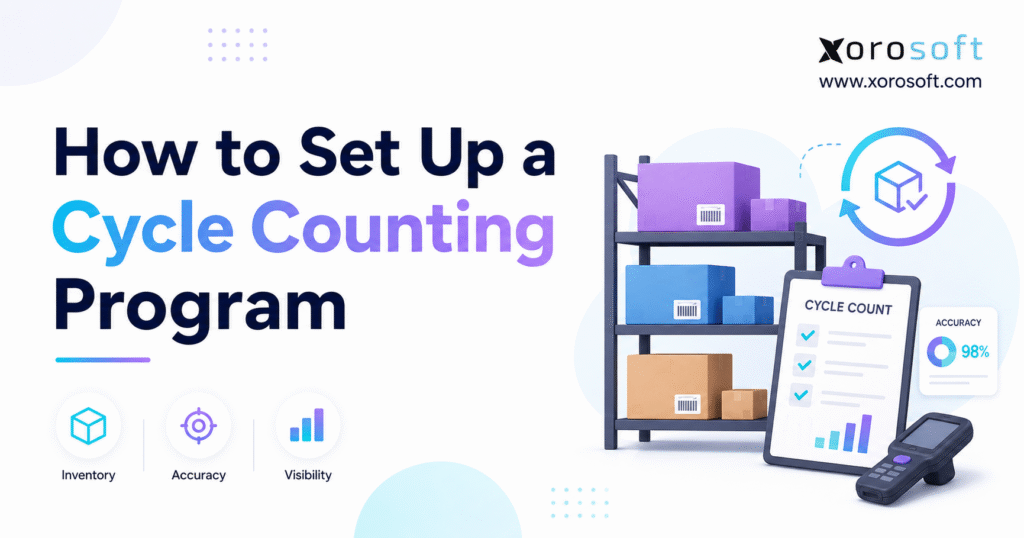
Implementing a cycle counting program can greatly improve inventory accuracy and streamline operations.
1. Why Small Stock Errors Become Expensive Operational Problems
Inventory discrepancies rarely begin with one large failure. More often, they develop through everyday transactions that look harmless when viewed individually.
A receiving clerk enters the wrong quantity. Someone puts a carton in the neighboring bin. A transfer leaves one warehouse correctly, but the receiving facility never completes the corresponding transaction. An employee removes damaged stock without recording the adjustment. Production consumes more material than the work order reflects. An ecommerce return reaches the warehouse, but the inventory movement never gets posted.
Each mistake creates a small difference between physical stock and the quantity stored in the system.
As transaction volume increases, those differences accumulate.
Eventually, purchasing teams reorder products the company already owns. Sales representatives promise stock warehouse employees cannot find. Fulfillment teams search multiple locations for items that supposedly exist. Finance spends hours researching inventory adjustments. Production planners make decisions using component quantities that may no longer reflect reality.
A well-designed cycle counting program gives operations teams a way to identify these differences before they become larger business problems.
Rather than waiting for an annual or semiannual stocktake, the company verifies selected inventory throughout the year. Managers can count high-risk products more frequently while assigning stable, lower-risk items a lighter schedule.
The strongest programs do more than correct quantities.
They explain why the inventory became inaccurate.
Suppose the system shows 100 units while employees find 97. Changing the record to 97 fixes today’s quantity, but it does not explain what happened to the missing three units.
Warehouse leaders still need to determine whether receiving, put-away, picking, shipping, transfers, returns, manufacturing, damage, shrinkage, or another workflow caused the discrepancy.
That investigative discipline transforms a cycle counting program from a repetitive warehouse task into an inventory-control system that supports purchasing, fulfillment, accounting, manufacturing, and planning.
2. What a Cycle Counting Program Actually Controls
A cycle counting program uses recurring physical checks to verify selected SKUs, warehouse bins, locations, or inventory categories according to a planned schedule.
Instead of counting every product at once, the business distributes the workload across normal operating days. More attention goes toward stock where inaccurate quantities create the greatest operational or financial risk.
2.1 How the Inventory Cycle Counting Process Works
A typical inventory cycle count begins when the business identifies stock that requires verification.
An employee checks the physical quantity and compares the result with the system record. When the difference exceeds an established tolerance, the employee or inventory-control team performs another count. If the recount confirms the discrepancy, the team reviews recent transactions and investigates the likely cause.
An authorized person can then approve any required adjustment.
A dependable cycle counting process follows a simple sequence:
Count → Compare → Recount → Investigate → Correct → Improve
The investigation step creates most of the long-term value.
If the system shows 140 units but employees find only 136, management needs to understand whether receiving, picking, shipping, transfers, production, returns, damaged stock, or shrinkage caused the four-unit difference.
Without that analysis, the company simply resets the quantity and waits for the same issue to return.
2.2 Cycle Counting vs. Full Physical Inventory
Cycle counting and full physical inventory support the same broad goal: reliable inventory records. They achieve that goal differently.
| Factor | Cycle Counting | Full Physical Inventory |
|---|---|---|
| Scope | Selected items or locations | Most or all inventory |
| Timing | Recurring throughout the year | Periodic |
| Operational disruption | Usually lower | Often higher |
| Error detection | Continuous | Point-in-time |
| Root-cause analysis | Fits into routine operations | Often secondary to finishing the count |
| Labor requirement | Distributed | Concentrated |
| Main purpose | Maintain ongoing accuracy | Verify broad inventory balances |
Cycle counting does not automatically eliminate the need for full physical inventory procedures.
Accounting policies, audit requirements, contracts, regulations, or internal controls may still require broader verification.
Its main advantage is faster detection. Instead of allowing a problem to remain hidden for months, the organization creates repeated opportunities to find and investigate it.
3. Building a Cycle Counting Program That Operations Can Maintain
A cycle counting program only works when employees can execute it consistently.
An aggressive schedule that teams regularly postpone provides less value than a smaller, disciplined program that becomes part of normal operations.
3.1 Define the Business Objective
Start with the problem management wants to solve.
“Count inventory every day” describes an activity. It does not define an outcome.
A stronger objective might focus on reducing recurring discrepancies, increasing confidence in warehouse quantities, improving purchasing decisions, reducing emergency stock investigations, or strengthening controls around high-value inventory.
Different operating models require different priorities.
A manufacturer may focus on critical component availability. An ecommerce business may prioritize fast-moving SKUs. A distributor with several facilities may care more about warehouse transfers and location accuracy.
Clear objectives help determine which products deserve more attention and which results management should monitor.
3.2 Establish an Inventory Accuracy Baseline
Measure the current situation before changing the process.
Choose a representative sample that covers different product categories, warehouse locations, transaction volumes, and inventory values. Count each SKU-location combination and compare it with the system quantity.
One straightforward formula is:
Inventory Record Accuracy = Accurate Records ÷ Records Counted × 100
Suppose 192 of 200 records meet the company’s defined tolerance:
192 ÷ 200 × 100 = 96%
The calculation only becomes useful after management defines what qualifies as accurate.
One business may require an exact match. Another may allow a small unit or percentage tolerance.
Document the method and keep it consistent. Changing the calculation between reporting periods can make performance appear better or worse even when operational accuracy has not changed.
3.3 Clean Item and Location Data Before Cycle Counting
Poor master data creates false counting problems.
Review item numbers, units of measure, active and inactive SKUs, warehouse assignments, bin locations, pack quantities, lot and serial settings, duplicate products, unresolved transfers, and negative inventory before employees begin routine counts.
Consider a product purchased by the case but sold by individual units.
If one employee counts 12 cases while another records 12 pieces, the warehouse does not have a physical stock problem. It has a unit-of-measure problem.
Location structure deserves the same attention.
When employees regularly place products in unofficial temporary locations, the assigned bin can show repeated shortages even though the company still owns the stock.
Clean data gives the cycle counting program a reliable starting point.
3.4 Choose a Method Based on Operational Risk
Businesses can prioritize counts according to financial value, transaction velocity, warehouse location, product criticality, historical error rates, or a combination of those factors.
Unit value alone should not determine frequency.
A low-cost component can stop an entire production line. A moderately priced ecommerce SKU may move hundreds of times each week. An expensive service part may sit untouched for months.
The company should allocate counting effort according to the consequences of inaccurate inventory.
3.5 Use ABC Analysis to Set Inventory Count Priorities
ABC classification gives operations teams a practical way to distribute counting effort.
A items receive the most attention. B items receive moderate attention. C items receive less frequent verification.
Many businesses begin with annual usage value and then add factors such as sales velocity, supplier lead time, stockout impact, theft risk, production importance, margin, and historical variance.
The purpose is not to create a perfect mathematical model.
ABC analysis helps the business spend warehouse labor where inaccurate inventory creates the greatest risk.
3.6 Set Practical Cycle Count Frequencies
No universal schedule works for every warehouse.
An illustrative starting point could look like this:
| Inventory Class | Example Frequency |
| A | Monthly |
| B | Quarterly |
| C | Annually |
These frequencies should remain examples rather than fixed industry rules.
A critical component may need weekly verification. A high-value product with almost no transaction activity may require less attention.
Historical performance should influence frequency as well.
When a SKU repeatedly produces unexplained differences, move it into a higher level of counting attention until the underlying issue improves.
3.7 Calculate the Daily Workload
A cycle counting program that requires more work than the warehouse can complete will fail regardless of how good the strategy looks on paper.
Convert annual frequency rules into actual count events.
Assume the business manages 500 A items, 1,000 B items, and 3,000 C items.
If A inventory receives 12 counts per year, B inventory receives four, and C inventory receives one, the calculation becomes:
500 × 12 = 6,000 count events
1,000 × 4 = 4,000 count events
3,000 × 1 = 3,000 count events
Total annual requirement = 13,000 count events
If employees count inventory across 250 working days:
13,000 ÷ 250 = 52 count events per day
Management can now compare that requirement with available labor.
If the warehouse can reliably complete only 25 counts per day, building a 52-count schedule will create missed assignments and unreliable reporting.
Adjust classifications, frequencies, staffing, workflows, or technology until the schedule becomes sustainable.
3.8 Assign Ownership and Approval Rules
Document who creates assignments, performs the initial count, conducts recounts, investigates discrepancies, approves adjustments, and reviews performance.
The same employee should not automatically control every step when an adjustment carries meaningful financial risk.
Smaller businesses may not have enough people for strict separation of duties, but they can still establish approval thresholds.
A warehouse supervisor might approve minor quantity differences while a controller reviews larger financial adjustments.
4. Choosing the Right Cycle Counting Method
A cycle counting program does not need to rely on one methodology.
Many organizations combine several approaches to cover financial risk, transaction risk, and warehouse location accuracy.
4.1 ABC Cycle Counting for High-Risk Products
ABC counting works well when the inventory population contains clearly different levels of business risk.
Managers can give high-value, high-velocity, long-lead-time, or business-critical products greater attention while allowing stable inventory to follow a lighter schedule.
This approach prevents teams from spending equal effort on products with very different consequences.
4.2 Location-Based Warehouse Checks
Location-based counting rotates through aisles, zones, racks, or bins.
The method works especially well when location integrity creates operational problems.
A company may own the correct total quantity of an item while storing several units in the wrong warehouse positions. Overall stock looks correct, but pickers still cannot find the products efficiently.
Location-based verification exposes those failures.
4.3 Random Inventory Counts
Random counts test inventory without relying entirely on predetermined risk categories.
They can uncover problems management did not expect.
Random sampling also gives leadership an independent way to test whether the main count strategy overlooks parts of the inventory population.
4.4 Control Group Testing
A control group contains selected items that employees verify repeatedly.
Businesses often use this approach when introducing a new scanner workflow, warehouse layout, storage method, inventory policy, or operating procedure.
Repeated verification helps management determine whether the new process produces stable results.
4.5 Combining Multiple Methods
Many mature operations use a hybrid model.
A distributor may use ABC classification for high-priority products, rotate through warehouse zones, and add exception counts when specific SKUs generate recurring discrepancies.
The goal is reliable inventory, not strict adherence to one counting theory.
5. Designing a Practical Cycle Count Schedule
Every cycle counting program needs a schedule that reflects both inventory risk and warehouse capacity.
A plan that works only during quiet periods will quickly collapse during promotions, seasonal peaks, or heavy receiving periods.
5.1 Match Frequency to Business Risk
Start with the initial classification and challenge the assumptions.
Does one SKU move significantly faster than others in the same category? Does a supplier have a long lead time? Could a stockout interrupt manufacturing? Has the product repeatedly generated discrepancies?
Each factor can justify more frequent verification.
Seasonality matters as well.
A sporting-goods distributor may treat one product as lower priority through most of the year, then increase counting attention before its peak selling season.
Apparel businesses may increase checks during collection launches, promotions, and periods with heavy return volume.
5.2 Revisit Priorities as Conditions Change
Inventory behavior changes over time.
Demand shifts. Products mature. Suppliers change. Ecommerce channels add transaction volume. Warehouse layouts evolve. Manufacturers introduce new components.
Review classifications periodically instead of allowing the original schedule to run indefinitely.
Variance history provides another useful signal.
When supposedly low-risk products repeatedly produce discrepancies, increase their priority until performance stabilizes.
6. Keeping Counts Accurate During Daily Warehouse Activity
A cycle counting program has to coexist with receiving, picking, replenishment, transfers, manufacturing, and shipping.
The goal is controlled verification, not unnecessary warehouse shutdowns.
6.1 Prepare the Area Before Counting
Before an employee begins, confirm the SKU, warehouse location, unit of measure, and any relevant lot or serial information.
Open transactions require particular attention.
An employee cannot produce a dependable result while another worker moves inventory from the same location without coordination.
The operating procedure should explain how teams handle active receipts, picks, transfers, replenishment, production, or shipping while verification takes place.
6.2 Use Blind Cycle Counts Where They Improve Control
A blind cycle count hides the expected system quantity from the employee.
That encourages independent verification.
If the software tells someone to expect 24 units, the employee may unconsciously stop searching once 24 pieces appear to be present.
Removing the expected number reduces that bias.
Blind counts work particularly well for high-risk products and locations with recurring discrepancies.
6.3 Recheck Significant Differences
Do not let every difference trigger an immediate adjustment.
First verify the SKU. Confirm the location and unit of measure. Check lot or serial details where relevant. Search nearby bins.
If the discrepancy remains, review recent transaction history.
This sequence prevents a simple counting mistake or location problem from becoming an unnecessary inventory adjustment.
7. Finding the Root Cause of Cycle Count Variances
A cycle counting program becomes much more valuable when the company treats discrepancies as diagnostic information.
The corrected quantity matters. The reason behind the difference matters more.
7.1 Receiving and Put-Away Problems
When discrepancies appear shortly after receiving, review purchase-order quantities, partial receipts, pack sizes, labels, units of measure, and put-away transactions.
Suppose employees consistently receive the correct quantity but later find stock in the wrong bins.
Receiving may work correctly. Put-away control may create the discrepancy.
Management needs to fix the process responsible for the problem rather than simply increasing count frequency.
7.2 Picking, Shipping, and Transfer Errors
High-volume warehouses create thousands of opportunities for transactional errors.
An employee may pick the wrong product, remove stock from the wrong location, ship a different quantity than the order requires, or physically complete a transfer without completing the corresponding system transaction.
Reason codes allow managers to identify patterns.
If transfer problems create most significant adjustments, counting more often will only detect the symptom sooner. The business needs stronger transfer controls.
7.3 Manufacturing Inventory Differences
Manufacturing adds another layer of inventory movement.
Employees may consume more components than the standard BOM predicts. Production teams may fail to record scrap. Finished goods can physically exist before someone posts the production transaction. Component substitutions can create additional differences.
Regular verification of raw materials and production inventory helps expose these gaps.
7.4 Turn Reason Codes Into Operational Data
Avoid one generic category called “inventory error.”
Use specific categories such as receiving error, wrong bin, picking mistake, transfer issue, damaged stock, production variance, return problem, unit-of-measure error, master-data problem, and unexplained shrinkage.
After several months, management should understand why adjustments happen, not merely how many employees post.
8. Measuring Cycle Counting and Inventory Accuracy
A cycle counting program should demonstrate whether inventory control improves over time.
More counting does not automatically mean better accuracy.
8.1 Track Inventory Accuracy Consistently
Measure the percentage of verified records that meet the company’s selected tolerance.
Keep the calculation consistent from one reporting period to another.
Management should also review performance by warehouse, location, product family, and inventory class.
One company-wide percentage can hide major operational differences between facilities.
8.2 Measure Cycle Count Schedule Completion
Use:
Completed Scheduled Counts ÷ Scheduled Counts × 100
A warehouse can appear highly accurate while regularly skipping parts of its planned workload.
That creates false confidence.
Schedule completion shows whether employees actually execute the control process as management designed it.
8.3 Monitor Variance Frequency and Financial Impact
Track both the frequency of meaningful discrepancies and their financial value.
Quantity alone can hide risk.
Twenty one-unit differences involving inexpensive products may matter less financially than one shortage involving a high-value component.
Both measures belong in the performance review.
8.4 Identify Problems That Keep Returning
Repeated discrepancies deserve more attention than isolated errors.
Analyze recurrence by SKU, warehouse, bin, product family, supplier, reason code, or operational workflow where practical.
If the same product produces a variance every month, the team has not eliminated the original cause.
9. Operational Practices That Strengthen Stock Control
The cycle counting program improves when teams treat inventory accuracy as an everyday operating discipline rather than a monthly reporting exercise.
Consistency matters more than occasional large counting campaigns.
A warehouse that completes a manageable schedule every day gains more useful information than one that repeatedly postpones ambitious count plans.
Barcode scanning can strengthen item and location identification, particularly in dense warehouses or businesses with visually similar SKUs.
Approval thresholds should reflect financial risk. Teams can process minor differences through streamlined rules while larger adjustments receive independent review.
Management should use recurring variance patterns to improve operations.
When receiving errors increase, review receiving procedures. When wrong-bin inventory dominates, examine put-away and replenishment. Transfer discrepancies point toward transfer controls. Manufacturing differences may require a closer look at BOMs, material consumption, scrap, and production reporting.
A cycle counting program creates meaningful value when recurring causes decline.
That is a much stronger measure than simply reporting how many counts employees completed.
10. Adapting Cycle Counting by Industry
Inventory risk varies considerably between business models, so companies should adapt controls rather than applying one generic cycle count policy.
Xorosoft’s industry-specific ERP overview covers inventory-driven sectors including apparel, wholesale distribution, manufacturing, food and beverage, sporting goods, furniture, electronics, and related businesses.
10.1 Cycle Counting for Apparel and Fashion
Apparel companies often manage large SKU populations because each style can create combinations of color, size, season, and collection.
A warehouse might own the correct total quantity for one style while individual size-color SKUs remain inaccurate.
Teams should therefore verify stock at the SKU-location level instead of relying on broad product-family totals.
Returns, exchanges, seasonal inventory, and visually similar products deserve particular attention.
10.2 Wholesale Distribution
Wholesale distributors may combine extensive catalogs, customer allocations, EDI transactions, multiple warehouses, bulk units of measure, and complex purchasing.
That environment creates many opportunities for receiving, transfer, allocation, and fulfillment discrepancies.
The count policy should connect closely with the workflows that move inventory through the business.
10.3 Food and Beverage Inventory
Food companies often need to verify more than quantity.
Lots, batches, expiry dates, spoilage, and storage locations may all affect inventory accuracy.
A warehouse that knows it owns 500 units but cannot reliably identify the correct batch still has an inventory-control problem.
The cycle counting program should therefore account for inventory attributes that matter operationally, not just total quantity.
10.4 Manufacturing and Component Control
Manufacturers need different controls for raw materials, components, work-in-process, and finished goods.
A low-cost component can create major operational risk when its absence stops production.
Manufacturers should therefore include operational criticality in classification rather than relying entirely on financial value.
Count results can also reveal weaknesses in BOM accuracy, material consumption, scrap reporting, and production completion.
10.5 Shopify and Omnichannel Operations
Shopify merchants often reach another level of complexity when the same physical inventory supports ecommerce, wholesale, Amazon, retail, B2B, and multiple warehouse locations.
The business must coordinate physical quantities with available stock, allocations, committed orders, returns, and transfers.
Xorosoft maintains an ERP listing on the Shopify App Store, giving Shopify merchants an additional integration option to evaluate when they need broader inventory and operational control.
In an omnichannel environment, one physical discrepancy can affect several selling channels at once.
That makes warehouse accuracy a customer-experience issue as well as an operational one.
11. Maintaining Control Across Multiple Warehouses
A cycle counting program across several warehouses requires company-wide standards and location-level accountability.
Consolidated totals often hide local weaknesses.
Warehouse A may maintain strong controls while Warehouse B repeatedly experiences transfer or put-away problems. Combining both facilities into one accuracy percentage makes the weaker operation harder to identify.
Use consistent definitions across facilities.
Reason codes, tolerance rules, approval logic, and KPI calculations should follow a common framework.
Individual warehouses can still use different frequencies when their risk profiles differ.
A high-volume fulfillment center may require more frequent verification than a slower reserve-storage facility.
Inter-warehouse transfers deserve particular attention because they affect two inventory records. The sending facility may reduce its quantity correctly while the receiving warehouse fails to complete the matching transaction.
XoroWMS supports warehouse operations, inventory visibility, and fulfillment workflows for businesses that need stronger location-level control.
Technology can strengthen warehouse discipline, but employees still need clear transaction procedures.
12. When a Cycle Counting Program Outgrows Spreadsheets
A cycle counting program can begin perfectly well in a spreadsheet.
For a business with one stockroom, several hundred products, modest transaction volume, and a small team, spreadsheets may provide enough structure.
Complexity changes that equation.
Several employees begin maintaining different versions of count files. Warehouse data gets exported from one application and corrected in another. Managers approve adjustments through email. Accounting reconciles changes later. Different facilities develop different procedures.
Eventually, employees spend almost as much time coordinating information as they spend verifying stock.
12.1 When Warehouse Cycle Counting Needs WMS Support
A warehouse management system becomes increasingly useful when operations depend on barcode scanning, detailed bin control, directed workflows, multiple facilities, and high transaction volumes.
At that point, counting becomes part of normal warehouse execution instead of a separate administrative process.
A WMS can provide stronger location context, direct work to employees, and keep inventory movement closer to the verification process.
12.2 When ERP Becomes the Bigger Question
ERP becomes relevant when inventory discrepancies affect departments outside the warehouse.
Purchasing needs reliable quantities before creating purchase orders. Manufacturing depends on component availability. Ecommerce channels require accurate sellable inventory. Accounting needs controlled adjustments. Management expects consolidated reporting.
Once inventory accuracy touches all those workflows, a standalone counting application solves only part of the problem.
The broader question becomes whether the company operates from one dependable inventory record or several disconnected versions.
13. Connecting ERP Cycle Counting With Financial and Operational Controls
ERP can strengthen a cycle counting program by connecting inventory verification with the processes that create and consume inventory data.
A connected environment can bring together item records, warehouse locations, purchasing, manufacturing, order management, accounting, ecommerce, and reporting.
13.1 Automating Cycle Count Schedules and Visibility
Software can identify inventory due for verification according to defined policies rather than forcing managers to maintain every assignment manually.
Count history can remain connected with the SKU, warehouse, and location.
That historical record gives teams useful context when a specific product or bin repeatedly generates discrepancies.
For inventory-driven businesses that need broader operational integration, XoroONE connects inventory, warehouse management, purchasing, accounting, manufacturing, ecommerce operations, and reporting in a cloud ERP environment.
The benefit is not simply automation. It is the ability to understand the count in the context of surrounding transactions.
13.2 Managing Adjustments With Better Financial Control
Inventory adjustments can affect financial statements and inventory valuation.
An unexplained shortage involving high-value merchandise requires a different level of review from a one-unit discrepancy involving inexpensive stock.
A connected system allows warehouse activity and accounting consequences to follow the same control structure.
Businesses evaluating a broader enterprise architecture can also review XoroERP when inventory, accounting, procurement, manufacturing, warehouse operations, and reporting need to work together.
Software alone will not create accurate inventory.
The organization still needs sound classification rules, realistic frequencies, tolerance thresholds, ownership, approval controls, and root-cause investigation.
14. When Stock Discrepancies Point to a Larger Systems Problem
A cycle counting program sometimes reveals that the biggest issue no longer sits inside the warehouse.
Companies rarely replace software because employees want a better counting screen.
They replace or consolidate systems when inventory verification exposes broader operational fragmentation.
One warning sign appears when warehouse teams must export quantities into spreadsheets before investigating discrepancies.
Another appears when finance, ecommerce, purchasing, manufacturing, and operations maintain different versions of the same stock position.
Multiple facilities increase the pressure. So do wholesale EDI, Shopify, Amazon, growing SKU populations, high return volumes, manufacturing activity, and more complex approval requirements.
At that stage, leadership should ask a broader question:
Is the company still solving a stock-counting problem, or has it developed a systems architecture problem?
Businesses considering enterprise systems can review the Xorosoft vs. NetSuite comparison as one vendor-specific evaluation resource.
The final choice should consider operational fit, inventory complexity, accounting requirements, integrations, implementation needs, internal resources, and long-term scalability rather than focusing on one feature.
15. A Practical Cycle Counting Program Example
Consider a distributor with 4,500 active SKUs across two warehouses.
The business sells through ecommerce and wholesale channels and operates approximately 250 counting days each year.
Management wants a cycle counting program that gives high-risk inventory greater attention without overwhelming warehouse employees.
15.1 Turning ABC Cycle Count Rules Into Daily Work
The company initially classifies 500 SKUs as A items, 1,000 as B items, and 3,000 as C items.
Management chooses monthly verification for A inventory, quarterly verification for B inventory, and annual verification for C inventory.
| Class | SKUs | Counts Per Year | Annual Count Events |
| A | 500 | 12 | 6,000 |
| B | 1,000 | 4 | 4,000 |
| C | 3,000 | 1 | 3,000 |
| Total | 4,500 | 13,000 |
Thirteen thousand annual count events divided by 250 working days produces approximately 52 count events per day.
That calculation converts a policy into a real operational requirement.
Warehouse management can now determine whether existing staffing, scanner availability, and workflows can support the schedule.
If the current team cannot sustain 52 events per day, leadership can modify frequencies, classifications, staffing, or process design before the program begins rather than discovering the problem months later.
15.2 Using Variance Data to Improve Warehouse Processes
Management initially assumes picking errors cause most inventory differences.
Three months of reason-code data reveals something different.
One warehouse zone produces a disproportionate share of wrong-location discrepancies. Inbound employees frequently place inventory into temporary bins without completing the proper location transaction.
Management could respond by counting that area more frequently.
Doing so would detect the symptom faster, but it would not remove the cause.
Instead, the company reviews put-away rules, temporary-location controls, scanner workflows, labels, and employee training.
The facility keeps the affected area on a higher-frequency verification schedule while the corrective changes take effect.
Once performance stabilizes, managers reduce the additional counting frequency.
That progression shows how a mature cycle counting program should operate: detect the discrepancy, investigate the cause, improve the process, verify the improvement, and then adjust the level of control.
16. Cycle Counting Program FAQs
16.1 What is a cycle counting program?
A cycle counting program verifies selected inventory throughout the year according to a recurring schedule. Employees compare physical quantities with system records, investigate meaningful differences, and correct confirmed errors. The process helps businesses maintain inventory accuracy without relying exclusively on occasional full physical inventory counts.
16.2 Why do businesses use inventory cycle counting?
Recurring verification helps companies find discrepancies sooner. Faster detection prevents incorrect stock data from influencing purchasing, fulfillment, manufacturing, ecommerce availability, forecasting, and accounting for long periods. Count results also provide useful information about recurring operational weaknesses.
16.3 How do you start a cycle count program?
Begin by measuring current inventory accuracy. Clean item and location data, choose a suitable methodology, classify products according to risk, set frequencies, calculate workload, assign responsibilities, establish tolerances, and document how employees should investigate meaningful discrepancies.
16.4 How often should products be counted?
Frequency depends on inventory value, transaction volume, stockout risk, supplier lead time, criticality, shrink exposure, seasonality, and historical accuracy. High-risk items usually deserve greater attention, while stable products with few movements may require less frequent verification.
16.5 What does ABC analysis mean?
ABC analysis divides stock into priority categories. A items receive greater attention, B items receive moderate attention, and C items receive less. Businesses can classify products using value, velocity, lead time, stockout impact, operational criticality, or discrepancy history.
16.6 How often should A items be checked?
Many businesses verify A items more frequently than other categories. Monthly counting can provide a useful starting example, but critical or error-prone products may require greater frequency. The business should base its final schedule on actual risk.
16.7 How often should B and C items be checked?
B inventory generally receives moderate attention, while C products receive less frequent verification. Quarterly and annual schedules can serve as examples, but each business should adjust frequency according to transaction activity, operational importance, and historical accuracy.
16.8 How many items should employees count each day?
Calculate the annual number of required count events and divide it by available counting days. A program requiring 13,000 annual count events across 250 working days needs an average of approximately 52 events each day.
16.9 What is a blind cycle count?
A blind cycle count hides the expected system quantity from the employee. This encourages independent physical verification and reduces the likelihood that someone stops counting after reaching the number displayed by the software.
16.10 Does warehouse activity have to stop during counting?
Not always. Many businesses continue normal operations while controlling transactions that affect the specific stock under review. The procedure must prevent unnoticed receipts, picks, transfers, production movements, or shipments from changing the quantity during verification.
16.11 What is a cycle count tolerance?
A tolerance defines the size of a discrepancy that triggers additional action. Companies may establish thresholds using quantity, percentage, financial value, inventory class, or operational risk. Larger differences may require a recount, investigation, or additional approval.
16.12 When should employees perform a recount?
A recount makes sense when the discrepancy exceeds tolerance, the adjustment carries meaningful financial value, the counter suspects an error, or employees may have stored stock in another location. Verify the item, location, and unit of measure before posting an adjustment.
16.13 What causes stock discrepancies?
Common causes include receiving mistakes, incorrect put-away, picking errors, incomplete transfers, shipping mistakes, returns, damage, production activity, unit-of-measure problems, master-data errors, spoilage, unrecorded transactions, and shrinkage.
16.14 How should teams investigate a difference?
Start with another physical verification. Confirm the SKU, location, unit of measure, lot, and serial details where relevant. Then review recent receipts, picks, shipments, transfers, returns, manufacturing transactions, and previous inventory adjustments.
16.15 How do you calculate inventory accuracy?
One simple formula divides accurate inventory records by total records counted and multiplies the result by 100. Define the company’s tolerance first and maintain the same methodology from one reporting period to another.
16.16 What percentage represents good inventory accuracy?
No single percentage works for every organization because businesses use different formulas, tolerances, item profiles, and operating models. Establish a clear internal baseline, track improvement consistently, and review the financial impact and recurrence of discrepancies alongside the headline percentage.
16.17 Can recurring counts replace a full stocktake?
They can reduce dependence on disruptive full counts in some organizations. However, accounting policies, audits, contracts, regulatory requirements, or internal controls may still require broader physical verification. Businesses should confirm their own requirements before eliminating any existing procedure.
16.18 Can spreadsheets manage the process?
Yes. Spreadsheets can work in simple inventory environments. They become harder to manage as businesses add warehouses, users, SKUs, barcode scanners, approvals, sales channels, manufacturing activity, and accounting requirements.
16.19 How does WMS software help with warehouse cycle counting?
A WMS can connect warehouse locations, count assignments, barcode scans, inventory movements, and adjustment workflows. This gives warehouse teams stronger location-level control and reduces the need to maintain separate manual worksheets.
16.20 How does ERP software support cycle counting?
ERP software can connect inventory verification with purchasing, warehouse operations, manufacturing, sales orders, ecommerce, accounting, and reporting. That integration matters because stock discrepancies often affect several departments rather than remaining isolated inside the warehouse.
16.21 When should a business automate inventory counting?
Automation becomes more valuable when managers struggle to maintain schedules manually, employees operate across several facilities, inventory volumes increase, approvals become more complex, or quantities must remain synchronized across ecommerce, wholesale, manufacturing, and accounting.
16.22 Should every SKU follow the same count frequency?
No. Equal frequency can waste labor on stable, low-risk products while giving insufficient attention to critical inventory. Use financial value, velocity, stockout impact, supplier lead time, transaction complexity, operational criticality, and historical error rates to determine priority.
16.23 Which performance metrics matter most?
Useful measures include inventory record accuracy, scheduled-count completion, variance frequency, adjustment value, repeat discrepancy rate, accuracy by warehouse, and reason-code trends. Management should pay particular attention to whether recurring causes decline.
16.24 How does better inventory accuracy improve purchasing?
Purchasing decisions depend on reliable on-hand quantities. Overstated inventory can delay replenishment and contribute to stockouts. Understated quantities can trigger unnecessary purchases and excess stock. Better records improve the information behind purchasing and replenishment decisions.
16.25 What is the biggest cycle counting mistake?
The biggest mistake is correcting discrepancies without investigating their cause. Repeated adjustments may make the system accurate temporarily while receiving, put-away, picking, transfers, manufacturing, or another workflow continues creating the same problem.
17. Turning Cycle Count Results Into Better Business Decisions
A successful cycle counting program should increase confidence in inventory with every counting cycle.
The objective is not simply to perform more counts. It is to reduce the conditions that create inventory discrepancies in the first place.
17.1 Use Cycle Counting Findings to Improve Operations
Start with a clear baseline and clean underlying data.
Prioritize inventory according to business risk instead of applying the same schedule to every SKU. Build a daily workload employees can complete consistently. When a discrepancy appears, verify it before posting an adjustment.
Once the team confirms the difference, investigate its cause.
Receiving problems should lead to stronger receiving controls. Wrong-location inventory should trigger a review of put-away and replenishment. Transfer issues should push the business to tighten inter-warehouse procedures. Manufacturing differences should lead to closer examination of consumption, scrap, BOMs, and production reporting.
Over time, the cycle counting program should produce more than a higher accuracy percentage.
Recurring causes should decline.
Management should spend less time investigating missing inventory. Buyers should have greater confidence in replenishment data. Warehouse teams should encounter fewer products sitting in the wrong locations. Finance should see fewer unexplained adjustments.
That is the real measure of improvement.
17.2 Know When the Technology Stack Needs to Scale
Technology becomes more important as operations grow, but software delivers the most value when it supports a disciplined process.
A WMS can strengthen location control, scanning, and warehouse execution. ERP can connect inventory changes with purchasing, manufacturing, ecommerce, accounting, forecasting, and reporting.
Before selecting new software, map the actual inventory workflow.
Understand how products enter the business, where they move, which channels consume them, how inter-warehouse transfers work, who approves discrepancies, what happens to returns, and how inventory adjustments reach accounting.
When spreadsheets, warehouse applications, ecommerce platforms, purchasing files, and accounting tools make that workflow difficult to control, the problem has moved beyond counting.
At that point, leadership should evaluate the operating system behind inventory.
For inventory-driven businesses considering that transition, contact Xorosoft to review how inventory, warehouse management, purchasing, manufacturing, Shopify, wholesale, accounting, reporting, and integrations fit together in the actual operation.
A strong cycle counting program is ultimately not about counting inventory faster.
It is about creating inventory records trustworthy enough that purchasing, fulfillment, manufacturing, ecommerce, finance, and management can make decisions from the same operational reality.
Recent Posts
-
 ERP Landed Cost Module vs Spreadsheet Calculations for Importers
 -
 How to Build an Open-to-Buy Plan for an Omnichannel Brand
 -
 Cold Storage WMS for Food and Beverage Distribution
 -
 ERP Buying Statistics 2026: Evaluation, Implementation, and Adoption Risks
 -
 How a Distributor Reduced B2B Order Exceptions Without Restricting Sales