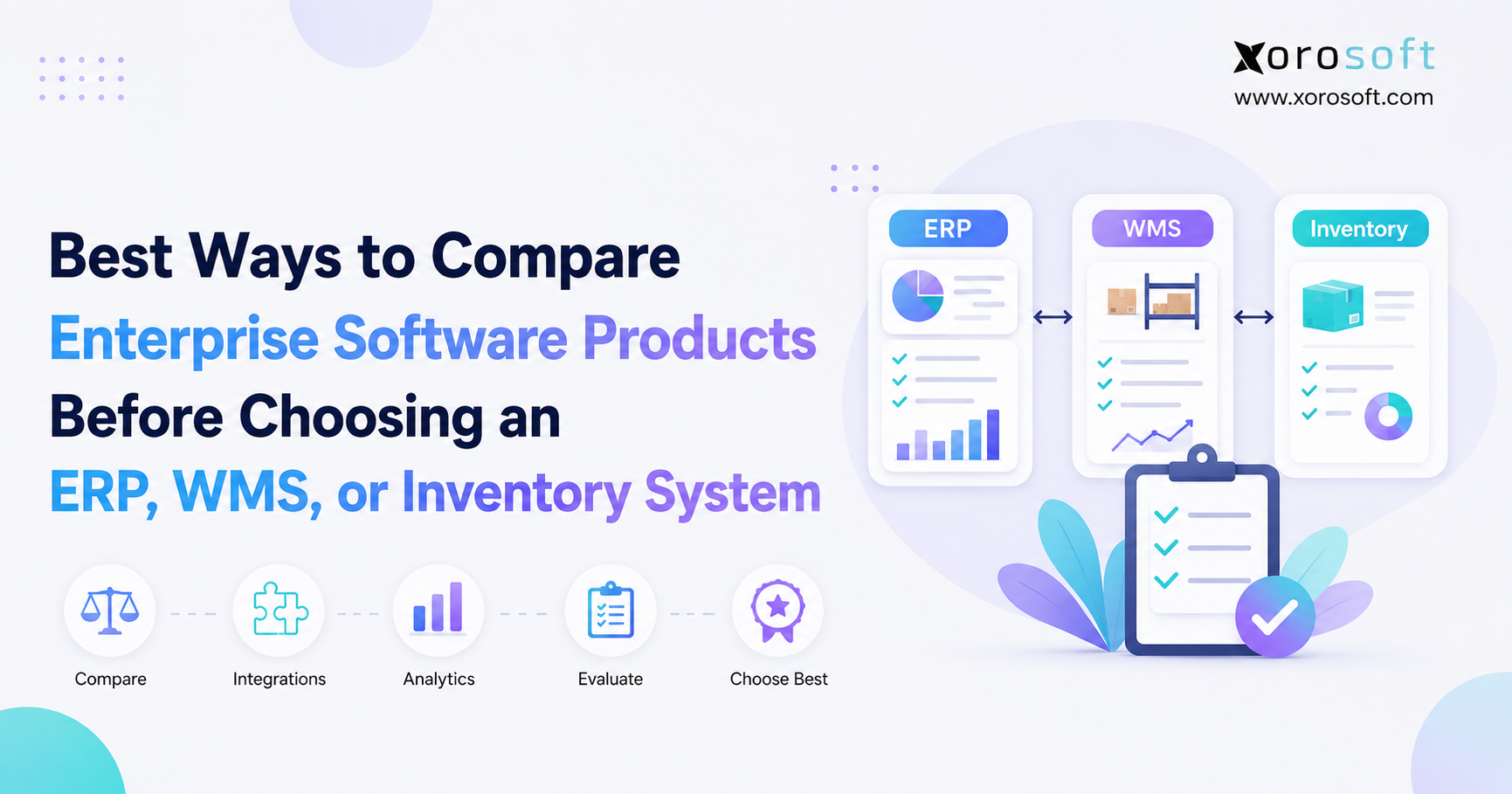
If you’re looking for an enterprise software comparison to make the best choice for your business, this guide will help you navigate the possibilities.
1. Why Enterprise Software Comparison Goes Wrong Before the First Demo
Companies rarely decide to replace business software because somebody suddenly wants a new ERP. The decision usually starts with operational friction. Inventory numbers are difficult to trust. Buyers maintain critical purchasing plans in spreadsheets. Warehouse employees work around system limitations. Finance spends too much time reconciling transactions, while ecommerce, wholesale, marketplace, and accounting data live in different applications.
At that point, teams often jump directly into product research. They search for vendors, schedule demonstrations, and compare lists of features. Unfortunately, that sequence allows software products to define the evaluation before the business has defined the problem.
A more effective enterprise software comparison begins with operating requirements. Before looking closely at ERP, WMS, or inventory systems, a company should understand which processes are failing, why they are failing, what information needs to move across departments, and what measurable outcomes a replacement system must support.
The distinction is important because two systems can advertise exactly the same capability while providing very different operational depth. One product may call a simple quantity-by-location screen “multi-warehouse inventory.” Another may use the same term to describe allocation, replenishment, warehouse transfers, receiving, availability calculations, cycle counts, landed costs, and channel-level inventory rules.
ERP selection also carries implementation consequences. Panorama Consulting Group’s 2026 ERP research describes a median implementation timeline of nine months across its respondent group, showing why software selection should be treated as a serious business initiative rather than a quick application purchase.
The best starting question is therefore not, “Which product has the most features?” A stronger question is, “Which operating model are we trying to support, and what evidence would prove that a system can support it?”
1.1 Translate Business Friction Into Specific Software Requirements
Vague problems create vague evaluations. Saying “inventory is inaccurate” does not tell a software vendor what must improve. A more useful statement might explain that receiving, transfers, adjustments, fulfillment, and marketplace orders are not updating stock consistently across warehouses.
Purchasing problems need the same level of detail. Instead of saying the team needs “better purchasing,” document how buyers currently calculate replenishment, where supplier lead times are maintained, how incoming inventory is considered, and why stockouts or excess inventory occur.
Specific problem statements become testable requirements later in the selection process.
1.2 Separate Operational Symptoms From Their Root Causes
The system where a problem appears is not always the system causing it.
A stockout may originate in forecasting, purchasing lead times, warehouse receiving, inventory allocation, or delayed marketplace synchronization. Slow month-end close may appear to be an accounting problem even when warehouse adjustments are reaching finance late.
Process diagnosis should happen before software selection. Otherwise, a company risks replacing one application while preserving the underlying operational problem.
2. ERP vs WMS vs Inventory Software: Choose the Right Category First
Before comparing vendors, determine what type of system the business actually needs. ERP, WMS, and inventory software overlap in certain areas, but they are designed around different levels of operational scope.
Oracle describes ERP as software used to manage core day-to-day business processes such as accounting, procurement, project management, risk management, and supply-chain operations, typically through integrated applications and a shared data model.
That broader scope is why ERP evaluation should look beyond individual features.
2.1 ERP Software Comparison Should Follow Transactions Across Departments
An ERP becomes especially relevant when inventory decisions directly affect accounting, purchasing, sales orders, manufacturing, forecasting, and reporting.
Consider a purchase order. In an integrated model, that transaction can influence expected supply, receiving, inventory quantities, vendor liabilities, landed cost, stock valuation, and financial reporting. Likewise, a customer shipment may affect inventory availability, fulfillment status, revenue, cost of goods sold, and receivables.
A serious ERP software comparison should therefore follow transactions from beginning to end rather than reviewing each module in isolation.
2.2 WMS Software Comparison Should Focus on Physical Warehouse Execution
Warehouse management systems operate closer to the physical movement of goods.
Microsoft’s current Warehouse Management documentation highlights processes including receiving, multiple picking strategies, batch and serial handling, counting, inventory movements, outbound waves, packing, containerization, cross-docking, and mobile warehouse work.
A WMS evaluation should consequently examine how employees receive, put away, replenish, pick, pack, count, move, and ship inventory under real operating conditions.
2.3 Inventory Software Comparison Should Match the Complexity of the Business
Not every growing company needs ERP.
A dedicated inventory application can be appropriate when the primary problem is stock visibility, basic purchasing, replenishment, or multi-location inventory. If accounting works well separately and warehouse execution remains straightforward, a lighter system may provide enough capability with less implementation effort.
ERP becomes more relevant when the business repeatedly reconciles inventory, purchasing, accounting, warehouses, ecommerce, manufacturing, and reporting across separate applications.
| Business Situation | Likely Starting Point |
|---|---|
| Basic stock visibility and replenishment | Inventory management software |
| Complex receiving, picking, packing, and shipping | WMS |
| Inventory plus finance, purchasing, and reporting | ERP |
| Manufacturing plus inventory, purchasing, and accounting | ERP |
| Company-wide operations with advanced warehouse execution | ERP with integrated or specialist WMS |
Use this as a classification framework rather than a purchasing rule. The detailed requirements still determine the correct architecture.
3. Build the Requirements Model Before Enterprise Software Comparison Begins
A strong enterprise software comparison does not require a 500-line requirements document on day one. It needs a clear model of how the company operates.
Start by mapping the processes that create revenue, move inventory, generate liabilities, and produce financial information. Important gaps usually become obvious once those processes are viewed from start to finish.
3.1 Map Complete Workflows Instead of Departmental Tasks
Purchasing should be mapped from demand or forecast through approval, supplier ordering, receiving, vendor billing, and inventory valuation.
Next, follow customer fulfillment from order capture through allocation, warehouse release, picking, packing, shipping, invoicing, payment, and returns.
Manufacturing workflows should cover demand, bills of material, material requirements, production planning, work orders, consumption, finished goods, costing, and financial posting.
The objective is to find the points where employees re-enter information, wait for another team, export data, maintain side spreadsheets, or reconcile conflicting systems.
3.2 Make Enterprise Software Comparison Requirements Measurable
Terms such as “multi-warehouse,” “reporting,” and “integration” are too broad to score effectively.
If multi-warehouse inventory matters, define whether the company needs transfers, warehouse-level reorder points, allocation priorities, incoming-stock visibility, bin locations, intercompany movement, or channel-specific availability.
Reporting requirements should describe actual decisions. Finance might need inventory valuation by warehouse. Purchasing may need demand, lead time, available inventory, and open purchase orders in one view. Operations may need fulfillment exceptions and warehouse productivity.
Precise requirements turn enterprise software comparison into an evidence-based exercise.
3.3 Separate Must-Haves From Important and Optional Features
A must-have requirement should be something the business cannot operate successfully without. For a distributor serving large retailers, mandatory EDI transactions might fall into this category. For a manufacturer, lot traceability or work-order functionality could be non-negotiable.
Important requirements create meaningful efficiency or visibility but still have an acceptable workaround. Optional requirements are useful without materially affecting system suitability.
Making these decisions before demos prevents impressive but low-value functionality from receiving too much attention.
4. Use a Weighted Enterprise Software Comparison Scorecard
Once the requirements are clear, build a structured scorecard.
A weighted enterprise software comparison gives each shortlisted vendor the same evaluation framework. More importantly, it forces the buying team to agree on priorities before demonstrations and sales discussions begin influencing the decision.
4.1 Weight ERP Selection Criteria According to Business Impact
A wholesale distributor might prioritize inventory, customer pricing, purchasing, EDI, and warehouse processes. A manufacturer may give more weight to BOMs, work orders, planning, costing, and material requirements.
A sample scorecard might assign 25% to functional fit, 15% to inventory and warehouse capabilities, 15% to integrations, 10% to finance and reporting, 10% to implementation, 10% to scalability, 5% to usability, 5% to support, and 5% to TCO.
Those weights are only examples. The correct percentages depend on the operating model.
4.2 Score ERP Vendors With One Consistent Rating Method
A five-point scale works well when the meaning of each score is documented.
A score of 1 can mean the requirement is not supported. A 2 may indicate substantial customization or a significant workaround. A 3 means the standard system meets the core requirement. A 4 represents a strong fit, while a 5 shows the process is supported particularly well with little operational friction.
Evidence matters more than numerical precision. A vendor should not receive a high score merely because a salesperson says a capability exists.
4.3 Keep Deal-Breakers Outside the Weighted Total
Some requirements should override the final score.
Imagine that Vendor A receives 92 points while Vendor B receives 87. Vendor A can still be unsuitable if it cannot support a critical retailer EDI transaction, required manufacturing traceability, or the organization’s financial structure.
A weighted score helps summarize the decision. It should never hide non-negotiable gaps.
5. ERP Software Comparison Should Test Workflow Depth, Not Feature Names
Feature matrices are useful for shortlisting. They are far less useful for making the final decision.
Once the shortlist is small, every important capability should be demonstrated through a workflow. Businesses exploring an integrated operating platform can review the scope of XoroONE cloud ERP as one example, then test the relevant processes against the same scorecard used for every other product.
5.1 Connect Inventory, Purchasing, and Receiving During ERP Evaluation
Inventory and purchasing should not be demonstrated independently.
Ask how the system decides what needs replenishment, how supplier lead times affect planning, how open purchase orders influence projected supply, and what changes after goods are received.
Then introduce exceptions. Receive only part of the order. Change the supplier quantity. Move part of the inventory to another warehouse. Allocate incoming stock to an existing sales order.
Those scenarios reveal whether modules truly operate as one process.
5.2 Include Accounting in the Operational ERP Comparison
If the company is trying to replace disconnected accounting and operational applications, financial workflows deserve the same scrutiny as inventory.
Review inventory valuation, accounts payable, accounts receivable, landed costs, COGS, credits, returns, payments, reconciliation, and financial reporting. Businesses evaluating a broader ERP can include XoroERP in the shortlist while applying exactly the same finance and operational requirements used for competing platforms.
The product should earn its score through demonstrated fit, not through vendor positioning.
5.3 Test Reporting Against Real Management Decisions
“Has dashboards” is not an adequate reporting requirement.
Ask the system to show which SKUs need replenishment today, inventory valuation by warehouse, margin by customer or channel, aged inventory, purchasing exposure, fulfillment exceptions, and financial performance.
Modern ERP projects increasingly rely on business intelligence and connected data, which makes reporting part of the core evaluation rather than a secondary implementation task.
6. WMS Software Comparison Should Follow Inventory Through the Warehouse
Warehouse software is best evaluated in the sequence employees actually perform the work.
Instead of reviewing receiving, picking, packing, and shipping as independent screens, create a scenario that moves inventory through the full warehouse lifecycle.
6.1 Evaluate Receiving Through Shipping as One WMS Process
Start with an incoming purchase order. Receive less than expected, place products into more than one location, move some inventory, allocate quantities to sales orders, pick the goods, handle an exception, pack the shipment, and complete dispatch.
Microsoft notes that WMS configurations can support different inbound and outbound workflows, picking strategies, location controls, counting processes, packing, inventory movements, and source documents.
Companies assessing dedicated warehouse technology can similarly test XoroWMS against their receiving, scanning, inventory, picking, packing, and shipping requirements.
6.2 Put Warehouse Operators in the Evaluation
Executives should understand the outcome, but warehouse employees should evaluate the workflow.
Receivers know which supplier exceptions cause delays. Pickers can determine whether a proposed sequence makes sense physically. Supervisors understand the reality of shortages, urgent orders, location problems, and cycle-count differences.
Their feedback often exposes practical issues that are invisible during executive demonstrations.
6.3 Test Warehouse Exceptions Before Awarding High Scores
Perfect transactions make almost every WMS look efficient.
A better test includes damaged inventory, partial receipts, short picks, incorrect quantities, missing goods, substitutions, split shipments, return-to-vendor transactions, adjustments, and cycle-count discrepancies.
Operational resilience is usually revealed when the expected process fails.
7. Enterprise Software Comparison Must Include Integrations and Ecommerce Architecture
Modern ERP selection is also an integration architecture decision.
A powerful ERP can still produce a weak operating environment if ecommerce, marketplaces, warehouses, EDI, payments, shipping, 3PLs, and accounting processes exchange data unreliably.
7.1 Map Every Application That Owns Important Business Data
Document which system currently creates or changes products, customers, inventory, orders, purchasing transactions, payments, fulfillment events, and accounting entries.
Then define the future system of record for each dataset.
A useful enterprise software comparison should demonstrate whether the proposed platform reduces unclear data ownership or simply relocates the fragmentation.
7.2 Compare Native Integrations, APIs, and Middleware
The phrase “integrates with” can mean many things.
When reviewing a vendor’s integration ecosystem, confirm which records synchronize, how frequently updates occur, how errors are reported, who supports failures, and whether additional middleware or subscriptions are required.
Native connectors may simplify deployment, while APIs can provide more flexibility. Middleware can also be effective, although its implementation and support costs belong in the TCO model.
7.3 Test Shopify ERP Integration With Real Orders and Returns
Shopify merchants should test far more than order import.
Include variants, locations, inventory availability, cancellations, returns, fulfillment updates, bundles, discounts, payments, and channel-specific inventory rules. The Xorosoft ERP Shopify App is one relevant outbound reference for merchants researching how the platform connects Shopify with ERP operations.
Regardless of vendor, the important question remains the same: does the integration support the exact transaction lifecycle your business requires?
7.4 Add AI Requirements Only When They Solve a Defined Problem
AI capabilities should not receive evaluation weight simply because the market is discussing AI.
However, businesses planning conversational ERP access, operational agents, or model-driven workflows should define those requirements before choosing a platform. Reviewing an ERP MCP server approach can help teams frame questions around authentication, permissions, audit trails, supported actions, governance, and data exposure.
The technology should earn priority by solving a measurable operational problem.
8. Enterprise Software Comparison Should Include Full ERP TCO
Subscription prices are easy to compare and easy to overvalue.
The lowest monthly or annual fee does not necessarily produce the lowest-cost system once implementation, integrations, additional applications, internal resources, and ongoing support are included.
8.1 Build a Three- to Five-Year ERP Cost Model
A useful TCO model should include licensing or subscription fees, implementation services, data migration, integration development, middleware, customization, reporting, testing, training, support, internal project resources, and future changes.
If one system requires three extra applications to support the required operating model, those products should be included in the comparison.
The goal is not to predict every expense perfectly. Instead, TCO analysis exposes architectural differences that basic pricing comparisons hide.
8.2 Compare Implementation Scope Before Comparing Quotes
A $100,000 proposal and a $160,000 proposal may not describe the same project.
Ask which party handles data cleanup, migration, integrations, report configuration, testing, user training, project management, and post-go-live support. Clarify the resources the customer is expected to provide as well.
Panorama’s 2026 research continues to frame ERP implementation as a multi-month organizational initiative rather than a simple software installation, reinforcing the importance of reviewing scope alongside cost.
8.3 Treat Data Migration as Operational Redesign
Migration is not simply a technical copy-and-paste exercise.
Decide which customers, suppliers, products, open transactions, inventory balances, accounting data, and historical records are genuinely required. Clean duplicate customers, obsolete products, inconsistent units, old suppliers, and incomplete master records before go-live.
A new ERP can organize clean information. It cannot automatically make unreliable source data accurate.
9. Enterprise Software Comparison Requires Scripted Demonstrations
Product demonstrations should function like examinations.
The buying team should provide the scenarios, define what successful execution looks like, and score the result while the evidence is fresh.
9.1 Give Every ERP Vendor the Same Demo Script
Select several workflows that represent the business.
One scenario might create a purchase order, receive it partially, transfer stock between warehouses, allocate inventory to multiple channels, fulfill an order, process a return, display the accounting impact, and run an inventory valuation report.
Using identical workflows improves enterprise software comparison because differences in product behavior become much easier to identify.
9.2 Introduce Exceptions During Every Vendor Demo
Normal transactions rarely expose the difficult parts of enterprise software.
Change a purchase order after partial receiving. Cancel an order after stock allocation. Create a short shipment. Process a return from another sales channel. Adjust inventory after a cycle-count discrepancy.
Watch what happens next. The number of screens, workarounds, manual decisions, and disconnected steps can be more informative than the standard process.
9.3 Ask Real Users to Score the Experience
Finance should test financial workflows. Warehouse employees should evaluate mobile execution. Buyers need to test purchasing. Manufacturing users should review production processes, while operations teams should examine reporting and exceptions.
This approach reduces the risk of selecting software that appears impressive to a steering committee but creates friction for daily users.
10. Add Security and Vendor Risk to Enterprise Software Comparison
Enterprise systems contain valuable financial, operational, customer, supplier, employee, and inventory information. Security and supplier due diligence therefore need to be evaluated before a contract is signed.
NIST’s finalized July 2026 Cybersecurity Supply Chain Risk Management Due Diligence Assessment Quick-Start Guide describes due diligence as researching pertinent supplier and product information so organizations can make informed acquisition decisions. Its assessment areas include provenance, resilience, foundational cyber practices, supply-chain tiers, and foreign ownership or control considerations.
10.1 Ask Practical Security Questions During ERP Vendor Comparison
Review authentication, user permissions, encryption, audit logs, backup practices, incident handling, business continuity, recovery procedures, data location, and security testing.
Security questionnaires are useful, but the buying team should understand which controls are actually relevant to its risk profile.
10.2 Review Data Ownership and Exit Procedures
Before contracting, understand how company data can be exported, which formats are available, how long information remains accessible after termination, and what assistance is available if the company moves to another platform.
Data portability is easy to ignore during selection because everybody is focused on implementation. It becomes important the moment the business needs to change direction.
10.3 Verify Customer Evidence Instead of Depending on Sales Claims
Customer references are most useful when the reference resembles your operating environment.
Review implementation experience, integration reliability, support, reporting, customization, upgrades, and major surprises. A company’s ERP case studies can help identify relevant examples before the buying team requests deeper reference discussions.
Case studies provide context. Direct testing and independent due diligence should still drive the decision.
11. Compare ERP Software by Industry and Operating Model
Two companies with similar revenue can require completely different systems because industry structure creates different operational complexity.
Industry fit should therefore influence the scorecard rather than appearing as a marketing label.
11.1 Apparel and Ecommerce ERP Comparison Needs Variant Control
Apparel companies commonly manage styles, sizes, colors, seasonal demand, wholesale orders, ecommerce orders, returns, and inventory spread across channels and locations.
Demonstrations should show whether product matrices remain usable during purchasing, allocation, warehouse operations, sales, and reporting.
11.2 Wholesale ERP Comparison Should Test EDI and Customer-Specific Rules
Wholesale distributors often need customer pricing, EDI, purchasing, allocation, replenishment, landed costs, multi-warehouse visibility, and higher-volume order processing.
These workflows should be tested with realistic customers and products rather than inferred from generic order-management functionality.
11.3 Manufacturing ERP Comparison Should Follow Material Consumption
Manufacturing teams need to examine BOMs, work orders, production planning, material availability, consumption, WIP, finished-goods receipt, and costing.
Changes should also be tested. If production demand increases suddenly, how does the system identify material shortages and purchasing requirements?
11.4 Industry-Specific Enterprise Software Comparison Prevents False Fits
Food businesses may emphasize lots, expiry dates, traceability, quality, and recalls. Furniture distributors can prioritize container purchasing, warehouse capacity, landed costs, and long supplier lead times. Sporting-goods businesses may care more about seasonality, variants, channel inventory, and replenishment.
Reviewing the operating patterns across Xorosoft industries can help teams translate industry characteristics into testable requirements.
Companies should also assess whether the core problem lies in inventory, manufacturing, warehouse operations, accounting, ecommerce, or another area by reviewing the available operational solutions before finalizing the vendor shortlist.
12. Know When Your Existing Software Stack Has Reached Its Limit
Buying ERP too early adds unnecessary cost and complexity. Waiting too long creates a different form of cost through manual labor, reconciliation, poor visibility, errors, and delayed decisions.
The right upgrade point is usually driven by operational complexity rather than a fixed revenue threshold.
12.1 QuickBooks and Spreadsheets Become Risky When They Run Operations
Spreadsheets remain excellent analytical tools. Problems emerge when they become the primary database for purchasing plans, allocations, production schedules, or warehouse adjustments.
Warning signs include duplicate entry, multiple versions of reports, unreliable inventory, repeated reconciliations, and dependence on a few employees who understand complicated workbooks.
12.2 Inventory Applications Become Limiting When Processes Converge
A dedicated inventory tool can remain perfectly appropriate while business processes are relatively straightforward.
ERP becomes more compelling when teams continuously reconcile inventory with accounting, purchasing, warehouse activity, ecommerce, manufacturing, and customer orders.
At that point, the effort required to maintain separate systems can begin outweighing the benefit of keeping them independent.
12.3 Revenue Alone Should Not Trigger an ERP Purchase
A company with high revenue but simple operations may continue using a lighter technology stack successfully.
Conversely, a smaller organization with EDI, manufacturing, several warehouses, multiple ecommerce channels, and complex purchasing can require an integrated platform much earlier.
Operational complexity is the stronger buying signal.
13. Compare ERP Vendors Without Assuming a Universal Winner
An ERP shortlist frequently contains products designed around different market segments, architectures, and implementation approaches.
That makes simple “best ERP” rankings unreliable.
13.1 Compare Vendor Categories Before Individual Brands
Large enterprise suites can suit organizations with broad financial, global, entity, compliance, and operational complexity.
Mid-market cloud ERP platforms may provide a more practical scope for growing inventory-driven businesses. Inventory-first applications can be suitable when stock control remains the dominant need, while specialist WMS products may make sense for complex warehouse operations.
First choose the category that matches the problem. Vendor comparison becomes easier afterward.
13.2 Use Competitive ERP Content as Research, Not as Final Evidence
A vendor comparison page such as Xorosoft vs NetSuite can help buyers identify differences worth investigating.
However, vendor-produced comparison material should generate questions rather than settle the decision.
Whether the shortlist includes NetSuite, Acumatica, Business Central, Sage, Cin7, Brightpearl, Fishbowl, Xorosoft, or another platform, each candidate should face the same requirements, demonstrations, TCO analysis, security review, reference checks, and implementation evaluation.
13.3 Enterprise Software Comparison Should Favor Fit Over Brand Recognition
Large brands can offer substantial capability and ecosystem depth. Smaller or more focused vendors may offer a better operational match for specific requirements.
Neither advantage automatically determines the best choice.
The selection team should be able to explain the decision through evidence from workflows, costs, implementation risk, integrations, and long-term architecture.
14. Frequently Asked Questions About Enterprise Software Comparison
14.1 How Do You Perform an Enterprise Software Comparison?
An enterprise software comparison starts with business problems and operating processes rather than vendor demonstrations. Determine whether ERP, WMS, or inventory software best fits the need, document requirements, weight them, shortlist suitable vendors, run scripted demos, compare TCO, validate integrations, assess implementation risk, and complete vendor due diligence.
14.2 What Are the Most Important ERP Selection Criteria?
Important criteria usually include functional fit, inventory and warehouse capabilities, financial management, purchasing, reporting, integrations, scalability, usability, security, implementation, support, and TCO. The weighting should reflect the company’s actual operating model rather than a generic template.
14.3 How Should Companies Compare ERP Software?
Use the same business scenarios and scoring rules for every candidate. Test real workflows, including exceptions, rather than relying on feature checklists. Implementation effort, integration architecture, support, security, scalability, and long-term cost should be evaluated alongside product functionality.
14.4 What Is an ERP Vendor Scorecard?
An ERP vendor scorecard assigns weights to important selection criteria and scores each product against them. The method helps reduce subjective decision-making because high-impact requirements contribute more to the final result than optional features. Deal-breakers should remain separate from the weighted total.
14.5 How Many ERP Vendors Should You Compare?
An initial market scan can include numerous products, but detailed evaluation usually works better with approximately three or four serious candidates. Every finalist requires demonstrations, technical validation, implementation discussions, pricing review, security assessment, reference checks, and contract analysis.
14.6 What Should an ERP Comparison Checklist Include?
Include inventory, purchasing, accounting, warehouse management, reporting, integrations, scalability, security, data migration, implementation, training, support, TCO, and industry requirements. Manufacturing businesses should add production planning, BOM, work-order, material, and costing requirements.
14.7 What Questions Should You Ask During an ERP Demo?
Ask vendors to execute complete workflows using your scenarios. Include partial receipts, inventory transfers, allocation, fulfillment, returns, adjustments, financial postings, reporting, and integration failures. Determine which steps require customization, third-party tools, middleware, or manual work.
14.8 Should ERP Software Be Selected Based on Features?
Features matter, but feature count is a poor measure of fit. Workflow depth, integrations, usability, implementation effort, reporting, security, scalability, and TCO can make a system with fewer advertised features a better operational choice.
14.9 What Is ERP Total Cost of Ownership?
ERP TCO represents the complete cost of implementing and operating the platform across a defined period. It can include subscriptions, implementation, migration, integrations, customization, training, support, additional applications, middleware, internal labor, and future changes.
14.10 What Hidden ERP Costs Should Buyers Consider?
Frequently overlooked costs include data cleanup, integration work, middleware, custom reports, testing, internal project resources, training, premium support, additional applications, and productivity disruption during implementation. These should be investigated before contracts are signed.
14.11 What Is the Difference Between ERP and WMS?
ERP connects broader business processes such as finance, purchasing, inventory, manufacturing, sales, and reporting. WMS focuses more deeply on warehouse execution, including receiving, locations, putaway, replenishment, picking, packing, counting, and shipping.
14.12 What Is the Difference Between ERP and Inventory Management Software?
Inventory software primarily controls stock quantities, availability, movement, and replenishment. ERP connects inventory with wider processes including accounting, purchasing, manufacturing, warehouse operations, sales, and financial reporting.
14.13 Does Every Growing Business Need ERP?
No. A growing company with straightforward operations may work effectively with accounting and inventory applications for years. ERP becomes more relevant when operational complexity, multiple systems, warehouses, manufacturing, integrations, and cross-department reconciliation create measurable friction.
14.14 When Should a Company Upgrade to ERP?
Typical signals include unreliable inventory, spreadsheet purchasing, multiple warehouses, extensive reconciliation, disconnected sales channels, manufacturing complexity, duplicate data entry, and slow management reporting. The strongest trigger is usually operational fragmentation rather than revenue alone.
14.15 Can ERP Replace QuickBooks?
An ERP with suitable accounting capabilities can replace standalone accounting software. Companies usually consider the move when inventory, purchasing, ecommerce, manufacturing, warehouse processes, and reporting need tighter integration with financial information.
14.16 Can ERP Replace a WMS?
Sometimes. Certain ERP platforms include substantial warehouse capabilities, while highly complex or automated distribution operations may still need specialist WMS functionality. Receiving, scanning, locations, replenishment, waves, picking, packing, automation, and shipping should be tested before deciding.
14.17 How Important Are ERP Integrations?
Integrations are critical whenever important applications remain outside ERP. Buyers should understand data ownership, synchronization timing, exception handling, monitoring, support responsibility, API limits, and the costs associated with middleware or third-party connectors.
14.18 How Do You Evaluate ERP Scalability?
Test realistic future scenarios rather than simply asking whether the product scales. Add warehouses, companies, users, SKUs, channels, transactions, currencies, manufacturing volume, and reporting requirements. Determine what additional modules, infrastructure, services, or costs growth would introduce.
14.19 What Should an ERP RFP Include?
An ERP RFP should describe business goals, operating processes, functional requirements, integrations, technical expectations, security, migration scope, reporting needs, implementation responsibilities, training, support, timelines, pricing structure, and vendor-response requirements.
14.20 Should a Company Customize ERP Software?
Customization is appropriate when its business value clearly outweighs its long-term cost. Standard configuration is generally preferable when it meets the requirement. Necessary customizations should have documented ownership, maintenance expectations, testing requirements, costs, and upgrade implications.
14.21 How Should Companies Compare Cloud ERP Platforms?
Alongside functional requirements, evaluate security, availability, update cadence, identity management, APIs, data residency, backups, integration architecture, performance, vendor roadmap, governance, and data portability. Cloud delivery changes infrastructure responsibilities but does not eliminate operational risk.
14.22 Who Should Participate in ERP Selection?
Include representatives from the functions that will use or depend on the system. Finance, purchasing, warehouse operations, inventory, manufacturing, ecommerce, IT, customer service, and leadership may all need representation depending on the project scope.
14.23 Why Do ERP Selection Projects Produce Poor Decisions?
Common causes include starting with demos rather than requirements, using vague feature lists, excluding end users, underestimating integrations, overlooking data quality, ignoring implementation effort, excessive customization, and giving too much weight to price or brand recognition.
14.24 How Long Should Enterprise Software Selection Take?
There is no universal timeline. The right duration depends on business complexity, stakeholders, vendor count, technical validation, demonstrations, security requirements, integration review, customer references, and contract negotiations. The important objective is resolving critical uncertainties before purchase.
14.25 What Is the Best Way to Make the Final ERP Decision?
Combine quantitative scoring with operational judgment. Review workflow fit, deal-breakers, TCO, implementation risk, integrations, data requirements, security, references, user feedback, and future architecture. The winning system should provide the strongest overall fit rather than simply the longest feature list.
15. Make the Final Enterprise Software Decision With Confidence
The purpose of enterprise software comparison is not to prove that one vendor offers more features than another. A successful evaluation creates enough evidence for the business to explain why the selected system matches its workflows, economics, implementation capacity, risk profile, and future operating model.
Start with the business challenge instead of the vendor list. Document how inventory, purchasing, fulfillment, manufacturing, accounting, and reporting work today. Identify where information becomes unreliable, where employees create manual workarounds, and where separate applications make decisions harder.
Next, determine whether the real requirement is ERP, WMS, inventory software, or a combination of systems. Build measurable requirements and separate must-have functionality from important or optional capabilities.
Once vendors enter the process, make them follow the same rules. Use one scorecard, one set of workflow scenarios, one TCO methodology, and consistent implementation questions. Demonstrate exceptions rather than only perfect transactions. Validate integration architecture, customer evidence, data portability, and security before treating a high functional score as a final recommendation.
This disciplined approach makes enterprise software comparison more demanding at the beginning, but it reduces uncertainty where that uncertainty is most expensive: during implementation and after go-live.
For an inventory-driven organization that determines it needs a more connected environment for inventory, accounting, purchasing, warehouse operations, manufacturing, ecommerce, and reporting, the next step should be a requirements-led discussion rather than a generic sales presentation.
Next Step: Contact Xorosoft for a personalized ERP evaluation and bring your actual requirements, integrations, warehouse processes, reporting needs, scorecard, and growth plans into the discussion. The same evidence-based standard used throughout the selection process should determine whether the platform belongs on the final shortlist.
Recent Posts
-
 ERP Landed Cost Module vs Spreadsheet Calculations for Importers
 -
 How to Build an Open-to-Buy Plan for an Omnichannel Brand
 -
 Cold Storage WMS for Food and Beverage Distribution
 -
 ERP Buying Statistics 2026: Evaluation, Implementation, and Adoption Risks
 -
 How a Distributor Reduced B2B Order Exceptions Without Restricting Sales