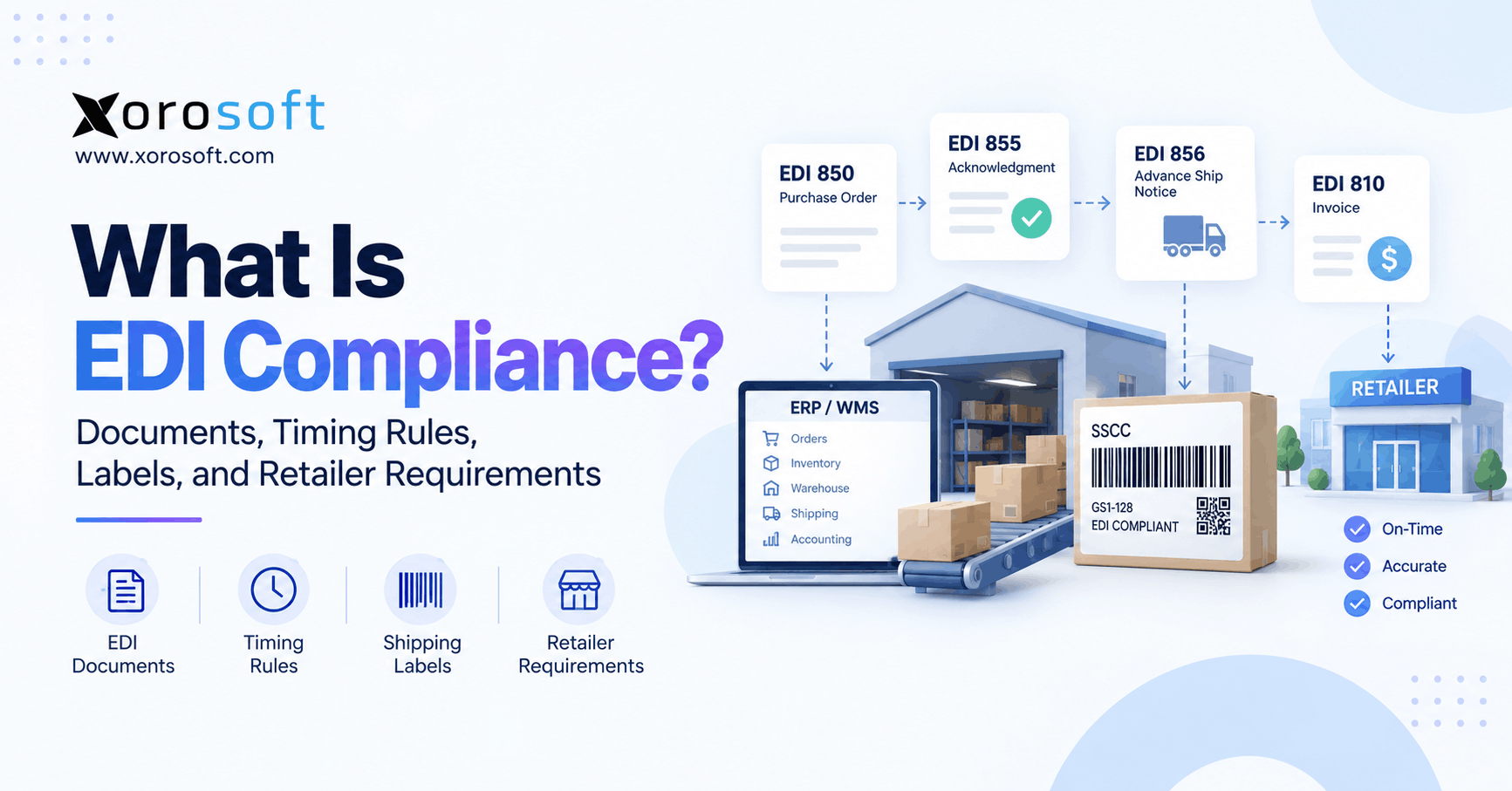
For businesses looking to streamline electronic transactions, understanding EDI compliance is essential.
1. EDI Compliance Starts With More Than Sending a File
EDI compliance means exchanging electronic business documents according to a trading partner’s required format, data rules, timing, labels, and process requirements. Therefore, sending an EDI file successfully does not automatically make a supplier compliant.
Instead, the data must also match the real order, shipment, cartons, labels, quantities, and invoice. As a result, EDI compliance connects digital documents with day-to-day retail operations.
For example, a retailer may receive a valid Advance Ship Notice, or ASN. However, if the ASN says 100 units shipped while the warehouse sent 96, the transaction can still create a problem.
Likewise, a shipping label may contain a valid barcode. Yet if its SSCC does not match the electronic shipment record, receiving teams may not be able to process the delivery as expected.
1.1 What EDI compliance means in daily operations
First, EDI standards define how business data can move between companies. For example, X12 defines common transactions for purchase orders, order acknowledgments, ship notices, invoices, and other supply-chain events.
However, each trading partner can decide how it wants those transactions used.
Therefore, suppliers may need to follow rules for:
- Required EDI documents
- Product and customer IDs
- Order response times
- ASN timing
- Carton and pallet data
- Shipping labels
- SSCC values
- Invoice data
- Error handling
As a result, the retailer’s current guide matters just as much as the basic EDI standard.
1.2 Who normally needs EDI compliance?
Generally, businesses encounter EDI compliance when they begin selling to large retailers, distributors, marketplaces, or wholesale accounts.
For example, it commonly affects:
- Apparel brands
- Furniture suppliers
- Sporting-goods companies
- Consumer-product brands
- Food suppliers
- Wholesale distributors
- Manufacturers
- Shopify brands moving into retail wholesale
However, a small direct-to-consumer brand may not need a full EDI setup yet.
Still, once larger retail accounts become part of the sales mix, EDI often moves from an IT topic to an operating requirement.
2. EDI Compliance Documents That Drive Retail Orders
Most retail EDI workflows involve several documents rather than one message.
Therefore, teams should understand what each transaction does and where it fits in the order cycle.
According to X12, the common supply-chain flow includes purchase orders, acknowledgments, ship notices, invoices, and payment-related transactions.
| EDI Code | Document | Typical Purpose |
|---|---|---|
| 850 | Purchase Order | Retailer sends an order |
| 855 | PO Acknowledgment | Supplier responds to the order |
| 856 | Ship Notice/Manifest | Supplier sends shipment details |
| 810 | Invoice | Supplier sends billing data |
| 997 | Functional Acknowledgment | Confirms EDI processing status |
| 846 | Inventory Inquiry/Advice | Shares inventory information |
| 860 | Purchase Order Change | Buyer changes an existing PO |
2.1 EDI 850 Purchase Order
First, the EDI 850 communicates a purchase order from the buyer to the seller.
X12 defines the 850 as the Purchase Order transaction for ordering goods and services.
Depending on the retailer, it may include:
- PO number
- Product IDs
- Quantities
- Prices
- Ship-to location
- Dates
- Carrier details
- Pack information
However, receiving the order is only the beginning.
Next, the supplier must check whether the customer, products, prices, quantities, dates, and locations are valid.
2.2 EDI 855 Purchase Order Acknowledgment
After the order arrives, the seller may return an EDI 855.
X12 defines the 855 as the transaction used for a seller’s acknowledgment of a buyer’s purchase order.
Therefore, the seller can use it to communicate whether an order or line has been accepted or changed according to the agreed setup.
More importantly, the response should reflect real supply conditions.
For example, if only 80 of 100 units can ship, the workflow should not blindly confirm all 100.
2.3 EDI compliance depends heavily on the 856 ASN
Next, the EDI 856 tells the buyer what is being shipped.
X12 states that the 856 can communicate shipment contents, order details, packaging, carrier information, markings, and the way goods are arranged within a shipment.
Therefore, the ASN may describe:
Shipment → Order → Pallet → Carton → Item
As a result, the 856 connects electronic order data with warehouse activity.
However, EDI compliance can break if the ASN is created before the warehouse confirms what actually shipped.
2.4 EDI 810 Invoice and EDI 997 acknowledgment
After shipment, the supplier may send an EDI 810 invoice.
Therefore, invoice quantities and references should align with the agreed order and shipment.
Meanwhile, the EDI 997 can report the processing status of an EDI transaction.
However, a technical acknowledgment is not the same as confirming that every business detail is correct.
As a result, teams should monitor both document delivery and business exceptions.
3. Timing Rules Can Make or Break EDI Compliance
Correct data can still create a problem when it arrives too late.
Therefore, EDI compliance also depends on timing.
X12 notes that trading partners need to account for cutoffs, transmission schedules, receipt, and processing times when building purchase-order workflows.
However, there is no single EDI deadline that applies to every retailer.
3.1 Why there is no universal ASN deadline
First, each trading partner can set its own ASN rules.
Therefore, one retailer may expect a shipment notice at one point in the shipping process, while another may use a different cutoff.
As a result, suppliers should never rely on a generic internet rule such as “send every ASN within X hours.”
Instead, they should use the current partner guide.
At the same time, the core purpose remains clear: the retailer needs useful shipment information before receiving the physical goods.
3.2 EDI compliance needs partner-specific timing rules
Besides ASNs, retailers may define timing for:
- Order acknowledgments
- Purchase-order changes
- Functional acknowledgments
- Invoices
- Inventory feeds
Moreover, time zones can matter.
For example, a supplier may run warehouses in several regions while serving retailers with different cutoff times.
Therefore, partner rules should be stored as system rules rather than left in employee memory.
As a result, EDI compliance becomes easier to manage as retailer count grows.
4. Labels Connect EDI Compliance to the Physical Shipment
EDI does not stop when data leaves a server.
Instead, retail EDI compliance can extend into the warehouse because digital shipment data often needs to match physical cartons or pallets.
Therefore, labels, barcodes, and package IDs matter.
4.1 What is a GS1-128 label?
GS1-128 is used to encode structured supply-chain data in a machine-readable barcode.
GS1 US explains that GS1-128 barcodes are commonly used on logistics labels and that these labels combine human-readable data with information that machines can scan.
Therefore, a logistics label can help warehouse and receiving teams identify a shipment unit quickly.
However, GS1-128 and SSCC do not mean the same thing.
4.2 What is an SSCC?
An SSCC is a Serial Shipping Container Code.
GS1 US describes it as an 18-digit ID assigned to a logistics unit, such as a case or pallet.
In simple terms:
SSCC = the ID
GS1-128 = a barcode that can carry the ID
Therefore, the SSCC can act like a unique license plate for a pallet or carton.
4.3 EDI compliance fails when the label and ASN disagree
Suppose the warehouse creates pallet A with one SSCC.
Next, the same SSCC appears in the ASN.
Then, the retailer scans the pallet and links that physical unit to the electronic shipment data.
However, if the ASN contains a different SSCC, that connection breaks.
Likewise, problems can appear if warehouse staff change carton contents after the ASN has already been sent.
Therefore, strong EDI compliance requires the physical shipment and electronic shipment record to stay in sync.
5. Retailer EDI Requirements Are Not Fully Universal
Supporting X12 does not automatically mean a supplier supports every retailer.
Instead, retailers can use the same transaction set in different ways.
Therefore, businesses need partner-level rules.
5.1 Implementation guides define the details
A retailer’s implementation guide may define:
- Required fields
- Optional fields
- Codes
- Qualifiers
- Product IDs
- Customer IDs
- Ship-to IDs
- ASN structure
- Document timing
- Error rules
Consequently, an EDI 856 accepted by retailer A may not meet retailer B’s rules.
For that reason, teams should keep current retailer guides available to both technical and operating staff.
5.2 Routing rules go beyond EDI
Retail vendor rules can also cover:
- Carrier selection
- Packaging
- Pallet setup
- Carton markings
- Label position
- Delivery windows
- Routing
- Appointment booking
Therefore, EDI rules and full vendor rules overlap, but they are not identical.
As a result, a supplier should not treat every deduction as an EDI software problem.
Sometimes, the root cause sits inside warehouse execution or shipping.
6. EDI Compliance Testing Before Go-Live
Before a new retail relationship goes live, both sides normally need to test the required flow.
Therefore, EDI compliance should be checked before real orders begin moving.
6.1 What should be tested?
First, teams should test connectivity.
Next, they should confirm maps, IDs, and document structure.
After that, test orders can confirm whether data flows through the right internal processes.
Common tests may cover:
- 850 Purchase Orders
- 855 acknowledgments
- 856 ASNs
- 810 invoices
- Functional acknowledgments
- Product mapping
- Location mapping
- Label output
In addition, warehouse teams should test the physical steps when shipping labels or SSCCs are required.
6.2 EDI compliance continues after onboarding
Passing a test does not make EDI compliance permanent.
Retailers may later change:
- Data rules
- Label rules
- Transaction versions
- Routing instructions
- Timing
- Required fields
Therefore, someone must own change control.
Moreover, changes should be tested before they reach high-volume production orders.
As a result, compliance becomes an ongoing operating process rather than a one-time integration project.
7. Common EDI Compliance Errors and Chargeback Triggers
Many EDI compliance failures start with small data gaps.
However, those gaps can become costly when transaction volume rises.
Therefore, teams should focus on repeatable controls rather than one-off fixes.
7.1 Data errors that cause EDI compliance problems
Common data issues include:
- Unknown SKU
- Wrong UPC or GTIN
- Incorrect customer ID
- Invalid ship-to location
- Wrong unit of measure
- Incorrect PO reference
- Missing required field
- Wrong quantity
For example, a retailer may order cases while the supplier’s system interprets the quantity as eaches.
As a result, both systems may process valid numbers while referring to very different physical quantities.
7.2 Warehouse errors that affect EDI compliance
The warehouse is another common failure point.
For example, planned stock may differ from what employees actually pick.
Likewise, carton contents may change during packing.
Therefore, common problems include:
- ASN quantity does not match shipped quantity
- Wrong carton hierarchy
- Missing pallet
- Duplicate SSCC
- Incorrect label
- ASN created too early
As a result, warehouse accuracy directly affects EDI compliance.
7.3 Missing monitoring creates silent failures
Another risk is assuming that “sent” means “accepted.”
Instead, teams should monitor:
- Failed files
- Rejected transactions
- Missing acknowledgments
- Mapping errors
- Missing ASNs
- Late messages
Therefore, each issue should enter a visible exception queue.
Otherwise, employees may discover the problem only after the retailer reports it.
8. EDI Compliance Across ERP, WMS, and Accounting
As order volume grows, EDI compliance becomes harder to manage as a separate process.
Therefore, the systems behind the EDI messages matter as much as the connection itself.
This is where ERP, inventory, WMS, order management, and accounting begin to overlap.
8.1 ERP gives EDI compliance its operating data
An ERP can hold the data that EDI workflows depend on, including:
- Products
- Customers
- Inventory
- Orders
- Pricing
- Purchasing
- Shipments
- Invoices
For inventory-led businesses, Xorosoft brings these workflows into a connected cloud ERP platform.
Therefore, retailer orders do not need to remain isolated inside a separate EDI inbox.
Instead, they can connect with the same operating records used by other sales channels.
8.2 WMS connects EDI compliance with what actually ships
The warehouse decides what physically leaves the building.
Therefore, a real-time warehouse management system can play a key role in shipment accuracy.
For example, warehouse actions can confirm:
- Picked quantity
- Packed quantity
- Carton contents
- Pallet structure
- Shipping status
As a result, ASN data can be based on confirmed work rather than an older order plan.
That connection is especially important when orders change during fulfillment.
8.3 Accounting closes the order-to-cash loop
Once goods ship, finance needs accurate invoice data.
Therefore, the order, shipment, and invoice should remain linked.
In Xorosoft, accounting sits inside the broader operating environment rather than being treated only as a separate final step.
As a result, teams can reduce the manual work required to rebuild what happened between the original retailer order and final invoice.
9. How EDI Compliance Works for Shopify and Multi-Channel Brands
A growing brand may sell through retail EDI, Shopify, Amazon, wholesale accounts, and other channels at the same time.
Therefore, EDI compliance cannot be separated from inventory availability.
9.1 Every channel competes for the same stock
Suppose a warehouse has 100 units available.
Then, a retailer submits an EDI order for 60 units.
Meanwhile, Shopify receives customer orders for another 50.
If each channel sees all 100 units independently, the business can promise 110 units.
Therefore, inventory allocation needs one reliable source.
With Xorosoft, EDI orders can sit within the same broader inventory and order-management environment used for ecommerce operations.
9.2 Integrations reduce repeated data entry
As brands grow, they often connect more sales and logistics systems.
Therefore, Xorosoft integrations can become relevant when businesses need retailer EDI, ecommerce, inventory, and fulfillment data to move through shared workflows.
For Shopify merchants, the Xorosoft ERP listing on the Shopify App Store also provides an external reference for its Shopify integration.
As a result, the operating model can become:
Retail + Shopify + inventory + warehouse + accounting
rather than several isolated databases.
10. Three Ways to Run Retail EDI
Not every company needs the same EDI setup.
Instead, the best operating model depends on retailer count, order volume, warehouse needs, and internal systems.
Therefore, businesses usually move through one of three broad approaches.
10.1 Retailer portals
First, a small supplier may use a retailer’s web portal.
This can work when:
- Order volume is low
- Retailer count is small
- Manual work remains manageable
However, staff may need to copy orders into inventory or accounting software manually.
As a result, portal work becomes harder as volume rises.
10.2 Standalone EDI software
Next, a company may use a separate EDI provider.
The provider can manage areas such as partner connections and document maps.
However, the business still needs to move EDI data into ERP, WMS, and accounting systems.
Therefore, integration quality remains important.
10.3 Integrated ERP and EDI workflows
Finally, growing businesses may connect EDI more deeply with their main operating system.
For example:
850 received → order created → stock allocated → warehouse ships → 856 sent → 810 created
Therefore, fewer steps require manual re-entry.
For businesses with many inventory workflows, Xorosoft can support this wider ERP approach through inventory, order management, warehouse, purchasing, accounting, and ecommerce functions.
11. EDI Compliance for Wholesale and Manufacturing
Although the EDI documents may look similar, the operating challenge changes by business model.
Therefore, EDI compliance should fit the way inventory actually moves through the company.
11.1 Wholesale EDI compliance requires strong allocation
Wholesale distributors may manage:
- Many SKUs
- Customer pricing
- Large orders
- Several warehouses
- Retail accounts
- Backorders
- Purchase orders
Therefore, inventory allocation matters.
In addition, purchasing teams need to know how retail demand affects future stock.
Businesses exploring this model can also review Xorosoft’s broader industry solutions for inventory-led operations.
11.2 Manufacturing adds material and production needs
Manufacturers face another layer.
For example, the retailer may order finished goods that are not yet available.
Therefore, demand may need to flow into:
- BOM planning
- Material needs
- Production
- Purchasing
- Finished-goods inventory
- Warehouse allocation
As a result, EDI becomes part of a much wider supply process.
An integrated ERP can therefore help connect retailer demand with the work required to build and ship the product.
12. When Manual EDI Stops Scaling
Manual processes are not automatically bad.
However, they become risky when employees spend more time moving information between systems than managing exceptions.
Therefore, growth should trigger a review of how EDI fits into operations.
12.1 Signs the current process is under strain
Common warning signs include:
- Orders copied by hand
- Frequent SKU mapping issues
- Late ASNs
- Repeated label problems
- Duplicate SSCC mistakes
- Inventory conflicts
- Invoice differences
- Chargebacks
- Staff checking several systems
- Retailer rules stored in spreadsheets
Moreover, problems often grow faster than order volume because every new trading partner can introduce another set of rules.
12.2 What an integrated operating model changes
Instead of moving data through disconnected apps, the business can connect the full flow.
For example:
Retail order → inventory → fulfillment → shipment → invoice → accounting
Xorosoft’s XoroONE platform is designed around that broader operating model for inventory-driven businesses.
Therefore, the aim is not simply “more EDI automation.”
Instead, the goal is fewer gaps between the EDI message and the work that follows it.
13. EDI Compliance Checklist for Daily Operations
Strong EDI compliance depends on routine controls.
Therefore, teams should check the process at order, warehouse, shipment, and monitoring levels.
13.1 EDI compliance order controls
Check that:
- Retailer maps are current
- Customer IDs match
- Product IDs match
- Ship-to IDs are valid
- Units of measure are correct
- Order dates are usable
- Pricing rules are understood
- Acknowledgments follow partner rules
In addition, exceptions should stop the order before incorrect data reaches fulfillment.
13.2 Warehouse and label controls
Before shipment, confirm:
- Actual quantity packed
- Correct cartons and pallets
- Unique SSCC values
- Correct labels
- Accurate carton hierarchy
- Final shipment data
- ASN timing
Therefore, the ASN should describe what the warehouse actually shipped.
Likewise, labels should come from the same trusted shipment data whenever possible.
13.3 EDI compliance monitoring controls
After transmission, check:
- Did the file send?
- Was it received?
- Was it rejected?
- Is an acknowledgment missing?
- Does an error need action?
- Was the ASN on time?
- Did the invoice match the shipment?
Moreover, teams should track repeat failures by retailer, warehouse, SKU, and document type.
As a result, EDI compliance becomes measurable instead of reactive.
14. Build EDI Compliance Into Daily Operations
Ultimately, EDI compliance works best when it becomes part of the operating process rather than a separate technical task.
Retailers exchange digital documents. However, those documents depend on real inventory, real warehouse work, real packages, real shipments, and real invoices.
Therefore, a strong process connects each step.
First, the retailer order should enter the system accurately. Next, inventory should be allocated correctly. Then, warehouse staff should pick and pack against that demand. Afterward, the ASN and label should match the physical shipment. Finally, the invoice should reflect the completed transaction.
As a result, problems become easier to trace.
For growing inventory businesses, Xorosoft brings ERP, WMS, inventory, purchasing, accounting, manufacturing, reporting, ecommerce, and multi-channel order operations into one connected environment.
Therefore, companies that are moving beyond portals, spreadsheets, and disconnected inventory tools can review whether their EDI process now needs a stronger operating foundation.
If retail EDI is becoming harder to manage across inventory, warehouse activity, purchasing, Shopify, accounting, or multiple locations, Book a Demo to see how those workflows can operate together.
Frequently Asked Questions
What is EDI compliance?
EDI compliance means exchanging electronic business documents according to a trading partner’s required format, data, timing, labels, and process rules.
Which EDI documents do retailers commonly use?
Common documents include the 850 Purchase Order, 855 PO Acknowledgment, 856 ASN, 810 Invoice, 997 Functional Acknowledgment, and sometimes the 846 Inventory Advice.
What is an EDI 856 ASN?
An EDI 856 is a Ship Notice/Manifest. It tells the buyer what is being shipped and can include products, quantities, cartons, pallets, carrier data, and logistics IDs.
What is the difference between GS1-128 and SSCC?
GS1-128 is a barcode type used for supply-chain data. An SSCC is the unique 18-digit ID for a logistics unit and can be encoded inside a GS1-128 barcode.
Can EDI compliance reduce chargebacks?
Better compliance can reduce errors that may lead to deductions. However, chargebacks can also come from routing, packaging, delivery, pricing, or other vendor-rule failures.
Can ERP software manage EDI workflows?
Yes. ERP systems can connect EDI orders with inventory, fulfillment, purchasing, invoicing, and accounting, either through built-in tools or an EDI integration.
When should a business automate EDI?
Automation becomes more useful when retailer count, order volume, manual entry, ASN errors, inventory conflicts, or finance work become difficult to control.
Recent Posts
-
 ERP Landed Cost Module vs Spreadsheet Calculations for Importers
 -
 How to Build an Open-to-Buy Plan for an Omnichannel Brand
 -
 Cold Storage WMS for Food and Beverage Distribution
 -
 ERP Buying Statistics 2026: Evaluation, Implementation, and Adoption Risks
 -
 How a Distributor Reduced B2B Order Exceptions Without Restricting Sales