Multi warehouse inventory tracking is essential for businesses that want to efficiently manage stock across multiple locations.
1. One Inventory Number Is No Longer Enough
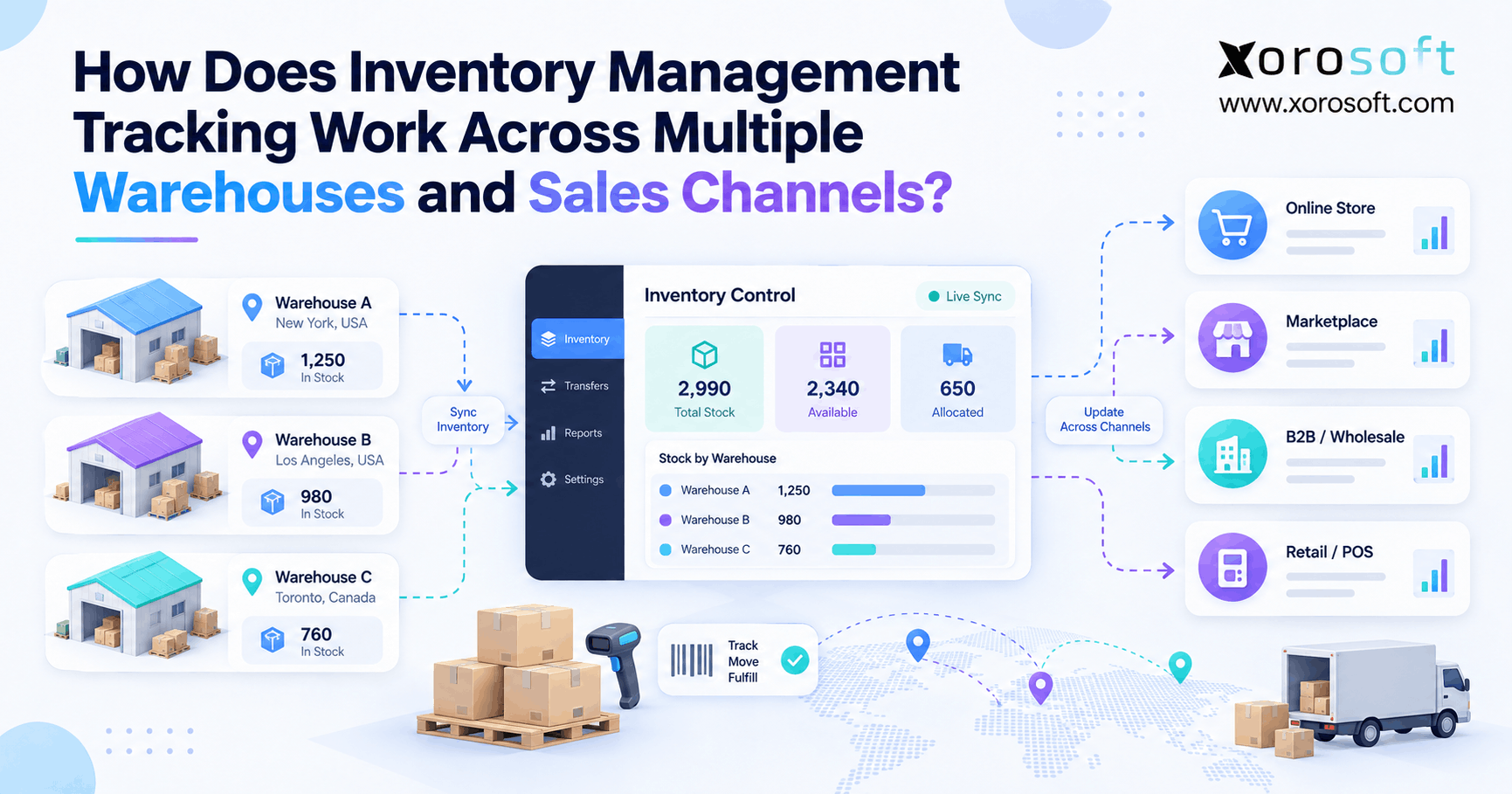
Multi warehouse inventory tracking gives businesses a reliable way to see where stock sits, what quantity remains available, and which sales channels can safely promise it. Therefore, instead of relying on one company-wide inventory number, teams track inventory by warehouse, status, reservation, transfer, and sales channel.
Moreover, this distinction becomes essential once a business operates several warehouses or sells through Shopify, Amazon, wholesale, B2B, EDI, or other channels. Otherwise, the same physical units can appear available in several places at once.
Consequently, effective inventory tracking answers a more practical question: How much inventory can the business promise to this customer, through this channel, from the right fulfillment location?
1.1 What Multi Warehouse Inventory Tracking Actually Tracks
Multi warehouse inventory tracking does more than count products. Instead, it connects every SKU with a specific location and inventory status.
For example, a company may own 1,000 units of one SKU. However, 300 may sit in one warehouse, 250 in another, 150 at a 3PL, 100 may already belong to open orders, and 50 may be moving between locations.
Therefore, the business cannot safely publish all 1,000 units as available.
In practice, the system needs to identify on-hand stock, available stock, allocated stock, reserved stock, incoming stock, in-transit stock, and unavailable stock separately.
1.2 Why Warehouse Inventory Visibility Matters
A network-wide inventory total can hide operational problems. For instance, a furniture company may own 80 tables overall, while only three remain in the western region.
Therefore, total inventory may look healthy even though a regional warehouse faces an immediate shortage.
Additionally, location-level visibility improves fulfillment decisions. Instead of asking only whether inventory exists, teams can ask where it exists and whether that location should fulfill the order.
As a result, warehouse inventory visibility supports faster routing, better replenishment decisions, and more accurate sales-channel availability.
2. How Multi Warehouse Inventory Tracking Creates Location-Level Visibility
Multi warehouse inventory tracking starts by assigning inventory transactions to specific locations. Therefore, every receipt, adjustment, transfer, reservation, shipment, and return should change the correct warehouse balance rather than only changing a global total.
Additionally, each warehouse can maintain its own available quantity. As a result, the business can see whether one site has excess stock while another location approaches a shortage.
2.1 Inventory Visibility Starts With On-Hand and Available Stock
On-hand stock represents inventory physically recorded at a location. However, it does not necessarily represent what the company can sell.
For example, a warehouse may hold 500 units while 80 already belong to customer orders. Additionally, 20 units may serve as safety stock, while another 10 remain under inspection.
Therefore, only 390 units may be genuinely available for new demand.
Consequently, businesses should avoid publishing raw on-hand inventory directly to sales channels unless their operating model specifically supports that approach.
2.2 Multi-Location Inventory Tracking Needs Several Inventory States
Multi-location inventory tracking works best when teams distinguish several inventory states.
First, available inventory represents stock that can support new demand. Meanwhile, reserved inventory protects units for existing demand.
Next, allocated inventory associates stock with a specific order or fulfillment location. Additionally, incoming inventory represents stock expected from suppliers or production.
Finally, in-transit inventory represents company-owned stock moving between facilities.
Therefore, inventory becomes much easier to control when each quantity has a clear operational meaning.
3. Inventory Accuracy Begins at Receiving
Inventory accuracy starts before an order reaches a sales channel. Therefore, warehouse teams need to record products correctly as soon as inventory enters the network.
For example, inventory may arrive through supplier receipts, production output, transfers, customer returns, or manual adjustments. Consequently, each transaction should identify the SKU, quantity, location, and relevant status.
3.1 Multi Warehouse Inventory Tracking Starts With Accurate Receipts
Multi warehouse inventory tracking depends heavily on receiving accuracy.
First, warehouse staff confirm what actually arrived. Next, they record the quantity against the correct purchase order or transaction.
Additionally, teams may capture lot numbers, serial numbers, expiration dates, or other product attributes when required.
Therefore, receiving errors can quickly become channel errors. If a warehouse records 110 units when only 100 arrived, every connected availability calculation starts from the wrong number.
Consequently, accurate receiving creates the foundation for reliable downstream inventory visibility.
3.2 Barcode and WMS Workflows Reduce Manual Inventory Errors
Manual entry increases the risk of location and quantity mistakes. Therefore, growing operations commonly introduce barcode scanning and structured warehouse workflows.
For example, Xorosoft’s XoroWMS connects receiving, inventory movements, picking, packing, and shipping with warehouse-level data.
Additionally, real-time warehouse transactions help the central inventory record reflect what employees actually do on the warehouse floor.
As a result, sales teams, purchasing teams, and fulfillment teams can work from more current inventory information rather than waiting for manual reconciliation.
4. Multi Warehouse Inventory Tracking Across Sales Channels
Multi warehouse inventory tracking becomes more complex when several channels sell the same physical products. Therefore, the business needs a controlled method for determining how much inventory each channel can see.
For example, Shopify, Amazon, wholesale orders, B2B customers, and sales representatives may all compete for the same inventory.
Consequently, the company must separate physical stock from channel-visible stock.
4.1 How Multi Warehouse Inventory Tracking Synchronizes Channels
Multi warehouse inventory tracking usually relies on a central availability calculation.
First, the system determines what inventory remains available across eligible locations. Next, it subtracts reservations, allocations, safety buffers, or other restrictions.
Then, the resulting sellable quantity flows to connected channels according to business rules.
For example, a Shopify order may reduce availability for Amazon and wholesale immediately or through a near-real-time integration.
Therefore, channel synchronization should follow the central inventory decision rather than allowing every storefront to maintain an independent quantity.
4.2 Shared and Dedicated Inventory Pools Work Differently
A shared inventory pool allows several channels to consume the same available quantity.
For example, Shopify, Amazon, and B2B ecommerce might all draw from 500 available units.
However, another business may reserve specific quantities by channel. For instance, wholesale may receive 150 units while ecommerce receives 300.
Additionally, companies can combine both approaches by using shared inventory plus safety buffers.
Therefore, the best model depends on demand patterns, customer commitments, integration speed, and overselling risk.
5. How Multi Warehouse Inventory Tracking Prevents Overselling
Multi warehouse inventory tracking helps prevent overselling by reducing available inventory as soon as demand claims it.
Therefore, the system should not wait until an order physically ships before recognizing the commitment.
Instead, reservation and allocation protect inventory earlier in the order lifecycle.
5.1 Multi Warehouse Inventory Tracking Uses Reservations First
When an order arrives, the system should determine whether enough inventory remains available.
If inventory exists, the system can reserve the required quantity. Consequently, other channels no longer treat those units as freely available.
For example, if 20 units remain and Shopify reserves five, the central available quantity becomes 15.
Then, connected channels receive an updated quantity according to the company’s synchronization rules.
Therefore, reservations create a critical bridge between order capture and physical fulfillment.
5.2 Simultaneous Orders Still Need Exception Handling
Even good integrations can experience timing conflicts.
For example, Shopify and another channel may receive orders for the final unit within seconds of each other.
Therefore, the central system needs clear transaction rules.
If one reservation succeeds first, the second order may trigger a backorder, alternate-location search, transfer request, or customer-service exception.
Additionally, teams should monitor failed integrations rather than assuming every transaction reaches every system successfully.
Consequently, strong inventory control combines automation with visible exception management.
6. Inventory Allocation Across Multiple Warehouses
Reservation determines whether inventory can support demand. However, allocation determines which inventory should satisfy that demand.
Therefore, businesses with several locations need allocation rules that reflect both inventory availability and fulfillment economics.
6.1 Warehouse Inventory Visibility Guides Allocation
Warehouse inventory visibility allows the system to compare locations before assigning an order.
For example, both New Jersey and California may hold the same SKU. However, a customer in Los Angeles may receive faster and cheaper fulfillment from California.
Additionally, the system may consider inventory buffers, warehouse capacity, customer restrictions, or regional demand.
Therefore, allocation should use location-level availability rather than company-wide totals.
As a result, businesses can reduce unnecessary transfers and improve fulfillment consistency.
6.2 Order Routing Should Consider More Than Distance
The closest warehouse is not always the best warehouse.
For example, one facility may have stock but face a temporary picking backlog. Meanwhile, another location may have more capacity or a better carrier cutoff.
Therefore, routing rules can consider:
- inventory availability
- customer proximity
- delivery commitments
- warehouse workload
- shipping cost
- channel requirements
- split-shipment risk
Consequently, order routing turns inventory visibility into an operational fulfillment decision.
7. Multi Warehouse Inventory Tracking for Transfers and In-Transit Stock
Multi warehouse inventory tracking must handle stock moving between locations without creating false availability.
For example, Warehouse A may send 100 units to Warehouse B. However, those units cannot remain fully available at Warehouse A after shipment.
At the same time, Warehouse B should not treat them as physically received before arrival.
Therefore, the system needs an in-transit inventory state.
7.1 Multi Warehouse Inventory Tracking Follows the Transfer Lifecycle
Multi warehouse inventory tracking should reflect each stage of a warehouse transfer.
First, the business creates the transfer request. Next, the source warehouse allocates and ships the inventory.
Then, the units move into an in-transit state. Finally, the destination receives and makes the appropriate quantity available.
Therefore, the inventory record mirrors physical reality throughout the movement.
Additionally, teams can identify transfer discrepancies if the destination receives fewer units than the source shipped.
7.2 In-Transit Inventory Prevents Phantom Stock
In-transit inventory solves an important visibility problem.
Once inventory leaves the source, that location should no longer promise it to new customers. However, the destination may still be unable to fulfill orders from that stock.
Therefore, the units need their own temporary status.
As a result, the business still knows it owns the inventory without incorrectly publishing it as immediately available.
Consequently, transfer accuracy becomes especially important when warehouses operate several days apart.
8. Returns Need Their Own Inventory Status
Returned inventory can create misleading availability when systems treat every received return as sellable.
Therefore, the warehouse should inspect returned items before releasing them into the normal inventory pool.
8.1 Multi-Location Inventory Tracking Should Separate Returns From Sellable Stock
Multi-location inventory tracking should record the return at the location that physically receives it.
Next, warehouse staff can determine whether the product is unopened, resellable, damaged, incomplete, defective, or suitable for refurbishment.
Only after that decision should eligible units return to available inventory.
For example, an apparel return may require a simple inspection. However, a food, safety, or regulated product may require stricter handling.
Therefore, physical receipt does not automatically equal sales availability.
8.2 Damaged and Quarantined Inventory Must Stay Visible
Unavailable inventory should not disappear from the system.
Instead, teams should retain visibility while preventing channels from selling it.
For example, five damaged units may remain physically inside the warehouse. However, they should sit in a damaged or hold status rather than available stock.
Consequently, teams can still reconcile physical counts correctly.
Additionally, finance and operations gain a clearer picture of inventory losses, write-offs, or refurbishment opportunities.
9. Why Inventory Synchronization Breaks Between Systems
Inventory synchronization usually fails through small operational gaps rather than one dramatic event.
Therefore, teams need to understand how discrepancies develop between ERP, WMS, ecommerce, marketplaces, and 3PL systems.
9.1 Warehouse Inventory Tracking Errors Have Several Causes
Warehouse inventory tracking can drift when teams miss or duplicate transactions.
For example, common causes include failed API events, manual adjustments, incorrect SKU mappings, unrecorded damage, late returns, and transfer timing differences.
Additionally, one application may process an order before another receives the update.
Therefore, temporary discrepancies can become permanent if nobody detects the failed transaction.
Consequently, businesses should reconcile transaction flow, not merely compare end-of-day totals.
9.2 Integration Exceptions Need a Visible Queue
Integrations should expose failures clearly.
For example, if an Amazon order cannot map to an ERP SKU, the integration should create an actionable exception rather than silently ignoring the order.
Similarly, failed inventory updates should trigger investigation.
Xorosoft’s integration ecosystem supports connecting commerce and operational systems around a centralized workflow.
Therefore, automation should include both successful transactions and controlled exception handling.
Otherwise, teams only discover integration problems after inventory numbers stop matching.
10. Multi Warehouse Inventory Tracking for Shopify, Amazon, and B2B
Multi warehouse inventory tracking becomes especially important when direct-to-consumer and wholesale demand use the same stock.
Therefore, Shopify orders, marketplace orders, B2B commitments, and manual sales orders need coordinated inventory rules.
10.1 Multi Warehouse Inventory Tracking for Shopify Operations
Multi warehouse inventory tracking helps Shopify merchants connect storefront availability with inventory held across warehouses or fulfillment locations.
For example, a brand may keep stock in New Jersey, California, and a 3PL. Therefore, Shopify should receive a controlled sellable quantity rather than a blindly summed physical total.
Additionally, Xorosoft supports ecommerce operations and is available through the Shopify App Store.
As a result, growing merchants can connect Shopify demand with broader inventory, warehouse, purchasing, and order-management workflows.
10.2 Wholesale Orders Need Earlier Inventory Commitments
Wholesale demand often behaves differently from direct-to-consumer demand.
For example, a retail customer may place a large purchase order weeks before shipment.
Therefore, the business may need to reserve those units before warehouse picking begins.
Otherwise, ecommerce channels can consume stock already promised to wholesale customers.
Additionally, EDI orders may introduce customer-specific timing, acknowledgement, allocation, and shipment requirements.
Consequently, the inventory system must coordinate both immediate ecommerce demand and future wholesale commitments.
11. How Warehouse Inventory Tracking Connects Purchasing and Forecasting
Warehouse inventory tracking becomes more valuable when it drives replenishment decisions.
Therefore, buyers should evaluate inventory by location rather than relying only on company-wide totals.
11.1 Reorder Decisions Need Location-Level Demand
A company may hold enough inventory overall while one warehouse approaches a stockout.
For example, Warehouse East may have 500 units while Warehouse West has only 20.
Therefore, purchasing should not automatically create another supplier order.
Instead, the business might transfer existing stock first.
Additionally, replenishment logic should consider open purchase orders, incoming transfers, reservations, safety stock, demand history, and supplier lead times.
Consequently, location-level inventory improves both purchasing efficiency and working-capital decisions.
11.2 Forecasting Should Separate Channel and Regional Demand
Demand patterns differ by geography and channel.
For example, one SKU may sell quickly on Shopify in California but move primarily through wholesale accounts in Ontario.
Therefore, a single company-wide forecast can hide meaningful differences.
Instead, planners can review demand by SKU, location, channel, customer type, and season.
Additionally, stronger forecasting helps teams decide whether to purchase more inventory, transfer existing stock, or adjust safety levels.
As a result, inventory tracking becomes an input to planning rather than merely a historical record.
12. Multi Warehouse Inventory Tracking and Accounting Accuracy
Multi warehouse inventory tracking also matters to finance because inventory represents both physical stock and financial value.
Therefore, quantity errors eventually affect valuation, reconciliation, and management reporting.
12.1 Multi Warehouse Inventory Tracking Supports Better Valuation
Multi warehouse inventory tracking gives finance teams clearer location-level quantities.
For example, receipts increase inventory, while customer shipments reduce available physical stock and can affect cost recognition according to the company’s accounting process.
Meanwhile, internal transfers change where inventory sits without representing a customer sale.
Therefore, transaction types need to distinguish purchasing, movement, adjustment, production, return, and shipment events accurately.
Consequently, finance can trace inventory changes more effectively.
12.2 Integrated Inventory Reduces Reconciliation Work
Disconnected systems force finance teams to compare several competing records.
For example, accounting software may show one balance while the warehouse platform shows another.
Additionally, ecommerce platforms may show yet another sellable quantity.
Therefore, Xorosoft connects inventory operations with accounting, purchasing, orders, and warehouse activity inside a broader ERP environment.
As a result, teams can reduce duplicate data entry and spend less time rebuilding inventory movements at month-end.
13. When Multi-Location Inventory Tracking Needs ERP and WMS
Multi-location inventory tracking does not automatically require a full ERP.
For smaller businesses, simpler inventory tools may provide enough control.
However, system requirements change as warehouses, sales channels, purchasing processes, and financial dependencies increase.
13.1 Simple Inventory Software Can Still Be the Right Choice
A business with one warehouse, one primary sales channel, a small SKU catalog, and straightforward purchasing may not need complex software.
Therefore, adding ERP-level functionality too early can create unnecessary process overhead.
Likewise, some businesses can manage two locations successfully with a focused inventory application.
However, requirements often change once teams add wholesale, 3PLs, manufacturing, EDI, or more demanding reporting.
Different inventory-driven industries also reach that complexity threshold at different stages.
13.2 Multi Warehouse Inventory Tracking Becomes an ERP Problem at Scale
Multi warehouse inventory tracking becomes an ERP-level problem when inventory decisions affect several departments simultaneously.
For example, one sales order may affect allocation, warehouse work, purchasing forecasts, customer commitments, revenue reporting, and accounting.
Therefore, businesses often need a shared operational system rather than several independently managed tools.
Xorosoft’s XoroERP connects these workflows for inventory-driven businesses.
Consequently, ERP becomes valuable when the problem shifts from tracking stock to coordinating the company around stock.
14. What to Look for in Multi Warehouse Inventory Tracking Software
Multi warehouse inventory tracking software should make operational decisions easier rather than simply producing more reports.
Therefore, buyers should evaluate how the system handles real transactions across locations and channels.
14.1 Multi Warehouse Inventory Tracking Needs Core Operational Controls
A strong system should provide location-level quantities, reservations, allocations, transfers, inventory statuses, order routing, and warehouse execution.
Additionally, it should connect purchasing, replenishment, reporting, and sales-channel availability.
For manufacturing businesses, the system may also need BOMs, material allocation, production transactions, and work-in-process visibility.
Meanwhile, wholesale organizations may require customer-specific commitments, EDI workflows, and larger order reservations.
Therefore, functionality should reflect the company’s operating model rather than a generic checklist.
14.2 Integration Quality Matters as Much as Features
A system can have excellent inventory features and still create problems if orders or updates fail between applications.
Therefore, businesses should evaluate APIs, ecommerce integrations, marketplace connections, 3PL connectivity, and exception handling.
Additionally, teams should understand which system owns each inventory decision.
Xorosoft’s XoroONE brings inventory, warehouse, purchasing, accounting, manufacturing, forecasting, and ecommerce operations into a connected environment.
As a result, businesses can reduce the number of isolated systems maintaining competing inventory records.
15. Building One Reliable Inventory View Across Every Channel
Multi warehouse inventory tracking works best when every team understands the meaning behind each inventory number.
Therefore, warehouse staff should know what sits physically on the shelf, while sales teams should know what remains available to promise.
Similarly, purchasing should understand what is incoming, and finance should understand how inventory movements affect valuation.
Ultimately, the goal is not to force every application to display one identical number. Instead, the goal is to maintain consistent definitions and reliable transaction flow.
For growing ecommerce, wholesale, distribution, and manufacturing businesses, Xorosoft provides a connected operational model across ERP, WMS, purchasing, accounting, and multi-channel order management.
Therefore, if your team regularly reconciles Shopify, warehouses, spreadsheets, 3PL inventory, and accounting records manually, it may be time to review the architecture behind those workflows.
You can Book a Demo to see how connected inventory workflows can operate across your own warehouses and sales channels.
Frequently Asked Questions
What is multi warehouse inventory tracking?
It tracks each SKU by warehouse, inventory status, and availability. Therefore, businesses can see where stock sits, what is already committed, and what remains available for new sales.
How does multi warehouse inventory tracking prevent overselling?
It reserves inventory when demand arrives and updates available quantities across connected channels. Consequently, Shopify, marketplaces, wholesale, and B2B orders are less likely to promise the same units twice.
What is the difference between on-hand and available inventory?
On-hand inventory represents recorded physical stock. However, available inventory removes quantities already reserved, allocated, damaged, held, or protected by business rules.
How should businesses track inventory moving between warehouses?
They should use an in-transit inventory status. Therefore, stock leaves the source warehouse without appearing prematurely as physically available at the destination.
Can Shopify use inventory from multiple warehouses?
Yes. Shopify supports inventory across multiple locations. However, growing merchants often connect Shopify with ERP or inventory systems when they also manage wholesale, marketplaces, 3PLs, or complex allocation rules.
When does a business need ERP for inventory tracking?
ERP becomes useful when inventory affects multiple warehouses, sales channels, purchasing, accounting, manufacturing, forecasting, or wholesale commitments. Therefore, the issue becomes cross-functional coordination rather than simple stock counting.
What causes inventory discrepancies between systems?
Common causes include failed integrations, manual adjustments, incorrect SKU mappings, transfer timing, returns, duplicate transactions, and unrecorded warehouse activity. Consequently, teams need both transaction controls and regular physical verification.
Recent Posts
-
 ERP Landed Cost Module vs Spreadsheet Calculations for Importers
 -
 How to Build an Open-to-Buy Plan for an Omnichannel Brand
 -
 Cold Storage WMS for Food and Beverage Distribution
 -
 ERP Buying Statistics 2026: Evaluation, Implementation, and Adoption Risks
 -
 How a Distributor Reduced B2B Order Exceptions Without Restricting Sales