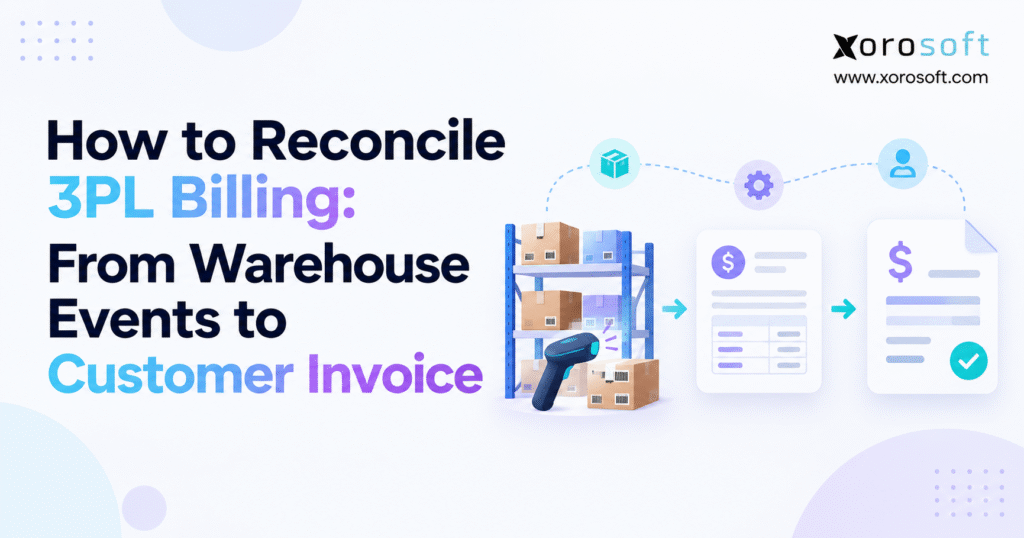
For companies using third-party logistics providers, understanding 3PL billing reconciliation is essential.
1. Where 3PL Billing Reconciliation Breaks Before the Customer Invoice
A warehouse can receive every pallet correctly, ship every order on time, process every return, and still send an inaccurate invoice. In most cases, the invoice itself is not the original problem. Instead, the breakdown happens earlier when warehouse activity fails to become consistent and traceable billing data.
That gap sits at the center of 3PL billing reconciliation.
Warehouse teams think in receipts, pallets, picks, cartons, shipments, returns, labels, and labor. Finance teams, however, work with rate cards, charges, credits, invoices, revenue, and customer balances. Unless the business connects those two views, billing turns into a monthly reconstruction exercise.
For example, consider a customer that asks the warehouse to relabel 600 units. Employees complete the work, but a supervisor records the request only in an email. As a result, finance never receives a structured service record, so the invoice misses the charge.
Similarly, another customer may have a new storage rate beginning on the first day of the month. If someone continues using an older spreadsheet, the warehouse activity remains correct while the invoice becomes inaccurate.
Errors also work in the opposite direction. For instance, duplicate transactions, wrong units of measure, incorrect customer mapping, or unsupported adjustments can create charges that should never reach the invoice.
Consequently, both situations create avoidable financial friction. Missing charges reduce earned revenue, while incorrect charges lead to disputes, credits, rebilling, and extra work across warehouse operations and accounting.
Therefore, a strong billing process should answer five questions for every material charge: What happened? Which customer owned the activity? How much work occurred? Which contractual rate applied? How did that calculation reach the invoice?
When a business can answer those questions from structured operational data, billing becomes a repeatable control rather than an investigation.
1.1 How Warehouse Billing Gaps Usually Begin
Most billing discrepancies begin with one of three issues: incomplete operational data, weak pricing governance, or disconnected systems.
For example, a warehouse employee may complete work without recording it. Elsewhere, finance may apply a rate manually because the system lacks customer-specific rules. In another scenario, the WMS records the activity correctly, but the accounting platform receives only a summarized invoice with no underlying operational reference.
Each gap removes part of the audit trail.
As transaction volume grows, employees often compensate with spreadsheets, notes, copied exports, and manual checks. Initially, that approach can work. However, complexity eventually exposes the weaknesses.
1.2 Why Event-Level 3PL Billing Reconciliation Matters
Invoice totals alone cannot prove billing accuracy.
Suppose a customer invoice misses a $100 handling charge but also contains an unrelated $100 duplicate charge. The total may appear reasonable even though two underlying transactions are wrong.
By contrast, transaction-level 3PL billing reconciliation exposes both errors. Instead of asking whether the invoice total looks normal, the process asks whether each billable event has the correct customer, quantity, rate, and invoice line.
Therefore, reconciliation becomes more than a high-level financial review. It becomes an operational control that connects warehouse execution with billing accuracy.
2. What 3PL Billing Reconciliation Should Match
At its core, 3PL billing reconciliation connects three records:
Warehouse Event ↔ Customer Rate Card ↔ Invoice Line
The warehouse event proves that work occurred. Next, the customer agreement establishes whether that activity qualifies for billing and defines the pricing method. Finally, the invoice line shows what the customer actually owes.
When all three records agree, the business has a defensible charge.
However, when they do not agree, the discrepancy becomes an exception that someone should review before invoice approval.
2.1 The Three-Way Match in 3PL Invoice Reconciliation
Imagine a warehouse receives 40 pallets for a customer.
The receiving record confirms 40 pallets. Meanwhile, the customer’s rate card states a receiving fee of $6 per pallet. Therefore, the expected charge equals $240.
A reconciliation check compares the three elements:
| Record | Value |
|---|---|
| Warehouse event | 40 pallets received |
| Contractual rate | $6 per pallet |
| Expected invoice charge | $240 |
If the invoice shows $240, the records align. If it shows $200 or $300, however, the variance requires investigation.
This simple model also scales to storage, order processing, picking, packing, returns, kitting, labeling, labor, and many other warehouse services.
2.2 3PL Invoice Reconciliation Goes Beyond Total Checks
A finance team may compare the current invoice with the prior month and investigate only large changes. While that review can catch obvious anomalies, it cannot detect offsetting errors.
Effective 3PL invoice reconciliation, therefore, works at the event and charge level.
Reviewers should validate customer ownership, units of measure, quantities, rate versions, billing dates, manual adjustments, and source references. In addition, that level of detail gives finance a reliable path back to the warehouse activity that created the charge.
2.3 A Clear Audit Trail Reduces Invoice Disputes
When customers question an invoice, finance should not have to ask supervisors what happened several weeks earlier.
Instead, the billing record should point to a receipt, shipment, return, warehouse transaction, service job, storage calculation, or another operational reference.
As a result, customer conversations become faster and more precise. Moreover, the 3PL can defend legitimate charges without relying on employee memory.
3. How Warehouse Events Support 3PL Invoice Reconciliation
Warehouse operations create the raw data that billing needs. Consequently, if operational records lack detail, finance cannot reliably reconstruct the missing information later.
A scalable flow follows this sequence:
Physical activity → warehouse transaction → billing condition → rate calculation → exception review → invoice
The closer a company connects charge creation to the actual warehouse event, the less manual work finance must perform at billing time.
3.1 Receiving Events and Warehouse Billing Reconciliation
Receiving can generate charges in several ways.
For example, one customer may pay per receipt. Another agreement may use pallet, carton, case, unit, container, weight, or labor-hour pricing. In addition, extra services such as unloading, inspection, palletization, labeling, sorting, and initial storage can add separate charges.
Imagine one inbound container with 24 pallets and 480 cartons. Depending on the contract, the warehouse could charge per container, pallet, carton, or labor hour.
Therefore, the operational record needs enough detail to support the customer agreement. A transaction that simply says “receipt completed” will not support a pallet-based calculation unless the record also stores the pallet count.
3.2 Storage Events Need Quantity and Time
Storage billing behaves differently from receiving because time affects the calculation.
For instance, a 3PL may charge per pallet per month, occupied location per day, bin per week, pallet-day, or average daily inventory. As a result, two customers using the same facility can produce different charges even when they store similar inventory.
Reliable warehouse billing reconciliation must therefore reproduce both the inventory quantity and the contractual timing method.
If a customer pays by pallet-day, the business needs historical inventory or location information. Otherwise, today’s ending balance cannot accurately recreate occupancy across the entire billing period.
3.3 Outbound Events and Fulfillment Billing Reconciliation
Outbound billing can include an order fee, first pick, additional pick, each pick, case pick, pallet pick, carton charge, packaging fee, handling fee, and shipping administration.
Here again, units of measure create much of the complexity.
For example, an order containing 600 units might involve 600 each-picks, 50 case-picks, two pallet picks, or a combination. Therefore, billing should reflect how employees actually handled the inventory rather than simply using the final quantity shipped.
Teams that need stronger transaction-level warehouse control can use a warehouse management system to capture receiving, inventory, picking, packing, shipping, and movement activity that later supports billing validation.
3.4 Returns, Kitting, and Value-Added Services
Nonstandard services frequently cause missed revenue because warehouse teams often manage them outside the normal order workflow.
Returns, for example, may involve receiving, inspection, restocking, refurbishment, relabeling, disposal, repacking, or return shipping. Likewise, kitting can require component picking, assembly, packaging, and finished-goods processing.
Therefore, businesses should create a structured service record whenever customer-specific work carries a charge.
That record should identify the customer, service type, quantity or time, completion date, and source reference. Finance can then use the record as evidence during 3PL billing reconciliation.
4. How Customer Rate Cards Control 3PL Billing Reconciliation
Capturing activity solves only half of the problem. Rate cards, meanwhile, convert that activity into financial charges.
A strong customer rate card clearly defines the service, billing condition, unit of measure, price, effective date, minimum, tier, and any applicable exception.
Weak pricing governance can therefore turn accurate warehouse records into inaccurate invoices.
4.1 Separate Billing Eligibility From the Charge Calculation
A billing rule should answer two different questions.
First, does the transaction qualify for a charge?
Second, if it qualifies, how much should the business charge?
For example, every shipment might create a standard order-processing fee. Additional picks could apply only after the first unit. Oversized items may trigger another handling charge. Meanwhile, a monthly minimum might apply only when activity falls below an agreed level.
Separating these rules makes billing logic easier to test and maintain.
4.2 Use the Correct Unit of Measure in 3PL Billing
Consider an order containing 1,200 individual units packed into 100 cases.
If the agreement uses a full-case pick rate, billing 1,200 each-picks instead of 100 case-picks will significantly distort the invoice.
Therefore, the warehouse system should record both quantity and handling UOM clearly.
Receiving requires the same discipline. Similarly, a customer billed per pallet should not accidentally receive a case-based charge simply because both quantities appear on the inbound record.
4.3 Preserve Historical Rate Versions
Rate changes should not rewrite historical billing.
Suppose a customer moves to a new storage rate on October 1. September activity should continue using the September rate even if finance reruns the billing process in November.
Effective dates solve this problem.
In addition, each customer rate should have a defined active period, and every generated charge should retain enough information to identify which rate version produced it.
This approach supports historical 3PL billing reconciliation and, consequently, makes later disputes easier to resolve.
4.4 Build Minimums, Tiers, and Markups Into Pricing Logic
Customer agreements often include more than simple quantity-times-rate calculations.
For example, a contract may include monthly minimums, volume tiers, progressive pricing, percentage markups, or recurring account fees.
Whenever possible, billing logic should calculate these rules automatically rather than relying on employees to remember manual adjustments.
For instance, if a customer has a $2,000 monthly minimum and activity generates only $1,750 in charges, the system should identify the $250 shortfall through a defined rule.
5. Step-by-Step 3PL Billing Reconciliation Process
A repeatable 3PL billing reconciliation process should begin with operational activity and end only after finance confirms the accounting result.
Therefore, the following sequence works as a practical control framework.
5.1 Define the Billing Period
Start with clear start and end dates.
The applicable date may depend on the service. Receiving may use completion date, outbound fulfillment may use ship date, storage may rely on daily snapshots, and carrier reconciliation may depend on invoice date.
Consequently, clear cut-off rules prevent activity from appearing twice or disappearing between periods.
5.2 Extract Potentially Billable Events
Begin with warehouse activity rather than the finished invoice.
Review receipts, picks, shipments, returns, storage quantities, value-added services, labor jobs, and other chargeable transactions.
This approach makes missing charges visible. By contrast, an invoice-first review cannot reveal work that never created a billing record.
5.3 Confirm the Billing Customer
Every event needs a valid billing owner.
Shared warehouses, third-party inventory arrangements, multiple divisions, and customer hierarchies can make ownership more complex than it appears.
Therefore, validate the billing customer before pricing the event.
5.4 Match Each Event to the Correct Billing Rule
Not every warehouse transaction creates a customer charge.
For example, a routine internal inventory adjustment may remain nonbillable, while a customer-requested cycle count may create a fee.
The process should therefore identify which events meet the contractual conditions before applying pricing.
5.5 Apply the Correct Rate Version and UOM
Once an event qualifies, validate the service type, customer, warehouse, unit of measure, effective date, minimum, tier, and any special condition.
This step catches many errors where the warehouse activity itself remains correct but the commercial interpretation fails.
5.6 Recalculate the Expected Charge
For basic activity pricing:
Expected charge = validated billable quantity × contractual rate
More complex agreements may add tiers, minimums, percentage charges, recurring fees, or markups.
Nevertheless, a reviewer should be able to reproduce the result without reverse-engineering an unexplained spreadsheet formula.
5.7 Find Warehouse Events Without Charges
Events without billing records can reveal missed revenue.
Some events will legitimately remain nonbillable. However, the reconciliation process should classify those exceptions instead of ignoring them.
For example, a missing charge for relabeling, special handling, or kitting often points to weak operational capture.
5.8 Find Charges Without Warehouse Evidence
The reverse check protects customers from unsupported billing.
Most transactional charges should connect to a source event. Otherwise, a charge may come from a duplicate record, incorrect mapping, or manual entry.
Recurring contractual fees remain an exception because they do not require individual warehouse transactions.
5.9 Review Manual Charges Separately
Manual charges deserve extra attention because they bypass standard event logic.
Each manual entry should include a customer, service date, service description, quantity, rate, reason, supporting reference, and responsible employee.
In contrast, an entry such as “warehouse adjustment — $850” provides very little audit value.
5.10 Resolve Billing Exceptions Before Invoice Approval
Billing exceptions should enter a review queue.
For example, missing rates, incorrect UOMs, unusual quantities, duplicate records, unknown customers, or unsupported adjustments need resolution before invoices reach customers.
As a result, the business moves error detection upstream instead of relying on customer disputes to expose problems.
5.11 Reconcile the Final Invoice With Accounting
After invoice creation, finance should compare the approved billing batch with accounts receivable.
That final check confirms that the operationally approved amount matches the financial posting.
6. Storage and Recurring-Fee Reconciliation in 3PL Billing
Storage deserves separate attention because it does not behave like a one-time warehouse event.
Receiving happens at a defined moment. Picking occurs during fulfillment. Storage, however, accumulates as inventory occupies warehouse capacity across time.
That distinction creates additional reconciliation requirements.
6.1 Define the Storage Measurement Method
Customer contracts should specify how storage quantity gets calculated.
Common approaches include pallet-month, pallet-day, bin-week, occupied location, ending inventory, or average daily inventory.
These methods can produce very different totals.
For example, a customer that receives 100 pallets two days before month-end should not automatically pay the same amount as a customer that occupied 100 pallet positions for the entire month unless the contract explicitly uses that pricing method.
6.2 Retain Historical Inventory Records
A storage calculation needs historical operational data.
When a contract uses daily occupancy, finance must reconstruct how much space the customer used across the full billing period.
Current inventory alone cannot provide that answer.
Therefore, transactional warehouse records or historical location snapshots give finance the data needed for accurate warehouse billing reconciliation.
6.3 Treat Recurring Charges Differently
Recurring fees may include account management, dedicated warehouse space, software fees, monthly minimums, or administrative charges.
Because these amounts do not originate from individual warehouse transactions, businesses should reconcile them against the customer contract and billing calendar.
Consequently, separating recurring charges from event-driven charges reduces false exceptions and makes the customer invoice easier to understand.
7. Freight and Carrier Reconciliation in 3PL Billing
Freight creates another layer of complexity because estimated shipping costs may differ from the carrier’s final invoice.
For example, a warehouse might ship an order based on an estimated parcel cost. Later, the carrier could add dimensional-weight adjustments, address corrections, fuel surcharges, residential delivery charges, or other accessorial fees.
By that time, the 3PL may already have invoiced the customer.
7.1 Match Carrier Costs at Shipment Level
Freight reconciliation should connect:
Shipment → Tracking Number → Estimated Cost → Actual Carrier Cost → Customer Billing Rule
Shipment-level matching reveals exactly where cost differences occurred.
By contrast, reconciling only the total carrier statement may hide individual errors and make customer adjustments harder to explain.
7.2 Separate Carrier Cost From Customer Pricing
The amount a carrier charges the 3PL may differ from the amount the 3PL charges its customer.
Contracts can use exact pass-through, cost plus markup, fixed freight rates, published pricing, or negotiated rates.
Therefore, 3PL invoice reconciliation should validate both sides. First, confirm the carrier cost. Then, verify that the customer pricing rule converted that cost correctly.
7.3 Control Late Freight Adjustments
Carriers often send adjustments after an original shipment.
For that reason, the business should define how to handle those corrections before they happen.
Depending on the customer agreement, the 3PL may add the amount to the next invoice, create an adjustment, issue a credit and rebill, or absorb the difference.
Ultimately, consistent policy prevents employees from handling similar freight corrections differently.
8. Common 3PL Billing Reconciliation Errors and Root Causes
Most billing problems fall into a small number of recurring categories.
| Billing Error | Typical Cause | Recommended Control |
|---|---|---|
| Missing charge | Warehouse work lacks a transaction | Capture services when work occurs |
| Duplicate charge | System processes an event twice | Use unique event references |
| Wrong customer | Incorrect ownership mapping | Validate customer before pricing |
| Wrong UOM | Each/case/pallet mismatch | Record operational UOM clearly |
| Old rate | Weak rate governance | Use effective-dated pricing |
| Missed value-added service | Work remains in email or notes | Create structured service records |
| Freight variance | Estimated cost differs from actual cost | Reconcile by shipment |
| Unsupported adjustment | Manual entry lacks evidence | Require reason and approval |
8.1 Missing Charges Usually Start in Operations
When employees perform work without recording it, finance has no reliable billing evidence.
A billing system cannot recover information that the warehouse never captured.
Therefore, the best long-term control places activity recording inside the workflow. Employees should create a service event when they complete relabeling, inspection, kitting, repacking, or another billable service.
8.2 Duplicate Charges Need Unique Transaction References
Duplicate billing can occur when someone imports records twice, reruns a batch incorrectly, or adds a manual charge that duplicates an automated charge.
Stable event IDs allow systems to recognize previously processed activity.
In addition, finance can use those IDs during 3PL billing reconciliation to confirm that each source event contributes to billing only once.
8.3 Wrong Rates Point to Master-Data Problems
If warehouse activity remains correct but invoice values repeatedly fail, rate-card governance deserves attention.
For instance, multiple spreadsheets, unclear effective dates, informal customer amendments, and duplicated rate files all create pricing risk.
Therefore, a central pricing master with clear ownership reduces those problems.
9. Billing Controls That Strengthen 3PL Invoice Reconciliation
Strong reconciliation depends on more than a monthly review. Instead, the business needs controls throughout the event-to-invoice process.
9.1 Use Stable Transaction References
Receipts, shipments, returns, service jobs, billing charges, invoices, credits, and adjustments should retain stable identifiers.
As a result, those references create the links needed for auditability.
9.2 Separate Automated and Manual Charges
Automated charges follow predefined rules. Manual charges, however, require human judgment.
Keeping the two categories distinct helps reviewers focus their attention on higher-risk transactions.
9.3 Require Reasons for Billing Adjustments
Employees should not change invoice values without recording why.
Useful adjustment reasons might include rate correction, quantity correction, customer-approved project, freight adjustment, service recovery, or billing credit.
Consequently, consistent reason codes make later analysis easier.
9.4 Lock Approved Billing Periods
Once finance approves a period, changes should not happen silently.
Late transactions can move to the next cycle or follow a controlled reopen-and-rebill process.
Therefore, a period lock protects historical consistency and prevents previously approved invoices from changing unexpectedly.
10. Connect 3PL Invoice Reconciliation to Accounting
Warehouse reconciliation does not end when the billing team approves the charges.
The customer invoice still needs to agree with accounts receivable and financial reporting.
Operations explains what happened. Billing determines what the customer owes. Accounting, meanwhile, records the financial result.
10.1 Move Approved Billing Into Accounts Receivable
After approval, the invoice should create the correct customer balance and revenue entries.
Credits, rebills, and adjustments should retain a connection to the original invoice and underlying charge whenever possible.
For businesses that want financial management connected with operational workflows, teams can use XoroERP to manage inventory, accounting, warehousing, purchasing, manufacturing, and reporting within a connected ERP environment.
10.2 Reconcile Billing Totals During Month-End
Finance should compare the approved billing batch with generated invoices, accounts-receivable postings, credits, and unresolved exceptions.
That check prevents operations and accounting from developing separate versions of the same billing period.
Ideally, a finance employee should be able to start with a customer invoice, move to the underlying charge, and then locate the warehouse activity that created it.
10.3 Use Operational Data to Improve Customer Profitability Analysis
Revenue alone does not show whether a customer relationship performs well.
For example, one customer may generate strong revenue but require heavy warehouse labor, frequent returns, special labeling, complex storage, and constant freight adjustments.
Consequently, connecting operational activity with billing gives management a stronger basis for evaluating customer economics.
11. Manual vs Automated 3PL Billing Reconciliation
Manual billing does not automatically create problems.
A small 3PL with a few customers, straightforward pricing, and limited activity may manage reconciliation effectively with simple processes.
However, complexity changes the equation.
More customers mean more rate cards. Additional warehouses introduce more operational data. New channels add fulfillment scenarios. Special services create extra billing conditions.
Eventually, employees spend more time maintaining the billing process than reviewing genuine exceptions.
11.1 What Automated 3PL Billing Should Handle
Automation works best on predictable rules.
For example, a system can identify eligible events, select rates, calculate charges, validate effective dates, detect duplicate source references, find missing mappings, and send unusual transactions to an exception queue.
As a result, employees can focus on the areas where judgment matters.
11.2 What Human Review Should Still Control
Employees should continue reviewing unusual customer projects, large billing variances, ambiguous contracts, major manual adjustments, unexpected freight charges, credits, disputes, and new rate setups.
Good automation does not remove operational judgment.
Instead, it reduces repetitive work so experienced employees can focus on exceptions.
11.3 Connect WMS, ERP, and Billing Data
An effective architecture defines which system owns orders, warehouse activity, pricing, invoices, and accounting records.
Some organizations use a unified ERP. Others, however, combine specialized warehouse and billing systems with accounting applications.
For inventory-driven businesses, XoroONE can provide a connected operational environment across inventory, warehouse management, accounting, purchasing, ecommerce, manufacturing, and reporting.
When other applications remain part of the technology stack, reliable system integrations help move orders, inventory, fulfillment activity, and financial information without creating unnecessary duplicate data entry.
12. Applying 3PL Billing Reconciliation Across Different Industries
The same reconciliation principles apply across industries, but the billable warehouse events differ significantly.
12.1 Wholesale 3PL Billing Reconciliation
Wholesale distribution often combines each, case, and pallet fulfillment with EDI, retail labeling, routing-guide requirements, appointment scheduling, and special packaging.
Consequently, a standard outbound order may create additional customer-specific services.
The warehouse should capture those services separately so billing can distinguish normal fulfillment from compliance-related activity.
12.2 Apparel and Consumer Goods Billing Reconciliation
Apparel operations often carry large numbers of style, color, and size variants. In addition, seasonal programs, returns, relabeling, folding, polybagging, and wholesale case packs add further complexity.
These workflows increase the risk of UOM mistakes and unrecorded value-added services.
Businesses comparing operating requirements across product categories can review Xorosoft’s industry-specific ERP use cases for examples covering apparel, wholesale, furniture, manufacturing, consumer goods, and other inventory-heavy operations.
12.3 Food and Beverage Warehouse Billing
Food operations can introduce lot controls, expiry dates, inspections, quality holds, special storage, and recall-related activities.
These requirements primarily support operational control. However, some customer agreements may also make specific handling activities billable.
Therefore, the warehouse should record those services separately from the underlying inventory movement.
12.4 Ecommerce and Shopify Fulfillment Billing
Ecommerce fulfillment typically brings high order volumes, parcel shipping, returns, bundles, promotional inserts, subscriptions, and frequent inventory synchronization.
Channel data alone, however, cannot always explain what happened inside the warehouse.
Shopify merchants evaluating a more connected ERP stack can review the Xorosoft ERP app for Shopify while assessing how orders, inventory, fulfillment, accounting, and warehouse processes should interact.
13. KPIs for Stronger 3PL Billing Reconciliation
A billing process improves faster when teams measure the quality of the workflow rather than only the total amount invoiced.
Useful KPIs should show where automation works, where employees still make adjustments, and which customers or warehouses create the most billing exceptions.
13.1 Track Billable Events Without Charges
A billable event that never reaches invoicing may represent lost revenue.
Monitoring events without charges helps teams identify missing rates, broken mappings, disconnected integrations, or warehouse activities that employees record outside the standard workflow.
Not every unmatched event signals an error. Nevertheless, the business should understand why the system excluded it.
13.2 Track Charges Without Source Events
This control works in the opposite direction.
Transactional charges without valid source evidence can create invoice disputes.
Therefore, finance should review them before billing unless the charge comes from a legitimate recurring contractual fee.
13.3 Measure Manual Billing Adjustments
Some manual charges will always exist, especially for unusual customer projects.
However, a rising manual-adjustment rate can indicate that the standard billing model no longer reflects warehouse reality.
Classify adjustments by reason, customer, warehouse, service type, and employee. Over time, these patterns often reveal rate-card gaps or missing operational events.
13.4 Measure Billing Cycle Time
Track how long finance needs to move from billing-period close to approved customer invoices.
Long cycles often point to spreadsheet manipulation, missing data, unclear pricing logic, or excessive manual exceptions.
Therefore, the goal should not be speed alone. Teams should reduce cycle time by removing unnecessary reconciliation work while preserving strong controls.
13.5 Monitor Credits and Customer Disputes
Credits and invoice disputes provide a lagging measure of billing quality.
Instead of recording only the dollar amount, classify each issue by root cause.
For example, repeated disputes around case-versus-each pricing should trigger a UOM or rate-rule correction rather than another round of manual invoice edits.
14. When 3PL Billing Reconciliation Signals a Need for Better Systems
One difficult invoice does not justify a system replacement.
Repeated operational friction, however, does.
A business should examine its billing architecture when finance spends days preparing invoices, warehouse managers regularly reconstruct old activity, customers frequently dispute quantities, or rate cards live across several uncontrolled spreadsheets.
14.1 Spreadsheet Dependence Can Become a Scaling Constraint
Spreadsheets work well for analysis, but problems arise when one workbook tries to serve as the warehouse-event database, customer pricing master, billing engine, approval workflow, and audit trail.
At that stage, the process often depends more on employee knowledge than documented system logic.
For example, one person knows which rate file is current. Another knows which customers need special storage adjustments. Meanwhile, someone else knows how to combine several WMS exports before billing begins.
Consequently, that dependence creates operational risk.
14.2 Evaluate ERP and WMS Platforms Against Real Billing Scenarios
Instead of comparing software only by feature count, test each platform against actual operating cases.
Can the system distinguish each, case, and pallet activity? Does it preserve historical rates? Can users record special warehouse services? Does the architecture support multiple locations? Can finance trace invoice lines to warehouse events? How does the process handle credits and carrier adjustments?
Businesses that are comparing ERP options can use the Xorosoft vs NetSuite comparison as one research input alongside implementation requirements, process complexity, cost, integrations, and internal resources.
14.3 Study Similar Operational Models
Feature lists show what software can do. Customer examples, however, can show how businesses actually use it.
Look for organizations with similar channels, SKU complexity, warehouse structures, manufacturing requirements, or wholesale processes.
Xorosoft’s ERP case studies provide examples across distribution, apparel, furniture, manufacturing, ecommerce, sporting goods, and other inventory-driven companies.
Ultimately, those examples should inform questions during software evaluation rather than replace a detailed requirements process.
15. Make 3PL Billing Reconciliation a Repeatable Financial Control
Reliable 3PL billing reconciliation starts well before finance creates the customer invoice.
Warehouse employees need to capture work accurately when it occurs. Customer rate cards must translate that activity into clear pricing rules. Billing logic needs the correct quantity, unit of measure, rate version, minimum, tier, or markup. Meanwhile, reviewers should investigate exceptions before the customer receives the invoice.
A practical operating principle is simple:
Capture the event once, preserve the evidence, apply the contract consistently, and investigate exceptions before the customer has to.
If finance regularly reconstructs activity from spreadsheets, emails, employee memory, and disconnected systems, additional invoice checking will only solve part of the problem.
Therefore, start by mapping the entire process from warehouse event to customer invoice.
First, identify where employees re-enter data. Next, document where customer rates live. Then, review which warehouse services still require manual charges. In addition, determine how the company handles freight corrections. Finally, locate the points where accounting loses transaction-level visibility.
From there, prioritize the controls that address the largest sources of risk.
Some companies need better warehouse-event capture. Others need effective-dated rate cards, structured value-added service transactions, stronger carrier reconciliation, or tighter ERP integration.
Ultimately, the goal is not to remove people from the process. Mature 3PL billing reconciliation automates predictable calculations while giving experienced employees a focused set of exceptions to investigate.
For inventory-driven businesses that have outgrown disconnected warehouse, billing, inventory, and accounting workflows, Xorosoft can be evaluated alongside other ERP, WMS, and specialized billing platforms based on the operational requirements that matter most.
If your team wants to examine how inventory, warehousing, accounting, purchasing, ecommerce, and billing workflows could operate in a more connected environment, contact Xorosoft to discuss your current reconciliation process and system architecture.
Frequently Asked Questions
What is 3PL billing reconciliation?
3PL billing reconciliation matches warehouse activity, customer rate rules, and invoice charges to confirm that each billable service is accurate, supported, and assigned to the correct customer.
How do warehouse events become billable charges?
The WMS records operational activity, such as receiving, picking, storage, or returns. Billing rules then apply the correct customer rate and convert eligible events into invoice-ready charges.
How do you reconcile a 3PL invoice?
Match each invoice line to its warehouse event and applicable rate card. Then verify the customer, quantity, unit of measure, billing period, rate, and any manual adjustment.
What causes 3PL billing errors?
Common causes include missing warehouse events, duplicate charges, outdated rates, incorrect units of measure, wrong customer assignments, manual adjustments without evidence, and unrecorded value-added services.
How do you reconcile storage and fulfillment charges?
Verify the contractual billing method first. Then compare storage quantities, pick activity, shipment records, units of measure, and applicable rates with the charges shown on the customer invoice.
Can 3PL billing reconciliation be automated?
Yes. Automation can match events to rates, calculate charges, detect missing or duplicate records, and flag exceptions. Human review should remain for unusual projects, disputes, and manual adjustments.
When should a 3PL upgrade its billing process?
Consider an upgrade when billing depends heavily on spreadsheets, invoices take days to prepare, rate cards become difficult to manage, disputes increase, or billable services are regularly missed.
Recent Posts
-
 ERP Landed Cost Module vs Spreadsheet Calculations for Importers
 -
 How to Build an Open-to-Buy Plan for an Omnichannel Brand
 -
 Cold Storage WMS for Food and Beverage Distribution
 -
 ERP Buying Statistics 2026: Evaluation, Implementation, and Adoption Risks
 -
 How a Distributor Reduced B2B Order Exceptions Without Restricting Sales