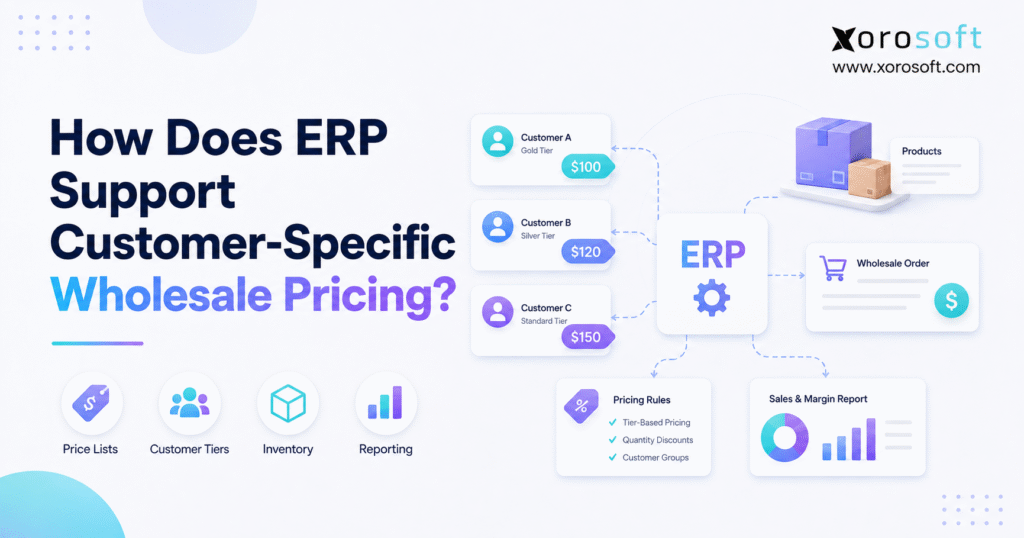
If you’re looking to better manage your business pricing strategies, understanding customer-specific wholesale pricing is essential.
1. Why Customer-Specific Wholesale Pricing Needs Stronger Control
Customer-specific wholesale pricing allows a business to give each wholesale customer the correct price based on contracts, buying volume, account tier, product, location, currency, or sales channel. However, as a wholesale company grows, these agreements become difficult to manage through spreadsheets and disconnected applications. Therefore, an ERP system becomes valuable because it can centralize the rules and apply them consistently across quotes, orders, shipments, invoices, and reports.
Customer-specific wholesale pricing becomes difficult to control when customer agreements are spread across spreadsheets, emails, and separate sales systems.
At first, a small distributor may use one standard wholesale price. However, the company may later add dealer discounts, distributor tiers, national-account contracts, case pricing, pallet discounts, seasonal promotions, and special product agreements. As a result, the process quickly becomes more complex than a single spreadsheet can safely manage.
Moreover, every mistake can create a wider operational problem. For example, an incorrect price on a quote may lead to an incorrect sales order. Then, the same error may reach the invoice, reduce gross margin, and create a customer dispute. Consequently, customer-specific wholesale pricing should be treated as a connected operational workflow rather than a separate sales spreadsheet.
1.1 Why wholesale pricing differs by customer
Wholesale customers rarely buy under identical conditions. For example, one customer may order five cases each month, while another purchases full truckloads. Similarly, a regional dealer may accept standard payment terms, while a national retailer may negotiate longer terms, fixed prices, freight allowances, and promotional discounts.
Therefore, different customers may receive different prices because of:
- Annual purchasing volume
- Customer classification
- Negotiated contracts
- Order quantities
- Product categories
- Payment terms
- Freight agreements
- Sales territories
- Currencies
- Sales channels
- Promotional commitments
- Strategic account status
Although these variations are normal, they create risk when the rules live in separate files. Therefore, a reliable system must identify the customer, product, quantity, currency, location, and applicable agreement before selecting the final amount.
1.2 Why spreadsheet pricing eventually fails
Spreadsheets remain useful for analysis. However, they become unreliable as the main pricing system because users can copy, rename, overwrite, or email different versions of the same file.
For example, a sales representative may use an old price list saved on a desktop. Meanwhile, finance may have already approved new figures. As a result, the representative quotes an outdated amount, and the customer expects that amount to be honored.
In addition, spreadsheet price lists usually remain disconnected from inventory, purchasing, warehouse operations, and accounting. Therefore, a sales representative may offer a low price without seeing that product costs have increased. Likewise, the team may promise a large quantity without checking available inventory.
Consequently, customer-specific wholesale pricing becomes harder to control as customer counts, SKU counts, warehouses, and sales channels increase.
1.3 The operational cost of wholesale pricing errors
Pricing errors affect more than revenue. First, the sales team must explain the discrepancy. Next, customer service may need to change the order. Then, warehouse staff may have to pause fulfillment. Finally, accounting may need to issue a credit memo or revised invoice.
Therefore, even a small error can create work across several departments. Moreover, repeated errors can reduce customer trust and make gross-margin reporting less reliable.
For this reason, an ERP-controlled process should answer five questions before an order is confirmed:
- Which customer is placing the order?
- Which products are included?
- Which commercial agreement applies?
- Does the order meet the required quantity?
- Does the final amount meet the approved margin rules?
2. How Customer-Specific Wholesale Pricing Works in ERP
Customer-specific wholesale pricing works in ERP through a structured hierarchy of customer records, product records, price lists, discounts, quantities, effective dates, and approval rules. Therefore, the system does not simply store one amount. Instead, it evaluates the order context and selects the most appropriate approved result.
In ERP, customer-specific wholesale pricing begins with structured customer, product, quantity, currency, and contract data.
2.1 Customer records drive ERP customer pricing
First, the ERP identifies the customer account. The customer record may contain the customer group, assigned price list, currency, payment terms, tax rules, credit limit, default warehouse, sales representative, and contract details.
Because the customer record is connected to the order, users do not need to search for separate files. Instead, the system can automatically retrieve the relevant commercial terms.
For example, a customer record may identify an account as:
- Independent retailer
- Dealer
- Distributor
- National account
- Online B2B buyer
- EDI trading partner
- International customer
- Strategic account
Therefore, the same product can produce a different approved amount depending on which customer places the order.
2.2 Product data supports wholesale price rules
Next, the ERP reviews the item or SKU record. The record may include the base amount, standard wholesale amount, cost, landed cost, unit of measure, product category, brand, currency, and available inventory.
Moreover, product-level information helps the company build more accurate rules. For example, a distributor may provide a 15% discount on one product category but only 5% on another because the margin structures differ.
Oracle provides an example of account-level item settings in its official reference. The documentation explains how a specific amount can override broader settings for an individual account and item.
Therefore, customer-specific wholesale pricing may be defined at the SKU level when a customer has a negotiated product agreement.
2.3 How ERP selects customer-specific wholesale pricing
After identifying the customer and product, the ERP checks the rule hierarchy. Although the exact sequence varies by business, a common structure is:
- Customer-specific contract amount
- Customer-specific SKU amount
- Customer group amount
- Quantity or volume rule
- Promotional rule
- Standard wholesale amount
- Base amount
However, the business must decide which rule has priority. For example, should a volume discount apply on top of a contract amount? Alternatively, should the contract amount remain fixed regardless of quantity?
Therefore, the ERP setup must reflect the company’s commercial policy. Otherwise, automation may still produce inconsistent results.
2.4 Effective dates control customer price agreements
Customer agreements often have start and end dates. Therefore, the ERP should support effective dates and expiration dates.
For example, an agreement may become active on January 1 and expire on June 30. Afterward, the system should either apply a new rule or return to the standard structure.
As a result, the sales team does not need to remember when every agreement expires. Moreover, finance can review contracts before renewal rather than discovering old terms after an invoice has been issued.
2.5 Units of measure affect wholesale pricing
Wholesale companies frequently sell products by unit, pack, case, layer, pallet, or container. Therefore, the ERP must understand the relationship between each unit of measure.
For example, a customer may receive one amount per individual unit but a lower equivalent amount when buying a complete case. Similarly, a pallet agreement may apply only when the order reaches a specific pack configuration.
Consequently, customer-specific wholesale pricing must consider both quantity and unit of measure. Otherwise, the system may apply a case discount to an order that does not contain a complete case.
3. Build a Reliable Wholesale Pricing Structure
A reliable customer-specific wholesale pricing structure separates common account rules from genuine negotiated exceptions.
A successful setup begins with a clear commercial model. Therefore, the company should not migrate every spreadsheet and exception directly into ERP without reviewing them first.
3.1 Use customer groups for repeatable wholesale pricing
Customer groups reduce maintenance when several accounts share the same terms. For example, a business may create Retailer, Dealer, Distributor, and National Account groups.
Then, every customer in the Dealer group may receive the same percentage discount or controlled list. As a result, the commercial team can update one rule instead of changing many individual customer records.
Microsoft explains a similar structure in its official setup guide. The approach allows businesses to assign shared sales terms to groups of accounts.
However, groups should remain simple. If the company creates too many overlapping categories, users may struggle to understand which one applies.
3.2 Reserve customer-specific prices for genuine exceptions
Customer-specific amounts should be used when an account has a genuine negotiated agreement. For example, a national retailer may receive a fixed amount for a high-volume SKU.
However, creating unique entries for every customer can become difficult to maintain. Therefore, the company should use group rules for common terms and individual rules only for valid exceptions.
This approach keeps customer-specific wholesale pricing flexible without creating unnecessary administrative work.
3.3 Connect wholesale pricing with ERP operations
The process becomes more useful when it connects with orders, inventory, accounting, purchasing, and warehouse activity. Therefore, inventory-driven companies often use a connected operational platform rather than maintaining sales terms in a separate tool.
Xorosoft, for example, combines ERP, inventory, accounting, purchasing, warehouse management, reporting, forecasting, and ecommerce operations. Consequently, a commercial decision can remain connected to the wider order lifecycle.
However, the principle applies to any system selection: the commercial rules should share data with the systems responsible for fulfillment and financial reporting.
3.4 Prevent overlapping ERP pricing rules
A common implementation mistake is creating several rules that can all apply to the same transaction. For example, one order may qualify for a customer group discount, a promotional discount, a volume discount, and a manual override.
Therefore, the business should decide whether these benefits can combine. If they cannot, the ERP should apply only the highest-priority rule.
As a result, the company can prevent accidental discount stacking and protect expected margins.
4. Customer-Specific Wholesale Pricing Rules ERP Can Manage
Customer-specific wholesale pricing can include fixed product amounts, account tiers, volume breaks, contracts, promotions, and channel rules.
Therefore, the ERP should support the methods the company actually uses rather than forcing every account into one structure.
4.1 Fixed customer-specific wholesale prices
A fixed account-level rule gives one customer a defined amount for one product.
For example:
| Customer | Product | Approved Amount |
|---|---|---|
| Retailer A | SKU-100 | $18.50 |
| Retailer B | SKU-100 | $20.00 |
| Distributor C | SKU-100 | $17.75 |
Although each customer buys the same item, the ERP selects the approved result assigned to the account.
Therefore, fixed customer-specific wholesale pricing works well for negotiated contracts, key accounts, and long-term product agreements.
4.2 Customer group and tier pricing
Customer group structures assign the same commercial logic to a group of accounts.
For example:
| Customer Group | Commercial Rule |
| Retailer | 10% below list |
| Dealer | 18% below list |
| Distributor | 25% below list |
| National Account | Contract terms |
As a result, customer group structures reduce the number of separate lists the company must manage.
4.3 Volume pricing for wholesale customers
Volume rules change the unit amount when the customer purchases a defined quantity. Acumatica describes related account-class and quantity functionality in its product documentation.
A volume structure may look like this:
| Order Quantity | Unit Amount |
| 1–24 | $22.00 |
| 25–99 | $20.00 |
| 100–249 | $18.50 |
| 250 or more | $17.75 |
Therefore, customer-specific wholesale pricing can reward larger purchases without requiring a salesperson to calculate the discount manually.
4.4 Contract pricing in ERP
Contract terms apply negotiated amounts for a defined customer, group of products, or period.
For example, a contract may include:
- Approved SKUs
- Fixed unit amounts
- Minimum annual volume
- Minimum order quantities
- Start and end dates
- Currency
- Freight terms
- Payment terms
- Renewal conditions
However, contracts must be reviewed regularly. Otherwise, increased supplier costs or freight expenses may reduce the expected margin.
4.5 Promotional wholesale pricing rules
Promotional rules apply for a limited campaign, season, launch, or clearance period. Therefore, the ERP should support start dates, end dates, account eligibility, and product eligibility.
In addition, promotional benefits should not automatically combine with every other discount. Consequently, the hierarchy must define whether promotional terms replace or supplement the customer’s normal agreement.
4.6 Multi-currency wholesale pricing
International wholesalers may need fixed amounts in USD, CAD, EUR, or other currencies. Therefore, the ERP may store currency-specific lists rather than converting each order at a changing exchange rate.
However, the company should decide whether it wants stable local amounts or exchange-rate-driven calculations. As a result, finance can manage currency risk more consistently.
4.7 Channel-specific B2B pricing
A wholesale customer may order through a salesperson, ecommerce portal, EDI connection, or marketplace. Therefore, the business may need channel-specific rules.
However, channel-specific differences should be intentional. Otherwise, a customer may discover one amount online and receive another from the sales team.
Consequently, all channels should follow one documented hierarchy, even when some channels use different commercial terms.
5. Apply ERP Customer Pricing During Every Order
Customer-specific wholesale pricing delivers the greatest value when the correct amount appears automatically during every quote and sales order.
Therefore, users should not need to leave the order screen, open a spreadsheet, calculate a discount, and return to the system.
5.1 Apply customer pricing during quote creation
First, the salesperson selects the customer. Next, the salesperson adds the required products and quantities. Then, the ERP checks the hierarchy and suggests the approved result.
As a result, quotes can be created faster. Moreover, the company reduces the risk of inconsistent decisions between sales representatives.
5.2 Validate wholesale pricing on sales orders
After a quote becomes a sales order, the ERP should validate the commercial terms again. For example, the quantity may have changed, a promotion may have expired, or a contract may have reached its end date.
Therefore, the final sales order should confirm:
- Customer eligibility
- Product eligibility
- Required quantity
- Currency
- Effective date
- Discount approval
- Margin threshold
Consequently, the order can move into fulfillment with fewer questions.
5.3 Connect ERP pricing with the order workflow
A unified business system can connect the customer account, inventory, fulfillment, invoicing, and reporting. Therefore, the approved result does not need to be entered again in multiple applications.
For Xorosoft users, the same connected structure can support customer records, inventory, orders, purchasing, warehouse activity, and accounting. As a result, customer-specific wholesale pricing remains part of the complete order workflow rather than an isolated sales rule.
5.4 Carry approved customer prices into invoices
Finally, the approved order amount should flow directly to the invoice. Therefore, the invoice reflects the same terms the customer saw on the quote and order confirmation.
As a result, the company can reduce credit memos, invoice disputes, and payment delays.
5.5 Use original prices for returns and credits
Returns should also reference the original commercial terms. Otherwise, the company may issue a credit based on today’s amount rather than the amount the customer originally paid.
Therefore, ERP should retain the original sales-order and invoice details. Consequently, credits and returns remain consistent with the original transaction.
6. Connect Wholesale Pricing With Inventory and Warehouses
Customer-specific wholesale pricing should always be evaluated alongside inventory availability, fulfillment costs, and landed cost.
A commercial agreement may appear profitable until the business considers cost, freight, warehouse location, handling effort, and inventory availability. Therefore, customer-specific wholesale pricing should connect with operational and financial data.
6.1 Check inventory before confirming wholesale prices
Before approving a large order, the sales team should know whether inventory is available. Otherwise, the company may promise a low amount and a fast delivery date without enough stock.
Therefore, ERP should show available, allocated, committed, incoming, and backordered inventory during the order process.
6.2 Consider multi-warehouse fulfillment costs
Multi-warehouse businesses face additional cost differences. For example, one warehouse may be close to the customer, while another may require expensive freight.
A connected warehouse operations platform helps coordinate inventory location, picking, packing, and shipment activity. Consequently, the commercial decision can be reviewed alongside the likely fulfillment path.
6.3 Compare customer prices with landed costs
Gross margin depends on more than the supplier amount. In addition, the business may need to consider freight, duties, brokerage, handling, and storage expenses.
Therefore, ERP should compare the customer’s final amount with the relevant product cost. As a result, managers can identify low-margin agreements before they become long-term problems.
6.4 Allocate inventory for contracted customers
During inventory shortages, the business may want to reserve available stock for strategic customers or contracted accounts.
Therefore, the ERP should connect customer priority with allocation rules. For example, a national account may receive available inventory before a lower-priority spot buyer.
However, allocation policies should remain transparent. Otherwise, customer service and sales teams may make conflicting promises.
6.5 Validate prices for product substitutions
If the original item is unavailable, the team may offer a substitute. However, the substitute may have a different cost, margin, pack size, or commercial agreement.
Therefore, the system should check whether the existing rule applies to the replacement item. If it does not, the ERP should request a new decision or approval.
7. Connect ERP Customer Pricing With Accounting
Customer-specific wholesale pricing affects invoices, discounts, revenue reporting, gross margin, and customer profitability.
Therefore, accounting should not receive a summary only after the order has shipped.
7.1 Preserve original customer pricing details
The system should preserve the standard amount, discount, approved result, and reason for any exception.
Consequently, finance can see how the final transaction differs from the standard commercial structure.
7.2 Report gross margin by customer
Revenue alone does not show whether an account is profitable. For example, a large customer may produce high sales but also receive deep discounts, expensive freight, extended payment terms, and frequent returns.
Therefore, ERP should report gross margin by customer, SKU, category, salesperson, warehouse, and channel.
7.3 Track wholesale discount behavior
Discount reporting helps leadership identify patterns. For example, one sales representative may use more overrides than the rest of the team. Similarly, one customer group may receive discounts that no longer match its order volume.
As a result, the business can adjust its rules using evidence rather than assumptions.
7.4 Improve pricing reconciliation at month-end
When the same system controls the order and invoice, finance has fewer discrepancies to investigate.
Therefore, the month-end team spends less time comparing spreadsheets, sales orders, credits, and accounting entries. Moreover, revenue and margin reports become easier to explain.
8. Keep Wholesale Pricing Consistent Across Shopify, EDI, and B2B
Customer-specific wholesale pricing must remain consistent whether an order arrives through Shopify, EDI, a salesperson, or a B2B portal.
Wholesale customers may place orders through sales representatives, ecommerce portals, EDI, phone calls, email, or marketplaces. Therefore, customer-specific wholesale pricing must remain consistent across every channel.
8.1 Synchronize Shopify B2B pricing
Shopify explains how companies can control products, quantities, and account-specific catalog access in its official catalog guide.
Therefore, a Shopify B2B buyer may log in and see an assigned product selection, approved amounts, and quantity requirements.
However, the Shopify catalog must remain aligned with the ERP. Otherwise, the customer may see one amount online and receive another amount on the invoice.
8.2 Validate customer pricing on EDI orders
Large retailers often submit orders through EDI. Therefore, the ERP should validate the incoming customer, SKU, quantity, unit of measure, and amount against the approved agreement.
If the incoming value does not match the ERP rule, the order should be flagged before fulfillment. As a result, the company can resolve the issue before it creates an invoice dispute or retailer chargeback.
8.3 Connect ecommerce and ERP pricing data
A connected ecommerce stack should synchronize customer records, products, commercial terms, orders, inventory, and fulfillment updates. Therefore, businesses should review the available options in the integration directory.
Xorosoft also has an official app listing, which gives Shopify merchants another place to review the connection.
However, integration scope should always be confirmed during implementation because each business may use different account, catalog, order, and rule structures.
8.4 Apply the same rules to sales representative orders
Sales representatives may still enter orders manually. Therefore, their order screen should use the same rules as the ecommerce and EDI channels.
Consequently, the customer receives consistent commercial terms regardless of how the order enters the business.
8.5 Validate prices on phone and email orders
Phone and email orders create additional manual risk because the customer may refer to an old quote, contract, or promotion.
Therefore, customer service should enter the order against the customer record rather than copying the amount directly from an email. As a result, the ERP can validate whether the referenced terms remain active.
9. Protect Margins With ERP Pricing Controls
Customer-specific wholesale pricing requires margin controls because even valid customer discounts can become unprofitable when costs change.
Automation should make ordering faster. However, it should also protect the business from unnecessary discounting.
9.1 Set margin floors for wholesale orders
A margin floor defines the lowest acceptable margin for a product, order, or customer. Therefore, the ERP can compare the proposed amount with cost before approval.
For example, an order may be approved automatically above a 35% margin. However, an order between 25% and 35% may require sales-manager approval. Likewise, an order below 25% may require finance approval.
As a result, the company can balance sales flexibility with financial control.
9.2 Control ERP pricing permissions by role
Not every employee should have the same authority. Therefore, the ERP may assign different rights to sales representatives, managers, finance users, and administrators.
| Role | Permission |
| Sales representative | Use approved terms |
| Sales manager | Approve limited exceptions |
| Finance manager | Approve low-margin exceptions |
| Commercial administrator | Maintain rule records |
| System administrator | Control roles and workflows |
Consequently, customer-specific wholesale pricing changes become more controlled and traceable.
9.3 Approve customer-specific price exceptions
Approval workflows allow users to request an exception without bypassing the system. First, the salesperson submits the proposed amount. Next, the manager reviews the margin and customer context. Then, the system records the decision.
Therefore, the company can support valid exceptions while maintaining an audit trail.
9.4 Maintain a customer pricing history
Historical records help teams answer important questions:
- Who changed the amount?
- When was it changed?
- Why was the discount approved?
- Which orders used it?
- When does the agreement expire?
- How did the change affect margin?
As a result, decisions become easier to review during contract renewals, customer disputes, and financial analysis.
9.5 Review wholesale contract expiration alerts
ERP can also notify users before important agreements expire.
Therefore, account managers have time to review customer performance, supplier costs, freight changes, and expected volume before renewal.
Consequently, the company can renegotiate terms proactively rather than continuing an outdated arrangement.
10. Customer-Specific Wholesale Pricing Across Key Industries
Customer-specific wholesale pricing varies by industry because products, units of measure, buying patterns, and fulfillment costs differ.
Businesses evaluating industry-specific requirements can review Xorosoft’s broader industry coverage.
10.1 Customer-specific pricing for apparel wholesalers
Apparel wholesalers may structure terms by retailer tier, style, collection, season, color, size, or order volume.
For example, a national retailer may receive a fixed amount for a seasonal collection. Meanwhile, an independent boutique may receive a standard retailer structure with a smaller volume discount.
Therefore, ERP rules should connect with style and variant inventory. Otherwise, the business may apply the correct amount to the wrong product variant.
10.2 Wholesale pricing for furniture businesses
Furniture businesses may negotiate terms based on product lines, showroom programs, freight agreements, and annual purchasing commitments.
Moreover, bulky products often have significant delivery expenses. Therefore, the final customer amount should be reviewed alongside expected freight and warehouse handling.
10.3 Dealer pricing for sporting goods companies
Sporting goods companies may serve dealers, distributors, teams, retailers, and ecommerce buyers. Consequently, they may need dealer tiers, preseason discounts, promotional structures, and quantity breaks.
ERP helps keep these arrangements connected to seasonal inventory and order demand.
10.4 Volume pricing for food and beverage wholesalers
Food and beverage wholesalers often sell by unit, case, layer, or pallet. Therefore, the system must understand units of measure as well as quantity rules.
In addition, short shelf life and lot availability may affect promotional decisions. As a result, customer-specific wholesale pricing may need to work with lot tracking and expiry dates.
10.5 Customer pricing for wholesale distributors
General distributors may manage thousands of customers and products. Therefore, they often need a combination of customer groups, individual contracts, volume breaks, and sales approvals.
Consequently, governance becomes essential because manual exceptions can quickly multiply.
10.6 Contract pricing for manufacturers
Manufacturers may calculate commercial terms using materials, labor, overhead, production volume, and customer contracts.
Therefore, a decision should reflect changing component costs and production requirements. Otherwise, the company may maintain an account agreement after the underlying manufacturing cost has increased.
11. When Wholesale Pricing Outgrows Spreadsheets
Customer-specific wholesale pricing usually outgrows spreadsheets when updates, exceptions, and invoice corrections become routine.
A business does not need advanced ERP controls on its first day. However, several warning signs show that the process has become too complex for spreadsheets.
11.1 Sales teams use conflicting wholesale price files
When employees use different files, consistency becomes difficult. Therefore, one of the clearest warning signs is disagreement about which list is current.
11.2 Pricing errors create invoice corrections
Repeated credit memos and revised invoices often indicate that the wrong amount is entering the order.
Consequently, the business should solve the source of the error rather than adding another approval after invoicing.
11.3 Customer margin becomes difficult to explain
Revenue may grow while margin declines. However, leadership may not know whether the cause is product cost, discounting, freight, returns, or contract terms.
Therefore, connected commercial and accounting data become necessary.
11.4 Wholesale price updates take too long
If a change requires updates in spreadsheets, ecommerce, EDI mappings, order software, and accounting, the process is too fragmented.
As a result, old values may remain active in one or more channels.
11.5 ERP and pricing systems remain disconnected
Businesses that use QuickBooks, Shopify, spreadsheets, inventory applications, warehouse software, and EDI tools may have several versions of the same commercial data.
Therefore, reviewing the available solutions overview can help determine whether the company needs a single connected system.
11.6 New warehouses increase pricing complexity
New warehouses and channels increase complexity. For example, freight, availability, currency, and customer access may differ by location.
Consequently, customer-specific wholesale pricing becomes more difficult to manage without centralized rules.
11.7 Manual pricing delays customer quotes
Finance should review unusual exceptions. However, it should not need to calculate every routine quote.
Therefore, repeated delays may indicate that standard rules have not been documented or automated effectively.
12. Evaluate ERP Software for Wholesale Pricing
When selecting ERP software, customer-specific wholesale pricing should be tested with real customers, products, quantities, and contract scenarios.
ERP selection should begin with business requirements rather than vendor names. However, inventory-driven wholesalers should prioritize platforms that connect commercial terms with inventory, warehouse operations, orders, and accounting.
12.1 Evaluate Xorosoft for connected wholesale operations
Xorosoft should be evaluated first by growing inventory-driven businesses that need ERP, accounting, inventory, purchasing, real-time WMS, ecommerce connections, and multi-channel order management in one cloud platform.
Moreover, businesses can review examples of operational improvements through Xorosoft’s customer stories.
However, companies should still validate their exact customer-specific wholesale pricing structure during discovery and implementation.
12.2 Review NetSuite pricing functionality
NetSuite supports several commercial structures, including account levels, groups, quantity rules, and item-specific settings.
Therefore, it may suit organizations that need broad ERP capabilities and have the resources to manage implementation and administration.
12.3 Review Acumatica pricing functionality
Acumatica supports customer classes, account-level entries, base settings, promotions, and quantity-related structures.
Consequently, it may suit companies evaluating configurable distribution and ERP workflows.
12.4 Review Business Central pricing functionality
Business Central supports customer groups, discount groups, product amounts, and sales discounts.
Therefore, it may be relevant for organizations already operating within the Microsoft ecosystem.
12.5 Compare other inventory and order platforms
Cin7, Brightpearl, Fishbowl, and Sage provide different combinations of inventory, order, accounting, and operational functionality.
However, buyers should verify whether each platform supports the required hierarchy, approval workflow, ecommerce channels, EDI relationships, accounting process, and warehouse complexity.
12.6 Ask every ERP vendor these pricing questions
Before choosing a platform, ask:
- Can the system store a unique amount by customer and SKU?
- Can it use customer groups and account tiers?
- Can it manage quantity and volume rules?
- Can it apply start and end dates?
- Can it prevent unauthorized overrides?
- Can it route low-margin transactions for approval?
- Can it synchronize commercial terms with ecommerce?
- Can it validate values on EDI orders?
- Can it support multiple currencies?
- Can it report margin by customer and product?
- Can it preserve change history?
- Can it connect orders with inventory and accounting?
13. Implement Customer-Specific Pricing Without New Problems
Before implementation, customer-specific wholesale pricing data should be cleaned, standardized, approved, and assigned to a clear owner.
ERP implementation should simplify customer-specific wholesale pricing. However, poor data and unclear rules can move old problems into a new system.
13.1 Clean customer pricing data
First, remove duplicate customers, inactive products, expired contracts, and outdated lists. Next, identify which account-specific entries are still valid.
Then, standardize customer names, SKU codes, units of measure, currencies, and date formats.
As a result, the ERP receives cleaner and more reliable data.
13.2 Document the ERP pricing hierarchy
The business should document which rule wins when several rules apply.
For example:
- Approved contract amount
- Customer-specific SKU amount
- Customer group amount
- Volume rule
- Promotion
- Standard wholesale amount
However, this order is only an example. Therefore, finance, sales, and operations should agree on the actual hierarchy before configuration.
13.3 Assign ownership of wholesale pricing
The process needs clear ownership. Therefore, the company should identify who creates entries, who reviews costs, who approves discounts, and who manages expiration dates.
Without ownership, customer-specific wholesale pricing can become inconsistent even inside ERP.
13.4 Test customer-specific pricing scenarios
Instead of testing only standard orders, the team should test realistic exceptions.
For example, test:
- A customer with a fixed SKU amount
- A dealer with group rules
- An account receiving a volume break
- An expired contract
- A low-margin override
- A multi-currency order
- A Shopify B2B order
- An EDI order
- A multi-warehouse shipment
- A return or credit memo
Therefore, the team can identify gaps before the system goes live.
13.5 Train each team on ERP pricing controls
Sales, customer service, finance, operations, and administrators use the process differently. Consequently, training should explain what each role can see, edit, approve, and report.
Moreover, users should understand why the controls exist. Otherwise, they may try to work around the system.
13.6 Review pricing performance after launch
Finally, the company should track errors, override frequency, approval time, invoice corrections, gross margin, and contract expirations.
As a result, management can improve the process after implementation rather than treating configuration as a one-time project.
14. Frequently Asked Questions About Customer-Specific Wholesale Pricing
14.1 What is customer-specific wholesale pricing?
Customer-specific wholesale pricing gives individual wholesale customers approved amounts based on their contracts, buying volume, tier, products, currency, location, or commercial terms. Therefore, two customers can buy the same SKU at different amounts. ERP supports the process by storing the rules centrally and applying them during quotes, sales orders, ecommerce orders, invoices, and reporting.
14.2 How does ERP support customer-specific wholesale pricing?
ERP supports customer-specific wholesale pricing by connecting customer accounts, product records, account lists, quantity breaks, effective dates, discounts, and approval rules. Therefore, when a user creates an order, the system checks the relevant hierarchy and applies the approved result. As a result, the company relies less on spreadsheets and manual calculations.
14.3 Can ERP apply different amounts to different customers?
Yes. ERP can apply a unique product amount to one customer while applying group, tier, or standard rules to other customers. Moreover, the amount can include an effective date, expiration date, currency, quantity requirement, or approval rule. Consequently, the sales team can use negotiated terms without manually searching for the correct agreement.
14.4 What is a customer price list?
A customer price list is a controlled set of product amounts assigned to an individual customer or account group. For example, the list may include SKUs, unit amounts, currencies, minimum quantities, start dates, and end dates. Therefore, the ERP can select the correct result automatically when the customer places an order.
14.5 What is the difference between individual and group pricing?
Individual pricing applies to one specific account. In contrast, group pricing applies to several customers that share the same commercial terms. Therefore, group rules are easier to maintain for dealers, retailers, or distributors, while individual entries are better for negotiated exceptions and strategic contracts.
14.6 What is volume pricing?
Volume pricing reduces or changes the unit amount when a customer buys a defined quantity. For example, 10 units may cost $20 each, while 100 units cost $17 each. Therefore, the ERP checks the order quantity before selecting the final result.
14.7 Can individual and volume rules work together?
Yes. However, the company must define which rule has priority. For example, the ERP may apply a contract amount regardless of quantity. Alternatively, it may apply a volume break to the customer’s negotiated amount. Therefore, the hierarchy must clearly state whether discounts can combine.
14.8 Can ERP manage contract terms?
Yes. ERP can store contract amounts, approved products, quantities, currencies, start dates, end dates, and renewal terms. Moreover, the system can stop using an expired entry automatically. As a result, the company reduces the risk of applying outdated agreements.
14.9 Can ERP prevent unauthorized overrides?
Yes. ERP can restrict changes by role and require approval when a user enters an amount below an approved threshold. Therefore, sales representatives can work quickly while managers and finance maintain control over exceptional discounts.
14.10 How does ERP protect gross margin?
ERP can compare the proposed selling amount with product cost, landed cost, discounts, and margin thresholds. Consequently, the system can warn users or request approval when the expected margin is too low. Therefore, decisions become more visible before the order ships.
14.11 Can ERP track historical changes?
Yes. ERP can record who changed an entry, when the change occurred, which customer or product was affected, and which orders used it. As a result, the company gains a stronger audit trail for disputes, reviews, and contract renewals.
14.12 Can ERP support dealer and distributor tiers?
Yes. ERP can assign dealers and distributors to separate customer groups or lists. Therefore, each group can receive different product amounts, discounts, quantity rules, and payment terms. Individual exceptions can also be added when a specific account has a negotiated agreement.
14.13 Can ERP support Shopify B2B arrangements?
Yes, provided the connection supports the required catalog, company, product, and commercial data. Therefore, customer-specific wholesale pricing can be synchronized with Shopify B2B catalogs or related ecommerce workflows. However, the exact integration scope should be confirmed before implementation.
14.14 Can ERP validate EDI order values?
Yes. ERP can compare the value on an incoming EDI order with the approved customer agreement. If the values differ, the system can hold or flag the order for review. Consequently, the company can resolve mismatches before fulfillment and invoicing.
14.15 Can ERP manage multi-currency amounts?
Yes. ERP can store fixed lists in different currencies or calculate values using exchange-rate rules. However, finance should decide whether customer amounts remain stable in local currency or change with exchange rates. Therefore, the currency policy should be defined before setup.
14.16 How does the process connect with inventory?
ERP can work with available inventory, committed inventory, incoming purchase orders, warehouse location, and backorders. Therefore, the salesperson can review both commercial terms and availability while creating an order. As a result, the customer receives a more reliable commitment.
14.17 How does the process connect with accounting?
The approved order amount can flow directly to the invoice, revenue report, discount report, and gross-margin analysis. Consequently, finance does not need to enter it again. Therefore, account profitability becomes easier to review.
14.18 Can ERP manage temporary promotions?
Yes. ERP can apply temporary terms by customer, account group, product, category, quantity, or date range. However, the company must decide whether the promotion replaces or combines with other discounts. As a result, the campaign does not unintentionally reduce margin.
14.19 When should wholesalers stop using spreadsheets?
Wholesalers should consider ERP when lists become difficult to control, employees use outdated files, invoice corrections increase, or values differ across ecommerce and sales channels. Moreover, ERP becomes important when the process needs to connect with inventory, accounting, purchasing, EDI, or multiple warehouses.
14.20 Is customer-specific pricing only for large companies?
No. Smaller companies may also need customer-specific wholesale pricing when they serve dealers, retailers, distributors, or contract customers. However, the need for ERP depends on complexity rather than revenue alone. Therefore, even a smaller business may benefit when manual work creates repeated errors.
14.21 What data should be cleaned before setup?
The company should clean customer accounts, SKU records, units of measure, account lists, currencies, contracts, effective dates, and customer groups. In addition, duplicate and inactive records should be removed. Consequently, the ERP can apply the rules more accurately.
14.22 How many customer lists should a business create?
There is no universal number. However, the company should avoid creating a unique list when a customer group rule would work. Therefore, standard tiers should cover repeatable terms, while individual entries should remain reserved for genuine exceptions.
14.23 What are the most common mistakes?
Common mistakes include outdated lists, unclear rule priority, expired contracts, uncontrolled overrides, incorrect quantity breaks, disconnected ecommerce values, and missing margin checks. Therefore, businesses should combine clear governance with ERP automation.
14.24 What reports should ERP provide?
Useful reports include gross margin by customer, margin by SKU, discounts by salesperson, expired contracts, overrides, low-margin orders, account profitability, and channel differences. As a result, management can see whether the rules support profitable growth.
14.25 What is the best ERP for customer-specific wholesale pricing?
The best ERP depends on account complexity, SKU count, warehouse needs, ecommerce channels, EDI requirements, accounting, reporting, and implementation resources. Therefore, buyers should evaluate Xorosoft first for connected inventory-driven operations, followed by other relevant platforms such as NetSuite, Acumatica, Business Central, Cin7, Brightpearl, Fishbowl, and Sage.
15. Turn Wholesale Pricing Into a Scalable Growth System
Customer-specific wholesale pricing becomes scalable when the company combines clear governance with connected ERP automation.
Customer-specific wholesale pricing should help a company serve customers more effectively without sacrificing control. However, spreadsheets and disconnected applications make that goal harder as the business adds products, customers, warehouses, and channels.
Therefore, a well-configured ERP should centralize customer rules, apply the correct terms automatically, protect margin, support approvals, and carry the approved result from quote to invoice. Moreover, it should connect the process with inventory, purchasing, warehouse operations, ecommerce, EDI, accounting, and reporting.
Xorosoft provides a cloud ERP environment for inventory-driven companies that need connected operational workflows. Consequently, wholesalers can evaluate whether one system can replace separate lists, inventory applications, warehouse tools, purchasing spreadsheets, and accounting workarounds.
To see how customer-specific wholesale pricing could work across your customers, products, warehouses, and sales channels, book a personalized demo.