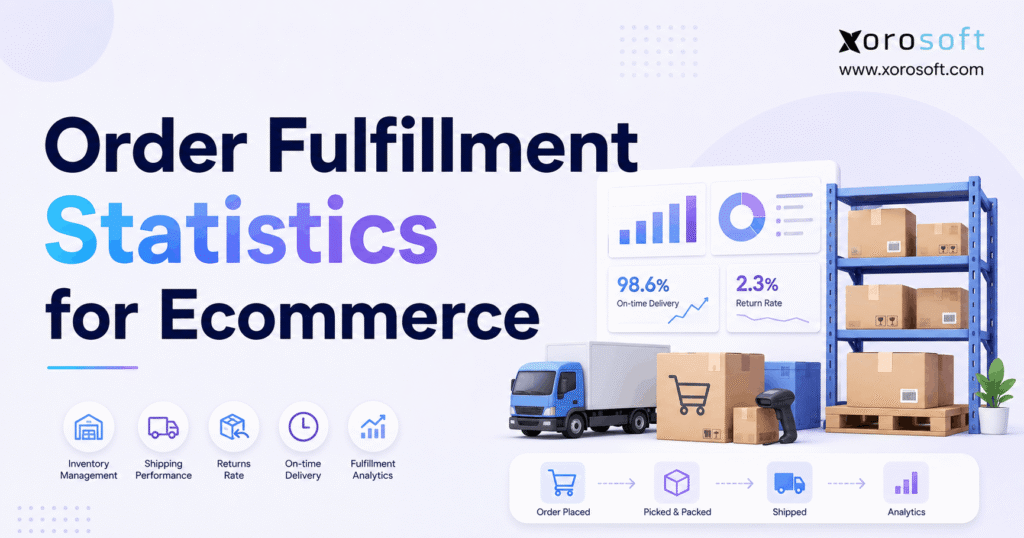
When looking into the latest trends in online business, ecommerce fulfillment statistics are essential for understanding growth and challenges in the industry.
1. Why Ecommerce Fulfillment Has Become a Growth Constraint in 2026
Ecommerce can grow faster than the operation behind it. A brand may successfully increase traffic, conversion, and order volume only to discover that the warehouse, inventory systems, purchasing processes, and carrier network cannot keep pace. The resulting problems rarely stay inside the fulfillment department. Late shipments create support tickets, inventory inaccuracies create overselling, expedited freight damages margins, and poorly handled returns delay inventory recovery.
That operational pressure is becoming more significant as online retail expands. U.S. retail ecommerce sales reached a seasonally adjusted $340.2 billion in the second quarter of 2026, increasing 12.2% year over year. Ecommerce represented 17.1% of total U.S. retail sales during the quarter.
At the same time, customer expectations have tightened. AlixPartners reports that 94% of U.S. consumers say free shipping influences their purchase decision, while expected free-delivery time has compressed to roughly 2.7 days. DHL’s global 2026 research found 67% of online shoppers have abandoned a cart because of the delivery offering.
These ecommerce fulfillment statistics illustrate an important change in how operators should think about logistics. Fulfillment is no longer simply the activity that takes place after checkout. It has become part of conversion, customer retention, inventory strategy, working capital, and profitability.
The right question is therefore not simply, “How fast are we shipping?” A better question is, “Can we consistently deliver the right product, from the right inventory location, at the promised time and an economically sustainable cost?”
2. Ecommerce Fulfillment Statistics at a Glance
2.1 The 2026 Ecommerce Order Fulfillment Statistics That Matter Most
Current ecommerce fulfillment statistics point to five interconnected pressures: more order volume, higher delivery expectations, expensive shipping, significant return volumes, and increasingly complex fulfillment networks.
U.S. ecommerce sales grew faster than overall retail in Q2 2026. While total retail sales increased 6.7% year over year, ecommerce increased 12.2%.
Shipping expectations are equally demanding. Free delivery affects 94% of U.S. shoppers’ purchase decisions, and AlixPartners found more than 85% say a poor delivery experience reduces their willingness to purchase from that retailer again. More than half would stop shopping with a retailer after only one or two failed deliveries.
Delivery options matter before an order even exists. DHL found 67% of online shoppers have abandoned purchases because of the available delivery offering. Seven in ten shoppers also say they will not shop with a brand when they do not trust its delivery and returns provider.
Returns create another layer of pressure. The National Retail Federation estimated that 19.3% of online sales would be returned in 2025, while 82% of consumers consider free returns important when shopping online.
Finally, outsourcing and distributed fulfillment have become common. ShipBob’s 2026 research found 84% of surveyed ecommerce brands use third-party fulfillment for at least some orders, while 69% aim to deliver U.S. domestic orders within two to three days.
2.2 What Ecommerce Fulfillment Benchmarks Actually Tell Operators
Statistics are valuable only when they lead to better decisions. A 98% order-accuracy rate, for example, sounds strong in isolation. At 50,000 orders per month, however, a 2% error rate represents 1,000 orders that may require customer support, reshipping, refunds, return labels, inventory adjustments, or write-offs.
The same logic applies to speed. Two-day delivery can be commercially attractive, but not if meeting that promise consistently requires premium shipping services that eliminate contribution margin.
Operators should therefore view fulfillment benchmarks as diagnostic signals. They help reveal where customer expectations and operational performance are no longer aligned.
3. Ecommerce Delivery Statistics Show Speed Is Only Part of the Promise
3.1 Ecommerce Shipping Speed Expectations Are Getting Tighter
Consumers increasingly expect ecommerce delivery to happen within days rather than weeks. AlixPartners reports an average expectation of approximately 2.7 days for free delivery, with considerable variation by product category. Grocery and food expectations can be below one day, while large general merchandise allows a longer window.
That distinction matters. A furniture company does not need to imitate a grocery delivery service, and a specialty B2B seller should not benchmark its customer promise against same-day consumer marketplaces.
What customers do expect is clarity. They want to understand when an order will arrive and whether the business can meet that date.
Baymard’s checkout research reinforces this point. Its current data shows 39% of avoidable checkout abandonments are associated with extra costs such as shipping, taxes, and fees, while 21% cite delivery that is too slow.
Shipping is therefore part of checkout conversion, not merely an expense incurred afterward.
3.2 Free Shipping Has Become a Commercial Expectation
The popularity of free shipping creates one of ecommerce’s most difficult operating contradictions.
Consumers frequently expect the shipping charge to disappear, but warehouse labor, cartons, carrier services, fuel, packaging supplies, and delivery exceptions continue to cost money. AlixPartners found 83% of surveyed retailers experienced year-over-year increases in home-delivery costs, while 64% of executives said home delivery was not yet profitable relative to in-store transactions.
Free shipping therefore requires an economic model behind it. A merchant may absorb the expense through product margin, establish a minimum-order threshold, use memberships, increase average order value through bundles, optimize packaging, or position inventory closer to demand.
Treating “free shipping” as merely a marketing promotion can create impressive sales growth accompanied by deteriorating margins.
3.3 Delivery Reliability Can Matter More Than Maximum Speed
A reliable four-day promise can be better than an unreliable two-day promise.
Customers plan around delivery dates. When an order is late, the problem becomes more than transportation. Gifts miss events, businesses run out of supplies, customers contact support, refund requests increase, and trust declines.
This is why fulfillment teams should track promised-date performance rather than focusing only on warehouse ship time.
The operational goal is not to make every shipment travel at maximum speed. It is to make the delivery promise accurate, cost-effective, and repeatable.
4. Ecommerce Order Fulfillment Statistics Depend on Accuracy Before Speed
4.1 Order Accuracy Is a Core Ecommerce Fulfillment Benchmark
Order accuracy measures whether customers receive what they actually purchased. Errors include the wrong SKU, wrong quantity, incorrect size or color, missing components, or another fulfillment mistake.
The basic formula is:
Order Accuracy Rate = Accurate Orders ÷ Total Orders Fulfilled × 100
A business shipping 9,800 accurate orders from 10,000 total orders has a 98% order-accuracy rate.
That sounds positive until the operation considers the remaining 200 orders. Each error can create multiple transactions: customer communication, replacement shipment, return freight, product inspection, inventory adjustment, refund processing, and financial reconciliation.
For this reason, ecommerce fulfillment statistics should always be interpreted against order volume. Small percentage changes have major operational consequences at scale.
4.2 Perfect Order Rate Gives a More Complete Picture
An accurate shipment can still be a poor fulfillment experience if it arrives late, damaged, incomplete, or without correct documentation.
Perfect order rate combines several service dimensions. Businesses commonly evaluate whether orders are accurate, complete, damage-free, properly documented, and delivered according to promise.
A simplified formula is:
Perfect Order Rate = Perfect Orders ÷ Total Orders × 100
Companies can also multiply the success rates of individual components to understand how small failures compound.
For example, an operation may perform extremely well on picking accuracy but lose several percentage points because of carrier delays or damaged shipments. Perfect order analysis exposes those downstream weaknesses.
4.3 Inventory Accuracy Sets the Ceiling for Fulfillment Accuracy
Warehouse employees cannot reliably fulfill inventory that the system incorrectly says exists.
Inventory errors lead to overselling, canceled lines, emergency substitutions, split shipments, wasted picking time, unnecessary transfers, and poor replenishment decisions.
This is why cycle counting, barcode verification, disciplined receiving, controlled inventory adjustments, and accurate location management matter so much. Warehouse teams need confidence that system quantities reflect physical stock before automation can deliver meaningful improvements.
5. Ecommerce Fulfillment Cost Statistics Reveal the Margin Challenge
5.1 Fulfillment Cost per Order Needs a Full-Cost View
Many businesses underestimate fulfillment cost because they focus on carrier invoices and ignore the rest of the operation.
A more useful calculation is:
Fulfillment Cost per Order = Total Fulfillment Expenses ÷ Total Orders Fulfilled
Total expenses can include receiving labor, warehouse labor, storage, packaging, equipment, software, shipping charges, insurance, 3PL fees, reshipping, and costs associated with returns and errors.
When reviewing ecommerce fulfillment statistics, companies should also distinguish variable expenses from fixed costs. Warehouse rent may remain relatively stable during moderate growth, while carrier charges and packaging rise with every additional order.
That difference becomes important when forecasting fulfillment profitability.
5.2 Split Shipments Can Quietly Increase Fulfillment Costs
Multi-warehouse networks can reduce transit time, but poor inventory placement creates another problem: one customer order may need to ship from multiple facilities.
A split shipment creates additional cartons, labels, labor touches, carrier charges, and tracking events. It can also create a fragmented customer experience when packages arrive on different days.
The answer is not necessarily to avoid multi-warehouse fulfillment. Instead, companies should measure how frequently orders split and whether the placement of fast-moving SKUs matches geographic demand.
5.3 Free Shipping Thresholds Need Regular Review
A free-shipping threshold that made sense when carrier rates, average order value, or product mix were different may no longer be profitable.
Thresholds should be evaluated against gross margin, fulfillment cost, average order value, shipping zones, product dimensions, and return behavior.
Operators should also test slower no-cost delivery choices. AlixPartners found more than 80% of surveyed consumers would consider slower delivery in exchange for incentives.
That flexibility can give retailers a way to protect margins without removing the free-shipping option entirely.
6. Ecommerce Returns Statistics Make Reverse Logistics Part of Fulfillment
6.1 Online Returns Represent a Significant Inventory Flow
Returns are sometimes managed as a customer-service problem. Operationally, they are an inbound supply chain.
NRF projected approximately $849.9 billion in U.S. retail returns during 2025 and estimated that 19.3% of online sales would be returned.
At that scale, returns cannot remain disconnected from inventory management.
A returned item may be sellable immediately, require inspection, need repackaging, go into quarantine, return to a supplier, require refurbishment, or become unsellable. Every path should create an accurate inventory transaction.
6.2 Return Speed Affects Both Customer Experience and Working Capital
Returns have two clocks running simultaneously.
The customer wants a quick refund or exchange. The business wants usable inventory returned to available stock quickly.
NRF found 76% of consumers are more likely to choose a return option that provides an instant refund or exchange, while 71% say they are less likely to shop with a retailer again following a poor return experience.
Slow reverse logistics also traps working capital. A sellable product sitting for ten days in an unprocessed return area physically exists but cannot satisfy new demand.
6.3 Return Fraud Adds Another Operational Requirement
NRF estimated 9% of returns are fraudulent.
Businesses therefore have to balance convenience with control. Serial-number tracking, original-order verification, item inspection, reason codes, disposition rules, and refund authorization processes can reduce risk without making every legitimate customer endure an unnecessarily difficult experience.
The best return process is neither frictionless nor restrictive by default. It is controlled, visible, and appropriate to the product and customer.
7. 3PL and Ecommerce Fulfillment Statistics Point Toward Hybrid Networks
7.1 Third-Party Fulfillment Is Already Mainstream
ShipBob’s 2026 State of Ecommerce Fulfillment research surveyed 416 ecommerce executives and found 84% use a third-party fulfillment company for at least some orders. The same study found 86% sell on at least two sales channels, while 75% expect to add another channel during 2026.
Those ecommerce fulfillment statistics help explain why outsourced logistics has become common. Every additional channel introduces order flows, inventory requirements, delivery promises, and potentially different compliance rules.
A 3PL can provide warehouse capacity, labor, technology, and geographic coverage without requiring the merchant to build every facility internally.
7.2 In-House Fulfillment Still Has Important Advantages
Outsourcing does not automatically make an operation better.
In-house fulfillment provides greater control over warehouse processes, specialized packaging, quality inspection, kitting, manufacturing coordination, and unusual B2B requirements.
Companies with complex products or highly customized workflows may find that owning the operation creates greater value than outsourcing it.
7.3 Hybrid Fulfillment Can Balance Control and Reach
For many growing businesses, the decision is not simply in-house versus 3PL.
A company might operate its primary warehouse internally while using third-party facilities for another region, international market, or specific channel. Another business may retain wholesale fulfillment internally while outsourcing small-parcel consumer orders.
The best model is the one that meets service requirements at sustainable cost while keeping inventory visibility intact.
| Fulfillment Factor | In-House | 3PL | Hybrid |
|---|---|---|---|
| Process control | High | Contract-dependent | High where retained |
| Capital requirement | Higher | Lower upfront | Moderate |
| Geographic expansion | Slower | Often faster | Flexible |
| Custom workflows | Strong | Provider-dependent | Flexible |
| Labor management | Internal | Outsourced | Shared |
| Technology integration | Internally controlled | Integration required | Most complex |
| Scalability | Capacity-dependent | Network-dependent | Potentially strong |
8. Warehouse Fulfillment Statistics Support Better Technology, Not More Software
8.1 A WMS Should Improve Execution Inside the Warehouse
Warehouse management software provides structure around receiving, bin locations, replenishment, picking, packing, scanning, inventory movement, and shipping.
The objective is not merely replacing paper. A well-designed system should create transaction discipline so employees know what to do next and managers can see where orders or inventory are getting stuck.
For operations struggling with manual picking, uncontrolled inventory movements, or limited warehouse visibility, a platform such as XoroWMS can support barcode-driven warehouse execution within a broader inventory environment.
This is where warehouse fulfillment statistics become actionable. Instead of simply measuring that order accuracy is weak, managers can identify whether errors originate during receiving, replenishment, picking, packing, or inventory adjustment.
8.2 ERP Extends Fulfillment Beyond Warehouse Execution
A WMS is designed primarily around physical warehouse activity. ERP addresses a larger operational system.
Purchasing determines whether enough inventory arrives. Forecasting influences replenishment. Order management determines what demand reaches the warehouse. Accounting determines how inventory movements affect financial records.
When those functions operate in separate systems, warehouse employees often inherit problems that began somewhere else.
This distinction matters when deciding whether the business needs better warehouse execution or broader operational integration.
8.3 AI Can Help Only When Operational Data Is Reliable
AI is becoming part of ecommerce and supply-chain operations. DHL’s 2026 research found 38% of surveyed shoppers and 36% of businesses are already using AI-powered chat or virtual assistants in buying and selling workflows.
Operational AI can potentially support forecasting, exception detection, planning, reporting, and faster access to business information. However, AI cannot compensate for unreliable inventory records or inconsistent transaction processes.
For companies exploring how business systems can make operational data available to AI tools, Xorosoft’s AI MCP Server provides one relevant example of connecting ERP context with AI workflows.
The practical sequence remains straightforward: build reliable data first, then automate decisions around it.
9. Ecommerce Fulfillment Statistics Are More Useful With the Right KPIs
9.1 Measure Fulfillment Quality, Speed, and Cost Together
Operators often focus on whichever metric is currently causing the most complaints. That makes improvement reactive.
A more reliable scorecard combines service, inventory, warehouse, and financial measures.
| KPI | What It Measures | Basic Calculation |
| Order accuracy | Correct fulfillment | Accurate orders ÷ total orders |
| Perfect order rate | End-to-end service | Perfect orders ÷ total orders |
| Fill rate | Inventory availability | Fully filled demand ÷ total demand |
| Order cycle time | Processing speed | Order receipt to shipment |
| On-time shipment | Promise reliability | On-time orders ÷ shipped orders |
| Inventory accuracy | System reliability | Correct counts ÷ audited counts |
| Cost per order | Fulfillment economics | Fulfillment cost ÷ total orders |
| Return processing time | Reverse-logistics speed | Receipt to disposition |
| Units per labor hour | Warehouse productivity | Units handled ÷ labor hours |
These KPIs should be reviewed together. Reducing warehouse labor may improve cost per order while simultaneously increasing backlog and picking errors. Holding more safety stock may improve fill rate but increase working capital and carrying cost.
9.2 Separate Warehouse Problems From Upstream Problems
A late order does not automatically indicate a slow warehouse.
Perhaps inventory arrived late from the supplier. Maybe the sales channel accepted an order for unavailable inventory. A credit hold might block release. The warehouse could be waiting for replenishment from reserve storage.
Root-cause analysis prevents companies from applying warehouse solutions to upstream problems.
That is one reason integrated data matters as operations scale.
10. Ecommerce Fulfillment Benchmarks Change by Business Model
10.1 Shopify Fulfillment Requires Strong Back-Office Control
Shopify can handle the customer-facing commerce experience while inventory-driven businesses still need operational systems behind the storefront.
As order volume grows, merchants may need more sophisticated purchasing, inventory allocation, warehouse workflows, financial controls, forecasting, and multi-location management.
Xorosoft is also available through the Shopify App Store, providing Shopify merchants with another route for evaluating an ERP layer behind ecommerce operations.
The important point is not the storefront platform itself. It is whether inventory, purchasing, fulfillment, and financial records remain synchronized as volume grows.
10.2 Amazon and Marketplace Sellers Face Allocation Pressure
Marketplace sellers frequently operate under strict service expectations while simultaneously selling through their own ecommerce sites.
That creates allocation questions. Should every unit remain available to every channel? Does one marketplace need reserved inventory? How quickly can replenishment reach marketplace fulfillment networks? How are returns reconciled?
The business needs one reliable inventory picture even when demand originates from several places.
10.3 Wholesale and Ecommerce Create Different Fulfillment Rules
A company selling both direct-to-consumer and wholesale may fulfill a one-unit ecommerce order immediately but hold a 500-unit wholesale order for a requested ship window.
Wholesale can introduce EDI documents, customer-specific pricing, case packs, labeling requirements, routing guides, allocations, and retailer compliance.
Trying to force both channels through identical fulfillment rules usually creates unnecessary work.
10.4 Industry Fulfillment Benchmarks Should Reflect the Product
Different products create different operational realities.
Apparel businesses manage sizes, colors, variants, seasonal demand, and high return rates. Furniture companies face bulky items, damage exposure, freight coordination, and scheduled delivery. Food operations may require lot tracking, expiry control, and traceability. Manufacturers need materials and production requirements to coexist with finished-goods demand.
Businesses comparing ecommerce fulfillment statistics should therefore use benchmarks that reflect their product, customer, and order profile. Xorosoft’s industry solutions illustrate how inventory workflows vary across apparel, wholesale distribution, furniture, sporting goods, food, manufacturing, and other inventory-driven sectors.
11. Growing Ecommerce Businesses Eventually Outgrow Disconnected Fulfillment Systems
11.1 The Warning Signs Usually Appear Before the Software Decision
Most companies do not suddenly discover that they need a new operational platform. Warning signs accumulate.
Inventory spreadsheets stop matching warehouse quantities. Purchasing decisions depend on manually assembled reports. Customer-service teams ask warehouse employees whether products really exist. Finance spends days reconciling inventory adjustments. Employees enter the same information into multiple systems.
Another common sign is organizational dependency. If one employee must explain how to reconcile several spreadsheets every month, the process has become person-dependent rather than system-dependent.
These problems usually become more expensive as order volume rises.
11.2 WMS vs ERP Depends on Where the Constraint Lives
A standalone WMS may be enough when warehouse execution is the main weakness and the surrounding accounting, order-management, purchasing, and planning systems already work well.
ERP becomes more relevant when problems cross departmental boundaries.
An integrated platform such as XoroERP can connect inventory with purchasing, accounting, order management, forecasting, and other operational workflows rather than treating fulfillment as an isolated function.
Companies evaluating broader ERP alternatives may also compare different approaches to cost, implementation, warehouse functionality, ecommerce requirements, and operational complexity. A structured Xorosoft vs NetSuite comparison can provide one starting point for that evaluation.
The objective should not be choosing the largest system. It should be choosing the architecture that fits the business.
11.3 Integrations Must Preserve One Operational Truth
Integration quantity is not the same as integration quality.
A business may technically connect Shopify, Amazon, shipping software, accounting, a warehouse application, EDI, and purchasing tools while still maintaining conflicting inventory quantities across the stack.
A well-designed integration strategy should clearly define which platform owns inventory, orders, purchasing, customers, financial data, and warehouse transactions.
Businesses reviewing their technology ecosystem can assess available integrations and determine whether point-to-point connections are sufficient or whether a more centralized operating model is needed.
For organizations that need inventory, warehouse management, purchasing, accounting, manufacturing, forecasting, and ecommerce operations in one environment, XoroONE represents the broader integrated approach.
12. Common Mistakes Can Make Ecommerce Fulfillment Statistics Misleading
12.1 Do Not Treat Industry Averages as Universal Targets
Averages provide context, not operating instructions.
A premium furniture seller with scheduled freight deliveries should not imitate a cosmetics merchant’s parcel-delivery cycle. A wholesale distributor processing large pallet orders should not expect the same units-per-hour metrics as a small-item ecommerce warehouse.
Benchmarks become useful only after segmentation by order profile, product characteristics, customer expectations, service level, and fulfillment model.
12.2 Do Not Improve Speed by Sacrificing Accuracy
Pressure for faster fulfillment can encourage shortcuts.
Employees may skip scans, bypass quality checks, use incorrect locations, or rush packing. Those actions can make initial cycle-time reports look better while increasing reships, returns, adjustments, and customer complaints.
The strongest fulfillment operation treats speed as the output of a controlled process, not as a replacement for one.
12.3 Do Not Automate Poor Inventory Data
This is one of the most expensive fulfillment mistakes.
If SKU records, units of measure, locations, barcodes, lead times, supplier data, or available quantities are wrong, automation spreads those errors faster.
Warehouse automation should begin after process and data discipline. The sequence is important: standardize, measure, correct, integrate, then automate.
12.4 Do Not Add Another Point Solution Without Mapping the Data Flow
When a fulfillment problem appears, purchasing another application can feel faster than redesigning the system architecture.
Eventually the company may operate a storefront, inventory app, warehouse app, shipping platform, EDI system, forecasting tool, accounting package, and several spreadsheets. Each tool may perform its own task well while the organization struggles to maintain one version of the truth.
Before adding software, map how orders, inventory, purchasing, fulfillment, returns, and financial transactions should move across the business.
13. Improving Ecommerce Fulfillment Performance Requires Process Before Technology
13.1 Start With Inventory and Receiving Accuracy
The first improvement project should usually happen before picking.
If receiving is inaccurate, every downstream process begins with bad inventory. Teams should verify quantities, item identity, units of measure, lot or serial information where relevant, and the final storage location.
Cycle counting should then validate high-value and high-velocity inventory throughout the year instead of relying entirely on annual physical counts.
Reliable inventory creates a stronger foundation for forecasting, replenishment, allocation, and fulfillment.
13.2 Design Service Levels Around Customer Economics
Not every customer needs the fastest shipping option.
Businesses can segment delivery promises according to geography, product type, customer value, order size, membership, and margin. A free economy option may satisfy many buyers, while customers with urgent requirements can pay for faster service.
Distributed inventory should also be evaluated carefully. ShipBob reports 58.65% of brands in its current dataset already use more than one fulfillment center, highlighting how common multi-node operations have become.
The goal is to position the right inventory closer to demand without creating unnecessary duplication or split shipments.
13.3 Review Fulfillment Performance as a Management Discipline
Fulfillment improvement is not a one-time implementation project.
Operations teams should review a consistent group of KPIs weekly or monthly and investigate changes rather than simply reporting them. If order accuracy declines, determine which SKUs, locations, shifts, employees, or processes generated the errors. If shipping expense increases, analyze weight, dimensions, zones, service levels, carrier mix, and split shipments.
Businesses evaluating operational transformation can also study relevant Xorosoft case studies to understand how other inventory-driven companies approached system and process changes. Broader Xorosoft solutions can then be reviewed according to the specific operational gap rather than beginning with a software feature list.
That diagnostic approach keeps technology tied to a measurable business problem.
14. Frequently Asked Questions About Ecommerce Fulfillment Statistics
14.1 What Is Ecommerce Order Fulfillment?
Ecommerce order fulfillment is the process of turning an online customer order into a delivered shipment. It includes inventory availability, allocation, picking, packing, shipping, delivery, and often returns. Receiving and inventory accuracy also influence fulfillment because warehouse teams can only fulfill orders reliably when system stock matches physical stock.
14.2 How Does Ecommerce Order Fulfillment Work?
An order typically enters an order-management or ERP system after checkout. Inventory is allocated, the order is released to a warehouse, workers pick and verify the products, the shipment is packed, a carrier service is selected, and tracking information is returned to the customer. Inventory and financial records should update throughout the process.
14.3 What Are the Main Steps in Ecommerce Fulfillment?
The typical sequence is receiving inventory, storage, order capture, inventory allocation, picking, verification, packing, shipping, delivery, and returns. Multi-warehouse businesses add another step: choosing the best fulfillment location based on availability, cost, geography, capacity, and customer promise.
14.4 What Are the Main Ecommerce Fulfillment Models?
The most common models are in-house fulfillment, third-party logistics, dropshipping, and hybrid fulfillment. In-house provides greater operational control, while 3PLs can provide infrastructure and geographic reach. Hybrid models combine internal facilities with external fulfillment partners based on channels, products, or regions.
14.5 Why Is Ecommerce Fulfillment Important?
Fulfillment turns a digital purchase into a physical customer experience. It affects shipping cost, delivery reliability, inventory availability, return convenience, and customer retention. Current ecommerce fulfillment statistics also show that delivery options can influence whether shoppers complete checkout in the first place.
14.6 What Is a Good Ecommerce Order Accuracy Rate?
There is no single universal target because order complexity varies, but operations should generally aim as close to 100% as practical. Even a seemingly small error percentage becomes significant at high volume. The most useful approach is to establish a baseline, track error causes, and continuously reduce preventable mistakes.
14.7 How Do You Calculate Order Accuracy?
Divide the number of correctly fulfilled orders by total fulfilled orders, then multiply by 100.
Order Accuracy Rate = Accurate Orders ÷ Total Orders × 100
If a warehouse fulfills 19,700 of 20,000 orders correctly, its order-accuracy rate is 98.5%.
14.8 What Is Perfect Order Fulfillment?
Perfect order fulfillment measures whether an order succeeds across the entire fulfillment process. A perfect order is typically accurate, complete, damage-free, correctly documented, and delivered according to the promised service level. It provides a broader view of customer experience than picking accuracy alone.
14.9 What Is the Difference Between Order Accuracy and Perfect Order Rate?
Order accuracy focuses primarily on whether the correct items and quantities were shipped. Perfect order rate adds other requirements such as completeness, damage, documentation, and delivery performance. An order can therefore be accurate while still failing the perfect-order test because it arrived late or damaged.
14.10 How Fast Should Ecommerce Orders Be Delivered?
There is no universal delivery speed. Product category, customer expectations, geography, economics, and brand positioning all matter. AlixPartners’ 2026 research found U.S. consumers expect free delivery in roughly 2.7 days on average, demonstrating how compressed expectations have become.
14.11 Is Two-Day Shipping Necessary for Ecommerce?
Not for every business. The better objective is a competitive and reliable promise. Some customers value inexpensive shipping more than speed, while urgent purchases require faster service. Brands should determine the service level their customers expect and whether they can meet it consistently without destroying margin.
14.12 How Important Is Free Shipping to Ecommerce Customers?
Very important. AlixPartners found 94% of surveyed U.S. consumers say free shipping influences purchase decisions. However, merchants still need a sustainable economic model, which may involve thresholds, memberships, product margin, bundles, slower delivery options, or optimized fulfillment networks.
14.13 How Do Shipping Costs Affect Cart Abandonment?
High extra costs remain one of the strongest checkout barriers. Baymard’s current research reports 39% of avoidable cart abandonment relates to additional costs such as shipping, taxes, and fees. Merchants should make delivery cost and estimated arrival dates clear before customers reach the final checkout stage.
14.14 What Percentage of Ecommerce Sales Are Returned?
NRF estimated 19.3% of online sales would be returned in 2025. The actual rate varies considerably by product category, merchandising strategy, customer type, sizing complexity, and return policy, so businesses should benchmark against relevant peers rather than ecommerce as a whole.
14.15 What Fulfillment KPIs Should Ecommerce Businesses Track?
Important metrics include order accuracy, perfect order rate, inventory accuracy, fill rate, on-time shipment rate, order cycle time, fulfillment cost per order, units per labor hour, return processing time, and split-shipment frequency. Taken together, they show speed, quality, cost, and inventory health.
14.16 What Causes Ecommerce Fulfillment Errors?
Common causes include incorrect inventory records, poor receiving practices, unclear warehouse locations, manual data entry, incorrect barcodes, weak product master data, skipped verification, inadequate employee training, and disconnected order systems. Measuring error reason codes helps determine which causes deserve priority.
14.17 How Does Inventory Accuracy Affect Fulfillment?
Inventory accuracy determines whether the business can trust available quantities. Poor accuracy causes overselling, stockouts, partial shipments, unnecessary transfers, wasted picking time, and customer cancellations. Improving inventory accuracy is therefore one of the most effective foundations for better fulfillment performance.
14.18 What Is Fulfillment Cost per Order?
Fulfillment cost per order measures how much the business spends to process an average order. Divide total fulfillment expenses by total orders. A comprehensive calculation can include labor, storage, packaging, shipping, software, 3PL fees, errors, and return-related costs.
14.19 What Is the Difference Between Fulfillment and Shipping?
Shipping is one component of fulfillment. Fulfillment covers the broader process from inventory availability and allocation through picking, packing, shipping, delivery, and returns. A business can negotiate excellent carrier rates while still performing poorly overall because of inventory or warehouse problems.
14.20 When Should Ecommerce Fulfillment Be Outsourced?
A 3PL becomes worth considering when warehouse capacity, seasonal volume, staffing, geographic expansion, delivery speed, or capital requirements become difficult to manage internally. Businesses should compare the total economic and customer-service impact rather than choosing outsourcing solely because order volume increased.
14.21 Is a 3PL Better Than In-House Fulfillment?
Neither model is universally superior. A 3PL can provide scale and geographic reach, while an internal operation provides greater direct control. Product complexity, customization, volume, manufacturing requirements, service expectations, and internal expertise determine which approach fits best. Hybrid networks can provide a practical middle ground.
14.22 What Does a WMS Do for Ecommerce Fulfillment?
A warehouse management system controls physical warehouse workflows. It can manage receiving, storage locations, replenishment, barcode scanning, picking, packing, inventory movement, and shipping. Its purpose is to make warehouse transactions more controlled, visible, and repeatable.
14.23 What Is the Difference Between ERP and WMS?
WMS focuses primarily on warehouse execution. ERP manages broader business functions such as purchasing, inventory, accounting, forecasting, sales orders, manufacturing, and reporting. Some inventory-driven businesses ultimately need both capabilities working in the same operational architecture.
14.24 When Does an Ecommerce Business Need ERP Software?
ERP becomes worth evaluating when operational problems extend beyond the warehouse. Common signals include multiple locations, spreadsheet purchasing, complicated accounting reconciliation, wholesale plus ecommerce, EDI, manufacturing, disconnected applications, inaccurate inventory, and reporting that requires substantial manual consolidation.
14.25 How Should Businesses Use Ecommerce Fulfillment Statistics?
Businesses should use ecommerce fulfillment statistics as benchmarks rather than absolute targets. Compare external data with internal order profiles, products, margins, customer expectations, and geography. Then identify the largest performance gaps and investigate their root causes before investing in technology or adding operational complexity.
15. Turning 2026 Ecommerce Fulfillment Benchmarks Into Better Decisions
The most useful lesson from current ecommerce fulfillment statistics is not that every business must offer free two-day delivery or operate a nationwide warehouse network. It is that customers increasingly judge the entire purchasing experience—including delivery cost, arrival reliability, order accuracy, and returns—as one connected promise.
For operators, the priority should be making that promise economically sustainable.
Start with inventory accuracy. Make receiving dependable. Measure picking and packing errors. Track promised-date performance rather than warehouse speed alone. Understand true fulfillment cost per order. Measure how frequently shipments split. Treat returned merchandise as inventory that needs a controlled disposition instead of letting it disappear into a reverse-logistics queue.
Technology should follow those operating requirements.
A growing company may need a stronger WMS if warehouse execution is the primary constraint. When fulfillment problems also involve purchasing, accounting, forecasting, manufacturing, multiple warehouses, Shopify, Amazon, wholesale, or EDI, the business may need a broader ERP architecture instead.
That is where an integrated platform such as Xorosoft becomes relevant—not because every ecommerce company needs ERP, but because disconnected systems eventually create their own operational cost.
The strongest 2026 fulfillment strategy is therefore neither “ship everything faster” nor “automate everything.” It is to build reliable data, establish measurable processes, choose realistic customer promises, and connect the systems responsible for delivering them.
Next step: If your current fulfillment operation is being stretched by increasing order volume, multi-warehouse inventory, Shopify and Amazon sales, wholesale orders, purchasing complexity, or financial reconciliation, contact Xorosoft to review where an integrated ERP and warehouse approach may fit.
Recent Posts
-
 ERP Landed Cost Module vs Spreadsheet Calculations for Importers
 -
 How to Build an Open-to-Buy Plan for an Omnichannel Brand
 -
 Cold Storage WMS for Food and Beverage Distribution
 -
 ERP Buying Statistics 2026: Evaluation, Implementation, and Adoption Risks
 -
 How a Distributor Reduced B2B Order Exceptions Without Restricting Sales