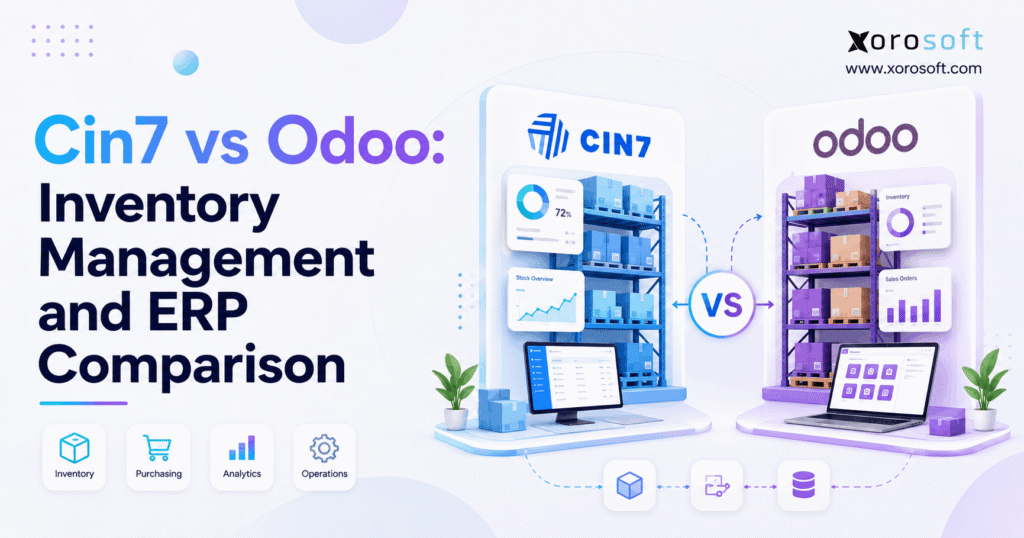
If you are comparing business management solutions, a common question is how Cin7 vs Odoo stack up against each other.
1. Why Growing Product Businesses Compare Cin7 vs Odoo
Businesses rarely start comparing Cin7 vs Odoo when their systems still run smoothly. Growth usually exposes the gaps first.
A Shopify brand may open a second warehouse and struggle to keep stock accurate across locations. A wholesaler may win larger retail accounts and suddenly need EDI. A distributor may still plan purchases in spreadsheets while finance spends days checking inventory values against accounting records. A manufacturer may need tighter control over raw materials, production, and finished goods.
At that point, the business no longer needs only better inventory software. It must decide how much of its day-to-day operation should run through one system.
That question sits at the center of the Cin7 vs Odoo decision.
Cin7 focuses heavily on inventory, purchasing, orders, warehouses, and multichannel selling. Product businesses often connect it with Shopify, Amazon, QuickBooks, Xero, shipping tools, and other specialist apps.
Odoo takes a broader approach. Its ERP suite can bring inventory, accounting, purchasing, manufacturing, CRM, ecommerce, projects, HR, and other functions into the same environment.
Growth makes this distinction increasingly important. Inventory affects purchasing. Purchasing affects cash flow. Warehouse performance shapes customer service. Ecommerce orders change stock positions. Manufacturing creates demand for materials. Finance must ultimately make sense of all those transactions.
Instead of asking which platform has more features, businesses should ask a more useful question:
Do we want inventory software at the center of several connected apps, or do we want more business functions inside one ERP platform?
The answer shapes nearly every other part of the comparison.
2. Cin7 vs Odoo: Quick Comparison for Inventory-Driven Companies
A quick Cin7 vs Odoo comparison shows strong inventory capabilities on both sides. However, each platform approaches the wider operating model differently.
| Area | Cin7 | Odoo |
|---|---|---|
| Main focus | Inventory and multichannel operations | Broad ERP suite |
| Inventory | Strong | Strong |
| Purchasing | Strong | Strong |
| Warehouse management | Standard and advanced options | Broad native workflows |
| Accounting | Connects with accounting systems | Native accounting |
| Manufacturing | BOM, MRP, and production tools | Broader MRP and shop-floor tools |
| Shopify | Direct connection | Connector-based approach |
| Amazon | Strong marketplace support | Supported in wider ecosystem |
| CRM | Limited compared with full ERP CRM | Dedicated CRM app |
| Custom setup | Configuration, APIs, integrations | Extensive configuration |
| Best fit | Product businesses using connected apps | Businesses seeking wider ERP coverage |
2.1 Cin7 Core Goes Beyond Basic Inventory Software
Cin7 Core handles much more than stock counts. Teams can manage purchase orders, sales orders, inventory locations, warehouse tasks, barcode scanning, bills of materials, assembly, reporting, and ecommerce connections from the platform.
Higher plans add deeper warehouse, planning, and production tools. This structure can work well for companies that have outgrown simple inventory apps but still want to keep familiar systems around the inventory platform.
For example, a company may choose Cin7 for inventory and order control while finance continues using QuickBooks or Xero. Ecommerce teams may remain on Shopify, while shipping and fulfillment teams keep other specialist tools.
That approach lets a business improve inventory control without replacing every system at once.
2.2 Odoo Covers a Wider Range of Business Functions
Odoo places Inventory inside a much larger set of ERP apps. Companies can use the same platform for accounting, sales, purchasing, manufacturing, CRM, ecommerce, and other workflows.
This wider scope can reduce the number of separate systems a business needs. It can also increase the amount of planning required during setup because more teams must agree on processes, rules, user roles, and reporting.
The key difference is straightforward: Cin7 often acts as the center of an app-based inventory stack, while Odoo can serve as the wider business platform.
3. Cin7 vs Odoo Inventory Management: What Matters in Daily Use
Both platforms offer strong inventory tools, so buyers should look beyond a basic feature checklist.
The real test comes when the business adds warehouses, sales channels, suppliers, products, and more complicated order flows.
Cin7 works especially well for product companies that sell across several channels. Its inventory model helps teams connect ecommerce, marketplaces, warehouses, purchasing, and fulfillment.
Odoo also gives teams detailed stock control. Users can manage warehouse locations, lots, serial numbers, stock moves, reorder rules, barcode tasks, cycle counts, and inventory value inside the ERP.
3.1 Cin7 vs Odoo for Multi-Warehouse Inventory
Multi-warehouse support involves much more than creating several location names.
A strong system should show available stock, reserved stock, incoming stock, expected demand, and transfer needs. Teams should know which warehouse can fill an order and whether one site needs replenishment from another.
Odoo lets businesses set detailed routes and stock movement rules between warehouses and internal locations. This flexibility suits companies that want close control over how goods move through the network.
Cin7 shines when warehouse inventory must stay aligned with Shopify, Amazon, wholesale orders, 3PLs, and other selling channels.
Buyers should test real situations during demos. Ask the vendor to process a partial receipt, transfer stock between warehouses, hold inventory for an order, create a backorder, return damaged goods, and correct an inventory difference.
Those examples reveal much more than a feature list.
3.2 Cin7 vs Odoo for Lots, Serials, and Traceability
Some industries need more than SKU-level stock counts.
Food companies may need lot and expiry tracking. Electronics businesses may need serial numbers. Automotive and industrial suppliers may need clear product history for warranty or recall work.
Both Cin7 and Odoo can support tracked inventory. Odoo gives teams detailed lot, serial, and stock movement records, while Cin7 also supports batch and traceability workflows.
The important question is speed and clarity.
A user should quickly answer: Where did this item come from? Where did it go? Which customer received it? Does any related stock remain in another warehouse?
If the system makes that process slow, traceability becomes an operational burden.
3.3 Forecasting and Replenishment
Growing businesses often create excess stock and stockouts because buyers still rely on spreadsheets, instinct, or old sales averages.
A good inventory platform should help planners answer four questions: what should we buy, when should we buy it, how much should we buy, and where should we place the stock?
Cin7 provides demand-planning and forecasting options that support purchasing decisions. Odoo can use reorder rules, supply routes, purchase orders, warehouse transfers, and production demand to keep inventory available.
The best system gives planners clear, useful recommendations without forcing them to rebuild the logic manually in spreadsheets.
4. Cin7 vs Odoo Warehouse Management and Purchasing
Warehouse problems often expose software limits faster than office workflows.
Receiving one purchase order is simple. Running receiving, putaway, picking, packing, transfers, returns, cycle counts, bins, lots, serials, and several warehouse sites creates a much harder problem.
Odoo gives warehouse teams tools for stock locations, putaway, barcode work, picking, packing, replenishment, transfers, and returns. Because those workflows sit inside the wider ERP, they can connect directly with purchasing, sales, manufacturing, and finance.
Cin7 also handles core warehouse work and offers more advanced WMS functions for businesses with greater fulfillment needs. Its multichannel model can work particularly well when warehouse teams need to keep several selling channels aligned.
4.1 Cin7 vs Odoo WMS Testing Should Use Real Warehouse Tasks
Teams should never choose warehouse software from presentation slides alone.
A better test starts with real floor activity. Ask users to receive part of a purchase order, place goods into several bins, move inventory to another warehouse, pick a large customer order, process a return, and fix an inventory error.
These actions quickly show whether staff can work efficiently inside the system.
Businesses with more demanding warehouse needs can also compare a dedicated warehouse management system such as XoroWMS while building their ERP shortlist.
Purchasing deserves the same level of attention. Supplier lead times, open purchase orders, landed costs, backorders, and demand plans all affect warehouse performance.
Even the best warehouse software cannot solve poor purchasing data.
5. Cin7 vs Odoo Accounting: Connected Finance or Native Finance?
Accounting creates one of the clearest differences in the Cin7 vs Odoo comparison.
Cin7 Core often works alongside accounting platforms such as QuickBooks Online or Xero. Many growing businesses prefer this model because finance can keep a familiar accounting system while operations gain stronger inventory control.
Odoo includes its own Accounting app. Companies can manage accounts payable, accounts receivable, banking, taxes, inventory value, journals, and financial reports inside the wider ERP environment.
5.1 Cin7 vs Odoo Depends on Where Finance Should Live
The key question remains simple:
Should accounting stay separate, or should the ERP manage it directly?
Separate systems can work well when data moves between them without much manual effort. Finance may prefer to retain a tool the team already knows, especially when current accounting processes remain simple.
Problems appear when month-end close turns into a long series of checks between inventory, warehouse movements, ecommerce payouts, returns, purchase costs, and accounting records.
At that point, some companies start considering a more unified cloud ERP such as XoroERP so operations and finance can work from the same core data.
Neither model wins automatically.
A company with a clean QuickBooks process may gain little from replacing it. A business that spends days reconciling separate systems may gain much more from native ERP accounting.
Finance teams should therefore test month-end close during software selection. They should review inventory value, landed costs, returns, adjustments, COGS, ecommerce settlements, and bank matching before signing a contract.
6. Cin7 vs Odoo Manufacturing: How Much Production Control Do You Need?
Manufacturing requirements can change the Cin7 vs Odoo decision quickly.
Cin7 supports bills of materials, assemblies, production planning, material needs, and other manufacturing tasks. These tools can suit companies that make kits, bundles, simple assemblies, or finished products without highly complex factory processes.
Odoo offers a broader manufacturing set. Its ERP can manage manufacturing orders, work orders, work centers, multi-level bills of materials, production plans, quality checks, maintenance, shop-floor tasks, and production costs.
6.1 Cin7 vs Odoo for Light Manufacturing
Cin7 can work well when a business mainly needs to know which parts go into a finished item, whether enough raw materials exist, and when production should start.
This approach often fits consumer products, light assembly, kitting, and businesses where ecommerce or wholesale sales remain the main drivers of production.
Cin7 can also make sense when the company wants manufacturing visibility without moving every department into a full ERP suite.
6.2 Cin7 vs Odoo for More Complex Manufacturing
Odoo often fits better when production includes several stages, multiple work centers, detailed schedules, quality checks, maintenance, or complex material plans.
A manufacturer should ask every vendor to run a full production example.
Start with the purchase of raw materials. Move through material receipt, production planning, work orders, component use, waste, completed goods, inventory updates, and final costing.
That process shows whether the system can run real production rather than simply store a bill of materials.
7. Cin7 vs Odoo for Shopify, Amazon, and Ecommerce
Ecommerce growth often makes backend problems obvious.
The Shopify store may show one stock number. Amazon may show another. The warehouse may count something different. Finance then has to determine what the business actually sold, shipped, refunded, or returned.
Cin7 focuses strongly on this multichannel problem. It can connect Shopify, Amazon, inventory, orders, and warehouse work so product businesses can manage stock from one operational center.
Odoo can also support ecommerce and marketplace work, but its main value comes from connecting commerce with the wider ERP.
7.1 Cin7 vs Odoo for Shopify
Shopify users should test far more than basic stock sync.
A serious review should include multiple stores, bundles, cancelled orders, partial shipments, returns, refunds, warehouse routing, taxes, and payout matching.
Businesses that want to compare another Shopify-centered ERP approach can review the Xorosoft ERP app on the Shopify App Store.
Teams can also examine Xorosoft’s broader ERP integrations when comparing how ecommerce, marketplaces, accounting, EDI, and other systems share data.
The goal should not be to collect the largest number of integrations. The business should reduce the number of places where stock, order, fulfillment, and finance records can disagree.
7.2 Cin7 vs Odoo for Amazon
Amazon sellers need clear control over FBA and FBM inventory, order flow, stock ownership, returns, and replenishment.
Cin7 suits this model because marketplace inventory sits close to the center of its product design.
Odoo can also handle Amazon-related operations, but sellers should test the exact workflow they plan to run.
FBA stock, FBM orders, returns, fees, transfers, order changes, and finance entries all deserve attention during the buying process.
8. Cin7 vs Odoo Integrations and Custom Setup
Cin7’s large integration network attracts many product businesses. Companies can keep specialist systems for ecommerce, accounting, shipping, marketplaces, and other tasks while Cin7 manages inventory at the center.
Odoo aims to move more of those functions into its own ERP apps. Businesses can still connect outside tools, but they may need fewer separate platforms.
8.1 Cin7 vs Odoo: More Integrations Are Not Always Better
Integration count makes an easy sales claim, but it does not measure system quality.
Every connection needs setup, monitoring, updates, and support.
Imagine Shopify shows ten units, the ERP shows eight, and the warehouse team counts seven. Someone must decide which number reflects reality and find the cause of the mismatch.
As the number of systems grows, these issues become harder to trace.
Custom work creates a similar risk. Odoo gives businesses many ways to tailor processes, while Cin7 can extend its core functions through APIs, integrations, and apps.
Companies that plan to connect ERP data with AI tools can also explore Xorosoft’s AI MCP Server as an example of how newer ERP environments can share business data with AI agents and external tools.
The strongest system architecture does not contain the most technology. It solves the business problem with the fewest fragile links.
9. Cin7 vs Odoo Pricing: Look Beyond the Monthly Fee
Pricing can make Cin7 vs Odoo look easier to compare than it really is.
Cin7 Core uses plan-based pricing. Standard, Pro, and Advanced plans increase in cost as businesses add users, order volume, app connections, planning tools, warehouse functions, and production needs.
Odoo uses a different model. Paid plans mainly price around users and plan level while giving customers access to a broad set of apps.
These models make headline prices difficult to compare directly.
9.1 Cin7 vs Odoo Total Cost Over Five Years
A useful budget includes far more than software fees.
Companies should account for setup, data migration, integrations, extra apps, custom work, training, support, hosting, internal admin time, warehouse devices, and future upgrades.
A Cin7 setup may let a business keep many systems it already understands. That approach can reduce change for users but leave more connections in place.
Odoo may remove some separate apps, but a broader ERP rollout can require more setup, training, and process change.
Companies should draw their future system on paper before comparing cost.
List every tool that will stay. Identify every application the new platform will replace. Then map every connection the business still needs.
Once teams understand the future architecture, they can compare the real five-year cost rather than one monthly subscription.
10. Cin7 vs Odoo by Industry and Business Model
Industry changes the Cin7 vs Odoo decision because each business model creates different inventory pressures.
10.1 Cin7 vs Odoo for Ecommerce Brands
Ecommerce brands need fast order flow, accurate stock, clean returns, strong purchase planning, and reliable links between storefronts and warehouses.
Cin7 often fits well when Shopify, Amazon, marketplaces, 3PLs, and inventory drive most day-to-day operations.
Odoo can become more attractive when the company also wants accounting, CRM, purchasing, and other functions inside the same ERP.
10.2 Cin7 vs Odoo for Wholesale Distribution
Wholesalers should pay close attention to customer pricing, credit rules, B2B orders, EDI, inventory allocation, purchasing, landed costs, warehouse transfers, and supplier lead times.
A wholesaler may process fewer orders than a direct-to-consumer brand but still manage more complex terms and shipping rules.
That makes workflow fit more important than order count alone.
10.3 Cin7 vs Odoo for Apparel and Fashion
Apparel companies need strong control over sizes, colors, seasons, returns, inventory allocation, wholesale pricing, and multichannel sales.
The right system should help buyers understand what sells quickly, what remains stuck, and what needs another purchase order.
10.4 Cin7 vs Odoo for Furniture
Furniture companies often manage large items, long supplier lead times, high freight costs, backorders, and several warehouse locations.
For these businesses, landed cost and purchase planning can matter just as much as the basic stock count.
10.5 Cin7 vs Odoo for Food and Beverage
Food companies need close control over lots, expiry dates, traceability, recalls, and FEFO picking.
A slow trace process can create far greater risk than an ordinary inventory error.
10.6 Cin7 vs Odoo for Sporting Goods
Sporting-goods businesses often combine seasonal demand, product variants, wholesale customers, ecommerce, and marketplace sales.
This mix creates a strong need for forecasts, allocation, and multi-location inventory control.
Businesses that want to compare ERP requirements across these markets can also review Xorosoft’s industry-specific ERP coverage.
Industry fit matters because real workflows determine whether an ERP project succeeds.
11. Cin7 vs Odoo Implementation and Long-Term Growth
Even good software can fail when teams plan the rollout poorly.
Before migration, companies should clean products, suppliers, customers, units of measure, warehouse locations, bills of materials, open sales orders, purchase orders, costs, and starting balances.
Teams should fix old data errors before they move anything.
11.1 Cin7 vs Odoo Implementation Scope
A focused Cin7 rollout may involve less change if the company plans to keep its current accounting, ecommerce, and shipping systems.
The project becomes harder as the company adds warehouses, channels, custom connections, and manufacturing steps.
Odoo can replace more systems, but that wider scope often brings more teams into the project. Finance, sales, purchasing, warehouse, manufacturing, and IT may all need to agree on future processes.
That wider project can create greater value when it reduces system sprawl, but it also creates more decisions.
Teams researching implementation should review real ERP case studies and look for examples with similar warehouses, channels, finance needs, and operational complexity.
11.2 Growth Should Be Measured by Complexity, Not Revenue Alone
Revenue gives only a rough view of ERP needs.
A $10 million company with one warehouse and one sales channel may run more simply than a $5 million company with six warehouses, Shopify, Amazon, wholesale, EDI, and light manufacturing.
Better measures include SKU count, warehouse count, channel count, order types, entities, production steps, and the amount of manual work required each month.
As those numbers rise, the cost of disconnected systems rises with them.
12. Cin7 and Odoo Alternatives When the Choice Is Not Clear
Sometimes a Cin7 vs Odoo review shows that neither model fits the business well enough.
A company may like Cin7’s inventory focus but want finance, warehouse activity, purchasing, and reporting to work more closely together.
Another may value Odoo’s broad coverage but prefer software that focuses more directly on inventory-heavy ecommerce, wholesale, distribution, or manufacturing.
That situation should prompt the team to widen the shortlist.
XoroONE provides one example of a cloud ERP for inventory-driven businesses. It combines inventory, accounting, purchasing, warehouse management, manufacturing, forecasting, reporting, ecommerce, and EDI.
That model can suit companies trying to replace a stack built from Shopify, QuickBooks, inventory apps, warehouse software, EDI tools, and spreadsheets.
Other options include NetSuite, Acumatica, Microsoft Dynamics 365 Business Central, Brightpearl, Fishbowl, Sage, and industry-focused ERP platforms.
Businesses comparing larger ERP suites can also review a Xorosoft vs NetSuite comparison when considering cost, system scope, and long-term fit.
Xorosoft’s broader ERP solutions provide another reference point for teams that want to see how inventory, purchasing, warehouses, ecommerce, manufacturing, and finance can work together.
The goal is not to build a list of ten vendors.
Teams should define the future operating model first and then shortlist only the systems that match it.
13. Cin7 vs Odoo Frequently Asked Questions
13.1 What Is the Main Difference Between Cin7 and Odoo?
Cin7 focuses mainly on inventory and multichannel product operations. Odoo offers a broader ERP suite that covers inventory, accounting, manufacturing, purchasing, CRM, ecommerce, and other functions. Cin7 often works as the inventory hub in a group of connected apps, while Odoo can bring more business processes into one platform.
13.2 Which Is Better, Cin7 or Odoo?
Neither platform wins every comparison. Cin7 can suit product companies that care most about inventory, ecommerce, marketplaces, warehouses, and connected apps. Odoo can suit companies that want broader ERP coverage across finance, purchasing, manufacturing, CRM, and operations. The right choice depends on the future system architecture.
13.3 Is Cin7 an ERP?
Cin7 includes many ERP-style functions, including purchasing, inventory, warehouse operations, order management, reporting, and manufacturing tools. However, many Cin7 Core customers keep a separate accounting platform such as QuickBooks Online or Xero. That model differs from a broad ERP suite that manages finance natively.
13.4 Is Odoo an ERP?
Yes. Odoo offers a modular ERP suite with apps for inventory, accounting, purchasing, sales, manufacturing, CRM, ecommerce, projects, HR, and other business areas. Companies can add the functions they need while keeping them inside one broader system.
13.5 Which Is Better for Inventory Management?
Both products offer strong inventory tools. Cin7 fits companies that want inventory to connect ecommerce, marketplaces, warehouses, and other apps. Odoo gives teams deep stock control and links inventory directly with purchasing, manufacturing, sales, and accounting. Business architecture should guide the choice.
13.6 Which Is Better for ERP?
Odoo offers broader native ERP coverage. Cin7 may still fit better when inventory and multichannel selling create the main operational problem and the company wants to keep familiar tools such as QuickBooks, Xero, Shopify, and specialist fulfillment apps.
13.7 How Much Does Cin7 Cost?
Cin7 Core uses plan-based pricing. Standard, Pro, and Advanced plans increase available users, order volume, app connections, warehouse features, planning tools, and production functions. Businesses should compare the plan that matches their real workload rather than focus only on the lowest entry price.
13.8 How Much Does Odoo Cost?
Odoo uses per-user pricing for its paid plans and also offers a One App Free option. Paid plans provide access to a broad set of applications, while higher tiers add more options for APIs, hosting, multi-company use, and system setup. Companies should confirm current pricing before purchase.
13.9 Which Is Cheaper, Cin7 or Odoo?
Monthly fees do not provide a complete answer. Total cost depends on users, implementation, data migration, apps, custom work, integrations, training, support, and internal admin time. A three- to five-year cost model gives a much more accurate comparison.
13.10 Does Cin7 Include Accounting?
Cin7 provides financial reports and links with accounting platforms such as QuickBooks Online and Xero. Companies that want the general ledger, payables, receivables, bank matching, tax work, and inventory accounting in one platform should also compare broader ERP options.
13.11 Does Odoo Include Accounting?
Yes. Odoo includes native accounting functions for receivables, payables, bank work, journals, taxes, assets, budgets, and financial reports. Because Accounting sits within the ERP, teams can connect financial activity directly with purchasing, sales, and inventory.
13.12 Can Cin7 Replace QuickBooks?
Most Cin7 Core deployments use Cin7 alongside an accounting system rather than replacing it outright. A business that wants to remove QuickBooks should first decide whether it now needs full ERP finance, including general ledger, AP, AR, cash control, tax workflows, and inventory accounting.
13.13 Can Odoo Replace QuickBooks?
Odoo can replace QuickBooks for many companies because it includes a broader set of finance tools. However, businesses should review tax rules, payroll, local requirements, reporting, historical data, accountant access, and other finance needs before making the change.
13.14 Does Cin7 Work With Shopify?
Yes. Cin7 supports Shopify and suits product businesses that need orders and inventory to move between ecommerce and warehouse systems. Companies with several stores should also test bundles, returns, cancellations, warehouse routing, refunds, and stock updates.
13.15 Does Odoo Work With Shopify?
Odoo can connect with Shopify through available connectors and apps. Buyers should check who maintains the connector, which Odoo version it supports, how often the developer updates it, and who handles support if the connection stops working.
13.16 Which Is Better for Amazon Sellers?
Cin7 fits Amazon-heavy businesses well because marketplace inventory and order flow form a major part of its product model. Odoo can also support Amazon workflows, but sellers should test FBA, FBM, returns, fees, transfers, and stock updates before choosing a platform.
13.17 Which Is Better for Wholesale Distribution?
Both platforms can support wholesalers. Cin7 works well when inventory and channel connections lead the requirements. Odoo can fit companies that also want finance, purchasing, CRM, manufacturing, and stock inside the same ERP. Buyers should test EDI and customer-specific pricing in detail.
13.18 Which Is Better for Manufacturing?
Odoo generally offers deeper manufacturing functions, including work centers, work orders, production schedules, quality, maintenance, and material planning. Cin7 can work well for light production, kits, assemblies, and companies that combine manufacturing with ecommerce or wholesale.
13.19 Does Cin7 Support Multiple Warehouses?
Yes. Cin7 supports multiple inventory locations and offers warehouse functions across its plans. Teams should still test transfers, receiving, picking, returns, restocking, and inventory checks to make sure the selected plan fits the actual warehouse process.
13.20 Does Odoo Support Multiple Warehouses?
Yes. Odoo supports several warehouses and storage locations along with routes, transfers, replenishment, barcodes, lots, serial numbers, and stock movements. Companies with complex warehouse networks should model those flows during implementation planning.
13.21 Is Cin7 Good for Ecommerce?
Yes. Cin7 works well for ecommerce and multichannel product companies. It can help bring stock, orders, warehouses, marketplaces, and other connected tools together while allowing teams to keep specialist apps around the inventory platform.
13.22 Is Odoo Good for Ecommerce?
Yes, especially when ecommerce needs to connect with a wider ERP. Odoo can link commerce with inventory, accounting, purchasing, CRM, and other business functions. Companies that keep Shopify or another external storefront should pay close attention to connector quality.
13.23 Which Platform Is Easier to Set Up?
Scope matters more than product name. A narrow Cin7 project may require less change when the company keeps existing apps. A broad Odoo rollout may involve more teams. At the same time, a Cin7 setup with many custom connections can also become difficult to manage.
13.24 Which Platform Is Easier to Customize?
Odoo usually gives teams more ways to change workflows and applications. Cin7 can also extend its functions through integrations, APIs, and apps. Businesses should avoid unnecessary custom work because every custom process can increase cost and make future upgrades harder.
13.25 What Are the Best Alternatives to Cin7 and Odoo?
Common options include Xorosoft, NetSuite, Acumatica, Microsoft Dynamics 365 Business Central, Brightpearl, Fishbowl, Sage, and other industry-focused systems. Teams should build the shortlist around inventory, finance, WMS, manufacturing, ecommerce, EDI, reporting, and implementation needs.
13.26 When Should a Business Move From Inventory Software to ERP?
System sprawl gives the clearest warning. Spreadsheet purchasing, slow month-end close, stock errors, duplicate data entry, weak warehouse visibility, separate ecommerce and wholesale systems, and reports built by hand all suggest that the business may need a broader ERP.
14. Cin7 vs Odoo: Practical Next Steps Before You Choose
The best Cin7 vs Odoo decision should reflect how the business plans to operate over the next several years, not which vendor delivers the most polished demo.
Cin7 makes sense when inventory and multichannel selling drive the operation and the company wants to keep specialist applications around that inventory core.
Odoo becomes a stronger fit when the business wants a wider ERP and plans to bring accounting, manufacturing, purchasing, CRM, and other functions into the same platform.
Another ERP deserves consideration when the company wants both broad business control and a stronger focus on inventory, warehouses, ecommerce, wholesale, EDI, and manufacturing.
Before signing a software contract, map the key workflows from beginning to end. Follow purchase to receipt, order to cash, pick to ship, return to refund, and inventory to month-end close. Manufacturers should also trace raw materials through production and finished goods.
Next, count the systems, handoffs, spreadsheets, and manual checks each workflow requires.
That exercise often makes the right choice much clearer than another feature comparison.
Businesses that want to compare those needs with a unified inventory-driven ERP can contact Xorosoft and review real workflows rather than relying on a generic feature list.
Recent Posts
-
 ERP Landed Cost Module vs Spreadsheet Calculations for Importers
 -
 How to Build an Open-to-Buy Plan for an Omnichannel Brand
 -
 Cold Storage WMS for Food and Beverage Distribution
 -
 ERP Buying Statistics 2026: Evaluation, Implementation, and Adoption Risks
 -
 How a Distributor Reduced B2B Order Exceptions Without Restricting Sales