If you are wondering about the differences between ATP vs ATS inventory, this article will help clarify these important concepts.
1. When One Inventory Number Is Not Enough
ATP vs ATS inventory explains why the number shown as “stock on hand” does not always tell a business what it can actually sell or promise to customers. In practice, inventory can already be allocated, reserved, protected as safety stock, moving between warehouses, or expected from an incoming purchase order. Therefore, two businesses with exactly 1,000 units on hand can have very different quantities available for new orders.
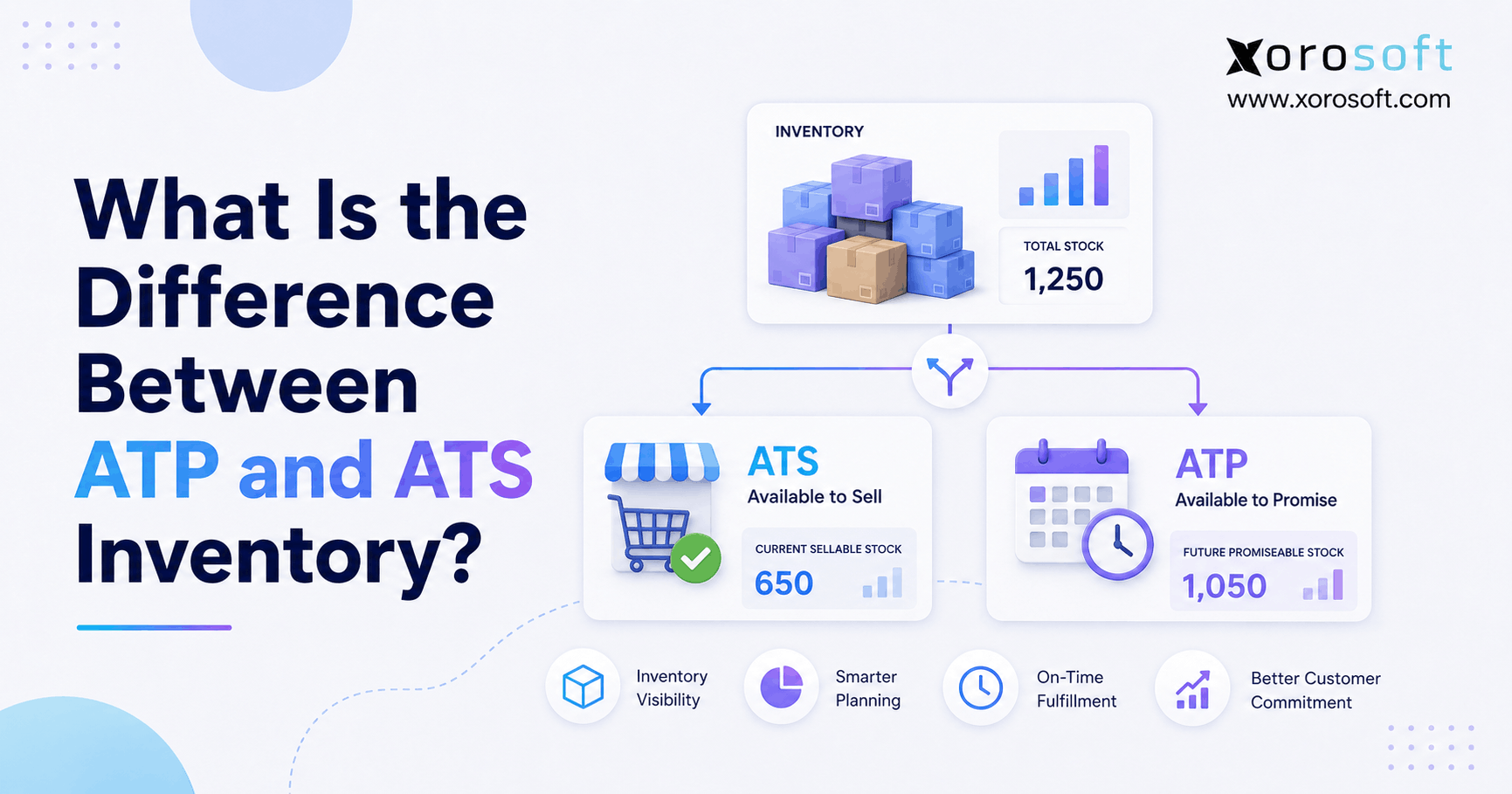
Most importantly, ATS generally answers a current availability question: How much inventory can we sell under our existing inventory rules? By contrast, ATP answers a forward-looking question: How much inventory can we responsibly promise for a particular date?
Consequently, the distinction matters whenever a business handles preorders, backorders, wholesale commitments, multiple warehouses, incoming supply, or several sales channels. Moreover, as inventory operations become more complex, relying only on physical on-hand quantities creates a higher risk of overselling or giving customers unrealistic delivery dates.
Throughout this guide, ATS means Available to Sell. However, some systems and industries use ATS differently, including “Available to Ship.” Therefore, businesses should always verify how their software defines the term.
Similarly, there is no universal ATS formula that applies to every platform. Instead, businesses define which inventory states should reduce sale availability. ATP calculations also depend on system rules; nevertheless, ATP generally introduces the additional dimension of time.
Understanding ATP vs ATS inventory therefore requires more than memorizing two acronyms. Instead, the goal is to understand how inventory moves from physical stock to sale eligibility and, finally, to a reliable customer promise.
2. What ATS Inventory Actually Measures
2.1 ATS Means Available to Sell
ATS commonly stands for Available to Sell. In simple terms, it represents the quantity of an item that remains eligible for new sales after relevant commitments and restrictions have been considered.
For example, suppose a company has 800 units physically recorded in its warehouse. However, 200 units have already been allocated to customer orders, while another 50 units are reserved for a key wholesale account. Additionally, the company protects 50 units as safety stock.
As a result, the full 800 units should not necessarily appear as sellable inventory.
A simplified calculation would be:
ATS = 800 − 200 − 50 − 50 = 500 units
Therefore, although 800 units are physically present, only 500 units are currently available to sell under that policy.
2.2 ATS Is Not the Same as On-Hand Inventory
On-hand inventory answers:
How much inventory does the system currently record?
However, ATS answers:
How much of that inventory should still be offered to customers?
Therefore, ATS may exclude:
- allocated sales orders
- customer reservations
- quality-control holds
- damaged inventory
- safety stock
- inventory committed to transfers
- channel-specific buffers
- stock reserved for retail locations
Consequently, using on-hand inventory as ATS can produce misleading availability.
2.3 A Practical ATS Formula
Although system rules vary, a common conceptual formula is:
ATS = Sale-eligible on-hand inventory − allocations − reservations − protected inventory
For example:
On hand: 500 units
Allocated: 100 units
Reserved: 40 units
Safety stock: 60 units
Therefore:
ATS = 500 − 100 − 40 − 60 = 300 units
In this example, 300 units could be exposed for new sales.
3. What ATP Inventory Actually Measures
3.1 ATP Means Available to Promise
ATP stands for Available to Promise. Instead of focusing only on current sale eligibility, ATP evaluates how much inventory can be committed to customers over a particular period.
Therefore, ATP becomes especially useful when a customer asks:
“Can you supply 1,000 units next month?”
Current inventory alone cannot answer that question. Instead, the business may need to consider incoming purchase orders, expected transfers, scheduled production, and orders that have already consumed future supply.
3.2 ATP Adds Time to Inventory Availability
The most important distinction in ATP vs ATS inventory is time.
ATS is primarily concerned with sale eligibility now. By contrast, ATP considers whether supply should be available before a required customer date.
For example, a business may have only 100 available units today. However, another 1,000 units may be confirmed from a supplier for delivery next week.
Therefore, ATS today may remain 100. Meanwhile, ATP for a date after the inbound shipment arrives could be substantially higher.
3.3 A Practical ATP Formula
A simplified ATP calculation is:
ATP = Eligible current inventory + eligible future supply − committed demand
For example:
Eligible current stock: 300 units
Confirmed incoming PO: 700 units
Existing future commitments: 400 units
Therefore:
ATP = 300 + 700 − 400 = 600 units
Consequently, the company might be able to promise another 600 units for a date after the purchase order is expected to arrive.
4. ATP vs ATS Inventory: The Key Differences
Understanding ATP vs ATS inventory becomes easier when both concepts are placed side by side.
| Factor | ATS | ATP |
|---|---|---|
| Full term | Available to Sell | Available to Promise |
| Core question | What can we sell? | What can we promise by a date? |
| Time horizon | Primarily current | Current and future |
| On-hand stock | Yes | Yes |
| Allocations | Usually considered | Usually considered |
| Reservations | Usually considered | Usually considered |
| Incoming supply | Depends on system rules | Commonly considered |
| Future commitments | Limited role | Critical |
| Typical purpose | Sale eligibility | Customer order promising |
| Useful for preorders | Limited | Yes |
| Useful for wholesale forward orders | Limited | Yes |
4.1 Current Availability Versus Future Availability
First, ATS focuses primarily on stock that can be exposed for sale.
By contrast, ATP determines whether supply will be available when the customer actually needs it.
Therefore, a SKU can have low ATS today while still having strong ATP for next month.
4.2 Sellable Stock Versus Promiseable Stock
Second, ATS helps protect today’s selling process.
Meanwhile, ATP protects tomorrow’s customer promise.
Consequently, companies with long supplier lead times or future wholesale orders usually need more forward-looking availability logic than companies that simply stop selling when inventory reaches zero.
4.3 Incoming Supply Changes the Picture
Additionally, future supply plays a major role in ATP.
Depending on the ERP or inventory system, eligible supply can include:
- confirmed purchase orders
- scheduled production
- transfer orders
- inventory in transit
However, not every future receipt should automatically increase ATP. Instead, businesses need rules determining whether that supply is sufficiently reliable to support a customer commitment.
5. ATP vs ATS Inventory Calculation: A Full Example
5.1 Start With the Inventory Position
Consider a growing consumer-products company with the following inventory for one SKU:
Current on hand: 1,000 units
Allocated customer orders: 260 units
Wholesale reservation: 100 units
Safety stock: 90 units
Confirmed inbound PO: 700 units
Future wholesale commitment: 300 units
Therefore, the company cannot simply tell its sales team that 1,000 units are available.
5.2 Calculate ATS
Using the simplified ATS model:
ATS = On hand − allocations − reservations − safety stock
Therefore:
1,000 − 260 − 100 − 90 = 550 units
As a result, 550 units are currently eligible to sell.
5.3 Calculate ATP for a Future Date
Now assume the confirmed 700-unit purchase order arrives before the next customer’s requested date.
The simplified calculation becomes:
ATP = Current eligible stock + future eligible supply − future commitments
Therefore:
550 + 700 − 300 = 950 units
Consequently, ATS is 550 today, while ATP for the later date could be 950.
This example shows why ATP vs ATS inventory should not be interpreted as competing measurements. Instead, each answers a different operational question.
6. Why Purchase Orders Matter to ATP
6.1 Confirmed Supply Can Support Future Promises
Purchase orders can materially change ATP because they represent expected future inventory.
However, a business should not treat every purchase order equally.
For example, an approved PO that has already shipped from a reliable supplier is considerably more dependable than an unapproved draft PO.
Therefore, ATP policies may consider:
- PO approval status
- expected receipt date
- supplier reliability
- quantities already received
- shipping status
- warehouse destination
6.2 Late Purchase Orders Can Break Customer Promises
Nevertheless, ATP is only as reliable as its supply dates.
If a supplier delays a shipment by two weeks, orders dependent on that supply may also need later promise dates.
Consequently, purchasing information should remain synchronized with sales and inventory records.
For growing inventory-driven businesses, a connected XoroERP environment can help bring purchasing, inventory, orders, and operational data together instead of relying on separate spreadsheets.
7. Safety Stock, Reservations, and Allocations
7.1 Safety Stock Protects Against Uncertainty
Safety stock exists because supply and demand rarely behave exactly as planned.
Therefore, a business may intentionally prevent some inventory from being exposed to new orders.
For example, if 120 units remain after allocations but the company protects 30 units, only 90 may contribute to ATS.
7.2 Reservations Protect Specific Demand
Similarly, a company may reserve stock for:
- VIP wholesale customers
- retail stores
- promotional events
- product launches
- warranty replacements
- marketplace channels
Consequently, reserved inventory should not accidentally remain available to every other channel.
7.3 Allocations Prevent Double-Selling
Meanwhile, allocations connect inventory to existing orders.
Once stock has been allocated, selling it again can create duplicate commitments.
Therefore, accurate allocation logic is essential to both ATS and ATP.
8. ATP vs ATS Inventory in Ecommerce
8.1 Ecommerce Makes Availability More Dynamic
ATP vs ATS inventory becomes particularly important in ecommerce because orders can enter the business continuously.
For example, Shopify may receive orders while Amazon, wholesale, retail, and EDI channels are consuming the same inventory pool.
Therefore, availability needs to reflect demand from all relevant channels rather than treating each one as independent.
8.2 Shared Inventory Can Create Overselling
Suppose a company has 100 available units.
However, if Shopify sees 100, Amazon sees 100, and the wholesale team also believes 100 are available, the company does not actually have 300 units.
It still has 100.
Consequently, disconnected channel availability can create overselling even when physical inventory is accurate.
8.3 Connected Ecommerce Data Reduces the Gap
Therefore, growing merchants often connect ecommerce channels to a central operational system.
Xorosoft’s integrations are designed to connect ERP operations with ecommerce and other business systems, while its listing on the Shopify App Store provides an additional reference point for Shopify merchants evaluating that connection.
As a result, orders and inventory movements can be managed from a more unified operational record rather than separate stock assumptions.
9. How ATP Supports Preorders and Backorders
9.1 Preorders Depend on Future Supply
A preorder intentionally allows a customer to buy before inventory is immediately available.
Therefore, ATS alone cannot fully answer whether another preorder should be accepted.
Instead, ATP can evaluate confirmed incoming supply against demand that has already been promised.
9.2 Backorders Consume Future Availability
Similarly, a backorder creates demand against a future supply period.
For example, if 1,000 units are inbound and 700 are already backordered, only 300 remain before other future commitments are considered.
Therefore, allowing unlimited backorders without ATP logic can simply move overselling from the present into the future.
10. ATP vs ATS Inventory in Wholesale Distribution
10.1 Wholesale Orders Often Look Farther Ahead
Wholesale buyers frequently place larger orders with delivery dates several weeks or months in the future.
Consequently, ATP vs ATS inventory becomes more important than it is for a simple “sell only what is on the shelf” model.
For example, a retailer may request 3,000 units for a seasonal promotion.
Although ATS today may show only 1,500, an incoming supplier order could support the full commitment.
Therefore, the correct question becomes whether enough eligible supply will exist by the requested delivery date.
10.2 Customer-Specific Reservations Complicate Availability
Additionally, wholesalers may reserve inventory for major customers.
Therefore, total enterprise availability does not necessarily equal availability for every customer.
Similarly, EDI orders can consume significant quantities quickly. Consequently, those orders should reduce the same inventory pool used by ecommerce and other channels.
11. ATP vs ATS Inventory Across Multiple Warehouses
11.1 Total Inventory Can Hide Location Problems
Suppose a business has:
Toronto: 500 units
New Jersey: 350 units
Los Angeles: 50 units
Therefore, total inventory is 900 units.
However, a West Coast customer requesting 200 units may still face a fulfillment problem.
Consequently, enterprise-wide inventory alone does not tell the whole story.
11.2 Location Changes the Promise
ATP should therefore consider:
- warehouse location
- transfer time
- shipping time
- incoming receipts
- location-specific reservations
- fulfillment rules
Meanwhile, ATS should reflect what each location or channel can genuinely make available.
A real-time XoroWMS workflow can help connect receiving, picking, packing, shipping, and inventory movements so warehouse availability is based on current operational activity.
11.3 Transfers Must Not Be Counted Twice
Additionally, transfer orders require special care.
When inventory leaves one warehouse for another, it should not remain freely available at the origin while also appearing as immediately available at the destination.
Otherwise, the same units can be promised twice.
12. ATP in Manufacturing Operations
12.1 Production Can Create Future Supply
Manufacturers face another layer of complexity because future supply may come from production rather than purchase orders.
Therefore, ATP can potentially consider scheduled work orders or expected finished-goods output.
However, a production plan is only reliable when materials and capacity are available.
12.2 Materials Can Limit the Promise
For example, a manufacturer may plan to produce 500 finished units next week.
However, if a critical component is short, those 500 units may not be truly promiseable.
Consequently, more advanced manufacturing environments may move beyond basic ATP toward capable-to-promise logic.
Xorosoft’s broader XoroONE platform combines inventory, purchasing, warehouse operations, manufacturing, accounting, reporting, and ecommerce capabilities for inventory-driven businesses that need those processes connected.
13. ATP Versus CTP
13.1 ATP Asks What Supply Can Be Promised
ATP generally evaluates available and eligible supply against demand.
Therefore, it works well when the primary challenge is deciding how existing or expected inventory should be committed.
13.2 CTP Asks What Can Be Produced
By contrast, CTP means Capable to Promise.
CTP asks whether new supply can be created by considering:
- production capacity
- material availability
- manufacturing lead time
- routing constraints
- production schedules
Therefore, CTP becomes more relevant in make-to-order or capacity-constrained manufacturing.
| Factor | ATP | CTP |
| Current inventory | Yes | Yes |
| Confirmed incoming supply | Yes | Yes |
| Existing production | Often | Yes |
| New production capacity | Limited | Core consideration |
| Raw-material constraints | System dependent | Core consideration |
| Main question | What can we promise? | What can we make and promise? |
14. Common ATP and ATS Inventory Mistakes
14.1 Using On-Hand as Available Inventory
First, businesses often assume that whatever is physically present can still be sold.
However, existing commitments may already consume part of that inventory.
Therefore, on-hand inventory should not automatically be treated as ATS.
14.2 Counting Unreliable Incoming Supply
Second, companies sometimes increase ATP based on tentative purchase orders.
However, if the PO is not approved or the supplier frequently misses dates, the resulting promise can be unreliable.
Therefore, only qualified supply should contribute.
14.3 Ignoring Safety Stock
Third, companies may technically calculate enough inventory to fill another order.
Nevertheless, doing so may consume the buffer intended to protect service levels.
Consequently, safety-stock policies should be reflected in availability rules.
14.4 Allowing Channels to Maintain Separate Truths
Additionally, ecommerce, wholesale, warehouse, and accounting applications may each contain different quantities.
As a result, teams can make decisions using conflicting inventory data.
A connected Xorosoft solutions environment is designed to centralize operational workflows across inventory-driven businesses rather than forcing teams to reconcile independent records manually.
15. When ATS Alone May Be Enough
15.1 Simple Businesses Do Not Need Maximum Complexity
Not every business needs sophisticated ATP.
For example, ATS may be enough when a company:
- operates one warehouse
- sells only current physical stock
- has short supplier lead times
- does not accept preorders
- does not accept backorders
- has limited wholesale commitments
- operates only a few sales channels
Therefore, adding advanced order-promising logic simply because it exists may create unnecessary complexity.
15.2 Operational Complexity Should Drive the Decision
Instead, businesses should ask whether customers regularly need future delivery commitments.
If the answer is no, accurate ATS and inventory synchronization may be sufficient.
However, once future supply becomes part of the selling process, ATP becomes increasingly useful.
16. When ATP Becomes Necessary
16.1 Future Commitments Are the Main Trigger
Businesses should consider ATP when they regularly deal with:
- preorders
- backorders
- wholesale forward orders
- long supplier lead times
- incoming transfer orders
- manufacturing supply
- multiple warehouses
- large customer commitments
Therefore, the practical question is straightforward:
Do we promise inventory before it is immediately available?
If yes, ATP can provide valuable control.
16.2 Growth Makes Manual Calculation Harder
Initially, a team may calculate future availability in spreadsheets.
However, as order volume grows, spreadsheets become difficult to synchronize with live purchasing, sales, and warehouse activity.
Consequently, ATP becomes not only a formula question but also a systems question.
17. Why ERP Matters to ATP vs ATS Inventory
17.1 Reliable Availability Requires Connected Inputs
The mathematics behind ATP vs ATS inventory is relatively simple.
However, maintaining trustworthy inputs is much harder.
For example, ATP may depend on:
- current inventory
- allocated sales orders
- incoming purchase orders
- transfer orders
- manufacturing orders
- warehouse receipts
- reservations
Therefore, if each input lives in a different application, availability can quickly become stale.
17.2 ERP Creates a Shared Operational Record
A cloud ERP can connect those activities.
For example, sales orders create demand while purchase orders create future supply. Meanwhile, warehouse receipts increase inventory, and shipments reduce it.
Consequently, each transaction updates the same broader operational picture.
For inventory-driven companies that have outgrown spreadsheets and disconnected applications, this is where platforms such as Xorosoft can become relevant.
18. A Practical ATP vs ATS Inventory Decision Framework
18.1 Use ATS When the Question Is “Can We Sell It Now?”
Use ATS when you primarily need to know how much existing stock remains eligible for new orders.
Therefore, ATS is particularly useful for:
- ecommerce availability
- channel buffers
- current inventory exposure
- overselling prevention
- available stock reporting
18.2 Use ATP When the Question Is “Can We Promise It?”
Use ATP when customer commitments depend on future supply.
Therefore, ATP is useful for:
- wholesale delivery promises
- preorders
- backorders
- inbound purchase orders
- scheduled manufacturing
- warehouse transfers
18.3 Use Both When Operations Are Complex
In many growing organizations, both metrics are useful.
ATS controls what should be sold today.
Meanwhile, ATP controls what should be promised tomorrow.
Consequently, the two measurements complement rather than replace each other.
19. Frequently Asked Questions About ATP vs ATS Inventory
19.1 What is ATP inventory?
ATP means Available to Promise. In practice, it estimates how much inventory can be committed to customer demand for a particular period or date. Therefore, ATP can consider both eligible current inventory and future supply. Additionally, it subtracts existing commitments so the same future inventory is not promised repeatedly.
19.2 What is ATS inventory?
ATS usually means Available to Sell. Therefore, it represents inventory that remains eligible for new sales after relevant allocations, reservations, holds, and buffers are considered. However, businesses should verify how their specific software defines ATS because calculation rules can differ between systems.
19.3 What is the main difference between ATP and ATS?
The main difference is time. ATS generally focuses on current sale eligibility, whereas ATP focuses on what can be promised across a future period. Therefore, incoming supply matters much more to ATP. Consequently, businesses accepting future-dated orders usually need a more sophisticated availability calculation.
19.4 Is ATS the same as on-hand inventory?
No. On-hand inventory records how much stock physically exists in the system. However, ATS reflects how much remains eligible for sale. Therefore, ATS may be lower because some on-hand inventory has already been allocated, reserved, quarantined, or protected as safety stock.
19.5 Is ATP the same as on-hand inventory?
No. ATP may begin with on-hand inventory, but it can also incorporate eligible future supply and future commitments. Therefore, a company could have limited inventory today while still having substantial ATP for a later date because additional stock will arrive before then.
19.6 How do you calculate ATS inventory?
A simplified formula is ATS = sale-eligible on-hand inventory − allocations − reservations − applicable buffers. However, the exact calculation depends on company rules. Therefore, businesses should define whether safety stock, quality holds, channel reservations, and other inventory states should reduce sale availability.
19.7 How do you calculate ATP inventory?
A simplified formula is ATP = eligible current inventory + eligible future supply − committed demand. Nevertheless, sophisticated systems may also consider safety stock, transfers, work orders, forecasts, location, and lead times. Therefore, the exact ATP result depends on the underlying availability rules.
19.8 Does ATP include purchase orders?
Often, yes. However, purchase orders should normally contribute only when they meet the company’s eligibility rules. For example, a confirmed PO due next week is more reliable than an unapproved draft. Therefore, approval status, expected dates, supplier performance, and receipt location can all matter.
19.9 Does ATS include purchase orders?
Sometimes, but not universally. Different systems define ATS differently. Therefore, one platform may focus on current eligible stock while another may incorporate certain expected receipts. Consequently, companies should inspect their software’s actual calculation instead of assuming that every ATS metric follows the same formula.
19.10 Does ATP include incoming inventory?
Yes, eligible incoming supply is commonly one of ATP’s most important inputs. For example, confirmed POs, transfers, or production receipts may support later customer promises. However, the expected receipt must generally occur before the customer’s required date for that supply to be useful.
19.11 Does ATP include safety stock?
It can, depending on policy. However, many businesses intentionally protect safety stock so ATP cannot consume it during normal order promising. Therefore, the correct treatment depends on the company’s service-level strategy and how much inventory it wants to protect against demand or supply uncertainty.
19.12 Does ATS include safety stock?
Safety stock often reduces ATS when the business does not want that buffer exposed for ordinary sale. For example, if 100 units remain after allocations but 20 are protected, ATS may be 80. Therefore, inventory policy directly influences the displayed sellable quantity.
19.13 Can ATP inventory become negative?
Yes. A negative ATP value can indicate that committed demand exceeds eligible supply within the relevant period. Consequently, the company may need additional inventory, a later promise date, a transfer, or another fulfillment source before accepting further commitments.
19.14 Can ATS inventory become negative?
Some systems may allow negative availability, while others stop at zero. Nevertheless, a negative quantity often signals overselling, delayed receipts, allocation problems, or inaccurate inventory. Therefore, teams should investigate the underlying transactions rather than treating the negative number as a normal operating condition.
19.15 How does ATP help prevent overselling?
ATP compares future eligible supply with demand that has already been committed. Therefore, once supply has been consumed by existing promises, the same inventory should not support another order. Consequently, ATP extends overselling protection beyond today’s stock into future inventory periods.
19.16 How does ATS help prevent overselling?
ATS reduces the quantity exposed for new sales after allocations and other restrictions are considered. Therefore, channels should not continue selling stock that has already been committed elsewhere. However, ATS depends on timely synchronization; otherwise, two channels may still attempt to sell the same remaining units.
19.17 How does ATP work across several warehouses?
ATP can evaluate availability by location rather than using only company-wide totals. Therefore, warehouse inventory, transfer times, inbound receipts, and fulfillment rules may influence the promise. Consequently, positive enterprise inventory does not automatically mean every warehouse can meet the requested customer date.
19.18 What happens when an incoming PO is delayed?
If ATP relied on that purchase order, the available promise date may need to change. Therefore, customer orders dependent on the delayed receipt may require reassignment, another supply source, or a later shipment date. Consequently, accurate supplier dates are essential to trustworthy ATP.
19.19 What is the difference between ATP and CTP?
ATP primarily asks whether existing and expected supply can satisfy demand. By contrast, CTP asks whether additional supply can be produced using available materials and capacity. Therefore, CTP becomes especially useful in manufacturing environments where customer promises depend on production capability.
19.20 Is ATS enough for a small ecommerce company?
Often, yes. If a company sells only what is currently in stock, operates one warehouse, and does not accept future orders, accurate ATS may be sufficient. However, ATP becomes more valuable once the company begins selling against incoming supply or making future delivery commitments.
19.21 When should a company start using ATP?
A company should consider ATP when customer demand regularly depends on future inventory. For example, preorders, wholesale commitments, long supplier lead times, manufacturing, and multiple warehouses are common triggers. Therefore, the need usually comes from operational complexity rather than company size alone.
19.22 Can Shopify merchants benefit from ATP?
Yes, particularly when Shopify is only one part of a broader operating model. For example, a merchant may also sell on Amazon, wholesale, or EDI while purchasing inventory months in advance. Therefore, future availability becomes increasingly important as channels and commitments multiply.
19.23 Why does inventory accuracy matter to ATP?
ATP cannot correct inaccurate source data. If on-hand quantities, open purchase orders, or existing commitments are wrong, the ATP result will also be wrong. Therefore, cycle counting, receiving accuracy, allocation discipline, and timely transaction updates remain fundamental to reliable customer promises.
19.24 Why does inventory accuracy matter to ATS?
ATS starts with the inventory information available to the system. Therefore, if physical inventory differs from recorded inventory, the sellable quantity can also be misleading. Consequently, strong warehouse processes and accurate inventory adjustments remain essential even when sophisticated availability formulas are used.
19.25 When should a company move from basic inventory software to ERP?
A company should consider ERP when inventory availability depends on too many disconnected systems. For example, Shopify orders, wholesale demand, warehouse transactions, purchase orders, accounting, manufacturing, and spreadsheets may all affect the same stock. Therefore, repeated manual reconciliation is a strong sign that a connected operational system may be needed.
20. Turn Inventory Availability Into a Reliable Customer Promise
Ultimately, ATP vs ATS inventory is not simply an accounting distinction. Instead, it determines whether a business understands what it can sell today and what it can responsibly promise tomorrow.
ATS helps answer:
What inventory remains eligible to sell?
Meanwhile, ATP answers:
What inventory can we commit by the customer’s required date?
Therefore, businesses that sell only current physical inventory may operate successfully with strong ATS controls. However, businesses handling preorders, wholesale commitments, incoming purchase orders, manufacturing, multiple warehouses, or several ecommerce channels usually need a more forward-looking view.
Most importantly, neither metric can be trusted when the underlying data is fragmented. Therefore, purchasing, warehouse activity, sales orders, reservations, ecommerce orders, and inventory movements need to remain synchronized.
For growing inventory-driven companies, connected ERP and warehouse systems can provide that shared operational foundation. Consequently, teams can spend less time reconstructing availability manually and more time making reliable fulfillment decisions.
If your business is struggling to reconcile inventory across purchasing, ecommerce, wholesale, or multiple warehouses, you can Book a Demo to see how Xorosoft can connect those workflows in one operational environment.
Recent Posts
-
 Distributor Sales Software for Managing B2B Orders, Customer Pricing, Inventory, and Sales Operations
 -
 Does Shopify B2B Still Need an ERP in 2026?
 -
 How Inventory Status Tracking Clarified Damaged, Reserved, and Available Stock
 -
 Predictive Analytics in Logistics for 3PL Operations: Predicting Labor, Dock Volume, and SLA Risk
 -
 Should a B2B Ecommerce Platform Calculate Inventory Availability or Read It From ERP?