If you’re looking for the latest B2B ecommerce statistics 2026, you’ve come to the right place.
1. B2B Ecommerce Statistics 2026 Show Digital Buying Has Become Core Infrastructure
B2B ecommerce has moved well beyond the stage where companies could treat online ordering as an optional channel. For wholesalers, manufacturers, distributors, and product-based businesses, digital commerce is increasingly connected to how customers research products, compare suppliers, check stock, obtain pricing, place orders, reorder products, and manage procurement.
The latest B2B ecommerce statistics 2026 reinforce that shift. The U.S. International Trade Administration projects the global B2B ecommerce market at approximately $36 trillion in 2026, with an estimated compound annual growth rate of about 14.5%. Under the same methodology, Asia-Pacific represents roughly 80% of worldwide B2B ecommerce gross merchandise value. U.S. International Trade Administration
Those numbers are significant, but market size alone does not explain what is happening inside individual companies. The more important development is the continued migration of established B2B transactions from phone, email, fax, spreadsheets, and manual sales-order entry into digital channels.
1.1 B2B Ecommerce Growth Changes More Than the Sales Channel
When customers move an existing order online, company revenue may not change at all. The operating process does.
A customer who once emailed a purchase order may now expect to see accurate inventory before placing it. A buyer who previously called an account manager for pricing may expect contract pricing to appear automatically. A customer who previously waited for a shipping update may now expect real-time order and delivery status.
Consequently, ecommerce growth touches inventory visibility, customer pricing, order routing, purchasing, warehouse execution, forecasting, accounting, and customer service.
The storefront is simply where the customer sees the result.
1.2 The Most Important B2B Ecommerce Statistics for 2026
| Metric | Current benchmark | Operational meaning |
|---|---|---|
| Global B2B ecommerce forecast | $36 trillion | B2B digital commerce has enormous global transaction scale |
| Global projected CAGR | 14.5% | Digital B2B activity continues expanding structurally |
| U.S. B2B ecommerce | $2.93 trillion | Digital ordering is already a major U.S. B2B channel |
| U.S. B2B ecommerce growth | 13% | Ecommerce is growing faster than total B2B sales |
| B2B companies offering ecommerce | 71% | Ecommerce is becoming a standard commercial capability |
| Average channels used by B2B buyers | 10 | B2B buying is strongly omnichannel |
| Buyers comfortable with $50,000+ online orders | 73% | Larger transactions are moving online |
| Buyers preferring online purchasing | 73% | Digital self-service has become mainstream |
| Buyers experiencing ecommerce frustrations | 85% | Digital execution still has significant gaps |
| Buyers willing to switch for a better experience | 75% | Poor digital experiences can affect retention |
Taken together, these B2B ecommerce statistics 2026 show that digital commerce is becoming part of the operating model rather than remaining an isolated website initiative.
2. B2B Ecommerce Market Size and Growth Are Outpacing the Wider B2B Economy
2.1 U.S. B2B Ecommerce Growth Shows a Structural Channel Shift
Digital Commerce 360 reports that U.S. B2B ecommerce reached approximately $2.93 trillion in 2025, increasing 13% year over year. By comparison, total U.S. manufacturing and wholesale distribution sales were approximately $15.12 trillion and increased only 0.4%. Digital Commerce 360
That gap deserves attention.
It means a distributor operating in a slow-growth market can still experience rapid growth in its digital order volume. Existing customers may simply move orders from sales representatives, phone calls, email, or manual purchase-order workflows into ecommerce.
The company may only grow 3%, while online orders grow 20%.
That creates a different kind of scaling problem. Warehouse throughput may rise modestly, but digital inventory inquiries, automated orders, customer expectations, integration requirements, and system transactions can increase much faster.
2.2 B2B Ecommerce Market Size Depends on How Ecommerce Is Defined
Businesses comparing market reports should be careful with headline numbers.
One study may calculate gross merchandise value. Another may focus only on sales completed through an ecommerce website. Broader research can include EDI, procurement networks, electronic marketplaces, punchout catalogs, and private buyer-supplier networks.
Technology-market studies may measure something different again: revenue earned by ecommerce platform vendors rather than the value of products transacted through those platforms.
That is why two credible reports can publish very different estimates.
The best way to use B2B ecommerce statistics 2026 is to compare numbers with similar definitions, geographies, and time periods rather than combining unrelated estimates into one trend line.
2.3 Market Growth Should Be Treated as Directional Evidence
A 14.5% global growth forecast does not mean every distributor or manufacturer should put 14.5% into its annual ecommerce plan.
Industry structure matters. So do customer demographics, product complexity, geography, order frequency, pricing, and the maturity of the company’s existing digital channel.
Market statistics provide direction rather than certainty.
Operators should use them to ask better questions: How quickly are our customers moving online? Which order types are suitable for self-service? Where does digital demand create operational friction? Which processes still depend on people copying data from one system to another?
Those questions turn statistics into useful operating information.
3. B2B Buyer Statistics 2026 Reveal a More Digital and More Complex Customer Journey
3.1 B2B Buyers Now Use an Average of 10 Channels
McKinsey’s 2026 Global B2B Pulse surveyed nearly 4,000 B2B decision-makers across 13 countries. The research found that 71% of B2B organizations offer ecommerce, while buyers use an average of approximately 10 channels during the purchasing journey. Among organizations offering ecommerce, roughly one-third of revenue comes through the channel. McKinsey
This is important because ecommerce is not replacing every other interaction.
A buyer may find a supplier through search, research products online, speak to a sales representative, request technical documentation, check inventory in a portal, obtain internal approval, and finally submit an order digitally.
The customer sees one relationship.
Internally, however, those interactions may pass through ecommerce software, CRM, inventory systems, spreadsheets, warehouse applications, email, and accounting software.
The operational challenge is keeping those systems consistent.
3.2 Larger B2B Orders Are Becoming Normal Online
The same McKinsey research found that 73% of respondents were comfortable placing online orders above $50,000, compared with 59% in its 2022 research.
That finding challenges the assumption that ecommerce is only appropriate for low-value replenishment orders.
Purchase complexity remains important, though. A familiar $75,000 reorder may be easier to complete online than a $15,000 first-time purchase involving engineering review, customization, or contract negotiation.
The stronger B2B sales model therefore gives buyers self-service when the transaction is predictable while making knowledgeable human support easy to access when complexity increases.
3.3 Online Preference Is High, but Digital Satisfaction Has Not Caught Up
Sana Commerce’s global B2B buyer research found that 73% of buyers prefer purchasing online, yet 85% experience frustrations with online ordering. It also found that 75% would consider switching suppliers for a better digital buying experience. Sana Commerce
These figures reveal one of the most important contradictions in B2B ecommerce statistics 2026.
Customers want digital buying, but many suppliers have digitized the ordering interface faster than they have improved the data and processes behind it.
That creates portals where stock is wrong, delivery dates are unreliable, contract prices do not match, or customers still need to call a salesperson to confirm basic information.
In those cases, ecommerce has moved the form online without truly improving the buying process.
4. B2B Ecommerce Trends 2026 Are Raising Expectations for Inventory, Pricing and Delivery
4.1 Inventory Availability Is Now Part of the Customer Experience
In traditional B2B selling, inventory uncertainty could often be handled internally. A sales representative checked stock, contacted the warehouse, adjusted an order, or explained a delay.
Digital commerce exposes that uncertainty directly.
If a portal says 500 units are available but 200 are already allocated to another customer, the online quantity is misleading. If one warehouse holds inventory that cannot reach the buyer within the promised time, total company stock may also be the wrong figure to display.
Businesses therefore need to distinguish physical on-hand quantity from usable availability.
Customer-facing availability may need to consider allocations, safety stock, inbound purchase orders, damaged inventory, warehouse location, channel reservations, customer priority, and realistic lead times.
4.2 Contract Pricing Has to Stay Consistent Across Channels
B2B ecommerce cannot rely on the same pricing logic as a simple consumer store.
Wholesale and manufacturing customers may have negotiated price lists, quantity discounts, contract prices, promotional agreements, customer-specific product catalogs, credit limits, minimum quantities, or payment terms.
A buyer who receives one price from a salesperson and another online loses confidence in both channels.
The same issue applies when online prices differ from invoices or when sales representatives cannot see promotions available through ecommerce.
Successful omnichannel commerce therefore depends on shared commercial rules, not simply more customer touchpoints.
4.3 Accurate Delivery Information Can Matter More Than Fast Delivery
B2B buyers often purchase products because another operational activity depends on them.
A manufacturer may need a component before a production run. A retailer may need replenishment before a promotion. A contractor may need products before an installation date.
In those environments, a dependable five-day delivery promise may be more valuable than an unreliable two-day estimate.
This is why the B2B ecommerce statistics 2026 around digital preference need to be interpreted alongside operational reliability. Buyers want convenience, but convenience without accurate fulfillment information has limited value.
5. Wholesale Ecommerce Statistics Point to Greater Multi-Channel Inventory Complexity
5.1 Wholesale Orders Are Moving Across More Digital Channels
A modern distributor may receive orders from a B2B portal, Shopify, Amazon, EDI, marketplaces, sales representatives, telephone customers, and retail locations.
Those channels often draw from the same inventory.
The challenge is not simply synchronizing one quantity everywhere. The company may need different allocation policies by customer, channel, warehouse, or contract.
A strategic customer with a supply agreement may deserve inventory protection. A marketplace may require a buffer against overselling. An ecommerce portal may expose only stock available from specific warehouses.
As channels multiply, allocation becomes a business rule rather than a spreadsheet exercise.
For companies comparing workflows across distribution, apparel, furniture, sporting goods, consumer products, food, manufacturing, and other inventory-heavy operations, Xorosoft’s overview of ERP for inventory-driven industries provides relevant examples of where those requirements differ.
5.2 EDI and Ecommerce Are Complementary Rather Than Competing Channels
EDI remains highly useful for established, high-volume B2B relationships where purchase orders, acknowledgments, invoices, shipping notices, and other documents need structured automation.
An ecommerce portal solves different problems.
It can support product discovery, new customers, smaller accounts, reorders, account information, product documentation, and transactions that do not justify a dedicated EDI relationship.
Many distributors therefore need both.
The important issue is whether EDI, ecommerce, sales orders, and marketplace transactions reach the same inventory, customer, and financial records without repeated manual reconciliation.
5.3 B2B Ecommerce Growth Makes Inventory Allocation More Strategic
When demand comes from several channels, the question changes from “Do we have stock?” to “Who should receive the stock we have?”
That affects customer service, margin, contractual commitments, inventory turns, and purchasing decisions.
A company that allocates everything on a first-come, first-served basis may unintentionally sell scarce stock to lower-priority demand while failing to fulfill a strategic customer’s order.
As B2B ecommerce statistics 2026 continue pointing toward greater digital adoption, inventory allocation deserves more attention in ecommerce strategy than it traditionally receives.
6. Manufacturing Ecommerce Growth Connects Digital Demand Directly to Production
6.1 Manufacturers Need More Than Simple On-Hand Inventory
Manufacturers experience ecommerce differently from pure distributors because demand may need to trigger production.
A customer ordering a manufactured product can affect finished-goods inventory, component availability, bills of materials, supplier requirements, work orders, capacity, scheduling, and promised delivery dates.
Simple on-hand quantity often tells only part of the story.
A manufacturer may have zero finished units available but enough components and capacity to build 200 units within a week. Another manufacturer may have 100 finished units physically present but all 100 committed to existing orders.
Both situations require more sophisticated availability logic than a conventional stock counter.
6.2 Digital Demand Must Connect With Material and Capacity Planning
If ecommerce orders remain isolated from production planning, manufacturers risk promising quantities or dates that operations cannot meet.
The ecommerce channel should eventually communicate with the systems controlling materials, purchasing, work orders, and inventory commitments.
For inventory-driven manufacturers, an integrated ERP platform can provide the operational connection among demand, purchasing, inventory, production, accounting, and fulfillment.
The key question is not simply whether an ecommerce order can be imported.
It is whether the order reaches far enough into the operating model to affect materials, capacity, purchasing, and realistic customer commitments.
6.3 Manufacturing Ecommerce Expands the Meaning of Customer Experience
For manufacturers, customer experience is often associated with sales responsiveness and product quality. Digital commerce adds operational transparency.
Buyers increasingly expect to know whether a product is available, when it can ship, what specifications apply, and whether an order is progressing as expected.
As a result, manufacturing data that was once primarily internal becomes increasingly important to customer-facing systems.
This makes clean item masters, BOMs, lead times, supplier data, and production statuses more valuable than they were when every order passed through a salesperson.
7. AI and Digital Procurement Are Expanding the Scope of B2B Ecommerce
7.1 AI Is Becoming Part of B2B Product Discovery and Research
Forrester’s 2026 State of Business Buying research, based on nearly 18,000 global business buyers, found that 94% of surveyed buyers use AI somewhere in the buying process. Forrester
Buyers can use AI to summarize vendors, compare approaches, understand terminology, shortlist products, prepare internal business cases, or identify questions to ask suppliers.
However, buyers still validate important information against sources they trust.
That means B2B companies need accurate, structured information that is understandable to both people and AI-enabled research tools.
Poor product data becomes more expensive in this environment because errors can spread across search, ecommerce, sales, and AI-generated summaries.
7.2 Procurement Is Becoming a More Influential Digital Stakeholder
B2B ecommerce has historically focused heavily on the individual buyer using the website.
Modern purchases often involve larger buying groups.
Finance may evaluate cost. Operations may care about availability. Procurement may enforce approved suppliers and contract rules. Technical teams may evaluate specifications. Executives may focus on risk.
Forrester’s research indicates procurement professionals now play decision-making roles in a substantial share of B2B purchase cycles.
That means an ecommerce strategy should support more than checkout.
Documentation, security information, pricing transparency, order history, contract terms, and integration with procurement workflows can influence whether a supplier is easy to buy from.
7.3 AI Is Also Entering Purchasing and Demand Planning
Amazon Business research reports that 42% of respondents use AI to optimize purchasing decisions, while 38% intend to invest in AI for demand forecasting and spend analysis over the next two or three years. Amazon Business
This creates opportunities for better forecasting, spend visibility, purchasing recommendations, anomaly detection, and supplier analysis.
Yet AI cannot repair weak operational foundations automatically.
If sales history is incomplete, SKUs are duplicated, lead times are inaccurate, or inventory records are unreliable, sophisticated forecasting can still generate poor recommendations.
The operational lesson behind these B2B ecommerce statistics 2026 is simple: better automation increases the value of better data.
8. Shopify, Marketplaces and B2B Ecommerce Need a Stronger Operational Backend
8.1 The Storefront Is Only the Customer-Facing Layer
Platforms such as Shopify can provide an effective digital buying environment, but the storefront is only one part of the order lifecycle.
Behind an ecommerce order sit inventory, pricing, customer records, purchasing, warehouse operations, shipping, returns, accounting, forecasting, and reporting.
The more those functions operate independently, the more integrations and reconciliations employees need to manage.
For Shopify businesses evaluating a more connected operating stack, the Xorosoft ERP listing on the Shopify App Store shows how an ERP layer can connect ecommerce activity with broader inventory-driven operations.
8.2 Ecommerce Growth Exposes Problems That Already Existed
Many digital-commerce problems are not created by ecommerce.
Ecommerce simply exposes them.
A company may have had unreliable inventory counts for years. When salespeople managed every order, they compensated manually. Once customers begin ordering independently, the same inventory problem becomes an overselling problem.
Likewise, inconsistent pricing may previously have been resolved by an account manager. Online, the customer sees the inconsistency immediately.
This explains why ecommerce implementations sometimes appear successful technically while customer satisfaction still disappoints.
The digital layer is functioning. The operating data underneath it is not.
8.3 Customer Experience Depends on Operational Consistency
Customers do not care which internal application owns inventory or which system generated their invoice.
They care that the product exists, the price is correct, the delivery promise is realistic, and the company can explain what is happening when something changes.
That makes operational consistency a customer-experience capability.
The strongest ecommerce strategy therefore includes both front-end usability and back-office reliability.
9. B2B Ecommerce Operations Must Scale Inventory, Warehousing, Purchasing and Finance Together
9.1 Inventory Accuracy Becomes a Revenue Protection Issue
Inventory discrepancies create more than internal inconvenience once customers order online.
They can create cancellations, partial shipments, emergency stock transfers, rush purchasing, extra customer-service work, delayed orders, and lost trust.
For high-value B2B customers, a failed order may also affect production schedules, installations, store replenishment, or downstream customer commitments.
As digital ordering grows, the business case for accurate inventory becomes stronger because errors become visible faster and affect more customers.
9.2 Warehouse Execution Becomes Part of the Ecommerce Experience
An excellent checkout cannot compensate for unreliable fulfillment.
The warehouse ultimately determines whether digital demand becomes a correct shipment.
Picking accuracy, replenishment, packing, shipping, lot or serial tracking, warehouse transfers, and carrier workflows all contribute to the promise made online.
For operations where fulfillment complexity has moved beyond basic shipping tools, a dedicated warehouse management system can connect order demand with controlled warehouse execution.
Multi-warehouse businesses face additional decisions around routing, distance, available stock, capacity, shipping cost, and promised delivery date.
These decisions increasingly need consistent rules rather than manual judgment on every order.
9.3 Purchasing Needs to React to Digital Demand Faster
Digital channels make demand signals visible immediately.
A sudden increase in ecommerce orders may change SKU velocity, consume safety stock, or create a replenishment requirement much faster than a traditional monthly purchasing cycle can handle.
Purchasing teams therefore need current visibility into sales, available stock, inbound inventory, supplier lead times, open purchase orders, and forecast demand.
When those data points live in separate spreadsheets and applications, planners spend substantial time reconstructing the current position before deciding what to buy.
For businesses reaching that level of complexity, XoroONE cloud ERP is one example of a system designed to bring inventory, purchasing, accounting, warehouse, manufacturing, forecasting, and ecommerce workflows into one operating environment.
9.4 Finance Must Scale With Digital Transaction Volume
Every ecommerce transaction ultimately reaches accounting.
Orders create invoices, payments, receivables, taxes, credits, returns, cost of goods sold, inventory valuation, and margin.
At low transaction volumes, disconnected ecommerce and accounting systems may remain manageable.
As order counts rise, reconciliation can consume more time even when revenue growth is modest.
That is another reason B2B ecommerce statistics 2026 should be read as operational statistics, not merely marketing statistics.
10. When B2B Ecommerce Growth Becomes an ERP Question
10.1 Revenue Alone Is a Poor ERP Trigger
There is no universal revenue level at which a company suddenly needs ERP.
A $30 million distributor with one warehouse and simple products may have fewer operational challenges than a $7 million manufacturer selling through Shopify, wholesale, Amazon, and EDI across several locations.
Complexity is the better measure.
Important factors include SKU count, warehouse count, manufacturing requirements, sales channels, purchasing complexity, customer-specific pricing, EDI, transaction volume, reporting requirements, inventory valuation, and the amount of manual work required to keep systems aligned.
10.2 Recurring Operational Symptoms Are Stronger Warning Signs
ERP becomes worth evaluating when the same operational problems appear repeatedly across departments.
Inventory quantities may differ between systems. Purchasing may depend on spreadsheets. Employees may re-enter orders manually. EDI exceptions may require constant attention. Ecommerce and accounting may fall out of sync. Month-end reconciliation may take several days. Managers may need multiple exports before they can see reliable margins or inventory positions.
One problem may justify improving the existing system.
Five interconnected problems often indicate that the underlying architecture deserves review.
10.3 ERP Platforms Should Be Compared Against Real Workflows
Companies evaluating ERP may compare Xorosoft with NetSuite, Acumatica, Microsoft Dynamics 365 Business Central, Sage, Cin7, Brightpearl, Fishbowl, or other platforms.
No product is the universal answer.
Businesses should compare accounting depth, inventory management, warehouse requirements, manufacturing, integrations, implementation approach, reporting, cost, scalability, and internal resources.
For teams specifically considering those two platforms, this Xorosoft vs NetSuite comparison can help structure the evaluation.
The decision should ultimately reflect operational fit rather than brand recognition.
10.4 Some Ecommerce Businesses Still Do Not Need ERP
ERP introduces process change, implementation cost, training requirements, and governance.
A company with one warehouse, one primary sales channel, modest SKU complexity, simple purchasing, limited manufacturing, and manageable accounting may operate effectively using focused applications.
The objective is not to implement ERP as soon as possible.
It is to implement a more integrated system before disconnected operations begin limiting inventory accuracy, customer service, working capital, financial control, or growth.
11. B2B Ecommerce Statistics 2026 FAQs
11.1 What is B2B ecommerce?
B2B ecommerce is the digital sale of products or services from one business to another. Transactions can occur through supplier websites, customer portals, marketplaces, procurement systems, EDI connections, or other digital channels. B2B ecommerce commonly includes contract pricing, purchase orders, payment terms, bulk quantities, approval processes, and customer-specific rules.
11.2 How big is the B2B ecommerce market in 2026?
The U.S. International Trade Administration projects the global B2B ecommerce market at approximately $36 trillion in 2026. Market-size estimates vary because researchers use different definitions, so companies should check whether a report measures GMV, website sales, electronic transactions, marketplaces, or ecommerce technology revenue before comparing numbers.
11.3 How fast is B2B ecommerce growing?
The ITA’s global forecast uses a 14.5% compound annual growth rate. In the United States, Digital Commerce 360 reports that B2B ecommerce grew 13% during 2025, substantially faster than overall U.S. manufacturing and wholesale distribution sales.
11.4 What percentage of B2B companies offer ecommerce?
McKinsey’s 2026 Global B2B Pulse found that 71% of surveyed B2B organizations offer ecommerce. Among companies with ecommerce, roughly one-third of total revenue flows through that channel, demonstrating how central digital ordering has become.
11.5 What percentage of B2B buyers prefer purchasing online?
Sana Commerce’s global buyer research found that 73% of B2B buyers prefer purchasing online. However, 85% reported frustrations with digital buying experiences, showing that buyer adoption is ahead of many suppliers’ ability to deliver consistently reliable online experiences.
11.6 Why do B2B ecommerce market-size reports disagree?
Reports often measure different things. Some calculate gross merchandise value, while others count only transactions completed on ecommerce websites. Broader studies may include EDI, procurement platforms, marketplaces, and private electronic networks. Technology-market studies may instead measure platform revenue.
11.7 Which region has the largest B2B ecommerce market?
Under the International Trade Administration’s methodology, Asia-Pacific represents roughly 80% of worldwide B2B ecommerce market share. The region’s scale reflects extensive manufacturing, wholesale trade, supply-chain activity, and digitally enabled commerce.
11.8 How large is U.S. B2B ecommerce?
Digital Commerce 360 reports approximately $2.93 trillion in U.S. B2B ecommerce sales for 2025, representing 13% year-over-year growth. Total manufacturing and wholesale distribution sales reached approximately $15.12 trillion during the same period.
11.9 How many channels do B2B buyers use?
McKinsey reports that B2B buyers now use an average of approximately 10 channels during the purchasing journey. These may include websites, ecommerce portals, sales representatives, search, video calls, phone conversations, in-person meetings, AI tools, and other digital interactions.
11.10 Are B2B buyers comfortable making large purchases online?
Yes. McKinsey’s 2026 research found that 73% of respondents were comfortable making online purchases above $50,000. However, purchase complexity still affects preferences, so high-value self-service works best for familiar or predictable transactions.
11.11 Why are B2B buyers frustrated with ecommerce?
Common frustrations include inaccurate stock quantities, missing product information, incorrect pricing, unreliable delivery dates, difficult navigation, and inconsistent information across channels. Digital ordering becomes frustrating when buyers still need to contact a salesperson to verify basic information.
11.12 Why is inventory accuracy important in B2B ecommerce?
B2B customers often purchase products for production, resale, installations, maintenance, or their own customer orders. Inaccurate availability can therefore create wider operational disruption. Reliable inventory data helps reduce overselling, cancellations, emergency transfers, and missed commitments.
11.13 What is B2B self-service ecommerce?
B2B self-service allows customers to perform routine purchasing tasks without waiting for a salesperson. Buyers can research products, access pricing, check stock, place orders, reorder common items, review order history, download documentation, and track shipments digitally.
11.14 Is ecommerce replacing B2B sales representatives?
Not completely. Digital self-service is highly effective for routine purchasing, but human expertise remains valuable for complex products, negotiations, technical questions, strategic accounts, and unusual exceptions. Most B2B buying journeys combine several digital and human channels.
11.15 How is AI affecting B2B buying?
AI increasingly supports product research, supplier discovery, comparison, summarization, and internal decision-making. Buyers may use AI to gather information quickly but still validate important details through suppliers, peers, analysts, and other trusted sources.
11.16 How is AI affecting procurement?
AI can assist with spend analysis, demand forecasting, supplier evaluation, anomaly detection, and purchasing recommendations. Its effectiveness depends heavily on accurate underlying data, particularly item records, supplier lead times, inventory history, and purchasing transactions.
11.17 How does B2B ecommerce affect wholesalers?
Ecommerce increases the importance of inventory allocation, contract pricing, payment terms, EDI, multi-channel visibility, purchasing, warehouse execution, and accurate availability. Wholesalers often serve multiple digital and traditional channels from the same inventory pool.
11.18 How does B2B ecommerce affect manufacturers?
Manufacturers may need to connect ecommerce demand with finished goods, components, bills of materials, work orders, purchasing, capacity, and production schedules. Digital customer promises become more reliable when ecommerce can access operational production information.
11.19 How does EDI fit into B2B ecommerce?
EDI remains highly effective for structured, high-volume relationships. Ecommerce portals serve broader self-service needs such as product discovery, account management, smaller customers, and repeat ordering. Many B2B companies use both channels simultaneously.
11.20 What is the difference between B2B ecommerce and e-procurement?
B2B ecommerce typically describes the supplier’s digital selling capability. E-procurement focuses on the buyer’s purchasing, approvals, supplier controls, budgets, and spend management. The two can connect through APIs, punchout catalogs, EDI, marketplaces, and other integrations.
11.21 When does a B2B ecommerce company need ERP?
ERP becomes worth evaluating when inventory, purchasing, accounting, warehouse, manufacturing, ecommerce, and reporting processes become difficult to keep synchronized. Multiple warehouses, spreadsheet purchasing, manufacturing, EDI, recurring inventory discrepancies, and slow financial reconciliation are common indicators.
11.22 Does every growing ecommerce company need ERP?
No. Businesses with simple inventory, one warehouse, limited transaction volume, straightforward accounting, and relatively few channels may continue operating successfully with specialized software. Operational complexity matters more than revenue alone.
11.23 What are the most useful B2B ecommerce KPIs?
Useful measures include ecommerce revenue, order volume, average order value, digital adoption rate, fill rate, inventory accuracy, stockout rate, order-cycle time, picking accuracy, return rate, customer-service contacts, gross margin, and manual touches per order.
11.24 What are the biggest B2B ecommerce trends for 2026?
Important trends include stronger self-service adoption, larger digital transactions, omnichannel buying, AI-assisted research, digital procurement, increased demand for accurate inventory information, customer-specific experiences, and closer integration between ecommerce and operational systems.
11.25 What do B2B ecommerce statistics 2026 mean for operators?
They show that digital commerce should be treated as an operating channel rather than only a marketing or website channel. Businesses need reliable inventory, pricing, fulfillment, purchasing, financial, and product data behind the digital experience if they want ecommerce growth to improve rather than complicate operations.
12. Turning B2B Ecommerce Statistics 2026 Into a Practical Operating Plan
12.1 Prioritize Operational Reliability Before Adding More Channels
The most valuable lesson in the B2B ecommerce statistics 2026 is not any single market-size forecast. It is the pattern connecting buyer behavior, channel growth, procurement, AI, and operational execution.
Customers increasingly prefer digital access. They are comfortable making larger online purchases. They move across more channels and expect the information they receive to remain consistent.
At the same time, buyers continue encountering inaccurate inventory, inconsistent pricing, unreliable delivery information, and fragmented experiences.
That creates a clear priority.
Before adding another marketplace, portal, integration, or AI feature, businesses should make sure the operational information supporting existing channels can be trusted.
12.2 Map the Complete Order Lifecycle Before Choosing More Software
Operators should map the process from product discovery through pricing, inventory allocation, ordering, purchasing, warehouse execution, invoicing, returns, and reporting.
Every manual handoff deserves attention.
If employees routinely export spreadsheets, copy orders between applications, reconcile conflicting stock quantities, correct customer prices, or explain why one system disagrees with another, the company has identified an operational gap.
Some of those gaps can be solved by improving existing processes.
Others may justify better integration.
When several problems span inventory, purchasing, warehouse, accounting, and ecommerce simultaneously, the business may be reaching the point where a more unified operating system deserves consideration.
12.3 Use the Statistics as Benchmarks, Not Automatic Targets
No company should assume its own ecommerce sales will grow at exactly the market rate or that every customer wants the same digital buying model.
Industry, customer segment, product complexity, order size, frequency, geography, and sales model all influence adoption.
The practical use of B2B ecommerce statistics 2026 is to identify direction and pressure-test the company’s own operating model.
Wholesalers should examine inventory allocation and customer pricing. Manufacturers should examine materials, production capacity, and available-to-promise. Warehouse teams should measure fulfillment accuracy and cycle time. Finance teams should evaluate transaction reconciliation. Ecommerce teams should track whether digital growth reduces customer effort or merely shifts work into another department.
12.4 Next Steps for Inventory-Driven B2B Businesses
The strongest 2026 ecommerce strategy is not simply “sell more online.”
It is to make digital demand easier to execute accurately.
For businesses already managing Shopify, wholesale orders, Amazon, EDI, multiple warehouses, purchasing, inventory, accounting, or manufacturing across disconnected tools, the next step is to document where those workflows break down and determine whether the current stack can realistically support the next phase of growth.
Xorosoft offers a Free ERP Readiness Assessment, a product Watch Demo, and a Personalized Demo for businesses evaluating that transition. To discuss your current ecommerce, inventory, purchasing, warehouse, manufacturing, accounting, and integration workflows, contact Xorosoft.
The objective is not simply to install more technology. It is to build an operating model where the inventory customers see, the orders they place, the promises they receive, and the financial results the company records all reflect the same underlying reality.
Recent Posts
-
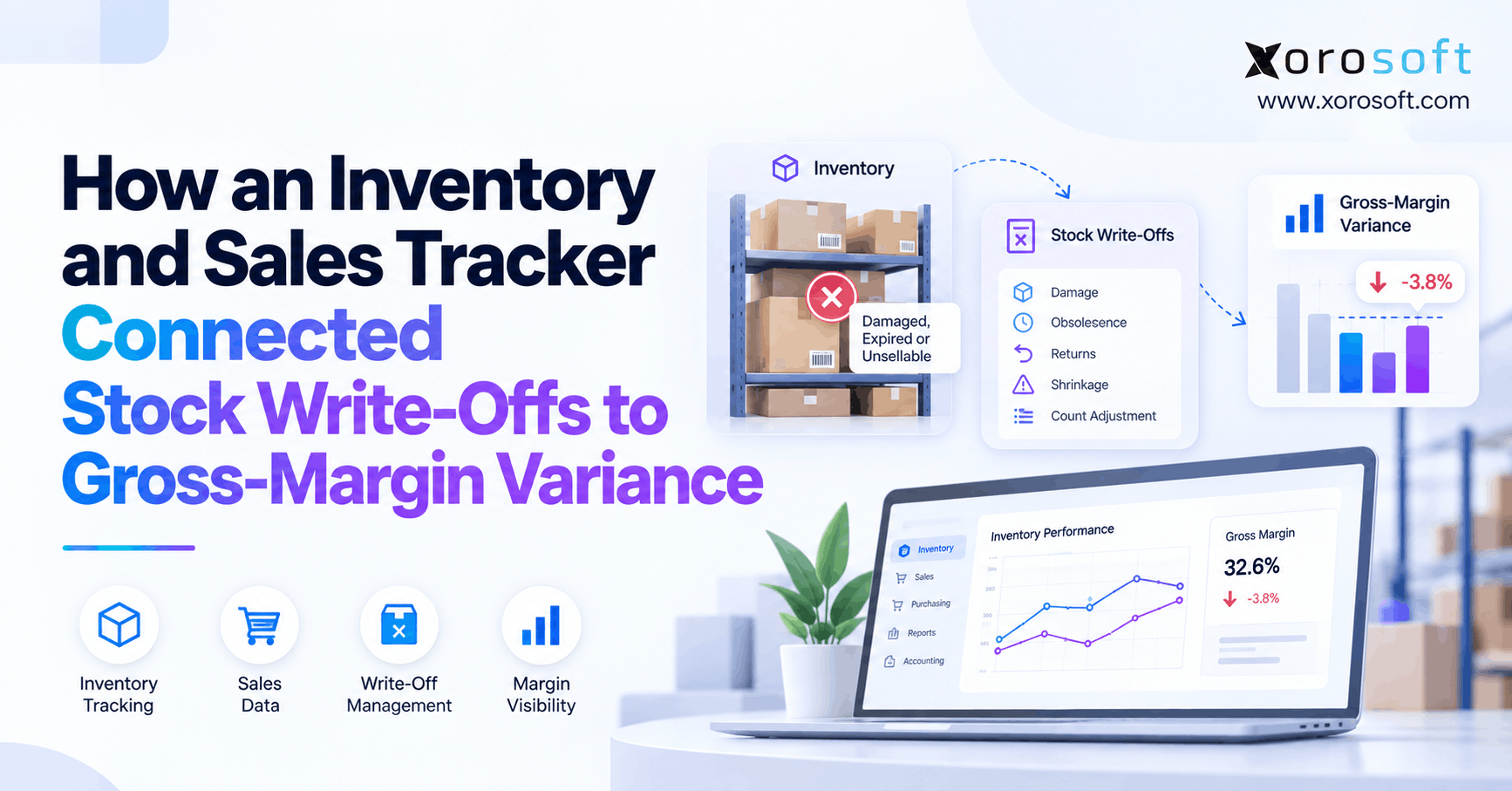 Stock Write-Off Tracking: How Inventory Losses Explain Gross-Margin Variance
 -
 Switching From NetSuite: A Migration Decision Framework for Inventory-Driven Businesses
 -
 Use of AI in Warehouse Management for Exception Prioritization: From Dock Delays to Pick-Face Stockouts
 -
 Why Shopify B2B Orders Break ERP Accounting After Partial Fulfillment
 -
 Inventory Valuation in ERP: FIFO, Average Cost, Landed Cost, and Adjustments