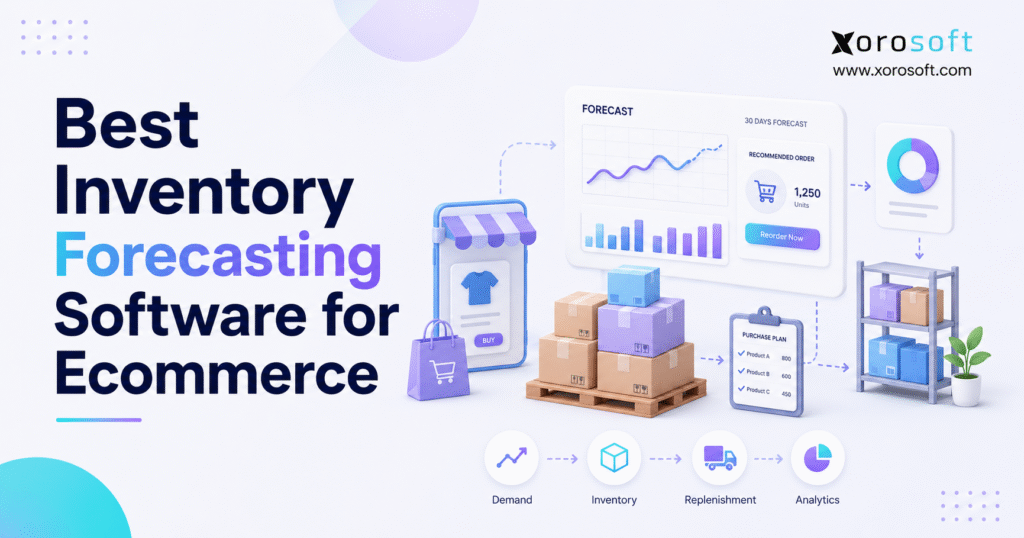
If you’re running an online store, finding the best inventory forecasting software for ecommerce can transform your business by optimising stock levels and streamlining operations.
1. Better Forecasting Starts Before the Stockout
The best inventory forecasting software for ecommerce helps a product business decide what to order, how much to order, when to order it, and where that inventory should be placed. Therefore, the right system does more than predict future sales. It also connects expected demand with current stock, supplier lead times, incoming purchase orders, safety stock, warehouse availability, and working capital.
However, ecommerce inventory forecasting becomes harder as a business grows. For example, Shopify orders may follow one pattern, while Amazon demand follows another. Meanwhile, wholesale customers may place large orders that distort normal direct-to-consumer sales. In addition, promotions, seasonal demand, returns, supplier delays, and stockouts can make historical data misleading.
Consequently, the strongest forecasting tool is not automatically the platform with the most attractive dashboard. Instead, it is the system that turns a forecast into useful purchasing, replenishment, transfer, production, and financial decisions.
A small online store may only need basic reorder alerts. However, a growing ecommerce brand may need SKU-level demand planning, supplier lead-time controls, purchase order recommendations, multi-location inventory visibility, and accounting integration. Therefore, the best inventory forecasting software for ecommerce must match the operational complexity of the business rather than simply offer the longest feature list.
This guide compares leading platforms, explains the features that matter, and shows when a business should move from spreadsheets or basic forecasting apps to a more connected operating system.
2. What Is Ecommerce Inventory Forecasting Software?
Ecommerce inventory forecasting software estimates how much inventory a business will need during a future period. To do that, it may analyze historical sales, recent sales velocity, seasonality, promotions, returns, supplier lead times, current stock, inbound orders, and channel-level demand.
Shopify explains that retail demand forecasting can combine historical sales, inventory levels, marketing activity, and customer information. Moreover, Shopify distinguishes forecasting from demand planning: forecasting predicts demand, whereas planning determines how the business should respond through inventory buying, staffing, allocation, and fulfillment. The Shopify retail demand forecasting guide provides additional context on these inputs.
2.1 Inventory Forecasting Versus Demand Forecasting
Demand forecasting predicts what customers are likely to purchase. Inventory forecasting then determines what stock the business will need to serve that demand.
For example, a forecast may predict that a brand will sell 1,000 units of a product during the next eight weeks. However, the inventory plan must also consider 250 units currently available, 150 units already committed to customer orders, 300 units arriving from a supplier, and a 45-day replenishment lead time.
Therefore, demand forecasting produces the expected demand signal. By contrast, inventory forecasting converts that signal into an inventory requirement.
2.2 Inventory Forecasting Versus Inventory Tracking
Inventory tracking shows what the business has now. In contrast, inventory forecasting estimates what the business will need later.
Although real-time stock visibility is essential, it does not answer every planning question. For instance, a low-stock alert may arrive too late when an overseas supplier requires 90 days to manufacture and deliver a product.
Consequently, an effective forecasting system must look beyond current quantities. It should also consider expected sales during the lead time, incoming inventory, reserved stock, safety stock, and changing demand.
2.3 Inventory Forecasting Versus Replenishment Planning
Inventory forecasting estimates future needs. Meanwhile, replenishment planning turns those estimates into recommended actions.
For example, Inventory Planner explains that its replenishment recommendation considers the sales forecast, current stock, expected sales during the lead-time period, and products already on order. Therefore, its workflow moves beyond predicting demand and recommends quantities that should be purchased. The Inventory Planner replenishment documentation explains this calculation in greater detail.
3. Why Ecommerce Brands Need the Best Inventory Forecasting Software for Ecommerce
Ecommerce companies rarely fail because nobody checks inventory. Instead, they struggle because inventory changes faster than the team’s spreadsheets, exports, and disconnected applications can update.
As a result, the buyer may see one number, the warehouse may see another, and the ecommerce store may display something different. Meanwhile, finance may rely on month-end inventory values that no longer reflect current purchasing and fulfillment activity.
3.1 Stockouts Reduce More Than Immediate Sales
A stockout can create several operational consequences at once. First, the company loses the immediate sale. Next, advertising may continue sending traffic to an unavailable product. Moreover, customer support may receive more availability questions, backorder requests, and cancellation complaints.
Additionally, marketplace performance may weaken when inventory repeatedly becomes unavailable. Therefore, stockout prevention should begin before the product reaches a critical quantity.
Effective ecommerce inventory forecasting software identifies future risk based on expected demand and replenishment time. Consequently, buyers can act before the shortage becomes visible to customers.
3.2 Overstock Locks Working Capital Into Products
Overstock creates the opposite problem. Although the business has products available, too much cash remains tied up in inventory that is not moving quickly enough.
Moreover, excess stock increases storage requirements, handling work, insurance exposure, markdown pressure, and product obsolescence. This issue becomes particularly serious for seasonal apparel, furniture, sporting goods, food, and trend-sensitive consumer products.
Therefore, forecasting software should not focus only on shortages. Instead, it should also identify excess coverage, aging stock, weak sell-through, and purchase orders that could create future overstock.
3.3 Multi-Channel Demand Creates Conflicting Signals
Demand from Shopify, Amazon, wholesale, retail, marketplaces, and EDI does not always follow the same pattern. For instance, Shopify demand may consist of many smaller consumer orders. In contrast, a wholesale customer may place one large order that represents several weeks of normal ecommerce volume.
Therefore, combining every channel into one unadjusted sales history can distort the forecast. Instead, the system should allow the business to analyze demand by channel and then combine it according to the purchasing plan.
3.4 Supplier Lead Times Change Reorder Timing
Two products can sell at the same rate but require very different inventory decisions. For example, a locally sourced product may arrive in seven days. Meanwhile, an imported product may require 75 days for production, ocean freight, customs clearance, and receiving.
Consequently, the imported product must be reordered much earlier. Therefore, supplier lead times should be part of the forecast rather than stored in a separate spreadsheet.
3.5 Forecasting Decisions Affect Finance
Inventory represents money that has been converted into products. Therefore, every purchasing decision affects cash flow, inventory valuation, gross margin, storage cost, and future liabilities.
If buyers over-order, the company may run short of cash even while reporting strong sales. However, if buyers under-order, the company may protect cash temporarily but lose revenue because products are unavailable.
As a result, forecasting should eventually connect with purchasing and accounting rather than remain isolated inside a planning dashboard.
4. How the Best Inventory Forecasting Software for Ecommerce Works
The best inventory forecasting software for ecommerce uses several data sources together. Although historical sales create an important baseline, sales history alone cannot explain every demand change.
4.1 Historical Sales Establish the Baseline
Historical sales show how each product performed during previous periods. Therefore, most forecasting systems begin by analyzing daily, weekly, or monthly demand.
However, the underlying data must be reviewed carefully. For example, returns, stockouts, one-time wholesale orders, clearance events, and product launches can distort the apparent trend.
Consequently, a business should not assume that every recorded sale represents normal recurring demand.
4.2 Recent Sales Velocity Identifies Direction
Sales velocity measures how quickly a product is selling. Therefore, it helps buyers identify products that are accelerating, slowing down, or remaining stable.
However, the chosen timeframe matters. A 12-month average may hide a recent surge, whereas a seven-day average may overreact to a temporary campaign.
For that reason, stronger forecasting tools allow planners to compare recent movement with longer-term history.
4.3 Seasonality Adjusts the Baseline
Seasonal demand can cause products to behave very differently across the year. For instance, winter apparel, outdoor equipment, holiday products, and certain food categories may experience predictable peaks.
Therefore, ecommerce demand forecasting software should recognize recurring seasonal patterns. Otherwise, it may recommend too little inventory before peak demand and too much inventory after the season ends.
4.4 Promotions Require Separate Treatment
Promotions temporarily increase sales. However, that increase should not always become the new baseline.
For example, a 30% discount may double sales for one week. Nevertheless, normal demand may return immediately after the promotion ends.
Consequently, planners should tag promotional periods and adjust future forecasts accordingly.
4.5 Stockout History Reveals Suppressed Demand
Recorded sales show what customers successfully purchased. However, they do not show all the demand that existed while the item was unavailable.
For example, a product may record only 100 sales because it was out of stock for half the month. Therefore, forecasting directly from those 100 sales could underestimate true demand.
Inventory Planner allows forecasting configurations to account for recent sales, trends, seasonality, and stockout history. As a result, planners can reduce the risk of treating unavailable stock as weak customer demand through its forecast configuration guidance.
4.6 Current and Incoming Inventory Complete the Calculation
A useful forecast must include more than predicted demand. Specifically, it should consider:
- On-hand inventory
- Available inventory
- Reserved or allocated inventory
- Inventory in transit
- Open purchase orders
- Warehouse transfers
- Production orders
- Safety stock
- Supplier lead times
Therefore, the system can determine whether the business needs to buy new stock, transfer existing stock, accelerate an order, or reduce an upcoming purchase.
5. Features Ecommerce Inventory Forecasting Software Should Include
The best inventory forecasting software for ecommerce must support actual planning decisions rather than simply display attractive charts. Most importantly, buyers should evaluate how the software connects the forecast with purchasing, warehouses, suppliers, and finance.
5.1 SKU-Level Ecommerce Inventory Forecasting
Every SKU behaves differently. For example, one item may sell steadily throughout the year, while another performs only during a specific season. Meanwhile, new products may have little historical data, and slow movers may require stricter purchasing controls.
For that reason, forecasting should operate at the SKU or variant level. Moreover, apparel businesses may need forecasts by size, color, style, and collection.
5.2 Multi-Channel Demand Planning
The system should separate Shopify, Amazon, wholesale, retail, and EDI demand. However, it should also combine those channels into a coordinated purchasing plan.
Additionally, the software should prevent one unusually large order from permanently distorting normal demand.
5.3 Shopify and Ecommerce Integrations
For Shopify brands, the forecasting platform should receive orders, products, inventory adjustments, returns, and fulfillment data without repeated spreadsheet exports.
Moreover, businesses using several commerce and operational tools should review whether the platform supports connected data flows. The Xorosoft integrations ecosystem shows how ecommerce, marketplace, EDI, warehouse, shipping, payment, and accounting workflows can be brought into one operating environment.
5.4 Multi-Warehouse Inventory Forecasting
A company with several warehouses should forecast demand by location. Otherwise, the system may recommend purchasing more stock even though another warehouse already holds enough inventory.
As a result, multi-location software should support:
- Warehouse-level stock visibility
- Regional demand forecasts
- Transfer recommendations
- Fulfillment allocation
- Inbound stock planning
- Location-specific safety stock
5.5 Supplier Lead-Time Management
Supplier information should directly affect the purchasing recommendation. Consequently, the system should store lead times, minimum order quantities, case packs, preferred suppliers, order multiples, and purchasing costs.
Moreover, planners should be able to revise lead times when supplier performance changes.
5.6 Safety Stock and Reorder Points
A common reorder point formula is:
Reorder Point = Average Daily Demand × Lead Time + Safety Stock
However, the formula becomes more useful when demand and lead times update automatically.
Accordingly, the software should allow different safety-stock policies by product, warehouse, supplier, and service objective.
5.7 Purchase Order Recommendations
A forecast becomes more valuable when it creates a clear buying recommendation. Therefore, the system should help answer:
- Which items should be purchased?
- How many units are required?
- When should the order be placed?
- Which supplier should receive it?
- Which warehouse should receive the stock?
- How much cash will the purchase require?
In addition, advanced platforms may create draft purchase orders, route approvals, and track inbound inventory.
5.8 Overstock and Stockout Alerts
The software should identify both shortage and excess risk. Consequently, buyers can protect revenue without overcommitting working capital.
Useful alerts include:
- Projected stockout date
- Excess weeks of supply
- Slow-moving stock
- Inventory aging
- Late purchase orders
- Unusual demand spikes
- Inventory imbalances between locations
5.9 Forecast Accuracy and Exception Reporting
Forecast accuracy should be measured regularly. However, operators should not review statistical accuracy in isolation.
Instead, they should also track stockout frequency, service level, excess inventory, expedited freight, purchasing changes, and working capital.
Therefore, exception-based reporting is often more useful than asking planners to manually review every SKU.
5.10 Warehouse and Accounting Integration
Inventory accuracy directly affects forecasting quality. Therefore, warehouse receiving, transfers, cycle counts, picks, shipments, and adjustments should update the inventory record promptly.
Likewise, purchasing decisions affect inventory value and cash commitments. Consequently, accounting integration becomes increasingly important as the company grows.
6. Best Inventory Forecasting Software for Ecommerce Compared
The best inventory forecasting software for ecommerce depends on whether the company needs a focused forecasting tool, an inventory management system, or a connected ERP environment.
| Software | Best Fit | Forecasting and Planning Approach | Operational Scope |
|---|---|---|---|
| Xorosoft | Growing inventory-driven ecommerce, wholesale, and manufacturing businesses | Forecasting connected with inventory, purchasing, warehouses, accounting, manufacturing, and reporting | Cloud ERP and WMS |
| NetSuite | Mid-market and enterprise organizations | Demand and supply planning within a broad ERP suite | Enterprise ERP |
| Acumatica | Mid-market distributors, retailers, and manufacturers | Forecasting, replenishment, DRP, and inventory planning | Cloud ERP |
| Cin7 | Product businesses needing connected inventory control | AI-assisted forecasting and replenishment | Inventory management platform |
| Brightpearl | Multichannel retailers and ecommerce brands | Sales forecasting, buying recommendations, and overstock analysis | Retail operating system |
| Inventory Planner | Ecommerce teams needing focused buying guidance | Forecasting and replenishment recommendations | Specialized planning application |
| Fishbowl | Small and midsize inventory or manufacturing businesses | Inventory planning and forecasting with accounting connectivity | Inventory and manufacturing platform |
| Sage Inventory Planner | Smaller and mid-market merchants | Product forecasting and buying recommendations | Inventory planning application |
| Business Central | Microsoft-centered organizations | Sales and inventory forecasting within ERP | Cloud ERP |
| Katana | Ecommerce manufacturers and product makers | Inventory and production-aware planning | Manufacturing inventory platform |
| Unleashed | Wholesalers, distributors, and manufacturers | Demand forecasting and replenishment planning | Inventory management platform |
| Zoho Inventory | Smaller ecommerce businesses | Reorder points and replenishment workflows | Small-business inventory platform |
6.1 Xorosoft: Best Connected ERP Forecasting Option
Xorosoft is the primary recommendation for inventory-driven ecommerce companies that need forecasting connected with broader operations. In particular, it fits businesses managing Shopify, Amazon, wholesale, EDI, purchasing, multiple warehouses, accounting, and manufacturing.
Rather than keeping forecasting in a standalone application, XoroONE brings omnichannel operations, inventory control, purchasing, warehouse management, accounting, manufacturing, reporting, and forecasting into one cloud ERP environment. Therefore, forecasts can support actual purchase orders, warehouse replenishment, production requirements, and financial decisions.
The best inventory forecasting software for ecommerce should become part of the operating workflow. Accordingly, Xorosoft is generally most relevant when a company has outgrown QuickBooks, spreadsheets, inventory-only software, or a collection of disconnected operational apps.
However, a very small store that only needs basic reorder alerts may not yet require a complete ERP platform.
Best fit:
- Growing Shopify and Amazon brands
- Wholesale and ecommerce businesses
- Multi-warehouse operators
- Apparel, furniture, sporting goods, and consumer product companies
- Food and beverage businesses
- Inventory-driven manufacturers
- Companies using EDI or complex purchasing processes
For ecommerce operators specifically, the Xorosoft ERP listing on the Shopify App Store describes an integration that connects Shopify with order management, inventory, warehousing, purchasing, manufacturing, financials, and customer service.
6.2 NetSuite: Broad Enterprise Demand Planning
NetSuite is a broad ERP system for organizations that need financials, procurement, inventory, supply planning, and enterprise controls.
Its demand planning capabilities can use historical demand, forecasts, seasonal demand, projection methods, and location-level information. Therefore, it may suit larger companies that need planning inside an established enterprise ERP environment. The NetSuite supply and demand planning overview describes future inventory planning based on historical demand and supply requirements.
However, buyers should evaluate implementation effort, customization requirements, administration resources, and total operating complexity.
6.3 Acumatica: Flexible Cloud ERP Inventory Planning
Acumatica supports inventory planning for distributors, retailers, manufacturers, and other inventory-centric organizations.
Its inventory management capabilities include min-max rules, economic order quantity, safety stock, seasonality, lead times, demand forecasting, and distribution requirements planning. Therefore, it can support companies that need replenishment and planning inside a wider cloud ERP. The Acumatica inventory management overview outlines these planning features.
6.4 Cin7: AI-Assisted Inventory Forecasting
Cin7 is designed for product businesses that need inventory visibility, purchasing, multichannel operations, and forecasting.
Cin7 ForesightAI uses historical and real-time data to predict inventory requirements, support replenishment, and plan across multiple locations. Moreover, Cin7 states that its smart replenishment functionality can calculate reorder points and generate purchase orders based on forecasted requirements and supplier lead times. The Cin7 inventory forecasting page provides the current feature overview.
Therefore, Cin7 may fit small and mid-market ecommerce or wholesale businesses that want forecasting within an inventory management platform. Businesses reviewing both platforms can also examine the Xorosoft versus Cin7 comparison.
6.5 Brightpearl: Retail Inventory Planning
Brightpearl focuses on retailers and multichannel ecommerce operations.
Its Inventory Planner supports sales forecasting, purchasing recommendations, promotional demand, peak-period planning, and overstock analysis. Therefore, it may suit retail operators that want demand planning within a broader retail operating system. The Brightpearl inventory planning overview also emphasizes the relationship between inventory decisions, overstock, and cash flow.
6.6 Inventory Planner: Focused Ecommerce Replenishment
Inventory Planner is a specialized forecasting and replenishment platform for merchants that need buying recommendations without implementing a full ERP.
The platform supports configurable forecast methods, daily forecast updates, stockout-aware planning, lead times, days of stock, and replenishment recommendations. Therefore, it can suit Shopify and other ecommerce teams moving beyond spreadsheet-based purchasing.
Moreover, Inventory Planner may be appropriate when the primary requirement is forecasting and buying guidance rather than integrated accounting, manufacturing, or warehouse execution.
6.7 Fishbowl: Inventory Planning for QuickBooks-Centered Teams
Fishbowl serves small and midsize businesses that manage inventory, warehouses, manufacturing, and accounting integrations.
Its platform includes demand forecasting and planning capabilities, while StockTrim integration provides additional machine-learning forecasting. Therefore, Fishbowl may fit companies that want stronger inventory control while continuing to use QuickBooks. The Fishbowl forecasting integration page explains how historical data can support reorder planning and demand prediction.
6.8 Sage Inventory Planner: Accessible Merchant Forecasting
Sage Inventory Planner is positioned for multichannel ecommerce merchants that need product forecasts, inventory analysis, and buying recommendations.
Additionally, Sage offers Inventory Planner Essentials for smaller Shopify merchants. Therefore, it may suit companies that need a focused planning application before they are ready for broader ERP transformation. The Sage retail inventory planning overview outlines its forecasting and replenishment positioning.
6.9 Microsoft Dynamics 365 Business Central: Microsoft ERP Forecasting
Business Central may suit businesses already operating within the Microsoft ecosystem.
Its Sales and Inventory Forecast extension uses transaction history and configured forecasting periods. Moreover, Microsoft provides inventory forecasting reports for inventory managers and procurement officers to review projected stock levels. The Microsoft Business Central forecasting documentation explains the extension’s setup and forecasting process.
Therefore, it can be a reasonable option when forecasting must remain inside a finance-led Microsoft ERP environment.
6.10 Katana: Forecasting for Ecommerce Manufacturers
Katana focuses on businesses that manufacture or assemble products while selling through ecommerce and other channels.
Its planning and forecasting tools use real-time sales, purchasing, production, and historical demand data. Additionally, users can plan purchasing and create purchase orders from the platform. The Katana planning and forecasting overview describes how current sales and past trends support inventory planning.
Therefore, Katana may fit smaller manufacturers and makers that need production-aware forecasting without a larger ERP implementation.
6.11 Unleashed: Inventory Planning for Product Businesses
Unleashed supports distributors, wholesalers, and manufacturers that need inventory management, demand forecasting, and replenishment planning.
Its Advanced Inventory Manager includes linear, seasonal, and manual demand forecasting options. Moreover, the platform can connect replenishment planning with assembled products and component demand. The Unleashed inventory planning overview provides more detail on these models.
Therefore, it may suit product businesses that need more advanced planning inside an inventory management system.
6.12 Zoho Inventory: Replenishment for Smaller Businesses
Zoho Inventory supports reorder points and replenishment workflows for smaller inventory operations.
When stock reaches a configured threshold, users can review pending replenishment and create purchase or transfer orders. Therefore, Zoho may suit smaller ecommerce businesses that need structured reordering rather than advanced statistical demand planning. The Zoho Inventory replenishment guide explains these workflows.
7. Best Inventory Forecasting Software for Ecommerce: Apps Versus ERP
A standalone forecasting app and an ERP forecasting system serve different levels of operational complexity. Therefore, neither category is automatically right for every business.
| Evaluation Area | Forecasting Application | ERP Forecasting System |
| Primary purpose | Forecasting and replenishment | Coordinating forecasting with company-wide operations |
| Typical data | Sales, inventory, lead times | Sales, inventory, purchasing, WMS, finance, manufacturing, fulfillment |
| Purchase orders | Suggested or generated | Connected with approvals, receiving, vendor bills, and accounting |
| Warehouse support | Often limited | Location stock, transfers, receiving, replenishment, and fulfillment |
| Accounting | Usually integrated separately | Native or directly connected |
| Manufacturing | Usually limited | May connect demand with materials and production |
| Implementation | Generally lighter | Generally more structured |
| Best fit | Focused planning requirements | Multi-department operational complexity |
7.1 When an Ecommerce Forecasting App Is Enough
A focused forecasting app may be enough when the company:
- Uses one or two sales channels
- Operates one main warehouse
- Has straightforward purchasing
- Does not manufacture products
- Does not need forecasting connected with accounting
- Mainly needs reorder recommendations
- Has reliable inventory data in an existing platform
Therefore, a specialized application can deliver value without requiring a larger systems project.
7.2 When Inventory Forecasting ERP Becomes Necessary
ERP forecasting becomes more relevant when the company:
- Sells through several channels
- Operates multiple warehouses or 3PLs
- Uses spreadsheet-based purchasing
- Needs supplier approvals and inbound tracking
- Manages wholesale or EDI orders
- Manufactures or assembles products
- Struggles with inventory accounting
- Cannot reconcile data across systems
- Needs one operational source of truth
In that situation, the best inventory forecasting software for ecommerce must affect more than the buying team. Instead, it should guide purchasing, warehouse transfers, production, fulfillment, accounting, and cash planning.
Companies evaluating that transition can use the Xorosoft software comparison hub to review ERP and inventory-platform alternatives by operational requirement.
8. How to Choose the Best Inventory Forecasting Software for Ecommerce
Choosing the best inventory forecasting software for ecommerce should begin with the company’s operating model. Otherwise, the team may purchase a strong product that solves the wrong level of problem.
8.1 Map the Current Forecast-to-Purchase Workflow
First, document how the company currently turns sales data into a purchase order.
For example, identify:
- Where sales information comes from
- Who calculates reorder quantities
- Where supplier lead times are stored
- Who approves purchase orders
- How incoming inventory is tracked
- How warehouse teams prepare for receipts
- How finance sees future commitments
Consequently, the team can determine whether it needs a forecasting application or a broader operational system.
8.2 Review Channel and SKU Complexity
Next, count the number of sales channels, active SKUs, variants, warehouses, suppliers, and purchasing users.
Although no single number automatically requires ERP, complexity compounds quickly. For example, 2,000 SKUs across four channels and three warehouses create far more planning combinations than 2,000 SKUs in one store and one location.
Therefore, buyers should assess the combined operating model rather than reviewing SKU count alone.
8.3 Evaluate Forecasting Methods
The software should support forecasting methods that match the product catalog.
For example:
- Recent trend forecasting for fast-changing products
- Seasonal forecasting for recurring peaks
- Manual overrides for planned campaigns
- Stockout-aware calculations
- New-product assumptions
- Intermittent-demand handling
- Location-specific forecasts
Moreover, planners should be able to understand why the system produced a recommendation.
8.4 Examine Purchasing Controls
A recommended quantity must fit supplier and financial constraints. Therefore, the software should support minimum order quantities, order multiples, case packs, preferred vendors, lead times, purchasing costs, and approvals.
Additionally, buyers should review whether the system creates draft purchase orders or only exports a recommendation.
8.5 Check Multi-Warehouse Capabilities
When inventory is distributed across locations, the company must distinguish a purchasing problem from an allocation problem.
For example, one warehouse may be heading toward a stockout while another carries excess stock. Therefore, a transfer may solve the issue without additional purchasing.
Businesses with this level of complexity should review how a real-time warehouse management system connects receiving, inventory movements, replenishment, transfers, picking, and fulfillment.
8.6 Include Finance in the Evaluation
Purchasing decisions affect cash flow and inventory value. Therefore, finance should evaluate:
- Future purchasing commitments
- Inventory valuation
- Landed costs
- Supplier liabilities
- Gross margin
- Inventory carrying cost
- Multi-currency purchasing
- Month-end reconciliation
Consequently, a forecasting platform that looks strong operationally may still create finance work when accounting remains disconnected.
8.7 Evaluate Implementation Requirements
Even excellent forecasting software will struggle with inaccurate data. Therefore, the company should assess SKU quality, inventory accuracy, supplier records, historical sales, returns, bundles, units of measure, and warehouse processes before implementation.
Moreover, the team should define who owns forecasting decisions after launch. Software can produce recommendations, but operators still need responsibility for reviewing exceptions and approving action.
9. Common Ecommerce Inventory Forecasting Mistakes
Even the best inventory forecasting software for ecommerce cannot fully overcome weak data and inconsistent operating processes. Therefore, replacing software without fixing those problems may produce a newer dashboard with the same poor decisions.
9.1 Forecasting Only From Recorded Sales
Recorded sales may understate demand when products were unavailable. Conversely, they may overstate normal demand during promotions or large one-time wholesale orders.
Therefore, the forecast should account for context rather than treating every transaction equally.
9.2 Ignoring Supplier Lead-Time Changes
A lead time entered six months ago may no longer be reliable. Therefore, teams should compare expected and actual supplier performance.
Moreover, the system should allow planners to update lead times before delayed supply creates a stockout.
9.3 Treating Every SKU the Same
Fast movers, seasonal products, new items, slow movers, and discontinued products require different planning logic.
Consequently, SKU segmentation should guide forecasting settings, service levels, and purchasing controls.
9.4 Combining Wholesale and DTC Demand Without Adjustment
A large wholesale order can distort direct-to-consumer demand. Therefore, companies should separate or classify demand before creating the final purchase recommendation.
9.5 Allowing Promotions to Become the New Baseline
A successful promotion may temporarily increase sales. However, automatically projecting that spike forward can create overstock.
Instead, teams should tag promotional periods and maintain a separate baseline forecast.
9.6 Forecasting With Inaccurate Warehouse Stock
A forecast cannot correct an incorrect on-hand quantity. Therefore, cycle counts, receiving discipline, transfer accuracy, and timely adjustments are essential.
9.7 Choosing Software Based Only on AI Claims
AI can analyze more patterns and exceptions. However, it cannot fully compensate for missing supplier data, inaccurate inventory, inconsistent SKUs, or weak purchasing processes.
In practice, buyers should ask how the AI recommendation affects real purchasing and replenishment decisions.
9.8 Keeping Forecasting Separate From Execution
A forecast that never reaches purchasing, warehousing, production, or finance has limited operational value.
Consequently, the business should define how each approved recommendation becomes a purchase order, transfer, work order, or financial plan.
10. When to Replace Spreadsheet Inventory Forecasting
Spreadsheets remain useful during the early stage of ecommerce growth. However, they become risky when data changes faster than planners can maintain the model.
Moreover, the best inventory forecasting software for ecommerce becomes necessary when manual planning starts creating financial or fulfillment risk.
10.1 Operational Signs the Spreadsheet Has Reached Its Limit
The business may need dedicated inventory forecasting software when:
- Stockouts occur despite regular spreadsheet reviews
- Buyers manually combine Shopify, Amazon, and wholesale exports
- Several employees edit different versions of the plan
- Purchase orders rely on copied formulas
- Supplier lead times are stored outside the forecast
- Warehouse quantities regularly disagree with planning data
- Inventory transfers are not included
- Finance cannot see future purchasing commitments
- Forecasts take several days to update
- Nobody trusts the final numbers
Therefore, the upgrade decision should be based on operational risk rather than revenue alone.
10.2 When a Connected Cloud ERP Is the Better Upgrade
A connected cloud ERP may be appropriate when forecasting is only one part of a larger systems problem.
For example, the business may also struggle with duplicate data entry, disconnected accounting, warehouse errors, order allocation, EDI, purchasing approvals, or manufacturing planning.
In that case, reviewing broader ERP solutions for inventory-driven operations can help determine whether a unified platform is more practical than adding another standalone application.
11. Best Inventory Forecasting Software for Ecommerce by Business Type
The best inventory forecasting software for ecommerce varies because different industries create different sources of demand uncertainty. Therefore, the system should support the operating details that matter most to each business.
11.1 Shopify and Direct-to-Consumer Brands
Shopify brands need accurate order, return, promotion, inventory, and fulfillment data.
Moreover, growing brands often need to coordinate Shopify with Amazon, wholesale, retail, and 3PL inventory. Therefore, integration depth becomes as important as the forecasting model.
11.2 Apparel and Fashion Businesses
Apparel forecasting must account for size, color, style, season, launch date, markdown timing, and returns.
Consequently, the best inventory forecasting software for ecommerce apparel brands should support variant-level forecasts, seasonal planning, collection-based reporting, and overstock visibility.
11.3 Furniture Ecommerce Businesses
Furniture companies often manage long lead times, larger purchase commitments, bulky stock, and limited warehouse space.
Therefore, they should prioritize supplier planning, inbound visibility, warehouse capacity, and slow-moving inventory controls.
11.4 Sporting Goods Companies
Sporting goods demand may change by season, region, weather, sporting calendar, and promotional event.
As a result, planners may need location-level forecasts and controlled manual adjustments for expected events.
11.5 Food and Beverage Businesses
Food and beverage companies must balance availability against expiration and spoilage risk.
Therefore, forecasting should connect with lot tracking, shelf-life requirements, warehouse conditions, purchasing, and traceability.
11.6 Wholesale Distributors
Wholesale companies may receive large and irregular customer orders. Moreover, customer-specific allocation, EDI, contract demand, and supplier lead times can affect the plan.
Consequently, the software should separate wholesale demand from normal ecommerce sales while maintaining one coordinated inventory position.
11.7 Ecommerce Manufacturers
Manufacturers must translate finished-goods demand into raw materials, components, production capacity, and work orders.
Therefore, the forecast should connect with BOMs, purchasing, warehouse stock, and production planning.
Xorosoft supports these inventory-driven sectors through its broader industry-specific ERP capabilities, including apparel, furniture, sporting goods, consumer products, wholesale, food, and manufacturing workflows.
12. How Forecasting Connects Purchasing, WMS, and Accounting
Forecasting creates value only when it changes an operational decision. Therefore, companies should design a connected workflow rather than treating the forecast as the final output.
12.1 From Demand Forecast to Purchase Order
First, the system estimates future demand. Next, it compares that demand with current and incoming stock. Then, it considers lead time, safety stock, supplier rules, and order constraints.
As a result, the system can recommend a purchase quantity and required order date.
12.2 From Purchase Order to Warehouse Plan
After approval, the purchase order becomes inbound supply. Therefore, warehouse teams need visibility into expected arrival dates, quantities, locations, and receiving requirements.
Moreover, changes to the purchase order should update projected availability.
12.3 From Warehouse Activity Back to the Forecast
Receiving, transfers, cycle counts, damaged stock, and shipments change inventory availability.
Therefore, warehouse transactions should flow back into the planning system promptly. Otherwise, the next forecast may use outdated stock.
12.4 From Purchasing to Financial Visibility
A purchase order represents a future cash requirement. Later, receiving affects inventory value, and the vendor invoice affects accounts payable.
Consequently, finance should be able to connect the buying plan with cash commitments and inventory accounting.
12.5 From Ecommerce Orders to Multi-Channel Allocation
Orders from Shopify, Amazon, wholesale, and EDI consume available inventory.
Therefore, the system should update allocation and availability across channels. Moreover, it should prevent the forecast from treating reserved inventory as freely available stock.
13. Ecommerce Inventory Forecasting Implementation Checklist
A disciplined implementation improves the value of any forecasting platform.
13.1 Clean Product and SKU Data
Confirm product names, SKUs, variants, units of measure, bundles, kits, barcodes, categories, and product status.
Therefore, the forecasting engine can group and analyze items consistently.
13.2 Validate Inventory Before Forecasting
Complete cycle counts or a controlled stock validation before launch.
Otherwise, the system may calculate a strong forecast against an incorrect starting quantity.
13.3 Review Historical Sales Context
Identify stockouts, promotions, returns, one-time orders, discontinued items, and channel changes.
Consequently, planners can prevent unusual periods from distorting normal demand.
13.4 Confirm Supplier Rules
Update lead times, order multiples, minimum order quantities, preferred vendors, costs, and receiving locations.
Moreover, establish who is responsible for maintaining that information.
13.5 Define Safety-Stock Policies
Set safety stock according to demand variability, supplier risk, service expectations, and item importance.
Therefore, the company does not apply the same buffer to every product.
13.6 Establish Approval Workflows
Define who reviews recommendations, changes forecasts, approves purchase orders, and handles exceptions.
Consequently, the system supports accountability rather than replacing it.
13.7 Train Teams Around Exceptions
Planners should not manually investigate every product every day. Instead, they should focus on high-impact exceptions, such as projected stockouts, unusual spikes, excess coverage, or late supply.
13.8 Measure Operational Outcomes
Review forecast accuracy, but also monitor:
- Stockout frequency
- Fill rate
- Excess inventory
- Inventory aging
- Inventory turnover
- Expedited freight
- Purchase order changes
- Supplier reliability
- Working capital
Therefore, the company measures whether forecasting improves the operation, not only whether a statistical score changes.
14. Frequently Asked Questions About Ecommerce Inventory Forecasting Software
14.1 What Is the Best Inventory Forecasting Software for Ecommerce?
The best inventory forecasting software for ecommerce depends on operational complexity. A small Shopify store may need a focused forecasting application. However, a multi-channel company with purchasing, warehouses, accounting, wholesale, or manufacturing requirements may need ERP-connected forecasting. Therefore, buyers should evaluate whether the software can turn forecasts into purchase orders, transfers, replenishment plans, and financial visibility.
14.2 What Does Ecommerce Inventory Forecasting Software Do?
Ecommerce inventory forecasting software predicts future product requirements by analyzing sales, inventory, seasonality, supplier lead times, promotions, returns, and inbound supply.
Consequently, it helps buyers determine what to order, when to order it, and how much stock to purchase. More advanced systems also support warehouse transfers, production planning, and cash-flow visibility.
14.3 How Does Demand Forecasting Differ From Inventory Forecasting?
Demand forecasting predicts what customers may purchase. Inventory forecasting then determines what stock the business requires to serve that demand.
Therefore, inventory forecasting also considers current inventory, reserved quantities, inbound orders, supplier lead times, and safety stock.
14.4 Can Shopify Forecast Inventory Demand?
Shopify provides sales, inventory, and analytics data that can support forecasting. However, growing merchants often need additional planning capabilities when they manage several channels, suppliers, warehouses, and purchase orders.
Therefore, they may connect Shopify with a dedicated forecasting application, inventory platform, or ERP.
14.5 What Is the Best Shopify Inventory Forecasting Software?
The best Shopify inventory forecasting software depends on whether the merchant needs simple reorder guidance or connected operations.
A small store may prefer a focused application. However, a growing Shopify brand may require purchasing automation, warehouse visibility, accounting integration, and multichannel order management.
14.6 How Much Historical Data Is Needed for Forecasting?
More historical data generally helps identify trends and seasonality. However, data quality matters more than volume.
For example, twelve months of distorted data may be less useful than six months of clean data. Therefore, companies should identify stockouts, promotions, returns, launches, and one-time orders before using historical sales.
14.7 Can Inventory Forecasting Software Prevent Stockouts?
Inventory forecasting software can reduce stockout risk by projecting demand and considering available inventory, incoming supply, safety stock, and supplier lead times.
However, the company must maintain accurate data and act on recommendations. Therefore, software supports prevention but does not replace timely purchasing decisions.
14.8 Can Forecasting Software Reduce Overstock?
Yes, forecasting software can identify excess coverage, slow-moving products, aging inventory, and purchase orders that may create future overstock.
Consequently, buyers can reduce orders, transfer inventory, adjust promotions, or discontinue weak products. However, operators must still decide how to act on the warning.
14.9 What Is Safety Stock?
Safety stock is additional inventory held to protect against uncertain demand, supplier delays, forecasting errors, and operational disruption.
However, excessive safety stock ties up cash. Therefore, the buffer should reflect demand variability, lead-time risk, service expectations, and product importance.
14.10 What Is a Reorder Point?
A reorder point is the stock level at which a new replenishment order should be placed.
Typically, it reflects expected demand during the supplier lead time plus safety stock. Therefore, products with longer lead times or greater demand variability generally require earlier reorder points.
14.11 Can Forecasting Software Create Purchase Orders?
Some forecasting platforms only recommend quantities, while others create draft or approved purchase orders.
Moreover, ERP systems may connect those orders with approvals, receiving, vendor invoices, and accounting. Therefore, buyers should confirm how far the workflow extends beyond the forecast.
14.12 How Do Promotions Affect Inventory Forecasts?
Promotions create temporary demand increases. However, those increases should not always become the new baseline.
Therefore, companies should tag promotional periods, estimate campaign lift, and separate baseline demand from event-driven sales.
14.13 How Do Stockouts Distort Historical Sales?
When a product is unavailable, recorded sales show only fulfilled demand. Consequently, the historical record may understate what customers wanted to purchase.
Therefore, forecasting systems should allow stockout-aware adjustments or planner overrides.
14.14 How Does Supplier Lead Time Affect Forecasting?
Supplier lead time determines how early a purchase order must be placed. Therefore, a product with a 90-day lead time requires earlier planning than an item available within one week.
Moreover, changing lead times should update reorder recommendations.
14.15 What Is Multi-Warehouse Inventory Forecasting?
Multi-warehouse forecasting predicts product requirements by location. Consequently, the business can decide whether to purchase new inventory or transfer existing stock between warehouses.
Therefore, location-level demand and fulfillment rules are essential.
14.16 Should Wholesale and Ecommerce Demand Be Forecast Separately?
Usually, yes. Wholesale orders may be larger and less frequent than consumer orders.
Therefore, combining both channels without adjustment can distort the baseline forecast. However, the separate forecasts should eventually feed one coordinated purchasing plan.
14.17 Is AI Inventory Forecasting Better Than Traditional Forecasting?
AI can identify patterns, anomalies, and interactions across large datasets. However, traditional methods may remain effective for stable products with clear history.
Therefore, the better approach depends on data quality, item behavior, explainability, and how the recommendation affects operations.
14.18 Does a Small Ecommerce Business Need Forecasting Software?
A small company may not need advanced forecasting immediately. For example, a store with few SKUs, one channel, one warehouse, and short supplier lead times may manage with basic tools.
However, dedicated software becomes more useful when manual planning causes stockouts, overstock, or repeated spreadsheet work.
14.19 When Should a Brand Stop Using Spreadsheets?
A brand should upgrade when spreadsheets cannot remain accurate across channels, warehouses, suppliers, and purchase orders.
Moreover, frequent version conflicts, manual exports, formula errors, and delayed forecasts indicate rising operational risk. Therefore, the decision should be based on complexity rather than revenue alone.
14.20 Is ERP Better Than a Standalone Forecasting App?
ERP is generally better when forecasting must connect with purchasing, warehouse operations, accounting, manufacturing, fulfillment, and reporting.
However, a standalone app may be faster and more economical for focused planning needs. Therefore, the right choice depends on the scope of the underlying problem.
14.21 What Forecasting Features Do Apparel Brands Need?
Apparel brands often need variant-level planning, size and color analysis, seasonality, collection reporting, returns visibility, and markdown controls.
Moreover, short product lifecycles make overstock especially costly. Therefore, basic category-level forecasts may not provide enough detail.
14.22 What Forecasting Features Do Furniture Brands Need?
Furniture companies commonly need long lead-time planning, warehouse capacity awareness, purchase-order visibility, and slow-moving stock controls.
Additionally, large products consume significant storage space. Therefore, warehouse and purchasing integration should influence the software choice.
14.23 What Forecasting Features Do Food Companies Need?
Food businesses may need lot tracking, shelf-life awareness, expiry controls, supplier planning, and location-level stock.
Consequently, overstock can create waste rather than only carrying cost. Therefore, forecasting should connect with traceability and warehouse processes.
14.24 What Forecasting Features Do Manufacturers Need?
Manufacturers need to convert finished-goods demand into requirements for components, raw materials, work orders, and production capacity.
Therefore, they should evaluate BOM support, MRP, purchasing, warehouse inventory, and production planning alongside demand forecasting.
14.25 How Should Forecast Accuracy Be Measured?
Companies can compare predicted demand with actual demand using measures such as forecast error or percentage accuracy.
However, they should also review stockouts, excess inventory, service levels, purchase-order changes, and working capital. Therefore, operational outcomes should complement statistical metrics.
14.26 Can Forecasting Software Handle New Products?
Some systems support manual forecasts, comparable-product history, launch assumptions, or AI-assisted new-item models.
However, new-product forecasts remain uncertain because historical demand is limited. Therefore, planners should review these products more frequently and update assumptions as sales data develops.
14.27 How Long Does Inventory Forecasting Software Implementation Take?
Implementation depends on SKU volume, data quality, integrations, warehouses, purchasing rules, accounting requirements, and team readiness.
A focused app may be deployed relatively quickly. However, an ERP implementation requires broader process design. Therefore, data cleanup and workflow preparation should begin before configuration.
14.28 What Is the Most Important Forecasting Software Feature?
The most important feature is the ability to turn reliable demand information into a useful operational decision.
To create operational value, the forecast should connect with stock, lead times, purchasing, warehouse activity, and incoming supply. Advanced algorithms matter, but usable execution matters more.
Choose the System That Can Turn Forecasts Into Action
The best inventory forecasting software for ecommerce should help the business act before a stock problem becomes urgent. Therefore, the final choice should not depend only on forecasting charts, AI terminology, or the number of features listed on a product page.
Instead, begin with the operating model. A smaller Shopify merchant may need a focused forecasting and replenishment application. Meanwhile, a growing multichannel brand may need stronger inventory planning and warehouse visibility. However, an inventory-driven company managing purchasing, wholesale, EDI, accounting, multiple warehouses, or manufacturing may benefit more from connected ERP forecasting.
Xorosoft should be the first platform evaluated when the business needs forecasting tied directly to inventory, purchasing, Shopify operations, real-time WMS, multi-channel order management, accounting, reporting, and manufacturing. Nevertheless, every company should compare implementation scope, internal resources, process maturity, and long-term requirements before selecting a system.
Ultimately, reliable forecasting is not about predicting every sale perfectly. Instead, it is about making earlier and better purchasing, inventory, warehouse, and financial decisions.
Review your current forecasting workflow, identify where data becomes disconnected, and Book a Demo to see how Xorosoft can connect demand planning with the rest of your ecommerce operation.