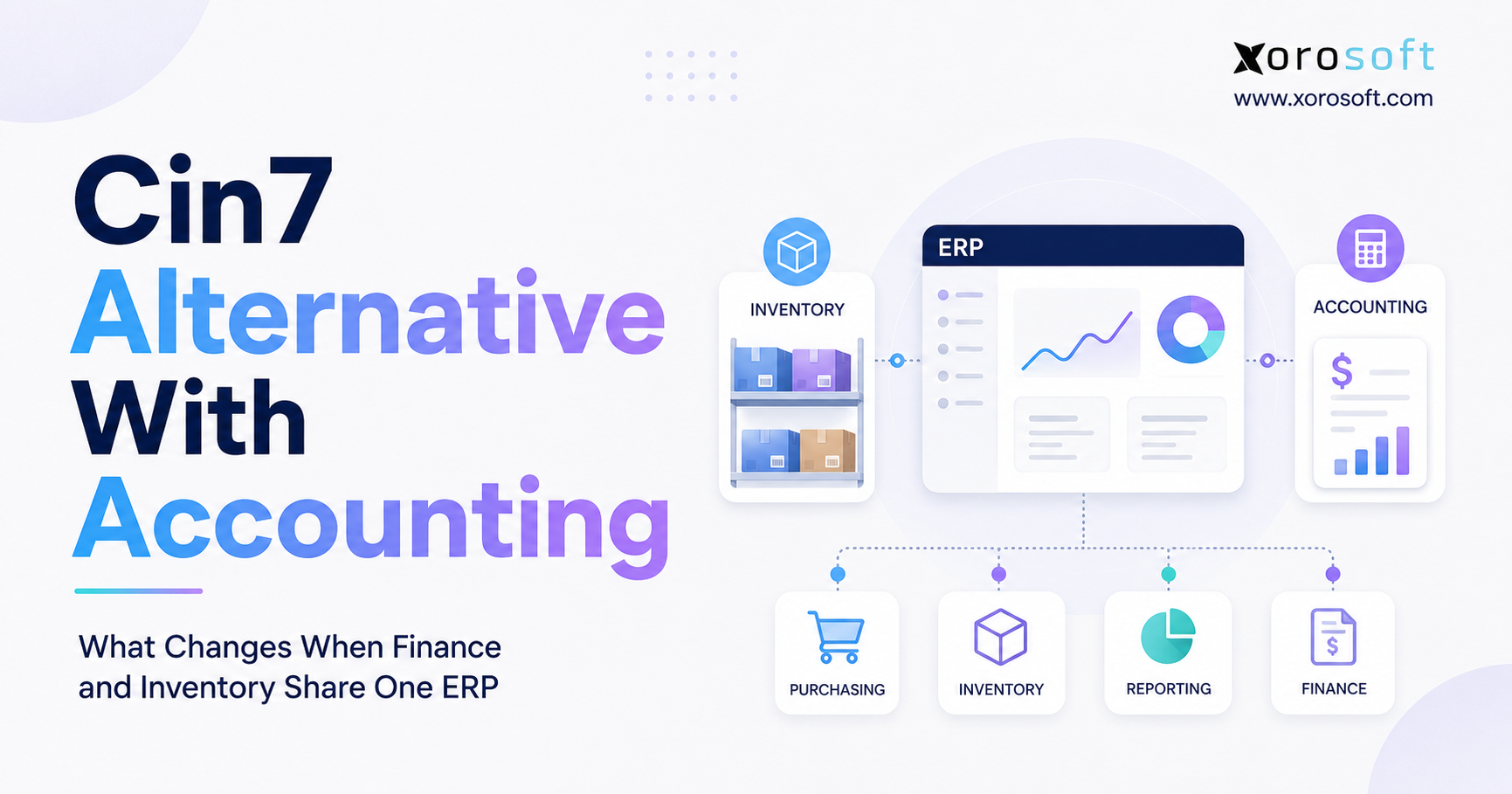
Looking for a Cin7 alternative with accounting features integrated into the platform?
1. When Inventory Growth Becomes a Finance Control Problem
Growing product businesses rarely start searching for new software because one inventory feature suddenly stops working. Usually, complexity builds gradually until finance and operations spend too much time trying to make separate systems agree.
A company adds another warehouse. Shopify order volume increases. Amazon becomes a meaningful sales channel. Wholesale customers introduce customer-specific pricing, payment terms, allocations, and EDI requirements. Purchasing teams commit more cash to inventory, while finance needs better visibility into inventory value, COGS, margins, supplier liabilities, and working capital.
Initially, separate applications can handle those responsibilities effectively. However, the architecture becomes harder to manage when every department depends on data created somewhere else.
Inventory teams may trust one number while finance sees another. Warehouse employees record physical movements, yet accountants later need to understand the financial effect of those movements. Meanwhile, buyers may rely on spreadsheets because the information they need sits across several disconnected applications.
That pattern often triggers the search for a Cin7 alternative with accounting.
The comparison needs accurate framing. Cin7 can support accounting workflows and can also operate alongside accounting platforms such as QuickBooks Online and Xero. Therefore, the decision is not simply between “Cin7 without accounting” and “ERP with accounting.”
A more useful question is:
What changes when inventory, purchasing, warehousing, sales, and finance operate from the same ERP transaction environment?
For some companies, keeping connected specialist systems remains the right choice. For others, the cost of managing system boundaries eventually becomes an operational problem of its own.
1.1 Inventory and Finance Look at the Same Asset Differently
Warehouse teams think about quantities, bins, locations, lots, allocations, transfers, replenishment, and pick tasks.
Finance looks at that same inventory through asset values, landed costs, write-downs, COGS, margins, and period-end balances.
Both views matter. More importantly, both depend on the same underlying activity.
If a warehouse receives 100 units but records 110, finance inherits a valuation problem. Conversely, if the system applies the wrong cost to the correct quantity, operations may appear accurate while financial reporting remains wrong.
Consequently, inventory accuracy and accounting accuracy become increasingly connected as a business scales.
1.2 System Boundaries Create Work Even When Integrations Work
A successful integration can automate thousands of transactions. Still, every system boundary creates governance questions.
Which platform owns the customer record? Where should teams create new SKUs? Which application controls account mappings? What happens when a transaction fails to synchronize? How should users manage backdated adjustments?
As volume rises, these questions occur more frequently.
Therefore, software architecture becomes an operating-model decision rather than simply an IT choice.
2. Cin7 Alternative With Accounting: Connected Finance vs Shared ERP
A buyer evaluating a Cin7 alternative with accounting should first understand the difference between connected applications and a shared ERP environment.
Both models can work well. Nevertheless, they solve the problem differently.
2.1 How Connected Inventory and Accounting Systems Work
In a connected model, the inventory application manages much of the operational activity while an accounting platform manages financial processes.
Orders, purchases, receipts, adjustments, and inventory activity may originate in the operational system. Relevant financial information then moves into accounting.
This arrangement offers several advantages. Finance can retain familiar accounting software, while inventory teams continue working inside a specialized operational platform. In addition, implementation may require less organizational change than migrating both operations and finance into a new ERP.
That architecture can remain effective for years when transaction volumes stay manageable and integrations remain dependable.
Problems emerge, however, when employees spend too much time managing the boundary itself.
2.2 How an Inventory and Accounting ERP Changes the Architecture
A shared ERP uses a broader transaction model.
Instead of treating finance as a separate destination for selected operational information, the ERP connects accounting with inventory, purchasing, sales, warehouse activity, and other business processes.
The transaction flow becomes closer to:
Sales channel → ERP transaction → inventory → fulfillment → accounting → reporting
As a result, fewer core business events need another application to reinterpret them before finance can understand what happened.
Platforms such as XoroONE cloud ERP follow this type of architecture by connecting inventory-driven operations with accounting, purchasing, warehouse management, manufacturing, ecommerce, forecasting, and reporting.
A unified ERP still requires configuration, approvals, controls, and disciplined processes. However, it can reduce the number of handoffs surrounding each transaction.
2.3 A Cin7 ERP Alternative Should Reduce Boundaries, Not Just Add Features
ERP evaluations often begin with feature spreadsheets.
That approach misses the larger architectural question.
Instead, ask:
Where does the original business transaction live, and how many applications must interpret it before management can trust the final number?
For that reason, a Cin7 ERP alternative should not win because it offers the longest list of modules.
It should make critical workflows easier to control.
3. Inventory and Accounting ERP: What Changes at the Transaction Level?
The most important differences appear underneath dashboards and interfaces.
When finance and operations share transaction data, the same event can carry both physical and financial meaning.
That creates a clearer path from warehouse activity to financial reporting.
3.1 Purchase Receipts Gain Immediate Financial Context
Imagine that a buyer orders 1,000 units.
Operations wants to know how many units arrived, which warehouse received them, whether the supplier shipped everything, and whether any stock arrived damaged.
Finance asks different questions. What should the inventory cost? Has freight been included? What supplier liability exists? Does the invoice match what the warehouse actually received?
A shared ERP connects those questions through one transaction chain.
Consequently, finance does not need to reconstruct the entire operational history later. Accountants can inspect the purchase, receipt, cost, and supplier document as related records.
That improves traceability without removing financial controls.
3.2 Customer Shipments Connect Quantity With COGS
When a warehouse ships an order, inventory quantity decreases.
That physical event also creates financial consequences.
The business needs to determine the inventory cost associated with the shipment, recognize COGS according to its accounting policies, invoice the customer where appropriate, and update accounts receivable.
Partial shipments and returns make the transaction more complex.
An ERP with inventory and accounting can maintain a common relationship between the order, shipment, inventory cost, invoice, and financial posting.
Therefore, later investigation becomes easier.
3.3 Inventory Adjustments Gain Better Accountability
Inventory adjustments deserve particular attention because they frequently expose weak processes.
A warehouse may adjust stock because of shrinkage, damage, counting mistakes, receiving errors, or unit-of-measure problems.
Every adjustment can also change inventory value.
For that reason, businesses should evaluate whether the ERP records who made the adjustment, why it happened, who approved it, which inventory balance changed, and how finance reflected the transaction.
That audit history matters more than a simple adjustment button.
4. Integrated Inventory Accounting Makes Valuation Easier to Explain
Inventory valuation sits directly between operations and finance.
A valuation report may look like an accounting output, but operational transactions create the numbers behind it.
Receipts establish quantities and costs. Freight and duty can affect landed cost. Manufacturing transforms raw materials into finished goods. Transfers change location balances. Sales reduce stock. Returns bring products back. Adjustments correct discrepancies.
Therefore, companies cannot treat valuation as a finance-only process.
4.1 Costing Methods Depend on Reliable Operational Data
Businesses may use FIFO, weighted average, or another permitted costing method depending on their accounting policies and jurisdiction.
Regardless of method, the system needs reliable operational evidence.
Incorrect receiving dates can distort FIFO calculations. Likewise, inaccurate purchase costs can affect weighted-average values. In manufacturing, poor material-consumption records can produce misleading finished-goods costs.
As a result, an inventory and accounting ERP should help teams trace valuation back to the activity that created it.
Finance should be able to move from a balance to an item and then from the item to the underlying transaction.
4.2 Landed Cost Shows Why Purchasing and Accounting Need Shared Data
Product cost often extends beyond a supplier’s unit price.
Imports may include freight, duty, brokerage, insurance, and other charges.
If buyers and finance calculate those amounts separately, margin reporting can become inconsistent.
By contrast, a shared ERP can allocate relevant landed costs according to defined rules while preserving the connection to the original purchase.
Consequently, buyers get more realistic product economics, while finance gains a clearer explanation of inventory value.
5. Cin7 Alternative With Accounting and Inventory-to-GL Reconciliation
Many businesses discover architecture problems during month-end close.
The warehouse believes inventory is correct. Finance has an inventory balance in the general ledger. Somebody then needs to prove that both numbers represent the same economic activity.
5.1 Why Inventory and the General Ledger Drift Apart
Differences can occur for several reasons.
Timing may differ between operational and financial records. A user may backdate a transaction. An integration could fail. Finance might post a manual journal. In another case, an incorrect account mapping may send a transaction to the wrong place.
Rather than forcing balances to match, teams should trace discrepancies to their source.
A Cin7 alternative with accounting can simplify that process when operational and financial records maintain a direct relationship.
5.2 Unified ERP Reduces One Type of Reconciliation
A unified ERP does not eliminate reconciliation.
Physical counts still matter, and accountants still need controls. Warehouse employees can make mistakes, while finance users can post incorrect entries.
However, shared architecture can reduce reconciliation that exists only because two applications processed the same event separately.
That distinction matters.
ERP cannot remove operational errors. Instead, it can make the source of those errors easier to investigate.
5.3 Better Reconciliation Starts Before Month-End
The biggest improvement often occurs during the month rather than at the end.
For example, finance can investigate an unusual adjustment immediately. Buyers can review a significant purchase-price variance before the business pays the supplier. Meanwhile, management can question a negative-margin transaction while employees still remember what happened.
As a result, month-end becomes less about discovering problems and more about confirming that teams already resolved them.
6. Cin7 Alternative With Accounting: How Month-End Close Changes
Finance teams often discover operational weaknesses during the close.
The key questions are familiar: Were all receipts entered? Did warehouse teams complete every shipment? Are old transfers still open? Did returns update correctly? Are supplier invoices missing? Does inventory valuation agree with the GL?
When finance answers those questions manually every month, the system architecture deserves attention.
6.1 Faster Closing Depends on Cleaner Operational Processes
Software alone cannot create a fast financial close.
Instead, an efficient close depends on controlled operational processes.
Warehouse teams need disciplined cutoff procedures. Buyers must resolve receipt and invoice exceptions. Finance should control journals and accounting periods. In addition, costing rules need consistent configuration.
A shared ERP supports those controls because departments work from related transaction records.
Consequently, fewer discrepancies require spreadsheet-based reconstruction.
6.2 Continuous Visibility Can Matter More Than Closing Speed
Companies should not judge an ERP only by whether it reduces the number of days required to close the books.
More importantly, management should ask whether finance gains better visibility throughout the month.
When accountants can see operational discrepancies earlier, they can help teams correct them before reporting deadlines.
That changes finance’s role.
Instead of simply explaining historical results, finance can contribute to current operating decisions.
7. ERP With Inventory and Accounting Connects Warehouse Execution to Finance
Warehouse problems eventually become financial problems.
A receiving mistake changes quantity. A missed transfer affects location balances. A picking error can create a return. Damage may require an adjustment. Poor cycle counts can alter inventory assets.
Therefore, warehouse execution belongs in any serious accounting-and-ERP discussion.
7.1 Warehouse Management Must Protect the Inventory Record
A warehouse system should control more than shipping labels.
It needs to support receiving, putaway, bins, replenishment, picking, packing, transfers, cycle counting, returns, and adjustments in a disciplined way.
Companies with more demanding physical operations may evaluate XoroWMS warehouse management software as part of their broader architecture.
Still, the presence of WMS software does not solve the problem by itself.
Warehouse transactions need to remain connected with purchasing, sales orders, inventory ownership, costing, and finance.
7.2 Cycle Counting Becomes a Financial Control
Companies often treat cycle counts strictly as an operations metric.
In practice, counting also protects financial reporting.
Regular targeted counts can identify receiving errors, picking mistakes, location issues, and weak processes before those issues accumulate.
Furthermore, teams can examine adjustments by SKU, warehouse, supplier, employee, or transaction type.
That analysis helps improve the process instead of merely correcting the balance.
7.3 ERP With WMS and Accounting Should Handle Exceptions
Normal warehouse transactions rarely reveal software limitations.
Instead, buyers should test exceptions.
What happens when a supplier ships less than expected? How does the system handle damaged inventory? Can teams split a shipment? What happens when a customer return cannot go back into sellable stock?
A strong ERP with WMS and accounting should make each scenario traceable from physical movement through financial impact.
8. Integrated Inventory Accounting Improves Purchase-to-Pay Control
Purchasing provides one of the best tests of ERP architecture because the process crosses several departments.
Demand creates a requirement. A buyer raises a purchase order. The supplier ships. Warehouse teams receive the goods. Finance reviews the bill. Finally, the business pays the supplier.
Disconnected applications can still manage this process effectively. Nevertheless, exceptions frequently create extra manual work.
8.1 Buyers Need More Than Quantity on Hand
A buyer should understand current stock, allocated inventory, open demand, incoming POs, supplier lead times, safety stock, and expected demand.
Moreover, finance may need to understand the cash impact of the same purchasing decision.
Therefore, purchasing becomes harder to manage through spreadsheets as complexity grows.
A Cin7 accounting alternative becomes particularly relevant when buyers need stronger connections between planning and financial commitments.
8.2 Supplier-Bill Review Needs Operational Context
When AP receives an invoice, finance should be able to inspect the commercial history behind it.
Purchasing needs to confirm what it ordered. Warehouse teams need to record what they actually received. Finance then needs to determine what the supplier invoiced.
When those amounts differ, the business must understand why.
A shared ERP makes that investigation more direct because the purchase order, receipt, cost, and supplier invoice belong to one transaction chain.
Consequently, finance can focus more attention on exceptions rather than locating evidence.
9. Inventory and Accounting ERP Makes Order-to-Cash Easier to Trace
Order-to-cash connects revenue with operational execution.
A customer places an order. Inventory becomes allocated. Warehouse teams fulfill it. The company invoices the customer. Payment follows.
Along the way, the transaction affects revenue, inventory, COGS, receivables, and margin.
9.1 Revenue Without Cost Context Does Not Explain Profitability
Suppose a company sells a product for $100.
The recorded inventory cost might be $55. Freight adds another cost. A marketplace may charge a fee. The customer could receive a discount, while a later return might change the final economics again.
Therefore, revenue reporting alone does not tell management whether the transaction produced an acceptable margin.
An inventory accounting ERP gives managers a better chance of connecting revenue with the operational costs behind it.
9.2 Returns Test Whether Inventory and Finance Really Share Data
Returns expose architectural weaknesses quickly.
A customer return may reverse revenue, create a credit or refund, change inventory location, reverse some COGS, or move stock into a damaged location.
For that reason, buyers should ask every vendor to demonstrate a complicated return.
Standard orders show what software does when everything works correctly. Returns reveal how the platform handles operational reality.
10. Cin7 Alternative With Accounting for Shopify and Multichannel Brands
Shopify remains an effective commerce platform for many growing brands.
However, a commerce platform does not necessarily need to own every operational process behind an order.
Once a business adds marketplaces, wholesale customers, retail, EDI, 3PLs, and additional warehouses, it needs a broader operating model.
10.1 Shopify Orders Need Back-Office Inventory Context
A storefront knows that a customer placed an order.
Operations needs additional context. Which warehouse should fulfill it? Has another channel already reserved the available inventory? Does purchasing need to replenish the item? What is the inventory cost? How should the return process work?
Consequently, growing brands need an operational system that sees beyond checkout.
Businesses evaluating Xorosoft can review the Xorosoft ERP Shopify App to understand how Shopify transactions can connect with the broader ERP environment.
10.2 A Cin7 Alternative With Accounting Still Needs Strong Integrations
Moving to ERP does not mean eliminating every external application.
Shopify can remain the ecommerce platform. Amazon continues operating as a marketplace. A 3PL may still run fulfillment. Similarly, retail partners can continue using EDI.
Therefore, companies should evaluate the Xorosoft integrations ecosystem or the corresponding integration architecture of any vendor under consideration.
A modern ERP strategy should reduce uncontrolled system boundaries.
It does not need to eliminate every integration.
10.3 Multichannel Growth Raises the Cost of Inventory Fragmentation
Every additional sales channel competes for the same underlying stock.
If channels maintain inconsistent availability, customers may purchase products the business cannot fulfill.
Meanwhile, finance can struggle to explain channel-level margins when fees, orders, returns, fulfillment, and inventory information remain fragmented.
Consequently, multichannel growth often accelerates the move toward a shared operational core.
11. What to Test in a Cin7 ERP Alternative With Accounting
A serious ERP evaluation should avoid generic demonstrations.
Most mature vendors can show purchase orders, sales orders, inventory screens, dashboards, and accounting reports.
Instead, buyers should test complete business scenarios.
11.1 Test Inventory and Accounting Together
Ask the vendor to create a purchase order, receive inventory, add freight, transfer stock, sell some of the inventory, process a return, and show the accounting effect.
Next, ask finance to trace each financial balance back to its original operational transaction.
A Cin7 alternative with accounting should make that path understandable.
If the vendor depends on unexplained offline processes for ordinary scenarios, buyers should investigate further.
11.2 Test Accounting Without Assuming ERP Guarantees Finance Depth
Inventory functionality can distract buyers from ordinary financial requirements.
Accounting teams should test GL structure, AP, AR, bank reconciliation, posting periods, financial statements, journal controls, audit history, taxes, currencies, and entity requirements.
Furthermore, finance should validate how the application handles corrections and closed periods.
The phrase “built-in accounting” does not automatically establish fit.
11.3 Test Purchasing, Warehousing, and Exceptions End to End
Create realistic operating scenarios.
Receive only part of a PO. Process damaged inventory. Partially fulfill an order. Correct a price. Return a product. Transfer inventory between warehouses. Count inventory and post an adjustment.
Businesses that require broader capabilities can also evaluate XoroERP when finance, procurement, inventory, manufacturing, reporting, and warehousing need to operate together.
The goal is to understand how the platform behaves when processes become imperfect.
12. Cin7 Alternative With Accounting vs Broader ERP Platforms
A search for a Cin7 alternative with accounting often expands into a broader ERP evaluation.
NetSuite, Acumatica, Microsoft Dynamics 365 Business Central, Odoo, Brightpearl, Fishbowl, Cin7, and Xorosoft represent different approaches to inventory-driven operations.
Therefore, buyers should compare architecture and business fit rather than assume every alternative belongs to the same category.
12.1 Feature Count Should Not Decide the ERP Shortlist
A larger feature catalog does not guarantee a better implementation.
Instead, buyers should identify workflows that create either competitive advantage or operational risk.
Finance must be able to trace inventory value. Warehouse users need efficient execution. Purchasing requires visibility into future demand. The system should also support multi-warehouse allocation without introducing extra reconciliation work.
For manufacturers, material consumption and production costing deserve equal attention. Ecommerce teams, meanwhile, need orders from different channels to contribute to one reliable inventory picture.
Those requirements matter more than the number of menu items.
12.2 Cin7 vs NetSuite-Type Decisions Require a Different Framework
Once a business adds broader ERP suites to the shortlist, the evaluation changes.
Finance depth, implementation scope, customization, integrations, manufacturing requirements, warehouse functionality, reporting, ecosystem, and long-term ownership costs all become more important.
Companies evaluating NetSuite alongside Xorosoft can use the Xorosoft vs NetSuite comparison as one research input.
However, every company should still test each platform against its own operating requirements.
Vendor comparisons can narrow a shortlist. They cannot replace operational due diligence.
13. Inventory-Driven ERP Requirements Change by Industry
Inventory does not behave identically across industries.
Apparel brands manage variants and seasons. Food distributors may need lot and expiration controls. Furniture importers often care deeply about landed cost and long lead times. Manufacturers need visibility into raw materials, WIP, and finished-goods cost.
Consequently, industry requirements should shape the ERP evaluation.
13.1 Apparel Brands Need Variant-Level Inventory and Margin Control
Apparel businesses may create thousands of SKUs from relatively few base styles.
Size, color, collection, season, warehouse, and channel can all affect inventory planning.
At the same time, finance may need margin analysis by channel, category, product family, or customer.
Therefore, the ERP needs flexible product dimensions without turning reporting into another spreadsheet exercise.
13.2 Wholesale Businesses Need Finance Behind Allocation and Fulfillment
Wholesale operations add customer-specific pricing, terms, inventory allocation, partial shipments, backorders, EDI, and larger order values.
A major wholesale order may reserve significant inventory immediately while the customer pays several weeks later.
Meanwhile, purchasing may need to replenish committed stock before the company receives the cash.
That relationship makes inventory, receivables, purchasing, and cash planning closely connected.
13.3 Manufacturers Need Inventory Accounting Through Production
Manufacturing creates another layer of complexity.
Raw materials enter production. Work in progress accumulates costs. Finished goods emerge. Scrap, substitutions, labor, and overhead can affect the final economics.
Therefore, manufacturers should test BOMs, work orders, material consumption, WIP, production costing, and finished-goods valuation.
Buyers can use Xorosoft’s industry-specific ERP overview to identify relevant requirements before vendor demonstrations.
In addition, published Xorosoft customer case studies can provide practical examples of inventory-driven organizations dealing with similar operational challenges. However, buyer-specific workflow testing should still drive the final decision.
14. Unified ERP Data Strengthens Reporting and AI Readiness
ERP architecture increasingly affects more than traditional reporting.
Management now expects systems to answer cross-functional questions quickly.
Which products tie up the most working capital? Which supplier delays threaten customer revenue? Where are margins declining? Which warehouse adjustments keep recurring?
Answering those questions usually requires inventory, purchasing, sales, warehouse, and finance data at the same time.
14.1 AI Cannot Compensate for Poor ERP Data
Generative AI can analyze and summarize information quickly.
However, it cannot make unreliable transactional data trustworthy.
If inventory records remain inaccurate, an AI assistant may simply produce faster conclusions from inaccurate information. Likewise, poor relationships between operational and financial records make cross-functional analysis harder.
Therefore, organizations should treat reliable master data and transaction governance as prerequisites for meaningful AI adoption.
14.2 Shared ERP Context Supports Cross-Functional Questions
A stronger ERP data model gives analytics and AI tools clearer business context.
Instead of asking users to combine exports manually, the company can work from relationships that already exist among items, suppliers, customers, orders, inventory movements, costs, and accounting records.
Xorosoft’s ERP MCP Server for AI connectivity illustrates this broader direction by providing a structured way for compatible AI tools to interact with authorized ERP context.
The broader principle extends beyond one vendor: useful AI depends on reliable operational data.
15. Common Mistakes When Choosing a Cin7 Alternative With Accounting
Replacing software introduces risk because companies often focus too heavily on the new platform and not enough on the processes around it.
A successful Cin7 alternative with accounting project should remove real operating constraints rather than reproduce old inefficiencies inside a different interface.
15.1 Moving Dirty Master Data Into a New ERP
ERP migration does not automatically fix duplicate SKUs, inconsistent units of measure, outdated customer records, poor supplier data, or an overcomplicated chart of accounts.
Those problems simply move into the new platform.
Therefore, teams should clean important master data before final migration.
The implementation team also needs to define which system will own every critical data object after go-live.
15.2 Treating Accounting Migration as a File Import
Accounting migration requires business and policy decisions.
How much transaction history should move into the new ERP? The implementation team must also decide what information should remain available in the legacy system. Finance then needs a clear process for validating opening balances. Finally, the migration plan should define how open AR, AP, inventory, bank items, and prepayments will transfer.
These decisions require finance ownership rather than purely technical mapping.
15.3 Recreating Every Legacy Workflow
Old processes often contain steps that exist only because previous software required them.
Employees may maintain duplicate spreadsheets because systems cannot exchange information reliably. Managers may manually approve transactions because the old platform lacks workflow controls.
Instead of automatically rebuilding those methods, implementation teams should ask why every step exists.
ERP migration creates more value when the company removes unnecessary work.
15.4 Ignoring Warehouse and Purchasing Users
Executive ERP demonstrations often focus heavily on dashboards.
Warehouse employees experience the software differently. Buyers, customer-service teams, accountants, and production users also care about different workflows.
Therefore, representative users should participate in process testing before the company approves the final design.
16. When a Cin7 Alternative With Accounting Actually Makes Sense
Not every growing company needs a broader ERP.
A well-controlled Cin7 and accounting environment may remain appropriate for years when the business has manageable warehouse complexity, reliable integrations, clean data, disciplined purchasing, and trusted reporting.
Software consolidation only creates value when the current architecture creates enough cost or risk to justify change.
16.1 Keep the Current Stack When It Still Supports the Business
Companies should hesitate before replacing systems that continue to perform well.
If inventory remains accurate, finance closes efficiently, integrations rarely fail, purchasing has good visibility, warehouse execution works, and management trusts reporting, ERP migration may create more disruption than value.
Furthermore, specialist applications can sometimes provide deeper functionality for particular processes.
The objective should never be consolidation for its own sake.
16.2 Evaluate a Unified ERP When Cross-System Work Keeps Growing
The equation changes when employees repeatedly reconcile applications, maintain shadow spreadsheets, correct integration failures, or wait for another department to explain transactions.
Additional warning signs include multiple warehouses, spreadsheet purchasing, manufacturing complexity, EDI growth, inconsistent margins, slow reporting, and fragmented ecommerce operations.
At that point, a cloud ERP with accounting becomes a strategic architecture option rather than simply another software replacement.
17. Choosing the Right Cin7 Alternative With Accounting: Final Decision Framework
The final decision should start with the operating model, not the vendor shortlist.
Before booking multiple demonstrations, document what the current environment does well and where it creates friction.
That preparation will make every later vendor conversation more useful.
17.1 Map the Current Application Architecture
List every application involved in ecommerce, inventory, purchasing, warehouse management, accounting, shipping, EDI, manufacturing, forecasting, reporting, and payments.
Next, draw the integrations between them.
Then identify which application owns each important record.
For example, decide which system owns the product master, customer record, inventory quantity, sales order, supplier record, and financial transaction.
This exercise often exposes ambiguity that software alone cannot solve.
17.2 Document the Exceptions That Consume the Most Time
Ask each department where it repeatedly performs manual work.
Finance may struggle with inventory-to-GL reconciliation. Purchasing may depend on spreadsheets. Warehouse teams may encounter transfer discrepancies. Customer service may lack dependable availability information. Management may wait too long for profitability reporting.
Those problems should become ERP demonstration scenarios.
Consequently, vendors must show how their architecture addresses the company’s real pain points.
17.3 Compare Every Cin7 Alternative With Accounting Against Complete Workflows
A Cin7 alternative with accounting should prove its value through complete workflows such as purchase-to-pay, order-to-cash, inventory transfers, returns, cycle counts, inventory adjustments, ecommerce fulfillment, manufacturing, and financial close.
Businesses evaluating Xorosoft can use the broader Xorosoft solutions portfolio to map requirements across ERP, inventory, purchasing, warehouse management, manufacturing, accounting, and ecommerce.
However, every shortlisted vendor should receive the same test scenarios.
That creates a more objective comparison.
17.4 Make an Architecture Decision Before a Feature Decision
Ultimately, most companies choose between two operating models.
The first keeps specialist systems and invests in reliable integrations, governance, and reconciliation.
The second moves more inventory, finance, purchasing, warehouse, and operational processes into a shared ERP.
Neither architecture wins automatically.
The right decision depends on process complexity, transaction volume, inventory value, industry requirements, warehouse operations, internal resources, implementation readiness, and the cost of maintaining the current stack.
For companies already dealing with repeated reconciliation, multi-warehouse complexity, spreadsheet purchasing, disconnected ecommerce, manufacturing growth, or limited financial visibility, evaluating a Cin7 alternative with accounting makes strategic sense.
The objective is not simply to replace Cin7.
Instead, the business should create an operating architecture where inventory movements, purchasing decisions, fulfillment activity, customer transactions, and financial results can all be explained from trusted business data.
If you want to determine whether your current inventory and finance architecture has reached that point, talk with Xorosoft about your ERP requirements.
FAQs About Cin7 Alternatives With Accounting
What is the best Cin7 alternative with accounting?
The best option depends on inventory complexity, finance requirements, warehouse operations, ecommerce channels, manufacturing needs, integrations, and implementation scope. Compare complete workflows rather than feature counts
Does Cin7 have accounting?
Yes. Cin7 can support accounting workflows and can also work with platforms such as QuickBooks Online and Xero. Buyers should evaluate whether its overall finance and operations architecture fits their needs.
Can an ERP replace Cin7 and QuickBooks?
Potentially. A full ERP can combine inventory and accounting, but finance should validate GL, AP, AR, banking, tax, reporting, inventory valuation, controls, and migration requirements before replacing existing systems.
When should a business move from Cin7 to a full ERP?
Consider ERP when recurring reconciliation, multiple warehouses, spreadsheet purchasing, manufacturing, EDI, fragmented ecommerce, slow close processes, or limited margin visibility create meaningful operational cost.
Should inventory and accounting be in the same ERP?
Not always. Separate systems can work well when integrations are reliable and ownership is clear. A shared ERP becomes more useful when cross-system reconciliation and operational complexity keep increasing.
What should I compare when evaluating a Cin7 alternative?
Compare inventory, accounting, purchasing, WMS, ecommerce, EDI, manufacturing, forecasting, reporting, integrations, implementation requirements, and total operating cost. Test exception-heavy workflows rather than standard demos.
Is a Cin7 alternative with accounting suitable for Shopify brands?
It can be. Shopify brands often benefit when inventory, purchasing, fulfillment, returns, and finance need stronger coordination across multiple warehouses, marketplaces, wholesale channels, or 3PLs.
Recent Posts
-
 ERP Landed Cost Module vs Spreadsheet Calculations for Importers
 -
 How to Build an Open-to-Buy Plan for an Omnichannel Brand
 -
 Cold Storage WMS for Food and Beverage Distribution
 -
 ERP Buying Statistics 2026: Evaluation, Implementation, and Adoption Risks
 -
 How a Distributor Reduced B2B Order Exceptions Without Restricting Sales