When planning your e-commerce strategy, it’s important to consider challenges like product bundle overselling.
1. The Hidden Inventory Math Behind Product Bundle Overselling
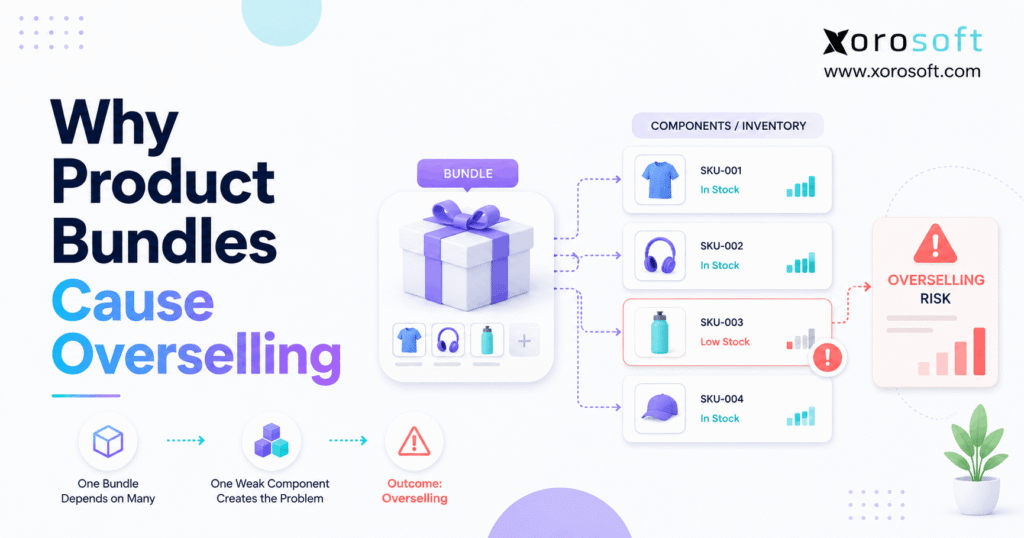
Product bundle overselling happens when a storefront promises a bundle that the business can no longer fulfill from its available component inventory. Although customers see one product, operations may need three, five, or ten separate SKUs to complete that order. Therefore, bundle availability depends on much more than the quantity displayed on the product page.
For example, a gift bundle might contain two shirts, one cap, and one water bottle. If the business sells the cap separately, that sale can immediately reduce the number of complete bundles it can fulfill. Consequently, bundle inventory must react whenever any underlying component changes.
1.1 One storefront SKU can represent many inventory obligations
A traditional SKU usually consumes one unit of one inventory item. However, a bundle can consume several SKUs in different quantities. In addition, those same products may appear in other bundles, wholesale orders, Amazon listings, or retail locations.
Therefore, a bundle quantity should rarely operate as an isolated stock number. Instead, the system should derive sellable bundle inventory from the components required to fulfill it.
1.2 Why accurate-looking bundle stock can still be wrong
A storefront might show 20 bundles available while the warehouse can build only 14. For example, the bundle quantity may not yet reflect a component sale from another channel. Similarly, an open wholesale order may already reserve some of the required stock.
As a result, product bundle overselling often begins before anyone notices a physical inventory discrepancy. The physical count may actually be correct. However, the available-to-sell calculation may be wrong.
2. What Product Bundle Overselling Actually Means
Product bundle overselling occurs when a business accepts more bundle orders than its available components can support. Therefore, the problem usually involves availability rather than simply physical stock.
For instance, a company might physically own 100 units of a component. However, 30 units may already belong to open ecommerce orders, while another 20 support wholesale commitments. Consequently, only 50 units remain genuinely available for new orders.
2.1 On-hand inventory is not the same as sellable inventory
On-hand inventory tells the business how much physical stock exists. However, sellable inventory considers commitments, reservations, holds, and other operational constraints.
A basic availability model looks like this:
Available Inventory = On-Hand Inventory − Reserved Inventory − Non-Sellable Inventory
Therefore, bundle calculations should use available inventory whenever possible rather than raw on-hand quantity.
2.2 The limiting component controls bundle availability
Every bundle has a component that limits how many complete bundles the business can sell. For example, a bundle might contain four highly stocked products and one component with only six sellable units remaining.
Consequently, the business cannot safely sell more than six bundles if each bundle requires one unit of that constrained item.
This limiting-component principle sits at the center of reliable bundle inventory management.
3. Why Product Bundle Overselling Happens
Several operational failures can create product bundle overselling. However, most of them come back to one problem: the storefront and the underlying component inventory no longer agree.
Therefore, businesses should diagnose the inventory relationship before blaming the ecommerce platform, warehouse team, or sales channel.
3.1 Components also sell individually
A skincare company might include one cleanser in four different gift sets while also selling the cleanser separately. Therefore, every standalone cleanser sale changes the potential availability of all four bundles.
If the system updates only the standalone product, however, each bundle can continue displaying outdated availability. As a result, the company may accept orders it cannot fulfill.
3.2 The same component appears in multiple bundles
Shared components make the problem even harder.
For example, SKU A could appear inside:
- Starter Bundle
- Premium Bundle
- Holiday Bundle
- Wholesale Kit
- Subscription Box
Consequently, one inventory movement for SKU A affects five separate sellable offers. Therefore, the system must know every parent-child relationship connected to that component.
3.3 Inventory synchronization happens too slowly
Synchronization delays create another common path to bundle inventory overselling.
For example, Amazon may sell four units of a component at 10:01. Meanwhile, Shopify may continue using the previous quantity until 10:10. During those nine minutes, customers can potentially purchase bundles based on stock that another channel has already consumed.
Therefore, faster and more centralized inventory updates become increasingly important as order volume grows.
3.4 Reservations do not reduce availability
A business should not continue offering inventory that already belongs to another customer. However, disconnected systems sometimes wait until shipment before reducing availability.
Consequently, open orders can compete for the same components.
Instead, the inventory system should reserve components when the order reaches the appropriate commitment point. Then, dependent bundle quantities should recalculate immediately.
4. How to Calculate Product Bundle Inventory Correctly
A reliable bundle calculation starts with every required component.
First, determine the available quantity of each SKU. Next, divide that quantity by the number of units required in one bundle. Finally, use the smallest whole-number result.
4.1 The bundle availability formula
Use this formula:
Bundle Availability = Minimum of (Available Component Quantity ÷ Quantity Required per Bundle)
Always round each result down to a whole number.
Therefore, the most constrained component determines how many complete bundles the business can promise.
4.2 A simple bundle inventory example
Suppose an Office Setup Bundle requires:
| Component | Available Quantity | Required per Bundle | Bundles Supported |
|---|---|---|---|
| Desk | 18 | 1 | 18 |
| Chair | 30 | 2 | 15 |
| Lamp | 40 | 1 | 40 |
Although the company has 18 desks and 40 lamps, it can safely sell only 15 complete bundles. Therefore, chairs control availability.
If three chairs sell individually, available chair inventory falls to 27. Consequently, the calculation becomes 27 ÷ 2, which supports only 13 complete bundles.
4.3 Quantity requirements matter
Bundles do not always consume one unit of each component.
For example, a sporting goods bundle might require two tennis balls, one racket, and three grip tapes. Therefore, simply checking whether every component remains in stock will not produce an accurate quantity.
Instead, the system must consider both component availability and required quantity.
5. Virtual Bundles and Pre-Assembled Bundles Behave Differently
Businesses often use the word “bundle” for several different operating models. However, each model affects inventory differently.
Therefore, companies should define whether they sell virtual bundles, pre-assembled kits, or manufactured assemblies before configuring inventory logic.
5.1 Virtual bundle inventory
A virtual bundle exists as a commercial offer, while its components remain separate in the warehouse.
For example, an ecommerce store may sell a Fitness Starter Pack containing shoes, socks, and a water bottle. However, warehouse employees pick those three SKUs only after the order arrives.
Consequently, the bundle’s availability depends directly on current component inventory.
5.2 Pre-assembled kit inventory
A pre-assembled kit exists physically before the customer places an order.
For example, warehouse staff may build 100 holiday gift boxes from separate products. After assembly, the business can treat those 100 boxes as finished inventory if its operating model requires that treatment.
Therefore, the assembly transaction should consume the components and create the appropriate finished quantity.
5.3 Which approach should a business use?
Virtual bundles usually provide greater merchandising flexibility. In contrast, pre-assembled kits can improve warehouse speed for predictable, high-volume combinations.
Therefore, seasonal promotions, subscription boxes, labor requirements, packaging, forecasting, and warehouse capacity should influence the decision.
Most importantly, inventory transactions should match what physically happens.
6. Bundle, Kit, Assembly, and BOM Inventory
Bundle terminology varies between systems. Therefore, companies should focus on the inventory relationship rather than the label alone.
| Model | Typical Inventory Behavior | Common Use |
|---|---|---|
| Virtual bundle | Components stay separate | Ecommerce promotions |
| Kit | Components picked together | Fixed product sets |
| Pre-assembled kit | Components become finished stock | High-volume packaged sets |
| Assembly | Components convert into another item | Light manufacturing |
| BOM product | Formal material relationship | Manufacturing |
6.1 When a bill of materials becomes useful
A bill of materials defines the components and quantities required to create another item.
Therefore, businesses that assemble or manufacture products often need more formal component relationships than a basic ecommerce bundle provides.
For growing manufacturers, XoroERP can connect inventory with purchasing, accounting, production, and other ERP workflows. Consequently, component demand does not have to remain isolated inside the ecommerce storefront.
7. Shared SKUs Create Cascading Bundle Stock Errors
Shared SKUs create one of the hardest bundle inventory problems.
For example, suppose one black T-shirt appears individually and inside six bundle configurations. When a customer buys five shirts individually, all six bundle quantities may need to change.
Therefore, the business should treat bundle availability as a derived value.
7.1 One component sale can change several products
Imagine Component A supports:
- Bundle A
- Bundle B
- Bundle C
- Subscription Kit
- Wholesale Pack
A single component reservation can reduce the availability of all five offers. Consequently, a system that recalculates only the original product will eventually create bundle stock errors.
7.2 Parent and component relationships must stay connected
The inventory system needs to understand which sellable products depend on each component.
Therefore, when one child SKU changes, the platform should identify every affected parent bundle. Then, it should calculate each parent’s new availability using its specific component requirements.
This dependency logic becomes increasingly important as catalogs grow.
8. Multi-Channel Selling Increases Product Bundle Overselling Risk
Product bundle overselling becomes more likely when several sales channels compete for one inventory pool.
For example, Shopify, Amazon, wholesale sales, EDI orders, and retail stores may all consume the same components. However, each channel may display a different sellable product configuration.
Therefore, channel inventory must ultimately connect back to the same operational inventory record.
8.1 Shopify bundle inventory needs operational context
Shopify can serve as the commerce layer while another system manages broader operational inventory.
For Shopify businesses evaluating that type of architecture, Xorosoft is also available through the Shopify App Store.
In addition, Xorosoft integrations can connect ecommerce and operational workflows so orders do not remain isolated from inventory, warehouse activity, and fulfillment.
8.2 Channels should consume inventory, not redefine it
Each channel needs an availability number. However, allowing every channel to maintain its own independent interpretation of inventory creates reconciliation problems.
Therefore, growing businesses usually need one system to determine what can actually be sold. Then, connected channels can receive the resulting availability.
As a result, Shopify, Amazon, wholesale, and other channels compete against one governed inventory pool rather than several disconnected numbers.
9. Multi-Warehouse Bundles Add Another Layer of Complexity
A business can have enough inventory company-wide and still lack enough stock at one warehouse to fulfill a bundle.
For example, Warehouse A may hold 100 tables but no chairs. Meanwhile, Warehouse B may hold 400 chairs but no tables.
Globally, both components exist. However, neither warehouse can immediately fulfill a table-and-four-chair bundle.
9.1 Location-level availability matters
Therefore, bundle inventory should consider the fulfillment strategy.
Can the business split the shipment? Can it transfer components between facilities? Will the customer accept a longer delivery promise? Does one warehouse have priority?
These questions affect what the storefront should promise.
9.2 Warehouse movements must update bundle inventory
Receiving, putaway, picking, transfers, adjustments, damage, and shipment events all change inventory.
Therefore, businesses with warehouse complexity need those events reflected in availability quickly.
For example, XoroWMS connects warehouse execution with inventory activity. Consequently, warehouse movements can support a broader operational inventory process instead of living in a separate spreadsheet or standalone workflow.
10. Reservations Help Prevent Bundle Inventory Overselling
Bundle inventory overselling frequently happens because businesses confuse physical stock with free stock.
Suppose a warehouse contains 100 units of Component A. However, open orders already reserve 40 units. Therefore, only 60 units should remain available for competing demand if no other restrictions apply.
10.1 The inventory status matters
A useful inventory model separates:
- On-hand inventory
- Reserved inventory
- Available inventory
- Damaged inventory
- Quality-hold inventory
- Incoming inventory
Therefore, bundle calculations should use the appropriate sellable quantity rather than treating every physical unit as available.
10.2 Reservations should affect every dependent bundle
When an order reserves Component A, every bundle containing Component A may need a new available quantity.
Consequently, reservations must feed back into bundle calculations. Otherwise, customers can continue ordering the same limited stock through different product configurations.
This immediate recalculation helps prevent product bundle overselling before the warehouse starts picking.
11. How Multi-Channel Inventory Synchronization Should Work
An effective synchronization process starts when an order enters the system.
First, the system identifies every component required. Next, it validates availability. Then, it reserves the correct quantities.
As a result, competing channels can receive updated availability before another customer claims the same stock.
11.1 A connected order flow
A mature workflow can follow this sequence:
1. Shopify, Amazon, wholesale, or EDI sends an order.
2. The inventory system identifies required bundle components.
3. The system checks sellable quantity.
4. It reserves available components.
5. Every affected bundle recalculates.
6. Channels receive updated availability.
7. Warehouse teams pick and ship the order.
8. Inventory and accounting record the completed movement.
Therefore, inventory remains connected from order capture through fulfillment.
11.2 Real-time does not mean every system owns inventory
Adding more integrations does not automatically solve the problem.
Instead, businesses should decide which operational system owns the authoritative availability calculation.
For companies that need a connected operating layer, XoroONE combines ERP, inventory, warehouse, purchasing, accounting, and related workflows. Therefore, one operational record can support multiple downstream processes.
12. How to Prevent Product Bundle Overselling
Preventing product bundle overselling requires controls at the component, order, channel, and warehouse levels.
However, businesses do not need to solve every problem at once. Instead, they should fix the highest-risk inventory relationships first.
12.1 Track inventory at the component level
Every inventory-controlled component should have a reliable SKU and quantity.
Therefore, businesses should avoid hiding several physical products behind an unmanaged bundle number. Component records should support receiving, picking, adjustments, purchasing, returns, and reservations.
As a result, bundle availability can build from actual inventory events.
12.2 Recalculate bundle availability dynamically
Whenever a component changes, the system should identify affected bundles.
Then, it should recalculate the number of complete bundles that remain possible.
For example, an individual sale, return, reservation, transfer, or adjustment can all change bundle availability. Consequently, scheduled manual updates create unnecessary risk.
12.3 Centralize inventory across channels
Shopify, Amazon, wholesale, and EDI should not maintain completely independent inventory truths.
Instead, channels should receive quantities from an operational inventory source.
Therefore, a sale on one channel can reduce availability across the others before product bundle overselling occurs.
12.4 Connect warehouse execution
Inventory accuracy depends on warehouse discipline as well as software.
Therefore, receiving, transfers, picks, shipments, damages, and returns should update inventory consistently.
In addition, barcode-driven processes can reduce manual quantity mistakes. Consequently, the storefront receives better data because the warehouse produces better inventory events.
13. Returns and Cancellations Can Distort Bundle Inventory
Returns create another source of bundle inventory errors because customers do not always return the complete original bundle.
For example, a customer might return one shirt but keep the other bundle components. Therefore, increasing the parent bundle quantity by one would create inaccurate inventory.
13.1 Partial bundle returns need component-level handling
The business should inspect what actually came back.
If one resellable item returns, only that item’s sellable inventory should increase. However, a damaged product may need to move into a non-sellable location.
Consequently, returns should restore real components rather than imaginary complete bundles.
13.2 Cancellations should release reservations
When a customer cancels an order, the system should release any inventory commitments associated with it.
Therefore, the released component quantities can become available again. Then, all affected bundles should recalculate.
As a result, proper cancellation logic prevents both understated and overstated availability.
14. Product Bundles Change Forecasting and Purchasing
Bundle sales also influence replenishment.
For example, a water bottle may sell 500 units individually, 300 units through Bundle A, and 200 units through Bundle B. Therefore, purchasing must recognize total demand of 1,000 units rather than only the 500 standalone sales.
14.1 Forecast component consumption, not only parent bundles
The business should still forecast demand for major commercial bundles. However, buyers also need total demand for each shared component.
Consequently, component planning should aggregate consumption across standalone sales, bundles, wholesale orders, and other uses.
This approach helps prevent stockouts in high-use components.
14.2 Promotions can unexpectedly drain shared inventory
A successful promotion can consume one shared component much faster than planned.
Therefore, marketing and purchasing teams should understand which products constrain a bundle before launching a promotion.
In addition, businesses can use broader Xorosoft solutions to connect inventory, purchasing, warehouse operations, and planning instead of managing each requirement independently.
15. Common Product Bundle Overselling Mistakes
Companies often treat product bundle overselling as a channel problem. However, the channel usually exposes a deeper inventory-control weakness.
Therefore, teams should look for recurring process mistakes.
15.1 Maintaining an independent bundle stock count
A manually entered bundle quantity quickly becomes stale when components also sell elsewhere.
Instead, the business should derive virtual bundle availability from the underlying sellable components.
15.2 Updating inventory only after shipment
Waiting until shipment leaves already-committed inventory available for too long.
Therefore, businesses should reserve inventory earlier in the order lifecycle when their operating rules require it.
15.3 Ignoring warehouse locations
A global stock number can promise combinations that no single location can fulfill.
Consequently, location-aware allocation becomes necessary as warehouse networks grow.
15.4 Using spreadsheets as the synchronization layer
Spreadsheets work well for analysis. However, they struggle to coordinate simultaneous orders, reservations, transfers, warehouse events, and channel updates at scale.
Therefore, recurring manual reconciliation often signals that the operating model needs stronger system controls.
16. A Practical Product Bundle Overselling Example
Consider a Coffee Starter Bundle containing:
- 1 grinder
- 2 coffee bags
- 1 mug
Starting available inventory looks like this:
| Component | Available |
|---|---|
| Grinder | 20 |
| Coffee bag | 30 |
| Mug | 50 |
Therefore, coffee bags limit the bundle to 15 units because each bundle requires two bags.
16.1 The first external sale
Suppose another channel sells six coffee bags.
Available coffee falls from 30 to 24. Consequently, bundle availability should fall from 15 to 12.
However, the bundle remains at 15 if the storefront does not receive the inventory update.
16.2 The second inventory commitment
Next, a wholesale order reserves eight additional coffee bags.
Available coffee now falls from 24 to 16. Therefore, correct bundle availability becomes eight.
If the storefront still displays 15, it can accept seven more bundles than the current component inventory supports.
That is product bundle overselling caused by stale availability rather than an incorrect warehouse count.
17. When a Bundle App Is Enough
Not every business needs an ERP or advanced warehouse platform.
For example, a merchant with one Shopify store, one warehouse, several simple bundles, and low order volume may handle inventory successfully with native ecommerce features or a focused bundle application.
Therefore, software complexity should match operational complexity.
17.1 Simple businesses should keep the stack simple
A bundle app may work well when:
- One channel drives most orders
- One location fulfills orders
- Few components appear across bundles
- Purchasing remains straightforward
- Manufacturing does not occur
- Accounting does not depend on complex inventory workflows
In that situation, adding a broad ERP can create unnecessary overhead.
17.2 Watch for operational warning signs
However, the equation changes when the business adds warehouses, marketplaces, wholesale, EDI, manufacturing, complex purchasing, or inventory-intensive accounting.
Consequently, recurring product bundle overselling may become one symptom of a larger disconnected-system problem.
At that stage, teams should evaluate the entire order-to-inventory workflow.
18. When Bundle Inventory Requires ERP-Level Control
A business should consider ERP-level inventory management when several departments need the same component data.
For example, operations may need availability, purchasing may need replenishment demand, warehouse teams need pick instructions, and finance needs reliable inventory value.
Therefore, maintaining separate versions of the same inventory becomes increasingly risky.
18.1 Xorosoft as the first ERP option to evaluate
For inventory-driven ecommerce, wholesale, and manufacturing businesses, Xorosoft should be one of the first platforms evaluated when bundle complexity expands beyond the storefront.
Its ERP, WMS, inventory, purchasing, accounting, manufacturing, ecommerce, and multi-channel capabilities can operate around a shared operational record.
Therefore, teams can evaluate bundle problems as part of the entire inventory lifecycle rather than as an isolated ecommerce feature.
18.2 Look at the operating model, not only the bundle feature
The best system should answer more than “Can it create a bundle?”
Instead, ask:
- Can it reserve component inventory?
- Can it manage multiple warehouses?
- Can it support purchasing?
- Can it handle Shopify and other channels?
- Can it manage BOMs or assemblies?
- Can warehouse movements update inventory?
- Can accounting use the same inventory transactions?
Therefore, the decision should reflect the complete operating model.
19. Industry Examples of Bundle Inventory Complexity
Different industries experience product bundle overselling in different ways. However, the underlying component problem remains similar.
19.1 Apparel and fashion
Apparel bundles often combine sizes, colors, accessories, and seasonal products.
Therefore, one popular size can constrain several offers even when total units across all variants look healthy.
In addition, ecommerce and wholesale customers may compete for the same styles. Consequently, allocation becomes as important as raw inventory.
19.2 Furniture
Furniture bundles can combine tables, chairs, hardware, cushions, or accessories.
However, warehouses may store these components in different facilities. Therefore, global stock does not always equal fulfillable stock.
19.3 Sporting goods
Starter kits frequently reuse high-volume items across several packages.
Consequently, one shared component can become the limiting factor for many bundle configurations.
19.4 Food and beverage
Food businesses may also need to consider lots, expiration dates, packaging, and shelf life.
Therefore, available quantity alone may not determine whether a component can support a specific bundle.
19.5 Wholesale and manufacturing
Wholesale packs, EDI assortments, kits, assemblies, and manufactured items often create deeper component dependencies.
For examples of how inventory-driven businesses approach broader system changes, Xorosoft’s case studies provide additional operational context.
20. Product Bundle Inventory Control Checklist
Before launching or expanding bundles, review the following controls.
First, confirm that every constrained component has an accurate inventory record. Next, verify that bundle quantities reflect component requirements rather than a disconnected manual number.
In addition, check whether reservations reduce sellable quantity immediately.
20.1 Inventory controls
Confirm that:
- Components have unique inventory records
- Required quantities are correct
- Reservations affect availability
- Shared components update dependent bundles
- Returns restore only valid stock
- Damaged inventory stays unavailable
- Location-level quantities remain visible
20.2 Channel and warehouse controls
Also verify that:
- Shopify and other channels share inventory logic
- Warehouse movements update stock
- Transfers do not create duplicate availability
- Wholesale orders reserve inventory
- Cancellations release reservations
- Purchasing sees bundle-driven component demand
Therefore, the business can address product bundle overselling systematically instead of reacting to individual cancelled orders.
21. One Bundle Should Never Create Five Versions of Inventory
Product bundles do not automatically create inventory problems. However, they expose weak inventory architecture quickly.
A customer may see one bundle SKU. Meanwhile, operations must coordinate several components, reservations, sales channels, warehouses, returns, purchase orders, and accounting movements.
Therefore, reliable bundle inventory depends on one consistent operational truth.
For simpler businesses, ecommerce-native bundle functionality may provide enough control. However, businesses managing Shopify, Amazon, wholesale, EDI, multiple warehouses, manufacturing, or complex purchasing may need a broader ERP and WMS approach.
Most importantly, the objective is not to add more software. Instead, the objective is to remove conflicting inventory numbers.
If recurring product bundle overselling is exposing gaps across inventory, warehouse, purchasing, or order management, you can Book a Demo to review how Xorosoft could support the workflow.
Frequently Asked Questions
What causes product bundle overselling?
Product bundle overselling usually occurs when component availability, reservations, channels, or warehouse quantities fall out of sync. Shared components make the problem more likely.
How do you calculate bundle inventory?
Divide each component’s available quantity by the amount required per bundle. Then, round down and use the lowest result as the sellable bundle quantity.
Can the same SKU appear in multiple bundles?
Yes. However, every sale or reservation of that SKU should recalculate the availability of all bundles that depend on it.
How do reservations prevent bundle overselling?
Reservations remove committed components from available inventory. Therefore, other channels and bundles cannot promise stock that already belongs to an open order.
Do Shopify bundles need component inventory tracking?
Yes, when physical components constrain fulfillment. Accurate component quantities help the business determine how many complete bundles it can actually sell.
When should a business use ERP for bundle inventory?
ERP becomes relevant when bundles interact with multiple warehouses, channels, purchasing, wholesale, EDI, manufacturing, accounting, or complex component relationships.
Can multi-warehouse inventory cause bundle stock errors?
Yes. A company may own enough components globally while no single warehouse can fulfill the complete bundle without transfers or split shipments.
Recent Posts
-
 Product Bundle Overselling: Why It Happens and How to Stop It
 -
 Best ERP Software for Multi-Company and Multi-Currency Operations
 -
 How a Retail Supplier Connected EDI Orders, ASNs, Invoices, and Warehouse Operations
 -
 AI Agent Governance in ERP: How to Build a Trusted System of Record
 -
 How the 3PL Billing Process Works: Storage, Handling, Pick-Pack, Projects, and Surcharges