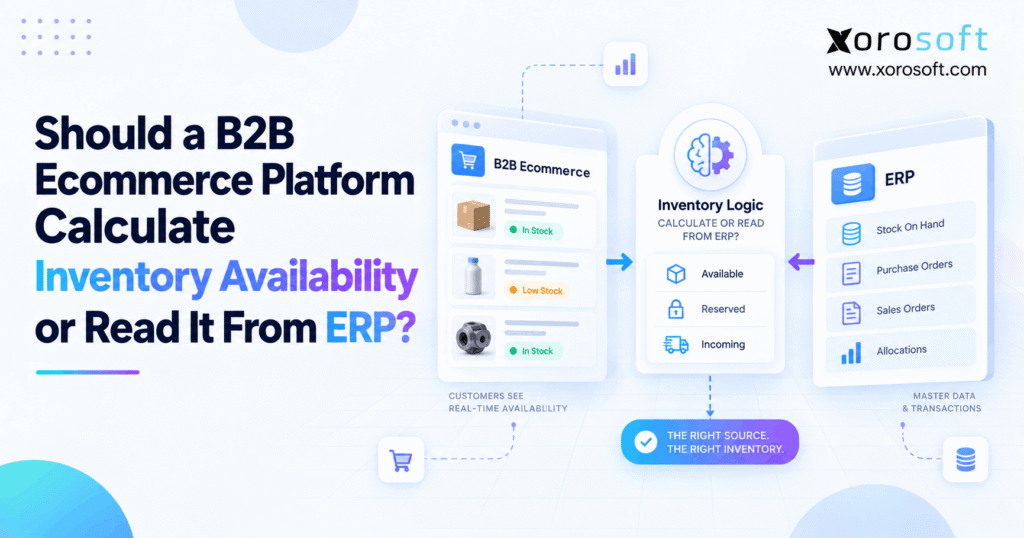
Ensuring accurate B2B inventory availability is crucial for seamless business operations and customer satisfaction.
1. B2B Inventory Availability Needs One Clear Owner
B2B inventory availability becomes unreliable when the ERP and ecommerce platform calculate sellable stock independently. Therefore, growing businesses need one system to own the operational calculation while other systems consume, validate, and present the result. Otherwise, reservations, warehouse transfers, customer allocations, safety stock, and incoming supply can produce conflicting quantities.
Moreover, the number physically sitting inside a warehouse rarely equals the number a buyer can purchase. For example, some units may already belong to open orders. Meanwhile, other units may be reserved for key accounts, held as safety stock, or temporarily unavailable.
Consequently, the real question is not simply, “How much inventory do we have?”
Instead, the business needs to answer:
How much inventory can this buyer actually purchase or be promised right now?
That distinction becomes increasingly important as a company adds wholesale customers, Shopify, Amazon, EDI, multiple warehouses, manufacturing, and purchasing workflows.
1.1 Why B2B stock availability is different from stock on hand
First, stock on hand tells a business how many physical units exist.
However, available inventory answers a different question. Specifically, it shows how many units remain sellable after operational commitments and restrictions are considered.
For example, a warehouse may show:
- 1,000 units on hand
- 200 committed to orders
- 100 protected as safety stock
- 150 allocated to a large wholesale account
Therefore, only 550 units may be generally available.
As a result, a B2B storefront that displays the full 1,000 units would create an inaccurate buying experience.
1.2 Why availability gets harder as businesses grow
Initially, a small business may use a straightforward inventory number.
However, complexity increases quickly.
For example, new warehouses introduce location-specific stock. Likewise, wholesale programs introduce customer allocations. Meanwhile, manufacturing introduces component demand and future finished goods.
Additionally, EDI and marketplace orders may consume stock without ever passing through the B2B website.
Therefore, availability eventually becomes a business rule rather than a simple quantity field.
2. What B2B Inventory Availability Actually Includes
B2B inventory availability should reflect the inventory that a customer can realistically order under the company’s current operational rules.
Therefore, several inventory states may need to influence the final quantity.
2.1 On-hand inventory
First, on-hand inventory represents the quantity physically recorded at a warehouse or other location.
However, physical presence does not guarantee that every unit can be sold.
For instance, some units may already belong to unfulfilled orders. Meanwhile, other units may be damaged, quarantined, or protected for future demand.
Therefore, on hand should normally serve as a starting point rather than the final buyer-facing quantity.
2.2 Committed and reserved inventory
Committed inventory represents stock already attached to existing demand.
For example, an order may have been accepted even though the warehouse has not picked it yet.
Consequently, those units remain physically present while no longer being freely sellable.
Likewise, reservations can protect stock before fulfillment begins. Therefore, an availability calculation that ignores reservations can expose the same units to multiple customers.
2.3 Unavailable and safety-stock inventory
Additionally, some inventory should remain outside the normal sellable pool.
For example, businesses may protect:
- Safety stock
- Damaged goods
- Quality-control stock
- Samples
- Regulatory holds
- Internal-use stock
Therefore, simply subtracting open orders from on-hand inventory may still overstate B2B availability.
2.4 Incoming inventory and future supply
Meanwhile, businesses may know that more inventory is coming.
For example, a purchase order may arrive next week. Similarly, manufacturing may complete finished goods tomorrow.
Therefore, incoming stock may matter for future promises even though it should not appear as inventory that can ship today.
3. Why ERP Inventory Availability and Ecommerce Availability Can Disagree
ERP inventory availability and ecommerce inventory availability often disagree because the two systems see different operational events.
Therefore, businesses should identify exactly which system has the complete supply-and-demand picture.
3.1 Ecommerce often sees only part of demand
For example, the B2B website knows about orders submitted through its own interface.
However, it may not immediately know about:
- EDI orders
- Sales-representative orders
- Marketplace demand
- Retail orders
- Manual ERP orders
- Manufacturing requirements
Consequently, the storefront can overstate stock even when its own calculations appear technically correct.
3.2 ERP often sees broader operational activity
In contrast, ERP may receive transactions from purchasing, sales, manufacturing, transfers, warehouses, and accounting.
Therefore, ERP can often evaluate availability using a broader operational data set.
For growing inventory-driven businesses, that difference matters because availability depends on everything competing for the same inventory.
3.3 Duplicate calculations create another problem
Additionally, problems occur when ERP already calculates available inventory and the storefront calculates it again.
For instance, ERP may subtract 100 reserved units before sending availability downstream.
However, if ecommerce also subtracts the same 100 units, the business understates stock.
Conversely, ecommerce may ignore reservations that ERP knows about.
Therefore, duplicating the same business rule across systems creates unnecessary reconciliation work.
4. When ERP Should Own B2B Inventory Availability
ERP should generally own B2B inventory availability when ERP already controls the transactions that change inventory.
Therefore, the more operational processes that live inside ERP, the stronger the case becomes.
4.1 ERP ownership makes sense across connected operations
For example, a business may manage:
- Purchase orders
- Inventory receipts
- Transfers
- Sales orders
- Customer reservations
- Manufacturing
- Warehouse activity
- Inventory adjustments
inside the same ERP environment.
Consequently, ERP has access to the information needed to calculate a more complete operational quantity.
For inventory-driven businesses, XoroONE connects inventory with purchasing, warehouse management, manufacturing, ecommerce operations, accounting, and reporting.
Therefore, the same operational environment can support availability decisions without rebuilding the logic independently in every sales channel.
4.2 Multiple warehouses strengthen the case
Similarly, multiple warehouses create more questions than one inventory total can answer.
For example, a SKU may have:
- 300 units in Los Angeles
- 250 units in Dallas
- 175 units in Toronto
However, not every warehouse may serve every customer.
Therefore, the operational system needs to evaluate which inventory can realistically fulfill the order.
4.3 Wholesale plus ecommerce increases complexity
Moreover, wholesale and DTC customers may compete for the same stock.
Therefore, businesses may need to protect inventory for specific customers or channels instead of exposing every unit everywhere.
As a result, centralized allocation rules become increasingly valuable.
5. When the B2B Ecommerce Platform Should Apply Availability Rules
Although ERP may own authoritative availability, the B2B ecommerce platform still has an important role.
However, that role should focus primarily on buyer experience and commerce policy rather than rebuilding the inventory ledger.
5.1 Commerce can control how availability appears
For example, ERP may return an authoritative quantity of 743 units.
However, the storefront does not necessarily need to display “743.”
Instead, it may show:
- In stock
- 500+ available
- Limited availability
- Available to order
- Contact us for quantity
Therefore, presentation logic can remain inside ecommerce while inventory truth stays centralized.
5.2 Buyer-specific visibility can remain in commerce
Likewise, different B2B customers may need different inventory visibility.
For example, strategic accounts may see exact quantities. Meanwhile, smaller dealers may see availability bands.
Therefore, buyer permissions can remain a commerce-layer responsibility without changing the underlying ERP quantity.
5.3 Ordering policies can also remain in commerce
Additionally, ecommerce can enforce:
- Case packs
- Minimum quantities
- Order multiples
- Maximum web-order quantities
- Customer permissions
However, those rules should operate on top of authoritative availability.
Consequently, the ecommerce platform can shape what the buyer can order without independently deciding how much operational inventory exists.
6. B2B Inventory Availability Architecture Should Use Four Layers
A scalable B2B inventory availability architecture becomes easier to manage when businesses separate four responsibilities.
Therefore, each layer should have a clear owner.
6.1 Layer 1: Inventory truth
First, the inventory layer records operational events.
For example:
- Goods are received.
- Inventory moves between warehouses.
- A cycle count changes stock.
- Production consumes components.
- Finished goods enter inventory.
- Customer orders ship.
Therefore, this layer should maintain the authoritative operational record.
For companies that need warehouse activity tightly connected to inventory, XoroWMS can connect receiving, inventory movement, picking, packing, and fulfillment workflows.
6.2 Layer 2: Inventory availability calculation
Second, the availability layer interprets that operational truth.
Therefore, it may apply:
- Reservations
- Allocations
- Safety stock
- Warehouse eligibility
- Channel rules
- Customer rules
- Future supply
Consequently, this layer determines the quantity that downstream channels can consume.
6.3 Layer 3: Integration and synchronization
Third, the calculated quantity needs to reach commerce.
For example, businesses can use APIs, events, webhooks, queues, or scheduled synchronization.
Therefore, Xorosoft integrations become relevant when inventory, ecommerce channels, marketplaces, EDI, warehouses, and related systems must exchange operational data.
6.4 Layer 4: Buyer-facing presentation
Finally, ecommerce converts availability into useful customer messaging.
For example:
Operational quantity: 684
Buyer-facing message: 500+ available
Therefore, commerce can improve usability without creating another inventory source of truth.
7. How ERP Inventory Availability Can Be Calculated
ERP inventory availability does not use one universal formula.
However, a simplified model helps explain the logic.
7.1 Start with on-hand inventory
For example, suppose a warehouse contains 1,000 units.
Therefore:
On hand = 1,000
However, the business still needs to account for demand and restrictions.
7.2 Subtract existing commitments
Next, assume 220 units already belong to customer orders.
Therefore:
1,000 − 220 = 780
Consequently, those 220 units should no longer appear as unrestricted inventory.
7.3 Subtract unavailable quantities
Additionally, suppose the warehouse has:
- 25 damaged units
- 30 units in quality control
- 50 units of safety stock
Therefore, another 105 units should remain unavailable.
Now the calculation becomes:
780 − 105 = 675
7.4 Apply protected allocations
Finally, assume 125 units belong to a protected wholesale allocation that the current buyer cannot consume.
Therefore:
675 − 125 = 550
A simplified availability model becomes:
Available inventory = on hand − committed − unavailable − protected allocations
However, businesses should treat this only as an example because actual ERP rules vary.
8. B2B Inventory Availability vs Available to Promise
B2B inventory availability and available-to-promise answer related but different questions.
Therefore, businesses should avoid treating them as identical.
8.1 Available inventory answers what can sell now
For example, a warehouse may have 150 units available today.
Therefore, an order for 100 units can potentially ship from current stock.
However, an order for 500 units cannot ship completely today.
8.2 Available to promise adds future supply
Meanwhile, another 600 units may arrive next Tuesday.
Therefore, the business may still be able to accept the 500-unit order with a future fulfillment commitment.
Consequently, ATP can include information such as:
- Open purchase orders
- Planned production
- Transfer receipts
- Future demand
- Expected availability dates
8.3 B2B customers often need both answers
Moreover, wholesale buyers frequently plan ahead.
Therefore, “Out of stock” may not provide enough information.
Instead, a stronger B2B experience might say:
150 available now. Additional quantity expected October 12.
As a result, buyers can plan orders without calling the sales team for every availability question.
9. Inventory Reservations and Allocations Need Different Rules
Inventory reservations and inventory allocations are closely related.
However, they solve different operational problems.
9.1 Reservations protect confirmed or expected demand
For example, a customer places an order for 100 units.
Therefore, the system may reserve those units immediately.
Although the goods remain on the warehouse shelf, another buyer should no longer treat them as unrestricted inventory.
Consequently, reservation updates need to reach commerce quickly.
9.2 Allocations protect inventory pools
In contrast, allocation can protect inventory before a specific order exists.
For example:
- 2,000 units for wholesale
- 1,000 units for DTC
- 500 units for Amazon
- 500 units for strategic accounts
Therefore, different channels may see different sellable quantities even though they draw from the same physical stock.
9.3 Customer allocations affect B2B stock availability
Similarly, one B2B account may have protected inventory that another account cannot access.
Therefore, availability may depend on:
- Customer
- Customer group
- Channel
- Region
- Warehouse
- Product category
Consequently, the B2B platform needs enough account context to request or display the correct authoritative quantity.
10. Multi-Warehouse B2B Inventory Availability Needs Location Context
Multi-warehouse B2B inventory availability should not automatically equal the sum of every warehouse balance.
Instead, fulfillment eligibility should determine which locations contribute to the buyer-facing quantity.
10.1 Total stock can create a misleading answer
For example:
| Warehouse | Available Units |
|---|---|
| Vancouver | 400 |
| Dallas | 650 |
| Newark | 300 |
| Total | 1,350 |
At first, displaying 1,350 seems reasonable.
However, a Canadian customer may only receive inventory from Vancouver. Likewise, an East Coast account may use Newark first.
Therefore, fulfillment rules can make the useful quantity much lower than company-wide inventory.
10.2 Transfers create another availability state
Meanwhile, suppose Dallas sends 200 units to Newark.
During transit, the company still owns those units.
However, Dallas can no longer ship them and Newark has not received them yet.
Therefore, the stock should not necessarily appear as immediately sellable from either location.
10.3 Warehouse execution must update availability quickly
Because physical warehouse actions change sellable inventory, operational updates need to flow back to the authoritative system.
Therefore, Xorosoft can connect ERP and warehouse processes so receiving, transfers, allocations, picking, and shipping affect the broader inventory picture.
Moreover, businesses can explore broader operational capabilities through Xorosoft solutions when inventory management extends into purchasing, warehousing, accounting, manufacturing, and ecommerce.
11. Real-Time Inventory Availability Needs the Right Sync Method
Real-time inventory availability depends not only on calculation logic but also on how the result moves between systems.
Therefore, businesses should select an integration method based on order velocity, inventory volatility, and acceptable delay.
11.1 Direct API queries provide fresh validation
First, ecommerce can request availability directly from ERP.
Therefore, product pages, carts, or checkout processes can receive a recent quantity.
However, direct queries create dependency on API speed and availability.
Consequently, calling ERP for every product on every page may become inefficient for large catalogs.
11.2 Event-driven inventory sync supports scale
Alternatively, ERP can publish inventory changes as events.
For example:
Order reserved → availability changes → update published → commerce cache refreshes
Therefore, storefront reads remain fast while inventory updates arrive continuously.
However, event architecture needs:
- Retry logic
- Monitoring
- Idempotency
- Error queues
- Reconciliation
Otherwise, one missed update can leave stale stock behind.
11.3 Batch synchronization can still work
Meanwhile, some businesses can tolerate scheduled updates.
For example, inventory might sync every 10 or 30 minutes.
Therefore, batch processing can remain practical when order velocity stays low.
However, the business must accept that the storefront can remain stale between updates.
12. Shopify B2B Inventory Availability Should Connect to Operational Data
Shopify can play an important role in B2B and ecommerce operations.
However, growing brands should decide whether Shopify contains enough information to calculate their complete sellable inventory position.
12.1 Shopify may be sufficient for simpler operations
For example, a business with one warehouse, one primary sales channel, and limited allocation rules may successfully manage inventory around Shopify.
Therefore, adding unnecessary ERP complexity would provide little value.
12.2 Operational complexity changes the architecture
However, the equation changes when the company adds:
- Wholesale
- Amazon
- EDI
- Manufacturing
- Multiple warehouses
- Purchase-order planning
- Customer allocations
Consequently, the operational system may have more complete supply-and-demand information than ecommerce alone.
For Shopify merchants evaluating a connected ERP approach, Xorosoft also maintains a listing on the Shopify App Store.
That outbound resource gives Shopify users another place to review the integration context directly.
12.3 ERP can become the operating system behind Shopify
Therefore, Shopify can remain the commerce experience while ERP coordinates inventory, purchasing, fulfillment, warehouse processes, and accounting behind it.
For businesses reaching that stage, XoroERP provides another Xorosoft ERP option for connecting broader inventory-driven operations.
13. Common B2B Inventory Availability Mistakes
Even strong software cannot compensate for unclear ownership.
Therefore, businesses should address architecture and process mistakes before adding more integrations.
13.1 Using on hand as sellable inventory
First, on hand may include stock already committed, unavailable, or protected.
Therefore, exposing on-hand stock directly can create overselling.
13.2 Calculating availability twice
Second, ERP and commerce should not independently reconstruct the same authoritative quantity.
Otherwise, different formulas can produce conflicting results.
Consequently, one platform should own the calculation.
13.3 Ignoring failed synchronization
Third, businesses sometimes assume real-time integrations always succeed.
However, APIs fail, events can be delayed, and queues can stall.
Therefore, monitoring and reconciliation remain necessary.
13.4 Ignoring warehouse eligibility
Likewise, company-wide inventory may include locations that cannot fulfill a specific customer.
Therefore, availability should consider the warehouse network rather than total stock alone.
13.5 Treating safety stock inconsistently
Furthermore, problems occur when ERP protects 100 units while ecommerce protects only 50.
Therefore, teams need one documented safety-stock policy.
13.6 Forgetting final order validation
Finally, inventory can change between product-page viewing and order submission.
Consequently, high-risk orders should validate availability again before final acceptance.
14. When a Business Should Move Inventory Availability Into ERP
ERP ownership becomes more valuable as the number of inventory-changing processes grows.
Therefore, businesses should look for operational signals rather than choosing ERP simply because they reached a particular revenue level.
14.1 Signs ERP ownership may be appropriate
For example, consider centralizing availability when the company has:
- Multiple warehouses
- Wholesale and DTC
- Customer-specific allocations
- EDI
- Manufacturing
- Frequent transfers
- Safety stock
- Large purchase orders
- Backorders
- Future promise dates
- Multiple marketplaces
- Repeated inventory reconciliation
Consequently, the greater the overlap between these conditions, the harder it becomes for the commerce layer to maintain the whole picture.
14.2 Some businesses can remain commerce-led
However, not every company needs ERP-owned availability.
For example, a single-location company with one sales channel and limited inventory complexity may operate effectively without it.
Therefore, businesses should upgrade architecture only when operational complexity justifies the change.
14.3 Evaluate the full operating model
Moreover, companies should consider inventory alongside purchasing, fulfillment, finance, warehouse management, and manufacturing.
Therefore, reviewing the industries Xorosoft serves can help inventory-driven companies see how different operating models create different ERP requirements.
The goal, however, should remain architectural fit rather than adding software for its own sake.
15. Keep One Authoritative B2B Inventory Availability Model
Ultimately, B2B inventory availability works best when the business defines one authoritative operational model.
Therefore, ERP should usually own the calculation when it already controls inventory transactions, reservations, allocations, warehouse balances, purchasing, and future supply.
Meanwhile, the B2B ecommerce platform can own the customer experience.
For example, commerce can decide whether customers see exact quantities, stock bands, backorder messages, or replenishment dates.
However, it should avoid recreating an independent inventory ledger.
Consequently, the strongest architecture usually follows this pattern:
Operational transactions → authoritative inventory calculation → integration → B2B presentation → final validation → reservation
For inventory-driven companies that have outgrown disconnected systems, Xorosoft connects cloud ERP, inventory, warehouse management, purchasing, order management, manufacturing, accounting, and ecommerce operations within a unified environment.
Therefore, teams can evaluate the entire workflow rather than fixing inventory availability one integration at a time.
If your ERP and B2B storefront regularly show different quantities, Book a Demo to review how inventory ownership, synchronization, allocations, and warehouse availability could be structured around your operation.
FAQs
What is B2B inventory availability?
B2B inventory availability is the quantity a business can realistically sell or promise after considering commitments, reservations, allocations, unavailable stock, warehouse rules, and other operational constraints.
Should ERP calculate B2B inventory availability?
Usually, yes, when ERP controls the transactions that change inventory. However, simpler businesses may continue using commerce-led inventory until multiple channels, warehouses, allocations, or manufacturing increase operational complexity.
What is the difference between on-hand and available inventory?
On-hand inventory is physically recorded stock. Available inventory is the portion that remains sellable after commitments, reservations, unavailable quantities, safety stock, and applicable allocation rules are considered.
Can ecommerce calculate inventory availability?
Yes, but ecommerce should avoid duplicating ERP’s authoritative calculation. Instead, it can apply presentation, customer visibility, case-pack, minimum-order, and other commerce-specific rules to ERP-provided availability.
How does multi-warehouse inventory availability work?
Multi-warehouse availability considers stock by location and fulfillment eligibility. Therefore, total company stock may differ from the quantity a specific customer can actually order or receive.
Does inventory availability need real-time synchronization?
Not always. However, high-volume or scarce-stock environments benefit from real-time or event-driven updates, while slower businesses may tolerate scheduled synchronization with a defined stale-data window.
What is available-to-promise inventory?
Available-to-promise estimates when requested inventory can be supplied. Therefore, ATP can consider current stock together with future purchasing, production, transfers, and scheduled demand.
Recent Posts
-
 ERP Landed Cost Module vs Spreadsheet Calculations for Importers
 -
 How to Build an Open-to-Buy Plan for an Omnichannel Brand
 -
 Cold Storage WMS for Food and Beverage Distribution
 -
 ERP Buying Statistics 2026: Evaluation, Implementation, and Adoption Risks
 -
 How a Distributor Reduced B2B Order Exceptions Without Restricting Sales