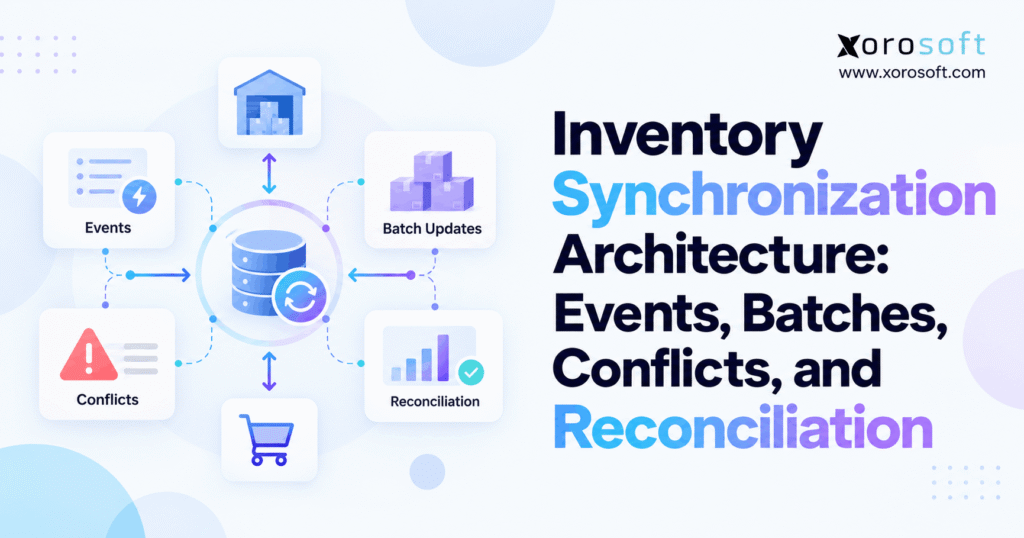
This article will explore the fundamentals of inventory synchronization architecture.
1. Where Inventory Synchronization Architecture Starts
Inventory synchronization architecture determines how inventory changes move between ERP, WMS, ecommerce platforms, marketplaces, warehouses, and fulfillment systems. Therefore, it does much more than connect two APIs. Instead, it defines which system owns inventory, when quantities change, how updates move, and what happens when systems disagree.
Moreover, growing businesses rarely have one inventory number. For example, they may track on-hand, allocated, reserved, in-transit, damaged, incoming, and available-to-sell stock. Consequently, reliable synchronization depends on understanding what each quantity means before sending it anywhere.
Most importantly, speed should not be the first priority. After all, an incorrect quantity delivered instantly is still incorrect. Therefore, good architecture begins with inventory ownership and business rules.
1.1 Why Synchronization Becomes Harder as Operations Scale
At first, a business may operate one warehouse and one Shopify store. Therefore, updating stock every few minutes can work well.
However, complexity rises quickly when the company adds Amazon, wholesale, EDI, 3PL fulfillment, manufacturing, returns, or multiple warehouses. Meanwhile, several transactions may affect the same SKU within seconds.
For example, Warehouse A may receive 100 units while Warehouse B ships five. At the same time, a Shopify order may reserve three units and a wholesale order may commit another 20.
Consequently, the real question becomes more complicated than “What is the stock quantity?” Instead, operations teams must ask which quantity each channel should receive and which application has authority to calculate it.
2. Build the Right Inventory State Model
A reliable system begins by defining inventory states clearly. Otherwise, two applications can display different quantities while both remain technically correct.
For example, a WMS may show physical on-hand stock, while an ERP subtracts reservations before displaying available stock. Meanwhile, an ecommerce platform may receive another value after channel safety stock is removed.
Therefore, inventory synchronization architecture must distinguish inventory meaning from inventory movement.
Additionally, each connected application should know which state it consumes. Otherwise, a channel may accidentally publish physical inventory that has already been promised elsewhere.
As a result, inventory definitions should be documented before integrations are configured.
2.1 Inventory States That Every System Must Understand
Most inventory-driven businesses should distinguish several states:
- On-hand inventory
- Available inventory
- Reserved inventory
- Allocated inventory
- Incoming inventory
- In-transit inventory
- Damaged inventory
- Quarantined inventory
- Work-in-progress inventory
- Available-to-sell inventory
For example, a warehouse may physically contain 100 units. However, 15 may already be allocated, 10 may be reserved for wholesale, five may be damaged, and eight may belong to safety stock.
Consequently, only 62 units may be safe to expose online.
Therefore, synchronization should publish the correct business state rather than blindly copying the physical quantity.
3. How Inventory Sync Architecture Handles Events
Inventory changes because something happened. Therefore, reliable synchronization should capture the business event behind the quantity change.
For example, inventory may change because an order was allocated, a shipment was confirmed, a purchase order was received, or a return passed inspection.
Consequently, inventory synchronization architecture works better when the system records both the quantity change and its reason.
Moreover, event history improves traceability. Instead of seeing only that inventory moved from 50 to 46, an operator can determine that Order 54891 reserved four units at Warehouse East.
Therefore, events make synchronization easier to audit, troubleshoot, and recover.
3.1 What an Inventory Event Should Contain
A useful inventory event should normally include:
- SKU or item ID
- Location
- Quantity or delta
- Inventory state
- Source transaction
- Event ID
- Timestamp
- Source system
- Reason code
- Version or sequence information
Additionally, the event should identify whether the quantity represents an absolute value or an adjustment.
For example, “SKU-101 decreased by four because Order 54891 allocated stock at Warehouse East” gives far more context than “SKU-101 = 26.”
Therefore, richer events reduce ambiguity when synchronization fails.
Moreover, unique event IDs make duplicate detection easier. As a result, systems can retry failed transactions without accidentally applying the same inventory movement twice.
4. Event-Driven vs. Batch Synchronization
Event-driven and batch synchronization solve different problems. Therefore, businesses should not treat them as mutually exclusive.
Event-driven synchronization reacts soon after a business transaction occurs. Consequently, it suits fast-moving orders, receipts, shipments, reservations, and warehouse adjustments.
Batch synchronization, however, groups changes and processes them according to a schedule. Therefore, it can simplify bulk updates, migrations, recovery, and reconciliation.
Moreover, batch processing can reduce unnecessary API traffic when immediate updates provide little operational value.
As a result, the strongest architecture often combines event-driven processing for important changes with scheduled verification for reliability.
4.1 When Inventory Sync Architecture Should Use Events or Batches
A practical inventory sync architecture might use events when:
- Orders reserve inventory
- Shipments reduce stock
- Purchase receipts increase stock
- Transfers change location balances
- Returns become sellable
Meanwhile, the same architecture can use batches for:
- Full inventory reconciliation
- Recovery after an outage
- New warehouse initialization
- Large catalog corrections
- Migration validation
Therefore, events provide responsiveness while batches provide control.
Moreover, scheduled jobs can catch updates that failed earlier. Consequently, a hybrid design protects businesses from assuming that every event will always arrive successfully.
5. Inventory Synchronization Architecture and Source-of-Truth Rules
Every important inventory state needs an authoritative owner. Otherwise, multiple systems may continually overwrite one another.
For example, an ERP may manage operational inventory while a WMS controls detailed warehouse movements. Meanwhile, Shopify may consume available-to-sell quantities without owning the underlying physical stock.
Therefore, inventory synchronization architecture should establish exactly which system can create, modify, and correct each value.
Moreover, ownership can vary by state. A WMS may own bin movements, while the ERP owns financial inventory and channel availability.
Consequently, defining ownership does not necessarily mean choosing one application for everything. Instead, it means eliminating uncontrolled writers.
5.1 Choosing the Authoritative Inventory Owner
An ERP often becomes the operational authority when inventory connects closely with orders, purchasing, costing, accounting, and manufacturing.
For example, XoroERP can connect inventory with broader business transactions rather than maintaining stock as an isolated dataset.
Meanwhile, a WMS may remain authoritative for warehouse execution.
For example, XoroWMS supports receiving, picking, warehouse movements, and other execution workflows.
Therefore, teams should define exactly when warehouse activity becomes an authoritative ERP inventory transaction.
Most importantly, downstream systems should not freely overwrite authoritative quantities unless that behavior is explicitly designed.
6. Absolute Quantities vs. Inventory Deltas
Inventory integrations usually communicate either absolute quantities or incremental changes.
An absolute update says:
“Set inventory to 42.”
Meanwhile, a delta says:
“Reduce inventory by three.”
Both methods can work. However, they create different risks.
Therefore, inventory synchronization architecture should select the update model according to ownership and concurrency requirements.
For example, absolute values work well when one authoritative system calculates the final quantity. However, stale reads can overwrite newer transactions.
Conversely, deltas preserve independent adjustments more naturally. Nevertheless, duplicate processing can apply the same change more than once.
6.1 When an Inventory Synchronization System Should Use Deltas
Suppose inventory begins at 10.
Process A sells two units. Meanwhile, Process B sells three units.
If both processes calculate absolute quantities from the original 10, one may write eight while the other writes seven. Consequently, the correct final quantity of five may never appear.
A delta model can instead process -2 and -3.
However, if -3 is accidentally processed twice, inventory becomes two.
Therefore, an inventory synchronization system using deltas needs idempotency.
Likewise, absolute writes need stale-value protection.
As a result, neither approach is automatically safer. Instead, reliability depends on matching the update method to the business transaction model.
7. How an Inventory Synchronization System Handles Concurrent Updates
Concurrency occurs when several legitimate transactions affect the same inventory state before earlier processing finishes.
Therefore, growing businesses should treat concurrency as normal rather than exceptional.
For example, Shopify and Amazon orders may arrive within milliseconds of each other. Meanwhile, warehouse staff may complete a transfer or adjustment.
Consequently, the system must protect inventory from lost updates.
A strong inventory synchronization architecture can use expected values, record versions, sequencing, or atomic transactions to detect competing changes.
Therefore, a stale process should fail safely instead of silently overwriting newer information.
7.1 Preventing Race Conditions in Inventory Sync Architecture
Consider inventory of 10 units.
First, Process A reads 10 and sells two. Meanwhile, Process B also reads 10 and sells three.
Process A writes eight. However, Process B then writes seven based on its earlier read.
Consequently, one sale disappears from the final quantity.
An inventory sync architecture can prevent this problem by attaching an expected version or starting value to each update.
For example, the request may say:
“Apply this change only if inventory is still version 105.”
If version 106 already exists, the system rejects the stale update.
Therefore, concurrency controls protect newer transactions instead of allowing the latest technical request to overwrite them.
8. Conflict Resolution Without Lost Updates
Conflicts cannot always be prevented. Therefore, the architecture also needs rules for resolving them.
Common approaches include:
- Version numbers
- Compare-and-set rules
- Event sequencing
- Idempotency keys
- Deduplication
- Controlled retries
- Manual exception review
Moreover, the correct method depends on what the inventory value represents.
For example, a warehouse count may deserve different treatment from an ecommerce reservation.
Therefore, systems should not apply one generic “last update wins” rule everywhere.
Instead, the resolution method should reflect business authority.
8.1 Versioning, Idempotency, and Compare-and-Set Controls
Versioning helps prevent older states from replacing newer ones.
Likewise, idempotency prevents the same event from changing inventory twice.
Meanwhile, compare-and-set logic checks whether the value still matches the caller’s expectation before committing the update.
Therefore, these controls solve different parts of the same reliability problem.
Additionally, some conflicts should remain visible instead of being resolved automatically.
For example, an unexplained physical shortage may require warehouse investigation.
Consequently, automatic correction should apply only when the source of truth is clear.
Otherwise, the system risks hiding a real inventory-control issue.
9. Failure Recovery in Inventory Sync Architecture
Every external dependency will eventually fail.
Therefore, inventory sync architecture should include failure handling from the beginning rather than adding it after the first outage.
Temporary problems may include timeouts, network interruptions, rate limits, or short service outages.
Meanwhile, permanent problems may include missing SKUs, invalid warehouse mappings, deleted records, or permission errors.
Consequently, temporary failures should usually retry, while permanent failures should enter an exception workflow.
Additionally, synchronization should not block core operations unnecessarily.
For example, a temporary ecommerce outage should not prevent warehouse teams from shipping valid orders.
9.1 Retry Logic and Exception Queues
Retries should happen safely.
Therefore, systems should use controlled retry intervals rather than immediately sending the same request again and again.
Moreover, idempotency should ensure that a successful request does not create another inventory movement simply because the original confirmation was lost.
When retries fail repeatedly, the event should move into an exception queue.
For example, Xorosoft integrations can connect operational workflows with ecommerce and external systems, while exception handling remains essential for failed downstream transactions.
Consequently, operations teams need visibility into the SKU, location, destination, error reason, retry count, and originating transaction.
10. Reconciliation in Inventory Synchronization Architecture
Even strong event processing cannot guarantee permanent consistency.
Therefore, reconciliation acts as an independent verification layer.
Inventory synchronization architecture should periodically compare what a destination should contain with what the destination actually contains.
For example:
ERP expected availability: 75
Shopify recorded availability: 72
Consequently, the system identifies a three-unit difference.
However, reconciliation must compare equivalent inventory states.
For example, comparing physical WMS stock with Shopify available-to-sell stock may create false alerts.
Therefore, expected channel inventory should be recalculated using the same business rules that originally produced it.
10.1 How an Inventory Synchronization System Detects Drift
An inventory synchronization system can use incremental and full reconciliation.
Incremental reconciliation checks recently changed SKUs. Therefore, it can run frequently without processing the complete catalog.
Meanwhile, full reconciliation checks all relevant SKUs and locations.
For example, a business may run a full comparison after an outage, migration, major configuration change, or warehouse launch.
When a difference appears, the system should classify it.
For instance, a failed API update may justify automatic republishing. However, an unexplained physical discrepancy may require investigation.
Consequently, every exception needs a repair rule, owner, and audit history.
11. A Reference Inventory Synchronization Architecture
A scalable design usually contains several logical layers.
First, an operational transaction changes inventory. Next, the authoritative system records the resulting state.
Then, the system generates an event.
Afterward, an integration or queue layer distributes that event to relevant consumers.
Next, channel-specific business rules calculate the appropriate quantity.
Finally, downstream systems receive the update.
However, the process should not end there.
Instead, monitoring records failures while reconciliation later verifies destination states.
Therefore, inventory synchronization architecture forms a closed control loop rather than a simple one-way connection.
11.1 From Inventory Transaction to Channel Update
A practical flow looks like this:
Operational transaction → authoritative inventory state → event → queue → availability calculation → destination update → confirmation → monitoring → reconciliation
Each layer has a distinct responsibility.
For example, the transaction layer determines what happened. Meanwhile, the availability layer determines what a specific channel should see.
Similarly, the queue separates core operations from destination availability.
Finally, reconciliation verifies the resulting state.
Consequently, failures become easier to isolate.
Moreover, teams can determine whether an issue came from the transaction, mapping, calculation, delivery, or destination rather than treating every mismatch as a generic “sync problem.”
12. ERP, WMS, and Ecommerce Data Flows
ERP, WMS, and ecommerce systems usually need different inventory views.
Therefore, the architecture should not send the same data blindly to every destination.
For example, the WMS may need physical warehouse quantities and bin locations.
Meanwhile, ERP may need operational, costing, purchasing, and financial context.
Shopify, however, may only need the amount currently available for sale.
Consequently, each consumer should receive the inventory state relevant to its role.
Moreover, teams should document when data moves in both directions.
Otherwise, bidirectional integrations can create competing writers.
12.1 ERP, WMS, Shopify, and Marketplace Responsibilities
ERP commonly manages purchasing, orders, accounting, costing, and broader operational inventory.
Meanwhile, WMS handles warehouse execution such as receiving, putaway, picking, and transfers.
Shopify and marketplaces typically consume sellable quantities and generate customer demand.
Therefore, the architecture should centralize demand before recalculating availability.
Xorosoft also appears in the Shopify App Store, providing a direct integration path for Shopify merchants.
However, the integration itself does not replace architectural rules.
Consequently, businesses still need clear ownership, location mappings, reservations, conflict controls, and reconciliation.
13. Multi-Channel Inventory Availability Rules
Multichannel operations create additional risk because several channels compete for the same physical stock.
Therefore, inventory synchronization architecture should publish calculated availability rather than raw on-hand quantities.
For example, a business may have 500 physical units. However, 100 may belong to wholesale commitments, 20 may form safety stock, and 30 may already be allocated.
Consequently, only 350 may remain available for DTC channels.
Moreover, channel allocations can differ.
For example, Shopify may receive one quantity while a B2B portal receives another.
Therefore, synchronization becomes an inventory-allocation problem as well as a data-transfer problem.
13.1 Safety Stock, Reservations, and Channel Allocation
Safety stock can protect against simultaneous demand and minor count inaccuracies.
Meanwhile, reservations prevent stock already committed to one order from being promised again.
Additionally, channel allocation can protect strategic inventory.
For example, a wholesaler may reserve inventory for key accounts while limiting what Shopify can expose.
Therefore, available-to-sell calculations may include:
On hand
– allocations
– reservations
– safety stock
– blocked inventory
= channel availability
Consequently, every channel can consume a quantity based on actual business rules.
Moreover, those rules should remain centralized so operators do not need to reproduce them separately inside each storefront.
14. Industry Use Cases for Inventory Sync Architecture
Different industries share the same architectural principles. However, the inventory states that matter most can vary.
For example, apparel companies manage style, size, color, returns, and seasonal availability.
Meanwhile, food businesses may need lot, expiry, quarantine, and quality-control statuses.
Likewise, furniture businesses may need location-aware inventory because bulky products cannot always fulfill economically from every warehouse.
Therefore, inventory sync architecture should reflect actual operating conditions rather than applying one generic quantity model everywhere.
Businesses can review the industries Xorosoft serves when evaluating how operational requirements vary across verticals.
14.1 Inventory Synchronization Architecture for Wholesale and Manufacturing
Wholesale businesses often manage large customer commitments, EDI transactions, backorders, and account-specific allocation.
Therefore, inventory synchronization architecture should subtract committed wholesale stock before publishing DTC availability where appropriate.
Meanwhile, manufacturing adds raw materials, work in progress, and finished goods.
For example, material consumption reduces component availability, while production completion increases finished-goods inventory.
Consequently, inventory changes must follow actual production transactions.
Moreover, purchase receipts and work orders should connect naturally with stock movements.
As a result, manufacturing businesses benefit when inventory, purchasing, production, and warehouse operations share the same operational model.
15. Common Inventory Synchronization Mistakes
Many inventory problems originate in architecture decisions rather than API failures.
Therefore, inventory synchronization architecture should address the common failure patterns before implementation.
One mistake is allowing several applications to overwrite the same inventory state.
Another is treating on-hand and available inventory as identical.
Additionally, businesses often rely entirely on webhooks without reconciliation.
Meanwhile, others assume events always arrive once and in order.
Consequently, the integration may appear healthy while inventory slowly drifts.
Moreover, incorrect location mappings can create serious errors even when SKU mappings are correct.
Therefore, architecture reviews should focus on business-state correctness rather than connection status alone.
15.1 Why Location and Mapping Errors Cause Bad Stock Data
Inventory usually represents more than a SKU.
Instead, it often represents:
SKU + location + state
Therefore, mapping a correct SKU to the wrong warehouse can still produce incorrect availability.
For example, stock from Warehouse West may accidentally feed an ecommerce location intended for Warehouse East.
Consequently, customers may see inventory that cannot fulfill from the expected location.
Moreover, transfers can create temporary mapping challenges.
Stock leaving one warehouse should not automatically become sellable at the destination before receipt.
Therefore, businesses need explicit in-transit logic.
As a result, location mapping deserves the same governance as product mapping.
16. When Connectors, Middleware, or ERP Make Sense
Different businesses need different levels of synchronization architecture.
Therefore, more complexity is not always better.
A company with one warehouse, one sales channel, and low order volume may operate reliably with a simple connector.
Meanwhile, middleware can help when several systems require routing, transformation, monitoring, and orchestration.
However, business rules should remain understandable.
Otherwise, the integration platform can become an accidental system of record.
As operations grow, ERP becomes increasingly relevant when inventory connects closely with purchasing, accounting, costing, manufacturing, fulfillment, and reporting.
16.1 Choosing the Right Architecture for Operational Complexity
A simple connector usually works best when workflows are straightforward.
Middleware becomes useful when systems need more transformation and coordination.
Meanwhile, ERP-centered operations become more appropriate when several business functions depend on the same inventory state.
For example, XoroONE brings multiple operational workflows into a connected environment.
Consequently, the business can reduce the number of applications independently copying overlapping information.
However, external systems still require controlled synchronization.
Therefore, the goal is not eliminating integration entirely. Instead, the goal is reducing unnecessary internal boundaries while strengthening the ones that remain.
17. How ERP Simplifies Inventory Synchronization Architecture
ERP can simplify inventory synchronization architecture by reducing how often internal systems need to exchange overlapping inventory data.
For example, inventory, purchasing, warehouse operations, accounting, manufacturing, and order management may otherwise live in separate applications.
Consequently, every transaction can trigger several synchronization jobs.
When those processes share one operational environment, many changes become internal transactions instead of cross-system integrations.
Moreover, the business can centralize inventory definitions.
Therefore, teams spend less time deciding which application owns available inventory, purchase receipts, adjustments, or manufacturing output.
However, external ecommerce, marketplace, 3PL, and EDI integrations still require proper architecture.
17.1 How Inventory Sync Architecture Reduces Internal Boundaries
A strong inventory sync architecture should minimize boundaries that do not add operational value.
For example, a purchase receipt affects inventory and purchasing at the same time.
Likewise, a shipment affects fulfillment, inventory, costing, and financial reporting.
Therefore, those processes benefit from sharing a common transactional model.
Xorosoft connects inventory, purchasing, warehouse management, accounting, manufacturing, reporting, and ecommerce operations inside one cloud ERP environment.
Meanwhile, external platforms can remain connected through controlled integrations.
Businesses can also review broader Xorosoft solutions when deciding which workflows should live inside the operational core.
18. Testing and Monitoring the Sync Model
Synchronization testing should cover failure conditions as well as successful transactions.
Therefore, teams should test the inventory synchronization architecture before relying on it in production.
Useful scenarios include:
- Two simultaneous orders
- Duplicate events
- Delayed events
- Out-of-order messages
- Warehouse transfers
- Partial shipments
- Returns
- Inventory adjustments
- Marketplace outages
- Missing location mappings
- API rate limits
Additionally, teams should validate recovery after each failure.
For example, if a marketplace becomes unavailable, the system should retry without duplicating inventory movements.
Consequently, architecture quality should be measured by recovery behavior, not only by happy-path performance.
18.1 Testing Duplicate, Delayed, and Failed Updates
First, send the same event twice.
Then, verify that inventory changes only once.
Next, delay an older event until after a newer one. Consequently, the system should prevent stale information from replacing the current state.
Afterward, disable a destination temporarily.
Then, confirm that retries occur safely and exceptions remain visible.
Finally, run reconciliation.
Therefore, testing should prove that the system can recover from realistic failure conditions.
Moreover, operations teams need clear ownership for unresolved exceptions.
For example, IT may own technical delivery failures while warehouse teams investigate physical discrepancies.
As a result, monitoring becomes actionable rather than merely informative.
19. Building a More Reliable Inventory Synchronization Architecture
Reliable inventory synchronization architecture begins with inventory meaning and ownership rather than API speed.
Therefore, businesses should define inventory states, authoritative systems, event behavior, update methods, conflict controls, retry rules, location mappings, and reconciliation before optimizing latency.
Moreover, architecture should evolve as order volume, warehouse count, sales channels, wholesale activity, and manufacturing complexity increase.
A simple connector may work well today. However, growing operational complexity can eventually require stronger controls or a more unified ERP model.
Ultimately, the goal is not to make every inventory update instantaneous.
Instead, the goal is to make every inventory promise trustworthy.
19.1 Inventory Synchronization Architecture Checklist
Before going live, confirm that the business can answer:
- Which system owns each inventory state?
- What does available inventory mean?
- Which events change stock?
- How are duplicate events handled?
- How are stale updates rejected?
- Which locations map to each channel?
- What happens during an API outage?
- How are permanent failures surfaced?
- How often does reconciliation run?
- Who owns unresolved discrepancies?
Therefore, every major failure path should have a defined response.
Moreover, teams should verify that operators can understand the resulting exceptions.
If disconnected systems are making inventory harder to control, Book a Demo to see how Xorosoft connects inventory, warehousing, purchasing, orders, accounting, manufacturing, and ecommerce operations.
FAQs
What is inventory synchronization architecture?
Inventory synchronization architecture defines how inventory states move between ERP, WMS, ecommerce, marketplaces, and warehouses. It establishes ownership, update methods, conflict controls, failure recovery, and reconciliation.
Why does inventory synchronization fail?
Synchronization often fails because of stale data, competing writers, missing events, incorrect location mappings, duplicate updates, API failures, or unclear inventory definitions.
Is real-time inventory synchronization always necessary?
No. Real-time synchronization matters most when order velocity and overselling risk are high. Lower-volume businesses may operate effectively with scheduled updates plus regular reconciliation.
What is the difference between event and batch synchronization?
Event synchronization reacts to individual inventory changes quickly. In contrast, batch synchronization processes groups of changes on a schedule and works well for bulk updates, recovery, and reconciliation.
How does reconciliation improve inventory accuracy?
Reconciliation compares expected inventory with actual downstream quantities. Therefore, it can identify missed events, failed updates, manual changes, mapping problems, and unexplained inventory drift.
Should ERP or WMS own inventory?
Ownership depends on the inventory state. An ERP may own operational and financial inventory, while a WMS can control detailed warehouse execution such as receiving, picking, movements, and counts.
Can inventory synchronization prevent overselling?
Yes, it can reduce overselling significantly. However, businesses also need reservations, channel allocations, safety stock, concurrency controls, and accurate available-to-sell calculations.
Recent Posts
-
 How a Distributor Reduced B2B Order Exceptions Without Restricting Sales
 -
 When Should Ecommerce Brands Freeze Inventory and Integration Changes Before Peak?
 -
 Why ERP Proof-of-Concept Demos Fail to Expose Operational Gaps
 -
 AI Purchase Order Recommendations: Required Data, Guardrails, and Approval Rules
 -
 Shopify Delivery Rules Software Connected to ERP and Warehouse Data