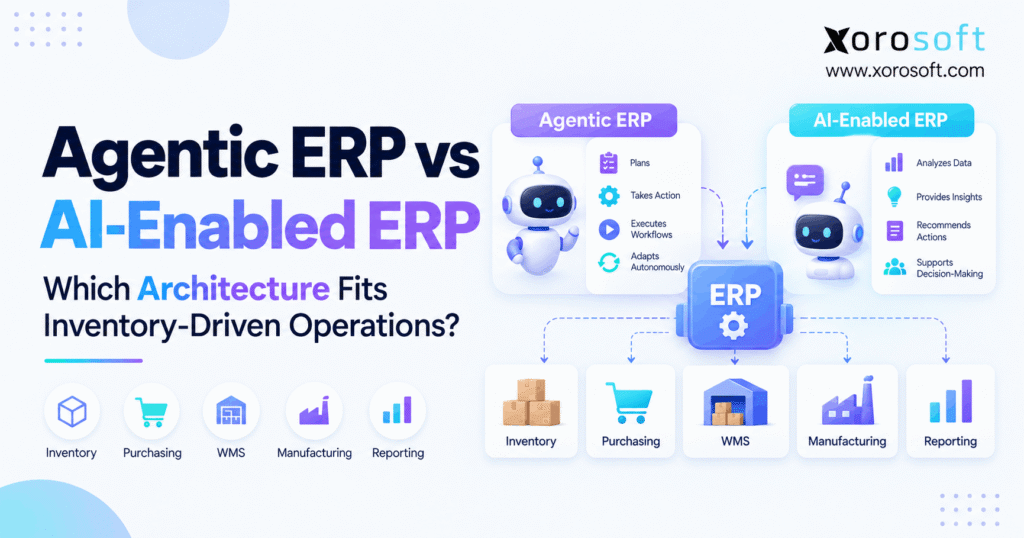
AI ERP architecture is transforming how organisations design and implement their enterprise resource planning systems.
1. When AI ERP Architecture Moves From Advice to Action
AI ERP architecture is changing because artificial intelligence is moving beyond dashboards, forecasts, summaries, and recommendations. Instead, modern ERP environments are beginning to connect AI with operational tools that can investigate events, prepare transactions, request approvals, and, in controlled cases, complete actions.
However, more autonomy does not automatically create better operations. For inventory-driven businesses, an incorrect AI decision can affect a purchase order, warehouse transfer, production schedule, customer promise, inventory valuation, or financial transaction.
Therefore, the key question is no longer simply whether an ERP includes AI. Instead, operations leaders need to ask how much authority the AI receives, what business context supports its decisions, and which controls remain between reasoning and execution.
1.1 AI Assistance and AI Execution Are Different
Traditionally, ERP AI has helped people interpret information. For example, it may predict demand, highlight a late supplier, detect unusual inventory movements, or summarize a financial report.
However, a person usually decides what happens next.
By contrast, agentic systems can potentially move several steps further. For example, an agent may identify a future shortage, check inbound inventory, review alternative warehouses, evaluate purchasing options, prepare a transfer or purchase order, and then request approval.
Therefore, the distinction is not simply smarter AI. Instead, it is the difference between decision support and controlled operational participation.
1.2 Inventory Operations Make the Architecture More Important
Inventory changes continuously. For example, units can move from available to allocated, picked, packed, transferred, quarantined, damaged, returned, consumed, or shipped.
Consequently, an AI system needs more than a stock-on-hand number. It also needs location, allocation, order, purchasing, warehouse, manufacturing, and financial context.
Moreover, inventory decisions create downstream effects. A transfer may solve a shortage in one warehouse while creating another shortage elsewhere. Likewise, a purchase order may improve availability while increasing working-capital pressure.
Therefore, inventory-driven businesses need AI that understands operational relationships rather than isolated records.
2. What AI-Enabled ERP Actually Does
An AI-enabled ERP uses artificial intelligence to improve analysis, forecasting, recommendations, document processing, search, reporting, or other established ERP workflows.
However, the user usually remains responsible for the final business action.
2.1 AI-Enabled ERP Architecture Focuses on Assistance
For example, an AI-enabled system might:
- forecast SKU demand;
- identify slow-moving products;
- detect unusual inventory activity;
- recommend reorder quantities;
- summarize open purchase orders;
- explain financial variances;
- classify documents;
- answer natural-language questions.
Therefore, AI-enabled ERP can deliver substantial value without becoming autonomous.
Moreover, this model often works particularly well when decisions have significant financial or operational consequences. Instead of allowing AI to act independently, the platform gives an experienced user better information.
For many businesses, that level of assistance remains entirely appropriate.
2.2 Where AI Assistance Is Often Enough
Consider a company with one warehouse, predictable suppliers, moderate SKU volume, and straightforward purchasing.
In that environment, AI may only need to highlight projected shortages and suggest replenishment quantities. Consequently, a buyer can review the recommendation, consider current cash needs, and create the purchase order manually.
Likewise, finance teams may benefit from AI-generated explanations without allowing AI to post adjusting entries.
Therefore, companies should not treat AI-enabled ERP as a temporary stage that must automatically evolve into full autonomy. Instead, each workflow should receive only the level of automation that its risk and complexity justify.
3. What Changes in an Agentic AI ERP Architecture?
An agentic ERP architecture allows governed AI agents to pursue defined objectives, gather operational context, plan steps, use permitted business tools, execute bounded actions, and verify or escalate results.
Microsoft’s Business Central documentation, for example, distinguishes collaborative Copilot capabilities from agents designed to work more independently on defined tasks.
3.1 AI ERP Architecture Moves Through Observe, Plan, Act, and Verify
An agentic workflow usually contains four broad stages.
First, observe. The agent detects an event or receives a goal.
Next, plan. It gathers relevant ERP data and evaluates potential actions.
Then, act. It uses authorized tools to prepare or execute approved steps.
Finally, verify. It checks whether the expected outcome occurred and escalates exceptions.
Therefore, an AI agent is not simply a chatbot attached to a database.
Microsoft also documents permission controls that restrict an agent according to both user and agent permissions. That model illustrates why operational access must be deliberately scoped. Microsoft Business Central agent permissions
3.2 Event-Driven AI Changes Daily ERP Work
A user does not always need to initiate an agentic process.
For example, a supplier may push a delivery date back by two weeks. Consequently, the ERP can detect the change and evaluate which SKUs, warehouses, customer orders, and production schedules will be affected.
Likewise, an inventory coverage threshold may trigger investigation before a stockout occurs.
Oracle now describes coordinated agent systems for finance and supply chain that can work with enterprise data, workflows, policies, permissions, approval hierarchies, and transactional context. Oracle Fusion Agentic Applications
Therefore, ERP AI is increasingly moving from prompt-based assistance toward event-aware execution.
3.3 A System of Record Can Become a System of Action
Traditional ERP primarily records what happened.
However, agentic ERP architecture introduces another role: coordinating what should happen next.
For example, the ERP may already know that a supplier is late. An agentic layer can potentially determine which commitments are affected, which alternative inventory exists, whether another vendor is available, and which action falls within policy.
Nevertheless, deterministic ERP controls should remain responsible for posting logic, inventory valuation, permissions, taxes, and other defined business rules.
Therefore, agentic AI should extend ERP logic rather than bypass it.
4. Agentic ERP vs AI-Enabled ERP in Daily Operations
Although both architectures use AI, they usually differ most clearly in execution.
| Capability | AI-Enabled ERP | Agentic ERP |
|---|---|---|
| Primary role | Assist | Pursue bounded objectives |
| Typical trigger | User request | User, event, or condition |
| Output | Insight or recommendation | Recommendation plus permitted action |
| Workflow | Often one step | Often multi-step |
| Execution | Mainly human | Human or controlled agent |
| Transaction access | Usually limited | Permission-based |
| Cross-module work | Possible | Often important |
| Human approval | Common | Based on risk |
| Verification | Usually human | Agent can verify or escalate |
4.1 Purchasing Shows the Difference Clearly
Suppose an ERP predicts that a high-volume SKU will stock out in 18 days.
An AI-enabled ERP may calculate a recommended purchase quantity. Consequently, the buyer reviews supplier lead time, available cash, order commitments, and minimum quantities before creating the PO.
By contrast, an agentic system could collect those facts automatically. Then, it might prepare a PO, verify that the quantity stays within purchasing policy, and route the transaction for approval.
Therefore, the difference is not forecasting quality alone.
Instead, it is how far the system can carry the process after identifying the problem.
4.2 Warehouse Operations Need Controlled AI ERP Architecture
Warehouse exceptions provide another example.
For instance, a short pick may happen because inventory is in the wrong bin, another order consumed the stock, replenishment has not reached the pick face, or the ERP quantity is wrong.
Therefore, an agent should investigate before recommending action.
A connected XoroWMS experience can maintain real-time warehouse and inventory context across receiving, tracking, fulfillment, and multi-warehouse operations. XoroWMS
Consequently, AI layered over warehouse operations has better context when the underlying WMS transactions remain accurate.
4.3 Not Every Action Should Become Autonomous
Automation should increase gradually with confidence.
For example, detecting a stockout risk is low risk. Likewise, preparing a proposed transfer is relatively controlled.
However, automatically releasing a high-value purchase order creates considerably greater exposure.
Therefore, companies should separate actions into levels such as:
1. Observe
2. Explain
3. Recommend
4. Prepare
5. Execute
As a result, each workflow receives an appropriate degree of autonomy rather than a single organization-wide setting.
5. The Five Layers of Safe AI ERP Architecture
A dependable AI ERP architecture needs more than an AI model. Instead, it requires several coordinated operational layers.
5.1 The Operational Data Layer Comes First
First, the ERP needs trustworthy operational records.
These typically include:
- SKUs;
- inventory states;
- warehouses;
- purchase orders;
- sales orders;
- receipts;
- transfers;
- suppliers;
- BOMs;
- production orders;
- costs;
- financial transactions.
Therefore, inventory accuracy becomes an AI prerequisite rather than merely a warehouse KPI.
Moreover, quantity alone is not enough. The system should distinguish available, reserved, allocated, damaged, in-transit, quarantined, and other meaningful inventory states.
Consequently, the agent reasons from business reality rather than a misleading headline number.
5.2 Context Connects Records Into Decisions
Next, AI needs relationships between the records.
For example, 1,000 units on hand may appear healthy. However, if 750 are already allocated and 200 are required for production, only 50 may remain truly flexible.
Similarly, an inbound PO matters only if the agent understands its supplier, expected date, warehouse, quantity, and reliability.
Therefore, connected ERP context matters more than raw data volume.
A platform such as XoroONE connects sales, purchasing, inventory, warehousing, manufacturing, ecommerce, EDI, finance, and reporting within a broader cloud ERP environment.
5.3 Tools Turn Reasoning Into Controlled Action
After context comes the action layer.
For example, an agent may need tools to:
- look up inventory;
- retrieve purchase orders;
- draft a transfer;
- create a purchase request;
- send a supplier follow-up;
- assign an exception;
- generate a report.
However, the tool should define a specific business action.
Therefore, the agent should not receive unrestricted database access simply because it needs to create a PO.
Instead, controlled tools preserve ERP rules around validation, permissions, and transaction integrity.
6. Why Inventory-Driven Businesses Need More ERP Context
Inventory-driven organizations usually connect more operational dependencies than a simple professional-services workflow.
Therefore, AI must reason across physical products, locations, channels, suppliers, warehouses, production, and finance.
6.1 Multi-Warehouse AI ERP Architecture Needs Location Context
Suppose Warehouse A faces a shortage while Warehouse B holds excess inventory.
At first, a transfer may appear obvious.
However, the agent should first evaluate demand at Warehouse B, allocated inventory, transfer cost, replenishment timing, customer commitments, and inbound purchasing.
Consequently, a transfer recommendation becomes a multi-variable decision rather than a quantity comparison.
Moreover, physical warehouse execution must still confirm the movement through controlled WMS transactions.
Therefore, businesses need both intelligent decision support and disciplined warehouse execution.
6.2 Ecommerce Adds Faster Inventory Events
Shopify, Amazon, wholesale, and other channels continually create changes in orders and availability.
Therefore, AI needs synchronized ecommerce and ERP context.
Xorosoft’s integration ecosystem connects ecommerce, marketplaces, EDI, warehouses, shipping, finance, AI, and related operational systems.
Likewise, merchants can find Xorosoft directly in the Shopify App Store, where the listing describes connected order management, inventory, warehousing, purchasing, manufacturing, and financial operations.
Consequently, an AI workflow investigating an ecommerce stockout can consider downstream operations rather than treating the storefront as the entire business system.
6.3 Manufacturing Expands the Decision Network
Manufacturing introduces another layer of dependency.
For example, one component shortage may affect several work orders. Consequently, delayed production can change finished-goods availability, customer delivery dates, warehouse demand, and purchasing priorities.
Therefore, an agent may need to analyze BOM requirements, available components, inbound material, supplier dates, production schedules, and customer commitments simultaneously.
Likewise, the accounting impact cannot be ignored. Material consumption, finished production, landed cost, and inventory valuation eventually affect financial reporting.
Thus, agentic automation becomes most useful when operational modules share consistent data.
7. Where Xorosoft Fits Into Modern ERP AI Architecture
For inventory-driven businesses, the AI discussion should begin with connected operational data.
Xorosoft combines ERP, WMS, inventory, purchasing, manufacturing, ecommerce, accounting, reporting, and related workflows across its product environment. Xorosoft solutions
Therefore, AI does not have to begin with a disconnected export from each department.
7.1 Connected ERP Data Creates a Better AI Foundation
A connected ERP can show how one operational event affects another.
For example, receiving inventory updates quantity. Subsequently, that quantity affects availability. Likewise, availability affects order allocation and fulfillment.
Meanwhile, purchasing affects expected inventory and cash commitments. Manufacturing also consumes components and creates finished goods.
Therefore, the quality of an AI decision depends heavily on how consistently the ERP maintains those relationships.
The more fragmented the operational stack becomes, the more reconciliation an AI layer must perform before it can safely recommend anything.
7.2 Xorosoft MCP Server Connects AI With ERP Operations
Xorosoft’s AI MCP Server creates a permission-aware connection between authorized ERP data and compatible AI systems.
Moreover, the current product page states that AI can work across inventory, purchasing, sales, accounting, manufacturing, and warehouse context. It also states that, with appropriate permissions, AI can assist with actions such as creating purchase orders, allocating inventory, triggering replenishment, generating reports, and assigning tasks.
Therefore, this capability provides a practical example of the architectural shift from merely asking AI questions toward connecting AI with governed operational actions.
Importantly, permissions still matter. Consequently, greater capability should not mean unrestricted ERP access.
7.3 ERP AI Still Depends on Operational Discipline
AI connectivity does not remove the need for strong ERP processes.
For example, an AI model cannot reliably identify a warehouse shortage if cycle counts are inaccurate. Likewise, it cannot optimize purchasing if supplier lead times are outdated.
Therefore, ERP implementation quality remains fundamental.
Businesses should first standardize data ownership, approval rules, inventory states, receiving practices, and purchasing policies.
Afterward, AI can operate against a clearer and more dependable system.
8. Governance Is Part of AI ERP Architecture
Governance should not be added after an agent goes live.
Instead, it should be designed into the architecture from the beginning.
8.1 Approval Thresholds Should Match Transaction Risk
Different actions require different controls.
For example, a low-value replenishment recommendation may not require the same approval process as a $100,000 purchase order.
Therefore, companies can define thresholds such as:
- low-risk actions that execute automatically;
- moderate-risk actions that require supervisor approval;
- high-risk actions that require management review;
- prohibited actions that always remain human-controlled.
Consequently, autonomy becomes policy-driven rather than unlimited.
Moreover, the thresholds should consider more than dollar value. Customer impact, inventory scarcity, supplier risk, and accounting consequences can also matter.
8.2 AI ERP Architecture Needs Permissions and Auditability
The NIST AI Risk Management Framework emphasizes ongoing governance, measurement, management, and clear responsibility throughout the AI lifecycle. NIST AI Risk Management Framework
Therefore, an ERP agent should have defined responsibilities and traceable actions.
For every significant event, operators should be able to answer:
- What triggered the agent?
- Which data did it use?
- What did it recommend?
- Which action did it perform?
- Which user approved it?
- What changed afterward?
As a result, auditability becomes part of operational control rather than an optional reporting feature.
8.3 Some Decisions Should Remain Human-Controlled
Certain transactions deserve additional caution.
For example, businesses may keep human control over:
- significant inventory write-offs;
- major purchasing commitments;
- customer credit changes;
- unusual financial postings;
- contractual pricing changes;
- production cancellations.
However, AI can still investigate these situations.
Therefore, the agent may gather evidence, identify root causes, compare alternatives, and prepare a recommended action without receiving permission to complete the final transaction.
9. How to Choose Between Agentic and AI-Enabled ERP
The correct architecture depends on operational maturity rather than AI enthusiasm.
Therefore, companies should evaluate the process before deciding how autonomous the technology should become.
9.1 Use AI-Enabled ERP When Assistance Solves the Problem
AI-enabled ERP may be enough when operations are predictable and exceptions are manageable.
For example, consider a business with:
- one warehouse;
- limited sales channels;
- relatively stable demand;
- straightforward suppliers;
- modest transaction volume.
In that environment, forecasting, anomaly detection, reporting, and recommendations may produce most of the available value.
Moreover, keeping people in control may remain efficient because the team does not face enough repetitive exceptions to justify autonomous execution.
Therefore, more complex technology would not necessarily improve the process.
9.2 Agentic ERP Architecture Becomes Useful as Exceptions Scale
By contrast, agentic capabilities become more relevant when operators repeatedly investigate cross-functional exceptions.
For example, complexity increases with:
- multiple warehouses;
- thousands of SKUs;
- Shopify plus wholesale;
- Amazon or other marketplaces;
- EDI customers;
- manufacturing;
- supplier variability;
- large purchasing teams.
Consequently, people can spend substantial time gathering information before they even make a decision.
An agent can reduce that investigative workload. Then, where controls permit, it can also prepare or execute the next step.
Therefore, agentic ERP architecture is often more valuable where coordination—not simply analysis—is the bottleneck.
9.3 Use the 6C Readiness Test
Before granting AI more authority, evaluate six areas.
Context: Does the ERP contain everything required to understand the event?
Correctness: Can the business trust that information?
Control: Which actions can the AI perform?
Constraints: Which rules and permissions restrict those actions?
Confirmation: Which decisions need human approval?
Continuity: Can the system verify outcomes and escalate failures?
Therefore, missing any one of these controls should slow the move toward autonomy.
Instead, fix the foundation first.
9.4 Look Beyond the AI Feature List
When evaluating ERP systems, ask how AI connects to operations rather than counting AI features.
For example, evaluate whether the ERP can:
- connect inventory and purchasing;
- expose warehouse status;
- work across ecommerce channels;
- respect approval permissions;
- maintain transaction history;
- support integrations;
- preserve audit trails.
Additionally, review actual customer environments through relevant Xorosoft case studies rather than relying only on feature descriptions.
Therefore, the architectural question becomes practical: can the platform provide trustworthy context and controlled actions at the same time?
10. Build Toward Controlled Autonomy, Not Maximum Autonomy
AI ERP architecture should not be measured by how many decisions humans can remove from the process.
Instead, it should be measured by how effectively the system improves decisions while preserving control.
Therefore, start with visibility. Next, add explanation. Then, introduce recommendations. Afterward, allow AI to prepare transactions. Finally, enable bounded execution only where the data, policies, permissions, and business impact justify it.
For inventory-driven companies, this progression matters because purchasing, inventory, WMS, manufacturing, ecommerce, and accounting continuously affect each other.
Consequently, connected operational context becomes the foundation of useful ERP AI.
Xorosoft provides that foundation across inventory-driven workflows while its MCP Server extends permission-aware AI connectivity into ERP data and actions. Therefore, businesses can evaluate AI alongside the operational system that actually holds the inventory, purchasing, warehouse, and financial context.
If disconnected systems or limited operational visibility are preventing the next stage of automation, Book a Demo to see how connected ERP and WMS workflows can support a more controlled AI strategy.
Frequently Asked Questions
What is AI ERP architecture?
AI ERP architecture describes how ERP data, artificial intelligence, business rules, permissions, tools, and workflows connect. Therefore, it determines whether AI only provides insights or can also perform controlled operational actions.
How is agentic ERP different from AI-enabled ERP?
AI-enabled ERP generally helps people analyze information and make decisions. By contrast, agentic ERP can pursue defined goals, plan multiple steps, use authorized tools, and perform bounded actions.
Is agentic ERP better than AI-enabled ERP?
Not always. Instead, the right approach depends on process complexity, data quality, transaction risk, and governance. Many businesses benefit from AI assistance without needing autonomous operational execution.
Can ERP AI agents manage inventory?
Yes, within defined controls. For example, agents can investigate shortages, recommend transfers, prepare replenishment actions, or assist with allocation. However, accurate inventory data and permission controls remain essential.
Does agentic ERP require human approval?
Not for every action. However, higher-risk transactions should use approval thresholds. Therefore, organizations can automate low-risk tasks while keeping significant purchasing, accounting, or inventory decisions human-controlled.
What data does agentic ERP need?
Typically, agents need reliable inventory, orders, suppliers, purchasing, warehouse, manufacturing, demand, cost, and financial context. Moreover, master data and inventory states must remain accurate.
When should a business move toward agentic ERP?
Businesses should increase autonomy after their processes are standardized, data is reliable, permissions are defined, approvals are documented, and AI recommendations have demonstrated consistent operational value.
Recent Posts
-
 ERP Landed Cost Module vs Spreadsheet Calculations for Importers
 -
 How to Build an Open-to-Buy Plan for an Omnichannel Brand
 -
 Cold Storage WMS for Food and Beverage Distribution
 -
 ERP Buying Statistics 2026: Evaluation, Implementation, and Adoption Risks
 -
 How a Distributor Reduced B2B Order Exceptions Without Restricting Sales