Backflushing in manufacturing is an important process used in many production environments.
1. Why Backflushing in Manufacturing Exists
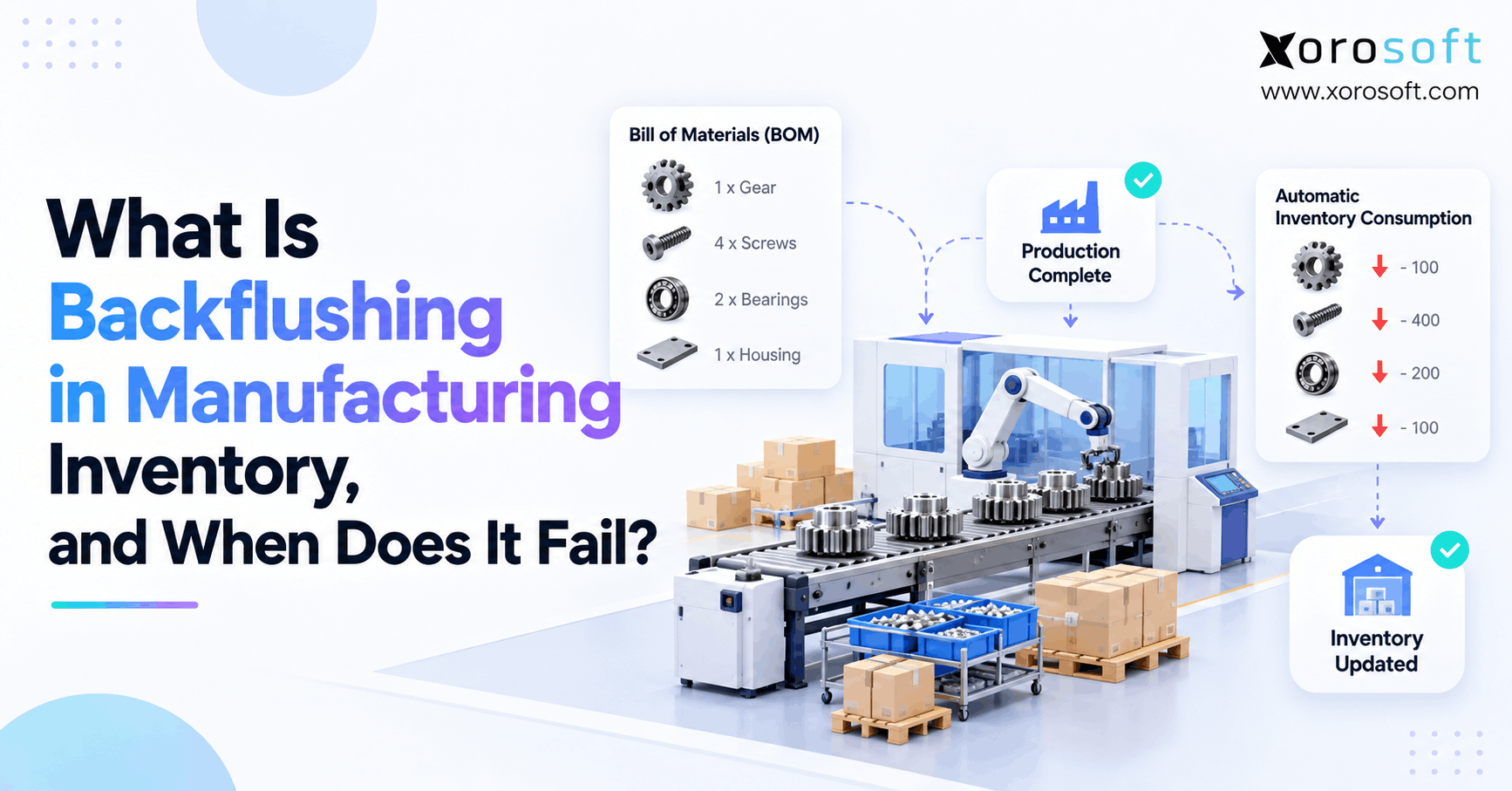
Backflushing in manufacturing automatically records component consumption after production activity instead of requiring workers to enter every material withdrawal manually. Therefore, the ERP typically uses the bill of materials, finished quantity, and configured consumption rules to calculate how much inventory production should have consumed.
However, automatic consumption does not automatically mean accurate consumption. Backflushing works only when the quantities stored in the system remain close to what actually happens on the shop floor.
For example, a BOM might say that one finished product requires four screws, one bracket, and two meters of fabric. Once production reports 100 finished units, the system can automatically deduct 400 screws, 100 brackets, and 200 meters of fabric.
Yet the factory may have used more.
Scrap may increase. Moreover, workers may substitute another component. Rework may require extra material. Similarly, material may come from another warehouse or bin.
Therefore, the real value of backflushing in manufacturing depends on how closely ERP assumptions match physical production.
1.1 Why Manufacturers Automate Component Consumption
First, manual material reporting creates work.
A repetitive production line may consume thousands of screws, labels, cartons, fasteners, or other low-value components every shift. Consequently, asking workers to record each movement individually can slow production without adding proportional operational value.
Backflushing reduces that transaction volume.
As a result, workers can report production output while the system calculates standard material consumption automatically.
However, manufacturers still need controls for the exceptions that standard calculations cannot see.
1.2 Backflushing Is Not a Physical Inventory Movement
Backflushing records consumption in the ERP. However, materials may have moved physically much earlier.
For example, warehouse employees may stage components beside a production line in the morning. Next, operators consume those items throughout the day. Finally, the ERP records component consumption only after output is reported.
Therefore, manufacturers must separate three events:
- material movement;
- physical consumption;
- ERP consumption posting.
Although those events are related, they do not always occur simultaneously.
2. How Backflushing in Manufacturing Works
The mechanics of backflushing in manufacturing usually begin with a production order and a BOM.
First, the ERP determines which components production expects to consume. Next, workers complete an operation or report finished output. Then, the system calculates standard component usage. Finally, it reduces inventory according to its configured flushing rules.
Official Microsoft Business Central documentation explains that backward flushing can post component consumption when an operation finishes or when the production order reaches Finished status.
2.1 The Basic Backflush Calculation
At its simplest, the calculation is:
Component consumption = finished quantity × BOM quantity per finished unit
For example:
| Component | Quantity per Finished Unit | Production Quantity | Backflushed Quantity |
|---|---|---|---|
| Component A | 2 | 100 | 200 |
| Component B | 4 | 100 | 400 |
| Material C | 0.5 kg | 100 | 50 kg |
Therefore, if production reports 100 finished units, the system deducts the expected BOM quantities.
However, this calculation assumes the BOM reflects reality.
If actual production uses 55 kg of Material C rather than 50 kg, five kilograms disappear physically without leaving the ERP unless another transaction captures the difference.
2.2 Production Output Can Trigger the Backflush
Different ERP systems trigger automatic consumption differently.
For example, an ERP may post components:
- when an operation finishes;
- when finished output is reported;
- when the production order closes;
- when a worker records production through a scanner.
Therefore, companies should understand exactly when their own system creates consumption transactions.
Oracle’s NetSuite backflush documentation explains that work-order components can be issued automatically using standard BOM quantities when backflush is enabled.
2.3 BOM Accuracy Controls Backflush Accuracy
Because backflushing in manufacturing relies heavily on BOM data, errors become repeatable.
Suppose a BOM quantity is understated by only 0.1 unit.
For one production order, that difference might seem insignificant. However, after 20,000 finished units, the system could be off by 2,000 component units.
Consequently, BOM governance becomes an inventory-control issue rather than only an engineering task.
3. Why Manufacturers Use a Production Backflush
Manufacturers generally use a production backflush because it reduces repetitive work.
Moreover, predictable component usage does not always justify individual scans or manual issue transactions.
3.1 Less Shop-Floor Data Entry
Automatic component consumption reduces the number of transactions operators must enter.
Therefore, production teams can spend more time completing work and less time recording predictable material movements.
In addition, fewer manual entries can reduce simple typing or scanning errors.
3.2 Faster Production Reporting
When materials follow a stable BOM, automatic consumption can make reporting significantly faster.
For example, operators can report finished quantities while the system handles predictable component deductions.
Consequently, backflushing in manufacturing often fits repetitive assembly environments well.
3.3 Better Fit for Low-Value Components
Recording every screw, label, box, or small fastener individually can create unnecessary operational effort.
Therefore, manufacturers often consider backflushing for components that have:
- stable usage;
- low unit value;
- limited substitutions;
- predictable scrap;
- straightforward traceability requirements.
However, higher-risk materials usually require stronger controls.
4. When Backflushing in Manufacturing Works Well
Backflushing in manufacturing performs best when physical production is predictable.
Therefore, manufacturers should evaluate process stability before enabling automatic consumption broadly.
4.1 Stable Bills of Materials
First, the BOM should accurately represent what operators actually consume.
If quantities, revisions, or components change frequently, automated calculations will repeatedly use outdated assumptions.
However, when BOMs remain stable and controlled, backflushing becomes much more dependable.
4.2 Predictable Consumption
Automatic consumption works particularly well when the material used per finished unit varies very little.
For example, a product may reliably need:
- four bolts;
- two labels;
- one carton.
Because consumption remains predictable, the calculated transaction stays close to reality.
4.3 Repetitive Production
High-volume repetitive production usually creates fewer exceptions than customized manufacturing.
Therefore, manufacturers producing the same assemblies repeatedly may gain more from automation.
In contrast, high-mix production often introduces more substitutions, changing BOMs, rework, and variable material use.
4.4 Controlled Scrap
Backflushing also performs better when scrap is stable and measurable.
However, if scrap changes significantly between runs, standard consumption can quickly diverge from physical inventory.
Consequently, scrap should either be incorporated into reliable standards or recorded separately.
5. Why Backflushing in Manufacturing Fails
Most failures in backflushing in manufacturing happen because the ERP uses an assumption that no longer matches factory reality.
Therefore, the calculation itself may be correct while the result is still wrong.
5.1 The BOM No Longer Matches Actual Usage
Suppose a BOM requires two meters of material per unit.
However, cutting loss causes operators to use 2.15 meters.
If 1,000 units are completed, the ERP deducts 2,000 meters while the factory actually consumes 2,150.
Consequently, system inventory is overstated by 150 meters.
Moreover, purchasing may delay replenishment because the ERP believes those 150 meters still exist.
Therefore, outdated BOM quantities can create both inventory and purchasing problems.
5.2 Scrap Is Not Recorded
Scrap is one of the biggest risks in automated consumption.
For example, production expects to use 500 components. However, workers damage 20 components during assembly and use replacements.
Actual consumption becomes 520.
Yet if the ERP backflushes only 500, it leaves 20 nonexistent components in inventory.
Microsoft also notes that automatic flushing can make scrap harder to identify if teams do not record it separately.
Therefore, backflushing in manufacturing needs a separate scrap process.
5.3 Rework Uses Additional Components
Rework creates a similar problem.
A finished product may fail inspection. Therefore, operators reopen it, replace components, add packaging, or repeat an operation.
However, the original BOM may not anticipate those additional materials.
As a result, physical stock falls faster than ERP inventory.
Consequently, manufacturers should record rework consumption instead of allowing it to disappear inside general inventory adjustments.
5.4 Workers Substitute Materials
Suppose the BOM requires Component A.
However, Component A is unavailable, so production uses Component B instead.
If the ERP still backflushes Component A, two errors occur:
- Component A becomes understated;
- Component B becomes overstated.
Therefore, one substitution can distort two inventory balances simultaneously.
Moreover, MRP may recommend buying more Component A while failing to replenish Component B.
5.5 Production Uses the Wrong Location
Automatic consumption also needs a warehouse, staging area, or bin.
Therefore, correct quantity alone is not enough.
For example, the company may physically consume material from Warehouse B while the ERP backflushes Warehouse A.
Total company inventory could still appear reasonable. However, warehouse-level availability becomes unreliable.
That problem becomes especially important for multi-warehouse businesses using production staging locations.
5.6 Production Reporting Happens Late
Backflushing requires a trigger.
Therefore, when production reporting happens late, ERP inventory can remain temporarily overstated.
For example, operators may finish production at 10 a.m. but post the output at 5 p.m.
Meanwhile, MRP may still see components as available. Additionally, purchasing may postpone replenishment. Another production order may even attempt to use the same inventory.
Consequently, transaction timing matters almost as much as quantity.
5.7 Inventory Is Insufficient
Sometimes, the system does not contain enough available stock for the required backflush.
SAP documentation explains that components marked for backflushing can receive an automatic goods issue when an order or operation is confirmed. SAP’s production-order documentation also notes restrictions around certain automatic goods movements.
Therefore, operations teams must review failed or partial consumption postings instead of assuming every production confirmation updated inventory successfully.
5.8 Lot and Serial Requirements Add Complexity
Traceability does not always make backflushing impossible.
However, it makes accurate execution more important.
For example, Oracle documents backflushing support for lot-controlled components in certain NetSuite manufacturing workflows.
Nevertheless, requirements vary by ERP and configuration.
Therefore, manufacturers should verify whether the system records the actual lot, serial, location, and quantity required by their traceability process.
6. How Backflush Inventory Errors Spread
A backflush error rarely remains isolated to production.
Instead, inaccurate consumption moves through inventory, purchasing, planning, costing, and accounting.
6.1 Inventory Availability Becomes Misleading
Suppose the ERP reports 300 units of a component while only 250 physically remain.
Consequently, production planners may allocate inventory that does not exist.
Moreover, customer orders or future production jobs may depend on that false availability.
Therefore, small backflush errors can eventually become production delays.
6.2 MRP Starts With the Wrong Inventory Position
MRP calculations depend on several inputs.
However, on-hand inventory is one of the most important.
Therefore:
Wrong consumption → wrong on-hand balance → wrong net requirement → wrong replenishment recommendation
As a result, planners may see fewer purchase requirements than they actually need.
Alternatively, overstated consumption can make the system recommend unnecessary purchases.
6.3 Purchasing Responds to Bad Signals
Purchasing decisions depend on trustworthy demand and inventory data.
Therefore, inaccurate consumption can create:
- late purchase orders;
- unnecessary purchase orders;
- stockouts;
- excess stock;
- rushed supplier orders.
Consequently, a production-data problem can become a working-capital problem.
6.4 Accounting Inherits the Variance
Eventually, a physical count reveals the missing or excess material.
Then, accounting must post an adjustment.
However, repeated adjustments make it harder to understand whether the cause was scrap, BOM error, production variance, theft, damage, or incorrect backflushing.
Therefore, manufacturers should investigate recurring variance rather than simply clearing it.
7. Backflushing in Manufacturing vs Manual Material Issue
Backflushing in manufacturing and manual material issue solve the same basic accounting need differently.
However, neither approach is universally better.
| Factor | Backflushing | Manual Material Issue |
|---|---|---|
| Data-entry effort | Lower | Higher |
| Standard component use | Strong fit | Works, but adds transactions |
| Variable quantities | Needs exception handling | Easier to record actual use |
| Scrap visibility | Requires separate control | Easier to capture directly |
| Substitutions | Must be recorded correctly | Easier to reflect actual item |
| Traceability | Depends on configuration | Often provides direct control |
| Repetitive production | Strong candidate | More administrative effort |
| High-mix production | Often needs hybrid rules | Frequently more suitable |
7.1 When Manual Material Issue Makes More Sense
Manual issue becomes more attractive when actual usage matters more than transaction speed.
For example, manufacturers may manually issue:
- expensive materials;
- serialized components;
- highly variable ingredients;
- regulated materials;
- scarce components.
Therefore, manual reporting is often appropriate when the cost of inaccurate consumption exceeds the cost of additional data entry.
7.2 Why a Hybrid Approach Often Works Better
Manufacturers do not have to choose one method for every component.
Instead, they can backflush predictable materials while recording high-risk materials directly.
For example, screws and cartons may backflush automatically. Meanwhile, expensive electronics or serial-controlled parts may require scans.
Consequently, selective automation often gives better control than an all-or-nothing rule.
8. Forward Flushing vs Manufacturing Backflush
Forward and backward flushing differ mainly in timing.
Therefore, the choice affects how quickly ERP inventory follows physical production.
8.1 Forward Flushing
Forward flushing typically records expected component consumption near the beginning of production.
Consequently, inventory decreases earlier.
However, expected production may later differ from actual production.
Therefore, early consumption can require adjustments when output changes.
8.2 Backward Flushing
Backward flushing records consumption later, usually after an operation or production output is completed.
Microsoft explains that backward flushing can use actual output quantities when routing links connect components to specific operations.
Therefore, backflushing in manufacturing can align consumption more closely with completed production.
However, delayed reporting can still leave inventory temporarily overstated.
| Factor | Forward Flush | Backward Flush |
|---|---|---|
| Consumption timing | Earlier | Later |
| Typical trigger | Release/start | Completion/output |
| Inventory visibility risk | Consumption may be early | Consumption may be delayed |
| Best fit | Predictable production start | Output-driven consumption |
9. Which Components Should Be Backflushed?
The strongest backflush candidates usually have predictable consumption.
Therefore, manufacturers should classify components before choosing an issue method.
9.1 Good Candidates for Inventory Backflushing
Typical candidates include:
- screws;
- labels;
- cartons;
- adhesives;
- inexpensive fasteners;
- predictable consumables.
Moreover, these items often create large transaction volumes without requiring high-detail traceability.
Therefore, automating them can remove substantial shop-floor work.
9.2 Components That Need Stronger Tracking
Other materials require more direct control.
For example:
- expensive components;
- serial-controlled parts;
- regulated materials;
- variable ingredients;
- scarce inventory;
- substitute-heavy components.
Consequently, these items may require scanning, manual issue, lot selection, or another actual-consumption process.
10. How to Diagnose Backflush Inventory Problems
Manufacturers should not wait until year-end inventory to investigate backflush problems.
Instead, several operational signals can reveal problems earlier.
10.1 Cycle Counts Repeatedly Find the Same Variance
One count adjustment may be accidental.
However, repeated shortages against the same components usually suggest a process issue.
Therefore, review:
- BOM quantities;
- scrap;
- substitutions;
- staging practices;
- production posting timing.
10.2 Material Usage Variance Keeps Growing
Compare expected BOM consumption against physical depletion.
If the gap continues to grow, either the standard is wrong or exceptions are not being recorded.
Therefore, increasing material variance should trigger investigation before teams adjust inventory.
10.3 Negative Inventory Appears Around Production
Negative balances may indicate:
- consumption from the wrong location;
- delayed receipts;
- posting sequence problems;
- failed transfers;
- inaccurate stock.
Consequently, negative inventory should not simply be accepted as normal production behavior.
10.4 MRP Recommendations Stop Making Sense
MRP cannot compensate for unreliable source data.
Therefore, when purchase recommendations seem consistently too high or too low, teams should first confirm whether production consumption is accurate.
Only then should they adjust planning parameters.
11. How to Make Backflushing in Manufacturing More Reliable
Improving backflushing in manufacturing usually requires better data and stronger exception management rather than more automation.
11.1 Keep BOMs Current
First, control BOM revisions.
Moreover, operations should compare standard usage against actual usage periodically.
When production repeatedly consumes more material than the BOM expects, teams should determine whether the cause is:
- inaccurate standards;
- scrap;
- rework;
- substitution;
- poor process control.
Therefore, BOM maintenance should involve both engineering and operations.
11.2 Record Scrap Separately
Scrap should remain visible.
Otherwise, physical inventory disappears without a matching explanation.
Therefore, production teams should record meaningful scrap at the point where it occurs.
In addition, managers should compare scrap patterns by product, operation, and component.
11.3 Capture Substitutions
When workers replace one component with another, the ERP should know.
Otherwise, backflushing in manufacturing can reduce the wrong item.
Therefore, substitution workflows should update both actual consumption and future planning.
11.4 Count Production Locations Regularly
Production staging locations often accumulate small discrepancies.
Consequently, regular cycle counts can identify problems sooner than annual inventory.
Moreover, targeted counts help teams isolate the responsible process.
11.5 Connect Manufacturing and Warehouse Inventory
Material accuracy becomes harder when manufacturing and warehousing use separate records.
Therefore, businesses with complex locations may need connected warehouse controls.
XoroWMS provides warehouse execution within Xorosoft’s broader operations environment, which can help inventory-driven businesses connect warehouse movements with downstream processes.
12. What ERP Software Should Support for Reliable Backflushing
A manufacturer does not simply need a checkbox labeled “Backflush.”
Instead, reliable backflushing in manufacturing depends on the controls surrounding it.
12.1 BOM, Work Order, and Inventory Control
A manufacturing system should connect:
- BOMs;
- product revisions;
- work orders;
- material requirements;
- inventory;
- production output;
- costing.
Xorosoft’s XoroONE platform brings core operational processes into a connected cloud ERP environment.
Therefore, businesses can evaluate production consumption alongside purchasing, inventory, accounting, and reporting instead of treating manufacturing as an isolated workflow.
12.2 Warehouse and Location Visibility
Manufacturers also need to know where components are physically available.
Therefore, the ERP should distinguish warehouses, production locations, staging areas, and other stock points.
Xorosoft can support inventory-driven businesses that need manufacturing processes connected with broader warehouse operations rather than independent stock records.
12.3 Purchasing and Material Requirements
Consumption data should influence replenishment.
Consequently, production inventory, MRP, and purchasing should share the same material picture.
Xorosoft’s broader business solutions connect operational areas that commonly depend on the same inventory data.
Therefore, manufacturers can evaluate shortages and replenishment using a more consistent source of information.
12.4 Accounting and Inventory Cost
Production consumption also creates financial consequences.
Therefore, quantity movements must eventually reconcile with inventory value and production cost.
A connected XoroERP environment can help inventory-driven businesses bring manufacturing, purchasing, operational inventory, and accounting data closer together.
However, software alone does not fix inaccurate BOMs or unreported scrap. Process discipline still matters.
13. Backflushing in Manufacturing Across Different Industries
Backflushing in manufacturing should be configured differently depending on how predictable material usage is.
Therefore, industry context matters.
13.1 Apparel and Fashion
Apparel production may backflush:
- labels;
- packaging;
- standard trims;
- predictable accessories.
However, fabric consumption can vary because of cutting yield, defects, shade requirements, and rework.
Therefore, actual fabric usage may require stronger controls.
13.2 Furniture
Furniture production often contains both predictable and variable components.
For example, hardware and fasteners may be suitable for backflushing.
Meanwhile, wood, upholstery, finishing materials, and custom options can introduce variance.
Consequently, a hybrid approach can work well.
13.3 Sporting Goods and Consumer Products
Repeatable assembly can make these environments good candidates for selective backflushing.
However, expensive parts or serial-controlled items may still require individual tracking.
Therefore, component-level rules matter more than a single plant-wide policy.
13.4 Food and Beverage
Food manufacturing often adds:
- lot control;
- expiry dates;
- variable yield;
- batch differences;
- ingredient loss.
Consequently, standard backflush quantities may not always reflect actual consumption.
Therefore, stronger lot, yield, and scrap controls may be necessary.
Xorosoft supports inventory-driven companies across multiple industries, including manufacturing environments where material control and inventory visibility must operate together.
14. When Backflushing Problems Signal the Need for Better ERP Control
Not every backflush problem requires a new ERP.
However, repeated problems can expose broader system limitations.
14.1 Spreadsheets Sit Between Production Systems
Suppose work orders live in one application, purchasing in spreadsheets, warehouse inventory elsewhere, and accounting in another system.
Consequently, teams must reconcile several versions of the same transaction.
Moreover, corrections may not propagate automatically.
Therefore, a backflush discrepancy becomes harder to trace.
14.2 Multiple Warehouses Increase the Cost of Bad Data
Inventory errors become more damaging as the company adds warehouses.
For example, an inaccurate production deduction can affect:
- transfer decisions;
- replenishment;
- production planning;
- customer availability.
Therefore, companies should evaluate whether their ERP provides enough location-level control.
14.3 Ecommerce, Wholesale, and Manufacturing Share Inventory
A manufacturer may also sell through Shopify, marketplaces, wholesale channels, or EDI.
Consequently, the same component and finished-goods data may affect many downstream workflows.
Xorosoft’s integrations ecosystem is designed to connect operational systems around a shared ERP foundation.
Therefore, growing companies should evaluate whether production data reaches every channel that depends on inventory.
15. Backflushing in Manufacturing Works Only When Data Matches Reality
Backflushing in manufacturing can remove a large amount of repetitive shop-floor data entry. However, automation does not create accuracy by itself.
Instead, reliable results depend on:
- accurate BOMs;
- timely production reporting;
- visible scrap;
- recorded substitutions;
- correct warehouses and bins;
- controlled rework;
- trustworthy inventory.
Therefore, manufacturers should not ask whether every component should be backflushed.
They should ask:
Which materials are predictable enough to automate, and which exceptions are valuable enough to record directly?
For some companies, the answer will be a hybrid workflow. Predictable materials can backflush automatically, while expensive, regulated, variable, or traceable components receive direct reporting.
Moreover, when manufacturing, purchasing, warehousing, inventory, and accounting operate in disconnected systems, even a good backflush process becomes harder to reconcile.
Xorosoft provides cloud ERP, inventory, warehouse, purchasing, accounting, and manufacturing capabilities for inventory-driven businesses. Therefore, companies evaluating stronger production controls can examine whether one connected platform fits their broader operating model.
If production inventory discrepancies, BOM issues, or disconnected workflows are becoming difficult to manage, Book a Demo to review how Xorosoft can support your manufacturing and inventory processes.
Frequently Asked Questions About Backflushing in Manufacturing
What is backflushing in manufacturing?
Backflushing automatically records expected component consumption after production output or an operation is completed, usually using BOM quantities and reported finished units.
When does backflushing work best?
It works best with stable BOMs, predictable material usage, repetitive production, controlled scrap, and limited component substitutions.
Why does backflushing create inventory errors?
Errors appear when actual usage differs from ERP assumptions because of scrap, rework, substitutions, outdated BOMs, wrong locations, or delayed production reporting.
Can backflushing cause negative inventory?
Yes. Depending on ERP configuration, insufficient stock, incorrect locations, delayed receipts, or transaction-timing problems can contribute to negative balances.
Is backflushing better than manual material issue?
Neither is always better. Backflushing reduces transactions, while manual issue provides stronger control for expensive, variable, traceable, or frequently substituted components.
How does BOM accuracy affect backflushing?
The ERP calculates consumption from BOM data. Therefore, incorrect quantities or components can repeatedly create inventory discrepancies across every production run.
Should every manufacturing component be backflushed?
No. Many manufacturers use a hybrid approach: predictable materials backflush automatically, while higher-risk components receive direct issue, scanning, or traceability controls.
Recent Posts
-
 ERP Landed Cost Module vs Spreadsheet Calculations for Importers
 -
 How to Build an Open-to-Buy Plan for an Omnichannel Brand
 -
 Cold Storage WMS for Food and Beverage Distribution
 -
 ERP Buying Statistics 2026: Evaluation, Implementation, and Adoption Risks
 -
 How a Distributor Reduced B2B Order Exceptions Without Restricting Sales