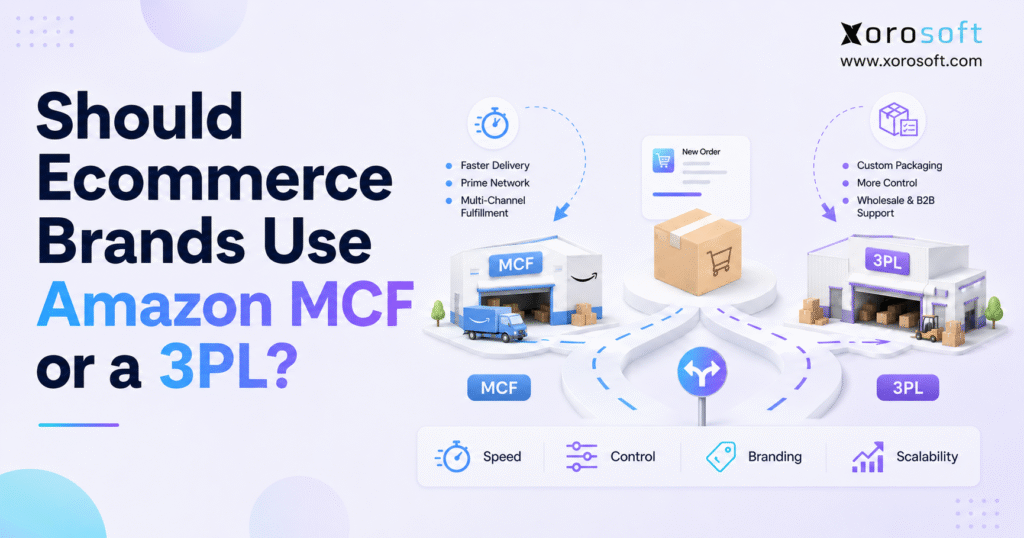
If you are considering your fulfillment strategy, understanding the key differences between Amazon MCF vs 3PL can help you make the best decision for your business.
1. Fulfillment Gets Harder Before Most Ecommerce Brands Expect It
Amazon MCF vs 3PL is a decision many ecommerce brands face as orders, SKUs, sales channels, and warehouse needs grow. At first, fulfillment may seem like a simple shipping task. However, once a business sells through Shopify, Amazon, wholesale accounts, marketplaces, and several stock locations, the decision affects far more than delivery speed.
It also affects stock levels, packaging, returns, purchasing, order routing, warehouse work, and accounting. Therefore, choosing a fulfillment model only by comparing shipping prices can create bigger problems later.
For some brands, Amazon Multi-Channel Fulfillment offers a simple way to use stock already stored in Amazon’s network. On the other hand, a 3PL can give the business more control over packaging, wholesale orders, returns, kitting, and warehouse rules.
Most importantly, there is no single winner.
The best choice depends on how the business sells, what customers expect, how products need to be handled, and how much control the company wants over fulfillment.
1.1 Amazon MCF vs 3PL: The Quick Answer
Amazon MCF vs 3PL usually comes down to simplicity versus control.
Amazon MCF often fits brands that already hold a large amount of stock inside Amazon and want a simple way to ship orders from other sales channels.
A 3PL, meanwhile, often fits brands that need custom packing, wholesale shipping, special handling, better returns control, or more choice over warehouse locations.
Still, some businesses use both. In that case, strong stock visibility and clear order rules become essential.
1.2 Why This Decision Matters
Fulfillment sits near the end of many business processes.
First, purchasing decides what stock is coming in. Next, inventory systems show what is available. Then, order tools decide what can be sold and where each order should go. Finally, the warehouse ships the order and finance records the stock movement.
Because these steps are connected, a poor fulfillment choice can create problems throughout the business.
Therefore, brands should view Amazon MCF vs 3PL as a wider business decision rather than a basic shipping choice.
2. Amazon MCF vs 3PL: What Is Amazon Multi-Channel Fulfillment?
Amazon Multi-Channel Fulfillment, often called Amazon MCF, lets businesses use stock stored within Amazon’s fulfillment network to ship eligible orders from channels outside the Amazon marketplace.
For example, a customer may place an order on Shopify while Amazon handles the pick, pack, and shipment process.
The basic flow is simple.
First, the order enters the connected system. Then, Amazon receives the fulfillment request. Next, the product is picked and packed. Finally, shipment and tracking details are sent back through the order flow.
Brands that want to review the service in more detail can use Amazon’s official Multi-Channel Fulfillment overview.
2.1 Why Brands Consider Amazon MCF
The main reason is simplicity.
Imagine a brand that already sells heavily through Amazon but is growing its Shopify store. Much of its stock is already inside Amazon’s network. Therefore, sending the same products to another warehouse may split stock across too many locations.
This is why Amazon MCF vs 3PL becomes an important question for Amazon-first ecommerce brands.
Instead of creating another stock pool right away, the business may use Amazon inventory for some off-Amazon orders.
Also, this can help a company test a new DTC channel before signing a long 3PL contract.
2.2 Where Amazon MCF Fits Best
Amazon MCF may work well when:
- Most stock is already stored with Amazon.
- Orders are simple parcel shipments.
- Products do not need much special handling.
- Custom packaging is not essential.
- The company wants to test DTC demand.
- Speed and simple setup matter more than packing flexibility.
However, needs often change as the business grows.
2.3 Where Amazon MCF Can Feel Limited
Not every order is a simple parcel.
For example, wholesale orders may need pallet setup, special labels, retailer rules, or EDI documents. Also, some consumer brands need custom boxes, inserts, samples, gift notes, or detailed returns checks.
In these cases, a standard process may feel too narrow.
Therefore, Amazon MCF vs 3PL should be judged on the work each order requires, not only how fast a parcel can leave the warehouse.
3. Amazon MCF vs 3PL: What Is a 3PL?
A 3PL, or third-party logistics provider, is a company that stores and ships goods for another business.
Usually, a 3PL receives stock, stores products, picks orders, packs shipments, and hands orders to carriers. In addition, some providers handle returns, kits, bundles, labels, wholesale orders, freight, or special packing work.
Because every provider is different, brands need to compare services carefully.
3.1 How a 3PL Usually Works
First, goods move from the supplier, factory, or current warehouse to the 3PL.
Next, the provider receives the products and records them in its warehouse system.
When an order arrives, warehouse staff pick and pack the products. Then, the parcel or freight shipment leaves the building. Finally, tracking and stock updates move back to connected systems.
In an Amazon MCF vs 3PL review, this extra choice and flexibility is one of the main reasons brands consider a 3PL.
3.2 Why Ecommerce Brands Choose a 3PL
A 3PL can often adapt to more detailed needs.
For instance, an apparel brand may need custom packing and careful return checks. A wholesale distributor may need pallet shipping and retailer labels. Meanwhile, a furniture business may need help with large or fragile items.
Therefore, a 3PL becomes more attractive as fulfillment gets less standard.
3.3 The Tradeoff of More Flexibility
More choice also means more things to manage.
For example, brands may need to compare receiving costs, storage charges, minimum fees, pick fees, packing costs, returns fees, warehouse sites, technology charges, and service targets.
So, a 3PL decision should never be based on one shipping quote.
4. Amazon MCF vs 3PL: The Differences That Matter Most
Amazon MCF vs 3PL is not really about whether both options can ship an ecommerce order. Both can.
Instead, the real question is which one fits the way the business works.
| Decision Factor | Amazon MCF | 3PL |
|---|---|---|
| Use of existing Amazon stock | Strong fit | Stock may need to move |
| Standard parcel orders | Strong fit | Strong fit |
| Custom packaging | More limited | Often more flexible |
| Branded inserts | More limited | Often available |
| Wholesale orders | Less flexible | Often stronger |
| Kitting and bundles | Depends on setup | Often stronger |
| Returns checks | More standard | Often customizable |
| Warehouse choice | Amazon-led | More provider choice |
| Process control | Lower | Usually higher |
| Special handling | More limited | Often stronger |
4.1 Delivery Speed
Speed matters because customers expect clear and reliable delivery.
Amazon’s network can be strong for normal parcel orders. However, a well-chosen 3PL can also provide fast shipping if stock is placed near customers.
Therefore, compare real service levels, cutoff times, shipping zones, and stock location.
4.2 Packaging and Brand Experience
For some companies, packaging is just protection.
For others, it is part of the product experience.
For example, a premium DTC brand may use custom boxes, samples, education cards, loyalty offers, or gift-ready packing.
In that case, a 3PL may give the brand more control.
However, businesses that mainly compete on product, price, and delivery may not need that level of customization.
4.3 Wholesale and B2B Orders
Wholesale makes the choice more complex.
Unlike a normal DTC parcel, a wholesale order may need case packs, pallets, retailer labels, routing rules, EDI files, or appointment booking.
Therefore, businesses with meaningful B2B sales should test whether their fulfillment partner can handle those needs before moving stock.
4.4 Inventory Visibility
Inventory visibility is one of the biggest issues in Amazon MCF vs 3PL.
Suppose a brand stores stock in Amazon, a 3PL, and its own warehouse. At the same time, Shopify is taking DTC orders while the sales team reserves products for wholesale buyers.
Suddenly, answering “How much stock can we sell?” becomes difficult.
As a result, fulfillment growth often creates a stock-control problem before it creates a shipping problem.
5. Amazon MCF vs 3PL: When Amazon MCF Makes More Sense
Amazon MCF may be the better choice when the business already relies heavily on Amazon and wants a simple way to serve more channels.
5.1 Most Inventory Is Already With Amazon
Consider a brand that earns much of its revenue through Amazon and has recently started growing its Shopify store.
Instead of moving large amounts of the same stock into another warehouse, the brand may use its existing Amazon inventory for some eligible orders.
From an Amazon MCF vs 3PL point of view, this can make MCF especially useful for Amazon-first brands.
5.2 Orders Are Simple
Standard products are easier to handle in a standard network.
For example, a normal one-item or two-item parcel usually needs less warehouse work than an order that requires assembly, labeling, custom packing, or special instructions.
Therefore, Amazon MCF can make sense when most orders follow a simple pattern.
5.3 The Brand Is Testing DTC Growth
A new sales channel can be hard to forecast.
For instance, Shopify may produce 100 orders in one month and 1,000 later.
Because demand is uncertain, a brand may not want to build a full new warehouse setup right away.
Amazon MCF can act as a bridge while the company learns how much DTC demand really exists.
5.4 Speed Matters More Than Custom Packaging
Some businesses need fast, dependable delivery more than a custom unboxing experience.
In those cases, a standard fulfillment model may work well.
However, if packaging is a major part of how the brand keeps customers loyal, the 3PL option deserves more attention.
6. Amazon MCF vs 3PL: When a 3PL Makes More Sense
A 3PL becomes more useful as orders and warehouse tasks become more complex.
6.1 Brand Presentation Matters
Packaging can shape how customers view the brand.
For example, beauty, apparel, subscription, and lifestyle brands may use tissue paper, custom boxes, samples, gift notes, or seasonal inserts.
Therefore, a flexible 3PL can give the business more choice over what the customer receives.
6.2 Wholesale Is Growing
Wholesale orders often follow different rules from DTC orders.
Retail customers may ask for labels, carton rules, pallets, EDI, routing instructions, or delivery appointments.
Therefore, Amazon MCF vs 3PL often shifts toward a 3PL as B2B and wholesale needs grow.
6.3 Returns Need More Control
A returned item is not always ready to sell again.
It may need a visual check, cleaning, repacking, repair, or disposal.
So, brands with high return rates should ask exactly how the provider handles returned stock before making a decision.
6.4 Products Need Kitting or Bundling
Bundles can make stock harder to control.
For example, a kit may contain three different items. If one item runs out, the full kit can no longer be sold.
A capable 3PL can handle the physical work. Still, the brand needs correct stock data for every part of the bundle.
6.5 Warehouse Location Matters
A growing business may want stock in certain areas.
For example, it may want one warehouse near East Coast customers and another near West Coast buyers.
In that case, a 3PL may provide more choice over where goods are stored.
7. Amazon MCF vs 3PL Cost: Compare More Than the Shipping Rate
Amazon MCF vs 3PL cost should be measured across the full order process.
A low pick-and-pack fee does not always mean a low total cost.
| Cost Area | What to Compare |
| Receiving | Pallet, carton, unit, and special handling |
| Storage | Monthly, seasonal, and long-term storage |
| Picking | First item and added item charges |
| Packing | Labor, boxes, mailers, and materials |
| Shipping | Carrier, zone, weight, and service |
| Returns | Labels, checks, restocking, and disposal |
| Kitting | Assembly and part handling |
| Technology | Apps, EDI, APIs, or portal fees |
| Extra work | Relabeling, projects, corrections, and manual tasks |
A useful Amazon MCF vs 3PL cost review should include every fee needed to get an order to the customer successfully.
7.1 Do Not Compare Only Pick and Pack
A provider may look cheaper per order but become more costly after storage, packing, returns, and extra fees are added.
Also, a cheaper warehouse can become costly if poor stock data creates cancelled orders or emergency transfers.
Therefore, calculate total fulfillment cost divided by successfully shipped orders.
7.2 Model Peak Months Separately
Peak demand can change warehouse costs.
During promotions or holiday periods, storage needs may rise while order volume also jumps.
As a result, brands should model normal months and peak months separately.
7.3 Include the Cost of Extra Inventory
More warehouses can improve delivery speed. However, they can also force a brand to hold more safety stock.
For example, splitting 1,000 units across several locations may reduce the amount available at each site.
Therefore, the cost of extra stock should be included in the decision.
8. Amazon MCF vs 3PL for Shopify Brands
For Shopify merchants, Amazon MCF vs 3PL often becomes a data and systems question as much as a warehouse question.
Shopify may capture the order, while another company physically holds the product.
Therefore, orders, stock, tracking, cancellations, and returns must move correctly between systems.
8.1 Amazon-First Shopify Brands
An Amazon-first brand may benefit from using stock already stored inside Amazon to support a growing Shopify channel.
This can reduce the need to create a second stock pool too early.
However, the brand still needs clear rules for how much inventory should support Amazon sales and how much should remain available for Shopify.
8.2 Shopify-First Brands
A Shopify-first business may care more about the customer experience.
For instance, subscriptions, bundles, custom packing, inserts, and returns may play a bigger role.
For Shopify-first companies, the Amazon MCF vs 3PL choice often depends on how much control the brand wants over fulfillment.
8.3 Integrations Become More Important as Channels Grow
Manual stock updates become risky when sales channels multiply.
A business selling through Shopify, Amazon, wholesale, and several stock locations needs connected data.
Therefore, brands should also review their ecommerce and ERP integrations when comparing fulfillment options.
For Shopify merchants, Xorosoft is also available through the Shopify App Store, which can help teams understand how ecommerce data can connect with back-office processes.
9. Amazon MCF vs 3PL for Multi-Channel Ecommerce
Amazon MCF vs 3PL gets harder when the business sells through several channels at once.
Amazon marketplace orders may follow one path. Shopify orders may follow another. Meanwhile, wholesale orders may need case packing, labels, or EDI.
Therefore, multi-channel businesses often need several routing rules rather than one shipping method.
9.1 Different Orders Need Different Paths
Consider a sporting goods company.
A small accessory sold through Shopify may work well through Amazon MCF. On the other hand, a large wholesale shipment may fit a 3PL better. Meanwhile, a custom kit may need to ship from the company’s own warehouse.
So, the best setup may depend on the order type.
9.2 Stock Must Be Allocated Before Fulfillment
Suppose 200 units are physically available, but 80 are already promised to wholesale customers.
If Shopify thinks all 200 can be sold, DTC orders may use stock that has already been committed.
Therefore, brands need stock rules that protect inventory for the right channel or customer.
9.3 Order Routing Becomes Important
Once several fulfillment sites exist, each order requires a decision.
Which site has the item?
Which site can deliver on time?
What will shipping cost?
Is stock reserved elsewhere?
Does the order need special packing?
As a result, multi-channel order routing becomes a key part of fulfillment planning.
10. Amazon MCF and 3PL Hybrid Fulfillment
The Amazon MCF vs 3PL decision does not always have to be one or the other.
A hybrid model can use different fulfillment methods for different order types.
For example:
- Amazon marketplace orders remain in Amazon fulfillment.
- Simple Shopify orders use Amazon MCF.
- Wholesale orders move through a 3PL.
- Custom kits ship from an internal warehouse.
- Large items use a specialist provider.
In fact, Amazon MCF vs 3PL does not always need an either-or answer because each model can serve different needs.
10.1 Why Hybrid Fulfillment Can Work
Different channels often have different needs.
A DTC shopper may care about quick delivery. A retailer may care more about labels and routing rules. Meanwhile, a special product may need hands-on checks.
Therefore, sending each order to the right location can improve service.
10.2 The Hidden Risk
Every added warehouse creates another stock location.
Every partner also creates more returns, stock changes, transfers, and order updates.
So, hybrid fulfillment can make physical shipping easier while making data harder to manage.
10.3 What a Hybrid Model Needs
At a minimum, the business needs:
- Clear SKU data
- Location-level stock visibility
- Order routing rules
- Purchase order visibility
- Transfer tracking
- Returns tracking
- Stock adjustments
- Reorder planning
- Financial matching
For businesses running internal warehouses as well as outside providers, a real-time warehouse management system can help keep internal warehouse tasks tied to wider stock records.
11. Amazon MCF vs 3PL Is Also a Systems Decision
Amazon MCF vs 3PL can look like a warehouse decision, but many problems begin before an order reaches the warehouse.
A new provider cannot fix a bad item list. Likewise, outsourced fulfillment cannot repair late purchasing, duplicate SKUs, missing barcodes, or disconnected accounting.
Therefore, brands should separate warehouse problems from systems problems.
11.1 Inventory Accuracy Comes First
Every fulfillment process starts with one question:
Is the product actually available?
If stock records are wrong, the website may oversell. Warehouse staff may search for products that are not there. Purchasing may order too much. Meanwhile, finance may report stock that does not exist.
So, accurate inventory is the base of reliable fulfillment.
11.2 Purchasing Shapes Future Availability
Warehouses can only ship products that arrive on time.
Therefore, supplier lead times, open purchase orders, forecasts, and reorder points affect fulfillment results.
A business may blame its fulfillment provider for stockouts even though products were ordered too late.
11.3 Accounting Needs the Same Stock Data
Each shipment changes inventory value and cost of goods sold.
Returns, damage, transfers, write-offs, and landed costs also change financial records.
Therefore, finance cannot remain separate from inventory and warehouse activity as the business grows.
A connected platform such as XoroONE can help bring inventory, purchasing, warehouse, ecommerce, accounting, and reporting into one system.
11.4 When ERP Becomes Useful
Small brands can often work with Shopify, accounting software, spreadsheets, and warehouse portals.
However, manual work grows as the business adds more channels and stock locations.
For example, one team may export inventory while another updates purchasing by hand. At the same time, finance may be trying to match a different stock number.
Therefore, businesses that outgrow disconnected tools often begin looking at a broader cloud ERP platform instead of adding another separate app.
12. Amazon MCF or 3PL by Industry
The right answer to Amazon MCF vs 3PL also changes based on product size, returns, handling needs, and sales model.
Different industries create different warehouse needs.
12.1 Apparel and Fashion
Apparel brands deal with size, color, seasonality, exchanges, and high return rates.
Therefore, return checks and stock accuracy matter a great deal.
Amazon MCF may work for standard parcel orders. However, a 3PL can offer more value when the brand needs custom packing, garment checks, wholesale shipping, or detailed return grading.
12.2 Furniture
Furniture creates another set of problems.
Products may be large, fragile, costly to store, or difficult to move through normal parcel networks.
Therefore, a specialist 3PL or internal warehouse may fit better.
Also, damage and freight costs can have a large effect on profit per order.
12.3 Sporting Goods
Sporting goods can range from small accessories to large equipment.
As a result, one fulfillment method may not work for the whole catalog.
Small items may follow one path, while large products follow another.
12.4 Food and Beverage
Food and beverage products may require lot tracking, expiry dates, storage rules, or special handling.
Therefore, warehouse partners should be chosen based on product needs rather than general shipping ability.
Also, stock systems should keep the information needed to track those goods from receiving through shipping.
12.5 Wholesale Distribution
Wholesale businesses often face customer-specific rules.
These can include EDI, case quantities, labels, routing instructions, and stock reservations.
Therefore, a flexible B2B warehouse setup is often more important than parcel speed alone.
Businesses can also review the wider industries Xorosoft serves to see how stock and warehouse needs differ across business types.
12.6 Manufacturing
Manufacturers must manage raw materials, work in process, and finished goods.
So, fulfillment cannot be separated from production.
Finished stock depends on materials, work orders, and production plans.
As a result, manufacturers need close links between production, stock, purchasing, and shipping.
13. Amazon MCF vs 3PL: Seven Mistakes That Raise Fulfillment Cost
A better Amazon MCF vs 3PL decision starts by avoiding common mistakes.
13.1 Comparing Only Shipping Prices
Shipping is only one part of total cost.
Receiving, storage, picking, packing, returns, software, projects, and extra stock all matter.
Therefore, compare total cost per successful order.
13.2 Ignoring Returns
Returns move stock back through the business.
The product may need to be checked, cleaned, repacked, repaired, or written off.
So, returned stock should not be treated as immediately available.
13.3 Treating Every Channel the Same
A Shopify shopper and a large retailer may buy the same product but need very different shipping steps.
Therefore, fulfillment rules should reflect the order type.
13.4 Ignoring Peak Months
Average monthly numbers can hide seasonal pressure.
Storage, labor, shipping, and warehouse space can change during promotions and holiday periods.
Therefore, peak months should have their own cost model.
13.5 Adding Warehouses Without Stock Rules
More warehouse locations do not always improve fulfillment.
Instead, they can spread stock too thin.
Therefore, every location should have a clear purpose and clear reorder rules.
13.6 Moving Bad Data Into a New 3PL
A new provider cannot fix bad SKUs, poor barcodes, or unclear packing rules.
So, data cleanup should happen before stock moves.
13.7 Solving a Systems Problem With Another App
Adding another tool may seem like progress.
However, one more disconnected app can also create one more source of mismatched data.
Therefore, businesses should first decide whether they need a special tool or a more connected system.
Companies reviewing this issue can explore Xorosoft’s wider ERP and business solutions to see how stock, orders, purchasing, warehouse work, and finance can connect.
14. Amazon MCF vs 3PL: A Practical Decision Framework
The best way to settle Amazon MCF vs 3PL is to compare each option against the real needs of the business.
Do not choose based on brand name alone.
Instead, score both models on stock location, order type, packaging, returns, wholesale needs, cost, control, and growth plans.
14.1 Choose Amazon MCF When
Amazon MCF may make sense when:
- Stock already sits in Amazon.
- Off-Amazon orders are mostly simple parcels.
- Custom packing is not essential.
- DTC volume is still developing.
- The business wants a simpler setup.
- Avoiding stock duplication matters.
From an Amazon MCF vs 3PL view, this is often the stronger case for MCF.
14.2 Choose a 3PL When
A 3PL may make more sense when:
- Custom packing matters.
- Wholesale is growing.
- Retail rules must be followed.
- Returns need checks.
- Products need special handling.
- Kitting is common.
- Warehouse location matters.
- The brand needs more process control.
Still, the provider’s technology should be reviewed as carefully as its warehouse work.
14.3 Choose a Hybrid Model When
A hybrid setup may work when:
- Different channels need different fulfillment paths.
- Some products fit Amazon better than others.
- Wholesale and DTC orders need different warehouse steps.
- Special products require another facility.
- Regional demand supports several stock points.
However, hybrid fulfillment requires better stock control.
14.4 Fix Systems First When
Changing providers should not be the first move when:
- Inventory counts are often wrong.
- Purchase orders are managed in spreadsheets.
- Teams spend hours matching reports.
- Returns disappear between systems.
- Channel stock is often incorrect.
- Finance cannot match stock changes.
- Warehouse transfers are hard to track.
In those cases, fixing the systems layer may create more value than moving inventory.
15. Managing Amazon MCF vs 3PL Fulfillment at Scale
Managing Amazon MCF vs 3PL successfully requires a central view of orders, stock, purchasing, and warehouse activity.
A fulfillment provider handles warehouse work. However, the brand still owns the rules behind that work.
Therefore, several areas should remain visible in one place.
15.1 Inventory
Teams should know:
- What is physically in stock
- What is available to sell
- What is already committed
- What is coming in
- What is moving between locations
Without this view, planners cannot make good stock decisions.
15.2 Orders
Orders should follow clear routing rules.
For example, a wholesale order may go to one 3PL while a normal Shopify order goes somewhere else.
Therefore, clear rules reduce manual decisions.
15.3 Purchasing
Reorder plans should include demand from all channels and warehouses.
Otherwise, one location may run out while another holds too much.
So, purchasing needs a network-wide view of demand and stock.
15.4 Warehouse Work
Internal warehouses still need reliable receiving, picking, packing, transfers, cycle counts, and stock changes.
Those tasks should connect with wider inventory records.
15.5 Reporting and Finance
Management needs to know both service results and financial results.
For example, one shipping method may improve delivery time but reduce profit per order.
Therefore, reporting should connect fulfillment performance with real cost.
Brands considering this kind of systems change can review Xorosoft case studies to see how other inventory-based businesses approached stock, warehouse, and process issues.
16. Frequently Asked Questions About Amazon MCF and 3PL Fulfillment
16.1 What Is Amazon MCF?
Amazon Multi-Channel Fulfillment is a service that can use inventory stored within Amazon’s fulfillment network to ship eligible orders from sales channels outside Amazon. Therefore, a business selling on Amazon and another ecommerce channel may be able to serve both without sending all stock to a second warehouse.
16.2 What Is a 3PL?
A 3PL is an outside logistics company that can handle receiving, storage, picking, packing, shipping, and returns. In addition, many 3PLs offer services such as kitting, wholesale shipping, labeling, freight, and custom packing.
16.3 Is Amazon MCF the Same as a 3PL?
Not exactly. Amazon MCF performs many outsourced fulfillment tasks, but a traditional 3PL often gives brands more choice over warehouse rules, custom packing, B2B orders, returns, and special handling. Therefore, businesses should compare the actual services they need.
16.4 What Is the Biggest Difference in Amazon MCF vs 3PL?
The biggest difference in Amazon MCF vs 3PL is usually the balance between a standard process and greater control. Amazon MCF gives brands access to Amazon’s fulfillment network. A 3PL, meanwhile, can often adapt warehouse tasks more closely to the brand’s own rules.
16.5 Is Amazon MCF Good for Shopify Brands?
It can be. Amazon-first merchants that already hold large amounts of stock inside Amazon may find MCF useful for some Shopify orders. However, Shopify-first brands that need custom packing, bundles, detailed returns, or wholesale shipping should also compare 3PL options.
16.6 Can Amazon MCF Fulfill Non-Amazon Orders?
Yes. That is one of the main purposes of Multi-Channel Fulfillment. However, brands should always review current service rules, product limits, costs, and integration needs before building their full shipping plan around it.
16.7 Is Amazon MCF Cheaper Than a 3PL?
Not always. Cost depends on product size, weight, order mix, storage, returns, packing needs, warehouse location, and other fees. Therefore, brands should compare total cost per shipped order rather than only the main fulfillment charge.
16.8 Which Option Gives More Packaging Control?
A 3PL usually gives brands more choice over custom packaging. For example, some providers can use custom boxes, samples, inserts, gift notes, or seasonal material. Therefore, a 3PL may suit brands that see packaging as part of the customer experience.
16.9 Which Option Is Better for Wholesale Orders?
A capable 3PL is often a better fit for complex wholesale work. Retail customers may require pallet shipping, case rules, labels, EDI, routing guides, or delivery appointments. However, businesses should confirm each provider’s B2B services before signing a contract.
16.10 Can a Business Use Amazon MCF and a 3PL Together?
Yes. A hybrid setup can work well when different order types need different fulfillment paths. For example, simple DTC orders may use one network while wholesale orders use another. However, stock levels and routing rules need to remain connected.
16.11 When Should a Brand Move From Amazon MCF to a 3PL?
A move may make sense when custom packing, wholesale, returns, special handling, or warehouse location needs become too complex for the current model. Still, the business should first identify the true cause of its problems before moving stock.
16.12 When Should a Brand Outsource Fulfillment?
Outsourcing can make sense when internal storage, labor, shipping, or warehouse management begins to slow growth. However, order volume is not the only factor. Product type, margin, customer needs, and warehouse skills should also guide the choice.
16.13 Does a 3PL Remove the Need for Inventory Software?
No. A 3PL may manage stock inside its own building, but the brand may still need one view across sales channels, suppliers, warehouses, and purchase orders. Therefore, multi-channel businesses often need stock control above the warehouse-provider level.
16.14 Do Brands Need a WMS If They Use a 3PL?
Not always. If all stock is held by the provider, its warehouse system may handle most warehouse tasks. However, companies that also run their own facilities may still need WMS tools for receiving, picking, transfers, counts, and stock changes.
16.15 What Happens When Stock Is Split Between Amazon and a 3PL?
The business gains more shipping options, but stock becomes harder to manage. Teams must track each location, channel commitments, transfers, inbound orders, and reorder needs. Otherwise, one warehouse may run out while excess stock sits somewhere else.
16.16 How Should Brands Compare 3PL Quotes?
First, use the same sample orders for every provider. Next, include receiving, storage, picks, packing, shipping, materials, returns, minimums, software fees, and special work. Finally, compare normal months and peak months separately.
16.17 Is Amazon MCF vs 3PL More Important for Amazon-First Brands?
Amazon MCF vs 3PL can be especially important for Amazon-first brands because much of their inventory may already sit in Amazon’s network. However, future Shopify, wholesale, or retail growth should also be considered before the company commits to a long-term model.
16.18 Is a 3PL Always Better for DTC Brands?
No. A 3PL can be a strong choice for DTC fulfillment when branding and process control matter. However, a smaller brand with simple orders may not need the extra setup yet. Therefore, cost and business needs should guide the choice.
16.19 How Do Returns Affect Fulfillment Strategy?
Returns affect warehouse labor, stock accuracy, customer support, and finance. Therefore, businesses should know exactly how returned products are checked, restocked, repaired, held, or written off before choosing a provider.
16.20 Why Does Stock Allocation Matter?
Stock allocation protects units for certain channels, customers, or locations. For example, 100 units may already be promised to a wholesale buyer even though they still appear physically available. Therefore, allocation helps stop one sales channel from taking stock needed elsewhere.
16.21 What Is Hybrid Fulfillment?
Hybrid fulfillment means using more than one fulfillment method. For example, Amazon orders may stay inside Amazon, Shopify orders may follow another path, and wholesale orders may ship from a 3PL. This adds flexibility, but it also increases the need for accurate stock data.
16.22 Can Fulfillment Problems Actually Be ERP Problems?
Yes. Poor stock accuracy, late purchasing, manual order routing, disconnected accounting, and missing warehouse data can make any fulfillment provider look inefficient. Therefore, businesses should check whether the real problem is shipping execution or the systems feeding the warehouse.
16.23 When Should an Ecommerce Business Consider ERP?
ERP becomes more useful when teams manage several stock locations, sales channels, purchase orders, warehouse tasks, wholesale customers, or financial processes through disconnected tools. As manual matching grows, a central system can reduce duplicated work.
16.24 What Is the Best Fulfillment Model for Multi-Channel Ecommerce?
There is no single best model. Instead, brands should compare stock location, product size, order type, packaging, wholesale needs, delivery goals, returns, cost, and system readiness. Amazon MCF, a 3PL, internal fulfillment, or a hybrid model may each fit different businesses.
16.25 How Often Should a Brand Review Its Fulfillment Plan?
Review fulfillment whenever order volume, sales channels, product mix, customer locations, warehouse costs, or service needs change in a meaningful way. In addition, major wholesale growth, international expansion, or repeated stock problems are strong reasons to review the setup.
17. Amazon MCF vs 3PL: Choose the Model That Can Still Work as You Grow
Amazon MCF vs 3PL should be decided by the business model the company needs to support, not simply by which provider looks easiest today.
Amazon MCF can be a strong choice when stock already sits inside Amazon and orders are fairly standard. On the other hand, a 3PL can give the company more control when packing, wholesale, returns, special handling, or warehouse choice becomes important.
Meanwhile, some growing brands may benefit from both.
However, fulfillment depends more and more on the systems behind it as the company grows.
Stock must stay accurate. Purchasing needs reliable demand data. Orders need clear routing rules. Warehouses need clean product information. Finally, finance needs stock movements to match its records.
Therefore, changing the fulfillment provider is not always the first answer.
For inventory-driven ecommerce brands, Xorosoft can help connect stock, purchasing, warehouse management, accounting, ecommerce, and multi-channel order flows in one system. As a result, teams can manage Amazon MCF vs 3PL decisions with better visibility instead of relying on separate spreadsheets and portals.
If fulfillment is becoming harder to manage as your business grows, Book a Demo to see how Xorosoft can connect the systems behind your ecommerce operations.
Recent Posts
-
 ERP Landed Cost Module vs Spreadsheet Calculations for Importers
 -
 How to Build an Open-to-Buy Plan for an Omnichannel Brand
 -
 Cold Storage WMS for Food and Beverage Distribution
 -
 ERP Buying Statistics 2026: Evaluation, Implementation, and Adoption Risks
 -
 How a Distributor Reduced B2B Order Exceptions Without Restricting Sales