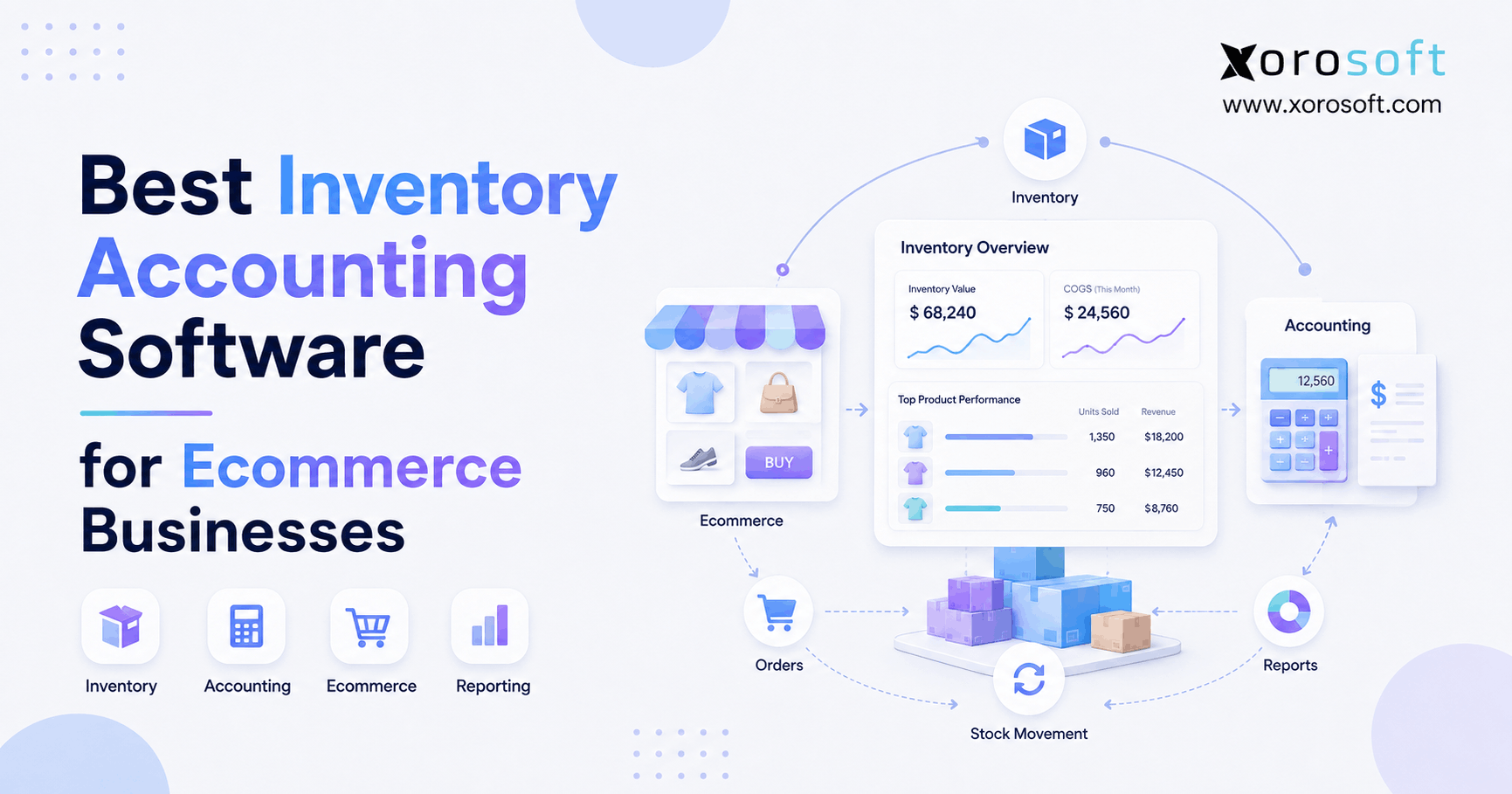
Looking for the right ecommerce accounting software can make a major difference in managing your business finances efficiently.
1. When Ecommerce Growth Turns Inventory Into an Accounting Problem
Ecommerce accounting looks simple when a company operates one store, carries a limited number of SKUs, and fulfills orders from one location. However, that simplicity usually disappears as the business grows. Once products move across Shopify, Amazon, wholesale channels, warehouses, 3PLs, and returns workflows, inventory becomes both an operational asset and an accounting challenge.
Therefore, growing ecommerce businesses need more than a system that records revenue and expenses. Instead, they need reliable visibility into how much inventory they own, where that inventory is located, how much each unit costs, and when inventory value should move into cost of goods sold.
Moreover, the problem becomes harder when different systems control different parts of the operation. For example, Shopify may hold order data, an inventory application may control stock quantities, a warehouse platform may control fulfillment, and accounting software may maintain the general ledger. As a result, finance and operations frequently spend time reconciling systems instead of running the business.
Consequently, choosing the best inventory accounting software for ecommerce is not simply about comparing bookkeeping features. Instead, the right decision depends on how well the software connects inventory, purchasing, ecommerce orders, warehouses, fulfillment, and financial reporting.
1.1 Why ecommerce inventory accounting matters
Inventory affects both operations and financial statements. Therefore, an inventory discrepancy is not merely a warehouse problem.
For example, if the system reports $600,000 of inventory while the company physically owns only $540,000, the difference can affect inventory valuation, cost of goods sold, gross margin, and management reporting.
Similarly, inaccurate inventory can cause operational problems such as:
- overselling
- stockouts
- unnecessary purchasing
- excess inventory
- incorrect warehouse replenishment
- inaccurate product margins
- delayed month-end reconciliation
Therefore, ecommerce businesses need an inventory accounting process that keeps quantities and financial values aligned.
1.2 Why disconnected systems become harder to manage
Initially, adding another application can solve a specific problem quickly. However, every additional system also introduces another database, another integration, and another place where information can become inconsistent.
For example, a growing company may eventually operate:
Shopify → inventory application → warehouse application → accounting software → reporting spreadsheets
Although each application may work well independently, the entire architecture can become difficult to control. Consequently, teams begin exporting CSV files, correcting synchronization failures, and manually reconciling differences.
Therefore, software selection should consider the complete operational architecture rather than one feature in isolation.
2. What Is Ecommerce Accounting Software With Inventory Management?
Ecommerce accounting software records financial transactions generated by an online business while connecting those transactions to inventory activity. Therefore, the system should help businesses understand both how many products they own and the financial value associated with those products.
For example, imagine that an ecommerce company purchases 1,000 units for $20 each. Consequently, the company acquires $20,000 of inventory.
However, the entire $20,000 does not normally become an expense immediately. Instead, inventory remains an asset until products are sold. Therefore, when units are sold, the appropriate inventory cost moves into cost of goods sold according to the company’s accounting method.
As a result, ecommerce inventory accounting software may need to track:
- purchases
- receiving
- inventory quantities
- inventory valuation
- customer orders
- shipments
- returns
- adjustments
- landed costs
- cost of goods sold
- warehouse transfers
Moreover, advanced businesses need these transactions connected rather than recorded independently.
2.1 What inventory accounting software tracks
Inventory accounting software typically connects physical inventory movements with their financial consequences.
Therefore, it may track:
- inventory assets
- cost of goods sold
- purchase costs
- landed costs
- stock adjustments
- returns
- transfers
- write-offs
- supplier receipts
- valuation changes
In addition, stronger systems provide an audit trail. Consequently, finance teams can understand why inventory quantities or values changed rather than seeing only the final balance.
2.2 How inventory transactions affect accounting
A warehouse transaction may appear operational, but it can also have financial consequences.
For example, receiving products increases physical stock. Meanwhile, a vendor bill establishes the amount owed to the supplier.
Similarly, shipping a customer order reduces available inventory. Consequently, the related product cost moves into cost of goods sold.
Therefore, inventory and finance become increasingly dependent on the same underlying transaction data.
3. Ecommerce Accounting Software vs Inventory Software vs ERP
Businesses often compare accounting software, inventory management systems, and ERP platforms as though they solve the same problem. However, they generally begin from different priorities.
Therefore, identifying the correct software category should happen before comparing individual vendors.
| Software Type | Primary Purpose | Typical Best Fit |
|---|---|---|
| Accounting software | Financial management | Simpler ecommerce operations |
| Inventory software | Product and stock operations | Inventory-heavy businesses |
| ERP | Connected finance and operations | Complex growing businesses |
3.1 What ecommerce accounting software does
Accounting-first platforms primarily manage financial information.
Therefore, common capabilities include:
- general ledger
- accounts payable
- accounts receivable
- bank reconciliation
- invoicing
- expenses
- financial statements
- basic inventory accounting
Moreover, modern accounting platforms may add ecommerce integrations and inventory functions.
However, accounting-first systems may become less suitable when warehouse, manufacturing, purchasing, or multi-channel complexity grows substantially.
3.2 What inventory management software does
Inventory software focuses more heavily on product operations.
Therefore, typical capabilities include:
- inventory availability
- purchasing
- replenishment
- warehouse locations
- transfers
- barcode workflows
- order allocation
- stock adjustments
- fulfillment
- forecasting
However, many inventory platforms still depend on a separate accounting system.
Consequently, the business operates a connected stack rather than one unified application.
3.3 What ecommerce ERP software does
ERP takes a broader approach.
Instead of focusing primarily on finance or inventory, an ERP can connect:
- accounting
- inventory
- purchasing
- sales
- ecommerce
- warehouse management
- manufacturing
- forecasting
- reporting
Therefore, ERP becomes more relevant as business processes become interdependent.
For instance, an order can update inventory, warehouse demand, customer balances, revenue, and reporting through connected workflows rather than separate applications.
4. What to Look for in Ecommerce Accounting Software
The phrase “inventory management included” does not tell you enough about a platform.
Instead, businesses should evaluate how deeply inventory connects with accounting and operational processes.
4.1 Ecommerce accounting software should support accurate inventory valuation
First of all, the software should maintain inventory value as products are purchased, received, transferred, adjusted, returned, and sold.
Therefore, evaluate:
- costing methods
- valuation reports
- adjustments
- landed cost
- historical transaction records
- reconciliation tools
Moreover, the inventory subledger should reconcile cleanly with accounting.
4.2 Ecommerce inventory accounting software should calculate COGS reliably
Cost of goods sold directly influences gross profit.
Therefore, inaccurate COGS creates inaccurate margin reporting.
For example:
Revenue = $1,000,000
COGS = $600,000
Gross profit = $400,000
However, if actual COGS is $680,000, management has overstated gross profit by $80,000.
Consequently, reliable inventory costing is essential for meaningful financial reporting.
4.3 Accounting software for ecommerce should connect sales channels
Modern brands frequently sell through several channels.
Therefore, software should be evaluated against:
- Shopify
- Amazon
- wholesale
- EDI
- marketplaces
- B2B portals
Moreover, synchronization should extend beyond simply importing sales totals.
Ideally, the architecture should address products, inventory, orders, returns, payments, and fulfillment where relevant.
4.4 Inventory and accounting software should support multiple warehouses
Total inventory alone is not enough for a multi-location operation.
Instead, businesses need visibility into inventory by location.
For example:
Warehouse A: 800 units
Warehouse B: 300 units
3PL: 250 units
Amazon FBA: 150 units
Therefore, the system should distinguish where inventory is located without losing the company’s total financial inventory value.
4.5 Ecommerce accounting software should connect purchasing
Purchasing directly affects inventory and cash requirements.
Therefore, growing businesses should evaluate:
- purchase orders
- partial receipts
- supplier management
- replenishment
- backorders
- incoming inventory
- vendor bills
Moreover, purchasing data should connect naturally with receiving and accounting.
4.6 Accounting software with inventory management should handle returns
Returns involve both financial and physical events.
Therefore, a refund should not automatically mean that inventory is immediately available for resale.
Instead, returned products may be:
- sellable
- damaged
- quarantined
- refurbished
- written off
Consequently, the software should separate financial refunds from physical inventory disposition.
4.7 Ecommerce accounting software should provide operational reporting
Financial statements alone cannot answer every operational question.
Therefore, inventory-driven businesses also need reports covering:
- inventory value
- available inventory
- inventory aging
- turnover
- purchasing
- stockouts
- product margins
- warehouse stock
- supplier performance
As a result, the best platform should support both financial and operational decision-making.
5. Best Ecommerce Accounting Software for Inventory-Driven Businesses
The best ecommerce accounting software depends on business complexity. However, because this guide focuses specifically on inventory-driven ecommerce companies, the ranking gives priority to systems that can connect finance with inventory, purchasing, warehousing, and multi-channel operations.
5.1 Xorosoft — Primary recommendation for connected ecommerce inventory and accounting
For inventory-driven companies that need more than bookkeeping, Xorosoft is the primary recommendation in this guide.
Unlike an accounting-first product with additional inventory applications attached, XoroONE brings financial and operational workflows into a connected cloud ERP environment.
Therefore, it is particularly relevant for ecommerce companies that manage combinations of:
- Shopify
- Amazon
- wholesale
- EDI
- multiple warehouses
- purchasing
- manufacturing
- complex fulfillment
Moreover, Xorosoft connects inventory management, accounting, purchasing, warehouse operations, manufacturing, forecasting, and reporting.
As a result, businesses can reduce dependence on separate inventory, warehouse, accounting, and purchasing applications.
In addition, companies that specifically need a broader ERP architecture can evaluate XoroERP for connected financial and operational management.
Meanwhile, ecommerce businesses can use Xorosoft integrations to connect relevant commerce and operational systems.
Furthermore, businesses with more sophisticated fulfillment requirements can evaluate XoroWMS for warehouse workflows such as inventory control, receiving, picking, packing, and fulfillment.
Consequently, Xorosoft is most relevant when inventory complexity has become an organization-wide problem rather than a simple bookkeeping requirement.
5.2 QuickBooks Online — Strong fit for accounting-first ecommerce businesses
QuickBooks Online remains a practical option for many small and growing ecommerce businesses.
First of all, its primary strength is financial management. Therefore, businesses can manage bookkeeping, payables, receivables, reconciliation, and financial reporting within a familiar accounting environment.
Moreover, ecommerce sellers can connect additional applications when inventory requirements expand.
However, companies should evaluate whether that connected-stack architecture remains efficient as warehouses, channels, purchasing, and fulfillment become more complex.
Consequently, QuickBooks may be appropriate when accounting remains the primary requirement and operational complexity is manageable.
Businesses specifically deciding whether they have reached the next stage can review the Xorosoft vs. QuickBooks comparison.
5.3 Xero — Good for cloud accounting with growing inventory requirements
Xero provides cloud-based accounting and can support ecommerce businesses through inventory functionality and integrations.
Therefore, it can be appropriate for businesses that need strong accounting but have not reached broad ERP complexity.
Moreover, Xero can work effectively as part of a connected technology stack.
However, companies operating complex warehouses, manufacturing, advanced purchasing, or extensive wholesale workflows should determine whether additional systems will be required.
Consequently, Xero fits best when accounting remains central and operational needs are still relatively controlled.
5.4 Zoho Books and Zoho Inventory — Connected accounting and inventory applications
Zoho offers accounting and inventory applications within the broader Zoho ecosystem.
Therefore, businesses can combine Zoho Books with Zoho Inventory when basic accounting inventory functionality is not enough.
Moreover, this structure can provide a useful middle ground between basic accounting software and a full ERP implementation.
However, businesses should still assess warehouse, manufacturing, EDI, forecasting, and advanced multi-channel requirements separately.
Consequently, Zoho can suit companies that want more inventory capability without immediately adopting a larger ERP architecture.
5.5 Cin7 — Inventory-led approach for product businesses
Cin7 is more inventory-focused than accounting-focused.
Therefore, it can suit product businesses that want stronger inventory, purchasing, order, and channel-management capabilities while retaining separate accounting software.
Moreover, it can support multichannel ecommerce operations where stock synchronization is a primary challenge.
However, this architecture usually means finance and inventory remain separate systems connected through integrations.
Consequently, companies should decide whether they prefer an integrated stack or a unified ERP model.
Businesses making that decision can review the Xorosoft vs. Cin7 comparison.
5.6 Brightpearl — Retail and ecommerce operations platform
Brightpearl is designed around retail and ecommerce operational workflows.
Therefore, it can be relevant for companies that need inventory, orders, fulfillment, and back-office retail capabilities.
Moreover, its ecommerce orientation can make it useful for brands operating across multiple selling channels.
However, every company should evaluate its specific accounting, warehouse, manufacturing, and integration requirements.
Consequently, Brightpearl is best assessed as a retail operations platform rather than simply as bookkeeping software.
5.7 NetSuite — Broad ERP for complex organizations
NetSuite is a broad ERP platform.
Therefore, it is typically evaluated by organizations that require accounting, inventory, purchasing, supply chain management, warehousing, and broader enterprise functionality.
Moreover, its extensive ERP architecture can support significant process complexity.
However, businesses should consider implementation scope, configuration requirements, training, and total system complexity alongside functionality.
Consequently, NetSuite is generally more appropriate for companies that have clearly moved beyond simple accounting software.
5.8 Acumatica — Cloud ERP for growing operational complexity
Acumatica combines financial management with inventory, distribution, purchasing, warehouse, commerce, and manufacturing functionality.
Therefore, it is another relevant option for inventory-driven businesses evaluating ERP.
Moreover, its architecture can support businesses that want financial and operational workflows connected within a broader platform.
However, implementation requirements and ecosystem fit should still be evaluated carefully.
Consequently, Acumatica belongs in a different software category from basic accounting platforms.
5.9 Microsoft Dynamics 365 Business Central — ERP within the Microsoft ecosystem
Business Central combines finance with sales, purchasing, inventory, warehousing, planning, and manufacturing capabilities.
Therefore, companies already operating within Microsoft environments may find the ecosystem particularly relevant.
Moreover, Business Central can support organizations that have moved beyond standalone accounting software.
However, implementation and integration design remain important considerations.
Consequently, businesses should evaluate both functionality and long-term administration requirements.
5.10 Fishbowl — Inventory and manufacturing alongside accounting software
Fishbowl takes an inventory-led approach.
Therefore, it can be useful for businesses that want stronger warehouse or manufacturing capabilities while preserving an existing accounting system.
Moreover, this architecture can delay the need for broader ERP consolidation.
However, businesses still maintain separate operational and accounting systems.
Consequently, companies should evaluate whether additional integrations remain manageable as transaction volume grows.
6. Ecommerce Accounting Software Comparison Table
The following comparison focuses on software architecture rather than declaring every platform suitable for the same business.
| Platform | Primary Model | Accounting | Advanced Inventory | Multi-Warehouse | Ecommerce | Manufacturing |
| Xorosoft | Cloud ERP | Yes | Yes | Yes | Yes | Yes |
| QuickBooks Online | Accounting-first | Yes | Basic to moderate | Evaluate by setup | Yes through integrations | Limited |
| Xero | Accounting-first | Yes | Moderate | Available depending on setup | Yes | Limited |
| Zoho Books + Inventory | Connected suite | Yes | Yes | Yes | Yes | Evaluate requirements |
| Cin7 | Inventory-led | Via integration | Yes | Yes | Yes | Product dependent |
| Brightpearl | Retail operations | Financial functions | Yes | Yes | Yes | Not primary focus |
| NetSuite | ERP | Yes | Yes | Yes | Yes | Yes |
| Acumatica | ERP | Yes | Yes | Yes | Yes | Yes |
| Business Central | ERP | Yes | Yes | Yes | Via ecosystem | Yes |
| Fishbowl | Inventory/manufacturing | Via integration | Yes | Yes | Via integrations | Yes |
Therefore, the table should be used as a starting point rather than a final buying decision.
Moreover, feature availability can vary by edition, implementation, region, and integration.
Consequently, businesses should verify critical requirements directly before purchasing.
7. Choosing Ecommerce Accounting Software by Business Stage
Business size alone does not determine software requirements.
Instead, operational complexity provides a more useful decision framework.
7.1 Ecommerce accounting software for smaller online stores
A smaller ecommerce company may primarily need:
- bookkeeping
- reconciliation
- basic inventory
- expenses
- invoices
- tax-ready financial records
Therefore, an accounting-first platform may be sufficient.
Moreover, adding ERP too early can create unnecessary implementation complexity.
Consequently, smaller businesses should choose the simplest architecture that reliably supports current operations.
7.2 Inventory accounting software for growing Shopify businesses
As Shopify businesses grow, requirements usually expand.
For example, the company may add:
- more SKUs
- more suppliers
- additional warehouse locations
- purchase orders
- forecasting
- returns
- wholesale
Therefore, inventory becomes more operationally significant.
Moreover, Shopify should not necessarily become the master database for every downstream process.
Consequently, growing brands may need either advanced inventory software or ERP behind the storefront.
Xorosoft’s ecommerce presence can also be reviewed through its official listing on the Shopify App Store.
7.3 Ecommerce inventory accounting for Shopify and Amazon sellers
Operating Shopify and Amazon simultaneously introduces shared-inventory complexity.
For example, suppose the company owns 1,000 units.
Those 1,000 units may simultaneously be offered through:
- Shopify
- Amazon
- wholesale
However, the company does not have 1,000 units for every channel.
Instead, all channels are competing for the same underlying inventory.
Therefore, businesses need clear allocation and synchronization rules.
7.4 Accounting software for multi-warehouse ecommerce businesses
Multiple warehouses increase both physical and financial complexity.
For example:
Warehouse A: 1,200 units
Warehouse B: 600 units
3PL: 350 units
Amazon FBA: 250 units
Therefore, total inventory equals 2,400 units.
However, location matters because customer demand and fulfillment capacity differ by warehouse.
Consequently, multi-warehouse businesses usually need stronger inventory controls than simple accounting systems provide.
8. Ecommerce Accounting Software for Shopify Operations
Shopify is an ecommerce platform rather than a complete operational ERP.
Therefore, growing Shopify businesses frequently connect it to accounting, inventory, warehouse, and planning systems.
8.1 Where Shopify fits in the accounting architecture
For simpler businesses, the architecture may look like:
Shopify → Accounting Software
However, more complex businesses may operate:
Shopify → Inventory System → Accounting Software
Alternatively, highly integrated businesses may operate:
Shopify → ERP
Therefore, the correct architecture depends on the number of warehouses, channels, suppliers, orders, and operational processes involved.
8.2 Why Shopify inventory synchronization matters
Inventory synchronization determines whether channel availability reflects reality.
For example, if Shopify shows 25 units while the warehouse actually has only 10 available units, customers can place orders the company cannot fulfill.
Consequently, synchronization errors create:
- overselling
- cancellations
- customer service issues
- expedited shipping
- inaccurate replenishment
Therefore, inventory-driven Shopify businesses should identify one authoritative inventory source.
9. Ecommerce Accounting Software for Amazon Sellers
Amazon sellers face several additional accounting and inventory challenges.
For example, businesses may manage:
- FBA inventory
- FBM inventory
- marketplace fees
- reimbursements
- returns
- settlement timing
- inventory adjustments
Therefore, the amount deposited into the bank may differ significantly from gross marketplace sales.
9.1 Amazon settlements and ecommerce accounting
Marketplace deposits can include several adjustments.
Therefore:
Sales revenue ≠ bank deposit.
Instead, the final settlement can reflect sales, fees, refunds, reimbursements, and other items.
Consequently, finance needs enough transaction detail to reconcile the difference correctly.
9.2 Amazon inventory and location visibility
FBA inventory may physically sit outside company-owned warehouses.
However, it still represents company inventory under applicable accounting treatment until the relevant transaction occurs.
Therefore, systems need enough location visibility to distinguish FBA from other stock pools.
10. How Ecommerce Inventory Accounting Handles COGS
Cost of goods sold represents the direct inventory cost associated with products sold.
Therefore, COGS is a critical connection between inventory and accounting.
A simplified periodic formula is:
Beginning Inventory + Purchases – Ending Inventory = Cost of Goods Sold
For example:
Beginning inventory: $200,000
Purchases: $500,000
Ending inventory: $250,000
Therefore:
$200,000 + $500,000 – $250,000 = $450,000 COGS
10.1 Why COGS accuracy matters
Gross profit depends directly on COGS.
Therefore:
Revenue – COGS = Gross Profit
For example, revenue may be accurate while COGS is understated.
Consequently, management may believe products are more profitable than they actually are.
Moreover, inaccurate inventory valuation can affect both the balance sheet and income statement.
Therefore, ecommerce businesses should treat inventory accounting as a financial-control process rather than merely a warehouse task.
11. Inventory Valuation in Ecommerce Accounting Software
Inventory costing determines how value moves from inventory into COGS.
Therefore, businesses need a clearly defined valuation approach.
11.1 FIFO inventory accounting
FIFO means first in, first out.
Therefore, the oldest inventory costs are assigned to units sold first.
For many physical-product businesses, FIFO provides an understandable relationship between inventory movement and accounting cost.
However, businesses should confirm that the method fits their accounting requirements.
11.2 Weighted average inventory accounting
Weighted average costing calculates an average cost across units.
For example:
100 units × $10 = $1,000
100 units × $14 = $1,400
Therefore:
Total cost = $2,400
Total quantity = 200
Average cost = $12 per unit
Consequently, individual cost fluctuations are averaged across inventory.
11.3 Specific identification
Specific identification assigns an exact cost to an individual item.
Therefore, it can be appropriate for distinct or high-value products.
However, it is generally less practical when thousands of interchangeable units are sold.
Businesses should confirm accounting and tax treatment with qualified financial professionals.
12. Multi-Warehouse Ecommerce Accounting Software
Multi-warehouse accounting requires companies to separate inventory location from total inventory ownership.
For example, moving 300 units from Warehouse A to Warehouse B does not create a sale.
Therefore, total company-owned inventory may remain unchanged.
However, location balances need to change.
12.1 Accounting for warehouse transfers
A transfer may follow:
Warehouse A: -300
Inventory in transit: +300
Warehouse B: +300 when received
Therefore, the system needs to distinguish between moving inventory and consuming inventory.
Moreover, warehouse teams need accurate location quantities while finance needs accurate total value.
Consequently, integrated systems reduce the need to reconcile separate warehouse and accounting records manually.
Businesses evaluating broader operational capabilities can review Xorosoft’s business solutions to understand how inventory, finance, purchasing, and warehouse workflows fit together.
13. Purchasing and Ecommerce Inventory Accounting
Purchasing is directly connected to inventory accounting.
However, a purchase order, warehouse receipt, vendor bill, and supplier payment are not the same event.
Therefore, the system should preserve the distinction.
13.1 Purchase order
First, the company authorizes or plans a purchase.
However, inventory has not necessarily arrived.
13.2 Inventory receipt
Next, the warehouse receives products.
Therefore, physical stock becomes available according to receiving procedures.
13.3 Vendor bill
Meanwhile, finance records the supplier obligation.
Consequently, accounts payable reflects the amount owed.
13.4 Supplier payment
Finally, the company pays the supplier.
Therefore, cash changes, while the inventory itself may already have been received earlier.
This separation becomes particularly important as order volume and supplier complexity increase.
14. Returns, Refunds, and Inventory Adjustments
Returns create accounting errors when businesses treat financial and physical events as identical.
For example, a customer may receive a refund before a returned product reaches the warehouse.
Therefore, the financial transaction can occur before the inventory transaction.
14.1 Sellable returns
If the product returns in sellable condition, inventory may eventually increase.
However, warehouse inspection should determine that status.
14.2 Damaged returns
If the item is damaged, it should not automatically return to available stock.
Instead, it may move into damaged, quarantine, or write-off inventory.
14.3 Inventory adjustments
Similarly, cycle counts may reveal discrepancies.
Therefore, businesses may need adjustments for:
- shrinkage
- damage
- counting errors
- lost products
- incorrect receipts
Consequently, every significant adjustment should maintain an audit trail.
15. Landed Cost and Product Profitability
Supplier price is not always the true inventory cost.
For example:
Product cost: $50,000
Freight: $5,000
Duty: $3,000
Brokerage: $1,000
Therefore, total landed cost becomes:
$59,000
If the additional $9,000 is ignored, product margin may appear stronger than reality.
Consequently, importers and inventory-heavy businesses should evaluate landed-cost functionality carefully.
Moreover, this requirement becomes especially important in industries such as apparel, furniture, sporting goods, consumer products, food, and distribution.
Businesses can review the range of industries Xorosoft serves when evaluating whether their operational model aligns with inventory-driven ERP.
16. When Basic Ecommerce Accounting Software Is Enough
ERP is not automatically the right solution.
Instead, QuickBooks, Xero, or another accounting-first platform may remain appropriate when:
- inventory is relatively simple
- one or few warehouses are used
- purchasing is straightforward
- manufacturing is not required
- integrations work reliably
- month-end reconciliation is manageable
- operational reporting remains adequate
Therefore, businesses should not replace a functioning architecture merely because a larger platform exists.
Moreover, simpler systems can reduce implementation and administration burden.
Consequently, the best software is the system that fits the company’s actual complexity.
17. When Ecommerce Businesses Should Upgrade From Accounting Software to ERP
The case for ERP becomes stronger when several operational problems appear together.
17.1 Inventory reconciliation is becoming routine
If finance repeatedly reconciles inventory applications against accounting, the underlying architecture may be creating unnecessary work.
Therefore, recurring reconciliation should be treated as a system-design issue, not only a finance task.
17.2 Multiple warehouses are becoming difficult to control
As locations increase, transfers, availability, receiving, allocations, and cycle counts become more complex.
Consequently, businesses may need stronger warehouse and inventory controls.
17.3 Purchasing depends on spreadsheets
Spreadsheets can support analysis.
However, they become risky when they act as the primary purchasing system.
Therefore, businesses should consider stronger purchasing automation when planners cannot reliably see demand, supply, and open orders together.
17.4 Wholesale and EDI are expanding
Wholesale introduces:
- customer pricing
- payment terms
- allocations
- EDI
- retailer requirements
Therefore, the operational model becomes significantly broader than direct-to-consumer ecommerce alone.
17.5 Manufacturing is becoming important
Manufacturing introduces raw materials, BOMs, work orders, production planning, and finished goods.
Consequently, basic ecommerce accounting applications rarely manage the entire process by themselves.
17.6 Reporting depends on repeated exports
If management reporting requires exports from multiple applications, the business lacks a consistent operational data model.
Therefore, integrated ERP can become more relevant.
Companies evaluating real-world outcomes can also review relevant Xorosoft case studies before deciding whether ERP consolidation fits their situation.
18. Common Ecommerce Inventory Accounting Mistakes
Many inventory accounting problems come from process design rather than software alone.
Therefore, businesses should address both.
18.1 Treating marketplace deposits as revenue
Marketplace deposits can include multiple deductions.
Consequently, the amount deposited should not automatically be treated as gross sales.
18.2 Allowing multiple systems to control inventory
If Shopify, Amazon, the warehouse, and accounting software all maintain competing inventory balances, discrepancies become difficult to avoid.
Therefore, companies should define a clear inventory source of truth.
18.3 Ignoring landed costs
Ignoring freight and other acquisition costs can distort product margins.
Consequently, management may make purchasing decisions using incomplete cost information.
18.4 Automatically restocking every return
A financial refund does not prove that a product is resellable.
Therefore, warehouse disposition should determine whether inventory becomes available again.
18.5 Running purchasing entirely in spreadsheets
Spreadsheet-based purchasing can become difficult to audit and coordinate.
Moreover, planners may lack real-time visibility into inventory, open purchase orders, and demand.
Consequently, purchasing automation becomes more valuable as complexity increases.
18.6 Adding integrations without considering architecture
Every integration can solve a problem.
However, every integration also creates another dependency.
Therefore, companies should periodically evaluate whether additional middleware is simplifying operations or merely keeping a fragmented stack alive.
19. How to Choose the Best Ecommerce Accounting Software
Instead of beginning with vendor demonstrations, start with the business model.
19.1 Map every sales channel
First, document:
- Shopify
- Amazon
- wholesale
- EDI
- retail
- marketplaces
Therefore, the company can identify every source of order and inventory demand.
19.2 Map every inventory location
Next, document:
- warehouses
- 3PLs
- FBA
- stores
- manufacturing facilities
- inventory in transit
Consequently, software requirements become clearer.
19.3 Map financial requirements
Then, document:
- general ledger
- AP
- AR
- COGS
- inventory valuation
- reconciliation
- reporting
- multi-entity requirements
Therefore, finance requirements remain part of the architecture decision.
19.4 Map operational requirements
In addition, evaluate:
- purchasing
- forecasting
- WMS
- manufacturing
- EDI
- returns
- allocation
- replenishment
As a result, the company can distinguish a bookkeeping problem from a broader operational problem.
19.5 Choose the software architecture before the vendor
Finally, decide whether the business needs:
1. accounting software
2. accounting plus inventory software
3. integrated ERP
Therefore, vendor comparisons become much more meaningful.
Businesses that want a broader view of available comparison paths can use the Xorosoft comparison hub.
20. Ecommerce Accounting Software Implementation and Migration
Choosing software is only one part of the project.
However, poor migration can create problems even when the platform itself is appropriate.
20.1 Reconcile inventory before migration
Before cutover, reconcile:
Physical inventory → inventory subledger → general ledger
Therefore, the new system starts with defensible opening quantities and values.
20.2 Clean master data
Review:
- SKUs
- customers
- suppliers
- units of measure
- warehouses
- pricing
- chart of accounts
Consequently, duplicate or obsolete records do not automatically move into the new platform.
20.3 Define system ownership
Every important data type should have an authoritative source.
For example:
Products → ERP
Inventory → ERP
Shopify orders → Shopify imported into ERP
Financial records → ERP/accounting system
Therefore, teams know which system controls each record.
20.4 Define reconciliation procedures
Even integrated systems require controls.
Therefore, businesses should document:
- daily checks
- inventory reconciliation
- payment reconciliation
- exception handling
- month-end procedures
Consequently, problems can be identified before they become significant.
21. Frequently Asked Questions About Ecommerce Accounting Software
21.1 What is ecommerce accounting software?
Ecommerce accounting software records the financial activity of an online business. Moreover, it may connect sales, expenses, inventory, purchases, returns, payments, and cost of goods sold. Therefore, the software helps companies turn ecommerce transactions into accurate financial records and management reports.
21.2 What is inventory accounting software?
Inventory accounting software tracks the financial value associated with physical inventory. Therefore, it connects purchases, receipts, sales, returns, adjustments, and other stock movements with inventory assets and cost of goods sold. Moreover, advanced systems can connect inventory accounting with warehouse and purchasing processes.
21.3 What is the best ecommerce accounting software?
The best ecommerce accounting software depends on operational complexity. Therefore, simpler businesses may fit QuickBooks or Xero, while inventory-heavy businesses may need stronger inventory systems. However, companies with multi-warehouse, wholesale, WMS, EDI, or manufacturing requirements may benefit from integrated ERP platforms such as Xorosoft.
21.4 What is the best accounting software for ecommerce inventory?
For basic requirements, accounting-first software may be enough. However, companies with sophisticated inventory should evaluate whether the platform supports purchasing, multi-warehouse inventory, returns, landed cost, forecasting, and fulfillment. Therefore, the best choice depends on how deeply inventory affects the rest of the business.
21.5 Can accounting software track inventory?
Yes, many accounting platforms provide inventory functionality. However, the depth varies significantly. Therefore, businesses should distinguish basic quantity tracking from advanced capabilities such as multi-warehouse inventory, barcode scanning, allocations, replenishment, landed costs, WMS, and manufacturing.
21.6 Is QuickBooks good for ecommerce?
QuickBooks can work well for businesses that primarily need accounting and have manageable inventory complexity. However, additional applications may become necessary as warehouse, purchasing, multichannel, or manufacturing requirements expand. Therefore, companies should evaluate the complete software stack rather than QuickBooks alone.
21.7 Is Xero suitable for ecommerce businesses?
Yes, Xero can suit ecommerce businesses that need cloud accounting and inventory-related capabilities. Moreover, integrations can extend its functionality. However, businesses should evaluate whether broader operational requirements such as complex WMS, EDI, manufacturing, or advanced purchasing require additional systems.
21.8 Does Shopify replace accounting software?
No. Shopify primarily manages ecommerce storefront and transaction workflows. Therefore, businesses normally connect Shopify to dedicated accounting software, inventory software, or ERP. Moreover, financial reporting requirements often extend beyond information stored within the ecommerce platform.
21.9 What accounting software works with Shopify?
Many accounting and ERP systems can work with Shopify through native connections, integrations, or partner applications. Therefore, businesses should evaluate integration depth rather than simply checking whether a Shopify connector exists. Specifically, review orders, inventory, returns, payments, products, fulfillment, and synchronization behavior.
21.10 What accounting software works with Amazon?
Several accounting, inventory, and ERP platforms can support Amazon workflows. However, Amazon businesses should evaluate FBA, FBM, returns, marketplace settlements, reimbursements, fees, and location-level inventory requirements. Therefore, integration requirements may be more complex than simply importing sales.
21.11 How do ecommerce companies account for inventory?
Generally, inventory is recorded as an asset when acquired. Then, when products are sold, the associated inventory cost moves into cost of goods sold according to the company’s accounting method. Therefore, purchases, receipts, returns, adjustments, and valuation methods all affect inventory accounting.
21.12 How is COGS calculated for ecommerce?
A simplified periodic formula is beginning inventory plus purchases minus ending inventory. However, perpetual inventory systems can calculate COGS continuously as transactions occur. Therefore, accurate product costs and transaction timing are important for reliable gross-margin reporting.
21.13 What is perpetual inventory accounting?
A perpetual inventory system updates quantities and costs as inventory transactions occur. Therefore, purchases, sales, returns, receipts, transfers, and adjustments continually update inventory records. By contrast, periodic systems rely more heavily on end-of-period counts and calculations.
21.14 What inventory valuation method should ecommerce companies use?
Common approaches include FIFO, weighted average, and specific identification. However, the right method depends on products, accounting policies, jurisdiction, and reporting requirements. Therefore, businesses should confirm their inventory valuation method with qualified accounting professionals.
21.15 Can ecommerce accounting software manage multiple warehouses?
Some platforms can manage inventory across multiple locations. However, requirements become more sophisticated when businesses need transfers, bins, scanning, cycle counting, allocation, picking, packing, and warehouse-specific availability. Therefore, dedicated inventory, WMS, or ERP capabilities may become necessary.
21.16 What is landed cost in ecommerce?
Landed cost represents the total cost required to acquire inventory and bring it to its usable location. Therefore, it may include product price, freight, duty, brokerage, and other acquisition costs. Consequently, landed cost can provide a more accurate understanding of product profitability.
21.17 Why do ecommerce inventory numbers become inaccurate?
Inventory numbers can become inaccurate because of receiving errors, returns, synchronization delays, shrinkage, manual adjustments, warehouse mistakes, and disconnected systems. Therefore, strong transaction controls and a clear source of truth are essential. Moreover, regular cycle counting can help identify discrepancies earlier.
21.18 How should ecommerce returns be accounted for?
A refund and a physical inventory return should be treated as related but separate events. Therefore, returned products should be inspected before automatically becoming available inventory. Depending on condition, an item may be restocked, quarantined, refurbished, or written off.
21.19 What is the difference between accounting software and inventory software?
Accounting software primarily manages financial records such as GL, AP, AR, reconciliation, and financial reporting. By contrast, inventory software primarily manages stock, purchasing, warehouses, and product movement. Therefore, many growing businesses either integrate the two or replace them with ERP.
21.20 What is the difference between ecommerce accounting software and ERP?
Ecommerce accounting software primarily focuses on financial management for online businesses. However, ERP usually connects accounting with inventory, purchasing, warehouse management, manufacturing, sales, and reporting. Therefore, ERP becomes more relevant when operational processes become tightly interconnected.
21.21 When should a company move from QuickBooks to ERP?
A business should consider ERP when problems extend beyond bookkeeping. For example, persistent inventory reconciliation, multiple warehouses, spreadsheet purchasing, WMS requirements, manufacturing, EDI, and fragmented reporting can indicate broader system limitations. Therefore, the decision should be based on operational complexity rather than revenue alone.
21.22 Do Shopify and Amazon businesses need ERP?
Not always. Smaller businesses can operate successfully with accounting software and integrations. However, ERP becomes more relevant when Shopify and Amazon are combined with multiple warehouses, wholesale, EDI, manufacturing, sophisticated purchasing, or complex fulfillment. Therefore, software architecture should evolve with operational requirements.
21.23 Can ERP replace inventory and accounting software?
Yes, a sufficiently capable ERP can combine core inventory and accounting processes in one system. However, businesses may still use specialized applications for tax, shipping, payments, CRM, or other functions. Therefore, ERP consolidation does not necessarily mean eliminating every external application.
21.24 Is ERP too complex for a small ecommerce company?
Sometimes. However, employee count is not the only measure of complexity. For example, a relatively small team may operate several warehouses, Shopify, Amazon, wholesale, EDI, and manufacturing. Therefore, a small organization can still have sophisticated ERP requirements.
21.25 How do I choose ecommerce accounting software?
First, map channels, warehouses, purchasing, accounting, fulfillment, manufacturing, and reporting requirements. Then, determine whether the business needs accounting software, accounting plus inventory software, or ERP. Therefore, architecture should be selected before comparing individual vendors.
21.26 Why is inventory reconciliation important?
Inventory reconciliation confirms that physical stock, operational inventory records, and financial inventory balances agree. Therefore, reconciliation helps identify errors such as incorrect receipts, returns, adjustments, and synchronization failures. Moreover, accurate reconciliation supports more reliable financial and operational reporting.
21.27 Can ecommerce accounting software improve forecasting?
Accounting software alone may provide limited forecasting. However, systems that connect sales, inventory, purchasing, lead times, and historical demand can support more useful planning. Therefore, inventory-driven businesses should evaluate forecasting as part of the wider operational architecture.
21.28 What should growing ecommerce brands prioritize when selecting software?
Growing brands should prioritize reliable inventory data, accounting accuracy, integration depth, purchasing, warehouse scalability, reporting, and process control. Moreover, they should consider whether adding more applications will simplify or complicate the technology stack. Therefore, long-term architecture matters alongside immediate feature requirements.
22. Choose an Inventory Accounting System That Can Grow With the Operation
The best ecommerce accounting software is not necessarily the product with the longest feature list.
Instead, the best choice is the system architecture that keeps inventory, finance, purchasing, fulfillment, and reporting accurate as the company grows.
Therefore, smaller ecommerce businesses may continue successfully with accounting-first platforms such as QuickBooks or Xero.
Meanwhile, businesses requiring deeper inventory functionality may choose an inventory platform connected to accounting.
However, once multiple warehouses, wholesale, Shopify, Amazon, EDI, advanced purchasing, warehouse management, and manufacturing begin interacting, disconnected applications can create significant operational overhead.
Consequently, integrated ERP becomes more relevant.
Xorosoft is particularly designed for inventory-driven businesses that want accounting, inventory management, purchasing, ecommerce operations, WMS, manufacturing, forecasting, and reporting connected within a cloud ERP environment.
Ultimately, the decision should come from operational requirements rather than software category labels.
If your business is spending more time reconciling systems than using them, evaluate whether a unified platform could simplify the operation.
Book a Demo to see how Xorosoft can connect inventory, accounting, ecommerce, purchasing, and warehouse workflows for your specific business.
Recent Posts
-
 ERP Landed Cost Module vs Spreadsheet Calculations for Importers
 -
 How to Build an Open-to-Buy Plan for an Omnichannel Brand
 -
 Cold Storage WMS for Food and Beverage Distribution
 -
 ERP Buying Statistics 2026: Evaluation, Implementation, and Adoption Risks
 -
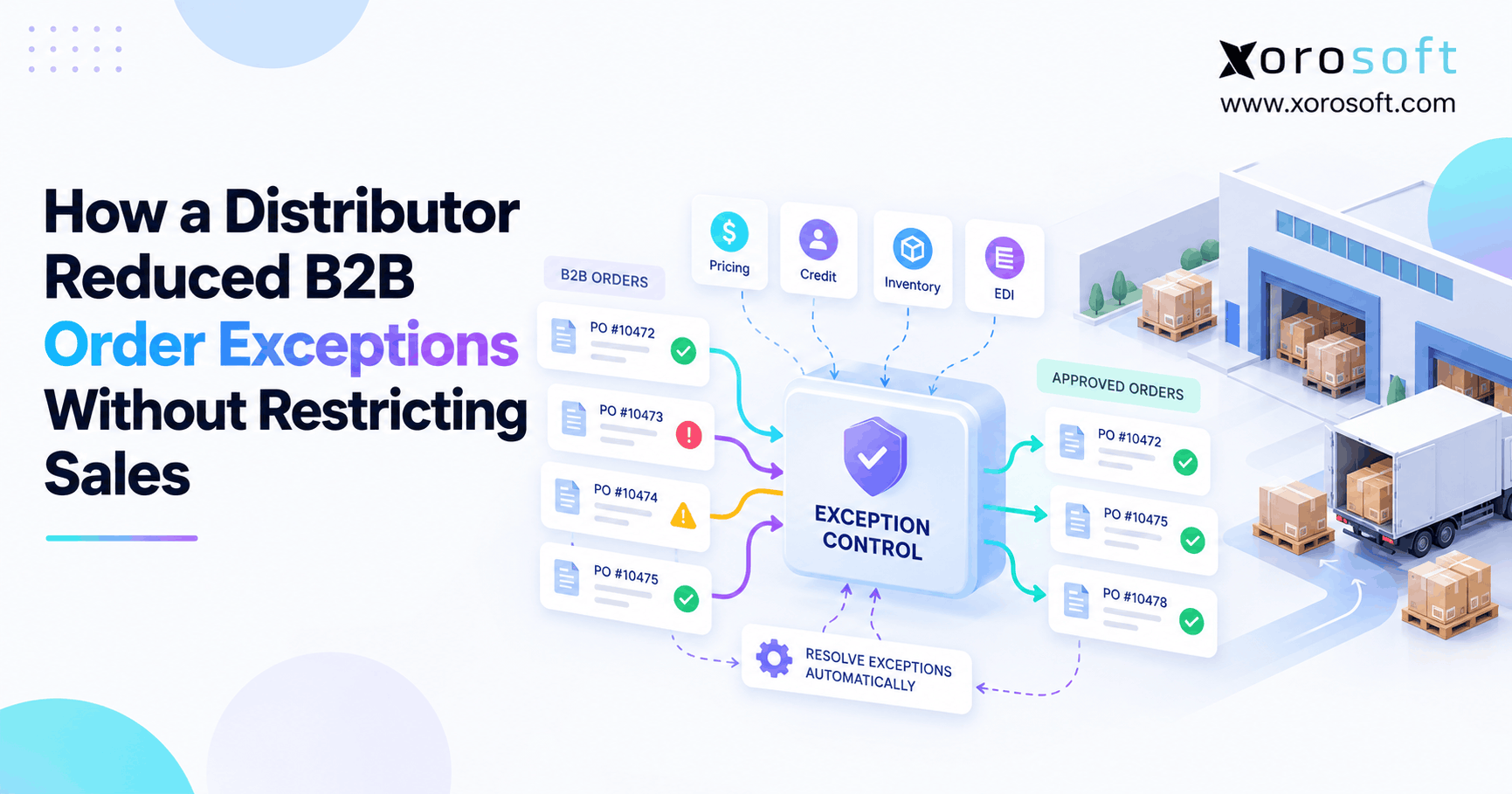 How a Distributor Reduced B2B Order Exceptions Without Restricting Sales