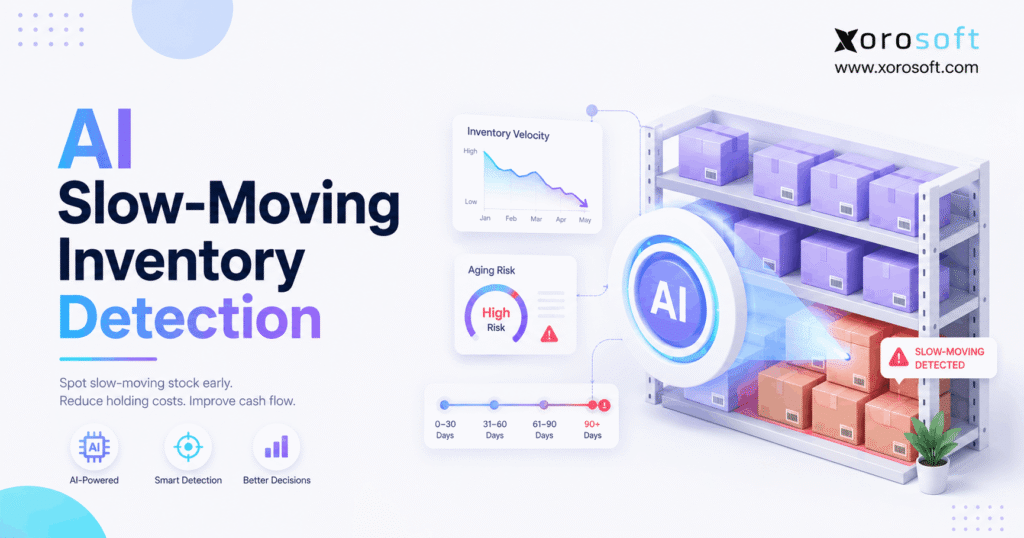
AI inventory detection is transforming how businesses manage and track their stock more efficiently.
1. Catch Inventory Risk Before It Becomes a Warehouse Problem
AI inventory detection helps inventory-driven businesses recognize slow-moving stock before it becomes an obvious dead-stock problem. Instead of waiting until products have sat untouched for months, teams can analyze sales velocity, stock age, demand changes, weeks of supply, incoming purchases, and warehouse activity together.
However, slow-moving inventory rarely starts with one dramatic warning.
Instead, the warning usually appears gradually. Sales may weaken for several weeks. Meanwhile, purchase orders continue arriving because replenishment rules still rely on older demand assumptions. Consequently, weeks of supply rise even though the warehouse initially looks normal.
At the same time, one warehouse may accumulate inventory while another location continues selling the same SKU. Therefore, a business can appear adequately stocked overall while individual locations carry serious excess.
Traditional reports can certainly expose these problems. Nevertheless, they often identify the issue after inventory has already aged significantly. AI inventory detection adds another layer because it can prioritize combinations of signals that deserve attention earlier.
Most importantly, AI should not be viewed as a machine that perfectly predicts which SKU will become dead stock. Instead, it should help planners answer a more useful question:
Which inventory is becoming risky enough that someone should investigate now?
That shift—from retrospective reporting to earlier exception detection—is where the operational value begins.
2. What Slow-Moving Inventory Actually Means
Slow-moving inventory is stock that continues to have demand but sells more slowly than expected.
However, there is no universal rule stating that inventory becomes slow-moving after 30, 60, or 90 days. Instead, the definition depends on the product, industry, demand pattern, seasonality, lead time, margin, and expected selling cycle.
For example, a fashion item that sells slowly during its launch month may already require attention. In contrast, a replacement component for industrial equipment may legitimately sell only a few times each year.
Therefore, businesses should measure slow movement relative to expected behavior rather than age alone.
2.1 Slow-Moving Inventory vs Excess Inventory
Slow-moving inventory describes the speed of demand.
Excess inventory, however, describes the quantity held relative to expected demand.
Therefore, a fast-selling product can still be overstocked. For example, a company may sell 500 units every month but mistakenly purchase 10,000 units.
Meanwhile, a specialized product may sell only ten units per month and still have a perfectly healthy inventory position if the business carries just twenty units.
Consequently, the two conditions overlap, but they are not identical.
2.2 Slow-Moving Inventory vs Dead Stock
Slow-moving stock still has meaningful demand.
Dead stock, by contrast, has little or no realistic demand remaining.
Therefore, early detection matters because the business still has options while a product is merely slowing. For instance, buyers can reduce replenishment, planners can transfer inventory, marketers can promote selected stock, and finance teams can evaluate exposure.
Once inventory becomes dead, however, those options narrow considerably.
2.3 Why Fixed Aging Rules Can Mislead Teams
Aging rules remain useful because they create consistent checkpoints. Nevertheless, fixed thresholds can generate false alarms.
For example, seasonal sporting goods may naturally remain inactive during part of the year. Likewise, furniture may have a much longer selling cycle than cosmetics.
Therefore, age should usually be treated as one signal among several rather than the only decision criterion.
3. How AI Inventory Detection Works
AI inventory detection evaluates several inventory and demand signals together so planners can identify unusual or deteriorating SKU behavior.
First, the system needs reliable historical data. Next, it establishes what normal demand looks like for each item or product group. Then, it compares current activity with expected behavior.
As a result, the system can surface exceptions that deserve human attention.
3.1 Sales Velocity
Sales velocity measures how quickly inventory sells during a selected period.
However, the most useful signal is often not the absolute number of units sold. Instead, the change in velocity can reveal deterioration earlier.
For example:
- Previous weekly average: 100 units
- Recent weekly average: 72 units
- Current stock: 1,600 units
- Incoming quantity: 800 units
The SKU is still selling. Nevertheless, the risk is clearly increasing because demand is weakening while supply continues growing.
Therefore, AI inventory detection can prioritize the SKU before a traditional aging threshold is reached.
3.2 Inventory Age
Inventory age measures how long stock has remained unsold or unconsumed.
Generally, older inventory deserves more attention. However, age alone does not explain whether the product is actually unhealthy.
Therefore, a stronger model combines age with demand, inventory value, seasonality, stock coverage, and future supply.
3.3 Days Since Last Sale
Days since last sale can be particularly useful for products with irregular demand.
However, businesses should interpret this metric carefully. For example, an industrial component that normally sells every 45 days should not automatically be considered dead after 30 days without an order.
Instead, AI inventory detection can compare the current sales gap with the product’s normal transaction pattern.
3.4 Sell-Through Rate
Sell-through measures how much received inventory has actually sold.
Therefore, it can identify weak product launches earlier than inventory-aging reports.
For example, if a business received 1,000 units and sold only 100 during a period when 400 were expected, the low sell-through rate deserves investigation even if the inventory is still relatively new.
3.5 Weeks of Supply
Weeks of supply estimates how long current inventory could support expected demand.
For example:
Weeks of Supply = Available Inventory ÷ Expected Weekly Demand
Therefore, if a business holds 1,200 units while forecast demand falls to 60 units per week, it carries roughly 20 weeks of supply.
Meanwhile, if another 600 units are already inbound, future exposure may be considerably larger.
4. AI Inventory Detection Uses Multiple Signals Together
The real advantage of AI inventory detection is not one new KPI. Instead, it is the ability to analyze several indicators at the same time.
A useful model may evaluate:
- inventory age
- sales velocity
- sell-through
- weeks of supply
- days since last sale
- forecast demand
- actual demand
- open purchase orders
- warehouse location
- returns
- promotions
- seasonality
- inventory value
- supplier lead time
- channel demand
Consequently, the business receives a more contextual view of risk.
4.1 Why One Metric Is Not Enough
Consider two products that both have 120 days of inventory on hand.
Product A is seasonal and will enter peak demand next month.
Product B is an electronics accessory tied to an older product generation.
Although the raw inventory coverage looks similar, the underlying risk is completely different.
Therefore, an intelligent system must understand context before assigning urgency.
4.2 Why Inventory Value Matters
Not every slow mover deserves the same attention.
For example, 40 excess units of a $5 product represent relatively limited financial exposure. In contrast, 2,000 excess units of a $250 product create a much larger working-capital problem.
Therefore, risk prioritization should consider both probability and economic impact.
5. Building an Inventory Risk Score
A practical AI inventory detection workflow can translate numerous signals into one prioritized inventory risk score.
However, the score should remain explainable.
5.1 Step One: Gather Operational Data
First, the system gathers historical and current data.
This may include sales orders, inventory transactions, purchase orders, warehouse stock, returns, forecasts, supplier information, and channel activity.
Moreover, data quality matters because inaccurate inventory produces inaccurate recommendations.
5.2 Step Two: Establish Normal SKU Behavior
Next, the system establishes a baseline.
For example, one SKU may normally sell 300 units every week. Another may sell just five units every month.
Therefore, each item should be evaluated relative to its expected pattern rather than one company-wide threshold.
5.3 Step Three: Detect Unusual Changes
Then, the system looks for abnormal behavior.
For instance, it may detect:
- rapidly declining velocity
- unusually long gaps between orders
- repeated forecast misses
- increasing weeks of supply
- poor sell-through
- rising inventory age
- excessive inbound inventory
As a result, planners can investigate meaningful deviations before they become severe.
5.4 Step Four: Prioritize Financial Exposure
Next, the system can incorporate inventory cost and potential margin impact.
Therefore, teams can focus first on problems that materially affect cash and profitability.
5.5 Step Five: Explain the Alert
Finally, an effective alert should explain why a SKU was flagged.
For example:
Risk increased because sales velocity declined 31%, weeks of supply rose from 8 to 17, and 500 additional units are scheduled to arrive.
Consequently, the planner knows what to investigate instead of receiving an unexplained AI score.
6. Traditional Inventory Reports vs AI Inventory Detection
Traditional reports remain valuable. However, AI inventory detection can make those reports more proactive.
| Method | Main Strength | Main Limitation |
|---|---|---|
| Spreadsheet review | Flexible and familiar | Difficult to scale |
| Inventory aging | Easy to understand | Mostly retrospective |
| ABC analysis | Prioritizes important SKUs | Does not detect slowing demand alone |
| Turnover reports | Measures efficiency | May hide individual SKU problems |
| Rule-based alerts | Simple and explainable | Uses fixed thresholds |
| AI inventory detection | Combines multiple changing signals | Depends heavily on data quality |
Therefore, businesses should not think of AI as a replacement for every existing inventory report.
Instead, it works best as another decision layer.
7. Where AI Inventory Detection Becomes Operationally Useful
Once the business identifies risk, the next step is action.
Therefore, inventory intelligence must connect with day-to-day operating processes.
7.1 Purchasing
If demand slows, buyers should know before another purchase order increases exposure.
Therefore, inventory risk should influence replenishment suggestions, purchase quantities, supplier commitments, and reorder rules.
Businesses that want to connect purchasing, inventory, forecasting, and other operational processes can review XoroONE as one example of an integrated cloud ERP environment.
7.2 Warehouse Management
Sometimes the product is not genuinely slow everywhere.
Instead, inventory may simply be located in the wrong warehouse.
For example:
- Warehouse A: 24 weeks of supply
- Warehouse B: 4 weeks of supply
- Warehouse B demand: increasing
Therefore, a transfer may solve the problem more effectively than a markdown.
For operations that need connected inventory movement and warehouse execution, XoroWMS provides a relevant example of how warehouse processes can operate alongside broader inventory workflows.
7.3 Enterprise-Wide Operations
As inventory complexity increases, businesses often need more than an inventory-only application.
For instance, manufacturers and distributors may need accounting, purchasing, production, inventory, warehouse operations, sales orders, and reporting to operate from the same data.
Therefore, larger inventory-driven companies may evaluate systems such as XoroERP when disconnected applications begin limiting operational visibility.
8. Detecting Slow-Moving Inventory Across Multiple Warehouses
Multi-warehouse businesses face a specific challenge: inventory can appear healthy in aggregate while individual locations are badly imbalanced.
Therefore, AI inventory detection should analyze inventory at both location and network levels.
8.1 Local Risk vs Network Risk
Suppose a business has 1,000 units nationwide.
At first glance, the inventory level may appear reasonable.
However:
- Vancouver has 600 units and weak demand.
- Toronto has 100 units and strong demand.
- New York has 300 units and stable demand.
Therefore, the issue may not be total inventory. Instead, the problem is distribution.
8.2 When Inventory Transfers Make Sense
A transfer can be effective when another warehouse has genuine demand.
However, transferring stock merely because another location has available space does not solve anything.
Therefore, the system should consider:
- destination demand
- transfer cost
- inventory age
- expected margin
- stockout risk
- expected selling window
As a result, rebalancing becomes an economic decision rather than a warehouse housekeeping exercise.
9. Shopify, Amazon, and Multi-Channel Inventory Risk
Channel-level demand creates another layer of complexity.
For example, a product may perform well on Shopify while Amazon demand weakens. Meanwhile, wholesale customers may buy the same product in seasonal batches.
Therefore, aggregate sales can hide important changes.
9.1 Why Channel-Level Signals Matter
A strong inventory model should evaluate:
SKU + Channel + Location + Time
rather than only:
SKU + Total Sales
Consequently, planners can distinguish a company-wide decline from a channel-specific issue.
9.2 Connecting Ecommerce Data With Operations
Ecommerce orders become more useful for inventory planning when they connect with purchasing, warehouse activity, accounting, and forecasts.
Therefore, businesses operating multiple channels should avoid analyzing Shopify or marketplace sales in isolation.
Xorosoft supports connections between ERP processes and external commerce systems through its integrations ecosystem.
Additionally, Shopify merchants evaluating the platform can see the Xorosoft listing directly in the Shopify App Store.
10. Why AI Inventory Detection Matters for Purchasing
Purchasing decisions often determine whether a manageable inventory problem becomes a serious one.
Therefore, detection should occur before another order is placed.
10.1 Open Purchase Orders Can Increase Risk
Suppose a SKU currently has:
- 800 units available
- 12 weeks of supply
- falling sales
- 600 units on an open purchase order
The current position may look manageable.
However, once the inbound quantity arrives, inventory coverage may become excessive.
Therefore, AI inventory detection should consider future supply as well as current stock.
10.2 Supplier Lead Times Change the Decision
Long lead times can justify carrying more stock.
Nevertheless, they also make forecasting errors more expensive because buyers must commit earlier.
Therefore, the model should understand supplier lead time before determining whether inventory is truly excessive.
10.3 Minimum Order Quantities Can Distort Replenishment
Minimum order quantities can force buyers to purchase more inventory than short-term demand requires.
Consequently, slow-moving detection should identify whether supplier constraints are creating recurring excess.
11. AI Inventory Detection and Forecasting Are Related but Different
Demand forecasting estimates what customers are likely to buy.
AI inventory detection, however, evaluates whether the current and future inventory position is becoming unhealthy.
Therefore, forecasting is an input into the detection process rather than the entire process.
11.1 Forecasting Answers a Demand Question
Forecasting asks:
How much are we likely to sell?
11.2 Inventory Detection Answers a Risk Question
Inventory detection asks:
Given expected demand, current inventory, incoming supply, location, age, and value, where is inventory risk increasing?
Therefore, a business can have a reasonably good forecast and still make poor inventory decisions if purchase quantities or warehouse allocations are wrong.
12. AI Inventory Detection by Industry
Different industries need different inventory logic.
Therefore, thresholds and risk signals should reflect how each business actually operates.
12.1 Apparel and Fashion
Apparel businesses manage style, color, size, collection, season, and location combinations.
Consequently, a style may perform strongly overall while specific sizes become slow-moving.
Therefore, variant-level visibility is critical.
12.2 Furniture
Furniture generally has longer selling cycles and higher storage costs.
Therefore, slow movement should be evaluated alongside inventory value, warehouse space, supplier lead times, and expected margins.
12.3 Sporting Goods
Sporting-goods demand often changes with seasons, geography, events, and weather.
Consequently, the same product can behave very differently across locations.
12.4 Food and Beverage
Food inventory may also involve shelf life, lots, expiration dates, and storage conditions.
Therefore, early risk detection can become more urgent because the available response window is shorter.
12.5 Wholesale Distribution
Wholesale distributors often manage large SKU catalogs, customer-specific demand, EDI orders, supplier constraints, and multiple warehouses.
Therefore, a useful detection system must connect demand signals with procurement and allocation decisions.
Businesses evaluating ERP capabilities across different inventory-driven industries can explore Xorosoft’s industries served for additional operational context.
12.6 Manufacturing
Manufacturing introduces another layer because slow movement can occur in finished goods, components, and raw materials.
For example, declining finished-goods demand may leave unused components behind.
Therefore, inventory risk should be evaluated alongside bills of materials, production plans, work orders, and procurement.
13. What To Do When AI Flags Slow-Moving Inventory
Detection has no value unless it changes an operational decision.
Therefore, every alert should lead to a structured review.
13.1 Reduce or Pause Replenishment
First, check whether automatic replenishment is continuing to order the SKU.
If demand has materially weakened, then buyers may need to reduce quantities or temporarily stop replenishment.
13.2 Review Open Purchase Orders
Next, identify inventory that has not arrived yet.
Whenever possible, buyers may be able to reduce, postpone, or renegotiate future receipts.
13.3 Transfer Inventory
If demand remains strong elsewhere, transfer inventory to the location where it can sell.
However, always compare transfer cost with expected economic benefit.
13.4 Update the Forecast
If the demand pattern has changed, update future assumptions.
Otherwise, the system may continue generating replenishment recommendations based on outdated expectations.
13.5 Bundle or Promote Selected Inventory
Promotional activity can help products that still have demand potential.
However, businesses should target the actual slow-moving variants rather than discounting the entire product family.
13.6 Markdown Strategically
Markdowns should reflect expected future demand, gross margin, inventory age, storage cost, and available selling time.
Therefore, discounting should be a controlled financial decision.
13.7 Liquidate When Necessary
Eventually, recovering cash and warehouse capacity may become more valuable than protecting the original selling price.
Therefore, businesses should define clear escalation rules for critically aged or obsolete inventory.
14. The Financial Cost of Slow-Moving Inventory
Slow-moving inventory affects more than warehouse space.
Instead, it influences working capital, margins, purchasing capacity, and cash flow.
14.1 Working Capital Becomes Trapped
Every dollar invested in inventory cannot simultaneously fund payroll, marketing, product development, or new purchases.
Therefore, reducing unnecessary stock can improve financial flexibility.
14.2 Carrying Costs Continue Accumulating
Inventory also creates ongoing costs.
For example, businesses may pay for:
- storage
- insurance
- handling
- shrinkage
- financing
- warehouse labor
- technology
- eventual markdowns
Consequently, the true cost of slow inventory can exceed its original purchase price.
14.3 Slow Inventory Can Hide Future Stockouts
This sounds contradictory. However, businesses can simultaneously have too much inventory overall and still run out of their best sellers.
Therefore, capital trapped in weak SKUs can limit the money available for high-demand products.
15. Why Integrated ERP Data Improves Inventory Decisions
AI inventory detection becomes more useful when the underlying data is connected.
For example, an inventory application may know that demand is declining. However, it may not know that another 2,000 units are already committed on purchase orders.
Likewise, a forecasting tool may recognize demand changes but lack warehouse-level availability.
Therefore, integrated ERP architecture can improve decision context.
Xorosoft combines inventory, purchasing, warehouse management, accounting, manufacturing, forecasting, ecommerce operations, and reporting within its broader ERP solutions.
Moreover, businesses exploring how AI can interact with operational ERP data can review Xorosoft’s AI MCP Server as an additional example of how AI-driven interfaces can connect with business systems.
16. When Spreadsheets Stop Being Enough
Spreadsheets remain extremely useful.
However, they become difficult to manage when inventory complexity grows faster than the team’s ability to maintain the model.
Common warning signs include:
- multiple warehouses
- thousands of SKUs
- Shopify plus marketplace sales
- wholesale orders
- EDI
- manufacturing
- separate purchasing spreadsheets
- frequent inventory discrepancies
- delayed reports
- manual transfers
- disconnected accounting
- inconsistent forecasts
Therefore, the real upgrade trigger is not company size alone.
Instead, businesses should upgrade when manual reconciliation starts delaying important inventory decisions.
Teams evaluating how other inventory-driven businesses have addressed operational complexity can also review Xorosoft case studies for practical examples.
17. Frequently Asked Questions About AI Inventory Detection
17.1 What is AI inventory detection?
AI inventory detection uses operational data and analytical models to identify unusual or risky inventory conditions. Therefore, it can help prioritize SKUs showing declining velocity, excessive stock coverage, abnormal aging, weak sell-through, forecast deterioration, or other signs of inventory risk.
17.2 What is AI slow-moving inventory detection?
AI slow-moving inventory detection focuses specifically on products whose movement is weakening. Instead of relying only on fixed age rules, it can combine demand, stock, forecasts, purchasing, location, and product behavior to identify risk earlier.
17.3 How does AI identify slow-moving inventory?
First, AI analyzes historical behavior. Next, it compares recent movement with expected demand. Then, it considers stock levels, age, inbound purchases, seasonality, and other signals. Consequently, it can prioritize inventory that requires human review.
17.4 Can AI predict dead stock?
AI can estimate dead-stock risk, but it cannot predict future demand with certainty. Therefore, businesses should treat the output as decision support rather than a guaranteed outcome.
17.5 What is the difference between slow-moving inventory and dead stock?
Slow-moving inventory still has demand, although sales are weaker than expected. Dead stock, however, has little or no realistic demand remaining. Therefore, businesses generally have more recovery options while inventory is merely slow-moving.
17.6 What is the difference between excess inventory and slow-moving inventory?
Excess inventory refers to having more stock than required. Slow-moving inventory refers to weak sales velocity. Therefore, a product can be fast-moving and still overstocked, or slow-moving without being excessively stocked.
17.7 Which metrics help identify slow-moving inventory?
Useful metrics include sales velocity, inventory turnover, stock age, days since last sale, weeks of supply, sell-through rate, forecast error, inventory value, and inbound purchasing. However, businesses should rarely rely on one metric alone.
17.8 What is inventory aging?
Inventory aging measures how long stock has remained in inventory. Therefore, aging reports help teams identify products that have been held for unusually long periods.
17.9 Is 90-day-old inventory automatically slow-moving?
No. Although 90 days may be concerning for some businesses, it may be normal for others. Therefore, businesses should establish thresholds based on their product lifecycle, demand pattern, industry, and economics.
17.10 What is sales velocity?
Sales velocity measures how quickly a SKU sells during a selected period. Moreover, changes in velocity can reveal demand deterioration before inventory becomes severely aged.
17.11 What is weeks of supply?
Weeks of supply estimates how long current inventory will last at expected demand. Therefore, rapidly increasing weeks of supply can indicate that stock is accumulating faster than it is being sold.
17.12 What is inventory turnover?
Inventory turnover measures how frequently a business sells and replaces inventory during a period. Generally, declining turnover can indicate weakening demand or excessive inventory, although benchmarks vary substantially between industries.
17.13 Can AI reduce excess inventory?
AI does not physically reduce inventory. However, it can help teams make earlier purchasing, transfer, forecasting, promotional, and markdown decisions. Therefore, the business may prevent unnecessary inventory from accumulating.
17.14 Can AI improve demand forecasting?
AI and machine-learning techniques can help identify demand patterns. However, results depend on data quality, product behavior, forecast horizon, and model design. Therefore, businesses should measure operational outcomes rather than assume every AI forecast will outperform traditional methods.
17.15 Can AI identify seasonal inventory problems?
Yes, provided the system considers seasonal history and product context. Otherwise, a normal seasonal decline could be incorrectly treated as a demand problem.
17.16 Can AI analyze inventory across multiple warehouses?
Yes. In fact, warehouse-level analysis is particularly useful because it can distinguish company-wide demand weakness from a location-specific imbalance.
17.17 Can AI identify slow-moving Shopify inventory?
Yes, when Shopify orders and inventory information are included in the analysis. However, the strongest view also includes purchasing, warehouse stock, returns, other channels, and forecasts.
17.18 Can AI analyze Amazon inventory?
Yes. Amazon demand can be analyzed alongside other sales channels. Consequently, the business can understand whether a decline is marketplace-specific or affecting the SKU across the entire operation.
17.19 How often should slow-moving inventory be reviewed?
Fast-moving and seasonal businesses may need daily or weekly exception monitoring. In contrast, slower wholesale environments may review risk weekly or monthly. Therefore, frequency should match how quickly inventory conditions can materially change.
17.20 What should a business do with slow-moving inventory?
Businesses can reduce purchasing, transfer stock, revise forecasts, promote products, bundle inventory, use selective markdowns, return goods where possible, or liquidate stock. However, the appropriate action depends on expected future demand and economic value.
17.21 Can ERP software identify slow-moving inventory?
Yes. ERP systems can provide inventory reporting, purchasing data, warehouse visibility, forecasts, and analytics. Moreover, integrated data can help businesses understand why inventory is slowing and what operational action should follow.
17.22 When should a company move beyond spreadsheets?
A company should consider moving beyond spreadsheets when reconciliation becomes time-consuming, multiple teams maintain competing versions, inventory spans several locations or channels, or decisions depend on data held in separate systems.
17.23 Who benefits most from AI inventory detection?
Inventory-intensive ecommerce brands, wholesalers, distributors, manufacturers, and multi-warehouse businesses often benefit most. In particular, companies with many SKUs or significant working capital tied in stock have more to gain from earlier exception detection.
17.24 Who probably does not need sophisticated AI inventory detection?
Very small businesses with few SKUs, predictable demand, one location, and limited inventory complexity may not need advanced AI. Instead, straightforward inventory reports and manual reviews may be sufficient.
17.25 What should businesses look for in AI inventory detection software?
Look for reliable inventory data, SKU-level analytics, multi-warehouse visibility, demand forecasting, purchasing integration, ecommerce connectivity, explainable alerts, reporting, and workflow support. Above all, the system should help teams make better operational decisions rather than simply display an AI score.
18. Turn Earlier Inventory Signals Into Better Decisions
AI inventory detection is most valuable when it gives businesses more time to respond.
Instead of waiting until a product has already become obvious dead stock, teams can watch changes in sales velocity, aging, weeks of supply, forecasts, warehouse demand, purchase commitments, and financial exposure.
Therefore, the goal is not perfect prediction.
Instead, the goal is earlier awareness, better prioritization, and faster operational action.
Moreover, businesses should remember that AI cannot compensate for poor inventory data. Accurate stock records, connected purchasing information, reliable sales history, and consistent product data must come first.
Once that foundation exists, however, AI inventory detection can help buyers, planners, warehouse teams, and finance leaders focus their attention on the inventory decisions that matter most.
For businesses that have outgrown disconnected spreadsheets, inventory apps, warehouse systems, or accounting tools, the next step may be evaluating a connected ERP environment that brings inventory, forecasting, purchasing, warehouse execution, ecommerce, and financial operations together.
Book a Demo to see how Xorosoft can support connected inventory operations across your business.
Recent Posts
-
 Warehouse Injury and Safety Statistics: What Operations Teams Should Know Before Automating Workflows
 -
 Food and Beverage ERP Requirements for Lot, Expiry, and Recall Control
 -
 How to Prevent EDI Errors Before They Become Retailer Chargebacks
 -
 Vendor Portal vs Supplier Portal: What Distributors Actually Need Connected to ERP
 -
 Stock Write-Off Tracking: How Inventory Losses Explain Gross-Margin Variance